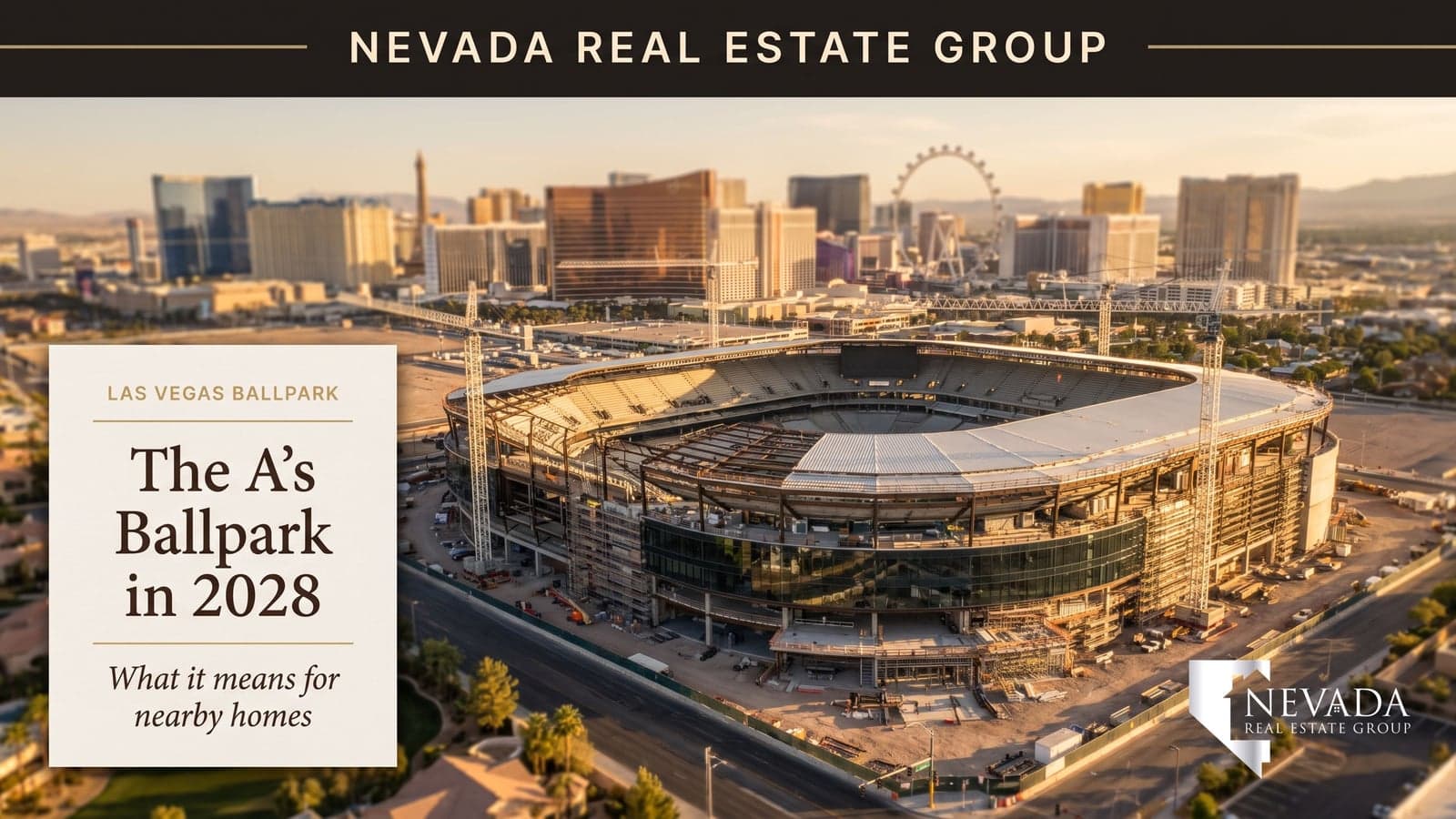

For the better part of two decades I have watched this valley turn every big swing into a housing headline: the arena, the football stadium, the corporate relocations that followed. The Athletics ballpark may be the most location-specific of them all. Major League Baseball is building a 33,000-seat, fully enclosed stadium on nine acres of the former Tropicana site at Las Vegas Boulevard and Tropicana Avenue, the hinge point where the south Strip meets the southern valley. I first published this guide in July 2026. This September 28, 2026 update adds what the public record now shows about construction, cost and financing, corrects one design detail I had wrong, and replaces rough price bands with measured sales for the homes closest to the site.
Recent headlines have described the stadium as "back on track" for 2028. The record is more specific than that. The ballpark itself was reported on schedule at each of the three Las Vegas Stadium Authority board meetings that covered it this year, in February, May and August; the open question in the spring was whether Bally's Corp. could finance the elevated plaza that will serve as the main entrance from the Strip. Below is the dated status first, then what the numbers say about buying nearby. There are no forecasts here, because nobody can promise what a ballpark will do to the value of one particular home.
Yes. At the Las Vegas Stadium Authority's August 20, 2026 meeting, the Athletics' roughly $2 billion, 33,000-seat ballpark was on schedule for the 2028 season, with two roof trusses up. The 2026 doubts concerned Bally's plaza financing, not the stadium. Within two miles, homes that went under contract October 2025–July 2026 and have since closed had a $320,000 median, down 9.2%, so price purchases on today's sales.
- Two of six roof trusses were up by August 18, 2026, and the contractor reported the ballpark on schedule.
- Cost estimates rose from $1.5 billion in 2023 to about $2 billion; SB1 caps public money at $380 million.
- Bally's said on August 20, 2026 it was finalizing plaza financing and aims to break ground near year-end.
- Within two miles, homes that went under contract October 2025–July 2026 have since closed at a $320,000 median.
- Research on other stadiums is mixed, so buy a home that works without the ballpark premium.
What Exactly Is the Athletics Ballpark Deal?
The headline is simple: Major League Baseball is moving a franchise to Las Vegas, and the valley has never had one. According to ESPN's report on the vote, league owners voted unanimously on November 16, 2023 to let the Athletics relocate from Oakland, which gives the valley a baseball team alongside the Raiders, the Golden Knights and the WNBA's Aces. According to MLB.com's June 13, 2026 construction tour, the ballpark is designed by Bjarke Ingels Group and HNTB for 33,000 fans, with the closest seats to home plate and the smallest foul territory of any MLB park. One correction to the July version of this guide: it is not a retractable-roof stadium. When the design was unveiled, FOX5 reported on March 5, 2024 that it would have a tiered design and a fixed roof, and MLB.com now describes a roof that fully encloses the ballpark. According to structural engineer Thornton Tomasetti, that roof is five overlapping, pennant-shaped metal panels carried on arch trusses spanning 700 feet, with a cable-net glass facade in the outfield facing the Strip.
The price has moved twice. According to ESPN's December 4, 2025 report, the estimate rose from $1.5 billion to $1.75 billion to about $2 billion, and The Nevada Independent reported on August 20, 2026 that owner John Fisher has committed to financing the bulk of the project, with U.S. Bank and Goldman Sachs lending the team $300 million for construction. MLB.com's June tour story still used the older $1.75 billion figure, so you will see both numbers in circulation; the $2 billion estimate is the current one.
The public share is fixed in law. According to the Nevada Legislature's record for Senate Bill 1, the bill passed the Senate 13 to 8 and the Assembly 25 to 15 in the June 2023 special session and was approved by the governor on June 15, 2023. The enrolled bill text caps the public contribution at the lesser of $380 million or what the pledged revenues can support, allows up to $180 million of it as transferable tax credits, and repays Clark County bonds with state and county taxes generated inside a sports and entertainment improvement district around the ballpark. According to the minutes of the Stadium Authority's May 21, 2026 meeting, no public money had been spent at that point; everything built so far had been paid for by the team and its owner.
Where Will the A's Ballpark Be Built?
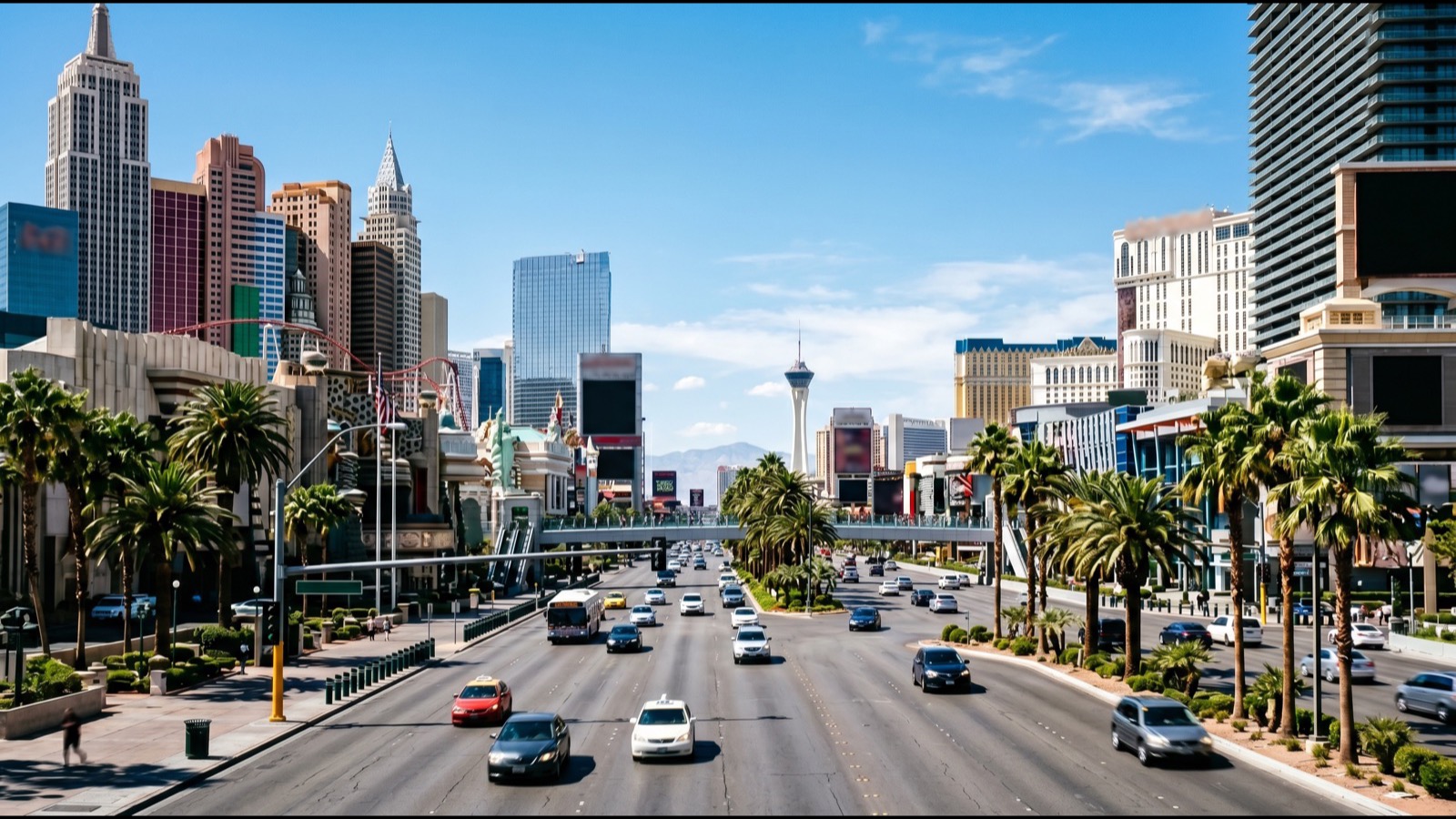
Location is the entire story for real estate, and this stadium sits on one of the most valuable corners in the state. According to MLB.com, the ballpark is being built on nine acres of a 36-acre lot at the southeast corner of Las Vegas Boulevard and Tropicana Avenue, the location SB1 itself requires, while Bally's is developing the remaining 27 acres, on land owned by Gaming and Leisure Properties, according to The Nevada Independent. The Tropicana hotel was imploded in October 2024 to clear the ground. That corner is not in the City of Las Vegas at all; it lies in the unincorporated Paradise township, the same jurisdiction that contains most of the Strip. If you want the neighborhood context, our Paradise, Nevada township guide walks through why this stretch of the valley behaves so differently from the incorporated cities around it.
Why does the exact site matter so much? Because whatever effect a stadium has on its neighbors is local. The residential neighborhoods in ZIP codes 89109, 89119, 89169, 89103 and 89158 sit closest to the corner, and most have their own market report on our site. Summerlin, North Las Vegas and Boulder City are a freeway drive or more away, well beyond the two-mile ring I measure below. Getting fans in and out of a nine-acre parcel is the practical challenge: A's president Marc Badain told MLB.com in June 2026 the team has access to about 30,000 parking spaces within reasonable walking distance, plus the Monorail and the Boring Company's Vegas Loop. Browse current Paradise homes for sale with the corner in mind and the geography becomes clear quickly: the ring's sales are mostly condominiums and high-rise units, not master-planned subdivisions; only 23 of the 365 closed sales in our current window were single-family houses.
Is the A's Stadium Still on Track to Open in 2028?
As of September 28, 2026, every public report I found says yes. The ceremonial groundbreaking was June 23, 2025, and in the week before MLB.com's June 13, 2026 tour story, crews raised the first of six trusses that will carry the roof, according to MLB.com (The Nevada Independent describes five large roof truss arches). The center truss went up on August 18, 2026, according to the Associated Press report carried by KTNV. Two days later the Stadium Authority board heard its latest formal update. According to the minutes of that August 20, 2026 meeting (submitted for approval at the September 2, 2026 meeting), the site was averaging more than 750 craft workers a day, two roof trusses were erected, the authority's own construction monitor confirmed the project remained on schedule, and private investment in the ballpark had passed $600 million. The team's vice chairman said the A's expect to begin discussions about the public funding before the middle of 2027.
The team is responsible for delivering the ballpark for the start of the April 2028 season, according to The Nevada Independent. Until then the A's play at Sutter Health Park in West Sacramento, which the team's April 4, 2024 announcement set for the 2025 through 2027 seasons. Badain told MLB.com in June that some parts of the project were ahead of schedule and that the plan carries cushions for the following 18 months. So what was "back on track"? At the May 21, 2026 meeting, Bally's was still working to secure financing for the northwest plaza, the elevated entrance from the Strip corner, and the board chair asked for a definitive plan by the next meeting. On August 20 Bally's said it was finalizing that financing. The stadium schedule itself was never reported as slipping. The next scheduled board meeting is December 3, 2026, per the Stadium Authority's meeting calendar.
| Project factor | Current figure | Source and date |
|---|---|---|
| Site | Nine acres of a 36-acre lot, SE corner of Las Vegas Blvd and Tropicana Ave | MLB.com, June 13, 2026 |
| Capacity and roof | 33,000 fans; fixed roof fully enclosing the ballpark | MLB.com; FOX5, March 5, 2024 |
| Cost estimate | About $2 billion, up from $1.5 billion and then $1.75 billion | ESPN, December 4, 2025 |
| Public money | Capped at $380 million under SB1; none spent as of May 21, 2026 | SB1 text; Stadium Authority minutes |
| Private spending | More than $600 million | Stadium Authority minutes, August 20, 2026 |
| Construction | Two of six roof trusses up; 750-plus craft workers a day | AP via KTNV; Stadium Authority minutes |
| Target opening | Start of the April 2028 MLB season | The Nevada Independent, August 20, 2026 |
How Does a New MLB Ballpark Change Home Demand?
The honest answer is that a ballpark creates channels for demand; it does not guarantee any. The first channel is jobs. The August 20 minutes put the construction workforce at more than 750 craft workers a day, and a finished ballpark adds permanent game-day and operations jobs, although no one has published a count I can verify. Workers who want to live within a reasonable commute of the corridor are renters and buyers in the neighborhoods around it. The second channel is visitors. A baseball team plays 81 home games in a regular season, far more dates than the roughly ten Raiders home games a year that Allegiant Stadium hosts, so the Tropicana corner will see activity across most of the calendar rather than on a handful of Sundays.
The third channel is the district around the venue. A stadium surrounded by a finished plaza, restaurants and a theater draws people on non-game days; a stadium surrounded by surface parking mostly does not. That is why the Bally's plaza question matters to anyone buying nearby, and I cover it in its own section below. The fourth channel works in the opposite direction: congestion, noise and event traffic, which the closest homes feel most. Whether the positives outweigh the negatives for a given address is an empirical question, and the research on other stadiums gives different answers in different places. Across our 9,600+ closings since 2011, the approach that has served our clients best is also the plainest one: price the home you are buying on today's comparable sales, and treat anything the ballpark adds later as a bonus rather than the reason the numbers work. The measured data for the ring around this site follows.
What Does It Cost to Buy Near the Ballpark Today?
Pricing the opportunity in real dollars is how you separate a thesis from a purchase, so I measured it. The table below compares home sales within about two miles (3.2 kilometers) of the ballpark site with the whole Las Vegas MLS, using MLS data pulled through Repliers on September 28, 2026. Each window counts homes that went under contract October through July (the MLS contract date in this feed) and have since closed. I use October-through-July windows because August and September 2025 closings are under-reported in this feed; the prior window's June–July 2025 contracts closed during that under-reported stretch, so its count may be low. These are our own tabulations of MLS records, not official Las Vegas REALTORS statistics.
| Area and window | Closed sales | Median sale price | Median days on market |
|---|---|---|---|
| Within two miles, Oct 2024 – Jul 2025 | 334 | $352,500 | 40 |
| Within two miles, Oct 2025 – Jul 2026 | 365 | $320,000 | 47 |
| Whole MLS, Oct 2024 – Jul 2025 | 28,422 | $432,045 | 27 |
| Whole MLS, Oct 2025 – Jul 2026 | 27,528 | $434,341 | 32 |
Read it plainly. For homes that went under contract from October 2025 through July 2026 and have since closed, the median within two miles of the site was $320,000, down 9.2% from $352,500 a year earlier, while the MLS-wide median barely moved (up 0.5%). Homes near the site also took a week longer to sell. Two cautions. First, the ring mixes high-rise condos, townhomes and older houses, so a shift in which buildings and neighborhoods traded can move the median on its own. Second, monthly counts in this feed carry known reporting spikes (March 2025 and January 2026 look inflated board-wide), so lean on the medians more than the sales counts. By ZIP code the medians moved in different directions: 89109 fell to $309,888 from $362,000, 89169 to $237,500 from $270,000 and 89158 to $710,000 from $730,000, while 89119 rose to $215,000 from $200,000 and 89103 to $405,000 from $390,000. For the official picture, according to Las Vegas REALTORS' August 2026 report, the Southern Nevada median single-family price was $475,000, down 1.0% from a year earlier and below the record $490,000 set in May and June, while condos and townhomes sold at a $299,900 median.
Now the carrying math. According to Freddie Mac's Primary Mortgage Market Survey, the average 30-year fixed rate was 7.03% for the week of September 24, 2026. At that rate, the ring's $320,000 median with 10% down means a $288,000 loan and a principal-and-interest payment of about $1,922 a month; the valley's $475,000 single-family median with 10% down means a $427,500 loan and about $2,853 a month. Both figures come before property tax, insurance, HOA dues and mortgage insurance, and near the Strip the HOA line can be the one that decides whether a condo pencils, so get the building's current dues and reserve study before you write an offer.
Which Las Vegas Neighborhoods Sit Closest to the Ballpark?
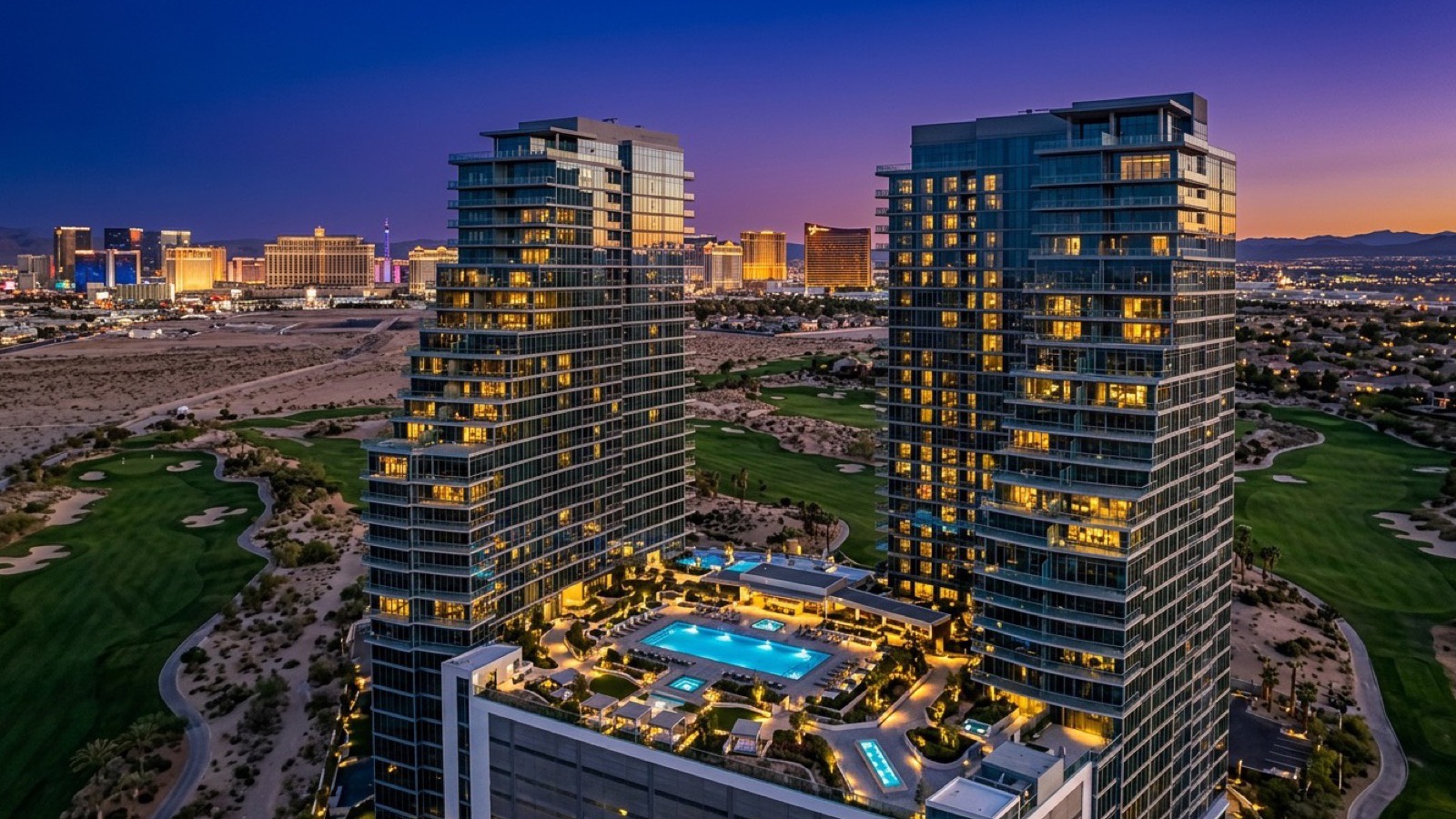
Matching the neighborhood to your purpose is where buyers make or lose money, so start with who actually lives near the corner. Paradise, the unincorporated township that wraps the Strip, the airport and UNLV, sits practically on top of the ballpark and carries a deep bench of condos, townhomes and older single-family houses. The Strip-adjacent high-rise condos are the other near-site option; The Signature at MGM Grand, for example, stands on Harmon Avenue behind the MGM Grand, across Tropicana Avenue from the ballpark site. Our guide to the best Las Vegas neighborhoods near the Strip compares these pockets side by side if you want more detail before touring.
Beyond the first ring, the southern valley's new-construction communities and Henderson offer newer houses within a freeway drive of the corridor's jobs, and the broader Las Vegas market is where most families end up once they weigh schools, commute and yard size. None of these areas is "benefiting" from the ballpark in any measured way yet; what distinguishes them is housing type and distance, and those drive what you should check before you buy. The table below is descriptive, not a ranking of expected appreciation.
| Submarket | Where it sits | Typical housing stock | Check before you buy |
|---|---|---|---|
| Paradise near the Strip | Inside the two-mile ring | Condos, townhomes, older houses | Game-day traffic, HOA reserves, rental rules |
| Strip-adjacent high-rise | Inside or at the edge of the ring | Condo and condo-hotel towers | Dues, rental program, financing eligibility |
| Southern valley new build | A freeway drive via I-15 or the 215 | Newer master-plan houses | Builder incentives, HOA and special assessments |
| Henderson | A freeway drive east and south | Master-plan single-family homes | Commute to the corridor, school zones |
Will the A's Ballpark Actually Raise Home Prices?
Nobody can promise that, and I will not pretend otherwise. What I can show you is what has been measured so far and what research on other stadiums found. So far, the measured answer is no lift: for homes that went under contract from October 2025 through July 2026, a year or more after the Tropicana implosion and in the first full year after groundbreaking, the median sale within two miles of the site was 9.2% lower than a year earlier while the MLS-wide median was flat. That does not prove the ballpark is hurting anything; valley condo prices are still below their October 2024 record, according to Las Vegas REALTORS' August 2026 report, and the ring's sales mix shifts from year to year. It does mean there is no stadium premium visible in closed sales today that a buyer should be paying for.
The research is genuinely mixed. According to Charles Tu's 2005 study of FedEx Field in Land Economics, homes near the Maryland stadium sold at a discount before it was built, and that discount narrowed after completion. According to Gabriel Ahlfeldt and Georgios Kavetsos, who studied the new Wembley and Emirates stadiums in London, nearby property prices rose, with effects appearing soon after the final plans were announced. According to Dehring, Depken and Ward, announcements of the publicly subsidized Cowboys stadium lowered Arlington, Texas home values by about 1.5% relative to the surrounding area, roughly the size of the expected household sales-tax burden. And according to Bradbury, Coates and Humphreys' 2023 survey of more than 130 studies in the Journal of Economic Surveys, the decades-old consensus still holds that teams and stadiums have very limited local economic impact. The takeaway for a buyer: effects, where they appear, are local and vary with design, surroundings and who pays. Buy the home on its own numbers.
How Does the Ballpark Compare to the Valley's Other Growth Catalysts?
The A's ballpark lands on a valley that has spent a decade adding venues: T-Mobile Arena and the Golden Knights, Allegiant Stadium and the Raiders, the Sphere, and a Formula 1 race on the Strip each November. The most useful comparison is Allegiant, because it is the other stadium built with public money under a Stadium Authority. According to the August 20, 2026 minutes, an analyst from Applied Analysis, presenting with the Raiders' stadium team, told the board that Allegiant had hosted 151 events since opening, including roughly ten Raiders games a year, and estimated $2.6 billion in economic impact in 2025 alone, against a $750 million public investment. Those are estimates presented on the stadium operator's behalf, not independent audits, and the academic survey above is a reminder of why economists read such figures skeptically.
What sets the ballpark apart is cadence and footprint. Eighty-one home dates on a nine-acre site at the busiest corner of the south Strip is a different pattern from ten football Sundays across I-15 at Allegiant. The ballpark's public cap is also about half of Allegiant's public investment, and SB1 repays the county's bonds from taxes generated inside the district around the ballpark. For the wider development picture, our overview of Southern Nevada's major development projects and our look at the proposed north Strip LVXP tower and arena cover the other projects buyers ask about. The table below sets out three ways buyers approach the ballpark and what has to be true for each to work.
| Approach | Target area | What has to be true | Main risk |
|---|---|---|---|
| Long-term rental | Paradise, Strip-adjacent condos | Rent covers costs at today's prices | Rental rules; 7%-plus mortgage rates |
| Second home | Strip-adjacent high-rise | You would buy it with no ballpark | HOA dues; plaza delays |
| Permanent move | Southern valley, Henderson | The home fits your commute and schools | Paying a premium for a headline |
Is a Strip-Adjacent Investment Property a Smart Play Before Opening Day?
It can be, for a buyer whose numbers work today, and the measured supply picture helps you negotiate. As of September 28, 2026, 388 listings were available (active with no accepted offer) within the same two-mile ring, against an average of about 37 closed sales a month from the October 2025–July 2026 contract window. By our math that is roughly 10.6 months of supply, well above the just-over-four-and-a-half months that Las Vegas REALTORS reported valley-wide for August 2026. The two figures use different methods, so read them as direction, not precision: near the ballpark, buyers currently have more choice and more room to negotiate than in the valley as a whole.
The biggest trap near the Strip is assuming nightly-rental income. According to Clark County's short-term rental FAQ, unincorporated county rules require a minimum 2,500-foot separation between a short-term rental and a resort hotel, and 1,000 feet between licensed rentals. A condo qualifies only if its governing documents expressly allow transient lodging and the building has at least 10 units, with no more than 10% of the building used as short-term rentals. Because the resort corridor runs through the middle of the ring, check any parcel near the ballpark against that buffer before you assume rental income. Our Las Vegas short-term rental rules guide tracks the county's licensing status, which has its own complications. Underwrite a property near the ballpark as a long-term rental or a home you would live in, and treat anything else as upside you have verified in writing. When you have a specific address, call Nevada Real Estate Group at (702) 637-1759 and we will run the rent, dues and financing on that unit.
How Does the Ballpark Fit the South-Strip Redevelopment?
The ballpark is one piece of a larger plan for the Tropicana lot, and the rest of that plan is where the 2026 uncertainty sat. According to ESPN's August 20, 2026 report, Bally's mixed-use project around the stadium is valued at $1.19 billion and includes restaurants, shopping and entertainment, a hotel-casino and a 2,500-seat theater. According to The Nevada Independent, Bally's revised the plan in August into phases. The first covers the ballpark, a 1,500-space parking garage and a central utility plant, with the A's paying for those first 1,500 spaces and their share of the plant. The second adds the elevated plaza, or podium, over a three-level garage. The casino resort comes later, and Clark County said the hotel towers had not yet received Federal Aviation Administration approval.
That plaza is the piece to watch, because it is designed as the main fan entrance from the corner of the Strip and Tropicana, and the calendar is tight. At the February 19, 2026 meeting, according to minutes published in the May 21, 2026 agenda book, the authority's construction monitor said the plaza should take about a year to build and recommended work begin by January 2027 to align with the stadium's planned February 2028 opening. According to the May 21, 2026 minutes (published in the August 20, 2026 agenda book), Bally's was then still working to secure the remaining financing, the parties discussed an interim plaza using pedestrian bridges and escalators if needed, and the chair asked for a definitive plan. By August 20, Bally's told the board it was finalizing financing with Gaming and Leisure Properties as a development partner, had filed permits for the podium foundation, had chosen a general contractor, and intends to break ground near the end of 2026. On August 19 the Clark County Commission approved Bally's initial entitlements for the retail and entertainment district, a 2,500-seat theater, the parking garage and podium, and interim surface parking, according to the minutes and The Nevada Independent. For nearby homeowners, a finished district is a stronger neighbor than a stadium ringed by parking lots, so this is the milestone I would track at the December 3 board meeting.
What Are the Risks and Caveats Buyers Should Know?
Honesty about the downside is what separates a sound purchase from a speculative one. First, the plaza: as of the August 20 meeting, Bally's financing was described as close, not closed. If it slips, the May minutes show the parties have already discussed an interim entrance for opening, but the district around the ballpark would take longer to fill in. Second, the public money has not been raised yet. The A's expect to begin public funding discussions before mid-2027, and the minutes show the improvement district had collected $4.4 million through May 2026, primarily from construction sales and use taxes, with staff projecting it would meet or exceed the roughly $38 million modeled in 2023. Third, the stadium has already survived one challenge: according to The Nevada Independent's May 13, 2024 report, the Nevada Supreme Court rejected the Schools Over Stadiums referendum on the public financing.
Fourth, schedule risk never fully disappears on a megaproject, even one reported on time; underwrite any purchase as a home you would still want if Opening Day moved. Fifth, the game-day trade-off is real. Adjacency brings congestion, event traffic and noise on 81-plus dates a year, and the closer you sit, the more you feel it. Sixth, rates rule the near term: at Freddie Mac's 7.03% for the week of September 24, 2026, financing costs will shape what you can afford more than any single venue. And seventh, as the measured data above shows, prices near the site have softened, which is an opportunity for a patient buyer and a warning for anyone paying a premium for a story. None of this is a reason to dismiss the A's ballpark; it is a reason to buy the right home at the right price.
How Should Buyers Position Ahead of the 2028 Opening?
Start with fundamentals and let the ballpark be a tiebreaker, not the thesis. Decide first whether you want a long-term rental, a lock-and-leave second home or a permanent residence, because each points to a different part of the valley. For a rental or a second home near the action, focus on Paradise and the Strip-adjacent high-rise market, and use the current supply to negotiate. For a permanent move, prioritize the schools, commute and community that fit your life in Henderson or the southern-valley new-construction neighborhoods. Get fully underwritten at today's rates so you can move on the right listing while sellers near the Strip are negotiating.
Then track the milestones that are public and dated: the Bally's plaza groundbreaking targeted for late 2026, the Stadium Authority's December 3, 2026 update, the A's public-bond discussions expected before mid-2027, and the April 2028 opening. None of those tells you what a specific home will be worth, but each tells you whether the district around the ballpark is being built as planned. If you are weighing a move to the valley in the first place, our moving to Las Vegas guide and our Brightline West real estate analysis pair naturally with this one. Browse current Paradise homes for sale or the wider Las Vegas homes for sale, map the Tropicana corner against your budget, and when a specific home fits, call Nevada Real Estate Group at (702) 637-1759 for an honest read on that address, its comparable sales and its carrying costs.
Frequently Asked Questions
When will the Athletics ballpark open in Las Vegas?
The A's are responsible for delivering the ballpark for the start of the April 2028 MLB season, and at the Stadium Authority's August 20, 2026 meeting the project was reported on schedule, with two of its six roof trusses erected and more than 750 craft workers on site daily. The team plays at Sutter Health Park in West Sacramento through the 2027 season. Treat 2028 as the published target, and underwrite any purchase as a home worth owning even if that date moved.
Is the A's Las Vegas stadium back on track?
The stadium itself was never reported off track; the contractor and the Stadium Authority's construction monitor described it as on schedule at the February, May and August 2026 board meetings. The uncertainty was Bally's financing for the northwest plaza, the elevated main entrance from the Strip. At the May 21, 2026 meeting Bally's was still seeking that money and the board asked for a firm plan. On August 20, 2026 Bally's said it was finalizing financing with Gaming and Leisure Properties and intends to break ground near the end of 2026.
Where is the A's ballpark being built?
On nine acres of a 36-acre lot at the southeast corner of Las Vegas Boulevard and Tropicana Avenue, the former Tropicana site, which was imploded in October 2024. Bally's is developing the remaining 27 acres, on land owned by Gaming and Leisure Properties, and plans a phased entertainment district and later a hotel-casino around it. The corner is in the unincorporated Paradise township, not the City of Las Vegas, and nearby residential ZIP codes include 89109, 89119, 89169, 89103 and 89158.
Will the ballpark raise Las Vegas home prices?
No one can promise that. Measured so far, the median price of homes within about two miles of the site that went under contract October 2025 through July 2026 (MLS contract date) and have since closed fell 9.2% to $320,000, while the MLS-wide median was roughly flat, based on MLS data pulled through Repliers on September 28, 2026. Research on other stadiums is mixed: some found nearby gains, one found declines tied to the tax burden, and a 2023 survey of more than 130 studies found very limited local economic impact.
Is buying near the ballpark a good investment before it opens?
It can be if the property works on today's numbers. Near the site, 388 listings were available as of September 28, 2026 against about 37 closed sales a month, so buyers have room to negotiate. Do not count on nightly-rental income: Clark County requires 2,500 feet between a short-term rental and a resort hotel, and condos qualify only when their governing documents expressly allow it. Underwrite the unit as a long-term rental or a home you would live in.
How much does the Las Vegas ballpark cost and who is paying?
The current estimate is about $2 billion, up from $1.5 billion and then $1.75 billion. SB1, approved on June 15, 2023, caps the public share at $380 million, including up to $180 million in transferable tax credits, with Clark County's bonds repaid from taxes generated inside a district around the ballpark. As of August 20, 2026, private investment had passed $600 million, U.S. Bank and Goldman Sachs were lending the team $300 million, and no public bonds had been issued.
Does the ballpark change the whole valley or just the south Strip?
Its direct effects, positive and negative, are concentrated near the Tropicana corner: game-day traffic, the planned entertainment district, and jobs on and around the site. The wider valley sees indirect effects from visitors and employment, but a home in Summerlin, Henderson or North Las Vegas is priced on its own neighborhood's sales, schools and commute. Even the FedEx Field study that found a gain measured it by comparing homes close to the stadium with comparable homes farther away.
Which Sources Inform This A's Ballpark Guide?
This guide draws on the Stadium Authority's own board minutes, the enacted legislation, the league and team, reporting by The Nevada Independent, ESPN and the Associated Press, peer-reviewed research on stadiums and property values, and measured market data. Project details were current as of September 28, 2026 and can change; confirm the latest status before making a transaction decision.
- Las Vegas Stadium Authority — August 20, 2026 board minutes (in the September 2, 2026 agenda book)
- Las Vegas Stadium Authority — May 21, 2026 board minutes (in the August 20, 2026 agenda book)
- Las Vegas Stadium Authority — February 19, 2026 board minutes (in the May 21, 2026 agenda book)
- Las Vegas Stadium Authority — 2026 meeting calendar
- Nevada Legislature — SB1 (35th Special Session, 2023) bill history
- SB1 as enrolled — public financing terms
- The Nevada Independent — A's stadium still on track for 2028 (August 20, 2026)
- The Nevada Independent — Nevada Supreme Court rejects stadium referendum (May 13, 2024)
- ESPN — MLB owners approve the Athletics' move (November 16, 2023)
- ESPN — A's say Vegas stadium on track for 2028 opening (December 4, 2025)
- ESPN — second steel truss arch rises (August 20, 2026)
- KTNV / Associated Press — center truss set August 18, 2026
- MLB.com — construction tour with A's president Marc Badain (June 13, 2026)
- MLB.com — Sutter Health Park to host the A's for 2025–2027 (April 4, 2024)
- FOX5 Las Vegas — A's unveil ballpark renderings with a fixed roof (March 5, 2024)
- Thornton Tomasetti — Las Vegas ballpark roof structure
- Las Vegas REALTORS — August 2026 market report (Nevada Business reprint) and LVR housing market statistics
- Freddie Mac — Primary Mortgage Market Survey
- Clark County — short-term rental frequently asked questions
- Tu (2005) — How Does a New Sports Stadium Affect Housing Values? The Case of FedEx Field, Land Economics
- Ahlfeldt and Kavetsos (2014) — Form or Function? The Effect of New Sports Stadia on Property Prices in London
- Dehring, Depken and Ward — The Impact of Stadium Announcements on Residential Property Values
- Bradbury, Coates and Humphreys (2023) — The Impact of Professional Sports Franchises and Venues on Local Economies
- Nevada Real Estate Group — Las Vegas market report (MLS data pulled through Repliers)