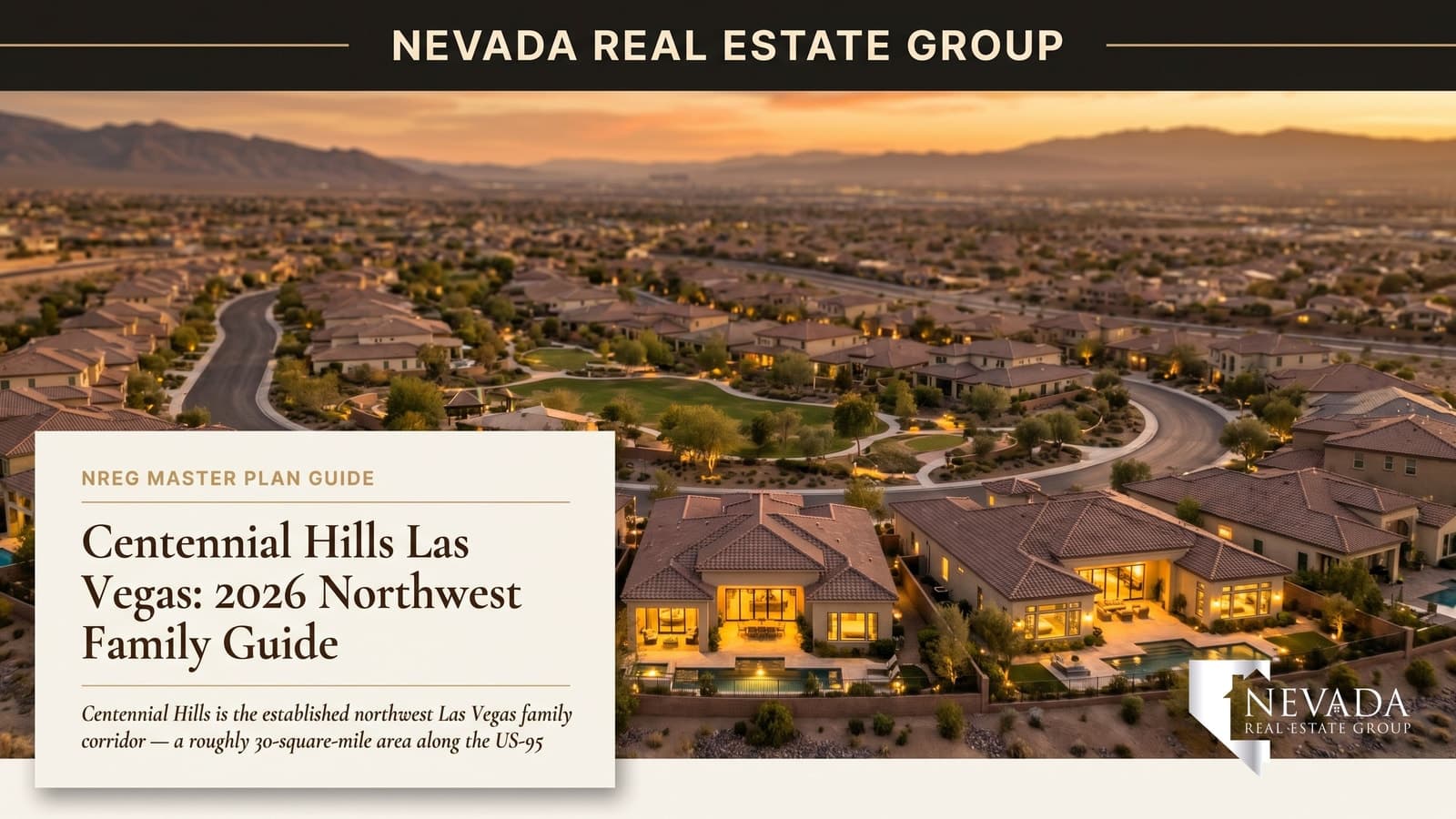

If you are looking to move to northwest Las Vegas in 2026, you are almost certainly weighing two heavyweights against each other: the prestigious, master-planned giant that is Summerlin, and its spacious, slightly more rugged neighbor to the north, Centennial Hills. They sit side by side on the map, they share the same 215 Beltway on-ramps, and buyers cross-shop them constantly — yet the lifestyle, the price tag, and the monthly carrying cost pull in different directions.
Summerlin hugs the Red Rock Canyon conservation area to the west, offering a highly curated, resort-style existence governed by one of the most disciplined master plans in the country. Centennial Hills anchors the upper northwest corner near US-95 and Skye Canyon, offering room to breathe, bigger lots, and — most importantly to many buyers — more house for the dollar. The core dilemma usually comes down to this: do you pay the premium for the Summerlin brand, the amenities, and the school pedigree, or do you head a few miles north to Centennial Hills to get a larger lot, a lighter HOA, and a smaller mortgage?
That gap is not small. Based on live Greater Las Vegas MLS (GLVAR) data pulled in July 2026, the trailing-12-month median sale price in Summerlin was $713,750 versus roughly $500,000 across the three Centennial Hills ZIP codes — a spread of more than $210,000 for buyers making the same decision. This guide breaks down every dimension that matters: real closed-sale numbers, the price-per-square-foot gap, the HOA and Special Improvement District structure that trips up first-time northwest buyers, schools, commute, lot sizes, and exactly who should pick which.
Summerlin and Centennial Hills are adjacent — not the same. Summerlin is Howard Hughes' 22,500-acre master plan hugging Red Rock; Centennial Hills is a City of Las Vegas district to the north. In mid-2026 the GLVAR median sale price ran $713,750 in Summerlin versus about $500,000 across Centennial Hills' ZIPs — roughly a $214,000 gap. Summerlin buys prestige and schools; Centennial Hills buys space and a lighter budget.
- Summerlin's median sale is $713,750 vs about $500,000 in Centennial Hills (GLVAR, July 2026) — a roughly $214K gap.
- Price per square foot runs about $401 in Summerlin vs roughly $255 north — a $146 spread worth 400–600 extra square feet.
- Summerlin layers master HOA + village sub-association + an SID bond; Centennial Hills tracts are often single-HOA or no-HOA — verify per address.
- Both markets move fast: median days on market sat at 32–33 in mid-2026.
- Choose Summerlin for amenities and schools; Centennial Hills for lot size and a lighter budget.
Shopping the area? Browse live Summerlin homes for sale and Las Vegas homes for sale — every active MLS listing with prices, photos, and instant filters. Or call our team at (702) 637-1759 to compare specific streets.
Are Summerlin and Centennial Hills the Same Place?
No — and this is the single most common point of confusion we clear up for relocating buyers. Summerlin and Centennial Hills are neighbors, not the same community. They border each other in the northwest valley, but they are governed and structured very differently.
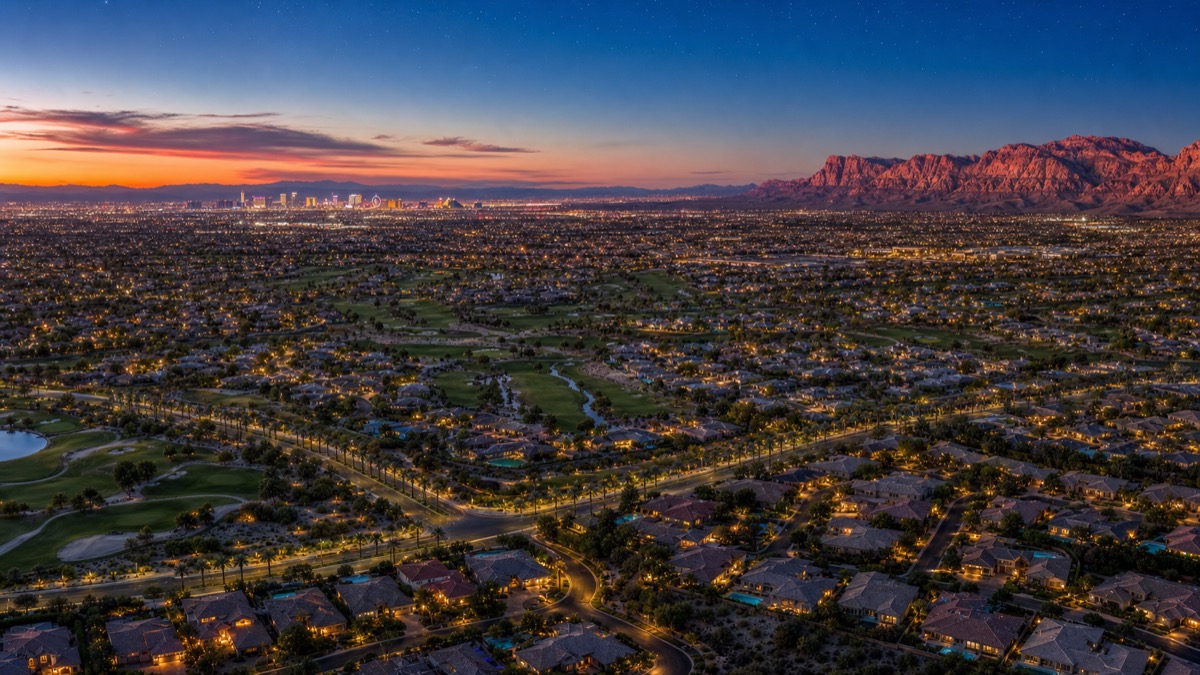
Summerlin is a single, unified master-planned community developed by Howard Hughes Holdings on roughly 22,500 acres along the western rim of the valley. It was announced in 1990, named for Howard Hughes' grandmother Jean Amelia Summerlin, and has been built out village by village across more than three decades. Everything inside Summerlin answers to one master plan, one design-review framework, and the Summerlin Community Association, with individual villages layered underneath. It is one entity with one brand.
Centennial Hills is different. It is a district of the City of Las Vegas in the far northwest — not a master plan and not a single HOA. The name describes a geography (loosely the ZIP codes 89131, 89149, and 89166, roughly bounded by US-95, the 215, and the northern edge of the valley near Floyd Lamb Park) that contains dozens of separate subdivisions: Skye Canyon, Providence, Iron Mountain Ranch, Silverstone Ranch, Elkhorn Springs, Tule Springs, and many custom and horse-property tracts. In fact, when you query the MLS, there is no single "Centennial Hills" neighborhood record — the listings resolve to those individual subdivision names, which is exactly why we scope Centennial Hills data by ZIP code rather than by a neighborhood label.
Here is the crucial overlap point: both areas sit within the City of Las Vegas municipal limits. Summerlin is not its own city (a frequent myth), and neither is Centennial Hills. Both pay City of Las Vegas taxes, both are served by Clark County School District schools, and both share the same regional infrastructure. What differs is the governance model — one tightly-run master plan versus a patchwork district — and that difference drives almost everything below, from HOA fees to lot sizes to how "uniform" the streets feel.
Across the 9,600+ closings Nevada Real Estate Group has represented statewide, the northwest corridor is one of the most cross-shopped decisions we see: buyers who tour a Summerlin village on Saturday morning are frequently walking a Centennial Hills lot by Saturday afternoon. That real-world deal flow — not a single median off a portal — is what shapes the guidance below, and it consistently points to the same two-part answer: Summerlin for polish and hold value, Centennial Hills for space and payment relief.
What Do the Latest Las Vegas MLS Numbers Say About Each Area?
Let's get straight to the financials, because this is usually the deciding factor. The numbers below come from live GLVAR data pulled in July 2026 — Summerlin scoped by community/neighborhood name, and Centennial Hills scoped across its three defining ZIP codes (89131, 89149, 89166). Figures are trailing-12-month closed sales except where noted as active inventory.
| Metric | Summerlin | Centennial Hills (89131/89149/89166) |
|---|---|---|
| Median closed price | $713,750 | roughly $500,000 (blended) |
| Average closed price | $1,153,879 | roughly $605,000 |
| Closed sales (12 mo) | 1,452 | ~1,975 combined |
| Price per sq ft | roughly $401 | roughly $255 |
| Median days on market | 33 | 32–33 |
| Active listings | ~920 | ~983 combined |
| Top of market | $22.5M | $6.9M |
A few things jump out. First, the median gap of roughly $214,000 confirms what buyers feel on the ground — Summerlin commands a real premium. Second, notice how much wider Summerlin's average-to-median spread is: an average of $1,153,879 against a median of $713,750 tells you the top of the Summerlin market (custom estates in The Ridges, Red Rock Country Club, and Ascension climbing past $20M) pulls the average sharply upward. In Centennial Hills the average and median sit much closer together, reflecting a more consistent, family-priced inventory. Third — and this surprises people — days on market are nearly identical. Both areas cleared at a median near 32–33 days in mid-2026, so neither is a "slow" market. Whichever you choose, come pre-approved.
According to Las Vegas REALTORS, the valley-wide median existing single-family price has hovered in the mid-$480,000s through 2026, which frames Summerlin as a clear premium submarket and Centennial Hills as sitting right around — to modestly above — the metro median. In our experience representing buyers across both areas, that positioning is exactly why the north keeps drawing Summerlin cross-shoppers who want to stay in the northwest without the Summerlin price of entry.
How Much More Does Summerlin Cost per Square Foot?
The purchase-price gap is real, but the price-per-square-foot gap is where the value story gets concrete. In mid-2026, closed Summerlin sales ran about $401 per square foot against roughly $255 per square foot across the Centennial Hills ZIPs — a spread of about $146 per square foot.
In our experience representing buyers on both sides of the 215 in northwest Las Vegas, that $145-to-$150 price-per-square-foot gap has held remarkably steady through the first half of 2026 — it is the number we come back to every time a client asks whether the drive north is "worth it."
Put that spread in practical terms. On a 2,600-square-foot home, a $146-per-square-foot difference works out to roughly $380,000 in raw structure value — which is why the same budget stretches so much further north. A buyer with a firm $560,000 ceiling is often shopping 2,000–2,200 square feet in Summerlin but 2,600–2,900 square feet in Centennial Hills, frequently newer, sometimes with a pool or a three-car garage. That is the 400-to-600-extra-square-feet rule of thumb we quote constantly, and the live numbers back it up.
| Budget | Summerlin (roughly $401/sq ft) | Centennial Hills (roughly $255/sq ft) | Extra space north |
|---|---|---|---|
| $475,000 | ~1,185 sq ft | ~1,860 sq ft | +675 sq ft |
| $560,000 | ~1,395 sq ft | ~2,195 sq ft | +800 sq ft |
| $680,000 | ~1,695 sq ft | ~2,665 sq ft | +970 sq ft |
Now the caveat: price per square foot is a blunt instrument. Summerlin's number carries the premium of curated landscaping, guard-gated enclaves, resort amenities, and the strongest resale liquidity in the valley — you are not only buying drywall and square footage, you are buying the master plan and its brand equity. Centennial Hills' lower number reflects a mix that includes older 1990s–2000s tracts, semi-rural lots, and value-priced newer production homes. The point is not that one is "overpriced." It is that your dollar does measurably different work in each place, and you should decide which kind of value you are optimizing for.
What Does the HOA and Tax Structure Look Like in Each Area?
This is where monthly budgets diverge sharply — and where the biggest surprises hide. When you buy in Summerlin, you are rarely paying one flat HOA fee. The structure is layered, and at least one layer shows up not as an HOA bill but as a line item on your Clark County property-tax statement. Centennial Hills, by contrast, ranges from no HOA at all to a single moderate fee. Do not compare a Summerlin listing to a Centennial Hills listing on price alone; compare the full monthly obligation.
| Cost layer | Summerlin | Centennial Hills |
|---|---|---|
| Master association | Summerlin Community Association (master) — most parcels | None district-wide; only within named master plans (Skye Canyon, Providence) |
| Village / sub-association | Village or gated sub-HOA on top of master (common) | Single tract HOA where present; many older tracts have none |
| SID / LID bond | Summerlin SID (Special Improvement District) bond on the tax bill — varies by parcel | SID/LID in newer master plans (e.g., Skye Canyon); absent in older tracts |
| Typical combined HOA | roughly $50–$220/mo (master + village); guard-gated can run higher | $0–$100/mo in most tracts; guard-gated golf communities higher |
| Bottom line | Multiple layers — always request the SID payoff and both HOA statements | Lighter and simpler on average — but verify per address |
The layer buyers miss most often is the Summerlin Special Improvement District (SID) bond. SID bonds financed the roads, utilities, and infrastructure when a parcel was developed, and they are repaid over years as an assessment on the property-tax bill. According to the Clark County Assessor and County Treasurer records, whether a given Summerlin parcel still carries a SID balance — and how much — depends entirely on the specific lot and its development phase. That is why "verify per address" is not a disclaimer here; it is a hard step. We pull the SID status on every Summerlin offer we write so a client is never surprised by a few hundred dollars a year they did not budget for.
In Centennial Hills, the older 1990s and early-2000s subdivisions frequently carry no HOA and no active SID — one of the north's genuine cost advantages. But the newer master-planned pockets are different: Skye Canyon and Providence layer in their own HOA and, in some phases, an SID/LID bond much like Summerlin's. And the guard-gated golf enclaves in the far northwest — Silverstone Ranch, Los Prados, Painted Desert — carry higher dues. The takeaway is not "Centennial Hills is always cheaper to carry." It is that the north gives you the option of a no-HOA or low-HOA home, which Summerlin structurally does not. Verify every layer, on every address, before you fall in love with the kitchen.
Which Area Offers Better Value for the Money?
"Value" means different things to different buyers, so let's separate the two definitions that actually matter: cost value (how much house and land per dollar) and hold value (how well the asset protects and grows your equity).
On cost value, Centennial Hills wins decisively. The roughly $255-per-square-foot pricing, the larger lots, and the frequent absence of HOA and SID layers mean your monthly cost of ownership on comparable square footage is materially lower in the north. For a family that wants a four-bedroom with a yard, a pool, and a place to park a boat, the math is not close — the north delivers more physical asset per dollar, full stop.
On hold value, Summerlin has the stronger long-term case. According to the Federal Housing Finance Agency house-price data for the Las Vegas metro, the valley as a whole has appreciated durably over the past decade, and within that, master-planned communities with brand recognition, amenity depth, and constrained developable land — Summerlin's defining traits, pinned against Red Rock's protected acreage — tend to hold value through downturns better than commodity suburban tracts. Summerlin's resale liquidity (1,452 closed sales in a year is enormous depth) means you can almost always sell, and sell fast, which is its own form of value.
Here is how we frame it for clients: if your priority is maximizing the home and land you live in today while keeping your payment down, Centennial Hills is the better value. If your priority is capital preservation, resale certainty, and the confidence that comes with a nationally-recognized master plan, Summerlin's premium buys something real. Neither answer is wrong — they are answers to different questions. A quick conversation with our team at (702) 637-1759 usually surfaces which question you are actually asking.
How Do the Lifestyles and Amenities Compare?
If you prioritize walkability and high-end retail, Summerlin is the clear winner. The community is anchored by Downtown Summerlin, an open-air fashion and dining hub with more than 125 stores and restaurants, the Las Vegas Ballpark (home of the Aviators), and City National Arena (the Vegas Golden Knights' practice facility). Add Tivoli Village, Red Rock Casino Resort, and dozens of patio-dining options, and Summerlin genuinely functions as a city within a city. You can live, shop, dine, work out, and catch a ballgame without leaving the master plan. It is a very polished, resort-style existence — and the amenity density is a real reason the price premium exists.
Centennial Hills has a different flavor. The commercial anchor is the Centennial Center, a sprawling big-box complex — Target, Home Depot, grocery, and chain restaurants — that is built for practical, day-to-day living rather than boutique browsing. It lacks Summerlin's luxury retail, but it covers the essentials extremely well and you are rarely more than a few minutes from a grocery run. The local dining scene in the north has grown meaningfully in the last few years, so you no longer have to drive to Summerlin for a good meal — but the overall vibe stays firmly "comfortable suburb" rather than "luxury destination."
There is a lifestyle trade buried in this. Summerlin's amenities are curated, close, and consistent — but you pay for them every month and share them with a lot of people. Centennial Hills' amenities are more utilitarian and spread out — but the lower density means quieter streets, less traffic, and more elbow room. Buyers moving from dense coastal metros often love Summerlin's energy; buyers coming for space and calm often find Centennial Hills is exactly the decompression they wanted.
What Are the Parks, Trails, and Outdoor Options in Each?
Both areas are excellent for outdoor life, but they offer access to different kinds of nature. Summerlin is famous for connectivity: the master plan includes more than 150 miles of interconnected trails and roughly 250 parks and open spaces, according to Howard Hughes, the developer. You can bike or walk from one end of the community to the other without leaving a path, and Summerlin sits at the doorstep of the Red Rock Canyon National Conservation Area scenic loop — a genuine perk for hikers, cyclists, and climbers who want dramatic desert terrain 10 minutes from home.
Centennial Hills takes a bigger-is-better approach. The area is home to large regional parks like Centennial Hills Park, with amphitheaters and splash pads, and — uniquely — Floyd Lamb Park at Tule Springs, a historic oasis with lakes, fishing, shaded picnic grounds, and wandering peacocks that you simply will not find in Summerlin. Skye Canyon adds its own signature amenity in Skye Canyon Park, built around an active, trail-forward identity that leans into the area's outdoor branding.
The north's other outdoor trump card is Mount Charleston. Living in the far northwest shaves roughly 15 to 20 minutes off the drive to the Spring Mountains compared to more central parts of the valley. If you ski or snowboard at Lee Canyon in winter, or escape 108-degree summers into the alpine forest, Centennial Hills is the better launch pad. Summerlin has the polished, connected, in-community trail network; Centennial Hills has the shorter drive to genuine wilderness and the peacocks at Tule Springs. Pick your flavor of outdoors.
How Do Schools Stack Up Between Summerlin and Centennial Hills?
For households where education drives the decision, both areas deliver — but the landscape looks different. Both are served by the Clark County School District, the fifth-largest district in the nation, so the framework is the same. The differences are in concentration and maturity.
Summerlin has a deep, established bench, covered in depth in our Summerlin schools guide. It carries a high concentration of top-rated public campuses and a cluster of prestigious private schools — The Meadows School, Faith Lutheran, Alexander Dawson, and easy access to Bishop Gorman just south. Public campuses like Palo Verde High School and several long-running charter schools have multi-decade track records, and according to GreatSchools ratings, the Summerlin corridor consistently posts some of the higher public-school scores in the metro. For families who want a proven, established academic environment with abundant private options, Summerlin is hard to beat.
Centennial Hills is in growth mode. Because the population boomed over the last 15 years, the north has newer facilities — recently built elementary campuses, expanding charter options (Skye Canyon and Providence both drew new schools as they developed), and modern buildings rather than 1990s ones. The trade is track record: many north campuses simply have not been operating long enough to build the multi-decade reputation Summerlin's have. If you value the newest facilities and are comfortable with schools still establishing their long-term ratings, Centennial Hills offers modern infrastructure. If you want the settled, proven, private-option-rich environment, Summerlin has the history. Either way, confirm current-year zoning and ratings for the exact address — CCSD boundaries shift as new schools open.
What Are the Commute Times From Each Area?
Location matters, and here the geography of the valley comes into play. Summerlin is centrally positioned along the western rim, with two fast arteries: Summerlin Parkway feeding straight toward downtown and the Strip, and the 215 Beltway wrapping the community's southern edge. In non-peak conditions you can reach the Strip or Harry Reid International Airport from most of Summerlin in about 20 minutes.
Centennial Hills sits farther north, and the primary route to the center of town is US-95 southbound. During rush hour, the US-95/I-15 "Spaghetti Bowl" interchange can bottleneck, so a commute from Centennial Hills to the central valley typically runs 30 to 40 minutes. The airport is also a longer trek — roughly 25 miles from the far northwest versus 15 to 20 miles from Summerlin. If you fly weekly for work or commute daily to the Strip corridor, that difference compounds.
| Destination | From Summerlin | From Centennial Hills |
|---|---|---|
| Las Vegas Strip | ~20 min | ~30–40 min |
| Harry Reid Airport | ~20–25 min (15–20 mi) | ~30–35 min (~25 mi) |
| Downtown Las Vegas | ~20 min | ~25 min |
| Mount Charleston / Lee Canyon | ~50–60 min | ~35–45 min |
| Red Rock Canyon loop | ~10–15 min | ~25–30 min |
Notice the commute story flips depending on where you're headed. For Strip- and airport-oriented lives, Summerlin's central position wins. For mountain-oriented lives — skiing, hiking, escaping the heat — Centennial Hills' northern position wins. Map your actual weekly destinations before you assume "closer to the Strip" is the tiebreaker; for a remote worker who skis every weekend, it may be the opposite.
What Housing Styles and Lot Sizes Can You Expect?
The physical look of the homes is perhaps the most visible difference. Summerlin is a true master plan with strict aesthetic guidelines governing paint colors, landscaping palettes, and architecture. This creates a cohesive, manicured beauty — the streets look consistently polished — but some buyers find it feels a bit uniform, even "cookie-cutter," and the design-review process means you cannot simply repaint or re-landscape on a whim. Lots skew toward efficient, professionally-maintained footprints; genuinely large or semi-rural parcels are rare inside Summerlin.
Centennial Hills is where you go for diversity of housing stock. You can find a standard stucco production subdivision directly across the street from a half-acre custom lot where a neighbor parks a boat and an RV. Horse-zoned tracts, detached casitas, oversized workshops, and big backyards without heavy HOA oversight are all attainable in the north in a way they simply are not in Summerlin. Homes range from 1990s builds to brand-new construction in Skye Canyon and Providence.
It is worth noting the middle ground: if you want the master-plan feel — uniform streets, community centers, trail networks, amenity parks — but in the north with the north's pricing, Skye Canyon and Providence deliver a "Summerlin-lite" experience within the Centennial Hills geography. Buyers set on staying in Summerlin can also compare new construction in Summerlin against these northern options head to head. And for buyers who want guard-gated exclusivity up north, Silverstone Ranch, Los Prados, and Painted Desert offer guard-gated communities built around golf. The north is not one thing; it is a spectrum from no-HOA horse property to gated master-plan living, all under the Centennial Hills umbrella.
Which Sub-Communities Should Buyers Know in Each Area?
Because both areas contain many sub-neighborhoods, a quick map helps buyers narrow the search fast. In Summerlin, the villages span a wide price range: established central villages like The Trails, The Hills, and Sun City Summerlin (55+) at the more attainable end; growth villages like Stonebridge, Kestrel, and Redpoint on the western frontier; and the ultra-luxury tiers of The Ridges, Red Rock Country Club, and the newer Summit and Ascension enclaves at the top. If you want the internal village-by-village breakdown, our companion guide on the Cliffs, Kestrel, and Redpoint villages walks through western Summerlin in detail.
In Centennial Hills, the anchors are Skye Canyon (trail-forward master plan with new construction), Providence (established master plan with community centers), Iron Mountain Ranch, Silverstone Ranch and Los Prados (guard-gated golf), Elkhorn Springs, and the semi-rural custom and horse-property tracts scattered near Tule Springs and the northern edge. For the full northwest picture, our dedicated Centennial Hills family guide covers the district's schools, parks, and subdivisions in depth. Buyers who want an even broader value map of the northern suburbs sometimes also cross-shop North Las Vegas, which borders Centennial Hills to the east and can push the value equation even further.

Who Should Choose Summerlin, and Who Should Choose Centennial Hills?
There is no bad choice here — just different lifestyles for different priorities. The decision table below distills the whole comparison into the dimensions buyers actually weigh.
| Priority | Summerlin | Centennial Hills |
|---|---|---|
| Lowest price per sq ft | No (roughly $401) | Yes (roughly $255) |
| Largest lot / RV & horse space | Rare | Common |
| Lowest / no HOA option | No — layered fees + SID | Yes — many no-HOA tracts |
| Walkable retail & dining | Best (Downtown Summerlin) | Practical big-box |
| Resale liquidity & brand | Strongest in the valley | Solid, market-rate |
| Established top schools | Deep, proven + private options | Newer facilities, less track record |
| Strip / airport commute | Shorter | Longer |
| Mountain / Lee Canyon access | Longer drive | Shorter drive |
Choose Summerlin if you want a curated, resort-style life — walking to dinner at Downtown Summerlin, top-rated and private schools, the strongest resale liquidity in the valley, and the confidence of a nationally-recognized master plan. You accept layered HOA fees and a possible SID bond as the price of that polish and that hold value.
Choose Centennial Hills if you want maximum home and land per dollar, a bigger lot, room for a boat or RV, a lighter (or zero) HOA, quicker access to Mount Charleston, and a quieter, less-regulated suburban existence. You accept a longer Strip commute and newer, less-established schools in exchange.
When you're ready to translate this into actual addresses, our team can run a side-by-side of specific streets, pull the SID and HOA status on any Summerlin parcel, and line up showings in both areas in a single afternoon. Start with our buyer resources or reach out through the contact page.
How Has Each Market Trended, and What's the 2026 Outlook?
Summerlin holds value exceptionally well thanks to global brand recognition, constrained developable land against Red Rock, and amenity depth that keeps demand durable through cycles. Its resale liquidity — again, 1,452 closed sales in the trailing 12 months — means the market is deep enough that sellers can move quickly and buyers always have inventory to choose from. The luxury tiers (The Ridges, Summit, Ascension) have expanded the top of the market to eight figures, which lifts the whole community's ceiling.
Centennial Hills has been appreciating steadily as buyers priced out of Summerlin look north for better value — a spillover dynamic we see in practically every relocation consult. Continued build-out in Skye Canyon and Providence keeps adding modern inventory, and the district's affordability relative to Summerlin gives it a demand tailwind whenever the metro's median price climbs. According to the U.S. Census Bureau, the Las Vegas metro continues to add population, and much of that growth lands in the affordable northwest — which supports Centennial Hills demand.
For 2026, expect both to remain seller-favorable but not frenzied, with mortgage-rate movement the main swing factor. According to Freddie Mac primary-mortgage-market data, rate direction has been the dominant driver of buyer purchasing power valley-wide, and both northwest markets respond to it. Whichever area you choose, the fast median days on market (32–33) tell you to line up financing and representation before you shop — homes priced right in either place still move quickly. If you're weighing a new-construction home against resale, or debating whether to buy now or wait, a quick call to (702) 637-1759 will get you a straight read on your specific price band. And when it's time to sell your current home to make the move, our seller resources and free valuation tools show you exactly where you stand.
Frequently Asked Questions
Is Summerlin more expensive than Centennial Hills?
Yes — meaningfully. In mid-2026 the GLVAR median sale price ran $713,750 in Summerlin versus about $500,000 across the Centennial Hills ZIP codes, roughly a $214,000 gap. On a price-per-square-foot basis it is about $401 in Summerlin against $255 in Centennial Hills. The premium reflects Summerlin's amenities, schools, brand, and resale liquidity — plus higher monthly carrying costs from layered HOA fees and possible SID bonds.
Are Summerlin and Centennial Hills the same community?
No. They are adjacent but distinct. Summerlin is a single 22,500-acre Howard Hughes master plan with unified governance. Centennial Hills is a City of Las Vegas district in the far northwest made up of many separate subdivisions (Skye Canyon, Providence, Iron Mountain Ranch, and others) with no single master plan or HOA. Both sit inside the City of Las Vegas, but they are governed and structured very differently.
How far is Centennial Hills from the Las Vegas Strip?
Centennial Hills sits in the far northwest corner of the valley. Depending on your exact street, it is roughly a 30-to-40-minute drive to the Strip via US-95, traffic permitting — versus about 20 minutes from most of Summerlin. The airport is also farther, around 25 miles from the far north.
Does Centennial Hills have a master plan like Summerlin?
Centennial Hills as a whole is not one master plan — it is a district containing many subdivisions and custom areas. However, it contains smaller master-planned communities, notably Skye Canyon and Providence, that offer Summerlin-style amenities like community centers, parks, and trail networks at north-of-Summerlin pricing.
Which area is closer to Mount Charleston?
Centennial Hills is the gateway to Mount Charleston. Living in the far north puts you roughly 15 to 20 minutes closer to Lee Canyon ski resort and the Spring Mountains alpine trails than more central parts of the valley, making it a favorite for skiers and hikers.
Are HOAs higher in Summerlin or Centennial Hills?
Almost universally higher in Summerlin. Most Summerlin homeowners pay a master Summerlin Community Association fee plus a village or gated sub-association fee, and many parcels also carry a Special Improvement District (SID) bond on the property-tax bill. In Centennial Hills, many older tracts have no HOA at all, and newer communities typically have a single moderate fee. Always verify every layer for the specific address.
Can I get a no-HOA home with RV or horse space in either area?
Realistically only in Centennial Hills. Summerlin's master-plan design guidelines make no-HOA, horse-zoned, or RV-friendly properties essentially unavailable. The northwest district — especially the semi-rural tracts near Tule Springs — regularly offers larger lots, horse zoning, and no-HOA options, which is a major reason value-focused and recreation-focused buyers head north.
Which Sources Inform This Northwest Las Vegas Comparison Guide?
This guide combines live Greater Las Vegas MLS (GLVAR) data pulled in July 2026 — Summerlin scoped by community/neighborhood name and Centennial Hills scoped across ZIP codes 89131, 89149, and 89166 — with the authoritative public sources below. Market figures are trailing-12-month closed sales unless noted as active inventory, and all HOA, SID, tax, and school-zoning specifics must be verified for the exact address before you write an offer.
- Las Vegas REALTORS (GLVAR) — valley-wide median price and market context
- Clark County Assessor — parcel values, SID/LID assessments, tax records
- Clark County School District — school zoning and enrollment
- GreatSchools — public and charter school ratings
- Howard Hughes / Summerlin — master-plan trail mileage, parks, and village data
- City of Las Vegas — municipal boundaries and district information
- U.S. Census Bureau — Las Vegas metro population and demographics
- Federal Housing Finance Agency (FHFA) — Las Vegas metro house-price index
- Freddie Mac PMMS — mortgage-rate trends affecting buyer purchasing power
- U.S. Bureau of Labor Statistics — Las Vegas metro employment context
Ready to compare specific streets, pull the SID status on a Summerlin parcel, or tour both areas in a day? Reach the Nevada Real Estate Group team at (702) 637-1759, or start with our Las Vegas and Summerlin community pages and browse live Summerlin homes for sale.