
A roof leak that shows up the year you plan to sell is one of the more stressful surprises a homeowner can get. The questions come fast. Do you have to replace the whole roof before you list? Will buyers walk away, or will their lender refuse the loan? Can you hand over a credit and move on, or sell the house as-is and let the next owner deal with it? And what do you have to tell people?
We went to the records for answers. Our analysis covers every detached resale house in Clark County that closed through the GLVAR multiple listing service from October 1, 2025 through September 30, 2026, 17,679 homes, with the listing agent's roof field and the public remarks of each one, and it compares what those homes sold for against similar houses nearby. Then we read Nevada's disclosure statute and form, the FHA appraisal handbook, Fannie Mae's property and concession rules, the state's contractor and home-inspector rules, and the City of Las Vegas permit records. The short version: a bad roof is a pricing and disclosure problem, rarely a reason a house can't sell.
Yes. Nevada doesn't require a roof repair before a sale, but most sellers must disclose a known roof problem on the state form at least 10 days before closing. Clark County resales advertising a new roof from October 2025 to September 2026 sold for about 1.1% more per square foot than similar homes, roughly $4,500 at their $416,000 median, so fix active leaks first and weigh a full re-roof against that gap.
- Only 9 of 17,679 Clark County resales from October 2025 to September 2026 admitted a roof problem in public remarks.
- Homes advertising a new roof sold about 1.1% above similar homes per square foot, roughly $4,500.
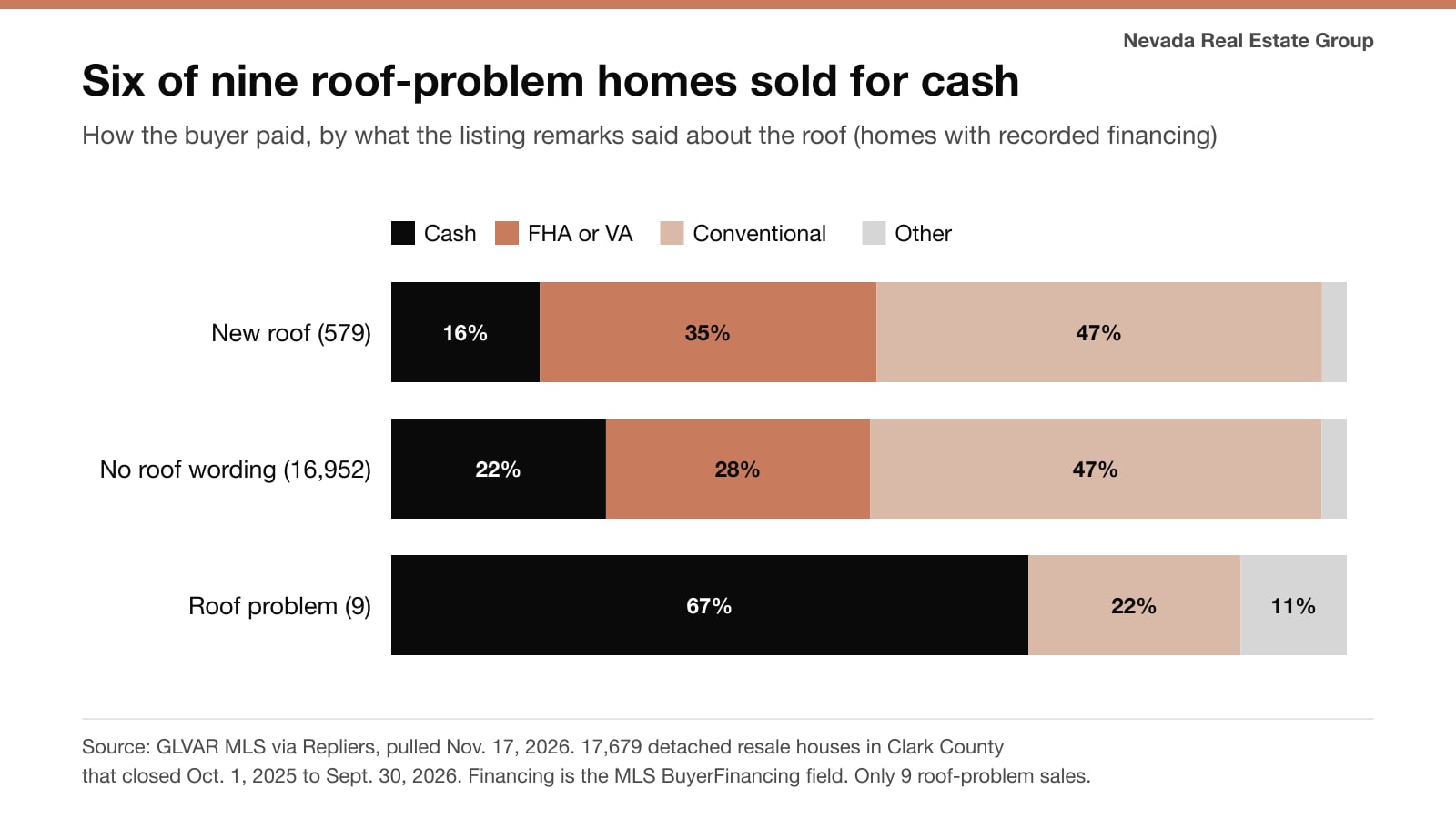
- Six of the nine roof-problem sales went to cash buyers, and none used FHA or VA financing.
- FHA appraisers must flag a roof with under two years of remaining life and require a roofer's inspection.
- Hiding a known roof defect can cost triple the repair under NRS 113.150; disclose it on Form 547.
| Measure | Advertised a new or newer roof | No roof wording | Admitted a roof problem |
|---|---|---|---|
| Homes | 579 | 16,955 | 9 |
| Median sale price | $416,000 | $475,000 | $320,000 |
| Median year built | 1979 | 2001 | 1978 |
| Price per sq ft vs similar homes (100 = same) | 101.1 | 100.0 | 73.5 |
| Median sale price vs original list price | 98.4% | 97.5% | 94.7% |
| Median days to an accepted contract | 24.5 | 27 | 20 |
| Bought with cash | 15.5% | 22.5% | 6 of 9 |
| Bought with FHA or VA loans | 35.2% | 27.6% | 0 of 9 |
Can you sell a Las Vegas house with a leaking roof?
You can, and it happens every year, although you would hardly know it from the listings. Nothing in Nevada law requires a seller to repair a roof before a sale. What the law requires is honesty about it. NRS 113.130 makes the seller complete the state's disclosure form and deliver it to the buyer at least 10 days before the property is conveyed, and the form asks directly whether you are aware of "any problem with the roof." Disclose a leaking roof and the buyer can negotiate, or back out within the short window NRS 113.150 allows. Hide one and you risk a lawsuit.
The market side is less dramatic than most sellers expect. In the 12 months to September 30, 2026, 17,679 detached resale houses closed in Clark County through the GLVAR MLS. The public remarks of only 9 of them, about one in 2,000, said the roof leaked, was damaged, needed work or needed replacing. That does not mean only nine houses had roof trouble; public remarks are advertising copy, and the law puts a known roof problem on the disclosure form, not in the marketing. On November 17, 2026, not one of the 7,474 detached resale listings in Clark County mentioned a roof problem in its public remarks, while 216 advertised a new or newer roof.
What the nine sales do show is the kind of house where a roof problem goes public: older, already rated Poor or Fixer by the listing agent, often with other defects, and usually bought by a cash buyer. Six of the nine were rated Poor or Fixer, two had fire damage, and one also disclosed failed sewer lines under the slab. A sound house with one leaking valley is a different situation, and the rest of this guide is about making the right call on that house, from what to disclose to whether a credit beats a repair.
What are Las Vegas roofs made of, and which ones are wearing out?
Most of the valley sits under concrete tile. Of the 17,679 houses in our 12-month study, the listing agent's MLS Roof field recorded tile on 14,723, or 83.3%. Composition or asphalt shingle covered 2,467 (14.0%), flat roofs of tar and gravel, foam or built-up layers covered 213 (1.2%), and metal only 29. The other 245 named slate, shake or stone (74) or carried a value such as "pitched" or "other" that doesn't name a material (171).
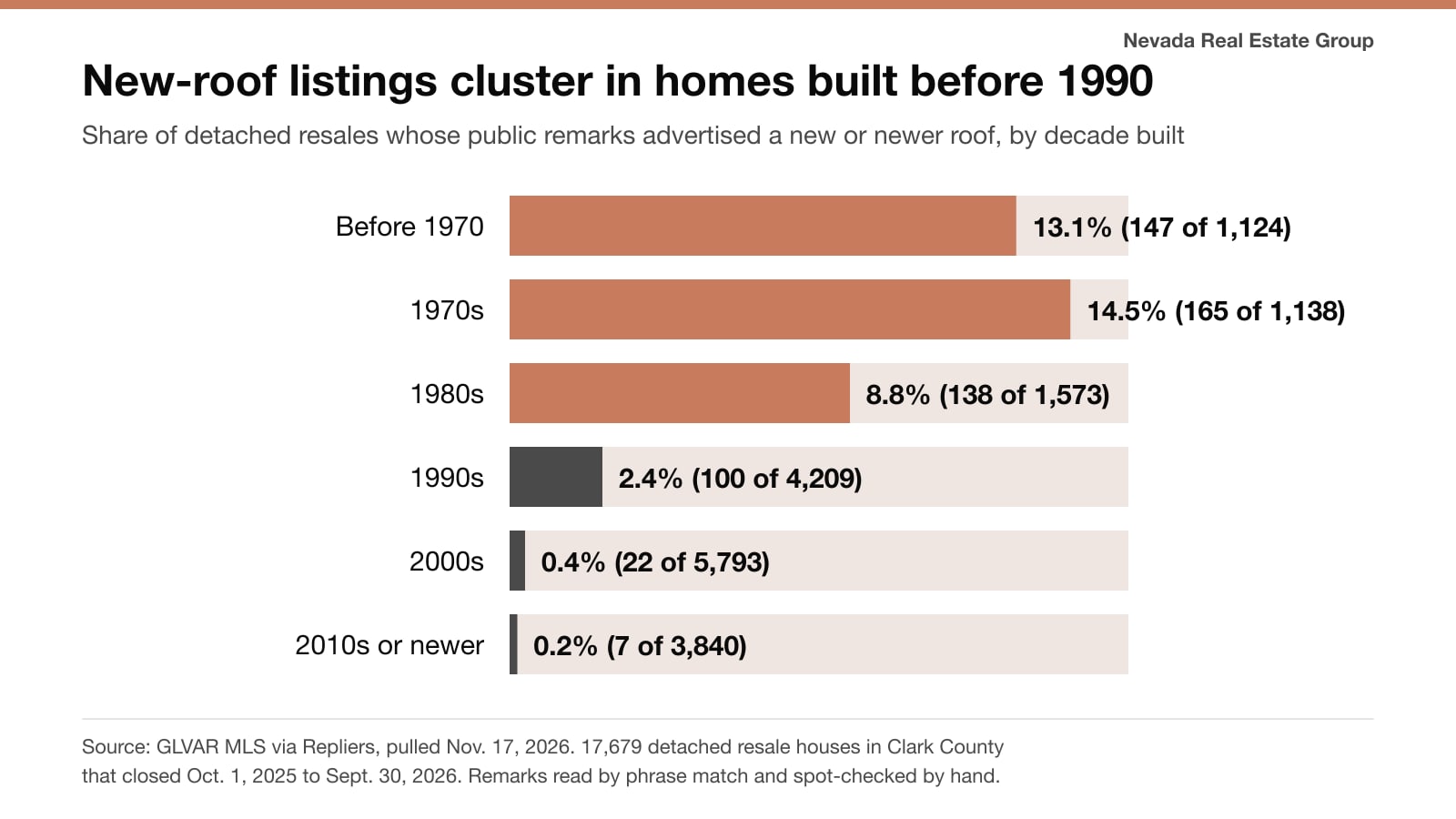
The split by decade tells you which houses are likely to be facing a roof decision. Shingle dominates the older half of the market: 80.9% of the 1,124 houses built before 1970 and 76.6% of the 1,138 built in the 1970s listed composition or shingle, and flat roofs reached 7.3% among the pre-1970 homes. The 1980s were the changeover decade, with 68.5% tile and 27.7% shingle. From the 1990s on, tile ran 95% to 98% of every decade.
Tile and shingle age differently, so they create different selling problems. The Tile Roofing Industry Alliance, a trade group, says on its consumer FAQ that concrete or clay tile roofs "can last 50 to 100 years or more." When sellers in our data described work on a tile roof, it was usually the layer under the tile: one listing said its front roof was "re-set in 2021 with new tar paper," others listed new plywood and felt underlayment beneath the tile, and one said the entire roof was "re-felt in 2024." So ask a roofer to assess the underlayment, not just the tiles. Shingle houses advertised new roofs far more often: among houses built in the 1980s, 15.9% of shingle-roof houses (69 of 435) advertised a new roof, against 5.8% of tile-roof houses (63 of 1,078). Our desert home inspection guide covers what an inspector can and can't see on each type.
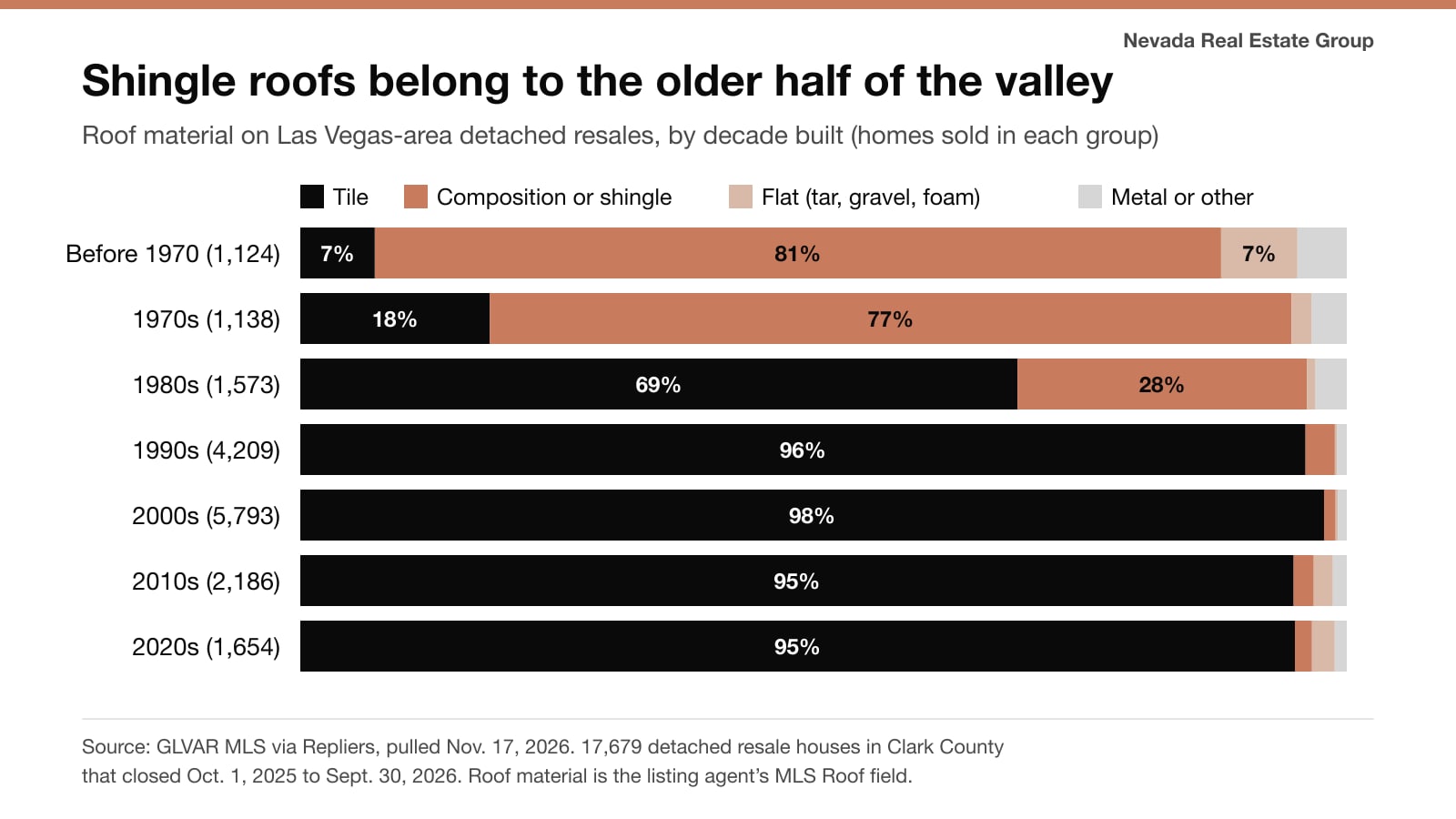
| Decade built | Homes sold | Tile | Composition or shingle | Flat | Advertised a new roof |
|---|---|---|---|---|---|
| Before 1970 | 1,124 | 7.1% | 80.9% | 7.3% | 13.1% |
| 1970s | 1,138 | 18.1% | 76.6% | 1.9% | 14.5% |
| 1980s | 1,573 | 68.5% | 27.7% | 0.8% | 8.8% |
| 1990s | 4,209 | 96.1% | 2.8% | 0.2% | 2.4% |
| 2000s | 5,793 | 97.8% | 1.1% | 0.2% | 0.4% |
| 2010s | 2,186 | 94.9% | 1.9% | 1.8% | 0.2% |
| 2020s | 1,654 | 95.0% | 1.6% | 2.2% | 0.2% |
How did homes with a new roof sell compared with similar homes?
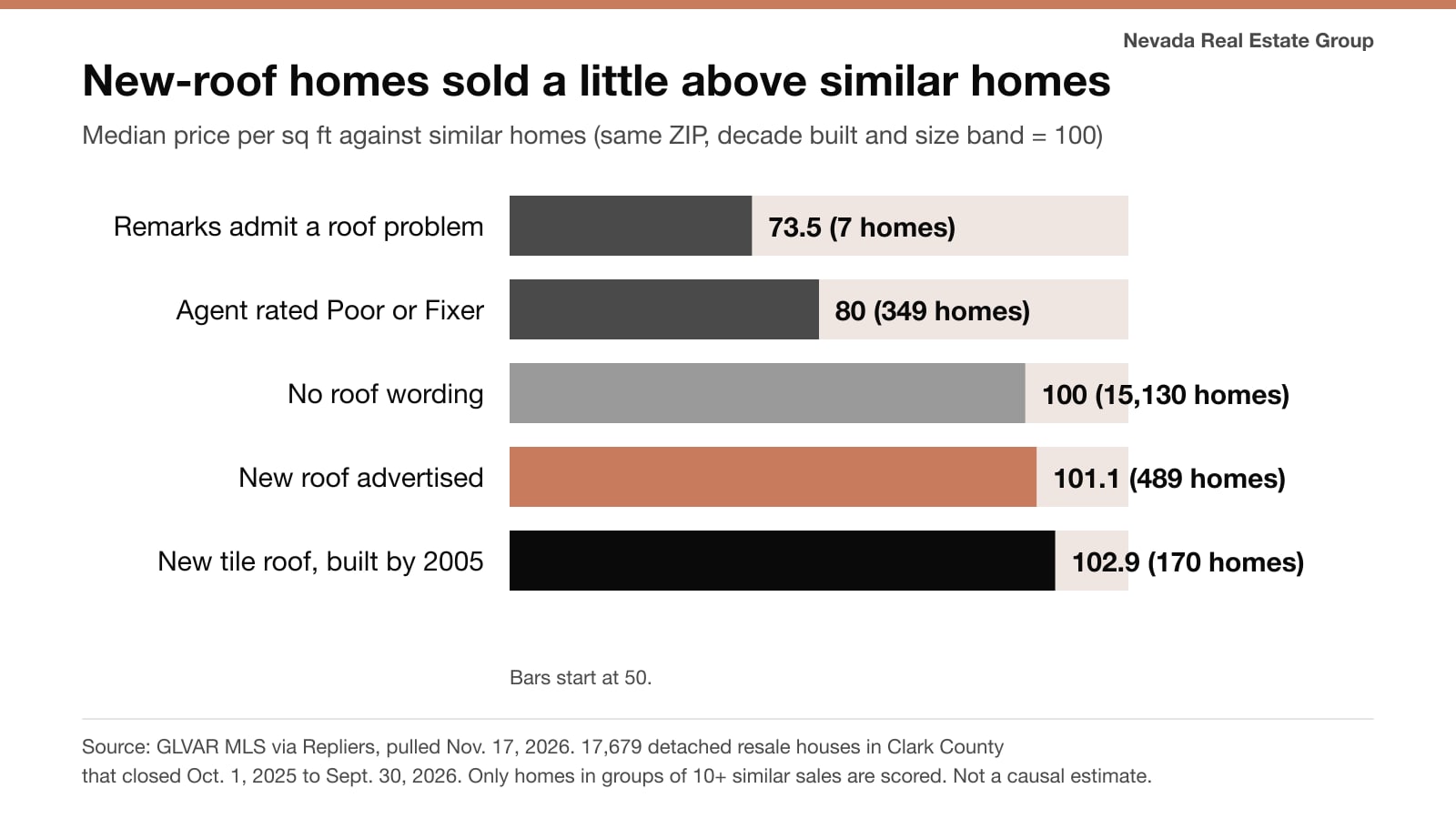
A little better, not a lot better. For each house we divided its sale price per square foot by the median for houses in the same ZIP code, built in the same decade and in the same size band, using only groups with at least 10 sales in the same 12 months. A score of 100 means the house sold right at its neighbors' median. The 489 new-roof houses that could be scored this way came in at a median of 101.1, against exactly 100.0 for the 15,130 scored houses whose remarks said nothing about the roof. At the new-roof group's median price of $416,000, that 1.1% gap is about $4,500.
The gap was bigger for tile. Among houses built through 2005, the 170 scored houses that advertised a new tile roof landed at 102.9, against 100.1 for tile houses with no roof wording, a gap of about 2.8%, or roughly $14,000 at that group's $506,000 median. The 288 scored shingle houses that advertised a new roof landed at 100.8 against 99.8, about 1%, or roughly $3,700 at $386,000.
New-roof houses closed at a median 98.4% of their original asking price, against 97.5% for houses with no roof wording, but within each roof type the difference disappeared (97.5% against 97.5% for tile houses built through 2005, 98.6% against 98.5% for shingle), so the overall gap mostly reflects which houses advertise new roofs. They did not sell meaningfully faster: a median 24.5 days to an accepted contract against 27 overall, and among tile houses built through 2005 the new-roof group actually took a median 29 days against 26.
Two cautions keep this honest. First, a remarks mention is what the seller chose to advertise, and a seller who replaced the roof often replaced other things too. Second, this is a comparison of medians, not a measurement of what a roof caused. Our earlier eight-month study in what not to fix before selling found a similar 0.9-point gap for new-roof mentions, so the direction is consistent, but nobody should read 1.1% as a promise.
Does replacing the roof before you list pay for itself?
Usually not on price alone, judging by what sellers themselves wrote about roof costs. No public index of Las Vegas roofing prices exists, and the City of Las Vegas permit records don't fill the gap: every one of the 302 permits carrying the city's residential re-roofing item from October 2025 through September 2026 shows the same $500 in the declared-value field, a placeholder rather than the job price. So we looked for the dollar figures that sellers put in their own listing remarks. Six named a roof figure in the closings we studied or the listings on the market on November 17, 2026.
| Home | Roof in the MLS | What the remarks said | Figure | Result |
|---|---|---|---|---|
| 1962 house, North Las Vegas 89030 | Flat | Roof replaced in 2024 | $10,000 | Sold March 2026 for $350,000 |
| 1964 house, Las Vegas 89107 | Composition shingle | Roof replaced within the past year | $15,000 | Sold November 2025 for $331,000 |
| 1989 house, Las Vegas 89130 | Asphalt | New roof among other upgrades | $15,000 | Sold May 2026 for $600,000 |
| 1990 house, Las Vegas 89123 | Tile | Needs a new roof; estimate quoted | $21,000 estimate | Sold February 2026 for $378,000, 94.7% of its original price |
| 1995 house, Henderson 89015 | Tile | Credit offered for roof repairs at closing | $10,000 credit | Sold April 2026 for $375,000, 93.8% of its original price |
| 1978 house, Henderson 89014 | Composition shingle | New roof installed in 2025 with a 30-year warranty | $40,000 | Listed at $399,999 on November 17, 2026 |
Six figures from six different houses are anecdotes, not a price survey, and they range from $10,000 to $40,000 for very different roofs and sizes. Still, put them next to the study. A new-roof mention lined up with roughly $4,500 more on a typical $416,000 house, and roughly $14,000 more on an older tile house at $506,000. All five stated replacement costs and estimates sit above the first number, and four of the five sit above the second.
That doesn't make a roof replacement a mistake. It means the reason to do it is rarely the sale price. Good reasons include a roof that is actively leaking or damaged, a buyer pool you need that relies on FHA or VA financing, insurance you can't keep in force, or a market where you'd rather not hand a buyer an easy renegotiation. Our guide to high-return improvements before selling walks through how to weigh other pre-listing projects the same way.
What does Nevada law make you disclose about a roof?
Anything you know about, in writing, before closing. Nevada's Seller's Real Property Disclosure Form, Form 547 from the Real Estate Division (revised June 1, 2023), asks the roof question in plain words: "Roof: Any problem with the roof?" The same form asks about "previous or current moisture conditions and/or water damage," and about "any construction, modification, alterations, or repairs made without required state, city or county building permits." A past leak that stained a ceiling, an active leak and a roof repaired without a required permit can each land on a different line of the same form.
Three pieces of NRS chapter 113 frame the rule. NRS 113.130 requires the seller, not the agent, to complete the form, and the seller or the seller's agent to serve it at least 10 days before conveyance; it also says a buyer cannot waive the form and a seller cannot require the buyer to waive it. A few sales are exempt, including foreclosures, sales between co-owners, spouses or close relatives, a builder's first sale of a new home, and certain relocation and fiduciary sales such as an estate sale by a personal representative. NRS 113.140 says you don't have to disclose a defect you aren't aware of, so the form is not a warranty and doesn't require you to climb on the roof. And NRS 113.150 sets the remedies: if you knew about a defect and didn't disclose it, the buyer can recover "treble the amount necessary to repair or replace the defective part of the property," plus court costs and attorney's fees, in an action brought within one year after the buyer discovers, or reasonably should have discovered, the defect or two years after the sale, whichever is later, for a defect whose repair cost the purchase agreement didn't limit.
One provision helps sellers who do their homework. NRS 113.150(5) says a buyer can't recover those damages for an error in the form caused by your reliance on information from a licensed contractor, certified inspector or certain other licensed professionals or public officials. That is one more reason to get the roofer's findings in writing and attach them to your disclosures. Our guide to Las Vegas seller disclosures walks through the rest of the form.
What happens if the roof starts leaking after you accept an offer?
You tell the buyer in writing, and the buyer gets a choice. NRS 113.130(1)(b) covers a leak that appears during escrow, for example after a storm: if, after the disclosure form is served but before closing, the seller discovers a new defect or finds that a disclosed defect "has become worse than was indicated on the form," the seller must inform the buyer in writing "as soon as practicable" and no later than closing. If the seller doesn't agree to repair or replace it, the buyer may rescind the purchase agreement or close escrow and accept the property as disclosed.
In practice that gives you three options the moment a new leak appears. You can offer to repair it before closing, with a licensed roofer and a written invoice. You can offer a price reduction or credit, subject to the buyer's loan rules covered below. Or you can disclose and let the buyer decide. What you can't do is patch the ceiling stain and say nothing.
The timing comes from NRS 113.150. When a seller discloses a defect before closing, on the original form or in a later written notice, and the purchase agreement didn't limit the repair cost for that item, the buyer may rescind or close and accept the defect. A rescission is effective only if it is in writing, notarized and served within four working days after the buyer is informed, on the escrow holder or, if no escrow is open, on the seller or the seller's agent. That applies to a roof problem on your original Form 547 too, which is why a disclosed roof is more than a negotiating item. A buyer can also waive rights under NRS 113.150, but only in a written document the buyer signs and has notarized. Read the timelines and repair provisions in your contract with your agent and, if needed, a Nevada real estate attorney.
A failed escrow puts the house back on the market, and buyers ask why. Our study of Las Vegas homes back on the market after a failed contract shows how relaunched listings were priced and what their remarks said about the return.
Will a buyer's FHA or conventional appraisal flag the roof?
It can, and the rules are specific. For FHA loans, HUD's Single Family Housing Policy Handbook 4000.1 (last revised August 12, 2026), section II.D.3.g on roof covering, tells the appraiser to report a deficiency when the roof covering "does not prevent entrance of moisture or provide reasonable future utility, durability and economy of maintenance and does not have a remaining physical life of at least two years." The appraiser "must report if the roof has less than two years of remaining life, and make the appraisal subject to inspection by a professional roofer." The handbook's list of conditions that call for an inspection by a qualified person includes "leaking or worn-out roofs."
Conventional loans run through a different test. Fannie Mae's Selling Guide, section B4-1.3-06, rates property condition from C1 to C6. A C5 property, one with "obvious deferred maintenance" where many short-lived components are at the end of their life "but remain functional," is eligible "as is." A C6 rating, which means deficiencies severe enough to affect "the safety, soundness, or structural integrity," makes the loan ineligible until the deficiency is repaired, and the appraisal must be completed "subject to" that work. An old but intact roof usually sits on the C5 side of that line; active water damage can push a house to the C6 side.
The financing data needs a careful read. From October 2025 to September 2026, 35.2% of the 579 new-roof sales used FHA or VA loans, against 27.6% for houses with no roof wording, but within the same roof type the gap all but vanished (24.9% against 25.7% for tile houses built through 2005, 40.6% against 37.8% for shingle), so it mostly reflects older, lower-priced houses. None of the nine roof-problem sales used FHA or VA financing, and six of the nine went to cash buyers, which fits the lender rules above but is a small sample. If your likely buyer at your price point uses FHA, an aging roof is a financing question, not just a looks question. Our FHA loan guide for Las Vegas and Las Vegas appraisal guide explain the rest of each process.
Should you repair the leak, replace the roof, give a credit or sell as-is?
Match the fix to the problem and to the buyer you expect. A roofer's written assessment comes first, because the answer to "repair or replace" is a roofing question, not a real estate one. Once you have it, the choice usually looks like this.
| Factor | Repair the leak | Replace the roof | Credit or price cut | Sell as-is |
|---|---|---|---|---|
| Upfront cost to you | Lowest; a roofer's bid | Highest; sellers stated $10,000 to $40,000 | None upfront; comes off proceeds | None upfront; lower price |
| FHA buyers | Works if the roofer documents at least two years of life | Works | Limited: FHA seller contributions go toward closing costs | Often not eligible if the roof leaks |
| Conventional buyers | Works if the house rates C5 or better | Works | Fannie Mae limits contributions to closing costs; excess comes off the price | Depends on the C rating |
| Cash buyers | Works | Works | Works | Most likely buyer |
| Price in our data, Oct 2025 to Sep 2026 | Not measured: too few clear repair mentions to score | New-roof mentions: 101.1 vs similar homes (489 scored) | Henderson credit case: 93.8% of original price | Roof-problem remarks: 73.5 vs similar homes (7 scored) |
| Disclosure still required | Yes, disclose the past leak and the repair | Yes, disclose any past water damage | Yes | Yes; as-is never waives Form 547 |
Repair is the right call for a single leak on an otherwise sound roof: a cracked or slipped tile, a failed flashing, a worn spot of underlayment at a valley or around a vent. It's usually the smallest bill, it removes the leak FHA's handbook singles out for inspection, and a roofer's written report with the remaining-life estimate does double duty for your disclosure.
Replacement makes sense when the roofer says the roof is at the end of its life, when your buyer pool depends on FHA or VA financing, or when the roof is a large shingle or flat roof on an older house where repairs won't hold. It also leaves a buyer's inspector less to write up on the roof. Just don't expect the sale price to pay it back dollar for dollar.
A credit or price cut works best when the buyer is already in contract and the roof issue surfaced in inspection; how to structure it is the next section. Selling as-is works when the house has other major problems too, which is exactly what the nine roof-problem sales in our data looked like. Our guide to selling a house as-is in Las Vegas covers that route in detail.
How do seller credits for a roof work with a buyer's loan?
Carefully, because lenders limit what a seller can pay. For FHA loans, HUD Handbook 4000.1 says interested parties "may contribute up to 6 percent of the sales price" toward the buyer's origination fees, other closing costs, prepaid items and discount points, and contributions beyond actual closing costs, or above 6%, "are considered an inducement to purchase." For conventional loans, Fannie Mae's Selling Guide section B3-4.1-02 caps financing concessions, measured against the lower of the sales price or appraised value, at 3% when the buyer puts down less than 10%, 6% between 10% and 25% down, and 9% at 25% or more down, for a principal residence or second home; investment property is capped at 2%. Fannie Mae lists closing costs, prepaids and up to 12 months of HOA assessments as acceptable uses. Repairs aren't on that list, and concessions above the limits "must be deducted from the property's sales price."
In plain terms, a "roof credit" usually becomes one of two things. It can be a closing-cost credit inside the lender's limit, which frees the buyer's own cash to fix the roof after closing. Or it can be a straight price reduction, which works for any buyer and any loan type and doesn't run into contribution caps. A price reduction also lowers the appraised-value hurdle for the buyer. Ask the buyer's lender how a proposed credit will be treated before anyone signs an addendum.
The one credit offer in our data shows the trade-off. A 1995 tile-roof house in Henderson's 89015 ZIP advertised a $10,000 credit for roof repairs at closing. It went under contract after 161 days and closed in April 2026 at $375,000 with a conventional loan, 93.8% of its $400,000 original asking price. One sale can't show whether the credit or the price made the difference, but the credit in its marketing didn't produce a quick contract. Our guide to seller concessions in Las Vegas explains how concessions show up in offers.
Who bought the Las Vegas homes whose listings admitted a roof problem?
Mostly cash buyers, buying houses with problems beyond the roof. We read the full public remarks of all nine roof-problem sales by hand. They aren't a statistical sample, but they show the pattern clearly.
| Built and ZIP | Roof in the MLS | What the remarks said | Agent's condition rating | Buyer paid with | Sale vs original price |
|---|---|---|---|---|---|
| 1966, 89101 | Asphalt | Needs total remodel and a new roof | Poor | Cash | 98.0% |
| 1986, 89145 | Flat, pitched and tile | Flat rear roof at end of life and uninsurable | Average | Cash | 92.8% |
| 1963, 89169 | Composition shingle | Missing shingles, plus failed sewer lines | Poor | Cash | 101.4% |
| 1990, 89123 | Tile | Needs new roof, $21,000 estimate | Poor, fixer | 1031 exchange | 94.7% |
| 1962, 89119 | Foam | Water-damaged roof and ceilings | Poor, fixer | Cash | 92.9% |
| 1995, 89015 | Tile | $10,000 credit for roof repairs | Average | Conventional | 93.8% |
| 1976, 89118 | Composition shingle | Roof and fire damage | Poor | Cash | 102.0% |
| 1978, 89104 | Composition shingle | Needs everything, in particular a full roof | Good | Conventional | 101.7% |
| 2002, 89131 | Tile | Fire damaged; needs some roof, attic and garage work | Poor, fixer | Cash | 58.1% |
The seven of these that could be scored against similar homes came in at a median 73.5, more than a quarter below their neighbors per square foot. That number belongs to the whole condition of each house, not just the roof. The broader group of 418 houses that listing agents rated Poor or Fixer from October 2025 to September 2026, whatever the reason, scored a median 80.0, went to cash buyers 73.4% of the time and closed at a median 93.7% of the original asking price.
If your house fits that profile, the cash market is real and fast; the eight roof-problem sales with contract dates took a median 20 days to reach an accepted contract. Our cash offer page and the current Las Vegas fixer-upper listings show both sides of that market. If your house is otherwise in good shape, it doesn't belong in that group, so get the roof priced before you decide how to sell.
What should your listing say about the roof?
Something short and factual, with dates. Give a year ("new roof in 2024"), the material, and whether a warranty transfers; that is information a buyer's agent can verify and an appraiser can use. Don't expect the wording itself to move the price, though. Among the 489 scored new-roof sales from October 2025 to September 2026, remarks that named a year sold at a median 100.7 against similar homes (106 sales) and those that mentioned a warranty at 100.2 (20 sales), against 101.1 for the 368 that mentioned neither. Remarks that described a roof repair, inspection or coating were too few, and too mixed with boilerplate such as "well-maintained," to measure.
Keep three lines separate. The public remarks are marketing, so put the positives there: the year of a replacement or repair, the warranty, the permit. The disclosure form is where problems belong, in your own words, completed by you rather than your agent, as NRS 113.130 requires. And the documents, meaning the roofer's report, invoice, warranty and permit card, go into the disclosure package so a buyer sees evidence instead of a claim.
The 9-in-17,679 figure shows how rarely sellers admit a roof problem in public remarks, and that is fine; the law puts the duty on the disclosure form, not the advertising. But don't write anything in the remarks that the disclosure contradicts. A listing that says "roof in great condition" over a disclosure that says "leaked in August" invites a buyer's attorney to ask what else was understated. Our guide to staging and preparing a Las Vegas home covers the rest of a listing's paperwork.
How do you hire a roofer and document the work before you sell?
Treat it like any contractor job a buyer will scrutinize later. In Nevada, roofing is licensed work: the Contractors Board's C-15a roofing subclassification, defined in NAC 624.320, covers "the installation, application, alteration and repair of watertight and weatherproof material used on roofs," and names tile, shingles, felt and urethane among the materials. Check any roofer on the Board's license search before you sign.
The Nevada State Contractors Board's Home Improvement Bill of Rights is a useful checklist. It tells homeowners to "get at least three written bids from licensed contractors," to ask to see "the contractor's official NSCB pocket card," and to make sure the bids cover the same scope of work. It also says homeowners have the right to a contract with "one project price, which includes all labor and materials," to require the contractor to obtain a building permit, and to withhold the final payment until the agreed work is complete.
Permits matter for the sale because Form 547 asks about repairs made without required permits. The City of Las Vegas permit records show what a re-roof permit looks like: the city's fee item reads "re-roofing/residential (tile to tile; or greater than 64 sf of structural sheathing)," and 302 permits carried that item from October 2025 through September 2026. Your roofer should know whether your job needs a permit from your city or from Clark County; get the permit and the final inspection in writing either way.
Finally, keep the file a buyer's inspector will want. Under NAC 645D.560, a Nevada home inspector must inspect the roof covering, flashing and penetrations and describe "the method of observation used to inspect the roof." A roofer's report fills the gap the inspection leaves. Our guide to a pre-listing home inspection in Las Vegas explains when ordering your own inspection first pays off.
What should a buyer know about a Las Vegas home with an old roof?
That the roof is negotiable, and that the loan may set the terms. Buyers see the other side of every rule above. A seller has to disclose a roof problem they know about, but NRS 113.140 also says a seller doesn't have to disclose defects they don't know about and that the form is not a warranty, and it reminds buyers of their own duty "to exercise reasonable care." On a tile roof that means the inspection matters more than the disclosure; our desert inspection guide explains why intact-looking tile doesn't prove the underlayment is sound.
If you are buying with FHA, the appraiser's two-year remaining-life test applies to your loan, so an obviously worn roof can trigger a roofer's inspection and a repair condition before closing. Fannie Mae conventional loans accept a C5 house as-is but not a C6 one. Neither rule protects you from a roof that is merely old; a roofer's assessment during your inspection period is what does that.
Price is the other lever. From October 2025 to September 2026, roof-problem houses that could be scored sold at a median 73.5 against similar homes, though most had other major issues. A sound house with an aging roof is a smaller discount, and an older shingle house with a new roof sold close to its neighbors. If you're shopping the older parts of the valley, our guides to buying a fixer-upper in Las Vegas and renovated versus original houses in Charleston Heights show how condition moves price. A roof that also carries solar panels adds another layer; see our guide to buying a Las Vegas home with solar.
What should you do this week if your roof leaks and you plan to sell?
Stop the water, then build the paper trail. Get a licensed roofer out to diagnose the leak and give you a written report with the cause, the repair, and an estimate of the roof's remaining life. Fix active leaks and any water damage inside; FHA's handbook names leaking or worn-out roofs among the conditions that call for an inspection, and Fannie Mae won't buy a loan on a house rated C6. If the roofer says the roof is done, get at least three written bids for replacement and decide whether you'll replace, credit or price it in, using the numbers in this guide as a check.
Then write the disclosure yourself, honestly, with the report attached. If you have homeowners insurance questions about a claim, a policy renewal or a carrier that won't cover an older roof, raise them with your insurer before you list; our Las Vegas homeowners insurance guide explains what drives premiums here. Price the house against recent sales of similar homes in your ZIP code and decade, adjusting for the roof's real condition, not for a hopeful one. If the house has other big defects, compare a fixer-style sale with a conventional listing before choosing. Septic owners face a similar decision, covered in our guide to selling a Las Vegas home on septic.
If you'd like help, Nevada Real Estate Group can review your roofer's report, the comparable sales and your options with you. Start with an instant home value estimate, read how we sell homes in Las Vegas, or see how we sell homes in North Las Vegas. If a long listing commitment worries you, our 7-day listing agreement is another option. When you're ready to talk through your roof and your price, call (702) 637-1759 or contact us online.
Frequently Asked Questions
Can you sell a house with a leaking roof in Las Vegas?
Yes. Nevada law doesn't require a seller to repair a roof before selling, but NRS 113.130 requires most sellers to disclose a roof problem you know about on the state's Seller's Real Property Disclosure Form at least 10 days before closing. From October 2025 to September 2026, 9 of 17,679 Clark County detached resales admitted a roof problem in their public remarks; six of those sold to cash buyers.
Do I have to replace my roof before selling my house in Nevada?
No. No Nevada rule requires a seller to replace a roof. A buyer's lender may require a repair, though: FHA appraisers must flag a roof with under two years of remaining life, and Fannie Mae won't buy a loan on a house rated C6 until safety or structural deficiencies are fixed. A credit, a price cut or a cash buyer are the usual alternatives.
Does a new roof increase home value in Las Vegas?
Slightly, as far as the sales show. From October 2025 to September 2026, Clark County resales whose remarks advertised a new roof sold at a median 101.1 against similar homes per square foot, about 1.1% more, or roughly $4,500 at their $416,000 median. For tile-roof houses built through 2005 the gap was about 2.8%. That is an association, not proof the roof caused it. Seller-stated roof costs in listing remarks ranged from $10,000 to $40,000.
What happens if I don't disclose a roof leak when selling in Nevada?
Under NRS 113.150, if you knew about a defect and didn't disclose it, the buyer can recover three times the cost to repair or replace it, plus court costs and attorney's fees. The buyer must sue within one year after discovering, or when they reasonably should have discovered, the defect or two years after the sale, whichever is later, and the rule covers defects whose repair cost the purchase agreement didn't limit. A buyer can't recover for a form error caused by your reliance on information from a licensed contractor, certified inspector or certain other professionals.
Will an FHA loan go through on a house with an old roof?
Often, if the roof still keeps water out and has at least two years of remaining life. HUD Handbook 4000.1 tells FHA appraisers to report a roof with less than two years of remaining life and make the appraisal subject to a professional roofer's inspection, and it lists leaking or worn-out roofs among the conditions that call for an inspection. Plan on repairing a leaking roof before an FHA loan closes.
How much does a new roof cost in Las Vegas?
No public index of local roofing prices exists. City of Las Vegas re-roof permits record a $500 placeholder instead of the job price. Six Clark County listings stated a roof figure in their remarks between October 2025 and November 2026: five replacement costs or estimates from $10,000 to $40,000 and one $10,000 repair credit. Get at least three written bids from licensed C-15 roofers.
Should I offer a roof credit or lower my price?
A price cut works with every loan type, while a credit is limited by the buyer's lender. FHA allows seller contributions up to 6% of the price toward closing costs, and Fannie Mae caps them at 3%, 6% or 9% depending on the down payment, with anything above the cap deducted from the price. Ask the buyer's lender before signing a credit addendum.
Which Sources Inform This Roof Seller Guide?
MLS study. Sales data comes from the GLVAR multiple listing service through Repliers, pulled November 17, 2026. The population is every sale listing in Clark County with the property subtype "Single Family Residence," a raw MLS status of Closed, a resale condition flag (new construction excluded), and a closing date from October 1, 2025 through September 30, 2026: 17,679 houses after removing 66 repeat closings of the same address within 30 days. Of 20,481 records pulled, 2,228 lacked a resale flag and 508 carried a status other than Closed. Roof material is the listing agent's structured Roof field. Each listing's public remarks were split into clauses and every clause that mentioned the roof was classified by phrase (problem, new or newer, repaired, older than 10 years, other mention, none); all nine problem listings were read in full by hand. A saved hand check of 50 randomly chosen new-roof reads found 45 correct, and an independent check of another 45 found 41 correct; the misses included older replacements dated by another item, solar panels "on top of the roof" and an HOA that covers roof repairs. The repair class also caught boilerplate such as "well-maintained," so it is not reported. Prices are compared with the median price per square foot of homes in the same ZIP code, decade built and size band (under 1,500, 1,500 to 1,999, 2,000 to 2,799 and 2,800 or more square feet), using only groups with 10 or more sales. Days to an accepted contract run from the listing contract date to the purchase contract date. Listings on the market are the 7,474 detached resale listings returned as active, including those under contract, on November 17, 2026. The study script is scripts/las-vegas-roof-condition-sales-study.ts.
Limits. Remarks are marketing copy, so the roof-problem group is a floor, not a count of houses with roof problems, and the new-roof group is what sellers chose to advertise. The Roof field can be wrong or blank. Off-MLS and wholesale sales are invisible. The comparisons show association, not cause, and the six seller-stated roof figures are anecdotes, not a price survey.
Rules and records, all read November 17, 2026. Nevada Real Estate Division Seller's Real Property Disclosure Form 547 (revised June 1, 2023); NRS 113.130, NRS 113.140 and NRS 113.150; HUD's Single Family Housing Policy Handbook 4000.1 (last revised August 12, 2026), sections II.D.3.g (roof covering), the defective-conditions and inspection provisions, and the interested-party contribution standard; Fannie Mae Selling Guide B4-1.3-06, property condition, and B3-4.1-02, interested party contributions; NAC 624.320, the C-15 roofing classification; the Nevada State Contractors Board's Home Improvement Bill of Rights and license search; NAC 645D.560, the home inspector's roofing standard; the City of Las Vegas building permits open data, queried for permits issued October 1, 2025 through September 30, 2026 with the residential re-roofing item and not cancelled; and the Tile Roofing Industry Alliance consumer FAQ.
This guide is general information, not legal, roofing or financial advice. Disclosure rules, lender guidelines and permit requirements change, so confirm the current requirements with your lender, a licensed roofer and a Nevada real estate attorney before you act.