

A Las Vegas fixer-upper is a purchase and a construction project with separate failure points. The house can be affordable while the repairs are not; the loan can fit your income while the contractor cannot accept its payment schedule. Start with the property, written scope and cash reserve together. A low asking price alone does not establish a discount against a comparable finished home.
Our company's background includes the roughly 9,600 closings our team has represented. The program guidance below comes from identified public authorities; the worksheets are invented examples, not company transaction research, contractor bids or appraisals. Review dates refer to October 2026. Current Las Vegas fixer-upper listings help you identify candidates; their condition and loan eligibility still require individual review.
To buy a Las Vegas fixer-upper, obtain property-specific renovation financing, a written repair scope and enough cash for closing and surprises. FHA Limited 203(k) permits up to $75,000 in eligible rehabilitation costs; Standard 203(k) and HomeStyle address other scopes under their own rules. Compare total project cost with credible completed-home evidence, and resolve inspections, permits, insurance and contractor approval before committing beyond your contract protections.
- A renovation mortgage combines eligible purchase and repair financing; approval remains property-specific.
- Limited 203(k) eligibility depends on the work and occupancy disruption, not just the $75,000 cap.
- Include reserves, fees and temporary housing when comparing a fixer with a finished home.
- Verify contractors, permit jurisdiction and inspections before releasing money.
- An appraisal, a loan approval and an inspection answer different questions.
How do you decide whether a fixer is a better purchase?
Compare two homes that could serve the same practical need. A dated house and a larger renovated property in a different location are not interchangeable alternatives. Write down the features you need, the work necessary to make the fixer usable, and the improvements you would merely prefer. This separates the essential project from a wish list that can consume the apparent savings.
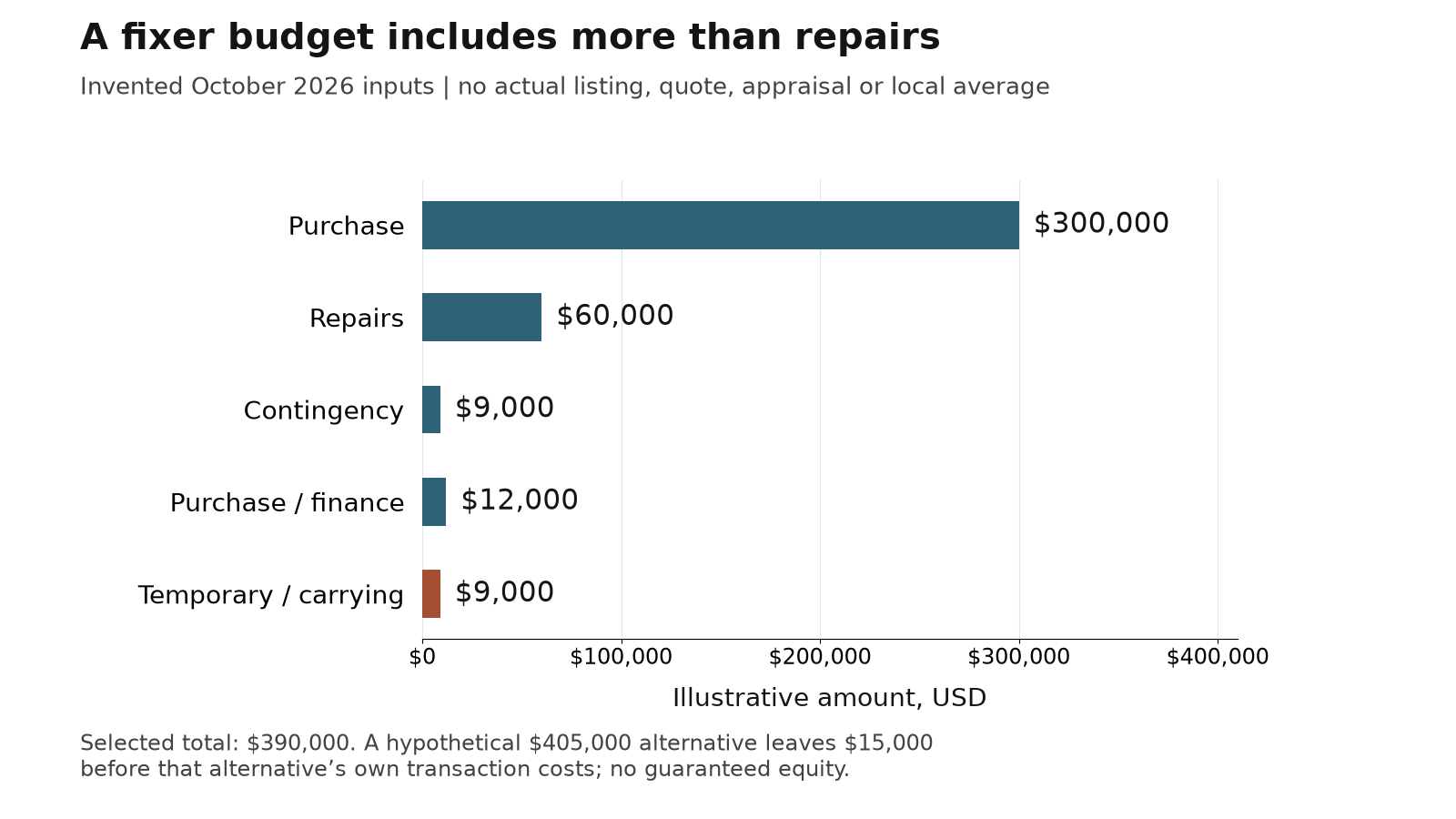
For an invented October 2026 planning example, start with a $300,000 purchase, $60,000 of quoted-in-the-example repairs, a $9,000 contingency, $12,000 of purchase and finance costs, and $9,000 of temporary housing and carrying costs. The selected total is $390,000. A hypothetical finished alternative at $405,000 leaves a $15,000 difference before that alternative's own transaction costs. Neither price is a Las Vegas median, a property valuation or evidence that a particular fixer is worth buying.
That difference is a decision allowance, not guaranteed equity. It compensates you for time, uncertainty and disruption only if the home actually meets your needs and the final numbers hold. A project that saves $15,000 but requires a move you cannot accommodate may be worse for you than the finished property. A custom layout you value can justify spending more, but personal usefulness does not ensure the same resale contribution.
Use the property search to compare actual alternatives, then obtain appropriate property evidence. Keep a written explanation for every comparison: location, condition, size, legally recognized space and sale date. Do not subtract an advertised fixer price from a valley-wide asking median and treat the result as a repair allowance. Historical listing counts and the July article's unsupported discount and speed claims are not current purchase evidence. For one neighborhood measured this way, our Charleston Heights renovated vs. original homes study sorts 563 house sales from October 2023 to September 2026 by recorded condition and size.
Which financing questions belong before the first offer?
Ask whether the lender actually originates the renovation product your property needs. A general preapproval for a normal purchase does not establish that the same lender will finance a house with missing systems or manage a rehabilitation escrow. Send a description of the intended work, anticipated occupancy and property type. Ask who reviews contractor qualifications and what must be ready before appraisal and underwriting can finish.
According to Fannie Mae's HomeStyle borrower and loan requirements, eligible property categories include one-to-four-unit principal residences, one-unit second homes and one-unit investment properties, with additional rules for condos and manufactured housing. That does not mean every lender offers every permitted configuration. Separate the agency's permitted category from the lender's actual willingness to make your loan.
The loan conversation should identify the purchase price, repair budget, financed fees, expected appraised value, down payment, mortgage insurance, reserves and available cash. Request a written breakdown rather than assuming a quoted percentage applies only to the seller's price. A lender's maximum mortgage is not a spending target, and unused cash should not disappear from your emergency planning merely because financing is available.
Ask about rate-lock duration and extension costs without assuming a renovation purchase will close on a conventional timeline. Establish who must approve a scope change and whether a delay affects your lock or contract. If another loan product is suggested, obtain that product's actual terms rather than importing the HomeStyle or 203(k) rules into it. Our Las Vegas FHA loan guide and first-time buyer resources provide background; the renovation lender must resolve this property's package.
When does FHA Limited 203(k) fit the work?
Limited 203(k) is intended for minor remodeling and nonstructural repairs. According to HUD Mortgagee Letter 2024-13, the total rehabilitation-cost limit is $75,000, and a consultant is optional rather than mandatory. The letter establishes annual review of the limit; do not assume it automatically rises each year. The subsequent June 2026 update still describes the $75,000 limit.
The scope matters as much as the amount. HUD's June 23,2026 update treats work as major when, among other conditions, it needs more than nine months, more than four draws per contractor, specified consultant plans, or prevents occupancy for more than 30 total days during rehabilitation. A relatively inexpensive project can therefore fall outside Limited. Conversely, a project does not become eligible just because a contractor labels it cosmetic.
For planning, imagine $60,000 of repair work, $9,000 of contingency and $3,000 of other eligible rehabilitation costs. The $72,000 total leaves only $3,000 beneath a $75,000 ceiling. This arithmetic is an invented scope illustration, not a lender's eligibility calculation. Have the lender identify which fees and reserves belong in that total and any separately governed items; do not decide the classification yourself from the contractor's headline bid.
The practical screening question is whether the entire required scope, cash-flow schedule and occupancy plan fit. If an inspection identifies a structural problem or the contractor needs a longer disruption, revisit the product before the purchase deadline. Do not omit necessary work to make the application look smaller. An honest scope protects both the financing decision and your ability to use the house after closing.
When should you consider Standard 203(k)?
Standard 203(k) serves rehabilitation projects outside the Limited program's narrower scope. HUD's handbook distinguishes its minimum repair cost of $5,000 and required 203(k) consultant. The consultant prepares the work write-up and cost estimate; the lender verifies the selection and documentation. According to HUD's program revision, the Standard rehabilitation agreement can allow up to 12 months, while Limited is capped at nine. These are program limits, not a prediction of your contractor's completion date.
Standard does not mean unlimited borrowing. The lender must calculate the permitted mortgage under FHA's valuation, investment and geographic limits. The HUD 2026 county-limit file lists Clark County's one-unit forward limit at $541,287. That corrects the old guide's approximate $552,000 figure; it is not a renovation-only allowance or a universal purchase-price ceiling. Unit count and the particular loan calculation matter.
Treat the consultant, independent inspection and appraisal as distinct functions. The consultant organizes the rehabilitation scope for the program, the appraiser addresses value and required property conditions, and your chosen inspectors investigate condition within their scope. None automatically replaces every other review. Ask which specialists a reported defect needs and whether their findings change the work write-up, price or your willingness to proceed.
An extended project can also create a household financing problem. HUD permits a qualifying Standard mortgage-payment reserve for the period the property cannot be occupied, subject to the rehabilitation timeframe and other rules. That reserve is financed money, not free housing. Ask the lender to distinguish it from rent, storage and additional living expenses that you will pay directly. A project is only workable when the loan documents and your actual living arrangement agree.
How does HomeStyle differ from the FHA choices?
HomeStyle is conventional renovation financing with its own property and underwriting requirements. For a purchase, Fannie Mae caps renovation costs at 75% of the lesser of purchase price plus renovation costs or the as-completed appraised value. This is different from saying the lender will simply lend 75% of the future value for any project. The mortgage amount and loan-to-value calculation are separate constraints. Manufactured housing has a different renovation cap.
An invented example makes the distinction visible. A $300,000 purchase plus $80,000 in qualifying renovation costs totals $380,000. If the as-completed appraisal is $400,000, the lesser amount is $380,000 and 75% is $285,000. The $80,000 work budget falls within that one ceiling, but this does not approve the loan, establish a down payment or prove the property is worth $400,000. See the actual HomeStyle eligibility calculations.
According to Fannie Mae's renovation FAQs, a complete teardown and reconstruction is not permitted, and improvements need not add dollar-for-dollar value. Those details matter when a buyer assumes any ambitious redesign is financeable or every renovation dollar creates equity. Select the work for a documented purpose and let qualified reviewers assess the property and financing.
HomeStyle may also cover an eligible one-unit investment purchase, but that category is not permission to ignore occupancy declarations, lender requirements or your intended exit. An investor planning to resell quickly needs financing explicitly compatible with the plan. An owner-occupant should disclose the intended use honestly and compare the complete payment, fees, cash requirement and renovation conditions. Choose the product that fits the actual transaction, rather than assuming one program is universally cheaper.
| Decision | Limited 203(k) | Standard 203(k) | HomeStyle |
|---|---|---|---|
| Work | Minor remodeling and nonstructural repairs | Broader rehabilitation; minimum $5,000 repair cost | Eligible renovation under conventional rules |
| Key constraint | $75,000 eligible rehabilitation cap plus scope rules | FHA mortgage calculation and applicable county limit | Purchase renovation cap uses the lesser-value calculation |
| Consultant | Optional under HUD rules | Required HUD-approved consultant | Lender review and documented plans apply |
| Investor question | Do not assume a flip qualifies | Do not assume a flip qualifies | One-unit investment category exists; confirm exact use |
How much cash should you keep beyond the down payment?
A down-payment percentage does not capture the entire cash requirement. Separate money due before closing, money due at closing and money you must retain afterward. Inspection and specialist costs may come before final loan approval. Closing costs, prepaid expenses, reserves and items the lender will not finance may add to the down payment. The lender's documents should show how each dollar is handled without double counting the same deposit or repair cost.
HUD's general FHA framework allows maximum financing for a borrower with a qualifying minimum decision credit score at or above 580;500–579 generally limits loan-to-value to 90%. The familiar 3.5% minimum investment is not approval for every applicant or every renovation property. These distinctions appear in Handbook 4000.1. A lender may have additional standards and must apply the relevant program calculation.
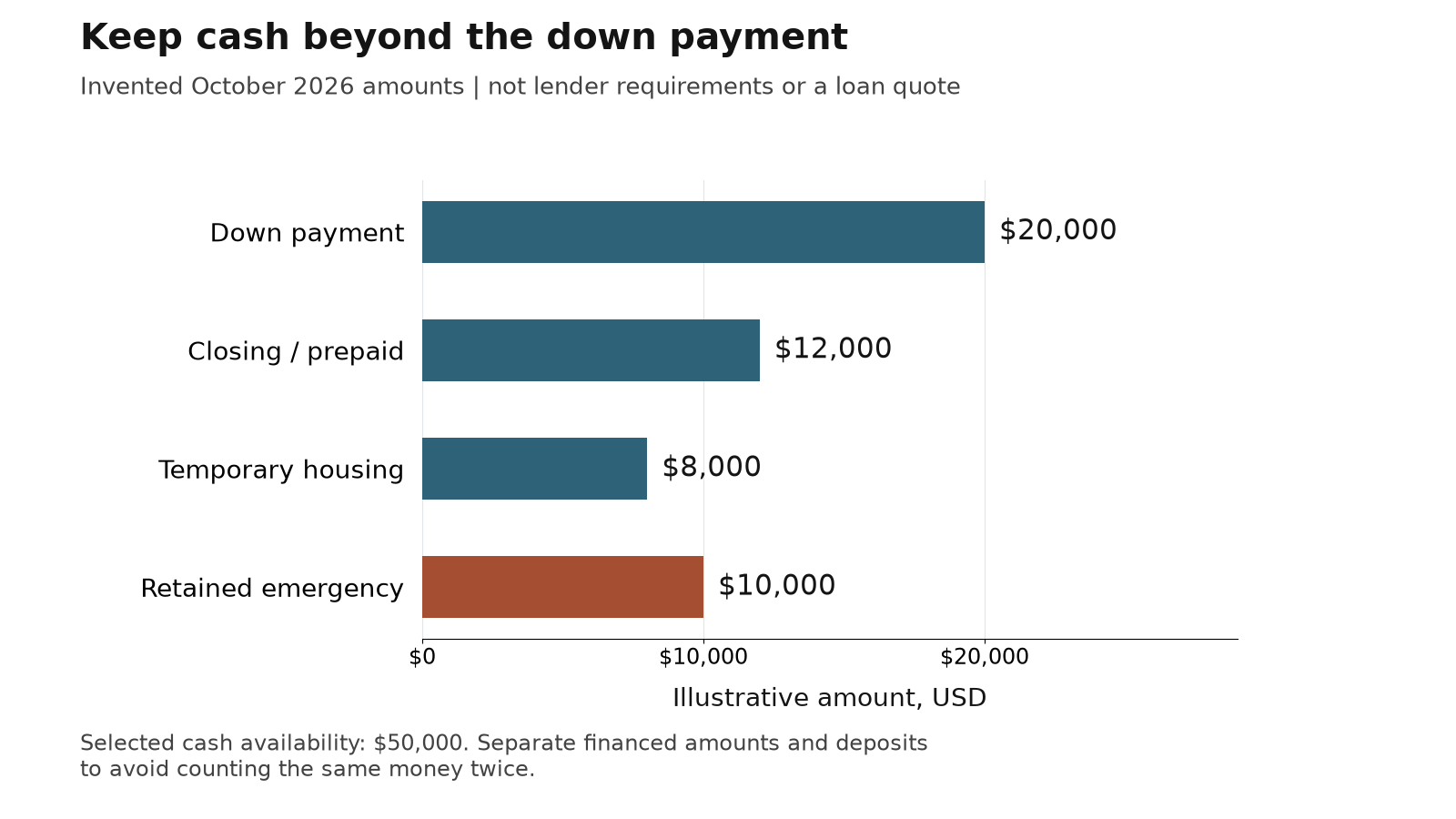
Use a separate household cash test. In an invented example, $20,000 for down payment, $12,000 for closing and prepaid expenses, $8,000 for temporary housing, and $10,000 retained for emergencies require $50,000 available. These are chosen amounts, not a quote or minimum for a Las Vegas purchase. If the lender finances a particular reserve, show the financing and the associated debt rather than counting the amount as both borrowed and spent from savings.
Ask what happens when a draw is delayed or an approved repair is more expensive than expected. The ability to make the final mortgage payment does not solve a temporary cash shortfall during construction. Keep essential living money separate from discretionary upgrades, and compare the reserve with your household's actual obligations. Our home affordability guide provides broader budget context; the renovation decision needs this additional timing layer.
How do you turn repair ideas into a usable budget?
Request bids against the same written scope. A kitchen price that includes cabinets, electrical work, permits and demolition cannot be compared directly with a cabinetry-only number. Identify material allowances, quantities, exclusions, disposal, access, required inspections and the person responsible for each task. Ask what would trigger a change order and how it would be priced. A detailed bid is more useful than a broad regional cost range that may describe a different house and finish level.
Keep essential repairs ahead of optional finishes. Safety, water intrusion, failed equipment or permit problems may determine whether the project can be financed and occupied. A new countertop should not consume money needed for an unresolved roof problem. Review the work sequence with qualified contractors so later work does not undo earlier work; this is a planning discussion, not a recommendation to perform regulated trades yourself.
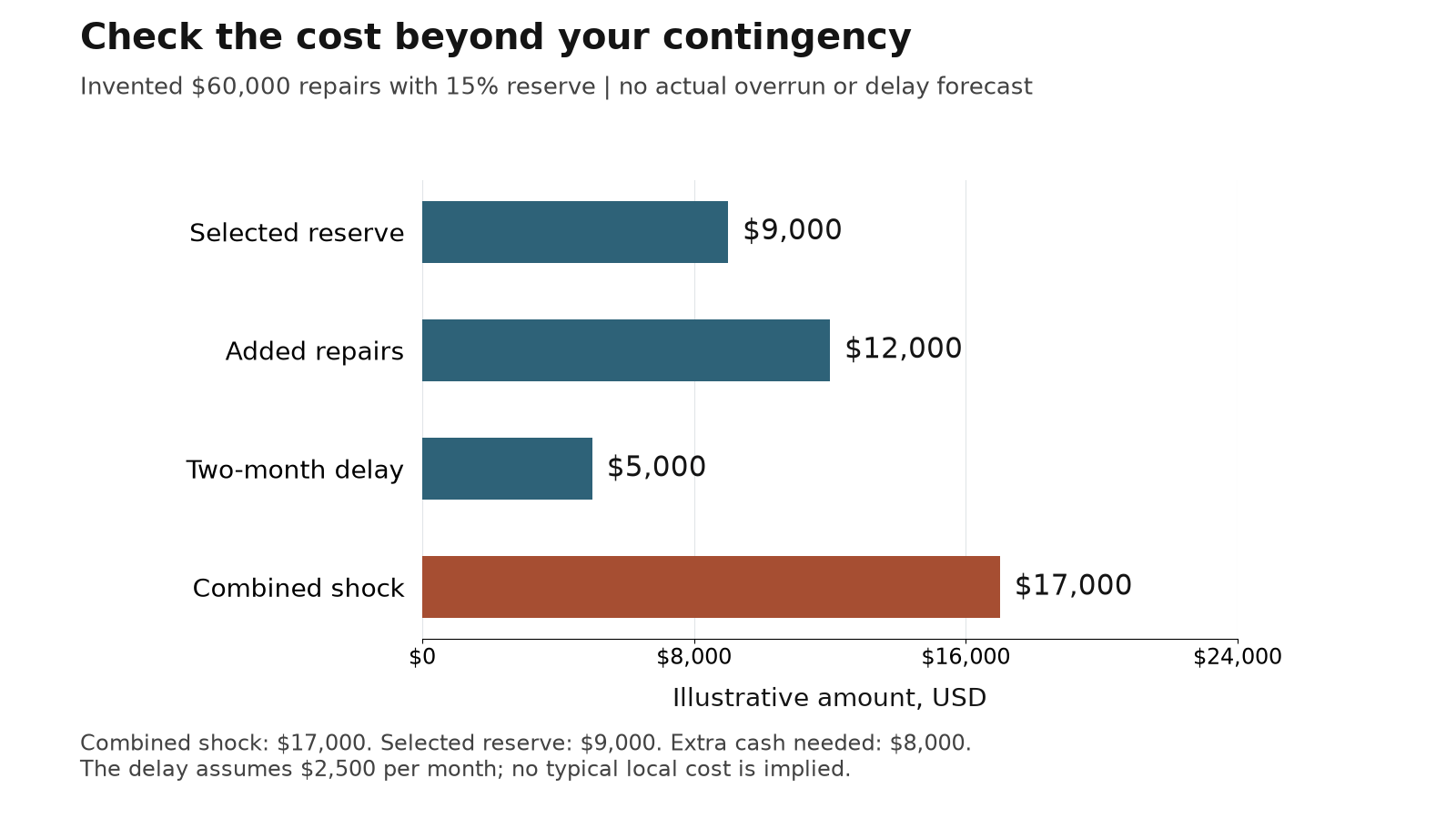
Contingency is also different from an upgrade allowance. In an invented October 2026 scenario, a $60,000 repair budget with 15% contingency has $9,000 reserved for uncertainty. If newly priced work adds $12,000, it exceeds that selected contingency by $3,000. A separate two-month delay costing an assumed $2,500 per month adds $5,000. The combined $17,000 shock consumes the $9,000 reserve and requires another $8,000. None of those assumptions establishes a typical Las Vegas overrun.
The HomeStyle FAQs distinguish lender discretion for a one-unit contingency reserve from specified requirements for two-to-four-unit properties. Your household's prudent reserve may differ from the minimum the loan requires. Ask the lender to reconcile the contractor scope, program reserve and your separate emergency funds. Use the what-not-to-fix guide as a discussion of prioritization, not a price list or guarantee of renovation return.
| Item | Calculation | Amount |
|---|---|---|
| Selected contingency | $60,000 × 15% | $9,000 |
| Additional repair scope | Assumed priced increase | $12,000 |
| Delay | 2 months × $2,500 | $5,000 |
| Combined shock | $12,000 + $5,000 | $17,000 |
| Beyond selected reserve | $17,000 − $9,000 | $8,000 |
What should inspections resolve before your deadline?
Use the property's condition to choose the review. A general home inspection can identify issues requiring a structural engineer, roofing contractor, HVAC professional, electrician or plumbing specialist. Ask each reviewer to explain what was inspected, what could not be observed and what further investigation is needed. A limited inspection is not evidence that hidden systems are sound, and a seller's repair estimate is not a substitute for your own scope review.
For a Las Vegas candidate, investigate cooling equipment, roof condition, water intrusion and the status of additions or conversions without assuming every older house has the same defects. If utilities are off, determine how relevant systems can be evaluated and who may safely restore service. Match any proposed invasive inspection or access arrangement to written permission and the contract. Do not treat the renovation budget as a reason to skip investigation: the budget needs the findings.
According to the EPA's Renovation, Repair and Painting guidance, paid work disturbing paint in covered pre-1978 housing generally requires lead-safe certification and practices. The page distinguishes owner DIY work from rental and house-flipping situations. A property's age is therefore a reason to ask about applicable safeguards and qualified contractors, not proof that every surface contains lead or that a particular removal method is safe.
Record the findings in a decision sheet: issue, relevant specialist, additional price, financing effect, timing effect and unresolved information. Decide whether the remaining uncertainty is acceptable before the contractual deadline. If a seller declines access, that limits what you can establish; it does not establish the absence of a defect. Compare Henderson fixer candidates or North Las Vegas fixer candidates using the same inspection standard rather than relaxing it to win a particular house.
How do contractors and permits affect the purchase?
According to the Nevada State Contractors Board's consumer checklist, buyers should check licenses, obtain references and multiple bids, use a written contract and retain payment records. Verify the exact business and relevant license scope, not just a number printed on a truck. Ask the renovation lender which contractor documentation it requires and make sure the contractor understands the loan's draw process before either side commits.
The Board's checklist states the residential-improvement down-payment rule as the lesser of $1,000 or 10% of the contract price, with specified bond or Board-relief exceptions. Confirm the applicability and contractor's status rather than assuming a large advance is acceptable because a lender may disburse funds. The construction contract, lender escrow rules and state contractor requirements must work together; a proposed schedule can require clarification before signing.
According to Clark County's permit guidance, regulated alterations and building-system work require permits, subject to relevant exemptions. First establish jurisdiction. The county's building questions and jurisdiction resources direct owners to the responsible building department. A Las Vegas mailing address alone is not the permit decision.
Review existing permits and final inspection records for claimed additions or conversions, then identify approvals for the proposed work. Listing photos and assessor information do not establish that a conversion was permitted or is acceptable to the lender. Ask who obtains permits, who attends inspections and which documents will demonstrate completion. Keep written change orders with costs and timing; an informal instruction at the job site can change your financing and legal responsibilities without changing the original budget sheet.
| Question | Useful evidence | Unresolved risk |
|---|---|---|
| What will be built? | Itemized scope, plans, allowances and exclusions | Different parties price different projects |
| Who can perform it? | License review and lender contractor acceptance | Work or draws cannot proceed as assumed |
| What approvals apply? | Jurisdiction, permits and inspection requirements | Unapproved work or unusable space |
| How is money released? | Written payment schedule and rehabilitation agreement | Cash demands precede available funds |
How can a financed offer compete without sacrificing diligence?
Make the offer understandable and executable. Confirm the seller will consider the proposed financing, explain which reviews remain and propose dates that reflect actual lender and contractor availability. A confident promise to close quickly is not useful if the repair scope or contractor approval cannot be finished in time. Ask the lender to identify the critical dependencies before choosing a closing date.
The old guide's 11-day selling window was an unsupported historical comparison, not a reason to tell every buyer to waive protections or act within hours. Current competition must be established for the particular listing. A property with several offers can require a different strategy from one whose condition prevents ordinary financing, but neither situation makes an uninvestigated defect cheaper. Use the Nevada offer guide to organize terms and questions with your representative.
Read inspection, appraisal, financing and cancellation provisions together. Identify the earnest-money consequences of a missed date and who is responsible for notices. Do not assume a loan denial or an expensive repair automatically returns a deposit; the signed agreement and circumstances control. If legal interpretation is needed, obtain it before a deadline rather than relying on a generic article or the other party's assurance.
Flexibility can concern timing, possession or the scope of a requested seller repair, but each concession has a cost. Write down what you are offering and what evidence would cause you to stop. Keep negotiations focused on property and transaction terms. A buyer does not need to describe personal characteristics or promise a particular lifestyle to present an organized offer. Compare alternatives on the Henderson and Summerlin hubs where those areas fit your requirements, so a single negotiation does not become your only plan.
What happens between closing and the final draw?
Closing does not turn a rehabilitation escrow into unrestricted cash. The agreement identifies the work, disbursement conditions and completion requirements. According to HUD's June 2026 draw update, Limited 203(k) permits up to four draws per contractor, with an initial draw, up to two intermediate draws and a final draw. A permitted draw may include two disbursements. The distinction matters when a contractor's usual payment schedule assumes a different number of requests.
Set a shared calendar for the scope, inspections, title updates when needed, documentation and payment requests. Ask the lender what constitutes a complete request and which party submits it. Do not promise a contractor payment based solely on the date work was finished if other required documentation remains. Keep invoices, approvals and receipts organized so a disagreement can be resolved from the record.
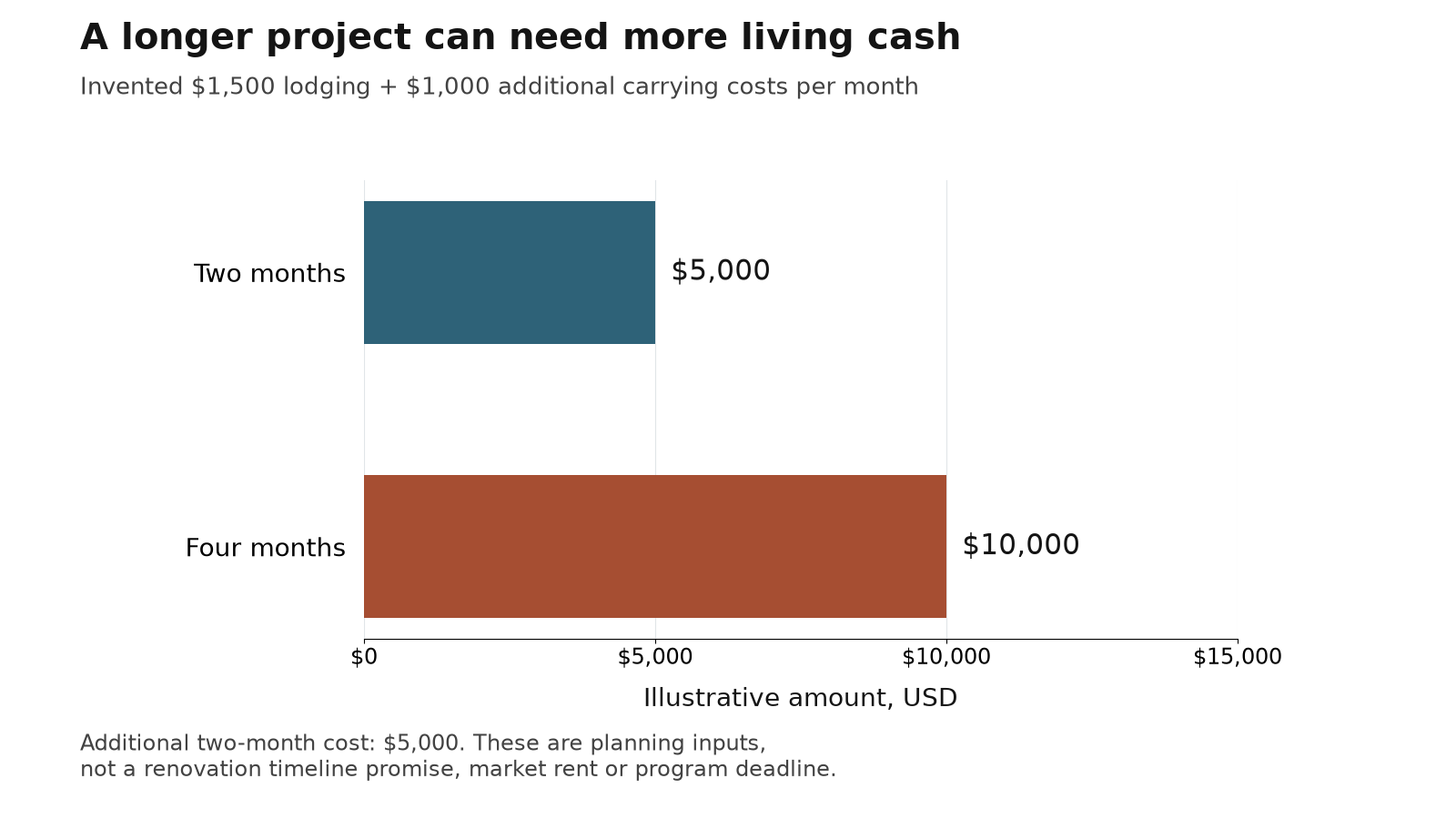
Use a cash-flow example separate from program deadlines. Suppose an invented household pays $1,500 monthly for temporary lodging and $1,000 of other additional carrying costs during a delay. Two months cost $5,000; four months cost $10,000. The extra two months consume another $5,000 even if the contractor's fixed repair price does not change. These are selected October 2026 planning inputs, not typical rents, predicted delays or the lender's payment-reserve calculation.
When conditions change, stop and obtain the required approvals before treating a change as financeable. Fannie Mae's HomeStyle collateral rules require documented plans and a detailed change request for proposed alterations. Completion also requires more than attractive photographs: reconcile required inspections, permits, lender conditions and outstanding payments. Plan the move around actual usable possession, with the Las Vegas relocation guide as broader logistics support.
What do appraisal and insurance approval actually establish?
An as-completed appraisal is an opinion under a defined scope and set of assumptions. It is not a guarantee of a future sale price, a contractor's performance or your final project cost. According to Fannie Mae's collateral requirements, the renovation plans inform the appraisal. Material changes can require further lender review and a revised value assessment. Do not quietly substitute a cheaper specification while continuing to use the original value assumption.
Avoid counting the same apparent benefit twice. If your hypothetical finished home is worth $400,000 and your selected total project cost is $390,000, the $10,000 difference is neither cash in the bank nor profit from a sale. Future transaction costs, debt payoff, changes in value and taxes may affect any eventual outcome. Use actual property-specific evidence for a decision and keep invented worksheets clearly separate from it.
Confirm insurance with the insurer before closing: condition, vacancy, renovation activity and intended occupancy can affect the coverage available. Ask what the policy covers during work and what must change when the project is complete. A contractor's insurance and your property coverage address different exposures; obtain explanations from the relevant providers rather than assuming either makes the other unnecessary.
Mortgage insurance is another separate question. According to the Consumer Financial Protection Bureau's PMI explanation, applicable conventional loans have a conditional cancellation request at 80% of original value and generally scheduled automatic termination at 78% when current. FHA insurance has different rules. Renovating to an estimated 20% equity does not automatically remove every type of mortgage insurance. Ask the servicer which requirements and valuation basis apply to your loan.
How should you make the final buy, renegotiate or walk-away decision?
Bring the property findings, financing conditions and household budget onto one page. The decision should identify the required work, unresolved inspection questions, approved financing, cash still available, permit responsibility and realistic possession plan. If one essential input remains unknown, state what would resolve it and whether your contract gives you enough time. Do not turn uncertainty into a favorable number merely to complete a spreadsheet.
Compare the likely ownership plan as well. An owner-occupant needs a home that works during and after the project. A rental buyer must examine operating expenses, permitted use and loan eligibility. A short-term reseller needs an appropriate business and financing analysis rather than an owner-occupant loan assumption. The rental-property guide is a separate decision path; a projected rent cannot repair an incomplete renovation scope or create cash that is needed before the property is ready.
Buying a fixer rewards local knowledge, speed, and someone who can read a renovation against the comps — the three things a strong local team provides. Nevada Real Estate Group is the #1 real estate team in Nevada (and #44 in the nation), with 9,600+ closed transactions and over $4.85 billion in career sales volume, a 150+ agent team, and 9,097+ verified five-star reviews. In 2025 alone our team closed 789 homes worth over $361.5 million — you can learn more about our team and track record.
Use those conversations to resolve an actual property decision. Review current Las Vegas fixer inventory, explore buyer resources, or contact our team at (702) 637-1759. Bring the address, scope, financing questions and timing constraints. The useful next step is a complete comparison you can evaluate, with contractor, lender and professional advice for their respective responsibilities; no article can promise the result of a particular renovation.
Frequently Asked Questions
Can I finance the purchase and renovation in one mortgage?
Eligible FHA 203(k) and HomeStyle transactions can combine those purposes. The lender must approve the borrower, property, scope, value and contractor arrangements. A normal purchase preapproval does not establish renovation eligibility. Ask for the full loan calculation and cash requirement before relying on a quoted down-payment percentage.
Is every project below $75,000 eligible for Limited 203(k)?
No. The eligible rehabilitation total must fit the cap, and the work must meet scope, occupancy-disruption, timing and draw requirements. A structural or otherwise major project does not become Limited-eligible because its bid is below $75,000. Review the complete scope with the lender before selecting the product.
What changed in the Limited 203(k) draw rules in 2026?
HUD's June 23,2026 letter permits a maximum of four draws per contractor, consisting of the initial draw, up to two intermediate draws and a final draw. A permitted draw may include two disbursements. The lender's rehabilitation agreement and documentation requirements still govern the actual release of money.
How much should I budget for a Las Vegas renovation?
Use itemized bids for the actual house and finish level, then add applicable fees, reserves, temporary housing and other carrying costs. The examples here are invented calculations, not local averages. Compare identical scopes and document exclusions; a single kitchen or square-foot allowance cannot establish your full project cost.
Does a higher as-completed appraisal guarantee equity?
No. It is an appraisal opinion under specified assumptions. It does not guarantee completion cost or a future sale price. Compare the full project cost, financing and any eventual selling costs, and obtain the lender's approval when the scope changes rather than assuming the original value still applies.
Can an investor use HomeStyle for a fixer?
Fannie Mae includes a one-unit investment-property category, subject to its eligibility rules and the lender's requirements. That is not blanket approval for every flip, teardown or borrower. Disclose the intended use and exit, and obtain financing explicitly compatible with the transaction rather than claiming owner occupancy to qualify.
Should I waive inspections to compete with cash?
Do not assume competition makes unknown repair costs acceptable. Match the offer timeline to actual lender, contractor and inspection availability, and understand the contract's deposit and cancellation consequences. Your representative and, when needed, an attorney can explain the specific terms. No generic selling-speed statistic resolves that decision.
Will mortgage insurance disappear after the renovation?
Not automatically. Applicable conventional PMI cancellation and termination rules depend on conditions and the relevant value basis; FHA insurance follows different rules. A hoped-for appraisal gain is not permission to remove coverage. Ask your servicer for the requirements that apply to the actual mortgage.
Which sources and calculations support this guide?
Public program and consumer guidance was reviewed in October 2026. HUD's 2024 rehabilitation revision is read with the June 2026 draw amendment; the latter supersedes the old two-draw language. Relevant FHA credit provisions and the 2026 Clark County limit were inspected using the retained official handbook and county file. The handbook includes future-effective sections; no new November 2026 rule is presented here as already effective. Linked authorities control their programs, and lenders determine an individual application.
Company experience includes the roughly 9,600 transactions Nevada Real Estate Group has closed across the valley. Those company figures are not the sample or verification method for this article's market or loan claims. The previous July listing counts, asking-price comparisons and selling-speed assertions are not used as current evidence. All cost charts and tables labeled invented use the stated arithmetic inputs; none represents a client transaction, contractor quote, appraisal or measured local average.
- HUD 2024-13: rehabilitation scope, consultant and timing changes.
- HUD 2026-06: current draw amendment.
- HUD Handbook 4000.1, August 2026 edition.
- HUD 2026 county mortgage-limit data.
- Fannie Mae HomeStyle eligibility and calculations.
- Fannie Mae contractor, plans and appraisal requirements.
- Fannie Mae HomeStyle FAQs.
- Nevada State Contractors Board consumer checklist.
- Clark County permit guidance.
- Clark County building and jurisdiction questions.
- EPA lead-safe renovation guidance.
- CFPB private mortgage-insurance cancellation.