

Owners in Las Vegas 55+ communities hear one worry more than any other when they decide to move: only some buyers are allowed to live there, so won't the house sit? It is a fair question, and the sales record answers it more precisely than opinion can. The short version is that age-restricted homes do take a little longer to reach an accepted offer, but they do not sell for meaningfully less, and they are less likely to come off the market unsold.
We pulled every resale that closed in Las Vegas, Henderson, North Las Vegas and Boulder City between October 1, 2025 and September 30, 2026 from the GLVAR multiple listing service, using the MLS's own age-restricted flag to separate 55+ homes from the rest. That produced 1,726 age-restricted resales. To compare like with like, we matched each 55+ house with ordinary houses in the same ZIP code and the same $100,000 price band, so a Sun City Summerlin sale is measured against other Summerlin-area houses at its price, not against the whole valley.
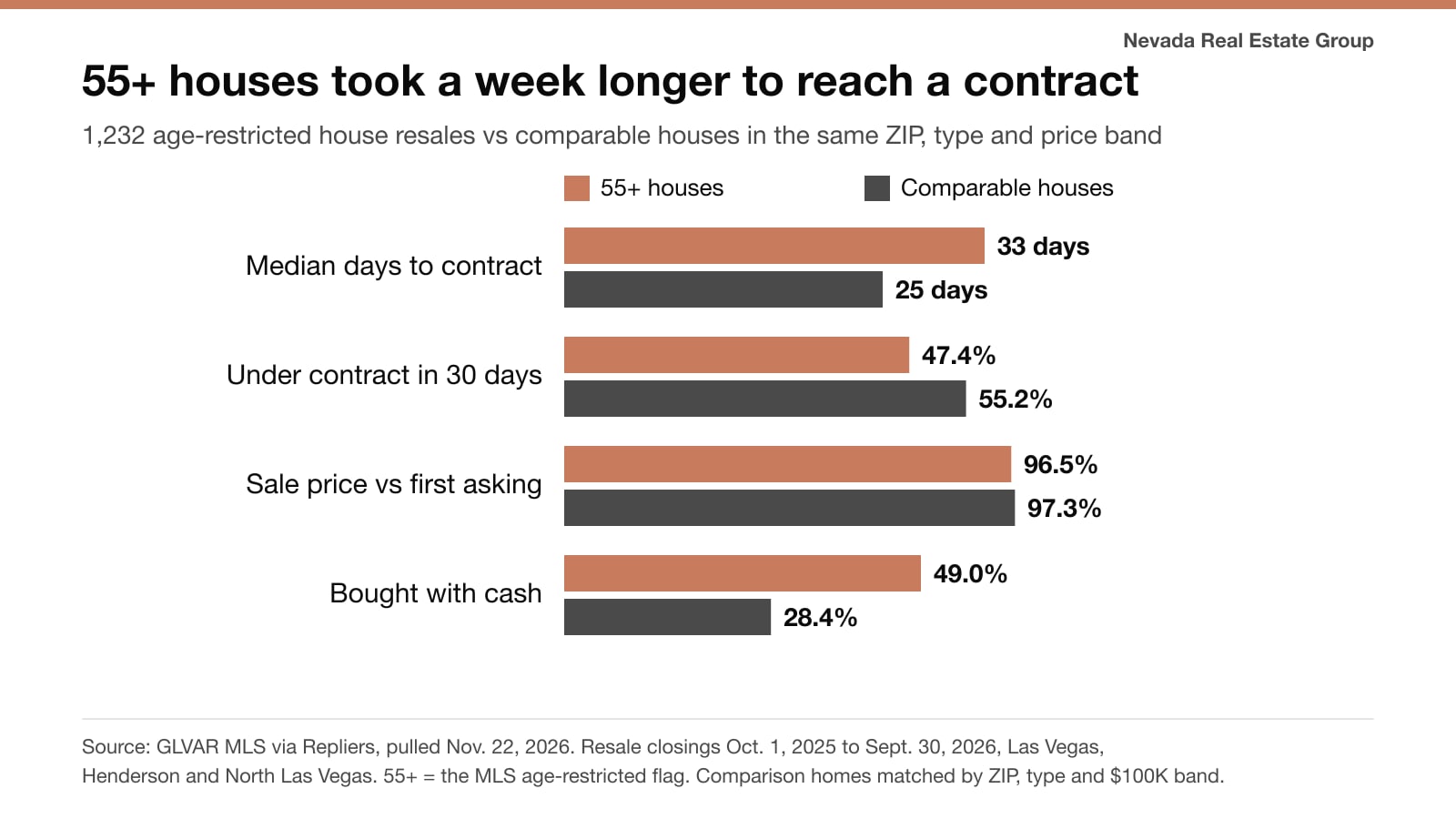
Slightly, on time but not on price. In the year ending September 30, 2026, age-restricted houses in the ten study ZIP codes took a median 33 days to reach an accepted offer, against 25 days for comparable houses in the same ZIP codes and price bands. They closed at 96.5% of the original asking price, against 97.3%, and 22.3% of 55+ listings of all types that left the market ended unsold, against 27.5% of others.
- Matched 55+ houses went under contract within 30 days 47.4% of the time; comparable houses did 55.2%.
- Cash paid for 49.0% of matched 55+ house sales, against 28.4% of comparable houses.
- 55+ homes under contract within 14 days closed at a median 98.8% of first asking; after 90 days, 91.8%.
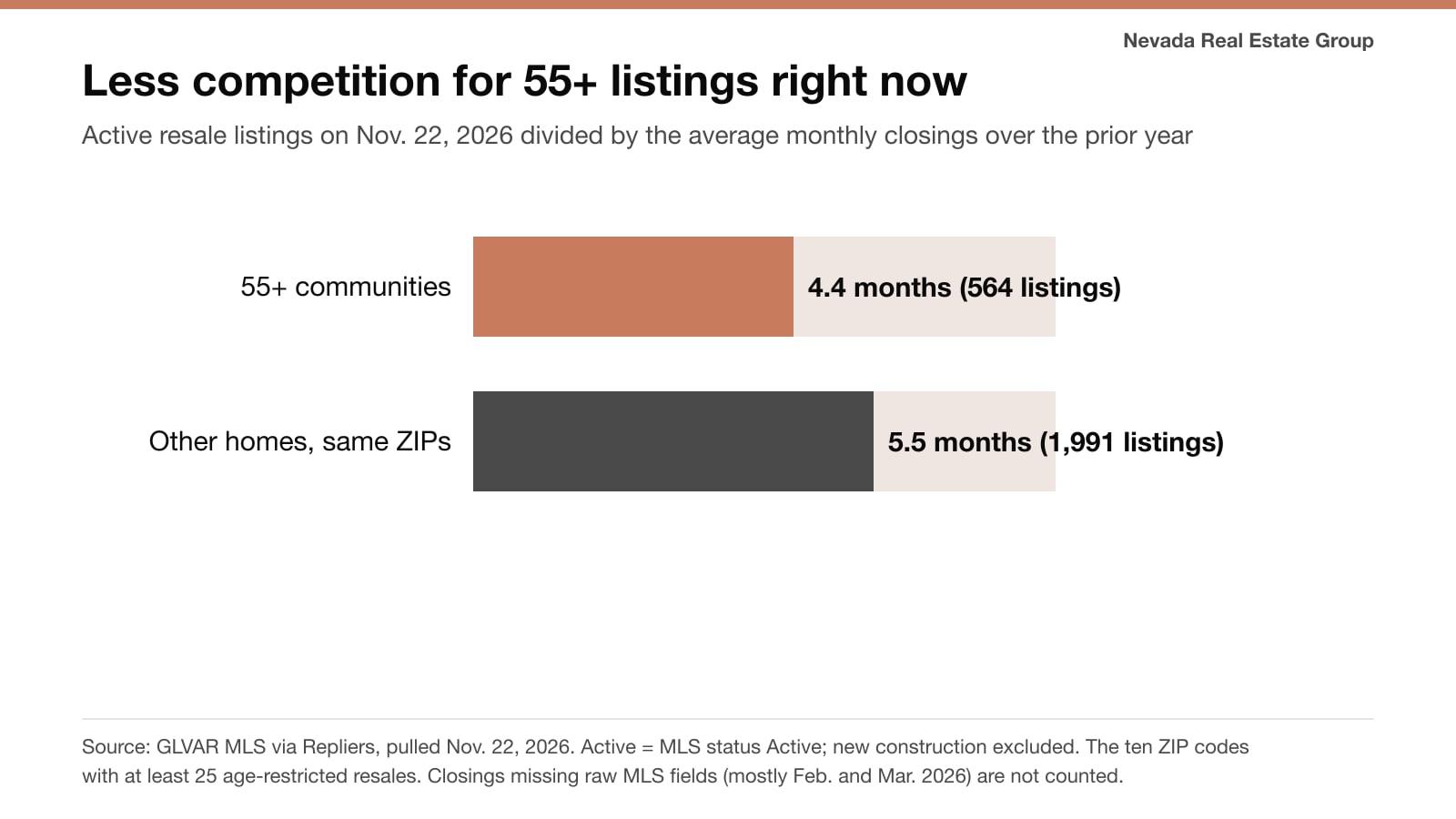
- On November 22, 2026, 55+ resales had 4.4 months of supply; other homes in those ZIPs had 5.5.
- Del Webb at Lake Las Vegas was slowest, a median 62.5 days to an offer.
| Measure | 55+ houses | Comparable houses (matched) | All other houses in the same ZIPs |
|---|---|---|---|
| Resale closings | 1,232 | 2,905 in matched cells, weighted to the 55+ mix | 3,574 |
| Median sale price | $490,000 | $495,000 | $585,000 |
| Median price per square foot | $300.80 | $268.60 | $274.20 |
| Median days to accepted offer | 33 | 25 | 30 |
| Under contract within 30 days | 47.4% | 55.2% | 50.9% |
| Took more than 90 days | 17.5% | 13.8% | 16.4% |
| Median sale price as share of original asking | 96.5% | 97.3% | 97.2% |
| Price cut before contract | 42.8% | 41.7% | 42.0% |
| Cash buyers | 49.0% | 28.4% | 25.1% |
Are 55+ homes harder to sell in Las Vegas than other homes?
They are slower, not weaker. Across the 12 months ending September 30, 2026, the matched comparison in the table above shows an age-restricted house needing a median of eight more days to find a buyer than an ordinary house at the same price in the same ZIP code: 33 days against 25. Fewer of them went under contract in the first month, 47.4% against 55.2%, and more of them, 17.5% against 13.8%, needed longer than 90 days.
Price is a different story. The median 55+ house closed at 96.5% of its original asking price, which means a home first listed at $500,000 typically sold for about $482,500. The comparable houses held 97.3%, or about $486,500 on the same list price. A gap of 0.8 percentage points is real, but it is small next to the swings that pricing decisions cause inside either group, which later sections show are worth several points.
The share of sellers who cut their price before contract was almost identical: 42.8% of 55+ houses and 41.7% of the matched comparison. So the extra time is not mainly a sign that 55+ sellers overprice. A smaller pool of eligible buyers is a likely reason, though the MLS cannot show it, and as the next sections show, those buyers pay differently.
There is one more measure where 55+ listings did better. In the ten ZIP codes we studied, 22.3% of age-restricted listings that left the market ended without a sale, against 27.5% of other listings. A 55+ seller is more likely to wait a little longer and still close than to give up. Our guide to why a Las Vegas home is not selling covers the general causes of a stalled listing; the 55+ pattern is a narrower version of the same arithmetic.
How did we compare 55+ homes with similar homes?
A raw comparison would mislead. Age-restricted houses in the Las Vegas valley are smaller and cheaper than the houses around them: across the ten study ZIP codes, the median 55+ house had 1,653 square feet and sold for $490,000, while the median ordinary house had 2,282 square feet and sold for $585,000. Bigger, pricier homes sell on a different clock, so lining up those two medians would compare different products.
Instead, we grouped every sale into cells by ZIP code, property type and $100,000 price band. For each cell that held at least one 55+ sale and one ordinary sale, we weighted the ordinary sales so each cell counts as often as it does among 55+ sales, which gives the comparison group the same mix of places and prices as the 55+ group. That used 79 cells for houses and matched 1,232 of the 1,233 age-restricted house resales in the study ZIPs.
The ten ZIP codes were the ones with at least 25 age-restricted resales in the valley: 89011, 89012, 89044, 89052, 89081, 89084, 89122, 89134, 89135 and 89138. They take in Sun City Summerlin in 89134, Sun City Anthem in 89052 and 89044, Sun City MacDonald Ranch in 89012, Sun City Aliante in 89084 and Siena in 89135, among others.
Three limits matter. The age-restricted flag is the listing agent's answer on the MLS form, not an audit of the community's legal status. Closings that reached the feed without their detail fields could not be classified, which removed 292 of the 7,649 closings in the study ZIPs, mostly from February and March 2026. And a listing withdrawn and relisted under a new MLS number restarts its day count, so both groups understate the true time from first listing to sale.
Which Las Vegas 55+ communities sold fastest?
The communities did not move as one market. Sun City MacDonald Ranch in Henderson and Sun City Aliante in North Las Vegas both reached accepted offers in a median 26 days, as fast as ordinary houses nearby. Del Webb at Lake Las Vegas took 62.5 days and Solera at Stallion Mountain 55. The two largest communities sat in between: Sun City Summerlin at 32 days across 484 closings, and Sun City Anthem at 38 days across 311.
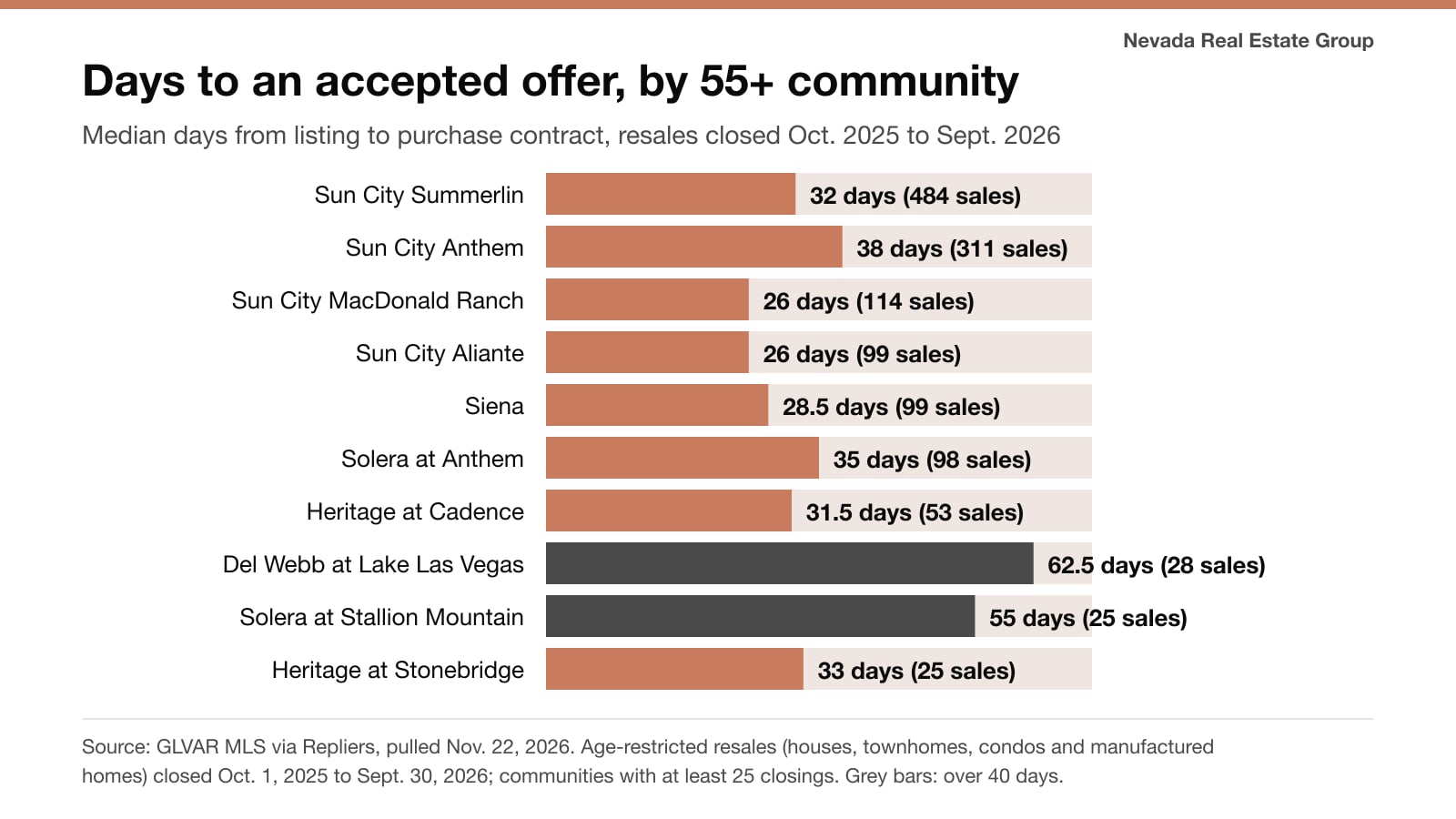
Price does not explain the spread on its own: Solera at Stallion Mountain, the lowest-priced community at a $349,900 median, took 55 days, while Siena, the highest at $654,000, took 28.5. Competition is a better candidate. Del Webb at Lake Las Vegas, the slowest community, had 26 active resale listings on November 22, 2026 against 28 resales in the whole previous year. That count comes after the sales it is set beside, so treat it as a sign of how much competition a seller there faces now, not as the cause of last year's pace. The slowest communities also had the smallest samples: the medians for Del Webb at Lake Las Vegas, Solera at Stallion Mountain and Heritage at Stonebridge rest on 24, 21 and 20 sales with contract dates.
| Community | Resales | Median price | Median days to offer | Sale vs original asking | Cash buyers | Months of supply |
|---|---|---|---|---|---|---|
| Sun City Summerlin | 484 | $447,950 | 32 | 95.9% | 56.6% | 4.1 |
| Sun City Anthem | 311 | $582,000 | 38 | 96.3% | 51.8% | 4.2 |
| Sun City MacDonald Ranch | 114 | $425,000 | 26 | 97.0% | 47.4% | 3.9 |
| Sun City Aliante | 99 | $375,000 | 26 | 97.6% | 38.4% | 3.2 |
| Siena | 99 | $654,000 | 28.5 | 96.2% | 59.6% | 5.9 |
| Solera at Anthem | 98 | $424,000 | 35 | 97.2% | 36.7% | 2.9 |
| Heritage at Cadence | 53 | $510,000 | 31.5 | 96.8% | 45.3% | 5.7 |
| Del Webb at Lake Las Vegas | 28 | $625,000 | 62.5 | 97.0% | 35.7% | 11.1 |
| Solera at Stallion Mountain | 25 | $349,900 | 55 | 96.5% | 28.0% | 4.3 |
| Heritage at Stonebridge | 25 | $552,725 | 33 | 97.9% | 52.0% | 3.4 |
The table covers every age-restricted property type in each community, including attached homes, so its figures differ slightly from the house-only comparison above. Months of supply divides the active resale listings on November 22, 2026 by the average monthly resales over the prior year. Del Webb at Lake Las Vegas had 28 resales and 26 active resale listings, which is why its figure reaches 11.1 months. Before you price, read the community guides for Sun City Summerlin and Sun City Anthem, which cover dues, amenities and village-level differences that a valley-wide table cannot show.
Why do so many 55+ buyers pay cash, and does it help you?
Nearly half of age-restricted homes sold for cash. In the study ZIP codes, for resales closed October 2025 to September 2026, 49.5% of 55+ resales with financing recorded were cash purchases, against 26.3% of other homes in the same ZIPs. Conventional loans financed 36.3% of 55+ sales, VA loans 7.2% and FHA loans 4.6%; for the other homes, FHA alone financed 14.3%. In the matched house comparison the cash gap holds: 49.0% for 55+ houses against 28.4%.
The MLS does not record why a buyer paid cash, so the data cannot say whether those buyers sold another home first, drew on savings or used a reverse-mortgage purchase. What the record does show is the practical effect: a cash buyer has no appraisal contingency tied to a lender and no loan approval to wait for. Sun City Summerlin and Siena, the two communities with the highest cash shares at 56.6% and 59.6%, closed at 95.9% and 96.2% of original asking, the two lowest shares in the table, which is consistent with cash buyers negotiating on price.
The flip side is that cash buyers negotiate. An offer with no financing contingency is worth something to a seller who needs a firm date, and buyers know it. Treat a cash offer as a trade between price and certainty, and compare it with a financed offer by its net and its risks, not only its headline number. Our Las Vegas condo selling study found the same tension in another cash-heavy segment.
If a buyer does use a loan, the loan type rarely limits a 55+ house the way it can limit a condo, because most of these communities are detached or attached homes on their own lots rather than condominium projects that need lender approval. A seller in a 55+ townhome or condo should still confirm with the association whether lenders have flagged the project.
How much does a price cut cost a 55+ seller?
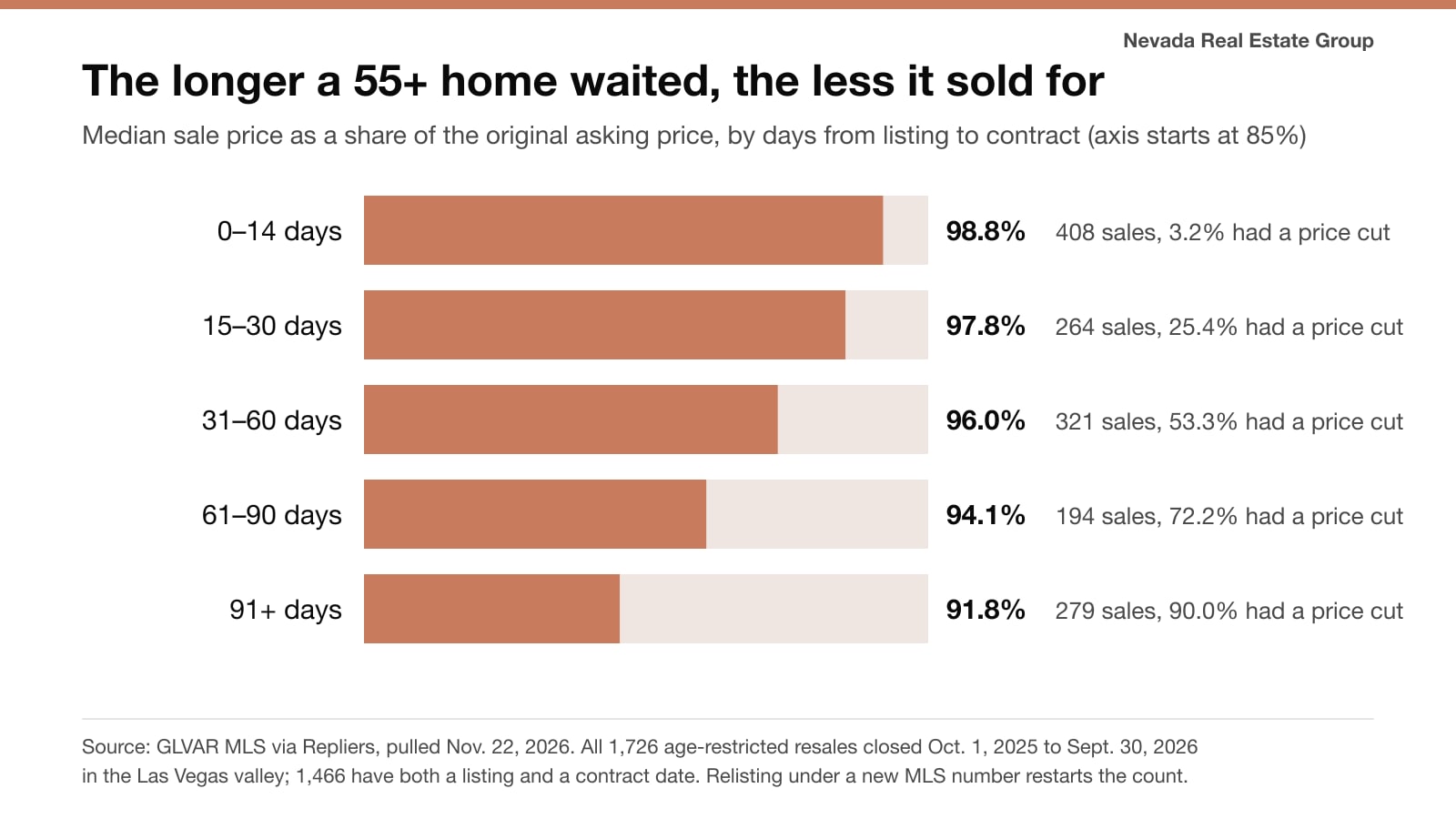
Time on the market tracked closely with how far below its first price a 55+ home sold. Of the 1,466 valley age-restricted resales with both a listing date and a contract date, the 408 that went under contract within 14 days closed at a median 98.8% of original asking, and only 3.2% of them had cut their price first. Homes that took 91 days or longer closed at 91.8%, and 90.0% of them had been cut.
| Days to accepted offer | Resales | Median sale vs original asking | Had a price cut | On a $450,000 first price |
|---|---|---|---|---|
| 0–14 days | 408 | 98.8% | 3.2% | About $444,600 |
| 15–30 days | 264 | 97.8% | 25.4% | About $440,100 |
| 31–60 days | 321 | 96.0% | 53.3% | About $432,000 |
| 61–90 days | 194 | 94.1% | 72.2% | About $423,450 |
| 91 days or more | 279 | 91.8% | 90.0% | About $413,100 |
On a home first listed at $450,000, close to the Sun City Summerlin median, the difference between selling in the first two weeks and selling after three months is roughly $31,500 at those medians. That is not proof that waiting caused the lower price. Homes that were overpriced at the start take longer and then cut, so the longer groups contain more of them. But it is the clearest guide a 55+ seller has: the market's verdict on a price arrives in the first few weeks, and acting on it early costs less than acting on it late.
For a 55+ house, the first month carries extra weight because the pool of eligible buyers is smaller. A buyer who has toured every listing in Sun City Anthem at your price this month may not be replaced by a new one next week. If the showings stop, the listing has probably been seen by most of its audience.
How many 55+ listings end without a sale?
Fewer than the listings around them. In the ten study ZIP codes, 437 age-restricted listings expired or were withdrawn with an end date between October 1, 2025 and September 30, 2026, against 1,526 that closed, so 22.3% of the 55+ listings that left the market did so without a sale. For the other homes in the same ZIPs, 1,645 ended and 4,329 closed: 27.5%.
The 55+ listings that ended had been on the market a median 80 days, against 88 for the others. Of the 437, 311 were withdrawn by the seller and 126 expired at the end of their listing term. A withdrawal often means the owner changed plans, decided to rent the home or relisted it with a new agent and price; the MLS record alone cannot tell which.
Two cautions apply to these shares. A listing that was withdrawn and then sold under a new MLS number appears once as ended and once as closed, which inflates the ended count for both groups. And the ended listings cover all property types, while the matched comparison above covers houses only.
Still, the direction is consistent with what the rest of the data shows. 55+ sellers waited longer for an offer, but they were less likely to give up before getting one. A smaller, more motivated buyer pool, much of it paying cash, seems to reward patience. When a listing does stall, our study of what happens to expired Las Vegas listings tracks how relisting price and timing affected the next attempt.
How much competition will your 55+ listing face right now?
Less than most sellers expect. On November 22, 2026, there were 564 active age-restricted resale listings in the ten study ZIP codes, about 4.4 months of supply at the past year's pace of sales. The 1,991 other active resale listings in the same ZIPs represented 5.5 months. Only listings marked as resales are counted, and because 292 unclassified closings are left out of the sales pace, both figures run slightly high.
The active 55+ listings had been on the market a median 59 days, and 30.5% had been listed more than 90 days. 44.0% already showed a price cut from their original asking price, almost the same share as the other homes at 45.1%. Their median asking price was $465,000, against a $447,950 median sale price in Sun City Summerlin and $582,000 in Sun City Anthem over the past year.
Read those numbers for your own community, not the average. Sun City Aliante had 3.2 months of supply and Solera at Anthem 2.9, which favors sellers. Siena had 5.9 months and Del Webb at Lake Las Vegas 11.1, where a seller is competing with more listings. The current listings in each community page, such as Siena in Summerlin and Solera at Anthem, show exactly who you would be competing with this week.
Seasonal demand matters too, but the sales record for this year cannot measure it cleanly, because many closings from February and March 2026 reached the feed without their detail fields. Treat any claim that one month is always best for a 55+ sale with caution and watch your own community's listings instead.
Who is allowed to buy a home in a 55+ community?
Federal law sets the floor. Under the Housing for Older Persons Act, written into the Fair Housing Act at 42 U.S.C. 3607(b), a community can legally limit occupancy by age if at least 80% of its occupied units have at least one resident who is 55 or older, it publishes and follows policies showing that intent, and it verifies residents' ages. HUD's rules spell out each part: the 80% test in 24 CFR 100.305, the intent requirement in 24 CFR 100.306 and age verification in 24 CFR 100.307.
The law governs occupancy of the home, not ownership of it. Each community's governing documents then add its own rules: the minimum age of other residents, how long younger guests may stay and what proof of age the association needs. Those rules decide who your realistic buyers are, so read them before you price. Our guide to 55+ community rules and age requirements in Las Vegas compares the main communities' documents.
For a seller, three practical points follow. First, an investor who plans to rent to younger tenants may be limited by the community's age and rental rules, so check them before counting on that buyer. Second, a buyer who will not live in the home, or a household in which at least one resident meets the community's age rule, may qualify, so do not assume a buyer is ineligible before the association says so. Third, the association, not you or your agent, applies its age rules, and your marketing should describe the community as age-restricted without screening or steering buyers by any other characteristic.
The rules also shape timing. Some associations ask for age verification before move-in, and that paperwork runs alongside the buyer's inspection and the resale package. Ask the management company early how long its approval step takes, so the closing date you accept is one the association can meet.
What will the HOA resale package add to a 55+ sale?
Most age-restricted communities in Las Vegas are common-interest communities, so a sale usually carries association paperwork that the seller orders and pays for. According to the Nevada Real Estate Division's Residential Disclosure Guide, revised May 2026, the association has 10 days to provide the resale package after a request, and the buyer may cancel by written notice within five calendar days of receiving it.
The fees are capped by the Division. Its Resale Package Overcharge Form 910, effective January 2026, lists the maximum an association may charge a selling owner.
| Document or action | Maximum charge | Expedite fee |
|---|---|---|
| Resale certificate | $213.84 | plus $100 |
| Demand statement | $190.73 | plus $100 |
| Opening or closing a file | $404.58 | none listed |
| Total | $809.15 | plus $200 |
Dues are a bigger part of a 55+ buyer's math than in most neighborhoods, because they pay for clubhouses, pools, fitness centers and staff. The median recorded monthly association cost on matched 55+ house resales closed October 2025 to September 2026 was $149, and it ranged widely by community: about $230 at Sun City Summerlin and $315 at Siena, against about $95 at Sun City MacDonald Ranch and $96 at Solera at Anthem. Those medians come from the fees agents entered in the MLS, so confirm your own figure from the latest statement.
A buyer comparing two communities will weigh the dues against what they buy. List what your association covers in plain language in the listing, and have the current budget and reserve summary ready, because a careful 55+ buyer reads them inside the five-day window. Our guide to selling a home with an HOA in Las Vegas walks through the package, demand statement and payoff in more detail.
Do attached 55+ homes and manufactured homes sell differently?
Most age-restricted resales in the valley were detached houses: 1,320 of the 1,726. The rest were 238 townhouses, 30 condominiums, 125 manufactured homes and 13 records with no property type. Taken together, the non-house resales sold for a median $323,575 and took a median 40 days to an offer, against $490,000 and 34 days for 55+ houses valley-wide.
Manufactured homes are their own market. Depending on the community, a buyer may purchase the home with its lot or the home alone on a rented space, and financing, insurance and any space rent differ from a house on its own lot. Comparing a manufactured home with a Sun City house would mislead in either direction, so use closings from your own park.
Attached 55+ homes compete with smaller detached houses in the same community. A buyer who wants low maintenance may prefer the attached plan, while a buyer who wants a yard will pay more for the detached one. The comparison that matters is your floor plan against the last few sales of the same plan in your community.
Because the attached and manufactured groups are small, their medians move more from one quarter to the next. Treat them as context and rely on your community's own closings, which are listed in any free comparative market analysis we prepare.
How should you price a 55+ home against your community's closings?
Start from the last six months of closings in your own community, same floor plan where possible, then adjust for condition, lot position and upgrades. A golf-course or mountain-view lot, a newer roof or a remodeled kitchen can each justify a different number. Active listings tell you about your competition, not your value: 44.0% of active 55+ listings already showed a price cut on November 22, 2026.
The time-on-market data gives a simple rule of thumb. In the past year, 55+ homes that went under contract within 14 days held a median 98.8% of their first price, and those that went 31 to 60 days held 96.0%. If your first price is right, most of the market's response arrives within the first month. If you have had showings but no offers after five weeks, the listing has passed the median for its group, and the price, not the buyer pool, is the more likely problem.
Our free home value estimator gives a first estimate where enough recent sales exist; treat it as a starting point and check it against your community's latest closings. When your community has recent sales of your exact floor plan, those plan-to-plan comparisons are more reliable than any valley-wide figure.
Price for the buyers you actually have. With half the matched buyers paying cash and FHA financing only 4.6% of 55+ sales in the study ZIPs, a strategy that depends on a stretched first-time buyer does not fit. A clean, well-documented home priced against recent closings fits a cash buyer who can choose among several listings.
How do taxes and your next move affect the timing?
A sale is usually one half of a move: to a smaller home, another city or a community with care services. Plan the sale around that next step. Our comparison of 55+ communities with independent and assisted living covers the costs on the other side of the move.
On taxes, the federal home-sale exclusion is the main rule. According to IRS Publication 523, a seller who owned and used the home as a main home for at least two of the five years before the sale can generally exclude up to $250,000 of gain, or $500,000 for most married taxpayers filing a joint return. Owners who bought decades ago can have gains above those limits, so ask a tax professional before you set a price floor. Our guide to capital gains when selling a home explains basis, improvements and reporting.
Nevada has no state personal income tax, as the Nevada Department of Taxation notes, so a Nevada resident's gain is not taxed again by the state. A seller moving to another state should check that state's rules for the year of the move.
Timing the two transactions is the other decision. A seller who must sell before buying needs a closing date with room to move, and should say so in the listing terms. A seller who can buy first should budget for carrying two sets of dues and taxes, which in a community with $230 or more in monthly dues adds up quickly if the sale takes the 33-day median plus a month of escrow.
What should you do before you list your 55+ home?
Write down four facts first: the last three closings of your floor plan in your community, your association's current dues and any planned assessment, the date you need to move, and the lowest net amount you would accept after fees and closing costs. With those in hand, the data above sets realistic expectations. In the past year, the typical 55+ house took about a week longer than its neighbors to get an offer and sold within about one percentage point of what comparable houses held.
Then prepare the documents that 55+ buyers ask for: the resale package order, the age-verification steps your association uses, a list of what the dues cover and a record of major repairs. Fix the items an inspector will flag; a buyer paying cash can afford to walk away from a long repair list. Our guide to 55+ communities in Las Vegas and the community pages for Sun City Aliante, Heritage at Cadence and Del Webb at Lake Las Vegas show the competition buyers will compare you with.
Nevada Real Estate Group can pull your community's closings by floor plan, check your association's approval steps and show you where your home sits against today's listings. See how we market and sell homes, or read about selling a house in Las Vegas and Henderson. A free comparative market analysis is a good first step, and our 7-day listing agreement lets you cancel at any time. When you are ready to talk it through, call (702) 637-1759 or contact us online.
Frequently Asked Questions
How long does it take to sell a home in a Las Vegas 55+ community?
In the 12 months ending September 30, 2026, age-restricted houses in the ten study ZIP codes took a median 33 days from listing to an accepted offer, against 25 days for comparable houses in the same ZIP codes and price bands. Add escrow, which ran a median 28 days from contract to closing for 55+ resales, for the full timeline.
Do 55+ homes sell for less than other homes in Las Vegas?
Only slightly, measured against the first asking price. Matched 55+ houses closed at a median 96.5% of their original asking price, against 97.3% for comparable houses. Per square foot they sold for more, $300.80 against $268.60, because 55+ houses are smaller.
Can a younger buyer purchase my home in a 55+ community?
HOPA lets a community limit occupancy, not ownership, if at least 80% of occupied homes have a resident 55 or older. Your community's governing documents set the rules for younger residents and owners who do not live there, so the association, not the seller, decides whether a particular buyer qualifies.
Which Las Vegas 55+ communities sell fastest?
Among communities with at least 25 resales in the past year, Sun City MacDonald Ranch and Sun City Aliante reached accepted offers fastest, both at a median 26 days. Del Webb at Lake Las Vegas was slowest at 62.5 days, and it had 26 active resale listings on November 22, 2026, close to one for each resale in the past year.
Are 55+ buyers more likely to pay cash?
Yes. In the ten study ZIP codes, for resales closed October 2025 to September 2026, 49.5% of age-restricted resales with financing recorded were cash purchases, against 26.3% of other homes in the same ZIPs. Cash removes a lender's appraisal and approval from the timeline, but cash buyers also negotiate on price.
What fees does a seller pay to the HOA when selling a 55+ home?
The seller orders the resale package. Nevada Real Estate Division Form 910 caps the charges at $809.15 per association for 2026, plus up to $200 to expedite, and a home in both a master and a sub-association can face two sets of fees. Unpaid dues and any special assessment are paid from the sale proceeds under the association's demand statement.
Should I lower my price if my 55+ home is not selling?
Look at the clock first. Among 55+ resales closed October 2025 to September 2026, homes under contract within 14 days held a median 98.8% of first asking, while those that took more than 90 days held 91.8% and 90.0% of them had cut. If you have had showings but no offers after about five weeks, review the price against recent closings of your floor plan.
Which Sources Inform This 55+ Selling Guide?
MLS study. Sales data comes from the GLVAR multiple listing service through Repliers, pulled November 22, 2026. A 55+ home is a listing whose MLS age-restricted field (SeniorCommunityYN) reads true; comparison homes read false. The population is resale closings with MLS city Las Vegas, Henderson, North Las Vegas or Boulder City and a closing date from October 1, 2025 to September 30, 2026: 1,726 age-restricted resales after excluding 109 in Mesquite, Pahrump, Laughlin and Ely, 42 new or unclassified builds and 50 records whose raw status was not Closed. The house comparison uses the ten ZIP codes with at least 25 age-restricted resales and matches each 55+ house with ordinary houses in the same ZIP code and $100,000 price band (79 cells; 1,232 of 1,233 matched); ordinary sales are weighted so each cell counts as often as among 55+ sales. Days to an offer run from the listing date to the purchase-contract date. Price cuts compare the original and final list prices on the same MLS number, so a listing withdrawn and relisted under a new number restarts both measures. Ended listings are those with raw status Expired or Withdrawn and an end date in the window. Active listings are resale listings with raw status Active on November 22, 2026. 292 of 7,649 closings in the study ZIP codes, mostly from February and March 2026, arrived without detail fields and could not be classified. Comparisons show association, not cause. The pull and analysis scripts, scripts/nov-2026-glvar-studies-pull.ts and scripts/selling-55-plus-las-vegas-study.ts, and their output are kept with this post's records.
Age-restriction law. 42 U.S.C. 3607, the Housing for Older Persons exemption in the Fair Housing Act, and HUD's rules at 24 CFR 100.305, 100.306 and 100.307, read November 22, 2026.
Nevada HOA resale rules. The Nevada Real Estate Division's Residential Disclosure Guide (revised May 2026) and its Resale Package Overcharge Form 910 (effective January 2026), read November 22, 2026.
Taxes. IRS Publication 523, Selling Your Home, IRS Topic 701, Sale of your home and the Nevada Department of Taxation's income tax page, read November 22, 2026.
This guide is general information, not legal, tax or lending advice. Confirm your association's documents, age-verification steps and your tax position with the appropriate professional.