
If you own a home on a half-acre lot off Lone Mountain Road, or on one of the older horse-property streets north of Cheyenne, you may have spent the last week reading headlines about Las Vegas annexing thousands of acres and wondering whether your address is about to change. A few of those headlines are recycling a story from 2018. The live one is narrower, quieter, and more consequential than the recycled version, because it is about the contract that has governed where the city line can move for the past decade.
I sell homes in these neighborhoods. I do not have a vote in the outcome and I am not going to guess at one. What I can do is lay out what the two governments have done and said, what the underlying agreement contains, what Nevada law requires before a single parcel changes jurisdictions, and how to confirm in four minutes which side of the line you are on. Every number below comes from a document I opened, and I flag the places where the public record gives no clean answer.
Nothing has been annexed. On September 16, 2026 the Las Vegas City Council postponed its decision on the Northwest Area Interlocal Agreement to October 7. That agreement, signed in 2016, caps northwest density at 2.0 units per gross acre and bars the city from annexing developed island property without county agreement. Under NRS 268.592, a majority protest by owners blocks annexation outright. Check your parcel's jurisdiction before you list or buy.
- Las Vegas postponed the Northwest Area Interlocal Agreement decision to October 7, 2026, after a unanimous council vote.
- The 2016 agreement bars annexing developed island property in Planning Areas A1, A2 and B without county consent.
- NRS 268.592 blocks annexation entirely when a majority of owners protest, measured by combined value and area.
- Metro policing, water and schools do not change with jurisdiction; animal limits, permits and licensing do.
- The Clark County Assessor parcel record names the legal city or town, not your mailing address.
What Is an Unincorporated County Island, and Why Does Las Vegas Have So Many?
A county island is a piece of unincorporated Clark County that sits inside, or almost inside, the outer boundary of an incorporated city. Nobody planned them. They are the residue of how the Las Vegas Valley grew: the county platted and permitted large-lot rural subdivisions in the northwest through the 1970s, 1980s and 1990s, and the city then grew past and around them as the master plans pushed north and west. The homes never moved. The line did.
The result is a jurisdictional map almost nobody can read from the street, and a Las Vegas mailing address tells you nothing. According to Clark County, the county contains six licensing jurisdictions — Henderson, Las Vegas, North Las Vegas, Boulder City, Mesquite and unincorporated Clark County — and its guidance tells owners to use a jurisdiction locator rather than an address, because physical location decides which government you answer to.
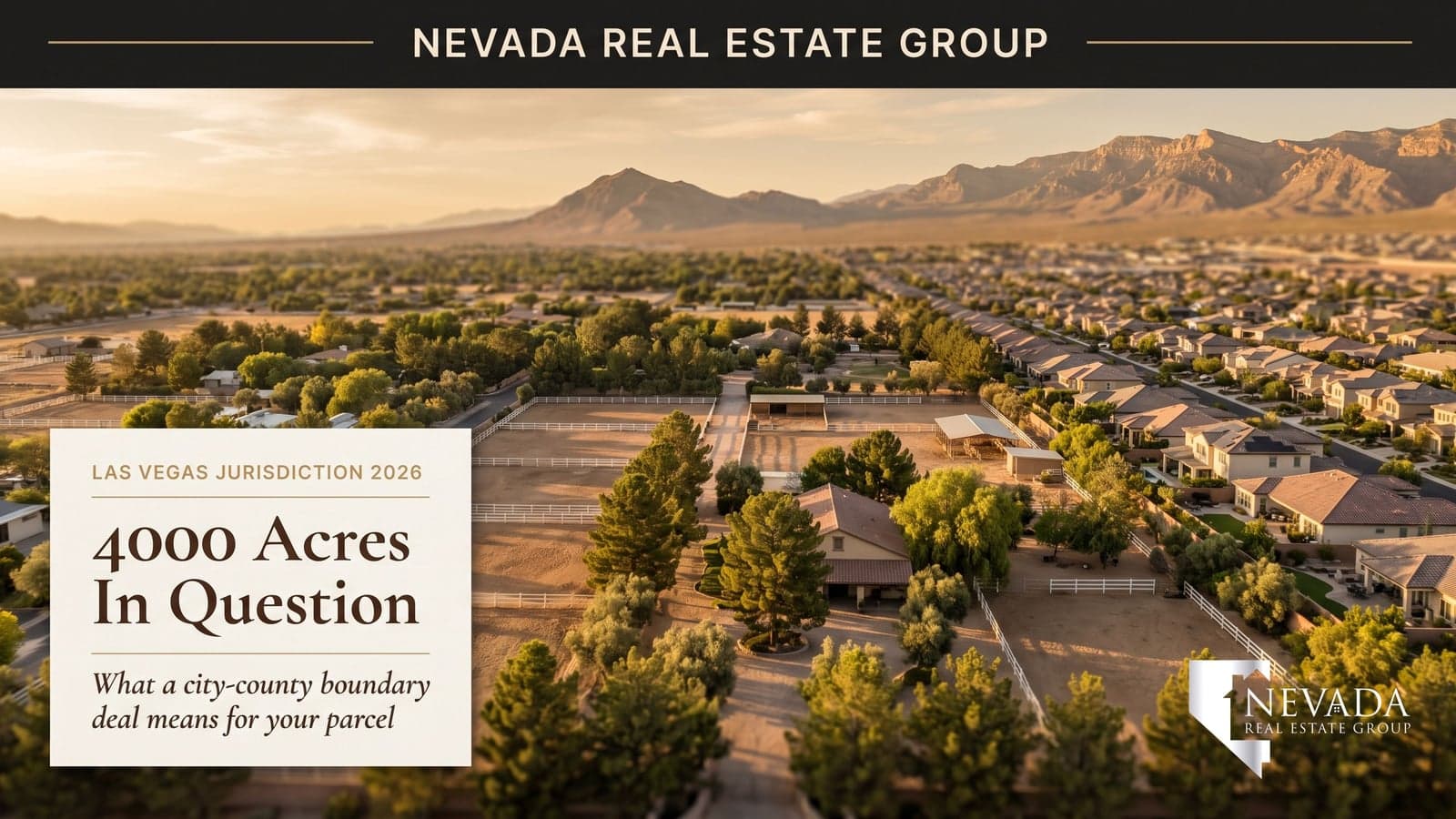
In the northwest, these islands are concentrated in and around the Lone Mountain and Centennial Hills areas. They are not slivers of vacant desert. They are established neighborhoods with mature landscaping, wide unlit streets without sidewalks, corrals, RV pads and septic systems, sitting a block or two from tract subdivisions built to city standards in the last twenty years. If you have ever driven west on Lone Mountain Road and noticed the streetlights simply stop, you have crossed one of these lines.
That contrast is the whole dispute in miniature: two governments, two rulebooks, one continuous neighborhood fabric. The interlocal agreement exists because the valley grew that way and neither government wanted the other rewriting land-use rules across a shared street. Anyone shopping Lone Mountain or the surrounding northwest Las Vegas neighborhoods is shopping across that line whether they realize it or not.
What Exactly Did the Las Vegas City Council Do on September 16, 2026?
It postponed a decision. That is the precise and complete description of the action, and it matters because several summaries circulating this week describe it as a termination.
The item on the agenda was the Northwest Area Interlocal Agreement, which Clark County refers to as the Lone Mountain Interlocal Agreement. According to reporting by Fox5 Vegas, the council voted to postpone discussion until October 7, 2026, and the outlet noted that if no action is taken by December the agreement automatically renews for an additional five years. According to 8 News Now, the vote to abate the discussion was unanimous, and the agreement is routinely revisited every ten years on the anniversary of its signing.
City staff presented service-call data to support the argument that the arrangement has become lopsided. According to the city's presentation as reported by 8 News Now, Las Vegas logged 5,707 incidents and 7,944 response calls into the county islands over the 2023 to 2026 period, and the city also flagged park trails, sewer lines and two planned fire stations that fall within those unincorporated pockets. Mayor Shelley Berkley was quoted saying the city is "under the gun time-wise" and that "taxpayers of the city have to be protected." Councilwoman Francis Allen-Palenske was quoted saying the city is "left holding the monetary bag."
Clark County disputed the framing. Commissioners Marilyn Kirkpatrick and April Becker issued a joint statement calling the presentation one-sided and saying "this is a money grab, plain and simple — this is not about services," and the county separately said it is "the larger financial contributor for several joint initiatives and regional services." Roughly ten residents of the islands spoke, and their stated concern was that amending or ending the agreement could reopen the door to city-initiated annexation. As of September 22, 2026, no further public action has been reported and October 7 remains the scheduled date.
What Does the Northwest Area Interlocal Agreement Actually Govern?
This is where news summaries and the document itself diverge, so it is worth reading the document. The City of Las Vegas publishes the executed 2016 interlocal agreement on its own planning file server. It is nine pages plus map exhibits, and it is not primarily an annexation agreement. It is a joint land-use agreement with an annexation section inside it.
According to the agreement's own recitals, it replaced a 2002 agreement that was restated in its entirety on December 3, 2008, and its stated purpose is to create "a framework for future growth in the northwest portion of the Las Vegas Valley by establishing mutually acceptable growth strategies." It divides the Joint Land Use Planning Area into Planning Area A1, Planning Area A2 and Planning Area B on an attached map exhibit rather than describing them by acreage.
The operative land-use terms are specific. In Planning Areas A1 and A2, both governments agree the land must remain residential at a density no greater than 2.0 units per gross acre, with a minimum buildable net lot area of at least 18,000 square feet and a stated goal of 18,500 square feet. Neither government may accept a general plan amendment, rezone or approve a special or conditional use permit that would allow commercial or industrial uses or higher density there. In Planning Area B, the county side is capped at 3.50 units per gross acre and the city side must maintain a minimum buildable lot size of 10,000 square feet.
The agreement also commits both parties to joint parks and trails planning, to a Northwest Master Park Plan, to seeking funding for four-lane improvements on Elkhorn Road, Tropical Parkway, Ann Road, Lone Mountain Road and Fort Apache Road, and to cooperating with the Clark County Regional Flood Control District. Press descriptions of a proposal covering roughly 4,000 acres refer to a version of the agreement under discussion. The 2016 document itself sets no acreage figure, and I could not verify an official acreage from a primary government source.
Section 4 is short, and for a homeowner inside an island it is the most important paragraph in the document. It says the city "shall not annex property within Planning Area A1 ... during the term of this Agreement, unless requested upon by the current property owner and mutually agreed to by the City and County." It then says the city "shall not annex developed property within Planning Areas A2 or B unless mutually agreed to by the City and County." It carves out an express exception: the parties acknowledge the city may annex vacant properties in Planning Areas A2 and B, or land outside the mapped planning areas, when permitted under NRS 268.580 or NRS 268.597.
Read plainly, that means the agreement layers two extra locks on top of state law for developed island property: owner request plus both governments agreeing, in A1; both governments agreeing, in A2 and B. Those locks exist only while the agreement is in force. That is why residents at the September 16 meeting framed the renewal question as an annexation question, and they were reading the document correctly.
Section 4 also has a provision people rarely mention: the county agreed to withdraw a pre-filed bill request from the 2017 legislative session and not to sponsor state legislation changing Nevada's annexation statutes contrary to the agreement. The 2016 deal bought peace in Carson City as well as on the ground.
Several terms described in current press reports — restricting annexation unless owners request it, capping density at about two houses per acre, an initial seven-to-ten-year term with automatic five-year extensions — track provisions that are already in the 2016 document. That is worth knowing before you read a summary that presents them as new concessions.
Why Is October 7 the Date Everyone Keeps Naming?
Because of Section 9 of the agreement, and it is worth understanding the mechanism rather than treating the date as arbitrary.
Section 9 sets a term that commences on the effective date and expires on the tenth anniversary of that date. It then provides that the agreement "will automatically extend for additional five (5) year periods unless notified to the other agency at least 60 days prior to the termination, and acted upon prior to the expiration date through a properly noticed public hearing providing reasoning for the termination by the governing body of either Party." Total extensions may not exceed ten additional years. The map exhibit inside the executed document carries a creation date of December 19, 2016, and the file the city publishes is dated December 21, 2016.
Put those two things together and the calendar explains itself. A December 2016 effective date puts the tenth anniversary in December 2026. A notice requirement of at least sixty days before termination puts the practical deadline in October. October 7 is a regular council meeting date that clears that sixty-day window with days to spare. If the council takes no action that satisfies Section 9 before the expiration date, the automatic five-year extension provision operates on its own terms — which is exactly what the reporting means when it says the agreement renews in December absent action.
One caveat. I verified Section 9's language and the December 2016 document dates from the executed agreement the city publishes, but I did not find a primary record stating the exact effective date, which Section 9 defines as the date the last party approved it. Treat the December anniversary as strongly consistent with the reported October deadline rather than confirmed. The mechanism is documented; the precise day is not.
What Would Actually Change for You if Your Parcel Moved to the City?
Here is where I had to verify item by item, because a lot of what gets repeated about city-versus-county living is wrong in both directions. Some things genuinely change. Several important ones do not.
Animal limits change, and for a rural-parcel owner that is not trivial. According to Clark County Animal Protection Services, no more than three dogs and three cats over four months of age are allowed at one residence in unincorporated Clark County without a permit, with a Pet Fancier's Permit at $50 annually allowing up to six altered dogs or ten altered cats. According to the City of Las Vegas ordinance summary, Las Vegas Municipal Code 7.08.140 allows six dogs and 7.08.160 allows six cats, with a pet fancier's permit under 7.08.180 allowing up to eight altered dogs or twelve altered cats. The responding agency can be the same either way — county Animal Protection Services states it covers unincorporated Clark County plus the cities of Las Vegas and North Las Vegas — but the ordinance that binds you is your parcel's.
Business licensing changes. According to Clark County, the primary physical location of the business determines the licensing jurisdiction. Code enforcement changes too: Clark County's Code Enforcement Public Response Office handles nuisance complaints — weeds over four inches, trash and debris, green pools, illegal dumping, unpermitted construction — in unincorporated Clark County only, and refers out anything else.
Short-term rental rules change materially. According to Clark County's short-term rental guidance, the county ordinance applies only to unincorporated Clark County, caps licenses at one percent of eligible housing units in each unincorporated area, and limits each person or entity to one licensed unit. The same page tells owners inside Las Vegas, North Las Vegas or Henderson to contact that city instead, because the city's own provisions apply. If you have ever considered that use for a northwest Las Vegas property, the rulebook is jurisdiction-specific, full stop.
Building permits and zoning authority change. Unincorporated parcels are permitted and inspected by the Clark County Department of Building and Fire Prevention and zoned under Clark County's Title 30 Unified Development Code; city parcels are permitted by the City of Las Vegas Building and Safety department and zoned under the city's own development code. That is the substantive one for anyone planning a casita, a shop building, a second driveway or a lot split.
Which Services Would Not Change at All?
More than people expect, and this is the part that the loudest version of the story gets wrong.
Policing does not change. The Las Vegas Metropolitan Police Department was created on July 1, 1973 when Senate Bill 340 consolidated the Las Vegas Police Department and the Clark County Sheriff's Office into a single agency. Metro polices both the incorporated City of Las Vegas and the unincorporated county. The patrol car that responds to a call on a county island street today is the same agency that would respond the day after an annexation. That is visible in the tax records too: both the Las Vegas city tax district and the unincorporated districts carry an LVMPD manpower supplement levy of 0.2800 per $100 of assessed value.
Schools do not change. The Clark County School District is a single countywide district, so a jurisdiction change does not move an attendance zone by a foot.
Water does not change for most of these parcels. According to the Las Vegas Valley Water District, it supplies most residents and businesses in the City of Las Vegas plus many areas of unincorporated Clark County, and regional conservation rules are set through the Southern Nevada Water Authority rather than by municipal boundary.
Fire response is more nuanced than a simple swap. The unincorporated islands sit in Clark County Fire Department territory and the surrounding city sits in Las Vegas Fire and Rescue territory, so the department that bills and staffs does change. But the valley operates an automatic aid system in which the computer-aided dispatch selects the closest available unit regardless of jurisdiction, with the three valley departments dispatched through a shared Fire Alarm Office. In practice, the closest engine already comes.
Sewer is the genuine wrinkle, and the agreement addresses it directly. Section 5 commits the city to provide sewer service to county-approved residential projects inside the planning areas where capacity exists, and it required the city to amend Las Vegas Municipal Code 14.04.110 to allow that. Critically, it states that the provision of sewer service "may not be conditioned upon the property owner agreeing to annexation of the property to the City." That is not a courtesy. It mirrors NRS 268.4107, adopted by the Nevada Legislature in 2015, which bars a municipal utility from conditioning service on an annexation agreement.
Sewer keeps surfacing because a meaningful number of island parcels are still on septic. According to the Southern Nevada Water Authority, roughly 8,000 municipal customers in Southern Nevada remain on septic, discharging nearly 619 million gallons annually that cannot be recycled. That matters in a Colorado River basin where the region's water accounting runs on return-flow credits: water sent down a sewer is treated, returned and credited. Water sent into a leach field is not.
SNWA runs a voluntary Septic to Sewer Conversion Program to close that gap. According to the program page, existing properties can qualify for a partially funded conversion covering 85 percent of eligible costs up to a maximum benefit of $40,000, with a limited fully funded pathway using grant money. New development is not eligible.
Now overlay the jurisdiction map. Many septic parcels sit in unincorporated islands while the sewer main in the street belongs to the City of Las Vegas. That is precisely the arrangement Section 5 governs, and it is why NRS 268.4107 exists: without it, an owner facing a septic failure inside an island could be asked to sign an annexation agreement to get connected. Connection economics, the SNWA incentive and that statutory protection all sit outside the renewal question.
| Function | Unincorporated Clark County | City of Las Vegas | Changes? |
|---|---|---|---|
| Police | LVMPD (consolidated 1973) | LVMPD (consolidated 1973) | No |
| Public schools | Clark County School District | Clark County School District | No |
| Water | Las Vegas Valley Water District | Las Vegas Valley Water District | No |
| Fire department | Clark County Fire Department | Las Vegas Fire and Rescue | Yes, but automatic aid already sends the closest unit |
| Zoning and land use | Clark County Title 30 | City of Las Vegas development code | Yes |
| Building permits | County Building and Fire Prevention | City Building and Safety | Yes |
| Code enforcement | County Public Response Office | City code enforcement | Yes |
| Business license | Clark County Business License | City of Las Vegas Business Licensing | Yes |
| Dogs allowed without permit | 3 dogs and 3 cats | 6 dogs and 6 cats | Yes |
| Short-term rental rules | County ordinance, 1 percent cap | City ordinance | Yes |
What Does Nevada Law Say About Annexing Property Over an Owner's Protest?
This is the question I get asked most, and the news shorthand gets it close but not right. The statute is NRS Chapter 268, and the relevant scheme runs from NRS 268.570 through NRS 268.608, which by its own terms applies only to cities located in a county whose population is 700,000 or more. Clark County qualifies, so this is the scheme that governs Las Vegas.
The procedure is prescriptive. Under NRS 268.584, a city that wants to annex must first pass a resolution of intent describing the boundaries and fixing a public hearing not less than 30 and not more than 60 days out. Under NRS 268.586, the notice must describe the territory accurately, list the names and addresses of every record owner, state that the annexation report will be available at the city clerk's office at least 20 days before the hearing, and state that unless a majority of property owners protest, the council may adopt an ordinance. The clerk must mail that notice by certified mail, return receipt requested, to every record owner.
Under NRS 268.590, a protest is waived unless it is stated verbally at the public hearing or filed in writing with the city clerk within 15 days after the hearing concludes. And then NRS 268.592 sets the consequence: if a majority of the property owners protest, "the city shall not annex in that proceeding any part of the territory described in the notice," and it may not commence a subsequent proceeding on that territory for more than one year.
The definition is where the shorthand fails. Press coverage usually says "51 percent of property owners." NRS 268.574 defines a majority of the property owners as the record owners of real property whose combined value is greater than 50 percent of the total value of real property in the territory as determined by assessment for taxation, and whose combined area is greater than 50 percent of the total area, excluding lands held by public bodies. It is a two-part test measured in assessed value and in acreage, not a headcount of people.
Two more protections sit alongside it. NRS 268.604 gives anyone who protested 30 days from adoption of an ordinance to ask the district court to stay it, and bars later challenges. NRS 268.602 lets a record owner seek a writ of mandamus between 24 and 27 months after an effective annexation if the city failed to deliver its own service plan, with attorney fees assessed against the city.
| Step | Statute | Timing | What it requires |
|---|---|---|---|
| Service report | NRS 268.578, 268.588 | At least 20 days before hearing | Approved plan for extending services, public at the city clerk |
| Resolution of intent | NRS 268.584 | Hearing set 30 to 60 days out | Describes boundaries, fixes hearing date |
| Notice to owners | NRS 268.586 | First publication 20+ days prior | Certified mail to every record owner, plus newspaper publication |
| Protest window | NRS 268.590 | At the hearing, or 15 days after | Verbal at hearing or written to the city clerk, or protest is waived |
| Outcome | NRS 268.592 | 16 to 90 days after hearing | Majority protest blocks it for a year; otherwise ordinance may pass |
| Court challenge | NRS 268.604 | 30 days from ordinance | District court stay; barred forever after the window closes |
| Service enforcement | NRS 268.602 | 24 to 27 months after effective date | Writ of mandamus plus attorney fees if services were not delivered |
What Happened the Last Time Las Vegas Tried to Annex These Islands?
The 2018 attempt is the reason many of these headlines exist, and it is also the cleanest available demonstration of how the protest mechanism performs in the real world.
According to the Las Vegas Sun, the Las Vegas City Council voted 6 to 1 on January 3, 2018 to begin the process of annexing 872 acres from the county, affecting 1,553 private properties. The Sun described the legal threshold as a majority of owners objecting, which blocks the annexation and forces the city to wait a year before trying again — a fair summary of NRS 268.592, though the statutory test is the value-and-area measure described above rather than a simple count.
According to 8 News Now, the city completed its review of responses and announced on March 6, 2018 that it would no longer pursue the annexation. The reported tally: 77 percent of parcel owners protested, and there was a 78 percent protest by assessed value. Both figures exceeded the 50 percent threshold, and the proceeding ended.
That history matters for three reasons. First, it shows the protest right is not theoretical — owners used it, and it worked, within about two months of the council's initial vote. Second, it shows the city's own posture can change quickly when the response is lopsided. Third, it is the direct antecedent of the 2016 agreement's Section 4 language and of the county ordinance the county adopted to add a hearing requirement for owners who believed a city had improperly taken in their property.
There is a longer thread behind all of it. In 2015 the Nevada Legislature adopted what became NRS 268.4107, barring a city from conditioning municipal utility service on an annexation agreement. The city responded with a sewer ordinance limiting service to applicants outside city limits. The county responded with its own ordinance. The 2016 interlocal agreement then unwound that standoff by committing the city to amend the sewer ordinance and to the annexation restrictions in Section 4. Every piece of the current dispute has a documented lineage.
What Would Annexation Do to Your Property Tax Bill?
I want to answer this carefully, because it is the question most likely to be answered badly, and because no annexation is currently proposed.
Start with what is verifiable. According to the Clark County Treasurer's tax district tables for fiscal year 2025-2026, District 200, Las Vegas City, carries a total rate of $3.2782 per $100 of assessed value. The unincorporated districts are lower: District 100, Unincorporated County, is $2.5017; District 103, Unincorporated County 911, is $2.5067; District 104, Unincorporated County Fire LVMPD, is $2.7214; and District 101, Unincorporated County Fire 911, is $2.7264. The difference between District 101 and District 200 is $0.5518 per $100 of assessed value, or about $552 per $100,000 of assessed value annually.
That gap is where the old "20 percent" number comes from. In 2018, 8 News Now reported the city's estimate that island residents' property taxes "could increase by an estimated 20 percent" if annexed. Run the arithmetic on the current rates and $3.2782 divided by $2.7264 is 1.202 — a 20.2 percent difference in the rate. The estimate was a rate comparison, not a forecast of anyone's bill.
Two things keep the rate difference from translating directly into a bill. First, assessed value is not your sale price. Under NRS 361.225, property is assessed at 35 percent of taxable value, and taxable value in Nevada is a replacement-cost-less-depreciation calculation for improvements plus land value, not what the house traded for. Second, NRS 361.4723 entitles the owner of an owner-occupied primary residence to a partial abatement capping the year-over-year increase at 3 percent. The statute measures that cap against the prior year's bill and the combined county rate, excluding only assessed-value increases from improvements or a change in use. A change of tax district is not one of the listed exclusions.
Separately, NRS 268.598 provides that annexed territory becomes subject to municipal taxes levied for the fiscal year following the effective date of annexation, so there is no mid-year bill. I have not found a Clark County Treasurer publication that walks through how the abatement base is recalculated in an annexation specifically, so treat that mechanism as statute-level rather than administratively confirmed, and confirm your own parcel with the Treasurer. If you want the cap mechanics in plain language first, our Nevada property tax cap explainer covers the 3 percent and 8 percent tiers.
| Tax district | Name | Total rate per $100 | Difference from District 200 |
|---|---|---|---|
| 200 | Las Vegas City | $3.2782 | Baseline |
| 101 | Unincorporated County Fire 911 | $2.7264 | $0.5518 lower |
| 104 | Unincorporated County Fire LVMPD | $2.7214 | $0.5568 lower |
| 103 | Unincorporated County 911 | $2.5067 | $0.7715 lower |
| 100 | Unincorporated County | $2.5017 | $0.7765 lower |
| 250 | North Las Vegas City (for comparison) | $3.3544 | $0.0762 higher |
How Do You Find Out Whether Your Own Parcel Sits in a County Island?
Four minutes, two free tools, and no phone calls. Do this before you draw any conclusion about what applies to you, because I have watched sellers and buyers get this wrong on the same street.
Start with the Clark County Assessor. Open the Assessor's parcel search and look up your property by address or by parcel number. The record returns an owner, a legal description, land use, assessed values and a tax district. The Assessor's own address search page carries the sentence that settles the question: "The city/town indicates the legal boundary the parcel is located in, not the mailing city." If that field reads Las Vegas, you are inside the city. If it reads unincorporated, or names an unincorporated town, you are not. The tax district number on the record then tells you exactly which rate table above applies to you.
Cross-check it against the Southern Nevada Regional Jurisdiction Locator, the interactive map the county and the valley cities maintain for business licensing. Clark County's own licensing guidance directs applicants to that map rather than to a mailing address, and the City of Las Vegas Building and Safety page points to a jurisdiction finder for the same reason. If the two sources agree, you are done.
Two failure modes to avoid. Do not rely on your mail, your utility bill or the city named in a listing — a Las Vegas mailing address covers an enormous amount of unincorporated county. And do not rely on a neighbor: northwest islands are frequently split down the middle of a street, so the house across from you can sit in a different jurisdiction with a different tax district and permit counter.
If you are buying rather than refinancing, put this in your due-diligence list alongside the HOA question. It is the same class of fact: it changes what you can build, what you can license and what you will pay, and it is not disclosed anywhere on the listing. Many of these same northwest streets show up in our survey of Las Vegas neighborhoods with no HOA, for the same historical reason — they were platted before the master plans arrived.
What Is the Northwest Island Market Actually Doing Right Now?
Here is the market context, with an important caveat first: the MLS does not carry a jurisdiction flag. There is no field that says "unincorporated." So what follows describes the seven northwest ZIP codes that contain the Lone Mountain and Centennial Hills county islands — 89129, 89131, 89149, 89143, 89130, 89134 and 89108 — and it necessarily mixes city and county parcels together. I am using lot size as the closest available proxy for the rural-preservation parcels that sit inside the islands, because the 18,000-square-foot minimum in Planning Areas A1 and A2 means island parcels skew large.
For the 12 months ending September 21, 2026, those seven ZIP codes recorded 3,326 single-family closings with a median sale price of $475,000, a median of $259 per square foot, a median of 28 days on market and a median list-to-sale ratio of 98.9 percent. There were 1,278 single-family actives as of September 22, 2026 with a median list price of $549,900, which is about 4.6 months of supply. All of that is MLS data pulled through Repliers on September 22, 2026.
Slice it by lot and a second market appears. Parcels under 10,000 square feet — the tract subdivisions — closed at a median of $439,000 on a median 5,663-square-foot lot, median year built 1998. Parcels between 10,000 square feet and a half acre closed at a median of $795,000. Half-acre-to-one-acre parcels closed at a median of $957,000 on a median 23,087-square-foot lot. Parcels of one acre or more closed at a median of $1,200,000 with a median 63 days on market, roughly double the time the tract market takes.
Half-acre-plus homes were only 4.9 percent of closings, 163 of 3,326, but 7.7 percent of the 1,278 actives — 99 listings, about 7.3 months of supply against 4.6 months across those ZIPs. That is the operative fact for anyone selling acreage here: the large-lot segment carries far more standing inventory relative to its own absorption, and it takes longer to move. If you are weighing a listing, our seller resources and the current Las Vegas market report are the place to start.
| Lot size band | Closings | Median sale price | Median lot (sq ft) | Median year built | Actives | Median list price |
|---|---|---|---|---|---|---|
| Under 10,000 sq ft | 2,633 | $439,000 | 5,663 | 1998 | 927 | $475,000 |
| 10,000 sq ft to half acre | 529 | $795,000 | 13,939 | 2002 | 252 | $949,000 |
| Half acre to one acre | 132 | $957,000 | 23,087 | 1999 | 73 | $1,325,000 |
| One acre or more | 31 | $1,200,000 | 48,787 | 1990 | 26 | $2,300,000 |
How Should You Handle a Sale or Purchase in These Areas Right Now?
Practically, and without drama. The agreement's renewal status does not change what you can sell, what you can buy or what you must disclose this month. It does change what a well-prepared file looks like.
If you are selling, pull the Assessor record and know your tax district and your legal jurisdiction before the first showing. Buyers in the northwest ask about horses, RV parking, casitas and shop buildings, and every one of those answers depends on which development code applies. A seller who can say "this parcel is in unincorporated Clark County, Title 30 applies, here is the tax district and here is the current annual tax" removes a week of uncertainty from the transaction. A seller who guesses creates a renegotiation.
If you are buying, treat jurisdiction as a contingency item, not a curiosity. Confirm the parcel's jurisdiction in the Assessor record, confirm the permit history with the correct building department, and if your plans involve an addition, a detached structure, livestock or any rental use, confirm the rule with that jurisdiction in writing before your due-diligence period closes. Verbal answers from the wrong counter are worthless.
If you are simply holding, there is nothing to do in response to an agenda item. Under NRS 268.586, any actual annexation proceeding requires the city clerk to send certified notice, return receipt requested, listing every record owner in the territory. You will not learn about an annexation affecting your parcel from a headline. You will learn about it from a green card.
One more note on timing. Across the 9,600-plus closings our team has represented, the transactions that go sideways in these neighborhoods are almost never about the market. They are about a shop building permitted under the wrong code, a lot split that was never recorded, or a septic system nobody inspected. The jurisdiction question is upstream of all three. Buyers comparing these streets against master-planned alternatives like Centennial Hills, Providence, Skye Canyon or Silverstone Ranch are usually trading exactly this complexity for HOA predictability.
What Happens Next Procedurally?
Three tracks, and they are independent of each other.
The first is the agenda. The Las Vegas City Council's item on the Northwest Area Interlocal Agreement stands postponed to October 7, 2026. The council can act on it, postpone it again, or let Section 9's automatic extension provision operate. Clark County's Board of Commissioners has its own calendar and its own posture, and any amended agreement requires both governing bodies. I am not going to forecast which of those happens, and you should discount anyone who does.
The second is the statutory track, which is entirely separate and currently empty. No resolution of intent under NRS 268.584 has been reported for any northwest territory. Without one, there is no annexation proceeding, no hearing date, no protest window and nothing for a homeowner to respond to. If one is ever filed, the sequence in the table above starts running and every record owner gets certified mail.
The third is the land-use track. The density caps in Planning Areas A1 and A2 — 2.0 units per gross acre, 18,000-square-foot minimum buildable net lot area — bind both governments only while the agreement is in force. If the agreement lapses, each government's own comprehensive plan and zoning code governs its own side of the line again, and any change to either would run through that government's normal general plan amendment and zoning process, with its own notice and hearing requirements. That is the quieter half of the story, and for a rural-parcel owner it is arguably the more consequential half.
Watch the city council and county commission agendas directly rather than the headlines. Both governments post agendas and minutes publicly, and both are more precise than any summary. For the broader picture, our moving to Las Vegas resource and the Las Vegas area guide cover the master plans that grew up around these islands.
Frequently Asked Questions
Is the City of Las Vegas annexing my property?
No annexation proceeding has been reported for any northwest territory as of September 22, 2026. What happened on September 16 was a postponement of a council decision about renewing a land-use agreement with Clark County, now set for October 7. Annexation in Nevada is a separate statutory process under NRS 268.570 to 268.608 that begins with a resolution of intent, requires a hearing scheduled 30 to 60 days out, and requires certified notice to every record owner. None of those steps has occurred.
Can Las Vegas annex my property if I object?
Not if enough owners object. Under NRS 268.592, if a majority of the property owners protest, the city may not annex any part of the described territory in that proceeding and may not start a new one for more than a year. NRS 268.574 defines that majority as owners whose combined value exceeds 50 percent of the territory's total assessed value and whose combined area exceeds 50 percent of the total area, excluding public land. Protests are waived unless voiced at the hearing or filed within 15 days after it closes.
Would my property taxes go up if my parcel were annexed?
The rate would be higher, but the bill is capped. For fiscal year 2025-2026 the Clark County Treasurer shows District 200, Las Vegas City, at $3.2782 per $100 of assessed value against $2.7264 for District 101 and $2.5017 for District 100. That is where the old 20 percent figure comes from. But NRS 361.4723 caps the year-over-year increase on an owner-occupied primary residence at 3 percent, measured against the prior year's bill, and NRS 268.598 defers municipal taxes to the following fiscal year. Confirm your parcel with the Treasurer.
How do I check whether my house is in the city or the county?
Look up your parcel on the Clark County Assessor's property search. The Assessor's address search states that "the city/town indicates the legal boundary the parcel is located in, not the mailing city," so that field is the answer, and the tax district number on the same record tells you which rate table applies. Cross-check the Southern Nevada Regional Jurisdiction Locator. Do not rely on your mailing address, your utility bill or your neighbor, because islands are often split down the middle of a street.
Would Metro still police my street after an annexation?
Yes. The Las Vegas Metropolitan Police Department has policed both the incorporated City of Las Vegas and unincorporated Clark County since July 1, 1973, when Senate Bill 340 consolidated the city police department and the county sheriff's office. Both the city and unincorporated tax districts carry an LVMPD manpower supplement levy of 0.2800 per $100 of assessed value. Fire is different: islands sit in Clark County Fire Department territory and the city in Las Vegas Fire and Rescue territory, though automatic aid already sends the closest unit.
Can the city make me annex in order to get sewer service?
No. NRS 268.4107, adopted in 2015, provides that where real property sits within the service area of a municipal utility, service may not be conditioned on the owner agreeing to annexation. Section 5 of the 2016 interlocal agreement restates that protection and required the city to amend Las Vegas Municipal Code 14.04.110 accordingly. If you are converting from septic, the Southern Nevada Water Authority's voluntary program covers 85 percent of eligible costs up to $40,000 for qualifying existing properties.
What actually changes day to day if jurisdiction changes?
The rulebook, not usually the service. Zoning moves from Clark County Title 30 to the city's development code, permits move from county Building and Fire Prevention to city Building and Safety, and code enforcement and business licensing move to the city. Animal limits change from three dogs and three cats without a permit to six dogs and six cats under Las Vegas Municipal Code 7.08.140 and 7.08.160. Short-term rental rules change entirely. Police, schools and water do not.
Does this affect the value of my northwest Las Vegas home?
There is no evidence in the closing data that it has. For the 12 months ending September 21, 2026, the seven northwest ZIP codes containing these islands recorded 3,326 single-family closings at a $475,000 median, 28 median days on market and a 98.9 percent median list-to-sale ratio, per MLS data pulled through Repliers on September 22, 2026. Half-acre-plus parcels carried about 7.3 months of supply against 4.6 months overall, but that reflects a thinner buyer pool for acreage, not a jurisdictional discount.
Who Can Walk You Through Your Own Northwest Las Vegas Parcel?
If you own in one of these neighborhoods and want a straight answer about your own property rather than a headline about 4,000 acres, that is a conversation I am happy to have, and it does not require you to be selling anything.
What we can do in one sitting: pull your Assessor record and name your legal jurisdiction and tax district, identify which building department and development code governs what you want to build, and pull closing comparables for your actual lot size rather than your ZIP code. For a half-acre-plus home that segment-level read matters more than the headline median, because the large-lot market carried roughly 7.3 months of supply as of September 22, 2026 against 4.6 months overall.
I have been selling Southern Nevada real estate for more than 16 years. Our team at Nevada Real Estate Group has closed more than 9,600 transactions and over $4.85 billion in volume, including 789 homes and $440 million in 2025 alone, with 9,061-plus verified five-star reviews behind it. We work these northwest streets constantly, including the horse properties and acreage parcels that sit inside and alongside the islands, and we know where the permit histories tend to have gaps.
Call or text me at (702) 637-1759, or email info@nevadagroup.com. Our office is at 8945 W Russell Rd, Suite 170, Las Vegas, NV 89148. I am Chris Nevada, owner of Nevada Real Estate Group, brokered by LPT Realty, Nevada license S.181401. If you would rather start by browsing what is on the market, the Las Vegas homes for sale search is filtered to live MLS inventory, and if you are relocating into the valley entirely, start with our Centennial Hills guide.
Which Sources Inform This Las Vegas Annexation Guide?
- Interlocal Agreement Between the City of Las Vegas and County of Clark (2016, executed) — Planning Areas A1, A2 and B, the 2.0 units per gross acre and 18,000-square-foot minimums, and Sections 4, 5 and 9 on annexation, sewer and term.
- Nevada Revised Statutes Chapter 268 — NRS 268.570, 268.574, 268.584, 268.586, 268.590, 268.592, 268.598, 268.602, 268.604 and 268.4107.
- Nevada Revised Statutes Chapter 361 — NRS 361.225 assessment at 35 percent of taxable value and NRS 361.4723 the 3 percent abatement.
- Nevada Revised Statutes Chapter 278 — NRS 278.0177 defining a rural preservation neighborhood.
- Clark County Treasurer tax district rates, District 200 — the $3.2782 Las Vegas City rate for fiscal year 2025-2026 and its component levies.
- Clark County Assessor property search and the Assessor address search page — parcel lookup and the legal-boundary-not-mailing-city statement.
- Clark County business licensing FAQ — the six licensing jurisdictions and the physical-location rule.
- Clark County Code Enforcement Public Response Office FAQ — unincorporated-only scope and nuisance categories.
- Clark County short-term rental FAQ — unincorporated-only scope, the one percent cap, the one-license limit and the instruction to contact a city directly.
- Clark County Animal Protection Services FAQ — the three-dog and three-cat limit and the $50 Pet Fancier's Permit.
- City of Las Vegas number of animals permitted ordinance summary — Las Vegas Municipal Code 7.08.140, 7.08.160 and 7.08.180 animal limits.
- Las Vegas Valley Water District — the district's service area across the City of Las Vegas and unincorporated Clark County.
- Southern Nevada Water Authority Septic to Sewer Conversion Program — roughly 8,000 septic customers and the 85 percent pathway up to $40,000.
- Fox5 Vegas, September 17, 2026 — the postponement to October 7, 2026.
- 8 News Now via Yahoo News, September 2026 — the 5,707 incidents and 7,944 response calls, the Berkley and Allen-Palenske quotes, the Kirkpatrick and Becker statement, and the roughly ten owner-initiated annexations.
- Las Vegas Sun, January 4, 2018 — the 6 to 1 vote to begin annexing 872 acres affecting 1,553 properties.
- 8 News Now, March 6, 2018 — the 2018 abandonment after a 77 percent parcel-owner protest and 78 percent protest by assessed value, plus the city's 20 percent tax estimate.
- MLS data pulled through Repliers on September 22, 2026 — 3,326 single-family closings and 1,278 actives across ZIP codes 89129, 89131, 89149, 89143, 89130, 89134 and 89108, with lot-size segmentation.