

Is Las Vegas actually a good place to buy a house, or is that just marketing? The question sounds simple. After 16 years and more than 5,000 personal closings across the Las Vegas Valley, I can give you a data-driven answer that respects both the opportunity and the real risks.
The short version: yes, Las Vegas is a strong market for the right buyer in 2026, but "right buyer" carries weight. The valley has genuine structural advantages (no state income tax, below-California pricing, continued population growth) and genuine risks (a tourism-heavy economy, water scarcity, summer heat and 30-year mortgage rates above 7%). This guide walks through each dimension with dated numbers so you can make an informed decision.
I am Chris Nevada, founder of Nevada Real Estate Group, the #1 real estate team in Nevada. We have closed $4.85B+ in total sales volume and hold 9,097+ verified five-star reviews. Each figure below names its source and its date.
Yes, for buyers with stable income and a five-year horizon. Las Vegas REALTORS' Southern Nevada single-family median was $475,000 in October 2026, roughly half of California's $899,720 September median. No Nevada income tax saves a single California filer earning $120,000 about $6,900 a year on 2025 brackets. FHFA's Las Vegas index rose about 8.5% a year from mid-2016 to mid-2026, but 2.8% in the latest year. The risks: tourism-heavy jobs, Colorado River limits, heat and 7.11% rates.
- Las Vegas REALTORS reported a $475,000 single-family median for October 2026, against California's $899,720 September median.
- No Nevada income tax saves a single filer earning $120,000 about $6,900 a year versus California.
- FHFA's Las Vegas index rose about 8.5% a year over the decade to mid-2026, but 2.8% in the latest year.
- Key risks: tourism-heavy jobs, long-term Colorado River limits, and about 78 days a year at 100 degrees or more.
- At 7.11% with 10% down, a $475,000 home costs about $3,165 a month before HOA and mortgage insurance, against $2,118 median three-bedroom rent.
Is Las Vegas a Good Place to Buy a House in 2026?
Las Vegas scores well on several fundamentals that shape long-term home value: population growth, relative affordability, favorable tax policy and a job base that is slowly widening beyond the casinos. According to Las Vegas REALTORS (LVR), the median price of existing single-family homes sold in Southern Nevada was $475,000 in October 2026, up 0.1% from October 2025 and below the record $490,000 set in May and June, as FOX5 reported from LVR's October release. That compares with a California statewide median of $899,720 in September 2026, according to the California Association of REALTORS.
The 2026 market is more balanced than 2021-2022. LVR counted 8,112 single-family homes and 2,837 condos and townhomes listed without offers at the end of October 2026, up 7.6% and 6.7% from a year earlier, and said October's sales pace equaled nearly a six-month supply. In the MLS city of Las Vegas, 45.6% of the 8,144 homes listed on November 11, 2026 had already cut their price, per our November 2026 Las Vegas market report. That leaves buyers time to inspect, negotiate repairs and ask sellers for closing-cost help.
According to the Federal Housing Finance Agency's all-transactions house price index for the Las Vegas metro, values rose about 8.5% a year from the second quarter of 2016 to the second quarter of 2026. That average includes the 2020-2022 surge and a 4.8% dip from the third quarter of 2022 to the first quarter of 2023; the latest year added 2.8%. A home bought for $300,000 at the index's 2019 average level would be worth about $496,000 at its second-quarter 2026 level.
The buyer question is not whether Las Vegas is a good market in the abstract. The real question is whether your personal finances and timeline align with today's market conditions.
How Have Las Vegas Home Values Performed Over Time?
The FHFA house price index for the Las Vegas-Henderson-Paradise metro shows a market that swings hard in both directions. Here is the trajectory in broad strokes:
- 2006-2012: Las Vegas suffered one of the deepest foreclosure crises in the nation. The FHFA index fell 61% from its fourth-quarter 2006 peak to its first-quarter 2012 trough. This scar shapes every conversation about Las Vegas real estate to this day.
- 2012-2019: Steady recovery averaging about 11.6% a year on the index as distressed inventory cleared.
- 2020-2022: Pandemic-era boom: the index rose 47% from early 2020 to its third-quarter 2022 peak, helped by mortgage rates that hit a record-low 2.65% in January 2021, per Freddie Mac.
- 2022-2023: The rate shock cooled the market. The index fell 4.8% into early 2023, and Freddie Mac's 30-year average peaked at 7.79% in October 2023.
- 2024-2026: Stabilization and gradual recovery. The metro index passed its 2022 peak in early 2024. LVR counted about a five-month supply of homes in September 2026 and nearly six months in October.
The lesson from this history is that Las Vegas cycles are sharp. A buyer at the 2006 peak was about 49% ahead on the index by mid-2026, but waited well over a decade just to get back to even. Buyers who purchase at cycle peaks and need to sell within 3-5 years can face losses.
| Quarter | FHFA Index Value | Market Condition | Key Driver |
|---|---|---|---|
| 2006 Q4 (peak) | 257.49 | Bubble peak | Speculative lending, investor flip activity |
| 2012 Q1 (trough) | 100.29 | Foreclosure crisis | Subprime collapse, mass distress |
| 2019 Q4 | 235.31 | Recovery | Population growth, cleared distressed inventory |
| 2022 Q3 (peak) | 351.08 | Frenzied seller's market | Record-low 2021 mortgage rates |
| 2024 Q4 | 372.23 | Stabilizing | Rate normalization, inventory recovery |
| 2026 Q2 (latest) | 384.82 | Balanced by fall 2026 (five to six months of supply) | Rates above 7% by October, rising inventory |
Is Las Vegas Affordable Compared to California?
For California buyers, Las Vegas offers a dramatic affordability reset. According to the California Association of REALTORS, the statewide median price of existing single-family homes was $899,720 in September 2026. The San Francisco Bay Area regional median was $1,325,000, the Southern California median was $895,000, and the Los Angeles County median was $994,670.
Against LVR's $470,000 Southern Nevada median for the same month, a buyer leaving California finds:
- A median price about 48% lower than California's statewide and Southern California medians
- A median price about 65% lower than the Bay Area's
- Zero state income tax, where California's top rate is 13.3% on income over $1 million, per the Tax Foundation's 2026 state income tax table
- A Clark County effective property tax rate of 0.52%, against California's base rate of 1% of the purchase price plus voter-approved bond levies under Proposition 13
According to the Bureau of Economic Analysis, overall prices in the Las Vegas metro ran at 100.2% of the national average in 2024, its latest regional price parity, while California's statewide parity was 110.7. Las Vegas is not cheap by national standards; it is cheap next to California.
| Metric | Las Vegas | Los Angeles County | San Francisco Bay Area |
|---|---|---|---|
| Median Home Price (Sept 2026) | $470,000 | $994,670 | $1,325,000 |
| State Income Tax (top rate) | 0% | 13.3% | 13.3% |
| Property Tax Basis | 0.52% county effective rate | 1% of price plus voter-approved bonds | 1% of price plus voter-approved bonds |
| Annual Property Tax on a $475,000 Home | About $2,470 | $4,750 plus bonds | $4,750 plus bonds |
| State Income Tax on $120,000 (single filer) | $0 | About $6,900 | About $6,900 |
| Total Annual Advantage | Baseline | Las Vegas saves at least about $9,200 | Las Vegas saves at least about $9,200 |
The income tax rows use the California single-filer brackets and standard deduction in the Tax Foundation's 2026 table, which are the 2025 brackets. A married couple filing jointly on the same $120,000 would owe about $3,300, so their advantage would be closer to $5,600 a year.
How Does Nevada's No State Income Tax Help Buyers?
Nevada is one of nine states that don't tax wages: the Tax Foundation's 2026 table counts eight states with no individual income tax, Nevada among them, plus Washington, which taxes only capital gains. In Nevada the ban is constitutional. Article 10, Section 1 of the Nevada Constitution says "No income tax shall be levied upon the wages or personal income of natural persons."
For real estate buyers, this matters in three compounding ways:
1. Immediate buying power. A single filer earning $100,000 who relocates from California saves about $5,100 a year in state income tax on 2025 brackets, or about $420 a month. At Freddie Mac's 7.11% average rate, that monthly sum covers principal and interest on roughly $63,000 of additional loan.
2. Accelerated equity building. A single filer earning $120,000 who puts the roughly $6,900 saved each year toward extra principal on a $427,500 loan at 7.11% would pay it off in about 18.8 years instead of 30.
3. Retirement advantage. With no personal income tax, Nevada does not tax Social Security benefits, pension income or capital gains at the state level. For retirees or near-retirees relocating, the after-tax income advantage is substantial.
The tax bill on an owner's primary residence can rise no more than 3% a year once the owner claims the abatement under NRS 361.4723, and homes that are not owner-occupied get a cap of up to 8%, according to the Clark County Assessor's abatement guidance. The Tax Foundation puts Clark County's effective property tax rate at 0.52% of home value, based on the Census Bureau's 2020-2024 American Community Survey five-year estimates.
Is Las Vegas Growing in Population and Jobs?
Population and job growth are the two most important long-term demand drivers for any housing market. Las Vegas is still growing on both, though more slowly than before.
According to the Census Bureau's Vintage 2025 county estimates, Clark County had 2,407,226 residents on July 1, 2025, up from an April 2020 base of 2,266,446. UNLV's Center for Business and Economic Research (CBER) projected on July 22, 2026 that the county will add about 40,000 residents a year in 2026 and 2027 and reach 3 million in 2055, a decade later than its earlier forecast of 2045. Slower growth still adds housing demand, but less of it.
On the employment side, the job base has slowly widened: leisure and hospitality held 33.5% of the metro's nonfarm jobs in 2000 and 25.9% in 2025, on BLS annual averages (leisure and hospitality, total nonfarm). Here is the September 2026 mix from the Bureau of Labor Statistics' Las Vegas economy at a glance (not seasonally adjusted):
- Hospitality and gaming: Still the largest sector, with 303,100 of the metro's 1,191,300 nonfarm jobs, about 25%.
- Trade and logistics: Trade, transportation and utilities, which includes retail, employed 210,000; retail trade alone averaged 110,800 jobs in 2025, per BLS data.
- Industrial growth: North Las Vegas's Apex Industrial Park is a long-term industrial bet; most of its projected jobs are still years away.
- Healthcare and education: Education and health services employed 143,400.
According to BLS data, the Las Vegas metro's unemployment rate was 4.8% in September 2026 and ranged from 4.8% to 5.9% between January 2025 and September 2026 on a not-seasonally-adjusted basis, above the national rate of 4.2% (seasonally adjusted) in September 2026. That gap reflects the hospitality sector's sensitivity to consumer spending cycles.
What Are the Risks of Buying in Las Vegas?
An honest buyer's guide cannot skip the risks. I respect clients enough to give them the full picture.
1. Tourism and gaming economic dependency. Despite some diversification, Las Vegas's economy still has outsized exposure to the hospitality sector. During the COVID-19 shutdown, the metro's unemployment rate hit 34.0% in April 2020, per BLS data. While that was an extreme exogenous shock, any deep national recession that cuts consumer travel spending disproportionately impacts Las Vegas employment. Buyers who depend on local employment should model a 6-12 month unemployment scenario into their financial planning.
2. Water scarcity and the Colorado River. Southern Nevada gets about 90% of its water supply from the Colorado River, which it draws from Lake Mead, according to the Southern Nevada Water Authority. SNWA says per-capita water use fell 58% between 2002 and 2025, and nearly all water used indoors is treated and returned to Lake Mead. Still, water is a genuine long-term constraint. Water-efficient landscaping and appliances lower a household's own use and bills.
3. Extreme summer heat. Las Vegas averages 78.2 days a year at 100 degrees or higher, and 9.5 days at 110 or higher, on the National Weather Service's 1991-2020 normals. Power bills peak in July and August, so ask the seller for 12 months of utility bills before you buy.
4. School quality variability. The Clark County School District (CCSD) calls itself the nation's fifth-largest school district, with 280,000 students. Results vary widely from school to school, so buyers with school-age children should research the specific schools zoned to an address, not district averages, using resources like GreatSchools.
5. HOA concentration. Many Las Vegas communities, especially master-planned developments like Summerlin, have HOAs, and guard-gated communities can carry higher dues. Buyers should get the fee schedule early and factor HOA costs into total housing expense calculations.
6. Market cycle amplification. As the 2006-2012 history shows, with a 61% fall on the FHFA index, Las Vegas can swing hard. Buyers with short time horizons (under 3 years) carry higher risk. The mitigation is a 5+ year ownership horizon, conservative financing, and a down payment large enough to avoid being underwater in a correction.
Is It Better to Rent or Buy in Las Vegas Right Now?
This is one of the most practical questions a buyer faces. Clark County's median gross rent for a three-bedroom home was $2,118 in the Census Bureau's 2025 survey, as our Las Vegas rent guide details. Gross rent includes utilities; the buying column below does not.
On a $475,000 home with 10% down ($47,500), at Freddie Mac's 7.11% 30-year average for November 12, 2026:
| Cost Component | Renting ($2,118/mo) | Buying ($475K, 10% down) |
|---|---|---|
| Base payment (P&I or rent) | $2,118 | $2,876 |
| Property tax (est.) | Included in rent | $206/mo ($2,470/yr at 0.52%) |
| HOA | Often included | Varies by community; not in total |
| Insurance | Renter's: about $15/mo | Homeowner's: about $84/mo |
| Mortgage insurance (under 20% down) | N/A | Lender quote; not in total |
| Estimated total monthly | About $2,133 | About $3,165 before HOA and mortgage insurance |
| Principal paid (yr 1) | $0 | About $354 a month |
| Appreciation at 2.8% (FHFA's latest year) | $0 | About $13,000 a year, not guaranteed |
Insurance figures are the NAIC's 2023 Nevada averages: $174 a year for a renter's HO-4 policy and $1,006 a year for an HO-3 homeowner's policy in the $450,000-$499,999 coverage band. Your quotes will differ.
The pure monthly cash flow favors renting by about $1,000 a month in this example, before HOA dues and mortgage insurance. Homeowners build equity through principal paydown and any appreciation. The Federal Reserve's 2025 Survey of Consumer Finances, published in October 2026, put homeowners' median net worth at $458,900 against $10,600 for renters, about 43 times as much; the survey compares groups, so ownership alone does not explain the whole gap. In Las Vegas, ownership tends to pay off only for buyers who stay long enough to absorb buying and selling costs.
As a rule of thumb, if you plan to be in Las Vegas for 5+ years, have stable income and a down payment saved, buying can make financial sense despite the higher monthly cost. If your timeline is under 3 years, renting is the lower-risk choice.
Work through our Nevada rent-versus-buy comparison with your own holding period and full ownership budget.
Who Should Buy a House in Las Vegas?
Las Vegas works exceptionally well for specific buyer profiles:
California relocators. A single filer earning $150,000 pays about $9,700 a year in California income tax on 2025 brackets, which Nevada does not levy, and Southern Nevada's median single-family price runs about half of California's. Many California buyers can afford significantly more home in Las Vegas than they could in Southern California. Our guide to whether 2026 is a good time to buy in Las Vegas covers timing in detail.
First-time buyers. FHA loans allow a down payment as low as 3.5% of the purchase price, per HUD. The Nevada Housing Division offers down payment assistance through Home Is Possible certified lenders. In December 2025 it launched a Worker Advantage Program that gives eligible essential workers $20,000 as a zero-interest, non-forgivable second mortgage. Funding is a first-come, first-served $18 million pool for about 900 households, so ask a Home Is Possible lender whether funds remain. In North Las Vegas, September 2026 closings had a $410,000 median, per our North Las Vegas November report.
Retirees and 55+ buyers. Nevada's tax structure is exceptional for retirees: no income tax, so no state tax on pensions or Social Security benefits. Sun City Anthem, Sun City MacDonald Ranch, and other age-restricted communities in Henderson offer 55+ living.
Investors. At the $2,118 Census median rent for a three-bedroom and the $475,000 October median price, a year's rent equals about 5.4% of the price before expenses. Run the numbers on the specific home and neighborhood rather than the valley-wide medians.
Remote workers. With no state income tax and overall prices at about the national average (BEA, 2024), Las Vegas suits remote workers earning coastal salaries. Outdoor recreation at Red Rock Canyon and Lake Mead is close by.
What Neighborhoods Should Las Vegas Buyers Consider?
The Las Vegas Valley is not one market. It is a collection of distinct communities with different price points, school zones, commute profiles, and lifestyle amenities. Here is a quick framework by budget, using September 2026 closings from our November market reports:
Around $400,000 — North Las Vegas. North Las Vegas closed at a $410,000 median on 259 sales in September 2026 ($415,000 for houses), and only 39.2% of those closings came in below list. North Las Vegas's Apex Industrial Park lies north along I-15, and most of its projected jobs are still years away.
$450,000-$550,000 — Henderson and Southwest Las Vegas. Henderson closed at a $505,000 median on 470 sales in September 2026 ($539,000 for houses). Cadence, Inspirada, Anthem, Henderson Hills, and Green Valley provide established community infrastructure. Southwest Las Vegas neighborhoods like Mountain's Edge offer newer construction inventory.
$500,000-$750,000 — Centennial Hills, Skye Canyon, and Summerlin West. September 2026 medians ran $500,355 in 89166 (Skye Canyon), $630,000 in 89131 (Iron Mountain) and $744,000 in 89138 (Summerlin West), per our November Las Vegas report. Centennial Hills in northwest Las Vegas offers quiet master-planned living with Skye Canyon's newer amenities nearby, and Summerlin's western villages share the community's 300+ parks.
$750,000-$1.5M — Summerlin South. 89135 (Summerlin South) had the top September 2026 median among Las Vegas ZIPs with 15 or more closings, at $847,000. Buyers in this tier should compare closed sales within the same village or enclave, because prices vary by village and enclave.
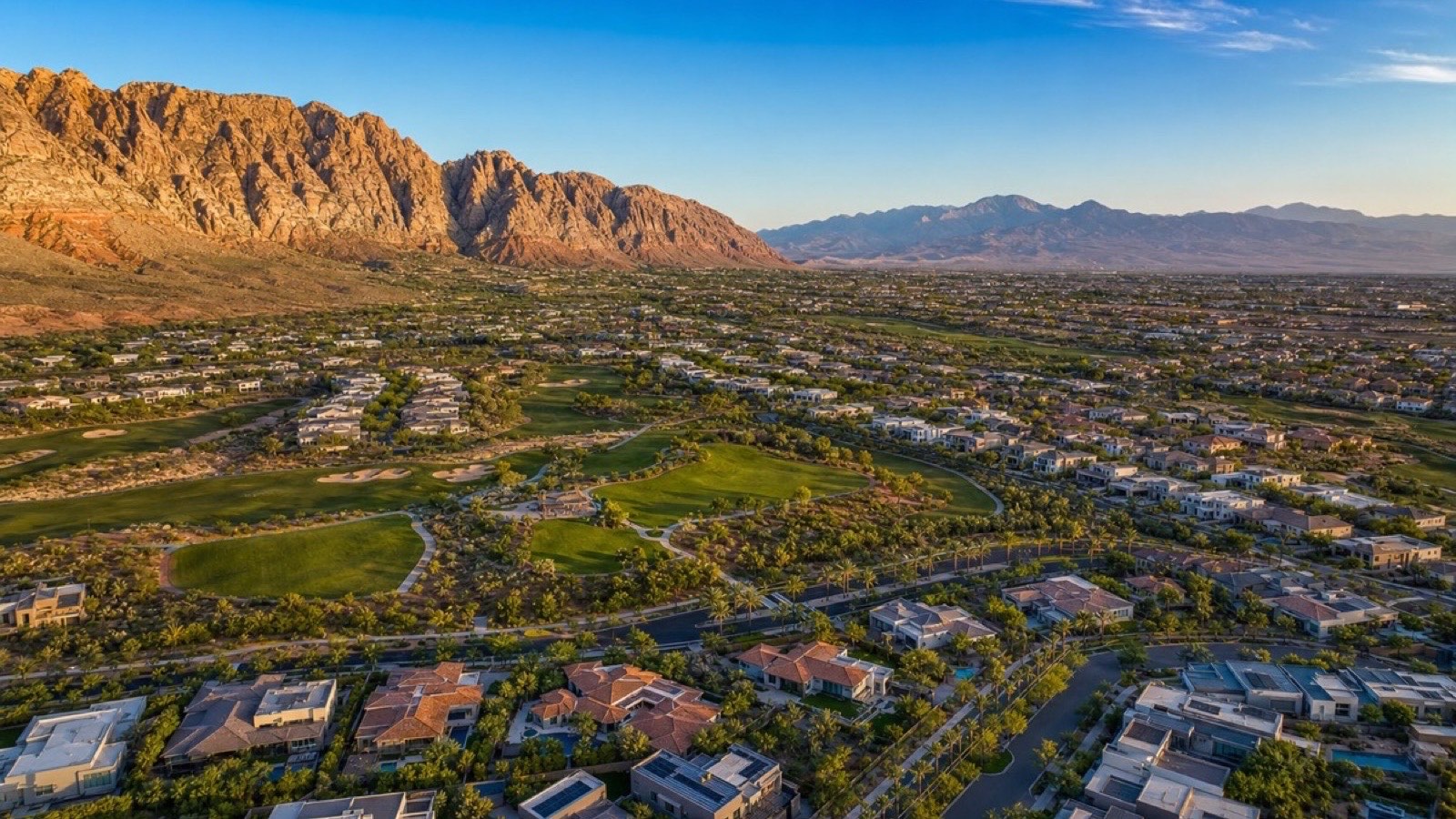
$1.5M+ — Guard-gated and ultra-luxury. MacDonald Highlands, The Ridges, Ascaya, and select guard-gated communities in Henderson and Summerlin offer estate-level properties with Strip views, golf course access, and custom architecture. In the city of Las Vegas, 34.2% of the 555 listings at $1.5 million or more had cut their price on November 11, 2026, the lowest share of any price band. Price against recent sales in the same enclave, not the citywide median.
How Do Las Vegas Property Taxes Compare?
Nevada's property tax system is one of the more buyer-friendly in the nation. According to the Clark County Assessor, taxable value is the market value of the land plus the current replacement cost of the improvements, assessed value is 35% of taxable value, and the tax is assessed value times the district's rate per $100 (3.2782 in the county's worked example). The Tax Foundation puts Clark County's effective rate at 0.52%, with a $2,057 median tax bill and a $431,000 median home value in the Census Bureau's 2020-2024 American Community Survey five-year estimates.
For a $475,000 home at that 0.52% rate, annual property taxes would be about $2,470. At each state's 2024 effective rate in the same Tax Foundation table, the same home would pay about:
- California: $3,325 at 0.70% statewide, though a new purchase is reassessed at 1% of price plus voter-approved bonds under Proposition 13, per the Board of Equalization, so $4,750 or more
- Texas (no income tax, higher property taxes): $6,650 at 1.40%
- Illinois: $8,930 at 1.88%
- New Jersey: $8,930 at 1.88%
The qualifying primary-residence abatement limits annual tax-bill growth to 3%, not assessed-value growth. Other property uses the applicable general cap of no more than 8%; some rentals qualify for the lower cap. New construction and changes in use are exceptions in their first fiscal year. Assessed value is 35% of the assessor’s taxable value, not automatically 35% of purchase price. Apply the parcel’s tax-district rate to assessed value, then account for abatements, exemptions and any separate assessments. See Clark County assessment rules and tax-abatement guidance.

What Does the 2026 Las Vegas Market Look Like?
According to Las Vegas REALTORS' October 2026 report, as covered by FOX5, and our own November market report, the fall 2026 market reflects a normalization after the 2020-2022 frenzy:
- Median single-family sale price: $475,000 in October 2026, up 0.1% from a year earlier; the record is $490,000, set in May and June 2026
- Listed without offers: 8,112 single-family homes and 2,837 condos and townhomes at the end of October, up 7.6% and 6.7% from a year earlier
- Supply: nearly six months at October's sales pace, per LVR
- Speed: 72.4% of existing homes sold in October went within 60 days, per LVR; in the MLS city of Las Vegas, the median September sale took 28 days from listing to contract
- Price cuts: 45.6% of the 8,144 homes listed in the MLS city of Las Vegas on November 11, 2026
- Builder incentives: rate buydowns, upgrade credits and closing-cost help are worth asking about; get each one in writing
According to Freddie Mac's Primary Mortgage Market Survey, the 30-year fixed rate averaged 7.11% on November 12, 2026, up from 6.24% a year earlier and from a 2026 low of 5.98% in late February, per Freddie Mac's weekly history. That is within a point of the 7.79% peak of October 2023 and far above the 2.65% record low of January 2021. On a $475,000 purchase with 10% down ($427,500 loan), 7.11% produces a principal-and-interest payment of about $2,876 a month.
The most important market dynamic for 2026 buyers: builder competition. Builders compete for buyers through incentive packages, and a new home with a builder rate buydown can carry a lower payment than a resale home at the same price. Compare the total cost of each offer, not just the price, before you choose between new construction and resale.
Frequently Asked Questions About Buying a House in Las Vegas
Is Las Vegas real estate a good investment in 2026?
It can be for long-term holders. According to FHFA data, Las Vegas metro home values rose about 8.5% a year from mid-2016 to mid-2026, though only 2.8% in the latest year, and the same index fell 61% from 2006 to 2012. Population growth, no state income tax and below-California pricing support demand. The primary risk is the cyclical tourism economy, so investors should carry 6-12 months of reserves.
What is the average home price in Las Vegas in 2026?
Las Vegas REALTORS put the Southern Nevada median single-family price at $475,000 in October 2026 and the condo and townhome median at $279,000. The average (mean) price runs higher because luxury sales pull it up: in the MLS city of Las Vegas, August 2026 single-family closings averaged $647,853 against a $482,000 median, per our average home cost analysis.
How much do I need to earn to buy a house in Las Vegas?
At a $475,000 price with 10% down ($47,500) and Freddie Mac's 7.11% average rate, principal and interest run about $2,876 a month. Adding property tax at the county's 0.52% effective rate ($206 a month) and insurance at the NAIC's 2023 Nevada average ($84) brings the total to about $3,165 before HOA dues and mortgage insurance. Using a 28% housing-to-income ratio, a buyer needs gross household income of about $136,000 a year. FHA loans (3.5% down) and Nevada Housing Division down-payment assistance can help buyers with lower savings qualify with less upfront capital.
Is it better to rent or buy in Las Vegas in 2026?
For buyers who expect to stay 5+ years, buying can come out ahead through principal paydown and any appreciation, though it costs more each month. Clark County's 2025 Census median gross rent for a three-bedroom was $2,118, against about $3,165 a month to own a $475,000 home with 10% down at 7.11%. The Federal Reserve's 2025 survey put homeowners' median net worth at $458,900 against $10,600 for renters. For buyers with a timeline under 3 years, renting carries less transaction-cost risk.
What are the biggest risks of buying in Las Vegas?
The four primary risks are: (1) economic cyclicality tied to the hospitality and gaming sector, which held about 25% of metro jobs in September 2026; (2) long-term water supply constraints, with about 90% of Southern Nevada's water coming from the Colorado River; (3) extreme summer heat, averaging about 78 days a year at 100 degrees or more; and (4) sharp boom-bust swings, such as the 61% fall on the FHFA index from 2006 to 2012, which penalize buyers who must sell in a down cycle within a few years of purchase.
Which Las Vegas neighborhoods have the best schools?
No neighborhood name guarantees a strong school. CCSD is the nation's fifth-largest district, with 280,000 students, and results vary widely from school to school. Look up the specific schools zoned to each address on GreatSchools and the Nevada Report Card, not neighborhood reputations or district averages, and confirm the attendance zone with CCSD before you buy.
How do I start the home-buying process in Las Vegas?
The first step is a pre-approval call with a Nevada-licensed mortgage lender to establish your budget and loan type (conventional, FHA or VA; USDA loans don't cover the Las Vegas, Henderson or North Las Vegas cores, as our October 2026 map check in the Nevada USDA loan guide found). The second step is connecting with a local buyer's agent — preferably one with deep knowledge of specific communities and current MLS data. Nevada Real Estate Group has 150+ licensed agents. Call us at (702) 637-1759 or visit 8945 W Russell Rd, Suite 170, Las Vegas, NV 89148 for a free consultation. License: S.181401.
Which Sources Inform This Las Vegas Buyer Guide?
The data and analysis in this guide draw from publicly available government, academic, and industry sources, plus NREG's own MLS market reports. Specific claims trace to the following:
- FHFA All-Transactions House Price Index, Las Vegas metro, on FRED — quarterly values through Q2 2026
- FOX5 coverage of Las Vegas REALTORS' October 2026 report and September 2026 report — medians, inventory and months of supply
- California Association of REALTORS, September 2026 sales and price report — California, Bay Area, Southern California and Los Angeles County medians
- U.S. Census Bureau, Vintage 2025 county population estimates for Nevada and UNLV CBER's July 22, 2026 forecast release — population and growth
- Bureau of Labor Statistics, Las Vegas economy at a glance — September 2026 employment by sector and unemployment
- Freddie Mac Primary Mortgage Market Survey and its weekly history — 30-year fixed rate benchmarks and historical peaks
- Tax Foundation, 2026 state income tax rates, property taxes by state and county, and the Nevada Constitution — income tax and effective property tax rates
- Clark County Assessor, real property and tax abatement — assessment ratio, tax rate example and the 3% and up-to-8% caps
- HUD, FHA loans and Nevada Housing Division Worker Advantage Program release — down payment minimums and assistance
- Federal Reserve, Changes in U.S. Family Finances from 2022 to 2025 — homeowner vs. renter net worth
- Southern Nevada Water Authority, where your water comes from, National Weather Service Las Vegas climate normals, NAIC homeowners insurance report, and BEA regional price parities — water, heat, insurance and cost of living
Market data reflects publicly available figures as of November 15, 2026. Consult a licensed Nevada real estate professional before making purchase decisions.