

Boulder City can be a good place to live when its location, housing and daily services fit the life you want to lead. The useful question is not whether the town deserves a universal letter grade. It is whether a particular home supports your work, school, care, recreation and spending priorities without requiring compromises you will resent. This October 23, 2026 review keeps the original July housing snapshot historical and adds current checks that matter before a move.
Boulder City is worth considering if you want its historic setting and Lake Mead access and can accommodate the actual property's costs, maintenance and travel requirements. Test an ordinary week before buying. The hospital announced a May 1, 2026 change to emergency and outpatient care without inpatient admissions. Verify services, school assignments and property rules individually; the July housing figures below are historical, not today's inventory.
- Compare a specific Boulder City home and routine with real Henderson or Las Vegas alternatives.
- Market figures dated July 12, 2026 do not show current prices or available homes.
- Growth management and historic status require project-specific checks; neither guarantees appreciation.
- Confirm school assignment, hospital services and actual travel before committing.
- Residential short-term rentals are prohibited; do not fund a purchase with assumed vacation-rental income.
What would make Boulder City a good fit for your ordinary week?
Start with the change you want from the move. You might want an established town setting, a particular outdoor activity, a different home layout or convenient access to a destination you already use. Describe that requirement in terms you can test. “I want to walk to these two businesses” is more useful than “I want a walkable town,” because an individual home's route, crossings, shade and distance can change the answer.
According to the City of Boulder City's history, the townsite housed Hoover Dam workers and administrators in 1931 and incorporated in January 1960. That history explains why the original townsite matters to local identity. It does not prove that every home is historic, every street has the same character or every property enjoys a protected view. Separate the town's identity from the address you might buy.
Write down your recurring destinations before opening a listing search. Include work, groceries, school if relevant, appointments, exercise and people you visit. Mark the trips you expect to make on foot and those that require a vehicle. A home that supports your favorite weekend activity can still make the rest of the week inconvenient. Conversely, a routine with fewer cross-valley trips may make a location work that would be frustrating for another household.
Use the Boulder City overview to orient the search, then compare actual Boulder City homes for sale. Avoid choosing by a description of who supposedly belongs in the town. Preferences about maintenance, travel and amenities can be stated directly, without assumptions about age, household type or background. Keep three requirements that are essential and three that are negotiable. Those priorities make a limited shortlist easier to evaluate and prevent a scenic photograph from deciding the entire move.
What do homes cost in Boulder City?
The July 12, 2026 edition of this article reported the following GLVAR-feed snapshot. It remains part of that edition's historical record. The figures have not been recreated from a retained transaction export for this October review, and they must not be read as current inventory or current market medians. An original publication date and a new substantive review date describe different events; neither turns a July observation into an October one.
| Measure | Boulder City | Henderson | Las Vegas |
|---|---|---|---|
| Active listings | 138 | 2,483 | 8,760 |
| Median asking price | $432,500 | $542,104 | $470,820 |
| Historical measure | Reported result | Interpretation limit |
|---|---|---|
| Closed sales | 45 | Market sales, not NREG company production |
| Median closed price | $399,000 | A different population from active asking prices |
| Actives described as no HOA | 57, reported as 41% | Listing classification does not replace title and association review |
| Actives mentioning a lake view | 55, reported as 40% | A keyword does not verify the view or its protection |
Several useful distinctions survive even when a snapshot ages. An asking-price median describes available listings, while a closed-price median describes homes that sold in the stated window. Their difference is not a typical discount on the same home. The July $432,500 asking median and $399,000 closing median therefore cannot be used to infer what a seller will accept. Property type, size, condition and the mix of homes can all differ.
The same caution applies across cities. The historical asking medians differ by $109,604 between Henderson and Boulder City, and $38,320 between Las Vegas and Boulder City. Those are arithmetic differences between the reported July medians, not savings available to a buyer selecting equivalent homes today. Review the regional market page for its separately stated scope and the home-pricing guide for comparable selection. Before offering, obtain a dated property-specific comparison that identifies its source, observation window, relevant matches and missing evidence.
How should you compare monthly cost with the purchase price?
A manageable purchase price can produce an uncomfortable monthly budget if repairs, transportation or utilities are missing. Build the budget around the property and loan you are actually considering. Separate the money needed at closing from ongoing expenses and future replacements. The seller's payment, a listing portal's estimate and a neighbor's tax bill may each describe a different situation.
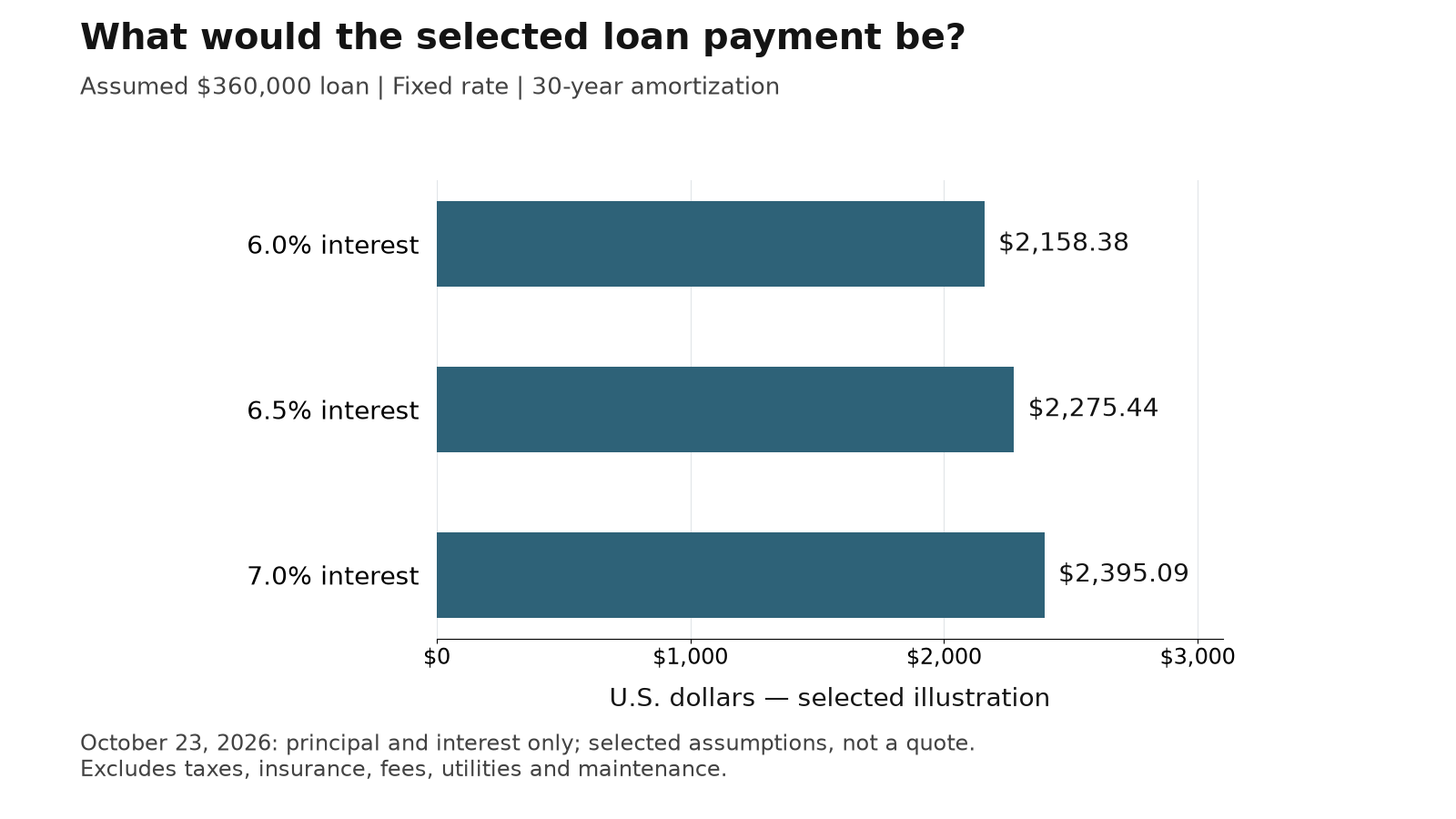
For a transparent illustration prepared as of October 23, 2026, select a $450,000 purchase, 20% down and a $360,000 loan amortized over 30 years. At an assumed fixed annual interest rate of 6.5%, principal and interest are about $2,275.44 monthly. This is a calculation, not a current mortgage quote, APR, approval or Boulder City median. At otherwise identical assumed rates of 6% and 7%, the payments are about $2,158.38 and $2,395.09. Loan fees and other housing costs are separate.
| Item | Monthly assumption | Evidence needed |
|---|---|---|
| Principal and interest | $2,275.44 | Actual loan terms and lender disclosures |
| Property tax allowance | $250 | Parcel bill, abatement eligibility and charges |
| Insurance allowance | $150 | Address-specific coverage and premium |
| Utilities allowance | $325 | Usage history and current applicable rates |
| Repair reserve | $375 | Inspection findings and replacement schedule |
| Selected subtotal | $3,375.44 | Excludes HOA, transport, other debt and ordinary living expenses |
According to the Consumer Financial Protection Bureau's Loan Estimate explanation, that disclosure helps borrowers review estimated loan terms and costs; it is not loan approval. Compare real lender documents on consistent assumptions. The $250 tax and $150 insurance entries above are deliberately selected allowances, not city rates or quotes. An association fee, special assessment or additional coverage would change the subtotal.
Cash needs also deserve their own calculation. In this example, $90,000 down plus a selected $13,500 closing allowance and $20,000 remaining reserve require $123,500. The closing allowance is not a claim that all transactions cost 3%. Keep lender and escrow estimates separate from desired reserves so that paying closing expenses does not silently consume the money intended for repairs.
How do growth controls and the gambling rule affect the choice?
Municipal rules influence what can be developed and how land can be used. They do not determine the future resale value of a particular home. According to Boulder City's Community Development department, staff administer the growth-control ordinance and review construction requests, zoning and building plans. A buyer considering vacant land or a proposed home needs the current approval record for that project, not an assumption that a listing description establishes buildability.
Growth management is sometimes summarized as a fixed cap on new houses. Treat that as the beginning of the question, not proof of an exact number of completed homes or no new supply. The city's planning FAQ distinguishes development-allotment situations and owner-builder treatment. The current code text was not extractable in this review, so obtain the city's current project-specific interpretation before relying on a numerical limit in a purchase decision. An allotment, a permit, a completed house and a home listed for sale are different things.
According to Boulder City Charter section 128, reviewed for the related retirement guide on October 22, gambling is prohibited with specified exceptions including private social games and certain permitted fundraising activities. The provision helps explain the town's different commercial setting. It is not a claim that no entertainment exists, all restaurants close early or nearby activity cannot affect a property.
Translate both rules into practical questions. If you want a newly built home, compare actual approved projects and available new construction. If avoiding casino-centered surroundings is a priority, inspect the actual location and routes you expect to use. Do not turn a civic rule into a universal safety ranking or a prediction of appreciation. A limited development pipeline can coexist with changing demand, carrying costs, condition problems and negotiating room on individual homes.
What does historic character mean for everyday ownership?
Decide whether you want the character of an older home, its location, or both. A compact cottage close to chosen destinations may serve you well even if it offers less storage or a different floor plan. Another buyer may need a garage configuration, step-free route or workspace that the same building cannot easily provide. Measure the practical requirements before imagining a renovation that makes every conflict disappear.
According to the city's historic-preservation program, its map identifies district location, construction year, contributing status and relevant design guidance. The program describes Certificate of Appropriateness review for qualifying exterior changes and an approval matrix based on status and scope. An older city FAQ saying there are no historic restrictions should not override this explicit current program. Ask about the actual work you intend, including materials and the elevation visible from the street.
Inspection and preservation review answer different questions. A roof may need repair even when you intend no design change; an attractive addition may require both planning and construction approvals. Obtain the condition findings, approved scope and contractor estimate separately. Legal living area, electrical capacity, cooling equipment, drainage and earlier alterations can matter more to the household budget than the architectural label.
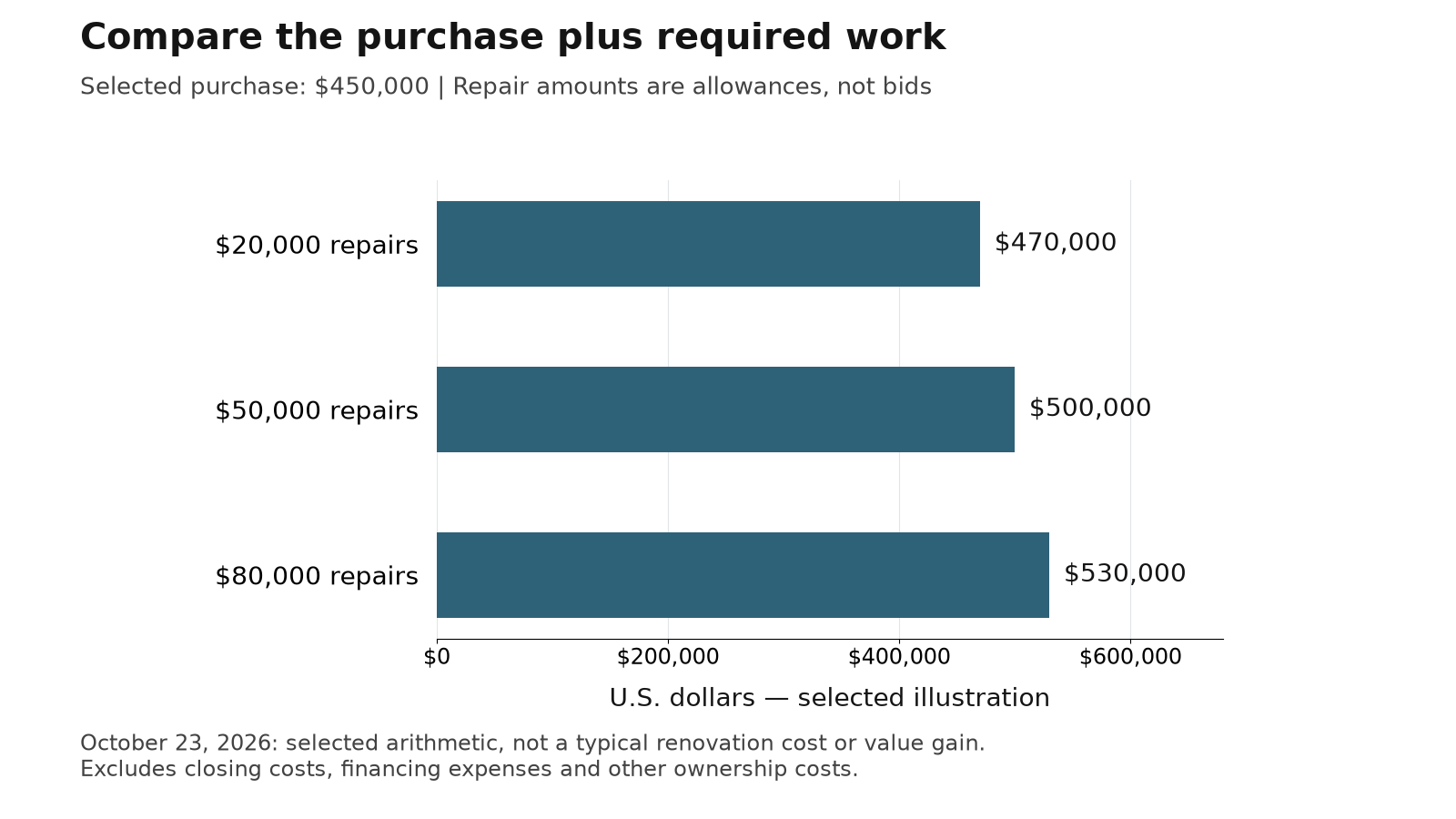
For a planning exercise as of October 23, 2026, a selected $450,000 purchase plus repair allowances of $20,000, $50,000 or $80,000 produces totals of $470,000, $500,000 or $530,000 before closing costs and financing expenses. These are sensitivity examples, not typical Boulder City renovation bills or promises of added value. A low asking price is not necessarily the least expensive option after required work. Compare the cash, time and uncertainty as well as the finished design.
The Boulder City relocation guide covers the document and moving process in more detail. Use this livability decision first: are you willing and able to manage the work required for the home to support your everyday life?
How should you evaluate schools without relying on a citywide grade?
School fit is specific to the student, program and school year. A town's size does not establish classroom size, course availability, admission to a specialty program or the services available at a particular campus. Begin with what the student needs, then verify the relevant facts directly. A general reputation or an old rating cannot answer those questions reliably.
According to CCSD's current zoning page, the district provides a school search, zoning maps and separate open-enrollment information. Use the actual residential address and correct school year. Do not infer assignment from the nearest school, the listing's labels or a neighborhood name. If the address is new, unusual or involved in shared housing, resolve it with the district before depending on an assumed assignment.
The district's 2026–2027 registration notice, dated April 20, 2026, says registration is required each year. It identifies documentation for new or returning students and a shared-housing process. It also distinguishes zoned enrollment from open-enrollment and magnet options. This review did not submit an application or obtain a seat determination. Confirm availability and deadlines for the option you need.
Make the school question part of an ordinary-day test. Check start and end times, transportation, after-school arrangements, activity locations and the trip home. If work and school schedules conflict, identify the practical solution and its cost before deciding that the location works. A program farther away can be suitable, but its transportation needs belong in the housing decision.
You can compare specific published performance measures when their year, population and limitations are clear. Avoid translating one score into a judgment about every student or the whole community. Keep educational priorities separate from assumptions about who lives nearby. A useful comparison says which verified program or service meets a stated need, what remains uncertain and what would change the decision. It does not assign Boulder City a blanket “B+” or promise that every child will have the same experience.
What evidence should you use when asking whether Boulder City is safe?
Ask a more precise question than whether a city is “safe.” You might be concerned about a type of reported crime, a pedestrian crossing, property drainage, summer heat or access to emergency services. Those concerns require different evidence. A single letter grade combines them without explaining the measure, time period or risk relevant to your household.
The Boulder City Police Department page identifies its law-enforcement, records and prevention functions. It also describes the community favorably, but that institutional description is not a standardized comparison of crime rates across Nevada cities. This review has not verified a complete, comparable current city crime dataset and does not certify a safest-city ranking. The earlier article's sweeping FBI comparison should not be treated as an established current result.
If you compare reported crime, keep the agency, offense definition, reporting period and population basis consistent. A raw count is not a rate, and a partial year is not interchangeable with a complete one. Changes in reporting or coverage can affect the comparison. Ask what the numbers include and omit before drawing a conclusion about a street or property. Do not infer risk from residents' age, ethnicity, income or household composition.
Then inspect the conditions the data cannot decide for you. Walk the intended route at the hours you expect to use it, assess visibility and crossings, and examine the home's locks, lighting and access. For physical property risks, rely on appropriate inspection, drainage and insurance evidence. A quiet visit does not establish flood exposure, just as a city's crime count does not describe the condition of a retaining wall.
If you are also considering the valley, the existing Henderson safety guide is a related starting point, with its own evidence and limitations to review. Apply the same standards to both locations. The goal is a consistent decision process, not a persuasive adjective attached to the town you already prefer.
How much would commuting change your weekly routine?
Test the exact destination at the hours you actually travel. “Las Vegas” can mean a workplace near Henderson, a Strip location or an address across the valley; those are not the same commute. Include the trip from the driveway to the workplace entrance, parking and any school or errand stop. A favorable map estimate at midday can hide the part of the journey that matters most.
Keep a simple record of outbound and return travel on representative days. Note the departure time, observed duration and unusual conditions. Compare the result with a Henderson location or Las Vegas location using the same destination and schedule. The old guide's general driving ranges were not a newly measured route study, and this review does not replace them with another universal minute estimate.
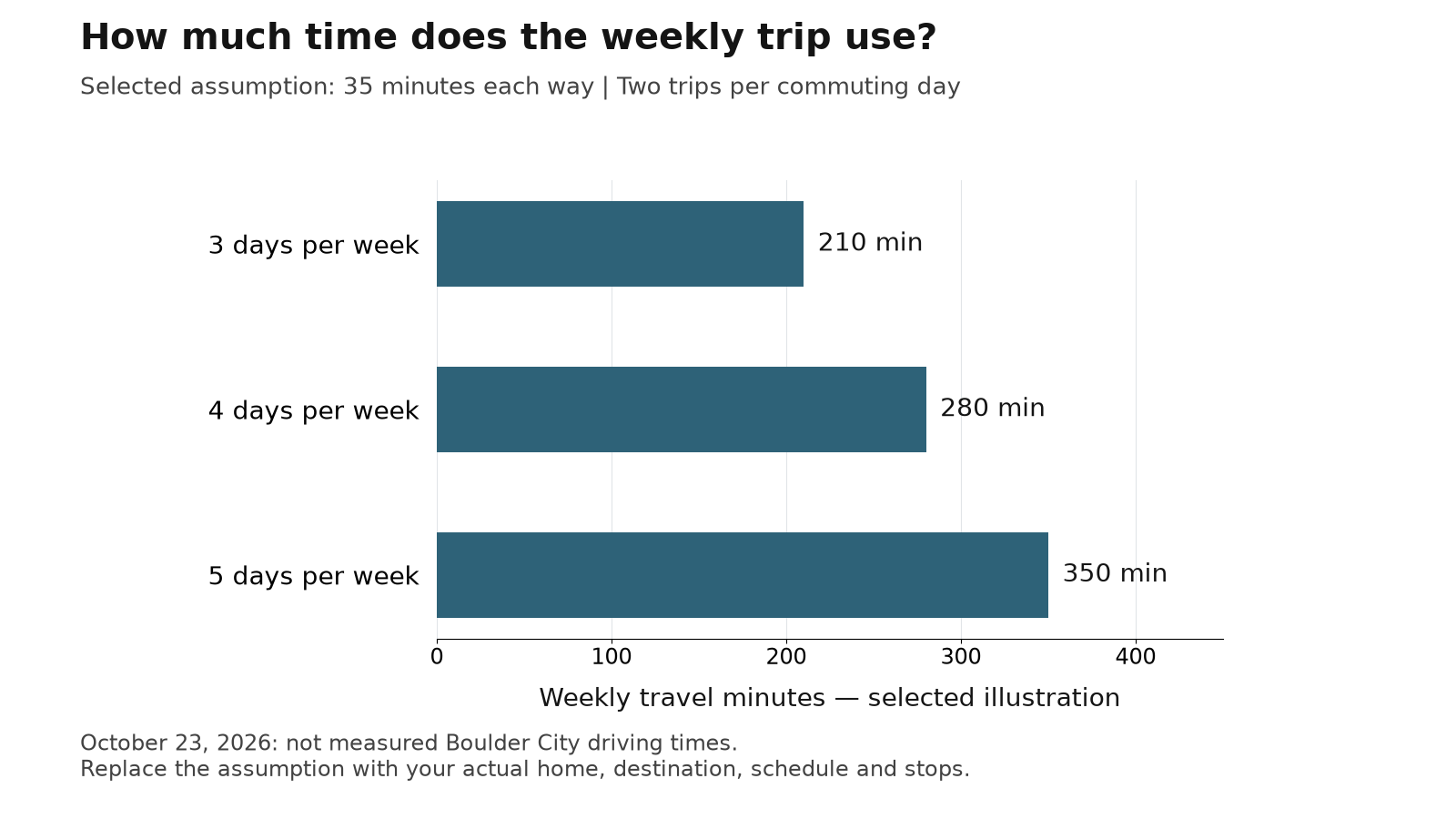
For a selected October 23, 2026 example, assume 35 minutes each way. Three commuting days require 210 minutes, or 3.5 hours, per week; four require 280 minutes, or 4 hours 40 minutes; five require 350 minutes, or 5 hours 50 minutes. These are arithmetic consequences of the assumption, not measured Boulder City travel times. Compare the result with the schedule you can reliably maintain, including seasonal or workplace changes.
A remote-work plan also needs evidence. Check the service available at the specific address, the workspace and your employer's attendance expectations. Do not buy on the assumption that an informal remote arrangement will remain permanent. If two household members travel to different destinations, compare the combined schedule rather than optimizing only one route. A home can be appealing and still be the wrong fit for the routine you need to sustain.
What healthcare and daily-service details deserve a current check?
The presence of a hospital does not mean every kind of hospital care is provided locally. According to Boulder City Hospital's transition notice, it announced a Rural Emergency Hospital model effective May 1, 2026, retaining emergency and outpatient services while ending inpatient admissions. The notice describes stabilization and transfers for patients who need inpatient hospitalization. That is a material change from an older broad description of a critical-access hospital.
The notice and the hospital's emergency-services page describe round-the-clock emergency care. They do not establish an individual's coverage, the availability of every specialist, appointment wait times or a guaranteed transfer destination. This article has not independently audited licensing, staffing or capacity. Verify the actual service and insurance arrangements important to your household with the relevant provider and plan.
Build a practical service map. List your regular clinician, pharmacy, dental care and other recurring appointments, then identify which are available locally and which require travel. Check whether the provider is accepting new patients and how ongoing treatment or prescriptions would transfer. For a planned procedure, the location, support needed afterward and return visits can affect the move more than the distance to an emergency department.
Apply the same method to ordinary errands. Visit the grocery stores and services you expect to use, check current hours, and see whether the selection meets your needs. A small downtown may suit someone who enjoys combining local errands, while another household may make frequent trips elsewhere for particular goods. Neither pattern is inherently better; the relevant question is how it fits your time and budget.
The Boulder City retirement guide develops care continuity and retirement-specific planning further. Those questions can matter at any life stage, but do not assume every household has the same medical or transportation needs. Make the location decision using the services you have actually confirmed rather than a generic claim that the town has everything nearby.
How do Lake Mead, outdoor plans and summer conditions affect livability?
Decide which outdoor activities are part of your normal life and which are occasional attractions. A location near Lake Mead may be valuable if you will use particular trails or access points regularly. Proximity alone does not establish convenient access, suitable conditions, affordable storage or the ability to participate at the hours you prefer. Test the real activity, route and equipment requirements before making them central to the purchase.
According to NPS's Historic Railroad Trail description, the route has exposed conditions that require attention to season and heat. The Lake Mead conditions page provides alerts and access information. Consult it close to a planned visit. A photograph of water or a trail description is not a promise that a ramp, route or activity will be available when you want it.
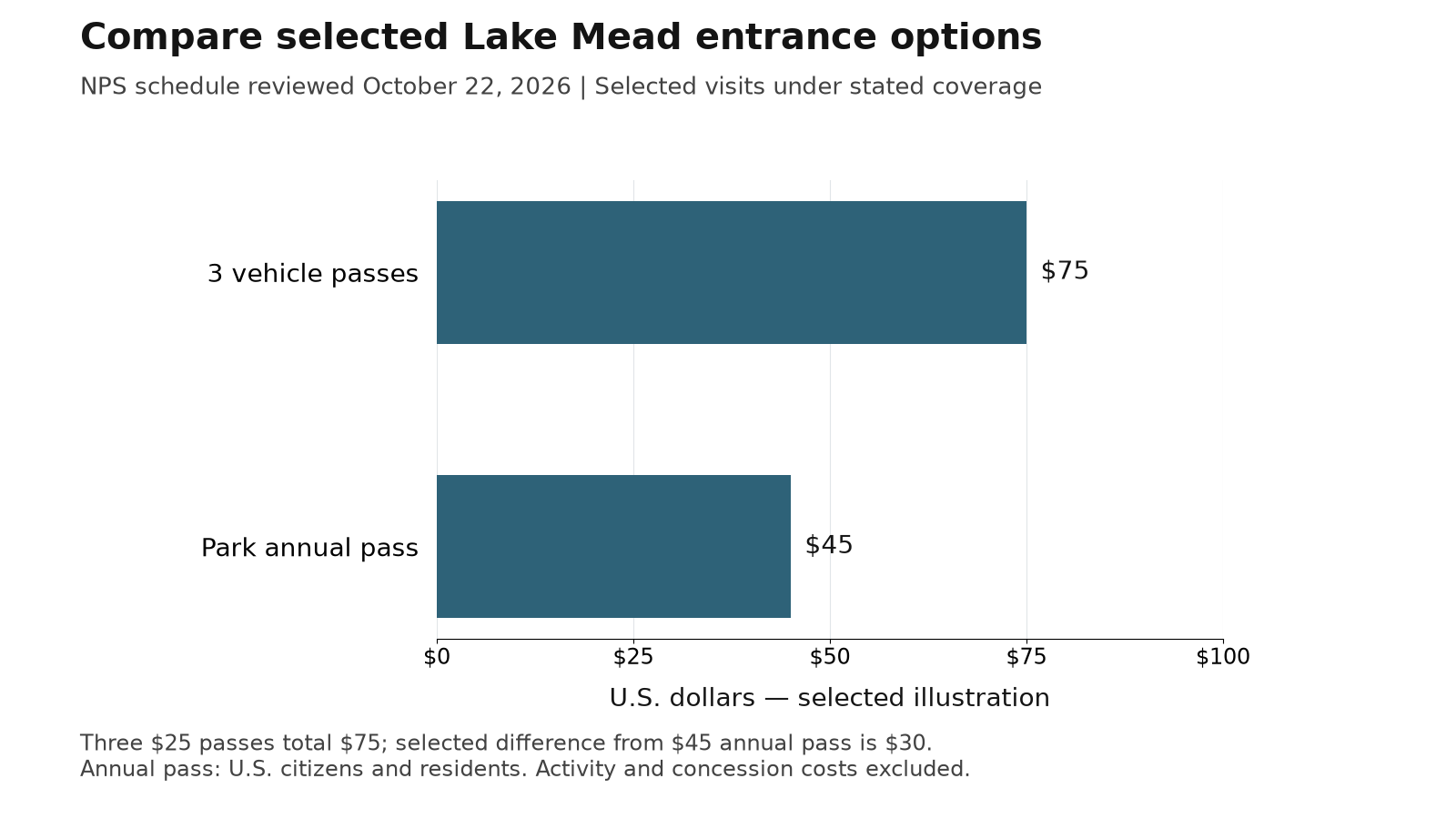
According to the NPS Lake Mead fee schedule, reviewed for the related guide on October 22, a private-vehicle entrance pass is $25 for one to seven days and the park annual pass is $45. The page lists the park annual pass for U.S. citizens and residents and describes its vehicle/passholder coverage. Under those stated prices, three separate $25 entrance purchases total $75, compared with $45 for the park annual pass. The selected $30 difference applies only when those are the relevant products and visits; it excludes separate activity, vessel, campsite or concession costs.
Heat belongs in the everyday plan as well as the recreation plan. Consider shade, cooling-system condition, outdoor work, pets and the times you can comfortably use the yard. Review the home's actual energy use and current rates. Do not promise that a location or a dry climate is medically beneficial. If heat affects a health condition or medication, obtain appropriate individual guidance. A home that works well in mild weather should still support a realistic routine during hotter periods and temporary outdoor closures.
What property rules can change how you use the home?
Ownership without an HOA does not mean ownership without rules. Title restrictions, easements, zoning, building requirements and municipal law can still affect the property. Conversely, an association can have obligations that are not obvious from an attractive shared amenity. Identify the actual ownership form and governing documents instead of inferring them from the age or style of the home.
The July snapshot's no-HOA and lake-view keyword counts are historical listing classifications. Verify association status through the transaction documents and the applicable records. For a view, inspect the actual sightline and intervening parcels. A listing phrase does not create a legal right to an unobstructed outlook. If that view is essential to your willingness to buy, understand what evidence supports any protection claim before assigning it a price premium.
According to the city's Short Term Rentals Prohibited notice, the March 26, 2024 ordinance clarified the prohibition on residential short-term rentals. The public notice describes occupancy for less than 30 consecutive calendar days and fines of up to $500 per day. Do not assume that buying a home creates a vacation-rental license or that a listing's income projection establishes lawful use. Obtain the applicable current code and property-specific guidance if the business plan depends on renting.
Longer-term occupancy, a home business, an accessory space or a planned addition requires its own review. A converted room shown in a listing is not proof that its use or construction was approved. Ask Community Development about the specific proposal and obtain relevant records. Do not extrapolate permission from a neighbor's project or from a general online answer that may be older than the current code.
For buyers comparing guard-gated communities or luxury communities elsewhere, use the same property-level process. Compare actual obligations and amenities; do not assume that every address within either city has one uniform fee structure. The right choice depends on the rules and responsibilities you are willing to accept.
How should you compare Boulder City with Henderson and Las Vegas?
Compare actual candidates against the same requirements. A large city's total inventory does not tell you how many homes meet your budget, layout, condition and location needs. A small city's historical median does not establish that the right home is available there. Start with matched criteria and record the date of the search, then inspect the properties that survive that first screen.
| Your requirement | Evidence to compare | Tradeoff to price | Finding that could change the choice |
|---|---|---|---|
| A useful daily location | Actual routes to your destinations | Travel time and recurring transport expense | A workplace or schedule change |
| Historic character | Property status, condition and intended-work review | Maintenance and approval uncertainty | An essential alteration is infeasible |
| Manageable monthly cost | Loan, tax, insurance, utilities and obligations | Cash reserve and future replacements | A quote or inspection exceeds the budget |
| Specific school or care access | Assignment, availability and coverage confirmation | Travel and scheduling | The needed service is unavailable |
| Outdoor activity | Current access, conditions and actual use | Equipment, fees and seasonal limitations | The preferred activity is impractical |
Use Henderson homes for sale and Las Vegas homes for sale as comparable search areas, then narrow to the destinations that matter. A home near Green Valley or Downtown Las Vegas may solve a different travel requirement from a Boulder City address. Those are location comparisons, not judgments about the people who live in them.
Avoid giving a single score to a tradeoff you have not priced. A smaller home that needs less work may suit one household better than a larger home with a lower asking price. A longer commute may be acceptable when it occurs infrequently and unacceptable when it occurs daily. State the assumption that drives the preference so that you can reconsider it when circumstances change.
If the broader move is still undecided, the moving to Las Vegas hub provides regional context. The separate relocation guide covers transaction and moving logistics; this page's purpose is deciding whether Boulder City's actual tradeoffs fit your life. You do not need to settle every future possibility, but the requirements that motivated the move should have evidence behind them before you commit.
What should you verify on a visit before choosing a home?
Plan a visit around the routine you intend to live. Tour the home, then travel to the destinations you identified rather than spending the entire visit on attractions. Look at storage, parking, steps, workspaces, shade and maintenance access. Record what you observed, what you were told and what still needs documentary confirmation. Keeping those categories separate prevents an appealing conversation from becoming an assumed property fact.
Revisit the budget after inspections and quotes. A $20,000 repair allowance may be insufficient or unnecessary for a particular home; its value is as a placeholder until actual evidence replaces it. Confirm the contract deadlines that govern inspections, financing and other investigations with the professionals handling the transaction. Do not waive a protection merely because a citywide description feels reassuring.
Nevada Real Estate Group is the #1-ranked real estate team in Nevada, with $4.85 billion+ in career sales volume, 9,600+ closed transactions, and 789 closings in 2025 alone. Across the 9,600+ closings our team has represented, the small-market deals — Boulder City included — are where local knowledge shows up most visibly in the final number.
For help comparing actual candidates, use the buyer resources, Boulder City hub and property search. Owners considering a move can start with the Boulder City seller page, seller resources or home value estimator; a property-specific valuation still depends on appropriate evidence. Read about the team or describe your requirements through the contact page. Call or text (702) 637-1759 to discuss a practical shortlist.
The strongest decision is one you can explain in concrete terms: this home meets these priorities, these costs are supported, these tradeoffs are acceptable and these remaining questions have a clear way to be resolved. Boulder City does not have to suit everyone to be a good choice for you. It needs to suit the life you have actually planned.
Frequently Asked Questions
Is Boulder City a good place to live in 2026?
It can be when its housing, location, services and property rules match your priorities. Test an ordinary week, obtain actual ownership costs and compare specific alternatives. The town's historic setting and Lake Mead access are reasons to investigate, not guarantees about every home's condition, convenience or future value.
Is Boulder City one of Nevada's safest cities?
This review does not certify a current statewide safety ranking. Compare consistent agency, offense, reporting-period and population data, then assess the actual property's access, routes and physical risks. A small population or favorable description on an institutional website does not establish a complete comparative safety result.
What do the $432,500 and $399,000 housing figures mean?
They are the asking-price and preceding-90-day closed-price medians reported in this article's July 12, 2026 edition. They describe different populations and are preserved as historical context. They are not October medians, an expected discount on the same home or a current property valuation.
Does the growth ordinance guarantee a shortage or rising prices?
No. Growth management affects development approvals, but allotments, permits, completed homes and available listings are different measures. Exceptions and project-specific requirements matter. Obtain current city guidance for a proposed build and use actual market evidence for pricing rather than treating a civic rule as an appreciation guarantee.
How do I know which school serves a Boulder City address?
Use CCSD's official zoning resources for the actual address, grade and relevant school year, then confirm unusual circumstances with the district. Zoned enrollment, open enrollment and magnet options are different pathways. Check registration documents, program availability and transportation before relying on a listing's school description.
Does Boulder City Hospital still provide inpatient care?
The hospital's notice announced a May 1, 2026 transition to emergency and outpatient care without inpatient admissions, with transfers when inpatient hospitalization is needed. Confirm the service and coverage you require directly. This review has not independently audited the facility's licensing, staffing, capacity or an individual care arrangement.
Can I use a Boulder City house as an Airbnb?
The city's published notice says residential short-term rentals are prohibited and describes occupancy of less than 30 consecutive calendar days. Do not assume a purchase creates permission or rely on an advertised income projection. Review the current code and obtain property-specific guidance before depending on any rental plan.
How long is the commute to Las Vegas?
It depends on the exact home, destination, hours and stops. Test both directions on representative days. The 35-minute figure in this guide is a selected weekly-time illustration, not a measured citywide commute or a promise about travel to the Strip, airport or a particular workplace.
Which sources inform this Boulder City guide?
- City history, Community Development, historic preservation and short-term-rental notice: municipal history, process and published guidance reviewed October 23, 2026. No parcel-specific approval obtained.
- Growth-management code and city charter: current code text was not extractable here; the charter's relevant section was reviewed October 22 for the related guide and its October 23 retrieval was unavailable. Obtain current official interpretation for a consequential project decision.
- CCSD zoning and 2026–2027 registration notice: address/year verification and enrollment process, not a school-quality ranking or admission decision.
- Police Department: official functions and resources; no complete comparative current crime dataset verified.
- Hospital transition notice and emergency services: the facility's own service descriptions, not an independent capacity or coverage audit.
- NPS trail description, conditions and fees: October 22 review reused for activity planning; check conditions and fees close to use.
- CFPB Loan Estimate explanation: lender-disclosure context. Payment, repair, cash and commute examples are original calculations using disclosed selections, not client transactions or quoted market costs.
Historical July figures retain the original period and measures. No new representative city transaction sample, vendor quote, field visit, school assignment or safety ranking is claimed. Related guides have their own source dates and limitations; a link does not recertify all of their contents.