

Boulder City's small-town setting can be appealing without answering every safety question. A quiet showing does not reveal a property's maintenance history, how a walking route works after dark or what preparations a Lake Mead outing requires. Those questions deserve separate answers rather than a single reassuring label.
We checked the official Nevada Crime Statistics portal on September 25, 2026. Boulder City Police Department reported 24 violent crimes and 129 property crimes in calendar 2025 within the portal's two crime themes. This guide explains the categories, compares the same agency's preceding year and turns the research into practical homebuyer questions. It does not assign a neighborhood safety ranking or claim a firsthand inspection of the homes discussed.
Boulder City has its own police department and published crime-prevention programs, but safety still depends on the location and activity. Nevada's official portal reports 24 violent crimes and 129 property crimes for Boulder City Police Department in 2025. Use those dated agency counts alongside recent local information, a property inspection and checks of your daily routes. Lake Mead and desert outings require their own safety preparation.
- Police reported 24 violent crimes and 129 property crimes in 2025.
- Compared with 2024, the violent total declined while the property total increased.
- City programs include Property Watch, Neighborhood Watch and bicycle identification.
- Check the actual house, walking routes, vehicle storage and cooling arrangements.
- Recreation-area hazards and residential crime are different questions.
What do Boulder City's official crime figures show?
According to Nevada's 2025 violent-crime report for Boulder City Police Department, the agency reported 24 crimes in that theme. According to the same agency's property-crime report, its property theme contained 129. These figures describe the named reporting agency and year, rather than every incident that someone might associate with a Boulder City mailing address or visit.
| Violent category | Count | Property category | Count |
|---|---|---|---|
| Murder and nonnegligent manslaughter | 1 | Burglary | 22 |
| Rape | 5 | Larceny | 78 |
| Robbery | 1 | Motor vehicle theft | 23 |
| Aggravated assault | 17 | Arson | 6 |
| Violent theme total | 24 | Property theme total | 129 |
The category sums reconcile with the displayed totals. The portal explains that murder, rape and aggravated assault are counted by victim, while robbery is counted by incident. Its property rules can count multiple offenses within an incident, and motor vehicle theft includes attempted thefts and individual stolen vehicles. Do not describe the combined categories as a count of affected homes, unique offenders or convictions.
The themes also do not represent all calls for service or every type of offense. A reader who wants information about a specific issue should ask which record set covers it. The absence of a category from this table does not prove the issue never occurs. Nor does an annual figure establish the conditions on a particular street today.
Save the report year with any number you repeat. An article reviewed in 2026 can correctly use a 2025 full-year report, but should never rename that figure a 2026 crime total. The source may later revise its records. For a pending housing decision, supplement this dated baseline with the most geographically appropriate information the agency can release.
Did crime rise or fall compared with the previous year?
The two headline measures moved in different directions. According to the 2024 violent-crime report, Boulder City Police reported 27 violent crimes that year, compared with 24 in 2025. According to the 2024 property-crime report, property crime was 111, compared with 129 in 2025. The changes are a decrease of three and an increase of eighteen, respectively.
Expressed as percentages of the earlier totals, those changes are approximately minus 11.11 percent for the violent theme and plus 16.22 percent for the property theme. The arithmetic is useful because it prevents a selective headline from turning two different results into a claim that everything improved or worsened. These are changes in reported counts, not adjusted per-capita rates.
A two-year comparison does not establish a lasting trend or explain its cause. This review does not have evidence to attribute the changes to a particular policy, population shift, development or neighborhood. Smaller totals can produce noticeable percentage movements from a modest numerical change, so retain the actual counts when discussing the percentages.
If another website presents a different number, first compare its definitions. It might use a different year, geographic boundary, offense grouping or estimated population. Ask whether it is describing police reports, calls, arrests or survey responses. Those measures should not be silently substituted for one another.
For a home search, use the comparison to generate better questions. Which recent information can be examined for the area around the property? Does the agency publish useful explanatory material? What uncertainty remains? The decision should not rest on choosing whichever year's headline feels most comfortable. Our broader Boulder City relocation guide addresses the housing and daily-life questions that sit alongside these records.
Which local police resources can a buyer actually use?
According to Boulder City's police department page, the department provides law enforcement and community policing within Boulder City, with divisions including patrol, records, communications and crime prevention. Start there for current contact routes and service information. A published office schedule should not be confused with the availability of patrol or dispatch; use the department's descriptions for the service you need.
Prepare a focused question before contacting records. Identify the address or area, the time period and the kind of information you want to understand. Ask what releasable records or public reporting tools are available. Do not request private victim information to create a homebuyer spreadsheet, and do not assume a clerk can produce a custom neighborhood ranking.
A map, if offered, needs its own reading instructions. Confirm the date range, reporting lag, categories and whether locations are approximate. A display with no visible markers might reflect filters or omitted categories. It is not automatically an official statement that no incidents occurred. Preserve the source and the settings so another person can understand what you actually reviewed.
Keep routine research separate from an emergency. Records questions, program enrollment and questions about an old incident belong through the appropriate nonemergency channel. An active emergency requires emergency services. This guide is a research resource, not a way to report a current incident or secure an immediate response.
When comparing Boulder City homes, ask the same questions for each address. A familiar street name, attractive landscaping or confident sales description is not a substitute for comparable evidence. Record unavailable information as unavailable. A responsible comparison can acknowledge a limit without turning the gap into either reassurance or suspicion about the people who live nearby.
What do Boulder City's prevention programs provide?
According to the city's crime-prevention program directory, Boulder City lists Neighborhood Watch, a Bicycle Identification Program, Operation Reminder, Operation We Care and Property Watch. Those are concrete starting points for learning about participation. The page's existence does not establish that a particular block participates or that a particular home has already received a service.
Property Watch is described for residents who are out of town. Before depending on it, ask the department about current enrollment, eligibility, scope and limitations. A requested check should not be treated as continuous monitoring, a repair service or an insurance certification. Arrange separate maintenance and emergency-contact responsibilities for the house.
The bicycle program is another useful prompt for a household that intends to ride locally. Ask how identification works and what documentation to retain. Independently record your equipment details and choose a suitable storage arrangement. A registration or identification program does not replace a physical lock or establish that all theft will be prevented.
Operation Reminder addresses issues such as unsecured property, while Operation We Care provides a route for nonemergency problem areas. Use the current official directions rather than relying on a neighbor's memory of how a program operated years ago. Confirm the proper channel before sharing sensitive information or assuming a submission has been received.
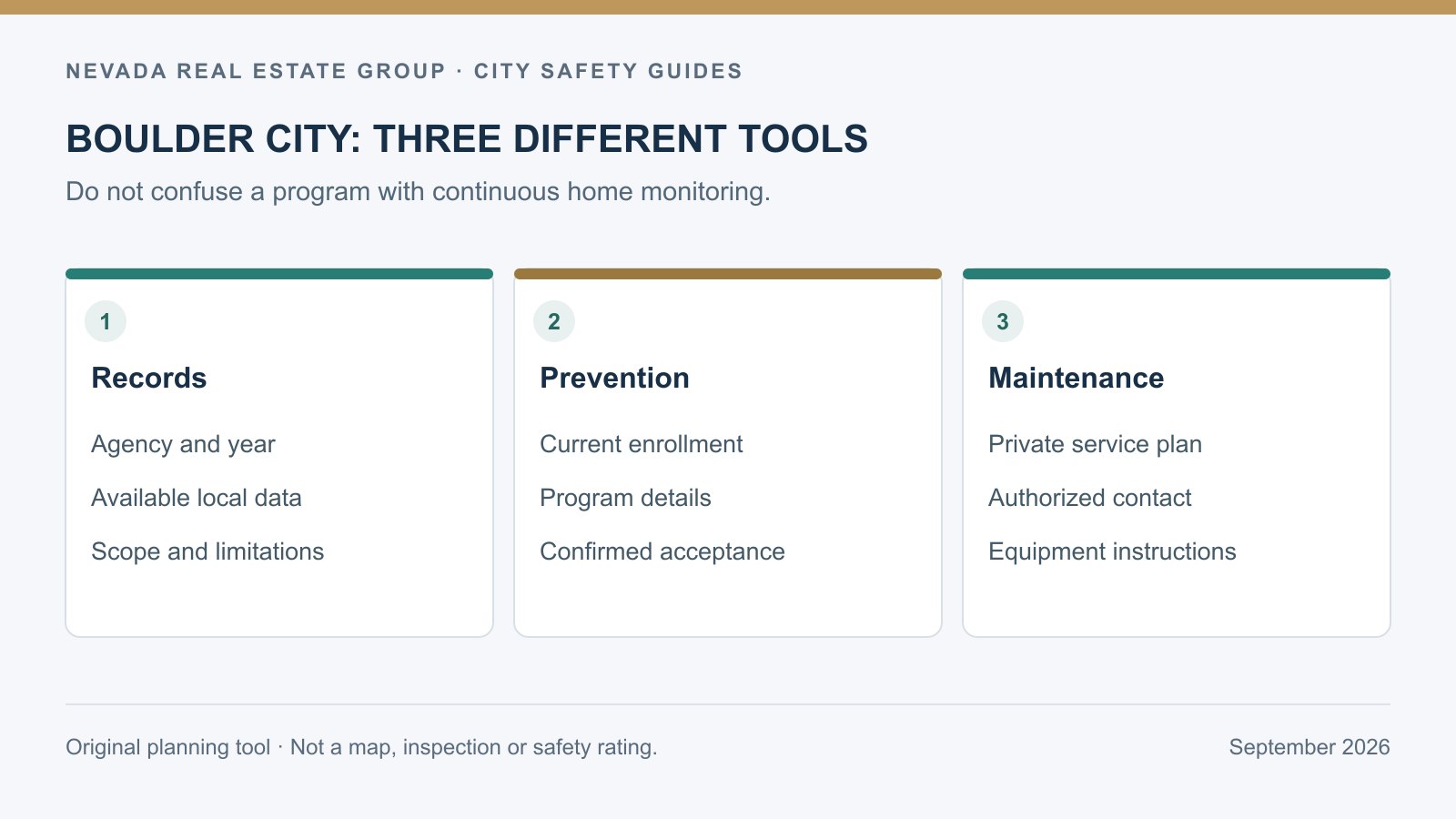
These programs provide ways to participate and ask informed questions. They do not justify a blanket “safest” label. In a purchase file, note which service is merely available, which one you have contacted and which arrangement has actually been confirmed. That distinction makes the information usable once you move in.
Can you identify the safest Boulder City neighborhood from a ranking?
This review does not establish a defensible neighborhood ranking. According to the FBI's longstanding caution against ranking places by crime figures alone, simple comparisons can omit factors needed to understand local conditions. That methodological warning is not a new Boulder City statistic, but it explains why raw totals should not become a verdict about every household.
A more useful approach separates preference from evidence. You may prefer a particular street layout, lot size, architectural style or proximity to activities. Those preferences can guide a search without becoming claims about the safety of residents or neighborhoods. Do not use price, age restrictions, demographic composition or the presence of gates as a shortcut for crime data.
Our Boulder City neighborhood guide can help organize housing choices. When you turn that list into visits, apply a consistent checklist: current incident information where available, the approach to the property, lighting, access, observed maintenance and the inspection questions raised by the actual house. Record observations separately from conclusions.
A useful note says the driveway has limited sightlines when backing out and needs another look at a busier time. An unhelpful note says an entire area “feels unsafe” without explaining a relevant condition. Specific observations can be checked and discussed; broad labels often cannot.
If the choice is still uncertain, revisit the unanswered questions instead of forcing a numerical score. Some can be resolved through a specialist, written record or second visit. Others may remain uncertain. The goal is a transparent housing decision using the same standards across properties, rather than a manufactured list that implies knowledge the available evidence does not provide.
What should you inspect in an older or substantially remodeled home?
Evaluate the home's actual condition, whether the listing emphasizes original character or recent renovation. An attractive room does not show the condition of wiring, plumbing, roof assemblies or prior alterations. Ask the inspector which systems were accessible, what was tested and which findings need a specialist. A general inspection should not be described as a certification that no hidden issue exists.
For additions or converted spaces, request the relevant records and ask the appropriate city office how to verify the work. Match the documents to the property and the work performed. A permit for one improvement does not establish approval of every change, and an old inspection report does not describe all subsequent alterations.
Follow the route you will use daily: parking, entry, kitchen, bathroom, sleeping area and outdoor space. Check steps, thresholds, door operation and useful lighting. If your household needs particular accessibility features, measure and test those features with the right professional rather than relying on “single story” as a complete answer.
Keep repair decisions concrete. Identify the condition, the recommended investigation, the person responsible and the timing. A seller's proposed repair deserves a written scope and whatever completion evidence the transaction requires. Do not let a cosmetic improvement silently substitute for correcting the issue that generated the recommendation.
Our desert home-inspection guide explains questions relevant to Southern Nevada systems; it is not a Boulder City inspection report. Combine general preparation with the findings for the exact address. The Boulder City housing guide can help with the separate search context, while condition and access remain property-level questions. A newer house still deserves the same careful review of installed equipment, incomplete work and documentation.
How should you test walking and cycling routes from a prospective home?
Start with a real destination rather than a radius on a map. If you expect to walk to a shop, ride for recreation or reach a community activity without driving, trace that specific route. Note intersections, sidewalk continuity, grade changes, lighting and the places where you would need to cross vehicle traffic. A short distance can still involve an inconvenient or unsuitable crossing for your needs.
Visit under conditions that resemble your intended use, while observing traffic rules and staying in public areas. A quiet weekday showing does not document a busy weekend, darkness or an event. You do not need to claim a route is universally safe to decide whether it works for your own mobility, equipment and schedule.
Treat a trail outing separately from an errand. According to the National Park Service's Lake Mead safety guidance, visitors should plan for weather and changing outdoor conditions. Check the official information for the particular destination before setting off. A neighborhood walk and an exposed desert route can require very different preparation.
For a bicycle household, test where the bike will be stored and how it gets from storage to the street. Stairs, narrow gates or a crowded garage may affect whether a seemingly attractive routine is practical. Ask about any association rules that matter, using the current written documents rather than an informal assurance.
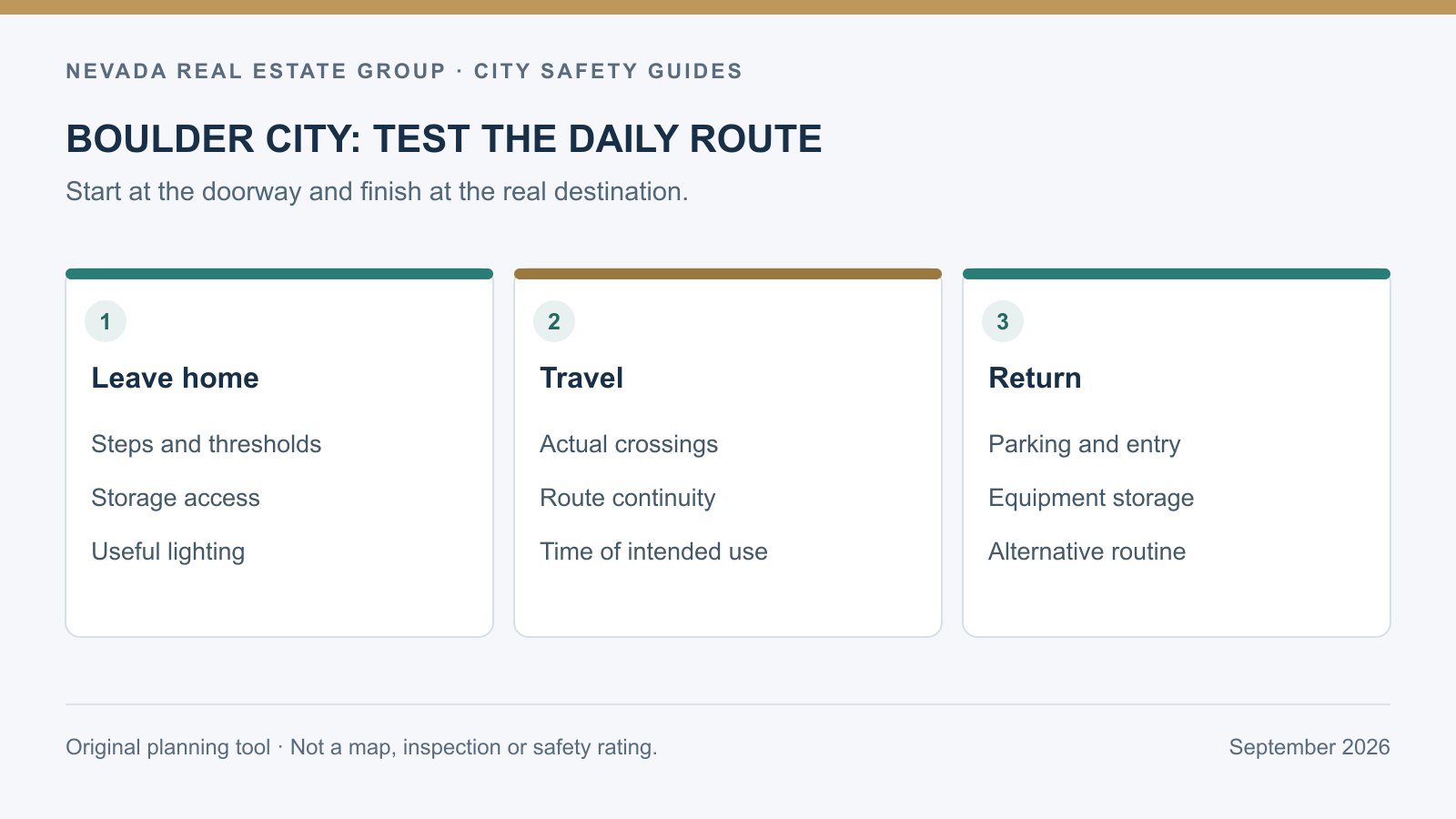
Save the route observations beside your broader Boulder City lifestyle comparison. Recheck a critical route if your schedule or needs change. The purpose is to verify a workable daily routine, not to label all pedestrians, cyclists or nearby residents by a citywide score.
What belongs in a Lake Mead and desert recreation plan?
A home near recreation does not remove the need to prepare for each outing. According to National Park Service safety guidance for Lake Mead, lake levels change, shoreline conditions require caution and rangers recommend wearing a life jacket even while swimming. Use current park information for your destination and activity, including any restrictions or closures in effect when you go.
These are recreation-area considerations. They should not be added to Boulder City Police crime totals or used to imply that an incident in a large recreation area describes the street where you are buying. Conversely, a favorable residential impression does not establish that a boating, swimming or backcountry trip is low risk.
Plan the outing before loading the vehicle. Identify the destination, route, forecast, equipment and person who knows your intended return. Check the applicable guidance for the activity rather than assuming yesterday's conditions persist. If a plan depends on a launch, trail or facility being open, verify that item directly before leaving.
For buyers with boats, trailers or outdoor equipment, the home search also needs a storage plan. Measure the usable space, gate opening and maneuvering area. Review written restrictions and determine whether the property can accommodate the actual equipment without obstructing normal access. A listing photograph with a parked trailer does not confirm every future storage use is permitted or practical.
Keep the home side of the plan straightforward: secure equipment, retain identification and insurance records, and leave access routes usable. When comparing Boulder City homes by budget, treat suitable storage and access as features to verify, not reasons to infer a safer neighborhood. This separates the appeal of outdoor living from the evidence needed to carry it out responsibly.
How do heat, drainage and utility interruptions affect the decision?
According to the National Weather Service's heat guidance, people should monitor conditions and use cooled indoor spaces during extreme heat. For a homebuyer, that makes the condition and operation of the cooling system a practical inspection topic. Ask about service records, installed equipment and any findings requiring specialist evaluation. A thermostat display is not a complete performance assessment.
Review how the house is used during an interruption. Confirm the utility contact route for the address, identify an alternative cooled location if needed and keep essential household information accessible. If someone depends on powered equipment, make an appropriate plan with the relevant professionals. Do not assume a nearby service location guarantees a particular restoration or emergency response time.
For local map research, Boulder City GIS links official interactive resources and a Public Works contact. The city labels its map data as reference material, not a legal design or completeness guarantee. Ask which layer or additional record answers your parcel question. Drainage deserves a separate review. Look at the approach, low points, retaining features and water paths around the building, then ask what maps, plans or professional assessment are appropriate. A dry-day photograph cannot establish storm performance. Nor does a desert setting eliminate the need to ask an insurer about the specific property's exposure and coverage.
| Condition | Property evidence | Practical follow-up |
|---|---|---|
| Cooling | Inspection and service records | Confirm operation and repair needs |
| Drainage | Maps, grading information and site observations | Ask qualified sources about uncertainty |
| Utility interruption | Actual provider and installed equipment | Keep contacts and a household fallback |
| Access | Entry route and gate operation | Test authorized entry and exit |
Our Nevada flood-zone and insurance guide can help frame the insurance conversation. Obtain answers for the actual address and intended use. Keep inspection findings, coverage questions and emergency planning separate so that completing one does not mistakenly appear to resolve the others.
What should you verify about driving, parking and emergency access?
Drive the routes that matter to your household, including the approach from your usual direction. Observe turns, visibility, parking arrangements and the final connection to the driveway. If a showing occurs at an unusually quiet time, consider a second visit that better reflects your schedule. Avoid inventing a universal commute time from a single trip.
According to Nevada Department of Transportation travel information, Nevada 511 provides road-condition information. Use the current service before a trip and check relevant restrictions or disruptions. A navigation estimate is a planning tool, not a guarantee that a particular road will remain open or travel will take the same time every day.
At the property, confirm how a visitor or authorized responder would identify the address and reach the entry. Ask about controlled gates, shared drives and any arrangement that requires an access code. Do not publish private codes in a public listing or shared article. Keep authorized contacts informed when access arrangements change.
Inspect the usable parking layout with the vehicles you actually own. A garage's advertised capacity may not answer questions about equipment, storage, door clearance or maneuvering. Preserve a clear path through the spaces you need every day. Have the appropriate professional evaluate any proposed changes rather than assuming an alteration will be simple.
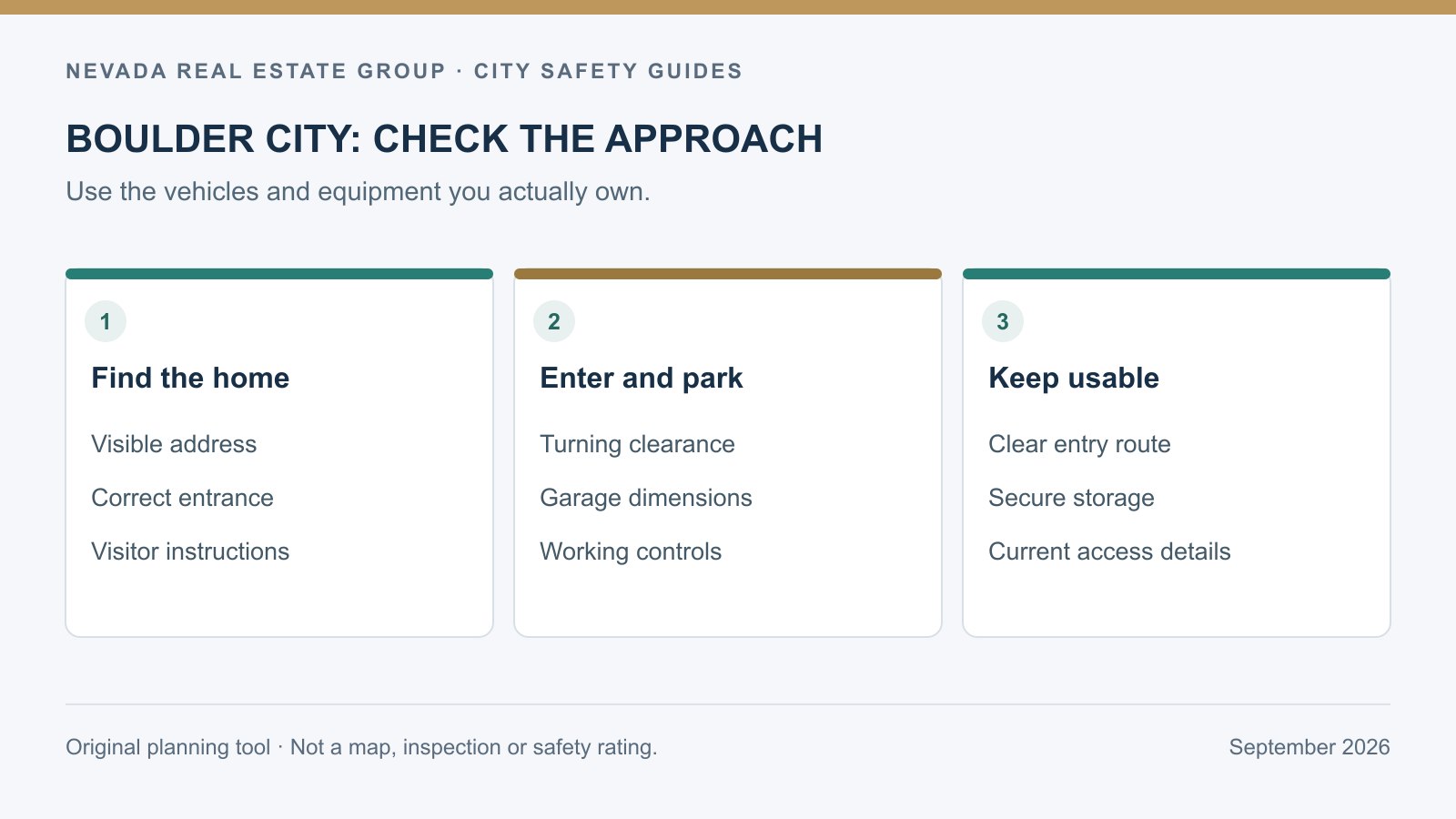
For a retirement move, consider how the route works if driving becomes less convenient. Our Boulder City retirement guide provides broader housing context. The safety review should still use the actual route and property conditions, without promising a response time based on distance to a station or facility.
How can you compare two Boulder City homes without a misleading score?
Use a short comparison sheet with evidence and unresolved questions instead of a single safety grade. A grade can hide the difference between a repairable lighting problem, an unknown drainage issue and a preference about street layout. Those conditions require different decisions and should remain visible throughout the purchase process.
For each property, retain the same headings: police-source review, inspection, access, drainage, cooling, storage and routine. Write what was observed, who verified it and what remains to be checked. Include the date. A source reviewed for one house should not be silently reused for another address with different circumstances.
| Topic | Home A evidence | Home B evidence | Decision needed |
|---|---|---|---|
| Daily route | Record actual visit | Record actual visit | Which routine works? |
| Condition | List inspection findings | List inspection findings | Which follow-up is material? |
| Access and storage | Measure usable space | Measure usable space | What needs changing? |
| Uncertainty | List unanswered questions | List unanswered questions | What must be resolved first? |
Costs belong in a companion budget. Use actual inspection recommendations and written quotes where available rather than a speculative average. Our Boulder City cost-of-living guide can organize broader expenses, but it cannot price a repair or insurance policy for an uninspected house. Avoid turning a lower asking price into an implied safety discount or a higher price into a safety guarantee.
If a material question cannot be answered within the available time, discuss the options with the relevant transaction professionals. The record should clearly distinguish a verified condition, an estimate and an assumption. A good comparison allows another household member to understand the decision without having attended every showing or conversation.
What should be ready when you move into the home?
Before move-in, collect the documents needed to operate the house: manuals, service contacts, access arrangements and any outstanding work record. Confirm which keys, controls and equipment transfer, and follow appropriate professional guidance for changing or resetting access. Test the routine with the people who will use the home rather than assuming everyone received the same explanation.
Set up a practical place for important information that does not depend on a single device. Keep the address, utility contacts and relevant instructions available. Review how the household would respond to an equipment failure, an unexpected absence or a changed travel plan. The details should follow the actual systems installed, not a generic promise that a smart-home product handles everything.
If you intend to use a city prevention program, confirm the enrollment separately. Record what the program provides and who handles the duties outside its scope. For a seasonal absence, identify the person who can enter, whom they should contact and what authority they have to arrange necessary help. Securely share only the information they need.
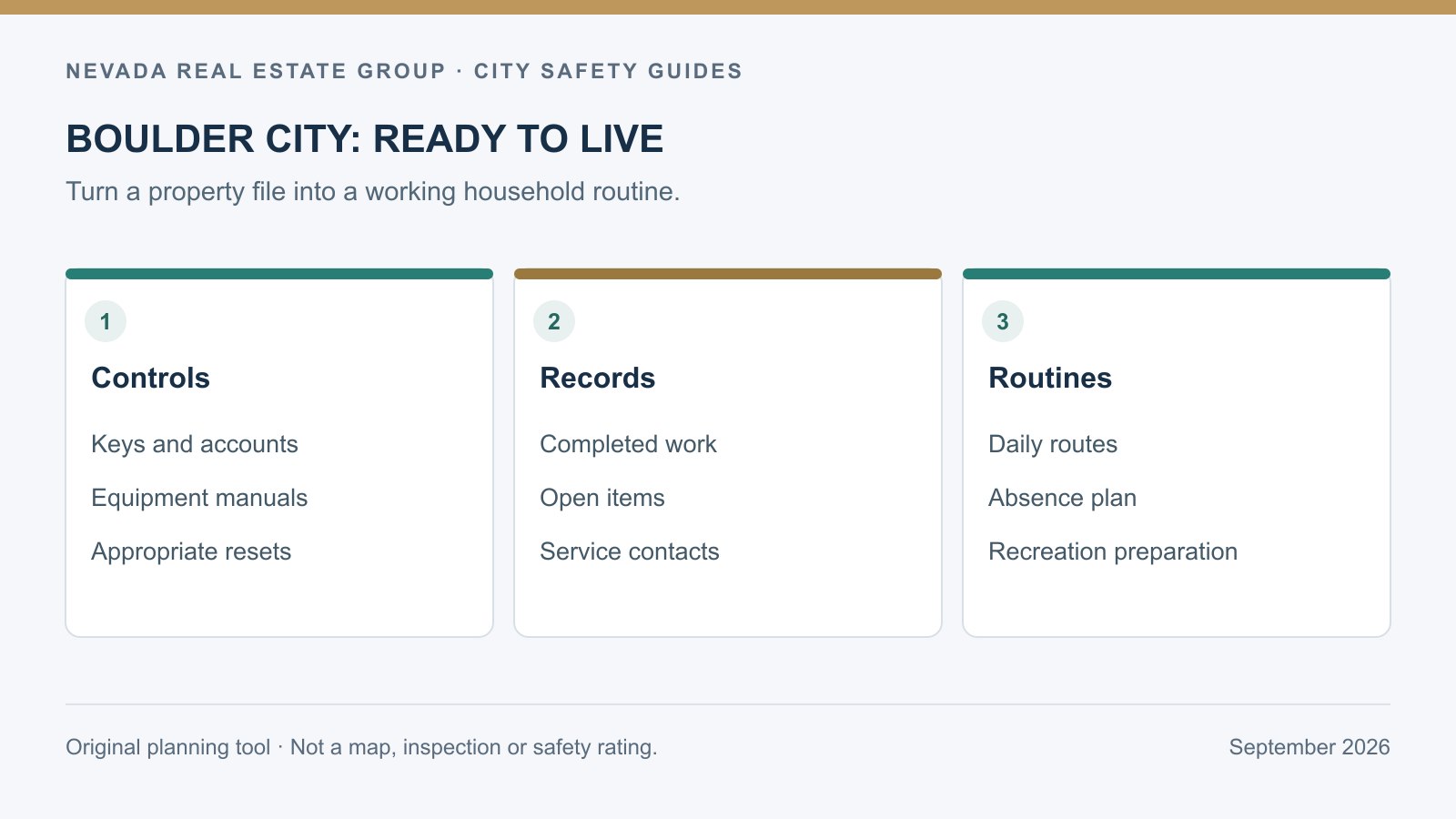
Revisit the plan when household needs or equipment change. A file that accurately reflects the house today is more valuable than a stack of outdated assurances. The objective is informed ownership, with clear follow-up for known issues and honest limits around what public statistics can establish.
For help organizing a Boulder City search, contact Nevada Real Estate Group or call (702) 637-1759. We can help compare properties and identify questions for the appropriate specialists. We do not certify neighborhoods as safe or substitute a citywide statistic for professional inspections and your own practical review.
Frequently Asked Questions
Is Boulder City completely free of crime?
No. Nevada's official portal reports 24 violent crimes and 129 property crimes for Boulder City Police Department in 2025. Those are reported agency counts within defined themes, not individual household risk. A property's location, condition and daily use still deserve their own review alongside current local information.
Did Boulder City's crime totals improve in 2025?
The results were mixed. The violent theme declined from 27 in 2024 to 24 in 2025, while the property theme increased from 111 to 129. These reported counts do not establish the cause of either change, a lasting trend or the conditions in every neighborhood.
Does Boulder City offer checks while residents are away?
The police department lists a Property Watch program for residents who are out of town. Contact the department for current enrollment, coverage and limitations before relying on it. Keep separate arrangements for maintenance and authorized emergency contacts, and do not assume enrollment establishes continuous monitoring or insurance compliance.
Can I find the safest Boulder City neighborhood from these figures?
These agency totals do not support a neighborhood ranking. Use comparable recent local information where available and inspect the actual property's access, condition and routine. Price, gates, demographic characteristics and architectural style do not establish a defensible crime comparison or guarantee personal safety.
Does living near Lake Mead make recreation automatically safe?
No. Check current National Park Service guidance for the particular activity and destination. Lake conditions, weather and access require their own preparation. Residential police statistics do not measure every recreation hazard, and familiarity with the area is not a substitute for appropriate equipment and current information.
What should a buyer check in an older Boulder City house?
Review the actual inspection findings, service history, alterations and relevant permits. Ask which systems were tested and which need specialist evaluation. Walk the routes through the home and verify access and lighting. Age or a recent cosmetic remodel alone does not determine a property's condition.
What is the most useful first step in a Boulder City safety review?
Start with the exact address and your intended daily routine. Confirm the relevant police source, obtain property records and arrange qualified inspections. Then test the routes and access arrangements you will use. Keep unresolved questions visible instead of allowing a broad city reputation to answer them by default.
Which sources and methods support this Boulder City guide?
Reviewed September 25, 2026. Nevada Crime Statistics reports: Boulder City Police Department 2025 violent, 2025 property, 2024 violent and 2024 property. Category sums and changes were recomputed; these are reported counts, not a completeness certification or per-capita rates.
Other primary sources: Boulder City GIS and map limitations, city police department, crime-prevention programs, FBI ranking caution, Lake Mead safety guidance, NWS heat guidance and NDOT travel information. Diagrams and comparison sheets are original editorial tools, not mapped crime boundaries, inspections or firsthand tour reports. Program details and conditions should be checked again when used.