

The best place to retire in Boulder City is the home that supports your ordinary week: appointments, errands, recreation, household costs and the amount of maintenance you want to manage. A downtown location, a hillside view and a newer floor plan offer different benefits. This October 22, 2026 review connects those choices to official planning resources, dated housing context and a consequential change in local hospital services.
I help retirees weigh exactly this kind of move, and Boulder City comes up often for buyers who love the idea of Las Vegas proximity but want somewhere calmer. Across the more than 9,600 transactions Nevada Real Estate Group has closed, the retirees happiest in Boulder City are the ones who value quiet, history, and Lake Mead over nightlife and master-planned amenities.
Boulder City can fit retirement when its housing, daily routes and care arrangements meet your needs. Compare downtown historic properties, established homes and view-oriented or lower-maintenance options individually. The hospital's notice describes a May 1, 2026 shift to emergency and outpatient care without inpatient admissions. Verify provider access and the complete household budget before treating small-town character or Nevada's income-tax rules as enough reason to buy.
- Choose a property and routine, not a universal “best retirement neighborhood.”
- Historic character can involve additional approval and renovation questions.
- Confirm the hospital service you need and any transfer or specialist arrangements.
- Census home values cover 2020–2024, so price from current asking and closed-sale figures.
- Budget healthcare, transportation, repairs and summer conditions alongside housing.
Is Boulder City a good retirement fit for your daily life?
Start with what you want the move to change. Someone seeking an established downtown setting may value a different property from someone whose priority is a single-level interior, a small yard or a short trip to a particular clinician. Write those requirements before touring. They provide a useful basis for comparing Boulder City with other Southern Nevada options without assuming that every retired household wants the same lifestyle.
According to Section 128 of the Boulder City Charter, gambling is prohibited, with specified exceptions including private social games and certain permitted fundraising activities. That is a municipal rule, not a guarantee about noise, safety or the experience of every street. Inspect the actual setting at the hours you will use it. Traffic, nearby activity and the route to services still matter in a town without casino development.
Try an ordinary week on paper. List the grocery stop, pharmacy, appointments, exercise, social activities and visits to friends or family. Identify which tasks you expect to do locally and which involve travel elsewhere. If the appeal depends on a service or club, confirm its current availability rather than assuming that proximity establishes membership or admission.
Use the Boulder City relocation guide for the broader move and ownership process. This retirement comparison focuses on how a particular home would support your changing routine. A location can be appealing and still fail an essential requirement; finding that out before making an offer is a useful result of the search.
Which Boulder City areas and property types should you compare?
Organize a shortlist by observable features rather than ranking whole neighborhoods. The city's planning maps and publications provide downtown, townsite and city zoning resources. Use them to establish the actual parcel and its planning context. A listing's descriptive area name does not establish legal boundaries, an age restriction, an association or the permitted use of a detached structure.
| Search option | Potential fit | Evidence to obtain | Tradeoff to test |
|---|---|---|---|
| Historic District / downtown vicinity | Character and access to chosen downtown destinations | Historic status, approval requirements, inspection and actual walking route | Renovation constraints, condition and street-level access |
| Established townsite homes | A layout and lot matching an ordinary residential routine | Floor plan, system ages, permit history and travel tests | Upkeep can vary substantially between similar-looking homes |
| Hillside / view-oriented properties | A particular outlook or outdoor setting | Survey, access, drainage, steps and conditions affecting the view | Grades, exterior work and daily travel may matter more than the outlook |
| Condominium, townhome or newer home | A different allocation of maintenance or a preferred interior | Ownership form, association documents, fees and condition | Newer or attached does not automatically mean inexpensive or accessible |
These are search categories, not assertions that every type is currently available at an affordable price. Compare the actual Boulder City homes for sale and note when the inventory was checked. The same property may fit more than one category. A downtown condominium, for example, needs both historic-context and association review if those conditions apply.
Give each candidate a short record: the requirement it meets, the evidence supporting that conclusion, the cost or inconvenience it introduces and the finding that would rule it out. This makes the comparison reviewable by everyone involved. It also keeps a scenic photograph or attractive architectural style from silently replacing the practical criteria that motivated the move.
What should you check before buying a historic home near downtown?
Historic character is a reason to investigate a property carefully. It does not tell you the condition of the roof, wiring, plumbing, cooling equipment or foundation. Arrange an appropriate inspection and obtain available repair and permit records. Separate work you would like to do from work needed for safe, reliable everyday use, and price the latter before committing the renovation budget elsewhere.
According to the city's historic-preservation resources, the available tools include a historic-district map, exterior design guidelines, a Certificate of Appropriateness application and an approval matrix. Ask Community Development how the current requirements apply to the exact parcel and proposed work. Do not rely on an old FAQ or an assumption that every exterior change is unrestricted. This guide has not obtained a parcel-specific approval determination.
Walk the route between the front door and the places you expect to visit. Check surfaces, crossings, shade, lighting, grades and the distance you personally find manageable. “Near downtown” is not a complete accessibility assessment. Repeat the visit when traffic and weather resemble the conditions you would encounter in daily life, and consider how the route works if carrying groceries or using a mobility aid.
The right historic home can combine a preferred setting with a workable maintenance plan, but an unsuitable layout may require changes whose feasibility is uncertain. Make any essential adaptation part of the decision before the purchase, not a hope to resolve afterward. The Boulder City hub helps orient the search; inspection, planning and property records establish what the individual home can support.
How do you evaluate a lower-maintenance or age-qualified alternative?
Define the work you want someone else to handle. Exterior painting, roofing, landscaping, pools and shared systems may be allocated differently among detached houses, condominiums and townhomes. Read the actual governing documents and budget. A monthly association charge can buy useful services, but it does not establish that every repair is covered or that a future special assessment is impossible.
Look at the interior as carefully as the exterior obligations. Check the route from parking to the living area, thresholds, stairs, bathroom arrangements, storage and the ability to manage essential rooms on one level. A property advertised as single-story can still have steps at entrances or outdoor areas. Obtain measurements relevant to your needs instead of relying on a broad accessibility label.
For an age-qualified community, verify the actual occupancy rules and application process. The federal framework in 24 CFR 100.305 includes an at-least-one-55-or-older occupant requirement for at least 80% of occupied units, alongside other requirements. That does not create a right to occupy the remaining units or replace a community's governing rules. Age qualification also does not promise particular care, amenities or maintenance services.
If Boulder City's available properties do not satisfy your requirements, compare Southern Nevada 55-plus communities and specific alternatives such as Sun City Anthem. Keep the same budget and document checklist. Broader new-construction options can expand the search, but delivery dates, included features, ongoing costs and the actual contract require their own verification.
What do the housing numbers and growth rules actually tell you?
According to Census QuickFacts for Boulder City, the median value of owner-occupied homes was $435,600 in the 2020–2024 estimates. This is historical occupied-housing context. It is not the median price of homes sold in October 2026, the asking price of current inventory or a valuation of the home you are considering. Keep the period and measure attached whenever you use it.
This review does not establish a current representative Boulder City closed-sale median. For a purchase, request recent comparable transactions matched to the property type, size, condition and location, with their dates and sample size. A small group of unusual sales can move a reported median substantially. Compare asking prices separately and check whether an advertised property is still available before building a plan around it.
The city's Community Development department confirms that it administers growth-control requirements. Its planning FAQ distinguishes development-allotment situations and owner-builder treatment. Ask the city about the current rules for a proposed project. A growth-management process does not prove that every home will appreciate, sell quickly or resist a market decline.
Use the Boulder City housing-market guide as a related topic and the live home search for current for-sale possibilities. Neither a historic city value nor a scarcity narrative substitutes for a documented property comparison. If a home would only fit after an addition or conversion, investigate that proposal before assuming its future space belongs in the purchase decision.
How can you build a realistic Boulder City retirement budget?
Build the plan from actual income, expenses and property quotes. Start with spendable monthly income after applicable taxes and deductions, then include housing, healthcare, utilities, transportation, food and the things you intend to keep doing. A paid-off home still requires taxes, insurance, maintenance and sometimes association charges. Avoid using a retirement-account withdrawal amount as though it were automatically the same as spendable income.
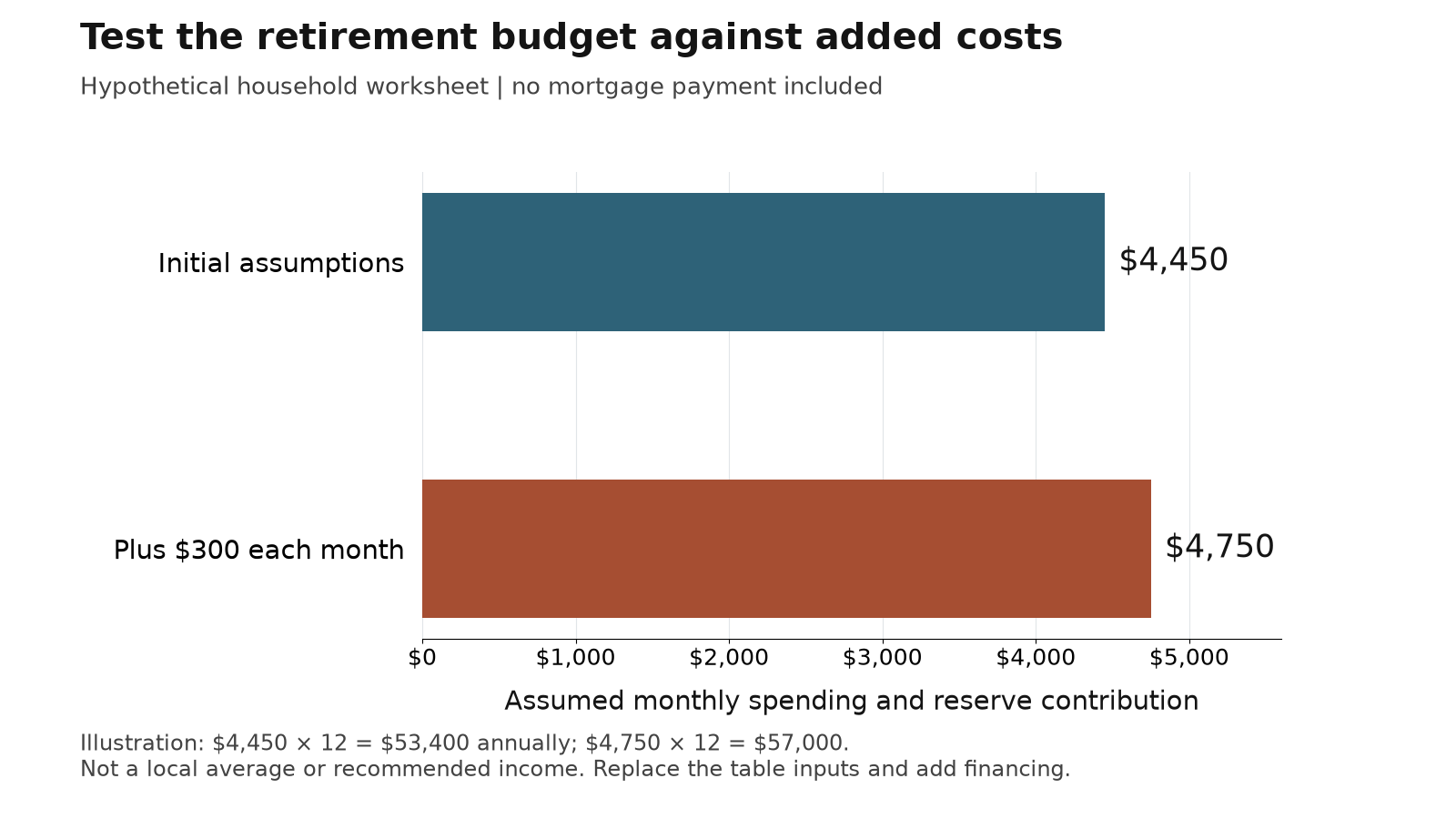
The following October 2026 worksheet uses invented inputs for a household without mortgage principal and interest. It is an arithmetic example, not a typical Boulder City couple, a minimum retirement income or an observed client budget. Replace each amount and add omitted costs. If you will finance the purchase, include the actual payment without counting escrowed taxes or insurance twice.
| Category | Assumed amount | Replace with |
|---|---|---|
| Housing taxes, insurance, upkeep and applicable dues | $1,250 | Property records, quotes and repair plan |
| Utilities and communications | $350 | Property use and service terms |
| Food and household purchases | $800 | Actual household spending |
| Healthcare | $700 | Coverage, prescriptions and out-of-pocket planning |
| Transportation | $450 | Vehicles, insurance and actual routes |
| Recreation, travel and other spending | $500 | Your intended routine |
| Separate reserve contribution | $400 | Your repair and contingency plan |
| Total | $4,450 | $53,400 annually under these assumptions |
Test a less comfortable version too: a repair, higher insurance, additional appointment travel or a temporary need for paid help. For illustration, adding $300 a month to the worksheet produces $4,750 monthly, or $57,000 annually. That is a sensitivity test, not a forecast. Decide which spending is flexible and which obligations would remain even if investment income or household circumstances changed.
How should Nevada taxes enter the retirement decision?
According to Nevada's Department of Taxation, Nevada has no individual state income tax. That distinction can matter for retirement income, but it does not eliminate federal tax, property tax, sales tax or obligations another state may retain. Compare the actual household income mix and move date rather than multiplying every dollar by another state's highest marginal rate.
For a California move, the FTB's part-year and nonresident guidance explains distinctions involving resident periods and California-source income. A Nevada address alone does not resolve every residency or income-source question. Have a qualified adviser review the facts that affect your plan, particularly when retaining a business, property or work connection in another state.
According to the Clark County Assessor's partial-abatement guidance, qualifying primary residences may receive the 3% annual tax-bill increase cap, subject to the program's rules and exceptions. It is not a 3% property-tax rate or a promise that every part of a future bill cannot change. Confirm the parcel's status and ownership/occupancy documentation after a transfer instead of assuming the seller's situation establishes yours.
Keep the comparison in dollars using your actual prior-state liability and the property's documented carrying costs. If a tax saving is offset by additional care, travel or housing expenses, the full budget should show it. Avoid treating the tax structure as a recommendation for every retiree; it is one input alongside the practical requirements that determine whether the home works for you.
What changed at Boulder City Hospital in 2026?
According to Boulder City Hospital's transition notice, the facility announced a Rural Emergency Hospital model effective May 1, 2026, retaining emergency and outpatient services while ending inpatient admissions. The notice describes transfers when inpatient hospitalization is required. This is a material distinction for someone choosing a retirement location; a familiar hospital name does not establish that all former services remain available.
The hospital's emergency-services page lists round-the-clock emergency care at 901 Adams Boulevard. Its service pages and the transition notice should be read together, since some older descriptions discuss a broader inpatient model. Confirm the particular service and arrangements you need directly. This guide has not independently audited licensing, staffing, capacity or an individual's admission pathway.
The practical approach, which I advise every retiree client, is to confirm your specialists and plan networks cover the Henderson and Las Vegas facilities you would use. Write down the relevant providers, appointment locations, prescription arrangements and transfer questions before choosing a property around assumed medical convenience. A planned specialist appointment and an emergency response are different situations; a routine driving estimate is not an emergency-care guarantee.
For a life-threatening emergency, call 911. For relocation planning, ask your current care team how records and ongoing treatment should transfer, and verify future appointments and coverage with the appropriate providers and insurer. Being close to a building is useful only when the care arrangement you need actually works. This article is a housing decision guide, not an assessment of clinical quality or personal treatment advice.
How do Medicare and insurance changes affect the move?
Review coverage before coordinating the home purchase and moving date. A provider's presence in a region does not establish that the provider participates in your particular plan, accepts new patients or offers the appointment schedule you need. Check both the insurer and the provider, including the exact plan and service location. Keep confirmation details with the rest of the move records.
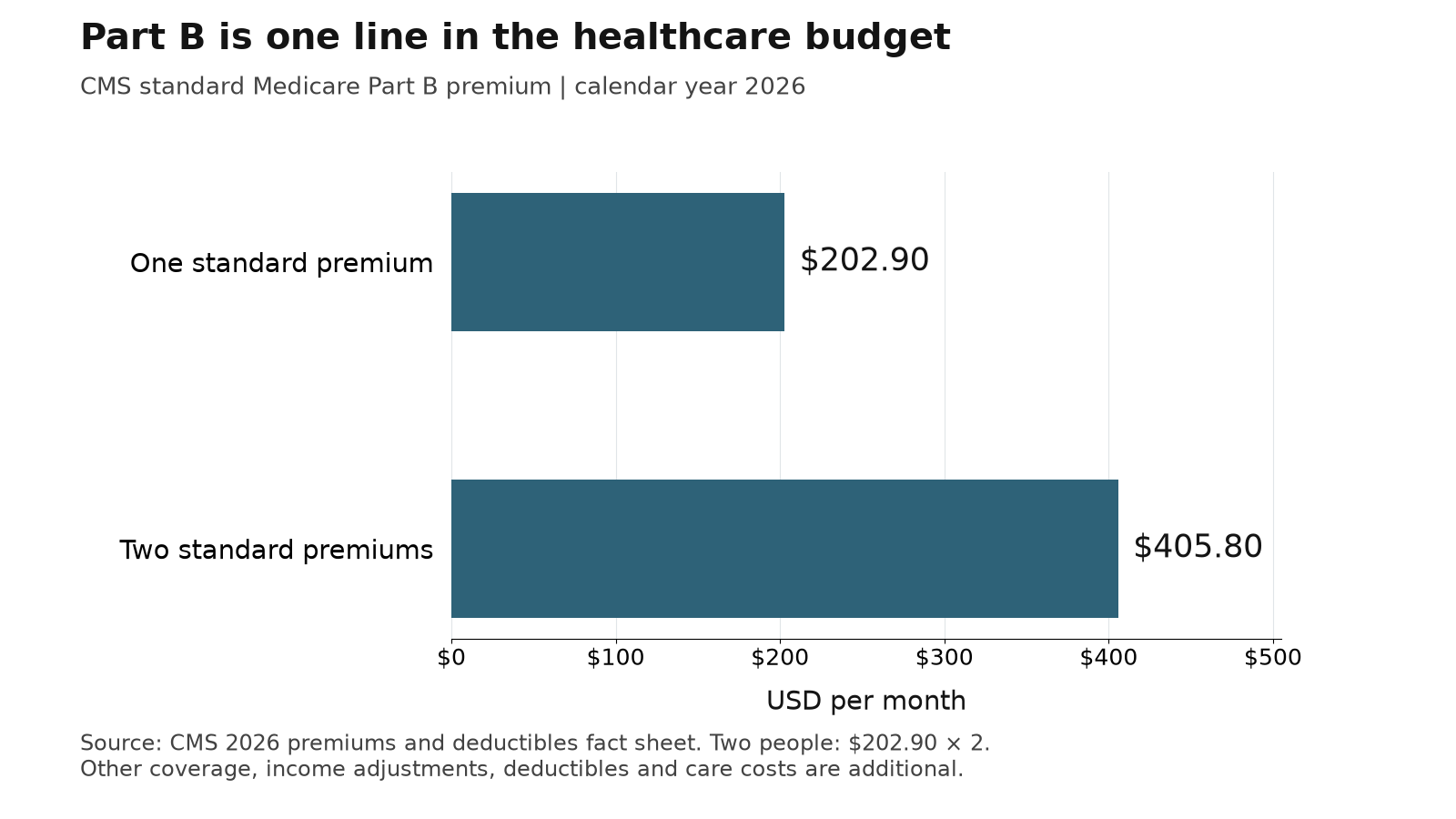
According to CMS's 2026 premium and deductible fact sheet, the standard Part B premium is $202.90 per month in 2026, with a $283 annual deductible. Income-related adjustments and other coverage costs can change a person's total. Two people each paying the standard premium would pay $405.80 monthly for that premium line alone; it is not a complete two-person healthcare budget.
Medicare's moving-related enrollment guidance describes special enrollment opportunities when a move affects the plan's service area or options. Timing depends on the circumstances and notification. Review the applicable rule before moving; do not assume that a Medicare Advantage change automatically settles Medigap eligibility or every other coverage question.
Include prescriptions, dental or vision arrangements where relevant, cost-sharing and travel in your household plan. Keep calendar-year amounts attached to their year and recheck them for a later move. If you are not Medicare eligible, obtain the applicable coverage comparison instead of borrowing a Medicare example. The useful number is the cost of the actual coverage and care you expect to use, with a plan for uncertainty.
What transportation and local support should you verify?
Record the trips you actually expect to make, including those outside Boulder City. Test them at the relevant time and include parking, walking and time inside the destination. A single “minutes from Las Vegas” statement cannot describe every clinic, airport trip or shopping stop. Consider the arrangement if you prefer not to drive, a vehicle is unavailable or your needs change later.
According to Lend A Hand of Boulder City's service information, the organization offers transportation and other support for eligible local residents, with assessment and service matching. Its transportation description includes medical trips in the Las Vegas Valley and local errands. Confirm eligibility, scheduling, assistance and availability before relying on it. A published service description is not a reserved ride or unlimited capacity.
The city's local assistance directory also identifies Senior Center meals and activities and Silver Riders transportation. Use these as contacts to investigate the routine you want. Current schedules, eligibility and service boundaries should be confirmed with the provider. No application or booking was made for this review, and the guide does not certify an individual's entitlement to support.
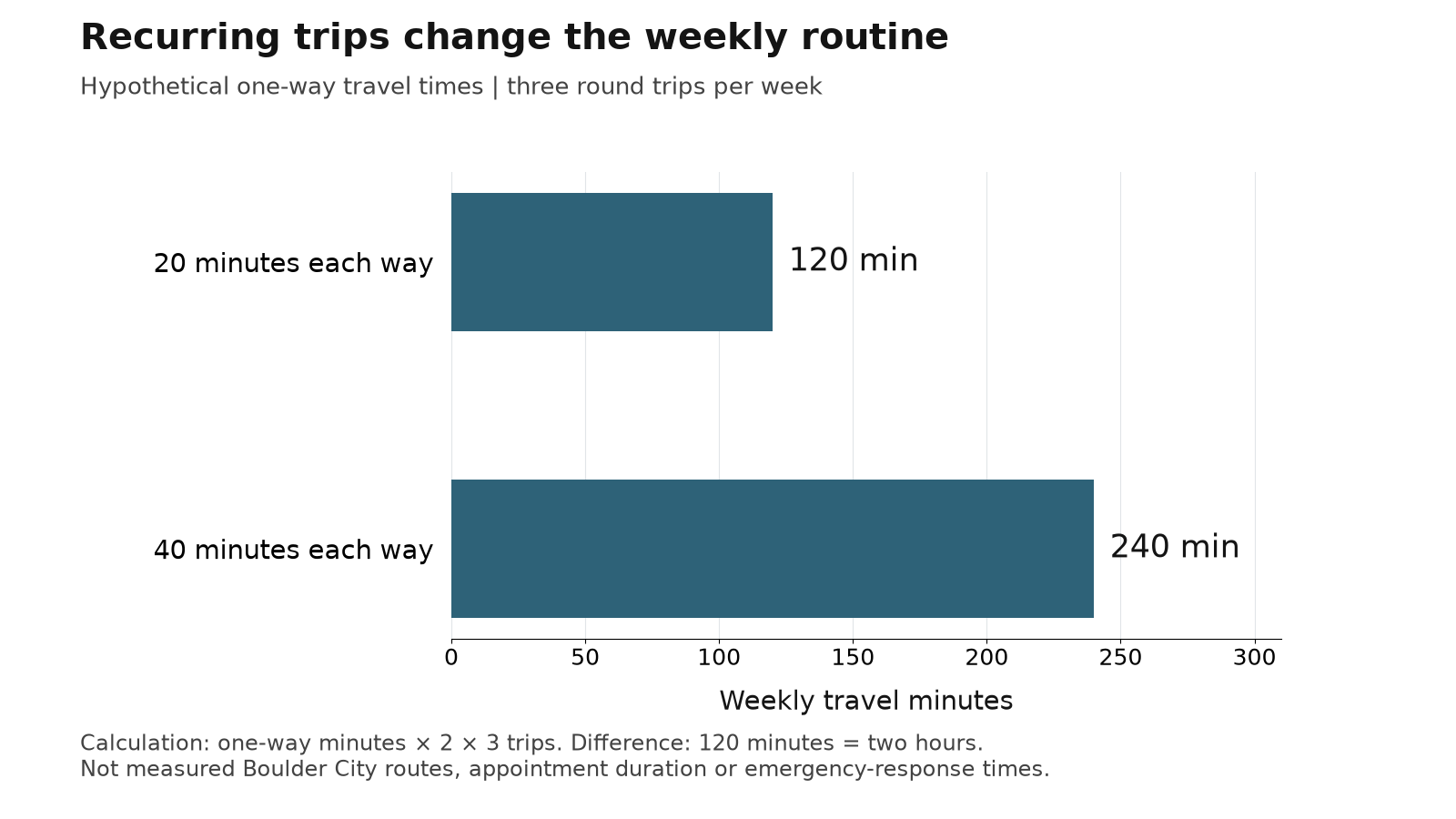
Calculate recurring travel separately from an occasional excursion. In a hypothetical week with three round trips, a 20-minute journey each way totals 120 minutes; a 40-minute journey totals 240 minutes. That two-hour difference is not a measured Boulder City route. It demonstrates why a home that is attractive on a map can carry a materially different weekly commitment once your actual destinations are included.
How can Lake Mead recreation fit a regular retirement routine?
Choose the activity and access point before deciding how close a home feels to the lake. Walking, shoreline access, boating and a scenic drive involve different equipment, surfaces and costs. Check the route from the property to the place you will actually use, including parking and the distance beyond it. A lake view from a home does not establish convenient or accessible shoreline access.
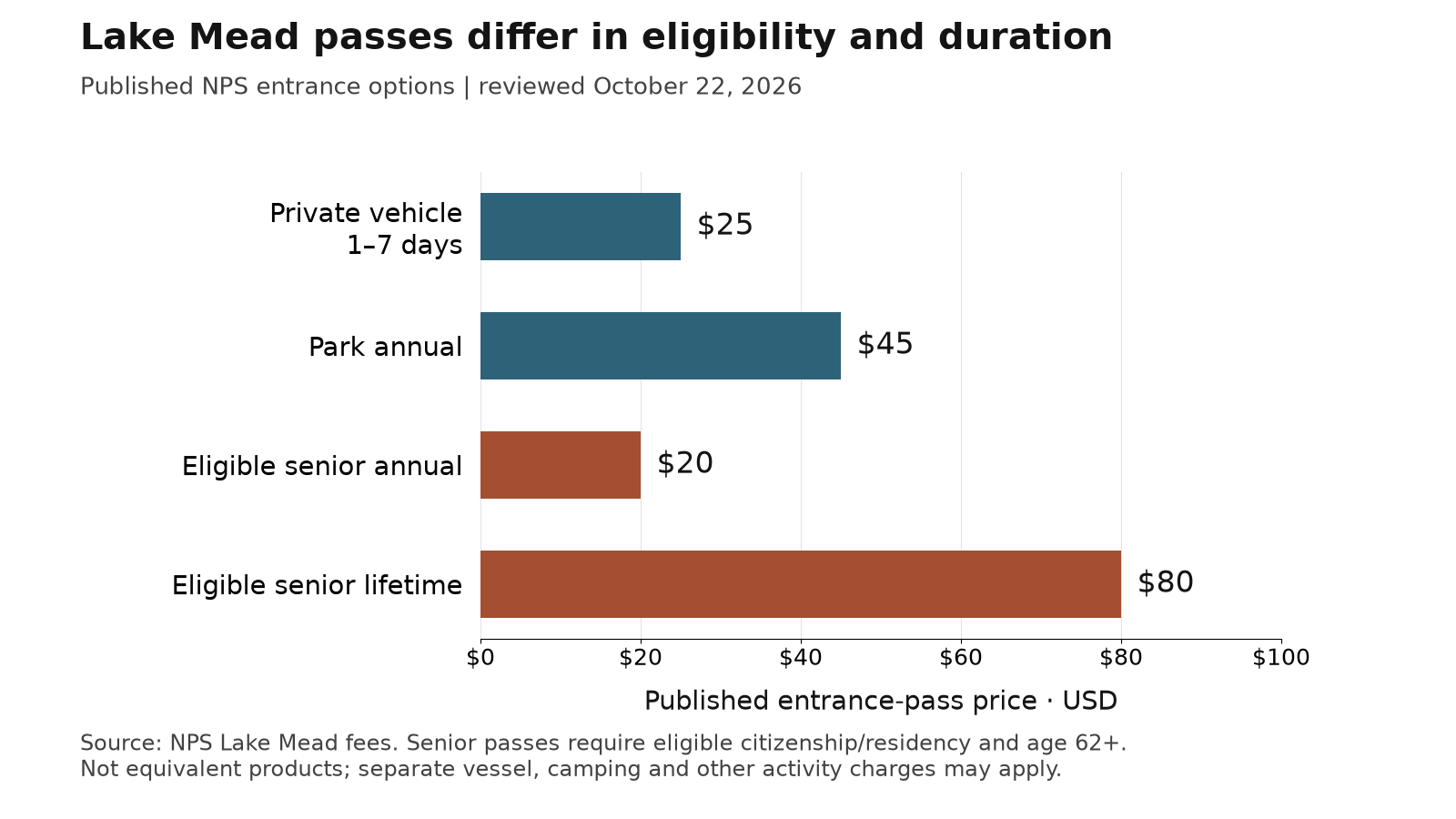
According to NPS's Lake Mead fee schedule, reviewed October 22, 2026, private-vehicle entrance costs $25 for one to seven days. The page lists a $45 park annual pass and eligible senior annual/lifetime passes at $20/$80, with citizenship/residency and age requirements. Choose a pass based on actual eligibility and use. Entrance does not cover every vessel, campsite, concession or other activity charge.
The Historic Railroad Trail description provides surface and accessibility context and warns about exposed summer conditions. Plan the segment you can comfortably use rather than assuming the entire route suits everyone. Ask about current conditions and any specific access needs. An “easy” rating is a general trail description, not a personal assessment or a promise that heat will be manageable.
For boating or shoreline plans, check NPS alerts and conditions close to the visit. Changing water levels and temporary closures can affect access. Decide how much of the retirement appeal depends on those activities and what you would do when weather or conditions interrupt them. A practical recreation plan includes alternatives and the cost of participating, not just a list of nearby attractions.
How should summer conditions affect your housing choice?
Evaluate the home and routine under demanding conditions, not only during a pleasant visit. Ask for available utility-use records, equipment ages, maintenance history and repair information. Look at shade, window exposure, the route from parking and the spaces you expect to occupy. An efficient-looking exterior is not evidence of a particular cooling bill or of how the interior performs during sustained heat.
According to the CDC's clinical overview of heat, older adults and some people with medical conditions or medications can face additional heat-related risks. Discuss personal planning with your clinician. This guide does not claim that dry weather improves joints or that being near Lake Mead makes summer heat harmless. A climate preference and a health plan are separate decisions.
Create a practical plan for interrupted cooling or transportation: whom you would contact, where you could go and how essential needs would be managed. Confirm the household's own arrangements rather than assuming a neighbor, club or public facility will always be available. Include pets and any equipment that depends on power in the discussion where relevant.
NPS's current conditions page distinguishes trails subject to seasonal closure from routes that remain open; an open trail is not proof of safe conditions for every visitor. Match activities to the forecast and official guidance. For the home purchase, a documented cooling and access plan matters more than an unsupported claim that Boulder City is always a few degrees more comfortable than another part of the valley.
How can you assess safety without relying on a townwide label?
Use defined evidence and property-specific observation. This review has not verified a current comparable city crime rate or a national safety ranking for Boulder City. A small population, a quiet visit or a no-gaming rule cannot establish that a particular household will be safe. Ask what incidents are counted, the reporting period and geography whenever someone presents a statistic as a deciding reason to buy.
At the property, examine the features relevant to your daily use: lighting, entries, locks, exterior steps, visibility, parking and the route between the car and home. Ask the inspector about hazards within the scope of the inspection. Separate a repairable issue from a location or layout problem that would persist even after spending money. Do not substitute a neighborhood reputation for that assessment.
Review environmental and access questions through the appropriate property records, insurer and local authorities. Ask about drainage, any required coverage and how an interruption of your usual route would affect essential travel. This guide has not completed a parcel hazard determination. The purpose of the checklist is to identify the evidence you need for the specific home, not to assign a blanket risk rating to a community.
Include scam and transaction safeguards in the purchase process. Verify important instructions through known contacts, review the actual contract and seek qualified advice when a term or document is unclear. A sound retirement move joins the financial plan with the practical conditions you can examine. No article, scenic photograph or townwide adjective can guarantee the outcome for an individual property.
How does Boulder City compare with Henderson for retirement?
Compare actual homes that meet the same requirements. If the priority is a particular specialist or association service, the location of that provider or amenity may matter more than the city label. If the priority is a historic setting or a specific recreation route, investigate those features directly. Avoid assuming that all Henderson homes belong to resort-style communities or that every Boulder City home offers the same downtown access.
| Requirement | Compare in each candidate home | Finding that can change the choice |
|---|---|---|
| Care continuity | Named providers, coverage, appointment sites and transfer questions | The required service or plan arrangement does not work |
| Manageable upkeep | Actual condition, maintenance allocation and recurring charges | Unfunded repairs or responsibilities exceed the household plan |
| Daily access | Measured personal routes, surfaces and transportation alternatives | Essential trips cannot be managed reliably |
| Recreation and community | Specific activities, membership rules and seasonal availability | The desired activity is unavailable or impractical to use |
Many of my retiree clients tour both, and the choice usually comes down to whether they want small-town quiet or master-planned convenience. For your own comparison, test those descriptions against the actual homes and documents. The Henderson retirement guide supplies a separate community and carrying-cost framework; it does not decide which city is right for every household.
Keep the budget consistent across the shortlist, including financing, insurance, dues, repairs and travel. If considering luxury communities or Summerlin as well, use the same method. A higher purchase price can buy a feature you value, but it should not hide an unresolved maintenance or care-access requirement. Decide which tradeoff you are willing and able to carry over time.
What should you complete before committing to the move?
Bring the property, household and timing records together. Identify the home features that are essential, the documents still missing, the quotes that have expired and the decisions that depend on another sale or a coverage change. A promising tour is a starting point. The purchase becomes reviewable when the important assumptions have supporting evidence and the remaining uncertainties have a realistic plan.
Use an extended visit or rental only if its terms and cost fit your situation. Spending ordinary days in Boulder City can reveal routes and preferences that a brief tour misses, but a rental also creates obligations and possible overlap with a purchase. Read the lease and coordinate dates rather than assuming flexibility. A visit cannot establish how every future season or health need will work.
Before making an offer, resolve essential inspection, insurance, financing, association and planning questions within the transaction's actual deadlines. If selling first, separate expected sale proceeds from money already available and allow for the costs of both moves. Keep a reserve that is not simultaneously counted as a down payment, repair fund and ordinary living cash. The buyer resources and seller resources explain the transaction topics to organize.
When you are ready to compare properties, bring the budget and must-have criteria to a conversation with our team, call (702) 637-1759, or browse Boulder City homes. The Las Vegas-area moving guide covers broader relocation logistics. The goal is a documented choice that fits your current routine and has room for foreseeable change, with the tradeoffs understood before you take on the obligation.
What are common questions about retiring in Boulder City?
What is the best neighborhood in Boulder City for retirees?
There is no single best area for every household. Compare downtown historic properties, established townsite homes, view-oriented locations and lower-maintenance ownership options against your actual needs. Check condition, planning requirements, routes, association obligations and care access. The table above organizes the evidence to request; it is not a ranking or a statement that every property type is currently available at a particular price.
What does a home cost in Boulder City in 2026?
This review does not establish a current city closed-sale median. Census reports a $435,600 median owner-occupied value for 2020–2024, which is a historical measure rather than today's transaction price. Use current listings and recent matched sales with their dates, property types and sample size. Price the actual home's insurance, tax, repairs and any association obligations separately before deciding it fits the retirement budget.
Does Boulder City prohibit gambling?
Section 128 of the city charter prohibits gambling with specified exceptions, including private social games and certain permitted fundraising activities. Read the rule in its actual jurisdictional context. It does not establish that every street is quiet or provide a personal safety guarantee. Evaluate the property and daily setting directly instead of turning the municipal rule into a universal lifestyle or risk claim.
Does Boulder City still have emergency medical care?
The hospital's emergency-services page lists 24/7 emergency care. Its transition notice describes a May 1, 2026 Rural Emergency Hospital model with emergency and outpatient services but no inpatient admissions, with transfers for inpatient care. Confirm the particular service and coverage you need. For a life-threatening emergency, call 911; a housing guide or routine driving estimate is not an emergency-care plan.
How much income is needed to retire in Boulder City?
There is no verified universal amount in this guide. The invented household worksheet totals $4,450 monthly before a mortgage payment, but every category must be replaced with your own evidence. Include applicable taxes, insurance, repairs, healthcare, transportation, travel and reserves. An average benefit or a paid-off home does not establish that another household's plan is affordable or resilient to unexpected costs.
Does Nevada tax Social Security or retirement withdrawals?
Nevada has no individual state income tax, according to the state tax department. Federal tax and another state's obligations can still matter, depending on the income and residency facts. Property and sales taxes also remain. Have the actual move and income mix reviewed before estimating savings; applying another state's highest marginal rate to all income is not a reliable household tax calculation.
Is all of Boulder City walkable for a retiree?
Do not assume that. Check the actual route from the home to the places you need, including grades, crossings, surfaces, shade, distance and seasonal conditions. A downtown address or single-story description is not a complete accessibility assessment. Consider transportation alternatives and how the plan would work if driving or walking became more difficult. No personal route or accessibility certification was completed for this review.
Should I choose Boulder City or Henderson?
Compare actual homes and care arrangements under the same budget and requirements. Boulder City's historic and recreation context may suit some priorities; a specific Henderson community may meet others. The deciding evidence is the property's condition, obligations, services and daily routine. Neither city label guarantees affordability, a particular safety level, healthcare access or satisfaction. Keep the unresolved questions visible until the needed evidence is available.
Which sources and limits support this retirement guide?
Reviewed October 22, 2026. The Census housing value is a 2020–2024 city estimate, CMS amounts apply to 2026, the hospital transition has its stated May 1 effective date and park fees reflect the reviewed NPS page. No current representative city sales sample, neighborhood price band, crime ranking, measured personal route or individual care/coverage determination was verified. Household and travel examples are hypothetical, not client outcomes.
- Boulder City planning maps, historic resources and Community Development: parcel and planning questions; no individual approval determination.
- City charter and Census QuickFacts: municipal rule and dated housing context.
- Hospital transition notice, CMS 2026 amounts and Medicare moving guidance: care-model and coverage planning.
- Nevada Taxation, Clark County abatement and California FTB: tax distinctions and application questions.
- NPS fees, trail information, conditions, CDC heat guidance and Lend A Hand services: activity, seasonal and support planning.
NREG links are affiliated follow-up resources. Recheck changing facts when the property, move date, coverage or household requirements change. This review does not imply a property visit, patient assessment, legal representation or a submitted service request.