

Most new homes sold in Las Vegas, Henderson and Reno come with a builder's limited warranty built on the same pattern: one year on workmanship, two years on systems, ten years on structure. That pattern is a builder product, not a state rule. Nevada law requires a written, transferable warranty of at least one year, and it adds protections that sit beside the builder's book: implied warranties in homeowners association communities, the Chapter 40 notice-and-repair process, a 10-year statute of repose and a Contractors Board complaint route.
I rebuilt this guide on October 10, 2026, because the earlier version carried repair-cost and coverage ranges that no source supports. Every statute below is quoted from the Nevada Legislature's current NRS, and every builder term comes from that builder's own warranty page or warranty book, read in a browser that day. Builders revise these documents, so the version attached to your purchase agreement is the one that governs your home. This is general information, not legal advice.
A Nevada new home's 1-2-10 warranty is the builder's promise: one year on workmanship, two on plumbing, electrical and HVAC systems, ten on load-bearing structure. Nevada law requires only a written, transferable warranty of at least one year (NRS 624.602). Chapter 40, NRS 11.202's 10-year repose period and a $40,000-per-claim Contractors Board fund sit beside it. Report defects early and in writing: Toll, Pulte and Lennar cut off claims received more than 30 days after a period ends.
- NRS 624.602 requires a written builder's warranty of at least one year, transferable to later buyers.
- Years 3 to 10 of D.R. Horton's Las Vegas sample warranty are backed by an insurer, not the builder.
- Toll, Pulte and Lennar cut off warranty claims received more than 30 days after a coverage period ends.
- NRS 11.202 bars most defect lawsuits filed more than 10 years after substantial completion; fraud claims excepted.
- Written defect notice within a year of the first closing triggers NRS 40.672's 45-day repair deadline.
What Does a 1-2-10 New Home Warranty Cover in Each Period?
The three numbers name three coverage periods. In the Lennar, Pulte and Toll documents each one runs from the first buyer's closing date; D.R. Horton's RWC sample uses the effective date on its warranty confirmation. According to Lennar's warranty page, read October 10, 2026, the periods are one year for workmanship, which "covers performance issues related to construction quality and finish"; two years for "electrical, plumbing and mechanical systems"; and ten years for "load-bearing elements and structural integrity." KB Home's warranty services page lists the same three periods, with the ten-year period covering "foundation, roof framing systems and framing."
The first year is the broad one, but it is not a blanket promise. Each book ties coverage to written performance standards. Toll Brothers' Limited Warranty dated September 15, 2026 says that if a component "is not specifically identified in the Standards of Performance, then it is not warranted." PulteGroup's 2024 national warranty book covers "defects in material or workmanship that were part of the structure or elements of the home" when the builder finished it, measured against written tolerances. If something falls inside a tolerance, it is not a defect under that book.
The second year narrows to systems. Pulte's book warrants "the heating, air conditioning, electrical, and plumbing systems" for two years, and Toll's warrants "the workability of certain plumbing, electrical, heating, ventilating, air conditioning, and other mechanical systems." Pulte adds a period many buyers never hear about: "certain kinds of water infiltration and internal leaks are warranted for a period of five years from the time of closing."
Years three through ten cover structure only, and the bar is high. Pulte's "Structural Elements" are "load-bearing walls, beams, girders, trusses, rafters, bearing columns, lintels, posts, structural fasteners, subfloors, footings and roof sheathing," and one is not defective "unless there is actual physical damage that diminishes the ability of the Structural Element to perform its load-bearing function such that the home is unsafe." Toll requires no action "unless the structural element is incapable of performing its load-bearing function such that the Home is unsafe," and its structural elements "do not include the Home's exterior wall cladding," which it says includes "brick, stucco or other siding materials." A stucco crack is a first-year workmanship item under these books, not a ten-year structural claim.
| Dimension | Year 1 | Year 2 | Years 3 to 10 |
|---|---|---|---|
| Scope | Materials and workmanship, judged against written tolerances | Plumbing, electrical, heating and air conditioning systems | Load-bearing structure only |
| Examples named in the documents | Drywall and stucco cracks, concrete, doors, windows, flooring, cabinets | Pipes and fittings, wiring and electrical boxes, ductwork and refrigerant lines | Footings, bearing walls, beams, girders, trusses, rafters, columns |
| Test for a repair | The item falls outside a stated tolerance | The system does not work as the standards describe | Actual physical damage that impairs the load-bearing function and makes the home unsafe |
| Who warrants it in D.R. Horton's Las Vegas sample | The builder | The builder | Western Pacific Mutual Insurance Company, a risk retention group |
| Pulte's extra water-leak period | Included | Included | Runs through year 5 only |
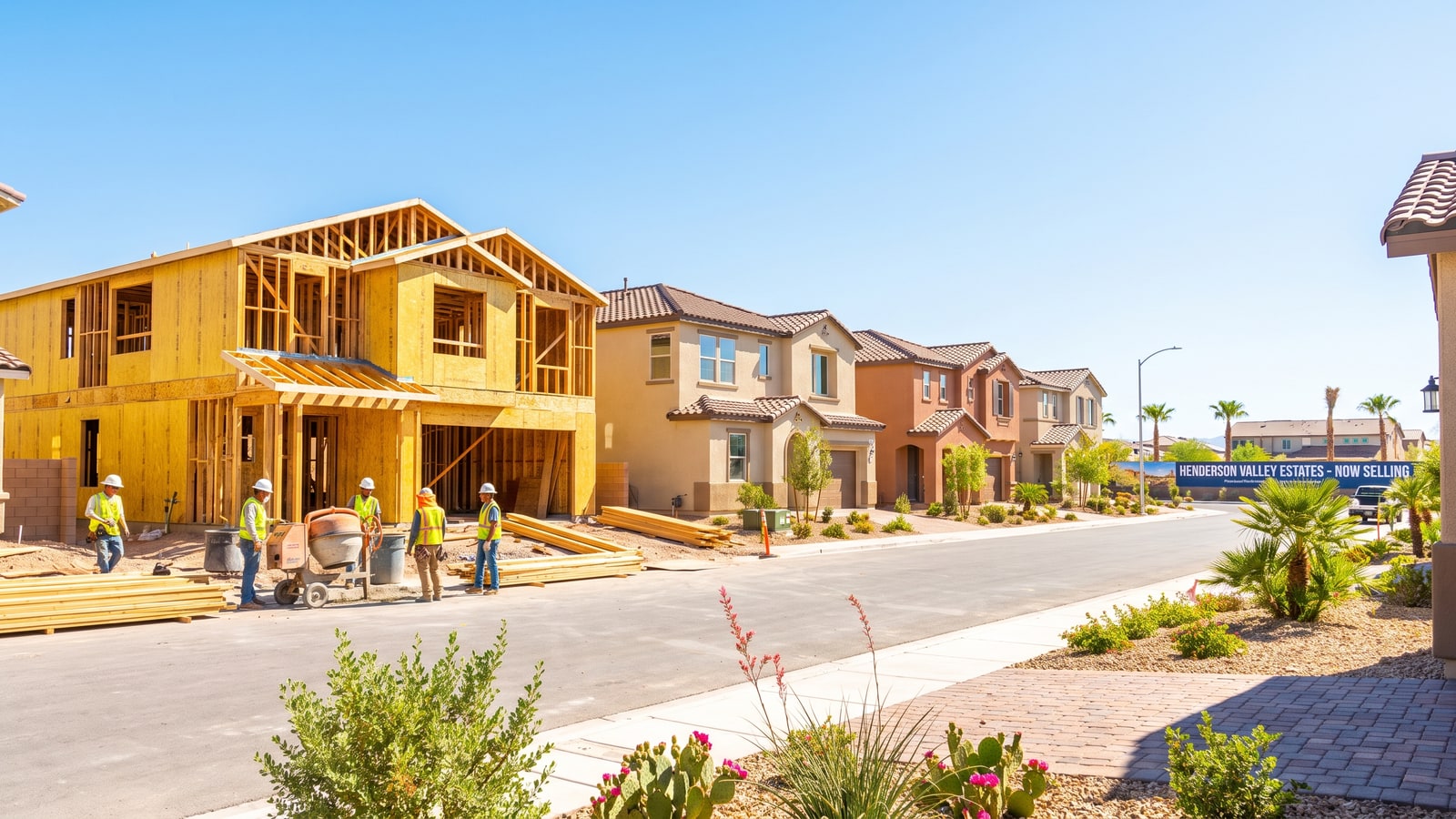
Does Nevada Law Require a Builder to Give You a Warranty?
Yes, but only one year of it. Since 2019, NRS 624.602 has required a licensed contractor "who completes construction of a new, single-family residence" to give the purchaser two documents. The first is "a separate, single-page disclosure describing the rights of the purchaser" under the contractor licensing chapter, including the right to seek recovery from the state's Residential Recovery Fund. The second is a builder's warranty that must:
- be in writing;
- be valid "for a period of at least 1 year from the date of completion of a written punch list";
- cover "all home systems, workmanship, materials, plumbing, electrical and mechanical systems, appliances installed by contractors, fixtures, equipment and structural components," unless a separate warranty comes from the manufacturer or installer;
- be "transferable to a subsequent purchaser of the residence"; and
- not be read as a waiver of any other warranty the contractor gives or Nevada law provides.
Two details in that statute are worth acting on. The statutory year runs from completion of a written punch list, which can fall after your closing, so keep a dated, signed copy of your walk-through list. And under NRS 624.3016, "failure to provide a builder's warranty as required by NRS 624.602 or to respond reasonably to a claim made under a builder's warranty" is cause for Contractors Board discipline.
What the law does not require is the second or the tenth year. An earlier version of this guide said the 1-2-10 structure comes from Contractors Board regulations; I found nothing in NRS Chapter 624 or the Board's regulations in NAC Chapter 624 that requires a two-year systems period or a ten-year structural period, so treat both as builder promises that live in the warranty book. Federal lending rules no longer require a ten-year plan either. According to HUD's Mortgagee Letter 2019-05, FHA eliminated its ten-year protection plan requirements for case numbers assigned on or after March 14, 2019. It kept the Warranty of Completion of Construction (form HUD-92544), and the letter says "the buyer will still retain a one-year warranty."
Your contract packet should also include the defect statutes themselves. Under NRS 113.135, a seller signing with the initial purchaser of a residence that was not occupied for more than 120 days after substantial completion must provide copies of NRS 11.202, 11.2055 and 40.600 to 40.695, and must tell you about any soil report for the home or subdivision. If you ask in writing within 5 days of signing, the seller must provide those reports free within 5 days, and you may rescind within 20 days after receiving them unless you waived that right in a signed document.
Which Builders Stand Behind Their Own Warranty, and Which Use a Third Party?
There are two models, and Nevada's defect statute recognizes both. Under NRS 40.607, a "builder's warranty" means "a warranty issued or purchased by or on behalf of a contractor," including one whose liability "is subsequently insured by a risk retention group."
In the first model the builder is the warrantor for all ten years. Toll Brothers' book describes "warranty protection provided by the seller of your Home" and says "the Warranty is not an insurance policy." PulteGroup's book is provided by "the PulteGroup building subsidiary identified in your home purchase agreement" and applies across its brands, which it lists as Pulte Homes, Centex, Fox & Jacobs, DiVosta, Del Webb, American West and John Wieland Homes and Neighborhoods. It also says that "in certain situations as required by VA or other lending regulations or applicable laws," the builder's obligations "are backed by an insurance policy issued by a member of the Zurich-American Insurance Group." Lennar, KB Home and Taylor Morrison present the warranty under their own names on the pages I read, without naming an administrator or insurer. According to Taylor Morrison's FAQ, its document is "an assignable Limited Warranty" with "a 1-year warranty on workmanship, a 2-year warranty on certain systems, and a limited 10-year warranty on structural elements."
In the second model a warranty company administers the program and an insurer stands behind the structural years. According to D.R. Horton's documents page, its warranty guide explains "how to submit a warranty claim with Residential Warranty Company, LLC ('RWC') for major structural defects," and the page posts a Las Vegas sample RWC warranty, a form marked "Rev. 9/14." That sample says "RWC is neither Warrantor nor Insurer," names Western Pacific Mutual Insurance Company, a Risk Retention Group, as the insurer, and defines the warrantor as "your Builder in Years 1 and 2; the Insurer in Years 3 through 10 and in Years 1 and 2 if your Builder defaults." It also says you must obtain a Warranty Confirmation online within 60 days of closing, and "you do not have a warranty without the Warranty Confirmation." The sample warns that the warranty on your home may differ, and on October 10, 2026 the page offered a Las Vegas file but no Reno-specific one, so Reno buyers should ask for their own book.
Third-party programs sell the same structure to builders. According to 2-10 Home Buyers Warranty's builder FAQ, its structural warranty "provides 1 year of coverage for workmanship, 2 years of coverage for distribution systems and a full 10 years of third-party insurance-backed coverage for qualifying structural defects," and builders "must register to become a member" of the program. I did not find a Las Vegas or Reno builder page naming 2-10 as its provider on October 10, so read it as an example of the model, not a statement about any builder. The practical question is who pays for a structural repair in year seven if the builder no longer exists; the book answers it.
| Builder | Periods published | Who backs the structural years | Late-claim rule | Disputes |
|---|---|---|---|---|
| Lennar | 1, 2 and 10 years | Lennar; no insurer named on the pages read | No obligation for claims submitted more than 30 days after a warranty expires | Mediation, then binding arbitration |
| PulteGroup (Pulte, Del Webb, Centex, American West) | 1, 2, 5 (certain leaks) and 10 years | The builder; Zurich-backed in certain situations | Claims must be received within 30 days after a period expires | Optional PWSC mediation, then binding arbitration |
| KB Home | 1, 2 and 10 years | Not stated on the pages read | Not stated on the pages read | Not stated on the pages read |
| Toll Brothers (September 15, 2026 book) | 1, 2 and 10 years | Toll Brothers, as seller | Notify within 30 days of noticing; nothing owed if received more than 30 days after expiry | Mandatory mediation, then binding arbitration |
| Taylor Morrison | 1, 2 and 10 years | Not stated on the FAQ | Not stated on the FAQ | Not stated on the FAQ |
| D.R. Horton (Las Vegas RWC sample) | 1, 2 and 10 years | Western Pacific Mutual Insurance Company in years 3 to 10; RWC administers | Written request no later than 30 days after a period expires | Binding arbitration through the RWC process |
Neither the Pulte book nor the September 15, 2026 Toll book carries a Nevada addendum; their state-specific sections cover other states, so in Nevada the published books apply their national terms. Our builder pages for Lennar, Pulte and Del Webb, KB Home, Toll Brothers and D.R. Horton list current communities, and our Las Vegas builders comparison covers how they differ beyond the warranty.

What Does Nevada's HOA Law Add When You Buy From the Builder?
If your new home is in a common-interest community, meaning one governed by a declaration under which owners share costs for common elements (the definition in NRS 116.021), Nevada adds statutory warranties that do not depend on the builder's book. They apply to the "declarant," the party that offers units under a common promotional plan, and to any "dealer," which NRS 116.033 defines as "a person in the business of selling units for his or her own account." A production builder selling its own homes in an HOA community is usually one or the other.
Implied warranties. Under NRS 116.4114, the declarant and any dealer impliedly warrant that a unit and the common elements "are suitable for the ordinary uses of real estate of its type" and that improvements will be "free from defective materials" and "constructed in accordance with applicable law, according to sound standards of engineering and construction, and in a workmanlike manner."
No general disclaimer. Builder books try to replace those duties. Toll's book disclaims "all other warranties, express or implied," "to the extent allowed by law," and Pulte's waiver applies "to the fullest extent permitted by law" while preserving warranties that "may not by law be waived." Nevada limits that. Under NRS 116.4115, for a unit that may be used as a residence, "no general disclaimer of implied warranties of quality is effective." A declarant or dealer may disclaim only "a specified defect or specified failure to comply with applicable law," in an instrument the purchaser signs. If your packet includes a signed list of disclosed conditions, that is the document doing the carving out. It pairs with NRS 40.640, which says a contractor is not liable in Chapter 40 for a defect disclosed before purchase "in underlined and boldfaced type with capital letters."
Express warranties. Under NRS 116.4113, "any model or description of the physical characteristics of the common-interest community, including plans and specifications," creates an express warranty that the community "will reasonably conform." These "may be excluded or modified by agreement of the parties," so read what your contract says about models.
A six-year clock that can be shortened. Under NRS 116.4116, a lawsuit for breach of these warranties "must be commenced within 6 years after the cause of action accrues," which for a unit is generally when the first purchaser takes possession. The parties may agree to cut that to "not less than 2 years," but for a residential unit the agreement "must be evidenced by a separate instrument executed by the purchaser." A separate signed page about a shorter limitation period is worth reading twice.
A planned community with no more than 12 units and no developmental rights is largely exempt under NRS 116.1203. Our Nevada HOA dispute guide covers how Chapter 116 disputes move once you own the home.
| Protection | Who it binds | Time limit | What it can deliver |
|---|---|---|---|
| Builder limited warranty | The builder, or an insurer in an insured program | 1, 2 and 10 years, plus a 30-day claim window in the books that state one | Repair, replacement or payment, at the warrantor's choice |
| NRS 624.602 statutory warranty | The licensed contractor that completed the home | At least 1 year from completion of the written punch list | A written, transferable warranty covering systems, workmanship, materials and structure |
| NRS 116.4114 implied warranty | The declarant and any dealer, in an HOA community | Suit within 6 years of possession, or as few as 2 by separate signed instrument | Damages for defective materials or unworkmanlike construction |
| Chapter 40 claim | Contractor, subcontractors, suppliers and design professionals | Within 10 years of substantial completion under NRS 11.202 | Repair, or the damages listed in NRS 40.655 |
| Contractors Board complaint | Licensed contractors | Filed within 4 years of the act or omission | Investigation, a Notice to Correct, discipline |
| Residential Recovery Fund | The Board's fund, for eligible owners | 4 years after the work, or 2 years after a judgment | Up to $40,000 per claim |
How Does a Warranty Claim Work, and What Deadlines Apply?
The books agree on more than they differ, and a claim that follows these steps is hard to lose on procedure.
1. Put it in writing, through the channel the book names. Toll's book takes requests online or by certified mail and says "providing notice orally in person or by telephone or electronic mail does not constitute a Warranty Request." Pulte asks you to contact its local office and not to send the request to "any person that is not our employee, such as a contractor." In D.R. Horton's RWC sample, defects in years 1 and 2 go to the builder in writing, and if that does not produce "satisfactory action within a reasonable time," you send written notice to RWC. Do not assume one notice covers both: the sample says a request to your builder "does not constitute notice to the Administrator, and it will not extend applicable coverage periods."
2. Report early, and never after the cutoff. Toll requires notice "as soon as possible and in no event later than 30 days after you become or should have become aware" of the problem, and says that if a request arrives "more than 30 days after the applicable one-year, two-year, or ten-year Warranty Period expires," Toll "will have no obligations under the Warranty." Pulte's claims "must be received by us no later than 30 days after the expiration of the applicable warranty coverage period." Lennar's homebuying page says it "has no obligation with respect to claims submitted more than 30 days after the expiration of the applicable limited warranty." The RWC sample uses the same 30-day window.
3. Do not fix it first. Pulte will not reimburse repairs you make or pay for "without first notifying us," and the RWC sample excludes "warranted Defects that you repair without prior written authorization of the Administrator." Emergencies are the exception: Pulte reimburses the reasonable cost of urgent repairs that protect occupants or prevent "imminent serious damage," as long as you notify it as soon as possible. The Contractors Board's complaint guide makes the same point: filing before you hire someone else "will allow the Board investigator to inspect and validate the complaint."
4. Give access, and expect the warrantor to choose the fix. Lennar's fine print says "failure to provide access to the home shall void the Limited Warranty with respect to that claim." Pulte may repair, replace or "pay you the reasonable cost of correction," and Toll may pay "the diminution in fair market value" instead of repairing.
5. Use the statute in the first year. Under NRS 40.672, if a contractor receives written notice of a constructional defect "not more than 1 year after the close of escrow of the initial purchase," it "shall make the repairs within 45 days" unless you delay them, events beyond its control intervene or timely repair "is not reasonably possible." A contractor that fails to comply "is immediately subject to discipline."
6. Schedule an inspection before month 12. No law requires one, but a written report gives your first-year claim specifics. Published Las Vegas prices, read October 10, 2026: Red Rock Home Inspections starts its 11th-month warranty inspection at $420, and Inspect LV's 2026 price sheet, which does not price a warranty inspection separately, lists its standard inspection at $475 for 1,501 to 2,000 square feet, $525 for 2,001 to 2,500 and $575 for 2,501 to 3,000, plus a new-build fee listed as "$100+." Earlier in the build, First Home Inspectors lists pre-drywall inspections from $469 for a house under 2,000 square feet to $549 for 3,001 to 3,500, on a price list dated June 29, 2026. Our inspection timing guide covers all three visits, our desert inspection guide covers what Las Vegas heat does to new homes, and Reno buyers can use our Northern Nevada inspection guide.

What Do Builder Warranties Exclude, and What Tolerances Decide a Repair?
The exclusions are printed in the books, so read them before you file. Pulte's list includes "normal wear and tear or normal deterioration"; "windstorm, hail," flood, surface water and other casualty events; condensation from failure "to maintain adequate ventilation"; "any condition which does not result in actual damage to the home," which it says includes mold; "bodily injury or damage to personal property"; and consequential costs such as "shelter, food, and transportation" and "any diminution of the market value of the home." Appliances fall under manufacturer warranties the builder assigns to you at closing. Pulte also caps its "aggregate total liability" at "the original contract price of the home," and the RWC sample caps the warrantor's total at the final sales price.
Books are not identical. Toll's, unlike Pulte's, reimburses "the reasonable costs of temporary hotel accommodations and a reasonable daily food allowance" when a covered condition makes the home temporarily uninhabitable, provided the hotel cost is preapproved. And some cosmetic damage has to be caught before you close. According to D.R. Horton's FAQ, damage such as "scratched glass, cuts in vinyl flooring, damaged countertops, drywall repairs & paint touch-ups are not warranted after closing" and "must be noted on the Orientation Builders Checklist and taken care of prior to closing."
Then there are tolerances. An earlier version of this guide quoted a 1/16-inch drywall crack limit that does not appear in the books I read, and a 1/8-inch concrete limit that Pulte's book applies only to foundation-wall cracks; its slab and flatwork limit is 1/4 inch. Here is what two books say.
| Condition | PulteGroup national book | D.R. Horton Las Vegas RWC sample |
|---|---|---|
| Drywall cracks and nail pops | Repaired once during the first year if readily visible from 5 feet in normal light; affected areas repainted | Cracks over 1/8 inch wide and nail pops that break the surface, repaired one time; report near the end of year 1 |
| Exterior stucco cracks | Over 1/8 inch wide, repaired for one year | Over 1/8 inch wide, corrected |
| Garage, driveway, walk and patio concrete | Over 1/4 inch wide or 1/4 inch vertical offset, repaired for two years at the builder's discretion | Attached garage slab: over 1/4 inch wide or in vertical displacement |
| Interior slab floor | Cracks of 1/4 inch in width or vertical displacement repaired for two years | Cracks that rupture or significantly impair the floor covering, corrected so they are not readily noticeable |
| Foundation cracks | Voids from cracks over 1/8 inch patched for two years; serious cracks that make the home unsafe repaired for up to ten years | Visible face of foundation: cracks over 1/4 inch wide corrected |
D.R. Horton's national FAQ adds its own concrete rule: cracks "in excess of 1/4 inch in width or vertical displacement" in the garage, driveway, walkway and patio, "and foundation cracks greater than 1/8 inch," are repaired under the warranty. Measure with a crack gauge and photograph it next to a ruler before you file.
What Happens Under Chapter 40 If the Builder Won't Fix a Defect?
When a real defect does not end at the service desk, Nevada's constructional-defect law, NRS 40.600 to 40.695, controls the path to court or arbitration. It starts with a definition. Under NRS 40.615, a constructional defect is one that "presents an unreasonable risk of injury to a person or property," or that "is not completed in a good and workmanlike manner and proximately causes physical damage." A cosmetic flaw that damages nothing may not qualify. NRS 40.640 adds that a contractor is not liable for "normal wear, tear or deterioration," "normal shrinkage, swelling, expansion or settlement," or an owner's failure to maintain the home.
Chapter 40 also points you back to the builder's warranty. NRS 40.650 says that if the home "is covered by a builder's warranty, a claimant shall diligently pursue a claim under the builder's warranty," and that "any sums paid under a builder's warranty" generally "must be deducted from any recovery." The same section strips the statute's damage limits and defenses from a contractor that fails to respond, make an offer, respond in good faith or take part in mediation.
| Step | Rule or deadline | Section |
|---|---|---|
| Written notice of defect | Certified mail, return receipt requested, to the contractor's address in Contractors Board or clerk records; defects described "in reasonable detail"; signed verification by each owner | NRS 40.645 |
| Inspection | Allow reasonable access; be present or send a representative; point out the defects | NRS 40.6462 and 40.647 |
| Contractor's written response | Within 90 days of receiving notice: repair or not, may offer money, may disclaim; a repair that moves you out must include housing or storage money | NRS 40.6472 |
| Elected repairs | Done by licensed, bonded and insured people within 105 days of the contractor receiving notice from four or fewer owners, 150 days for five or more or an HOA, unless both sides agree to more time; cannot be conditioned on a release; written repair statement within 30 days after completion | NRS 40.648 |
| First-year notice | Repairs within 45 days if notice arrives within 1 year after the initial close of escrow | NRS 40.672 |
| Imminent threat to health or safety | Contractor must take reasonable steps to cure "as soon as practicable" | NRS 40.670 |
| Mediation | Required unless waived in writing; claimant deposits $50; mediator fees capped at $750 a day unless agreed; convened within 30 days and completed within 45 | NRS 40.680 |
| Tolling | Limitation and repose periods paused from notice until the earlier of 1 year or 30 days after mediation ends | NRS 40.695 |
| If you later sell | Disclose notices, expert opinions, settlement terms and repairs to the buyer, generally at least 30 days before close of escrow | NRS 40.688 |
If the claim goes forward, NRS 40.655 limits recovery to listed items: the reasonable cost of necessary repairs and temporary housing, any loss of market value "because of structural failure," loss of use, the value of other property damaged, expert costs and statutory interest. Builder books add their own forum. Pulte, Toll, Lennar and the RWC sample all send unresolved disputes to binding arbitration, and Pulte's book notes that some states require "a notice of alleged defects ... by specific means" before arbitration. A Nevada construction-defect attorney should review any Chapter 40 notice before it goes out.
How Long Can You Wait to Sue Over a Construction Defect in Nevada?
The outer limit is ten years. NRS 11.202 says no action may be brought against the builder or design professionals "more than 10 years after the substantial completion" of the improvement for a construction deficiency or the injury it causes, while an action "for any act of fraud in causing a deficiency" may be brought "at any time." Claims for indemnity or contribution and claims over a defective product are outside the section. Under NRS 11.2055, substantial completion is the latest of the final building inspection, a notice of completion or the certificate of occupancy.
The period has not always been ten years. The 2019 Legislature's Assembly Bill 421 raised it from 6 years to 10, added the fraud exception and made the longer period apply "retroactively to actions in which the substantial completion of the improvement to the real property occurred before October 1, 2019." The same bill dropped an older rule that barred a Chapter 40 notice until an insurer had denied a claim under a purchased homeowner's warranty, and replaced it with today's duty to "diligently pursue a claim under the builder's warranty." Any article that still cites a six-year repose period is describing the law before October 1, 2019.
Watch the two clocks. The builder's ten years usually start at your closing, while repose starts at substantial completion. On a finished inventory home that sat for months, repose ends first: if the certificate of occupancy issued in March 2026, after the final inspection, and you close in October 2026, the warranty book runs to October 2036, but the repose period ends in March 2036. In an HOA community, NRS 116.4116's six-year limit for implied-warranty suits can run out earlier still. A Chapter 40 notice tolls these periods under NRS 40.695, but only for the time that section allows.
What Can the Nevada State Contractors Board Do for a New-Home Buyer?
The Board offers three things a builder book does not: an investigator, an answer to a question and, for eligible owners, a fund.
A complaint. Under NRS 624.331, a complaint "must be filed in writing with the Board within 4 years after the act or omission." According to the Board's contractor complaints page, an investigator decides whether a jobsite visit is needed, conducts it with the consumer and contractor present and, if corrections are required, sends a Notice to Correct "usually ... within five (5) working days following the jobsite visit"; the contractor "is generally allowed 20 to 30 days to comply." The Board notes that "many complaints are resolved without disciplinary action." Failing to respond reasonably to a builder's-warranty claim is itself a ground for discipline under NRS 624.3016.
A question. Under NRS 40.6887, you or the builder may submit a question or dispute about a constructional defect, including "the need for repairs, the appropriate method for repairs, [and] the sufficiency of any repairs," and the Board must respond or decide within 30 days. That answer "is not binding" and is not admissible in a Chapter 40 case, but it can settle a disagreement about whether a repair was done right.
The Residential Recovery Fund. According to the Board's Recovery Fund overview, "a single Residential Recovery Fund Claim cannot exceed $40,000, and claims against a single contractor cannot exceed $750,000, or 20% of the account balance, whichever is less," limits that match NRS 624.510. Claimants must apply "within four (4) years after the completion of the qualified services," or within two years of a judgment, and "the claimant must occupy the single-family residence." The Board's main fund page describes eligible owners as those who "have entered into a contract with a licensed residential contractor," "have suffered actual damages" and "have exhausted all other means of recovery." NRS 624.602 requires the builder of a new single-family home to disclose your right to file a fund complaint, but NRS 624.510 also makes an owner ineligible when the home was built "with the intent of renting, leasing or selling the residence within 1 year after the date of completion," a test a builder's inventory home can meet. Whether a particular purchase from a builder qualifies is the Board's decision, and under NRS 624.510 that decision "is final and not subject to judicial review." Ask the Board at (702) 486-1100 in Las Vegas or (775) 688-1141 in Reno before you count on it.
How Is a Home Warranty Different From a Builder Warranty?
They share a word and nothing else. Nevada's defect statute says a builder's warranty "does not include a policy of insurance for home protection" or "a service contract" (NRS 40.607). A service contract, under NRS 690C.080, is one in which a provider, "in exchange for separately stated consideration," agrees to repair, replace or maintain goods that fail from "a defect in materials, workmanship or normal wear and tear." A provider cannot sell one in Nevada without a certificate of registration under NRS 690C.150, and "insurance for home protection" is defined separately in NRS 690B.100.
The definitions also say who can sell each one. Home protection insurance, under NRS 690B.100, is coverage from "a person, other than the manufacturer, builder, seller or lessor of the home," so by definition it comes from someone other than your builder. In practice, the builder warranty is a construction promise from the party that built the house and comes with the purchase; a home warranty is a separately priced repair plan for systems and appliances, and it covers wear, which the Pulte, Toll and RWC books exclude. A builder claim goes to the builder's warranty desk; a home warranty claim goes to the plan company, under that plan's own terms. The two overlap only briefly on a new home, since appliances already carry manufacturer warranties assigned at closing. Our home warranty guide covers what Las Vegas plans cost and when one is worth buying, so I will not repeat it here.
Does the Builder Warranty Transfer When a New Home Is Resold?
Yes, by statute and in every builder document that addresses it, but some transfers need a step from the new owner. NRS 624.602 requires the builder's warranty to be "transferable to a subsequent purchaser." In an HOA community, NRS 116.4113 and NRS 116.4114 say any conveyance transfers to the purchaser the express warranties "made by previous sellers" and "all of the declarant's implied warranties of quality."
| Warranty | Transfers? | Condition or step |
|---|---|---|
| NRS 624.602 builder's warranty | Yes | Must be transferable to a subsequent purchaser |
| NRS 116 express and implied warranties | Yes | Pass with any conveyance of the unit |
| PulteGroup | Yes | Covers "all subsequent owners of the home who take title during the applicable warranty coverage periods" |
| KB Home | Yes | Transfers to "any subsequent buyer should you sell your KB home within 10 years" |
| Toll Brothers | Yes | New owner must register on Toll's homecare site "no later than 60 days after the closing date"; mediation and arbitration terms carry over |
| Taylor Morrison | Yes | Described as "an assignable Limited Warranty" |
| D.R. Horton (Las Vegas RWC sample) | Yes, automatically | Transfers during the ten-year term; a foreclosure voids it, except for FHA and VA financed homes under the HUD addendum |
| 2-10 Home Buyers Warranty program | Yes | "This protection can be transferred to the new owner" |
If you are buying a home that is two or three years old, ask the seller for four things: the warranty book and the original closing date, which sets every deadline; any warranty confirmation or validation number; a list of open or past claims; and, if the seller ever sent a Chapter 40 notice, the disclosures NRS 40.688 requires: the notices, expert opinions, settlement terms and a report of repairs. Then do any registration step right after closing. A second owner does not get the NRS 113.135 packet or rescission right, which belong to the initial purchaser, and does not get the first-year 45-day repair rule in NRS 40.672 once a year has passed since the first closing.

What Should You Get in Writing Before You Sign a Builder Contract?
A warranty you have not read is a warranty you will misuse. Before you sign a purchase agreement or reservation, get these in writing:
- The warranty book that will govern your home, with its version date. Pulte's site points buyers with purchase agreements signed before September 1, 2024 to an older book, and Toll's current book is dated September 15, 2026.
- The NRS 624.602 disclosure and the NRS 113.135 packet, including notice of any soil report and your 5-day window to request it.
- The dispute clause. Know whether you are agreeing to mediation and binding arbitration, and whether those terms bind a later buyer.
- Any separate instrument that shortens the six-year NRS 116.4116 period, and any boldface list of disclosed conditions.
- Who warrants the structural years, and whether you must register or confirm the warranty after closing, as D.R. Horton's RWC sample requires within 60 days.
- A signed, dated walk-through punch list, since the statutory year runs from its completion.
- For FHA buyers, the HUD-92544 warranty the lender will require.
Our builder contract guide covers the other clauses worth negotiating, and our Reno new construction guide covers the northern market. If you are new to buying, our first-time buyer page lays out the full process.
How Can Nevada Real Estate Group Help With a New-Home Warranty?
A buyer's agent's job on a new home starts before the contract. We can read the warranty book with you, point out the coverage periods, claim windows, arbitration terms and transfer steps, and check that the documents the statutes require are in your packet. After closing, we can help you organize a written claim with dates, photos and the clause it relies on. We are not attorneys; a Chapter 40 notice or an arbitration needs a Nevada construction-defect lawyer.
You can browse current Las Vegas new construction and Reno new construction, or read about Del Webb's Reno community in our Sierra Canyon guide; Del Webb is one of the PulteGroup brands named in the warranty book above, so a resale buyer there should ask which version came with the home. I lead Nevada Real Estate Group, the #1 real estate team in Nevada with 150+ licensed agents and 9,097+ verified five-star reviews; you can read more on our about page. Call our Las Vegas office at (702) 637-1759 or our Reno office at (775) 277-2120, email info@nevadagroup.com or send us a message. Our Las Vegas office is at 8945 W Russell Rd, Suite 170, Las Vegas, NV 89148. Nevada Real Estate Group is brokered by LPT Realty, and my Nevada license is S.181401.
Frequently Asked Questions
Does Nevada law require a 1-2-10 warranty on new homes?
No. NRS 624.602 requires a written warranty valid for at least one year from completion of a written punch list, covering systems, workmanship, materials, appliances, fixtures and structure, and transferable to a later buyer. The two-year and ten-year periods are builder promises. FHA dropped its ten-year protection plan requirement in 2019 and kept a one-year warranty.
What does the 10-year structural warranty actually cover?
Load-bearing structure, and only when it fails. Pulte lists items such as bearing walls, beams, trusses, rafters, footings and roof sheathing, and requires actual damage that impairs the load-bearing function so the home is unsafe. Toll uses a similar test and excludes brick, stucco and other cladding.
How long do I have to report a defect to my builder?
Report it in writing as soon as you see it. Toll requires notice within 30 days of when you became or should have become aware, and Toll, Pulte, Lennar and D.R. Horton's RWC sample cut off claims received more than 30 days after the coverage period ends. In the first year, written notice also triggers NRS 40.672's 45-day repair duty.
Can I still pursue my builder after the warranty expires?
Possibly. Chapter 40 claims can be brought within NRS 11.202's 10 years from substantial completion, and fraud has no repose limit. In an HOA community, implied-warranty suits under NRS 116.4116 must start within six years of possession unless a separate signed instrument shortened that period. Most builder books require arbitration, so see a Nevada construction-defect attorney first.
Does a builder warranty transfer if I buy a two- or three-year-old home?
Yes. NRS 624.602 requires transferability, and Pulte, KB Home, Toll Brothers, Taylor Morrison and D.R. Horton's RWC sample provide for it. Toll requires the new owner to register within 60 days after closing. The periods still run from the original closing date, so ask the seller for the book, that date and the claim history.
Is a home warranty the same as a builder warranty?
No. NRS 40.607 excludes home protection insurance and service contracts from the definition of a builder's warranty. A home warranty is a separately priced service contract from a provider registered under NRS 690C that covers repairs, including wear. A builder warranty is the builder's construction promise and excludes wear.
Can a new-home buyer use the Nevada Residential Recovery Fund?
Sometimes, and the Board decides. The fund pays up to $40,000 per claim to eligible owner-occupants who contracted with a licensed residential contractor, suffered actual damages and exhausted other recovery, within four years after the work. Builders must disclose the right to file, but the statute excludes homes built with the intent to sell them within a year of completion, and eligibility for a particular purchase is the Board's final call.
Do I need an inspection before my one-year warranty ends?
It is not required, but it makes a first-year claim specific. In Las Vegas, Red Rock Home Inspections starts its 11th-month inspection at $420, and Inspect LV lists its standard inspection at $475 to $575 for 1,501 to 3,000 square feet plus a new-build fee, as read October 10, 2026. Send the report's items to the builder in writing before the year ends.
Which Sources Inform This Nevada New Home Warranty Guide?
Statutes were read on the Nevada Legislature's site and builder documents in a browser on October 10, 2026. Builder terms change, and the book attached to your purchase agreement governs your home.
- NRS 624.602, NRS 624.3016, NRS 624.331 and NRS 624.510: the statutory builder's warranty, discipline, complaint deadline and Recovery Fund limits.
- NRS 40.600 to 40.695, including NRS 40.607, 40.645, 40.650, 40.672 and 40.680: Chapter 40 constructional-defect procedure.
- NRS 11.202, NRS 11.2055 and Assembly Bill 421 (2019), enrolled: the statute of repose and its 2019 change.
- NRS 116.4113, 116.4114, 116.4115 and 116.4116: warranties of quality in common-interest communities.
- NRS 113.135: statutes and soil reports owed to an initial purchaser.
- NRS 690C.080, NRS 690C.150 and NRS 690B.100: service contracts and home protection insurance.
- Nevada State Contractors Board: Residential Recovery Fund, fund overview, contractor complaints and how to file a complaint.
- HUD Mortgagee Letter 2019-05: removal of FHA's ten-year protection plan requirement.
- Builder documents: Lennar warranty and homebuying journey; Pulte warranty page and 2024 national book; KB Home warranty services and 10-year limited warranty; Toll Brothers Limited Warranty, September 15, 2026; Taylor Morrison FAQ; D.R. Horton documents, Las Vegas RWC sample warranty and FAQ.
- 2-10 Home Buyers Warranty builder FAQ: third-party structural warranty model and transfer.
- Inspection prices read October 10, 2026: Red Rock Home Inspections, Inspect LV 2026 price sheet and First Home Inspectors.