
Published June 28, 2026 · By Chris Nevada, Nevada Real Estate Group · NV License S.181401
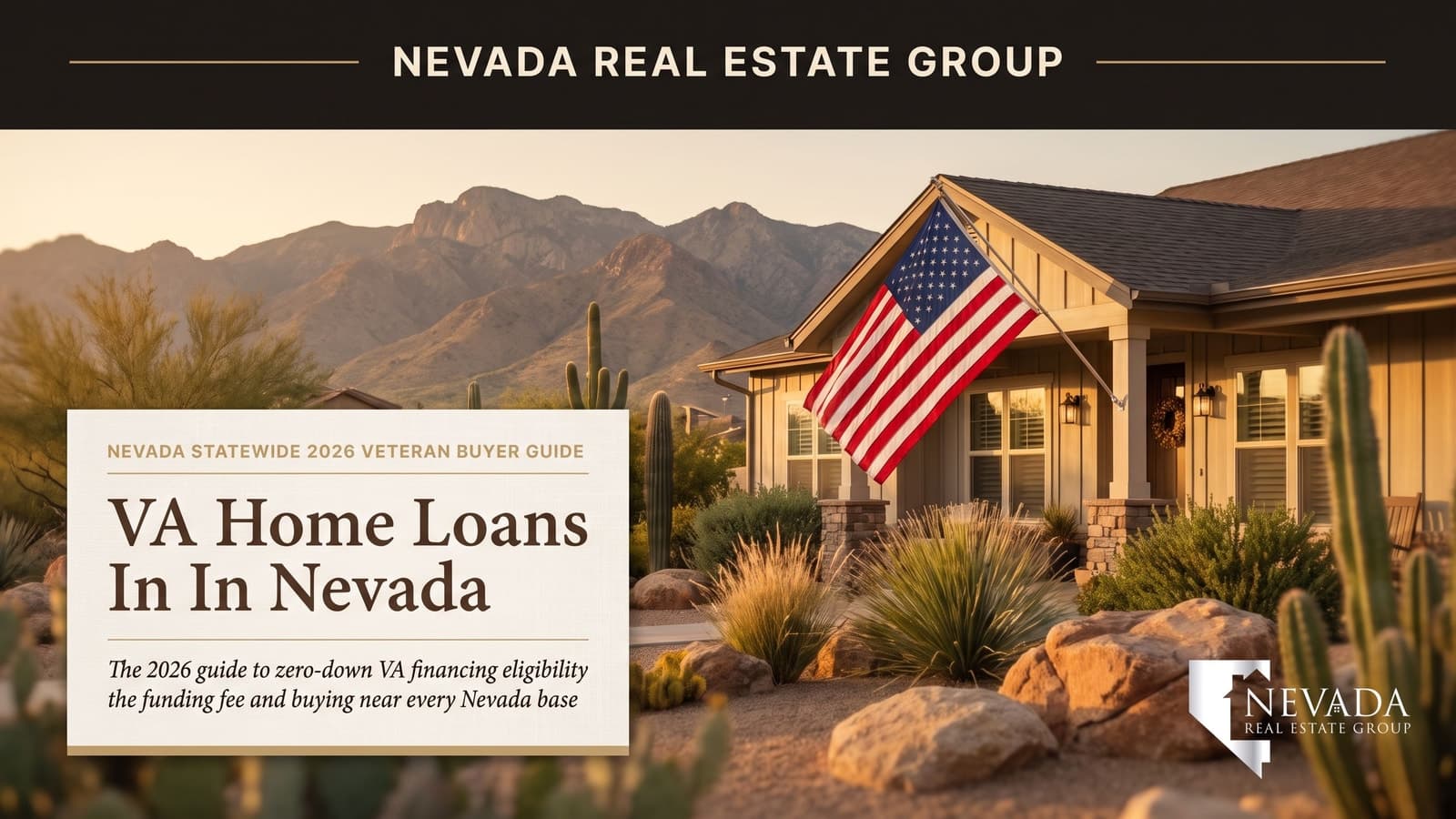
For the veterans, active-duty service members, and military families who call Nevada home — and there are many, with Nellis Air Force Base and Creech in the south and Naval Air Station Fallon and the Hawthorne Army Depot in the north — the VA home loan is one of the most powerful benefits available. It lets eligible buyers purchase a primary residence with zero down payment, no private mortgage insurance, and competitive rates, backed by the U.S. Department of Veterans Affairs. In a state where saving a 20% down payment is the biggest barrier for most buyers, the VA loan removes that barrier entirely for those who earned it.
Yet the VA loan is also widely misunderstood. Buyers worry it is slow, that sellers dislike it, or that there is a hard loan limit — most of which is outdated. This guide explains exactly how VA loans work in Nevada in 2026: who qualifies, the real benefits, the funding fee and its exemptions, how much you can borrow, the step-by-step process, and where VA buyers are purchasing across the state.
We have represented many military buyers and sellers across more than 9,600 Nevada closings worth over $4.85 billion, and we know how to make a VA offer compete. If you want to use your benefit, call our Southern Nevada team at (702) 637-1759 or our Northern Nevada team at (775) 277-2120, or start with our buyer resources.
A VA home loan lets eligible Nevada veterans, active-duty service members, National Guard, Reservists, and many surviving spouses buy a primary residence with zero down payment, no private mortgage insurance, and competitive rates, guaranteed by the Department of Veterans Affairs. With full entitlement there is no VA loan limit — you can borrow what you qualify for. A one-time funding fee applies (and is waived for veterans with a service-connected disability). It is reusable across your lifetime.
- VA loans offer 0% down and no PMI for eligible veterans, service members, and many surviving spouses.
- With full entitlement, there is no VA loan limit — you borrow what you qualify for, jumbo amounts included.
- The VA funding fee (2.15% first use, 3.3% after, with 0% or 5%+ down reductions) is waived for disability-rated veterans.
- Nevada's bases — Nellis, Creech, Fallon, Hawthorne — make VA financing common statewide.
- Use your benefit: call (702) 637-1759 in the south or (775) 277-2120 in the north.
- Confirm eligibility. Verify your service meets VA requirements and request your Certificate of Eligibility (COE).
- Get pre-approved with a VA-savvy lender. Not every lender does VA well — use one that closes them routinely.
- Shop within your comfortable payment. Zero down does not mean stretch — buy what you can carry.
- Write a strong VA offer. A good agent frames the offer so sellers see it as the solid financing it is.
- Close with no down payment. VA appraisal, funding fee (or exemption), and you get the keys.
What Is a VA Home Loan and Who Qualifies in Nevada?
A VA home loan is a mortgage issued by a private lender but partially guaranteed by the U.S. Department of Veterans Affairs. That government guarantee is what lets lenders offer terms no conventional loan can match — most notably zero down payment and no mortgage insurance — because the VA backstops part of the lender's risk. According to the U.S. Department of Veterans Affairs, the program exists specifically to help those who served become homeowners.
Eligibility is based on your service. In general, you may qualify if you are a veteran who meets minimum active-duty service requirements, an active-duty service member who has served a qualifying period, a member of the National Guard or Reserves with sufficient service, or a surviving spouse of a service member who died in the line of duty or from a service-connected disability. The exact service-length thresholds vary by era and circumstance, which is why the first step is always to confirm eligibility and obtain your Certificate of Eligibility (COE).
Nevada has a large and growing veteran and military population, concentrated around its installations: Nellis Air Force Base and Creech Air Force Base in the Las Vegas area, Naval Air Station Fallon in the north, and the Hawthorne Army Depot. That presence makes VA financing a routine part of the Nevada market — sellers and agents here see VA offers constantly, which helps dispel the outdated notion that a VA offer is somehow weaker. In our experience, a well-structured VA offer competes just fine; the key is working with an agent and lender who know how to present and close it.
What Are the Benefits of a VA Loan in Nevada?
The VA loan's advantages are substantial, and together they make it the strongest financing available to those who qualify.
Zero down payment. With full entitlement, you can finance 100% of the purchase price. On a $400,000 Nevada home, that is $0 down versus $14,000 for an FHA loan or $80,000 for a 20% conventional loan — the single biggest barrier removed entirely. No private mortgage insurance. Conventional loans under 20% down charge PMI, and FHA loans carry mortgage insurance for the life of the loan; VA loans have neither, saving you hundreds of dollars a month. On a typical loan, skipping PMI can save $150 to $250 monthly. Competitive interest rates. Because of the government guarantee, VA rates are often at or below conventional rates. No loan limit with full entitlement. You can borrow what you qualify for, including jumbo amounts, without a forced down payment. Limited closing costs. The VA restricts certain fees lenders can charge veterans. Easier qualification and a reusable benefit. VA guidelines can be more flexible on credit and debt-to-income, and you can use the benefit again and again over your lifetime.
| Feature | VA Loan | FHA / Conventional |
|---|---|---|
| Minimum down payment | $0 | $14,000 (FHA) / $80,000 (20% conv.) |
| Mortgage insurance | None | FHA: life of loan; Conv: until 20% equity |
| Typical monthly MI savings | $0 | $150–$250/mo |
| Loan limit (full entitlement) | None | Conforming cap $806,500 |
| Reusable | Yes, lifetime | N/A |
For a Nevada buyer who qualifies, these benefits routinely add up to tens of thousands of dollars saved upfront and hundreds saved monthly. It is, quite simply, the best mortgage most people will ever have access to.
What Are the VA Loan Eligibility Requirements in Nevada?
Beyond the service-based eligibility, a few financial requirements apply — though they are generally more forgiving than conventional standards.
Certificate of Eligibility (COE). This VA document proves your entitlement to the lender. You can request it through the VA, and a VA-experienced lender can often pull it for you in minutes. Credit score. The VA itself sets no minimum, but most lenders look for around 620; some go lower. Debt-to-income ratio. The VA uses a flexible standard and also applies a "residual income" test — ensuring you have enough left over each month after expenses — which can help borrowers who fall outside rigid conventional ratios. Primary residence. The VA loan is for a home you will live in, not an investment property or vacation home, though you can buy a multi-unit property and live in one unit. A VA appraisal. The home must pass a VA appraisal confirming both value and that it meets the VA's Minimum Property Requirements for safety and livability.
According to the U.S. Department of Veterans Affairs, the residual-income and flexible-DTI approach is a key reason VA loans help service members qualify who might struggle with a conventional loan. The COE is the gating document, so requesting it early smooths everything that follows. A lender who closes VA loans routinely will know exactly how to handle the COE, the appraisal, and the VA's property requirements — which is why lender choice matters as much for VA buyers as it does for anyone.
How Much Can You Borrow with a VA Loan in Nevada?
This is the most outdated myth worth clearing up: with full entitlement, there is no VA loan limit. You can borrow as much as a lender will approve based on your income and credit, with zero down — including amounts well above the conforming loan limit.
The old "VA loan limits" went away for buyers with full entitlement. According to the U.S. Department of Veterans Affairs, if you have your full entitlement, the VA does not cap how much you can borrow without a down payment — your lender's qualification standards do. That means a qualified Nevada veteran can buy a $500,000 Henderson home or a $900,000 Summerlin home with $0 down, provided their income and credit support the payment.
Entitlement matters when it is not full — for example, if you already have an active VA loan or had a prior VA foreclosure. In those cases, "remaining entitlement" may require a down payment on the portion above a certain threshold. This is exactly the kind of detail a VA-savvy lender calculates for you. The practical takeaway: do not assume there is a ceiling on what you can buy with a VA loan in Nevada. For most eligible buyers with full entitlement, the only limit is what you can comfortably afford — which our how much house can I afford in Nevada guide helps you figure out before you shop.
What Is the VA Funding Fee, and Who Is Exempt?
The VA funding fee is the program's one notable cost — a one-time fee that helps keep the VA loan program running for future veterans, charged in place of the monthly mortgage insurance other loans carry. Understanding it helps you budget accurately.
The fee is a percentage of the loan amount and varies by your down payment and whether it is your first VA loan. For a first-time use with zero down, it is 2.15% of the loan; it drops with a down payment (about 1.5% at 5% down and 1.25% at 10% down). For subsequent uses with zero down, it is 3.3%. On a $400,000 zero-down first-use loan, the 2.15% fee is about $8,600 — but here is the key: it can be rolled into the loan rather than paid in cash, so it does not become an upfront barrier.
Crucially, the funding fee is waived entirely for veterans receiving VA compensation for a service-connected disability, certain surviving spouses, and some Purple Heart recipients. According to the U.S. Department of Veterans Affairs, a large share of VA buyers qualify for this exemption, which makes an already-powerful loan even stronger.
| Down Payment | First Use | After First Use |
|---|---|---|
| 0% down | 2.15% | 3.3% |
| 5%–9% down | 1.5% | 1.5% |
| 10%+ down | 1.25% | 1.25% |
| Disability-rated veteran | $0 (waived) | $0 (waived) |
When you weigh the funding fee against a lifetime of no PMI and zero down, the math overwhelmingly favors the VA loan for eligible buyers — and for disability-rated veterans, that single cost disappears entirely.
How Does the VA Loan Process Work in Nevada?
The VA loan process closely mirrors a standard purchase, with a few VA-specific steps. Knowing them helps it go smoothly.
1. Confirm eligibility and get your COE. Verify your service qualifies and obtain the Certificate of Eligibility — your lender can usually pull it quickly. 2. Get pre-approved with a VA-experienced lender. This is critical; a lender who closes VA loans routinely handles the COE, appraisal, and property requirements without drama. 3. Shop with a VA-savvy agent. Your agent helps you target homes likely to pass the VA appraisal and structures a competitive offer. 4. Make an offer. A well-framed VA offer competes with conventional ones — your agent presents it as the solid, government-backed financing it is. 5. VA appraisal and underwriting. The VA appraiser confirms value and that the home meets Minimum Property Requirements; underwriting finalizes your loan. 6. Close with $0 down. Sign at the title company, the funding fee is paid or rolled in (or waived), and the home is yours.
The one VA-specific watch-point is the appraisal and Minimum Property Requirements — the home must be safe, structurally sound, and sanitary. According to the Consumer Financial Protection Bureau, this protects the buyer from purchasing a home with serious defects, though it can mean some fixer-uppers need repairs before closing. A good agent steers VA buyers toward homes that will pass cleanly. In our experience, the VA process in Nevada is no slower than conventional when the lender and agent know what they are doing — the "VA is slow" reputation comes from inexperienced players, not the program. For the full purchase walkthrough, see our how to buy a house in Nevada guide.
Where Do VA Buyers Purchase in Nevada?
VA buyers purchase statewide, but activity clusters around Nevada's military installations and the affordable, family-friendly communities near them.
In the south, North Las Vegas is the heart of VA buying thanks to its proximity to Nellis Air Force Base and its affordable price points — Aliante and Eldorado are popular with military families. The broader Las Vegas valley and Henderson also see steady VA activity, and Creech Air Force Base draws buyers to the northwest valley and Indian Springs area. In the north, Naval Air Station Fallon anchors VA buying in the Fallon area and nearby Carson City, Reno, and Sparks, while the Hawthorne Army Depot serves the rural west. Summerlin and Boulder City round out the options for VA buyers wanting specific lifestyles, and even rural Pahrump sees VA purchases.
| Base | Region | Popular VA Markets |
|---|---|---|
| Nellis AFB | Southern | North Las Vegas, Las Vegas, Henderson |
| Creech AFB | Southern | Northwest valley, Indian Springs |
| NAS Fallon | Northern | Fallon, Carson City, Reno-Sparks |
| Hawthorne Army Depot | Western | Hawthorne and rural west |
Because military families relocate often, a large share of VA buyers are also buying remotely or on a tight PCS timeline — exactly the kind of move a statewide team with both Southern and Northern Nevada coverage is built to handle.
Can You Use a VA Loan More Than Once in Nevada?
Yes — and this is one of the most valuable and least-understood features of the benefit. The VA home loan is not a one-time perk; it is a lifetime benefit you can use again and again.
Each time you pay off a VA loan in full (typically by selling the home or refinancing), your full entitlement is restored, and you can use it again on your next purchase. This is ideal for military families who move with assignments — you can buy at one duty station, sell when you transfer, and use your VA benefit again at the next. According to the U.S. Department of Veterans Affairs, entitlement can be restored and reused, and in some cases you can even have more than one VA loan at a time using remaining entitlement.
There is also the VA refinance side of the benefit. The VA Interest Rate Reduction Refinance Loan (IRRRL), or "streamline" refinance, lets you lower your rate on an existing VA loan with minimal paperwork, and the VA cash-out refinance lets you tap equity. For a Nevada family that bought near Nellis, transferred to Fallon, and later returned, the reusable benefit can finance multiple homes over a career with zero down each time. The note for repeat users: the funding fee is higher on subsequent uses (3.3% with zero down) unless you are exempt or make a down payment — a detail your lender will factor in. The reusability makes the VA loan a benefit that keeps giving across an entire military and post-service life.

How Does a VA Loan Compare to FHA and Conventional in Nevada?
For eligible buyers, the VA loan usually wins outright — but it helps to see exactly how it stacks up against the other common Nevada financing options.
A VA loan offers 0% down, no mortgage insurance, competitive rates, and no loan limit with full entitlement, but it is available only to those who qualify through service and carries the one-time funding fee (often waived). An FHA loan is open to everyone, allows 3.5% down with a 580 credit score, and is popular with first-time buyers, but it carries mortgage insurance for the life of the loan. A conventional loan offers the most flexibility and drops PMI at 20% equity, but it requires stronger credit and a larger down payment to compete.
| Factor | VA | FHA | Conventional |
|---|---|---|---|
| Minimum down | 0% | 3.5% | 3%–5% |
| Mortgage insurance | None | Life of loan | Until 20% equity |
| Credit (typical) | 620 | 580+ | 620+ |
| Who qualifies | Service-eligible | Everyone | Everyone |
| One-time fee | Funding fee (often waived) | Upfront MIP | None |
If you are eligible for a VA loan, it is almost always the best choice — the zero down and lack of mortgage insurance outweigh the funding fee for nearly every buyer. The exception is rare: a buyer with 20%-plus to put down and a desire to avoid the funding fee entirely might prefer conventional, but that is uncommon. For most eligible Nevadans, the VA loan is the clear winner, and pairing it with down payment assistance for closing costs can make the entry cost minimal.
What Mistakes Should VA Buyers Avoid in Nevada?
A few avoidable missteps trip up VA buyers — knowing them keeps your purchase smooth.
Using a lender who rarely does VA loans. The "VA is slow or difficult" reputation comes almost entirely from inexperienced lenders. Use one who closes VA loans routinely. Assuming there is a loan limit. With full entitlement, there is none — do not undersell what you can buy. Stretching just because there is no down payment. Zero down does not mean buy the maximum; buy a payment you can comfortably carry. Targeting homes that will not pass the VA appraisal. A good agent steers you toward homes that meet the VA's property requirements, avoiding wasted time and appraisal costs. Forgetting the funding fee in your budget. It is real (though rollable and often waived) — account for it. Believing sellers will not accept VA offers. In military-heavy Nevada, VA offers are routine; a well-presented one competes fine. Overlooking the disability-rated exemption. If you receive VA disability compensation, confirm your funding-fee waiver — it saves thousands.
According to the U.S. Department of Veterans Affairs, the most common reason eligible veterans miss out on the benefit is simply not knowing how strong it is or how to use it. In our experience, the VA buyers who do best pair a VA-experienced lender with an agent who knows how to make the offer compete — and then buy a home they can comfortably afford rather than the most the loan allows. Used well, it is the single best financing in American real estate, and Nevada's military community is perfectly positioned to take advantage of it.
Frequently Asked Questions About VA Home Loans in Nevada
Who qualifies for a VA home loan in Nevada?
Eligible veterans, active-duty service members, qualifying National Guard and Reserve members, and many surviving spouses. Eligibility is based on service length and circumstances, which vary by era. You prove it with a Certificate of Eligibility (COE), which a VA-experienced lender can often pull in minutes. Nevada's bases — Nellis, Creech, Fallon, Hawthorne — make VA financing common across the state.
Do VA loans really require zero down payment in Nevada?
Yes. With full entitlement, you can finance 100% of the purchase price with no down payment — $0 on a $400,000 home versus $14,000 for FHA or $80,000 for a 20% conventional loan. There is also no private mortgage insurance. The one cost is a one-time funding fee, which can be rolled into the loan and is waived for disability-rated veterans.
Is there a VA loan limit in Nevada?
Not with full entitlement. The old VA loan limits were removed for buyers with full entitlement, so you can borrow what your income and credit support with zero down — including amounts above the conforming cap. Limits only come into play with reduced or "remaining" entitlement, such as when you already have an active VA loan. A VA-savvy lender calculates your entitlement.
What is the VA funding fee in Nevada?
A one-time fee charged in place of monthly mortgage insurance. For first use with zero down it is 2.15% of the loan (about $8,600 on $400,000); it drops with a down payment and rises to 3.3% for subsequent zero-down uses. It can be rolled into the loan, and it is waived entirely for veterans receiving VA disability compensation and certain surviving spouses.
Can I use a VA loan more than once in Nevada?
Yes — it is a lifetime, reusable benefit. Each time you pay off a VA loan in full (by selling or refinancing), your entitlement is restored for the next purchase, which is ideal for military families who move with assignments. In some cases you can even hold more than one VA loan at a time using remaining entitlement. The funding fee is higher on subsequent zero-down uses unless you are exempt.
Are VA loans harder to get approved in Nevada?
Often easier, not harder. The VA sets no minimum credit score (most lenders want around 620) and uses a flexible debt-to-income standard plus a residual-income test that helps many service members qualify who might struggle with conventional standards. The "VA is difficult" reputation comes from inexperienced lenders; a VA-savvy lender closes them as smoothly as any loan.
Will Nevada sellers accept a VA loan offer?
Yes — VA offers are routine in military-heavy Nevada, especially near Nellis and Fallon. A well-structured, well-presented VA offer competes with conventional ones. The key is an agent who frames it as the solid, government-backed financing it is, and steers you toward homes that will pass the VA appraisal cleanly. The outdated idea that VA offers are weak does not hold up here.
Can I buy a home near Nellis AFB with a VA loan?
Absolutely — North Las Vegas, near Nellis, is one of the most active VA-loan markets in the state, with affordable communities like Aliante and Eldorado popular among military families. The broader Las Vegas valley and Henderson also see steady VA activity. With zero down and no PMI, the VA loan is ideally suited to the families stationed there.
Ready to Use Your VA Home Loan in Nevada?
The VA home loan is the strongest financing most people will ever qualify for: zero down, no mortgage insurance, competitive rates, no loan limit with full entitlement, and a benefit you can reuse for life. In Nevada — with bases across the state and a large veteran community — it is also a routine, well-understood part of the market. The keys to using it well are a VA-experienced lender, an agent who knows how to make the offer compete, and buying a home you can comfortably afford rather than the maximum the loan allows.
Nevada Real Estate Group helps veterans and military families use their benefit in all nine markets we serve, #1 in Nevada and #44 in the nation, backed by more than 9,600 closings and $4.85 billion-plus in volume. Whether you are stationed at Nellis in the Las Vegas area, near Fallon in the north, or buying in Henderson, we will connect you with a trusted VA lender and structure a winning offer. Call our Southern Nevada team at (702) 637-1759 or our Northern Nevada team at (775) 277-2120, learn more on our about page, or contact our team. Then prepare with our how to buy a house in Nevada guide and the how much house can I afford in Nevada breakdown.
Which Sources Inform This Nevada VA Loan Guide?
This guide draws on Nevada Real Estate Group's direct experience with military buyers plus public data from government and industry authorities. VA rules, fees, and entitlement details change — confirm current specifics with the VA or a VA-approved lender before acting. This is general educational information, not financial advice.
- U.S. Department of Veterans Affairs — VA home loans
- Consumer Financial Protection Bureau — VA and mortgage guidance
- U.S. Department of Housing and Urban Development — Nevada
- Nevada Housing Division — homebuyer programs
- Freddie Mac — Primary Mortgage Market Survey
- National Association of Realtors — veteran buyer research
- Las Vegas REALTORS — Southern Nevada market data
- Reno/Sparks Association of REALTORS — Northern Nevada market data
- Nevada Department of Taxation — no state income tax
- Nevada Real Estate Division — licensing and consumer resources