

If you have checked your home's value online recently, you have probably experienced the "Goldilocks" frustration. One website says your house is worth a fortune, another says the market has cooled, and a third lands somewhere in the middle. When you are about to make a six-figure decision, that spread is not just confusing — it is expensive.
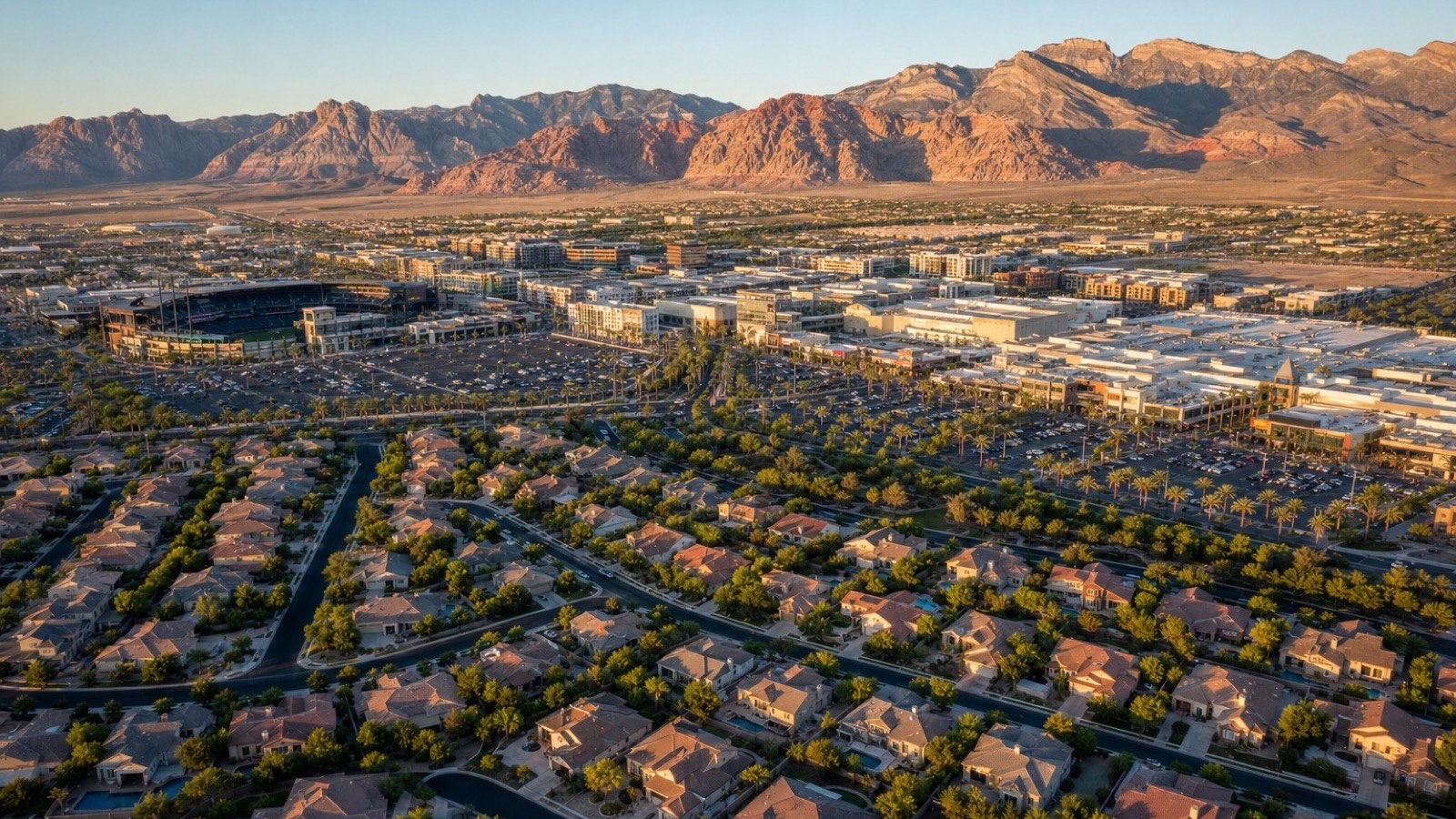
Pinning down an accurate property valuation in Summerlin is genuinely harder than in most of the Las Vegas Valley. Summerlin is not one market. It is a 22,500-acre master-planned community built around distinct "villages," and each village behaves like its own micro-market with its own price ceiling, buyer pool, and fee structure. Generic algorithms flatten all of that into a single number. A computer cannot tell the difference between a standard interior lot and one with an unobstructed Red Rock Canyon view, and it does not know that a guard-gated village three miles away trades at more than double the price per square foot.
Here is the number that matters most, and it is the one no online estimate will give you: across the trailing twelve months, Summerlin's price per square foot ranged from about $239 in The Mesa to $601 in Red Rock Country Club — a 2.5x spread inside a single ZIP-code cluster. Getting your valuation right starts with knowing which of those numbers actually applies to your street.
Shopping the area first? Browse live Summerlin homes for sale — every active MLS listing with prices, photos, and instant filters.
Accurately valuing a Summerlin home means starting with a village-specific comparative market analysis (CMA), not an online estimate. Summerlin's villages range from roughly $239 per square foot in The Mesa to $601 in Red Rock Country Club — a 2.5x spread no algorithm captures. Over the trailing twelve months, 1,452 homes sold at a $713,750 median and $401 average per square foot. Adjust for view, lot, and upgrades, then confirm with a licensed appraiser.
- Summerlin sold 1,452 homes last year at a $713,750 median and $401 average per square foot (GLVAR).
- Village choice swings value hard: Red Rock Country Club closed at a $2,050,000 median versus The Mesa at $407,500.
- AVMs miss Summerlin by 5% to 10%+ because they cannot see views, lot position, or upgrades.
- A CMA — not your tax bill — is the right pricing benchmark; Nevada caps taxable value growth at 3% a year.
- Get a free NREG home-value estimate, then a professional CMA, before you list or refinance.
How Do You Accurately Value a Home in Summerlin?
Accurate valuation is a process of narrowing, not a single lookup. You start wide with a market-level baseline, then filter down to your village, then to homes that genuinely match yours, and finally you adjust for the specific attributes buyers pay premiums for.
In our experience valuing Summerlin homes, the village is worth more than any other single variable — and the four-step method our team uses on every listing reflects that. First, establish the village. A 2,500-square-foot home in The Vistas and an identical floor plan in The Ridges are not comparable properties, even though an algorithm treats them as near-twins. Second, pull genuine comparable sales ("comps") — homes that closed in the last three to six months in the same village, within roughly 20% of your square footage. Third, adjust each comp for differences: a view, an extra garage bay, a pool, a corner lot. Fourth, pressure-test the result against active competition, because you are not just pricing against what sold — you are pricing against what a buyer can choose instead of your home today.
When the valuation becomes an asking-price decision, review these pricing strategies for a Summerlin sale with the property's comparable sales.
According to Las Vegas REALTORS, valley-wide inventory has climbed sharply over the past year, and Summerlin is no exception: active listings in the community sit near 920 as of mid-2026, up from a fraction of that a year earlier. More competition means valuation precision matters more, not less — an overpriced home now sits while buyers pick a sharper-priced neighbor.

Why Do Online Automated Estimates (AVMs) Miss in Summerlin?
Automated Valuation Models (AVMs) are the instant numbers you see on the big listing portals. They are built to average large volumes of transactions, and they work reasonably well in cookie-cutter subdivisions where every home is nearly the same. Summerlin is the opposite of that environment, which is exactly why AVMs struggle here.
An algorithm cannot see the things that move Summerlin prices most. It does not know your primary bedroom frames the Strip skyline while the comp it is using backs a sound wall on Charleston Boulevard. It cannot tell that you spent $80,000 on a resort-style pool and outdoor kitchen, or that your village added a private trailhead the next village lacks. In The Ridges and other custom-heavy villages, where no two homes share a floor plan, AVM error rates balloon — commonly 5% to 10%, and sometimes far more on trophy properties. On a $1,092,500 Ridges median, a 10% miss is over $109,000 of guesswork.
AVMs also lag the market. They lean on recorded sales that closed 30 to 60 days ago, which were negotiated 30 to 60 days before that. In a market where Summerlin's active count roughly quadrupled year over year, a three-month-old data foundation can be meaningfully stale. According to Freddie Mac, mortgage-rate swings ripple straight into buyer purchasing power within weeks — faster than any AVM refreshes. Treat the online number as a starting curiosity, then get a human read on the current tape.
What Does the Current Summerlin Market Say About Value?
Before you can value a single home, you need the community baseline. Here is where Summerlin stands right now, pulled live from the GLVAR (Las Vegas REALTORS) MLS via our Repliers feed on July 12, 2026.
How we sourced these numbers: All figures below reflect GLVAR MLS sold-and-active data for listings whose neighborhood field contains "Summerlin," queried July 12, 2026 across the trailing 12 months (July 2025 – July 2026). Village-level medians use each village's own closed sales, not a valley-wide average. This is the same data foundation our team applies across the 9,600+ transactions Nevada Real Estate Group has represented statewide.
Summerlin's headline numbers today: 1,452 homes closed in the trailing twelve months at a $713,750 median sold price and a $401 average price per square foot, with a median 33 days on market. On the active side, roughly 920 homes are listed at a $657,627 median list price — though that active median is dragged in both directions by Sun City condos near the bottom and estates asking as much as $29,500,000 at the top. The gap between the $713,750 sold median and the $657,627 list median is a mix-shift artifact, not a market crash: pricier villages simply closed at a higher clip this cycle.
| Metric | Value | What it tells a seller |
|---|---|---|
| Homes sold (12 mo.) | 1,452 | Deep, liquid market — plenty of comps to price against |
| Median sold price | $713,750 | The community midpoint; your village may sit far above or below |
| Average price per sq. ft. | $401 | A blended figure — useless without a village adjustment |
| Median days on market | 33 days | Well-priced homes still move in about a month |
| Active listings | ~920 | Rising inventory — sharper pricing wins buyers |
That blended $401 per square foot is the single most misused number in Summerlin. Apply it to a home in The Willows and you overprice by nearly 80%; apply it to a Red Rock Country Club estate and you leave $200 per square foot on the table. The community average exists to anchor a headline, not to price your specific house.
How Does Summerlin's Village Structure Change Price per Square Foot?
Summerlin was master-planned by the Howard Hughes Corporation as a sequence of villages, each released in its own era with its own product type, amenities, and buyer. That design is precisely why a single price-per-square-foot number is meaningless here. The village is the first and largest variable in any Summerlin valuation.
The spread is dramatic. According to our GLVAR sold data, guard-gated Red Rock Country Club closed at $601 per square foot while The Mesa closed at $239, and Reverence in Summerlin West landed at $527 — the higher-end villages trade at more than double the entry-level village on a per-foot basis. Same community, same developer, same ZIP-code cluster; radically different value. A valuation that does not start by identifying your exact village is guessing.
| Village | Median sold price | Avg. $/sq. ft. | Median days on market |
|---|---|---|---|
| Red Rock Country Club (guard-gated) | $2,050,000 | $601 | 42 |
| Reverence (Summerlin West, guard-gated) | $1,600,000 | $527 | 39 |
| The Ridges (guard-gated, custom) | $1,092,500 | $594 | 33 |
| The Vistas | $540,000 | $291 | 26 |
| The Willows | $445,000 | $225 | 17 |
| Sun City Summerlin (55+) | $435,000 | $308 | 33 |
| The Mesa | $407,500 | $239 | 29 |
Notice that days on market moves with the village too. The Willows cleared in a 17-day median while Red Rock Country Club took 42 — luxury inventory is thinner and takes longer to match with a buyer, which is a valuation signal in itself. If your village typically takes six weeks to sell, an aggressive "test the market high" price costs you far more in carrying time than it would in a faster-moving village. Explore each village's current inventory and price bands on the Summerlin community hub.
Which Summerlin Villages Command the Highest Premiums?
The premium tiers in Summerlin sort cleanly into three bands, and knowing which band your home sits in tells you which comps are valid and which are noise. Pulling a "recent Summerlin sale" from the wrong tier is the fastest way to misprice a home by six figures.
The table below compares the three tiers across the dimensions that actually drive the premium — guard-gating, view access, lot size, and typical build. Read it top-to-bottom for your tier, not left-to-right across tiers.
| Dimension | Luxury tier | Move-up tier | Entry / 55+ tier |
|---|---|---|---|
| Representative villages | Red Rock CC, Reverence, The Ridges | The Vistas, The Willows, Stonebridge | The Mesa, Sun City Summerlin |
| Typical $/sq. ft. | $525–$601 | $225–$291 | $239–$308 |
| Median sold price | $1,092,500–$2,050,000 | $445,000–$540,000 | $407,500–$435,000 |
| Guard-gated? | Usually yes | Sometimes | Rarely (age-restricted gating) |
| View premium potential | Very high (Strip + Red Rock) | Moderate | Low to moderate |
| Typical days on market | 33–42 | 17–26 | 29–33 |
The luxury tier is where AVMs break down most, and where a professional valuation earns its keep several times over. Guard-gated luxury communities and guard-gated communities carry view, privacy, and exclusivity premiums that recorded sales data captures poorly — two homes on the same Ridges street can differ by $300,000 based on whether the rear lot opens to a canyon view or a neighbor's wall.

What Specific Features Drive a Summerlin Home's Value?
Once the village and tier are set, valuation becomes a series of line-item adjustments. These are the attributes Summerlin buyers reliably pay up for — or discount away from — and they are exactly what an algorithm cannot weigh.
Views are currency. We've seen a canyon-view lot swing a Ridges valuation by more than $200,000 against an interior twin, and an unobstructed Red Rock Canyon or Strip view can add anywhere from $50,000 to well over $150,000 versus an identical home facing a wall. In the luxury tier the view premium is often the single largest line on the adjustment sheet. Lot position matters nearly as much: a cul-de-sac lot with no rear neighbor — backing to a wash, a park, or a golf fairway — commands a clear premium, while a home fronting a busy corridor like Town Center Drive or Charleston Boulevard takes a downward road-noise adjustment. Upgrades are the third lever. In the desert, a pool, covered patio, and outdoor kitchen can add real value; inside, buyers in 2026 pay for quartz counters, luxury vinyl plank flooring, and smart-home systems. Proximity rounds it out — walkable access to Downtown Summerlin, Red Rock Resort, or the 215 Beltway adds convenience value that shows up in faster sales and firmer prices.
| Feature | Typical effect on value | Why buyers pay (or discount) |
|---|---|---|
| Unobstructed Strip / Red Rock view | +$50,000 to $150,000+ | Scarce, irreplaceable, emotional draw |
| Cul-de-sac / no rear neighbor | +$15,000 to $40,000 | Privacy and reduced noise |
| Resort-style pool + outdoor kitchen | +$25,000 to $60,000 | Desert lifestyle; not full cost recovery |
| Modern interior remodel | +$20,000 to $75,000 | Move-in-ready commands a premium |
| Backs to a busy arterial road | −$10,000 to $30,000 | Road noise narrows the buyer pool |
These ranges are directional, not formulas — the actual dollar adjustment depends on your village and price tier. A $30,000 pool adjustment that is material on a $445,000 Willows home is nearly a rounding error on a $2,050,000 Red Rock Country Club estate. That tier-sensitivity is another reason a village-blind AVM cannot get you there.
How Does a CMA Actually Work — And Why Is It More Accurate?
A Comparative Market Analysis is the professional answer to "what would a buyer actually pay for this home today?" Unlike an AVM, it is built by a human who has stood inside comparable homes and knows what the photos do not show. It is also the pricing tool that directly informs your Summerlin selling strategy.
The process is disciplined, and we've walked comparable homes in nearly every Summerlin village, so we know what the listing photos leave out. We select three to six genuine comps — same village, similar size, sold in the last three to six months — and then make dollar adjustments for every meaningful difference: add for your extra bedroom, subtract for the comp's superior view, add for your renovated kitchen, subtract for the comp's larger lot. The adjusted comp prices converge on a supportable value range, and then we sanity-check that range against homes currently active and pending, because live competition sets the ceiling a buyer will pay. According to the Appraisal Institute, this sales-comparison approach is the same foundational method a licensed appraiser uses — the difference is that a CMA is a market-pricing tool for listing, while an appraisal is a formal, lender-grade opinion of value.
What Is the Difference Between an AVM, a CMA, and an Appraisal?
These three tools get used interchangeably in conversation, but they serve different purposes, cost different amounts, and carry very different accuracy in a market like Summerlin. Choosing the wrong one for the job is a common and costly mistake.
| Attribute | AVM (online estimate) | CMA (agent analysis) | Appraisal (licensed) |
|---|---|---|---|
| Typical cost | Free | Free | $500 to $800+ |
| Who produces it | An algorithm | A local real estate agent | A licensed third-party appraiser |
| Sees your upgrades? | No | Yes | Yes |
| Accuracy in Summerlin | Low (5–10%+ error) | High | Highest (lender-grade) |
| Best used for | A rough baseline | Setting a listing price | Loan approval, legal, tax appeals |
The practical workflow: start with a free AVM or the NREG home-value estimator for a five-minute baseline, move to a CMA when you are getting serious about listing, and rely on the appraisal when a lender or court requires a defensible figure. If you are on the other side of the deal, our Summerlin buyers guide covers how to read these same numbers when you are the one making the offer. Each step tightens the number — and in Summerlin, the jump from AVM to CMA is where most of the accuracy is recovered.
Is Summerlin Part of the City of Las Vegas?
Yes — mostly. This trips up a surprising number of homeowners at valuation and tax time, so it is worth stating clearly. The majority of Summerlin sits inside the incorporated City of Las Vegas (ZIP codes such as 89135, 89138, 89144, and 89134), while Summerlin South — including much of Sun City Summerlin — lies in unincorporated Clark County. Summerlin West's newer villages, including Reverence and Stonebridge, are annexed City of Las Vegas territory.
Why does this matter for valuation? Because jurisdiction affects your tax rate district, your municipal services, and occasionally your comp set. According to the U.S. Census Bureau, Summerlin South is even tracked as its own census-designated place, distinct from the City of Las Vegas — a reminder that "Summerlin" is a marketing and community identity that straddles two governments. When you pull comps or read a tax bill, confirm which jurisdiction your specific parcel falls in; a Sun City home in unincorporated Clark County and a Summerlin West home inside city limits are taxed under different overlapping districts even though both wear the Summerlin name. For the broader picture on how the community fits into the metro, see our Las Vegas area overview.
How Do Summerlin's HOA, SID, and LID Fees Affect Value?
Summerlin does not have one HOA fee — it has a stack of them, and understanding that stack is essential to valuing the home correctly. Critically, these fees affect a buyer's carrying cost and purchasing power, not the home's intrinsic value directly. But because buyers shop by total monthly payment, a heavy fee load can compress the price a home can command.
There are typically three layers on a Summerlin property. First, the master association (the Summerlin North, Summerlin South, or Summerlin West community association, depending on your village) funds the community's trails, parks, and shared landscaping. Second, a village or sub-association fee covers your specific neighborhood's amenities — a private pool, gate, or clubhouse — and in guard-gated villages this is where the biggest dues live. Third, many Summerlin parcels carry a Special Improvement District (SID) or Limited Improvement District (LID) assessment: a bond that financed the roads, utilities, and infrastructure when the village was built, repaid over years as a line item on your Clark County tax bill.
| Cost layer | What it funds | Effect on value |
|---|---|---|
| Master association dues | Community trails, parks, common areas | Broadly consistent; a baseline, not a differentiator |
| Village / sub-association dues | Neighborhood pool, gate, clubhouse | Higher dues can cap price via monthly-payment math |
| SID / LID bond assessment | Original roads and infrastructure | Reduces buyer budget until paid off; disclose it |
A skilled valuation weighs the location premium against this monthly reality. A guard-gated village may justify its dues through demonstrated resale strength, while an outsized SID balance on an otherwise average home can quietly shrink the buyer pool. According to the Clark County Assessor, SID and LID assessments appear on the real property tax bill separate from your ad valorem taxes — so always pull the full bill, not just the base tax line, before you price. For age-restricted buyers weighing these trade-offs, our Summerlin 55+ communities guide breaks down the Sun City fee structure specifically.
Why Is Your Clark County Tax Assessed Value Not Your Market Value?
Homeowners routinely panic when they see a "Taxable Value" on their bill that sits $200,000 below what a neighbor just sold for. That gap is normal, expected, and has nothing to do with your home losing value. Tax value and market value are two different numbers built for two different purposes.
In Nevada, Taxable Value is a mechanical calculation: the replacement cost of your home's improvements (minus statutory depreciation) plus the assessed value of the land. Assessed Value — the figure taxes are actually computed on — is 35% of that taxable value. Market Value, by contrast, is simply what a willing buyer will pay today. According to the Nevada Department of Taxation, taxable value is designed for revenue administration, not resale estimation, so in any rising market it will trail true market value.
There is a second reason the gap persists: Nevada's property-tax abatement. Under Nevada Revised Statutes Chapter 361, annual tax increases are capped at 3% for owner-occupied primary residences (and up to 8% for other property). So even if Summerlin values jump 15% in a year, your assessed value — and your bill — rises far more slowly. That protection is great for your wallet, but it is exactly why your tax bill is useless as a listing benchmark. Never anchor your price to your assessed value; anchor it to a village-level pricing analysis built on recent sold comps.
When Should You Get a Professional Valuation in Summerlin?
Most homeowners only think about value when the "For Sale" sign goes in the yard, but there are several other moments where an accurate, defensible number is worth its weight — and where an AVM will not cut it.
- Selling. You need a competitive listing price that draws buyers without leaving equity behind — the single highest-stakes valuation you will ever request.
- Refinancing or removing PMI. Lower your rate or pull cash out only if you know your equity. If your home crossed the 20% equity line as Summerlin values rose, an accurate valuation can cancel Private Mortgage Insurance and cut your payment.
- Estate planning and probate. Setting up a trust or settling an estate requires a "stepped-up basis" value as of a specific date — a job for a formal valuation, not an online guess.
- Divorce. Equitable division of assets demands a neutral, defensible home value both parties can trust.
- Tax appeal. If you believe the Clark County Assessor over-valued your parcel, a professional valuation is the evidence you need to appeal. According to the Nevada Taxpayers Association, appeals must be filed within a set window each January, so a timely valuation is essential.
In all five cases, the through-line is the same: the number has to survive scrutiny from a lender, a court, or a county board. That is a job for a CMA and, where required, a licensed appraisal — not a portal estimate. Ready to start? Reach the team at (702) 637-1759 or through our contact page for a complimentary Summerlin CMA.
How Should You Prepare Your Summerlin Home for the Most Accurate Valuation?
You can materially improve the accuracy — and often the outcome — of your valuation by giving the analyst (or appraiser) the full picture. AVMs work with public records; a professional works with what you show them.
Pull together a short list of every meaningful upgrade with rough dates and costs: the $80,000 pool, the $45,000 kitchen remodel, the paid-off solar, the new roof. Note the intangibles an appraiser might miss on a quick walk-through — the quietest street in the village, the only lot on the block with no rear neighbor, the primary-suite view. Gather your full Clark County tax bill (including any SID/LID line) and your current HOA statements so the fee stack is on the table. Finally, be honest about condition; a valuation built on optimistic assumptions only sets up a painful appraisal or inspection later. For a deeper playbook on lifting the number before you list, see our guide to increasing home value in Summerlin, and when you are ready to compare against the wider market, our how much is my house worth in Nevada guide widens the lens statewide. Sellers can also begin with the instant home-value estimator or connect with a Summerlin listing specialist directly.
For the broader framework beyond Summerlin, see our guide to valuing a home across the Las Vegas market.
Frequently Asked Questions
How accurate are online estimates for Summerlin homes?
Online AVMs are useful for spotting broad trends but frequently miss individual Summerlin homes by 5% to 10% or more. Because Summerlin is full of custom upgrades, view premiums, and diverse village amenities, algorithms cannot "see" that you installed a $50,000 pool or that new construction blocked your view. On a $1,092,500 Ridges median, even a modest 8% miss is roughly $87,000 of error. Use the online number as a curiosity, then get a CMA for a figure you can actually list on.
What is the median home price and price per square foot in Summerlin right now?
Across the trailing twelve months, Summerlin's median sold price is $713,750 with a $401 average price per square foot, and the median home sold in about 33 days, per GLVAR MLS data pulled July 12, 2026. That blended figure hides enormous village variation, though — from roughly $239 per square foot in The Mesa to $601 in Red Rock Country Club. Always value against your specific village, not the community average.
Does a pool increase home value in Summerlin?
Generally yes. In the Las Vegas desert climate, a pool makes a home meaningfully more marketable and can add roughly $25,000 to $60,000 depending on the village and tier — though you typically will not recoup 100% of installation cost dollar-for-dollar. The value lift is proportionally larger on a $445,000 move-up home than on a $2,050,000 luxury estate, where a pool is simply expected. A covered patio and outdoor kitchen amplify the effect.
What is the difference between a CMA and an appraisal?
A Comparative Market Analysis (CMA) is a free, agent-produced estimate of value built from recent comparable sales and current competition — the right tool for setting a listing price. An appraisal is a formal, paid valuation ($500 to $800+) performed by a licensed third-party appraiser, usually required by a lender to approve a mortgage or by a court for legal matters. Both use the sales-comparison method; the appraisal carries independent, lender-grade authority.
How do Summerlin HOA, SID, and LID fees affect my home's value?
They affect your buyer's carrying cost and purchasing power more than your home's intrinsic value, but the effect on price is real. Summerlin stacks a master association fee, a village sub-association fee, and often a SID or LID bond assessment on the tax bill. Because buyers shop by total monthly payment, a heavy fee load can compress the price a home commands. Always disclose the full stack and pull the complete Clark County tax bill before pricing.
Why is my Clark County tax assessed value so much lower than market value?
Assessed value is 35% of the assessor’s taxable value, not automatically 35% of purchase price. Apply the parcel’s tax-district rate to assessed value, then account for abatements, exemptions and any separate assessments. The tax-bill abatement is a separate step; it does not hold assessed value to 3% annual growth. Assessor values and current resale prices answer different questions. Never use a tax bill as the sole listing-price benchmark. See Clark County assessment rules and tax-abatement guidance.
Is Summerlin considered part of Las Vegas for valuation purposes?
Mostly yes. The majority of Summerlin lies within the incorporated City of Las Vegas (ZIPs 89135, 89138, 89144, 89134), while Summerlin South — including much of Sun City — sits in unincorporated Clark County. This split can affect your tax district and, occasionally, your comp set, so confirm your specific parcel's jurisdiction. Regardless of jurisdiction, always value against sold comps inside your own village, not the wider Las Vegas Valley.
Which Sources Inform This Summerlin Valuation Guide?
The data in this guide combines live GLVAR (Las Vegas REALTORS) MLS figures pulled via our Repliers feed on July 12, 2026 with the authoritative public sources below. Where we cite village-level medians, they reflect each village's own closed sales over the trailing twelve months, cross-referenced against the 9,600+ transactions Nevada Real Estate Group has represented statewide.
- Las Vegas REALTORS (GLVAR) — MLS sold and active data, market statistics
- Clark County Assessor — taxable value, SID/LID assessments, parcel records
- Nevada Department of Taxation — taxable-value methodology and assessment ratios
- Nevada Revised Statutes Chapter 361 — property tax abatement (3%/8% caps)
- U.S. Census Bureau — Summerlin South CDP demographics and geography
- Howard Hughes Corporation — Summerlin master-plan and village development
- Appraisal Institute — sales-comparison valuation methodology
- Freddie Mac Primary Mortgage Market Survey — mortgage-rate trends affecting buyer power
- U.S. Department of Housing and Urban Development (HUD) — fair housing and lending context
- Federal Housing Finance Agency (FHFA) — national and metro house-price index
- Nevada Taxpayers Association — property tax appeal windows and procedure
- U.S. Bureau of Labor Statistics — Las Vegas metro economic and employment context
Every valuation is a snapshot in time — markets move, and the right number for your Summerlin home depends on your exact village, lot, and the week you sell. For a figure you can actually list, refinance, or appeal on, start with our free home-value estimator or call Nevada Real Estate Group at (702) 637-1759 for a complimentary, village-specific CMA.