

Published August 29, 2026 · By Chris Nevada, Nevada Real Estate Group · NV License S.181401
Every homeowner in this valley has typed their address into a website and watched a number appear. The number feels authoritative. It has a dollar sign, no visible error bar, and it updates on its own, which reads as confidence.
We build one of those tools. In August 2026 we did something the industry mostly avoids: we graded it against reality, and we are publishing the result even though it is not flattering.
We tested our own Las Vegas home value estimate against 69 homes that sold, hiding each home's own sale from its comparable pool. The median miss was 10.8%, and only 48% landed within 10% of the price. The worst tenth missed by more than 31.7% — about $158,000 on a $500,000 house. So we now publish a figure on roughly 9% of Las Vegas homes and route the rest to comps and a human.
- Median error was 10.8% on 69 Las Vegas closed sales; only 48% landed within 10%.
- The worst 10% of estimates missed by more than 31.7% — roughly $158,000 on a $500,000 home.
- The same code scored 7.5% median in Reno, so the gap is the market, not the math.
- Pools, lot size, view, upgrades and SID/LID balances are invisible to an automated model.
- Treat any single-number estimate as a starting question, never as a listing price.
How Accurate Are Online Home Value Estimates in Las Vegas?
Not accurate enough to price a house on, and the gap is wider here than in most American markets.
Here is the test. We took 69 Las Vegas homes that closed recently, fed each one to our valuation engine, and removed that home's own sale from the pool of comparable sales the engine was allowed to see. That last step is the entire experiment. A model that can see the answer will always look brilliant, and a back-test that skips this step is measuring nothing at all.
The results, measured on August 30, 2026 against Las Vegas REALTORS MLS data:
| Measure | Las Vegas | Reno | What it means |
|---|---|---|---|
| Homes tested | 69 | 24 | Real closed sales, not listings or opinions |
| Median error | 10.8% | 7.5% | The typical miss — half of homes did worse |
| Within 10% of actual | 48% | 71% | In Las Vegas, a coin flip |
| 80th percentile error | 23.0% | 13.9% | One home in five misses by this much or more |
| 90th percentile error | 31.7% | 26.9% | The tail that generates the angry phone call |
| Directional bias | +2.8% high | -4.5% low | Las Vegas estimates skew slightly optimistic |
Read the "within 10%" row again, because it is the one that matters. In Las Vegas, fewer than half of the estimates came within 10% of what the home actually sold for. The number on the screen is closer to a well-informed guess than to a measurement.
The Reno column is there for a reason. It is the same code, the same comparable-selection logic, run the same day. Reno scored 7.5% median and 71% within 10%. When identical software performs meaningfully better in one Nevada market than another, the difference is not a bug in the software — it is something about how homes differ from their neighbors in each place. The rest of this guide is about what that something is.
What Happened When We Tested Our Own Estimate Against Real Sales?
The method matters more than the headline, because most accuracy claims in this industry are built on a broken test.
We hid each home's own sale from its comparable pool. This sounds obvious and it is routinely skipped. Automated valuation models are usually scored against recent sales drawn from the same window that supplies their comparable data, which means every home quietly helps to value itself. The first version of our own back-test made exactly this mistake and reported a flattering 6.5% median error. Adding one exclusion flag moved the real answer to roughly 11%. If a valuation tool advertises single-digit accuracy without describing how it isolated the subject property, the number is decoration.
We graded the code the website actually runs. In August 2026 we discovered our test harness was calling the estimator without passing pool status or lot size, while the live site passed both. Every accuracy figure we had produced before that fix described an estimator that does not exist. We now assert that the harness and the production route share the same call signature. According to the Consumer Financial Protection Bureau, automated valuation model quality-control standards exist precisely because these models are used in real lending decisions where a silent methodology gap becomes someone's loan.
We reported the tail, not just the average. A median tells you about the typical home. It tells you nothing about the homeowner who is about to be badly misled. The 90th-percentile error — 31.7% in Las Vegas — is the number that describes the person who calls angry, and it is the number most published accuracy claims omit.
Why Does a 10% Error Matter on a Las Vegas Home?
Because 10% of a Las Vegas home is a down payment, a remodel, or a year of someone's income.
Percentages are easy to shrug at. Dollars are not. Here is the same measured error applied across the price bands where most Las Vegas homes actually trade:
| Home price | Typical miss (10.8%) | 1-in-5 miss (23.0%) | Worst-case miss (31.7%) |
|---|---|---|---|
| $350,000 | $37,800 | $80,500 | $110,950 |
| $500,000 | $54,000 | $115,000 | $158,500 |
| $750,000 | $81,000 | $172,500 | $237,750 |
| $1,200,000 | $129,600 | $276,000 | $380,400 |
Where that error actually does damage. A number that is 10% high convinces a seller to list above the market, where the home sits, goes stale, and eventually sells for less than a correctly priced listing would have captured. A number that is 10% low convinces a homeowner they cannot afford to move, or that they lack the equity to refinance, and they simply do not act. According to Freddie Mac, mortgage rates in this cycle have already narrowed the window in which a move makes financial sense — a $54,000 error on top of that is enough to make a good decision look like a bad one. If you are early in the process, our Las Vegas buyer resources cover how pricing and rate math interact.
Overpricing is the expensive direction. Across the 9,600+ closings Nevada Real Estate Group has represented statewide — including 789 transactions in 2025 alone — the pattern is consistent: a listing priced above the market and later reduced tends to close below where it would have if it had been priced correctly at launch, because days on market is itself a negotiating signal. The first two weeks are the only time a listing is genuinely new, and an inflated automated estimate is the most common reason sellers spend that window at the wrong price.
Why Do Automated Valuations Miss More in Las Vegas Than in Reno?
This is the most interesting finding in the data, and the answer is counterintuitive.
You would expect Las Vegas to be the easier market to model. It is larger, it has far more transactions, and it is full of tract subdivisions where hundreds of homes share a handful of floor plans. More data and more uniformity should mean better estimates. Instead Las Vegas scored 10.8% median against Reno's 7.5%, and 48% within 10% against Reno's 71%.
The reason is that Las Vegas uniformity is a surface feature. Two homes on the same street with the same floor plan can differ by six figures because of variables an automated model cannot observe:
| The model can see | The model cannot see |
|---|---|
| Bedrooms, bathrooms, square footage | Whether the kitchen was remodeled in 2005 or 2025 |
| Year built and subdivision name | Whether the backyard is a pool oasis or bare dirt |
| Lot size on paper | Whether the lot backs a wash, a wall, or a six-lane arterial |
| Recorded sale prices nearby | Whether those sales included $40,000 in builder incentives |
| Tax-roll characteristics | Whether a Strip or mountain view adds $75,000 |
| Days on market of comparable homes | Whether an unpaid SID balance is attached to the parcel |
Reno's housing stock is older, more varied and less driven by builder incentive structures, so paradoxically the visible characteristics carry more of the value. In Las Vegas, an unusually large share of what a buyer is paying for is invisible to the tax roll. According to the U.S. Census Bureau, the Las Vegas metro's housing stock skews significantly newer than the national median, which concentrates value into finishes, lots, views and incentives rather than into the structural differences a model can read.
The next several sections take those invisible variables one at a time.
How Much Does a Pool Change a Las Vegas Home's Value?
Enough that getting it wrong is measurable in our own error rate.
When we audited where our estimates went wrong, pooled homes carried a systematic tilt: the engine valued them roughly 9.9% below what they actually sold for. That is not a rounding error, it is a structural blind spot, and it happened because the comparable-selection logic was not treating a pool as a matching characteristic. On a $500,000 Las Vegas home, a 9.9% tilt is about $49,500 — enough to talk a seller out of a listing price that was correct.
We corrected it by matching pooled homes to pooled comparables and applying a measured premium rather than a guessed one. The correction tested at a confidence interval that excluded zero, which is the bar we require before shipping any valuation change.
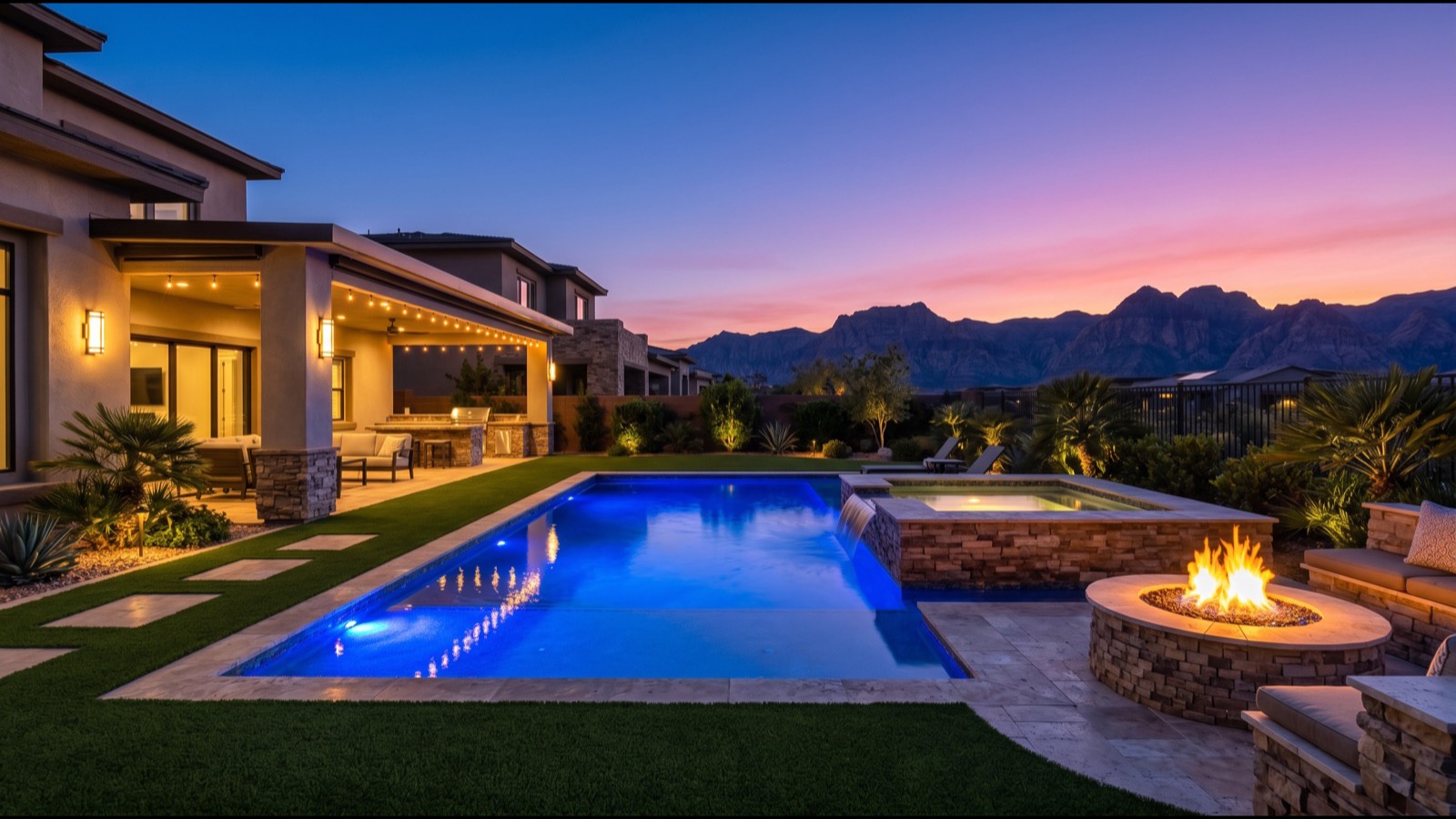
Why pools are so hard for a model in this specific market. In much of the country a pool is a modest amenity and sometimes a liability. In the Las Vegas valley, where triple-digit summers are routine, a pool is closer to core infrastructure. But the tax roll frequently does not record it, listing remarks describe it inconsistently, and two pools of identical recorded existence can differ by $80,000 in real contribution — a basic play pool versus a pool with spa, water feature, cool decking and a full outdoor kitchen are the same single data point to a model.
Why Do Two Identical Floor Plans Sell for Different Prices?
Because the house is only part of what a buyer is purchasing.
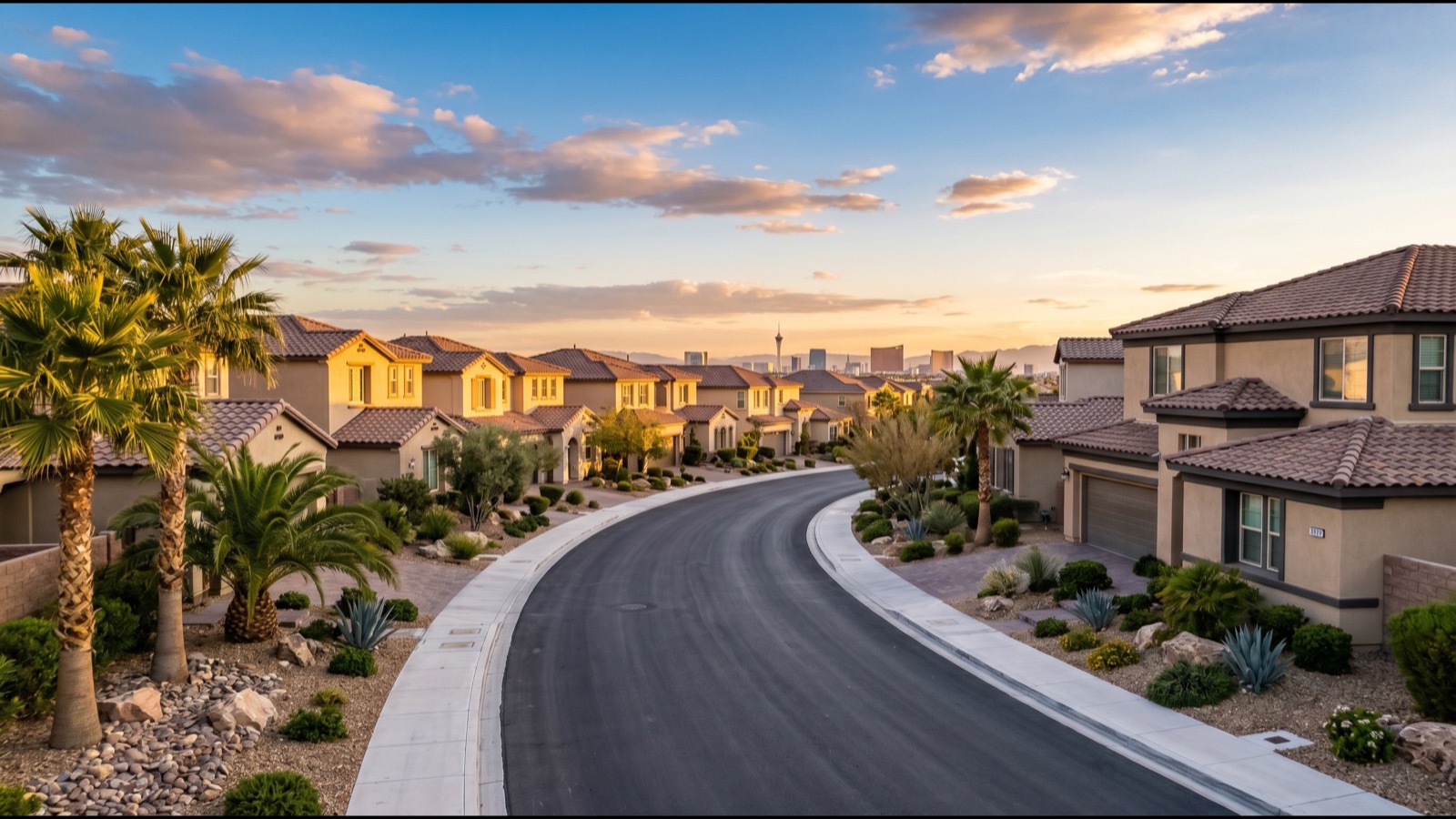
Walk any Las Vegas subdivision built after 2000 — or any newer Summerlin or North Las Vegas village — and you will find the same plan repeated dozens of times. On paper those homes are interchangeable, which is exactly why an automated model treats them as near-perfect comparables. In practice they routinely close $60,000 to $150,000 apart. The drivers:
- Lot position. An interior lot backing a neighbor's wall and a premium lot backing open desert or a golf course were sold by the builder at different prices from day one, often a $25,000 to $100,000 lot premium, and that spread persists at every resale.
- View. A second-story Strip view, a Red Rock view, or a mountain view can add $50,000 or more in the right neighborhood, and it appears nowhere in any public record.
- Upgrade level. Two buyers bought the same plan; one spent $18,000 at the design center and one spent $140,000. The model sees one floor plan.
- Orientation. North-facing backyards command a real premium in this climate because they are usable in July. Locals price this. No model does.
- Condition and age of systems. A 2004 home with an original HVAC and roof is not the same asset as the identical home with both replaced, a $20,000 to $35,000 difference.
According to the Clark County Assessor, parcel records capture structural characteristics and land area for taxation, not the finish quality, view corridor, or renovation history that buyers in this valley actually pay for. An automated model built on those records inherits their blind spots.
How Do SID and LID Assessments Distort an Automated Estimate?
This is the Las Vegas-specific trap that catches out-of-state buyers and every national valuation model.
Special Improvement Districts and Local Improvement Districts finance infrastructure — roads, sewer, streetlights, flood control — in many valley master plans, and the balance attaches to the parcel rather than to the owner. A home in an SID neighborhood can carry an outstanding assessment of $8,000 to $30,000 that transfers with the property, plus an annual payment that functions like a second tax bill.
For the broader question of how to use automated research, compare local expertise versus national property portals before relying on a portal result alone.
What that does to value. A buyer comparing two otherwise identical homes will discount the one carrying an unpaid assessment by roughly the balance, sometimes more, because the payment is an ongoing monthly obligation on top of the mortgage. Sellers in heavily assessed neighborhoods routinely take a $5,000 to $15,000 haircut or pay the balance off at closing to stay competitive.
What an automated model does with it. Nothing. The assessment is not a listing field. If the model's comparable pool mixes assessed and unassessed homes — which it will, because it cannot tell them apart — the resulting estimate is biased in whichever direction the mix happens to run.
According to the City of Henderson, special improvement district information is available to property owners on request, and the Nevada Department of Taxation publishes the framework governing how these assessments are levied and collected. Checking the balance is a five-minute task that no algorithm performs on your behalf.
What Does New Construction Do to Neighborhood Comps?
It contaminates them, in a way that is nearly invisible after closing.
When a builder sells a home for $520,000 with $35,000 in incentives — a rate buydown, closing costs, a design-center credit — the recorded sale price is still $520,000. The economic price was $485,000. Multiply that across an active community and a model reading recorded prices will conclude the neighborhood is worth several percent more than a resale buyer will actually pay.
This matters enormously in Las Vegas because so much of the valley is actively building. Our new construction guide explains how builder incentives are structured and why they do not appear in recorded prices. In Cadence, for example, our August 2026 measurement found 213 active listings of which 61 were builder inventory — roughly 29% of the visible market carrying incentive structures a model cannot subtract. A resale seller in that community who prices against builder comparables will be above the market from the first day.
The asymmetry that follows. New construction comparables push estimates up. Distressed or off-market family transfers push them down, and they are frequently unlabeled. A model that cannot distinguish an arm's-length sale from a below-market transfer between relatives inherits both errors at once.
According to Fannie Mae, sales concessions must be identified and adjusted for in a credible appraisal — a requirement that exists precisely because unadjusted concession-inflated prices distort every subsequent valuation in the neighborhood.
Why Are Luxury Homes the Hardest to Value in Las Vegas?
Because at the top of the market, every home is a sample size of one.
Our error measurement showed a clear price gradient. Homes under $350,000 came in slightly high, and homes above $1.5 million came in roughly 20% low. Those opposing tilts partially cancel when you average the whole market, which is exactly why a single headline accuracy number hides the problem — and why four separate attempts to fix our estimator with one global calibration adjustment all failed.
What breaks at the top. A $2.5 million home in MacDonald Highlands or The Ridges may have three genuine comparables in a year, none of them truly similar. Custom homes vary in ways square footage does not capture: a $400,000 kitchen, a subterranean garage, a casita, a view corridor that took the lot from $600,000 to $1.4 million. Automated models handle scarcity badly, and they handle uniqueness worse — which is why guard-gated communities are among the hardest properties in the valley to value from a desk.
That gradient is why our own tool now refuses to publish a figure above a price threshold and routes those homeowners to a person instead. It is not modesty. It is that the measurement told us the model is not competent in that band.
How Do Appraisers and Agents Actually Value a Home?
They do the one thing no automated system does: they look at the house.
A licensed appraiser working under the Uniform Standards of Professional Appraisal Practice selects a small number of genuinely comparable sales and then adjusts each one, line by line, for the differences. Pool, lot premium, view, condition, upgrade level, concessions, date of sale. The output is not a number pulled from a distribution — it is a reasoned argument with the adjustments shown.
According to The Appraisal Foundation, which sets those standards, credible assignment results require the appraiser to identify and analyze the characteristics that affect value rather than relying on aggregate data alone. That is the entire difference between a $12,000 adjustment for a remodeled kitchen and a model that never learns the kitchen exists.
What a good agent adds on top. In our experience listing homes across the valley, an appraiser answers what the home is worth today for lending purposes. A listing agent answers what a buyer will pay in the next 30 days, which is a different and more commercial question. It includes what is currently competing with you, what just went under contract two streets over and has not closed yet, and what the buyer pool in that specific price band is behaving like this month. Pending sales are the freshest signal in the market and they carry no recorded price at all — which is precisely why an automated model cannot use them and a working agent can.
For a deeper walk through the adjustment process and how to challenge a low number, our Las Vegas home appraisal guide covers the mechanics in detail.
What Should You Do Before Trusting Any Home Value Number?
Six checks, in order. None of them take long, and each one addresses a specific failure documented above.
- Find out how many comparable sales it used. Fewer than five is not an estimate, it is an anecdote. Our own tool declines to publish below that floor, because a three-comparable pool once produced a confident label and an $85,000 miss.
- Check whether the comparables are actually comparable. Same subdivision, similar square footage, sold within about 90 days. A comparable from a different master plan two miles away is a different market.
- Ask whether new construction is in the pool. If builder inventory is comping your resale, the number is inflated by incentives that were never subtracted.
- Look up your SID or LID balance. Clark County and the city assessor's office will tell you, and any of our Henderson homes for sale listings can be checked the same way. An unpaid $18,000 assessment is a real deduction from what a buyer will pay.
- Account for what the model cannot see. Add back your pool, your view, your lot premium, your remodel. Subtract for a 2003 roof and an original HVAC.
- Get a second number from a person. Not because software is useless, but because our own measurement says the software is right within 10% less than half the time in this market.
How Should You Read a Value Range Instead of a Single Number?
Carefully, because most published ranges are not what buyers think they are.
Here is a distinction worth understanding. Many valuation tools present a range that is simply the middle 50% of the comparable pool — the interquartile range. That is a description of the comparables, not a prediction about your house. By construction it excludes the outer half of outcomes, so a homeowner whose home is genuinely unusual will find their true value sitting outside the band. When we tested our published band against real closings, it contained the actual sale price about 82% of the time, and we only got there by narrowing which homes we would publish a band for at all.
| What you are shown | What it actually is | How much to trust it |
|---|---|---|
| A single dollar figure | The midpoint of a distribution, stripped of its uncertainty | Treat as a starting question, never a price |
| A range with no stated basis | Usually the middle 50% of the comparable pool | Assume your home can fall outside it |
| The comparable sales themselves | Actual recorded transactions you can inspect | The most reliable thing on the page |
We have found this distinction matters most to homeowners who are close to a decision. The comparable sales are worth more than the estimate. If a tool shows you the five homes it used, their sale prices, their dates and their addresses, you can drive past them. You can see that one backs the freeway and one backs a park. That is genuinely useful information, and it does not require you to trust anyone's model.
What Does Nevada Real Estate Group Show You Instead?
We changed the product after we measured it, and the change was to show fewer numbers.
Our valuation tool now runs every estimate through a set of evidence gates before it will publish a dollar figure. It withholds the number when the comparable pool is too thin, when the home is above the price band where our error rate climbs, when the property type is one the local MLS does not describe well, and when independent signals disagree with each other by more than a set threshold. In the August 2026 test, those gates published a figure on roughly 9% of Las Vegas homes. On the other 91%, we show comparable sales and connect the homeowner with an agent.
That is a deliberately unflattering conversion decision, and we made it on purpose. According to the Nevada Real Estate Division, licensees operate under a duty to exercise reasonable skill and care — publishing a number we have measured to be unreliable on a specific home is not consistent with that. The homeowners who emailed us calling their valuations "way too low or way too high" were correct, and the honest fix was to stop showing the number rather than to keep showing it with a softer disclaimer.
What you get from us. The comparable sales we would actually use, the adjustments we would actually make, and a real opinion of price from someone who has walked the neighborhood. If you want the automated starting point anyway, our home value estimator is still there — it will simply tell you when it does not know.
If you want a real number rather than an algorithmic guess, we will pull the comparable sales for your specific street, adjust them for your pool, lot, view and condition, and tell you what a buyer will realistically pay in the next 30 days — including when that answer is "less than you were hoping." Call or text (702) 637-1759, or start with the home value request page and we will follow up with the comparables behind it. If speed matters more than price, we can also walk you through a cash offer. If you are weighing a move, our seller resources walk through pricing, timing and net proceeds, and you can contact us directly with a specific address.
Frequently Asked Questions
How accurate are online home value estimates in Las Vegas?
In our August 2026 test against 69 real closed sales, our own estimate had a median error of 10.8%, and only 48% of estimates landed within 10% of the actual sale price. The worst tenth missed by more than 31.7%. Treat any online estimate as a rough starting point — on a $500,000 Las Vegas home the typical miss is about $54,000.
Why is my home's estimate different on every website?
Each tool uses a different comparable-selection rule, a different data source, and a different set of adjustments, and none of them have seen inside your house. Different assumptions about which nearby sales are relevant will produce different answers from the same public records. The spread between them is a useful signal in itself: a wide spread means the comparables are genuinely ambiguous for your property.
Does a pool increase my Las Vegas home's value?
Yes, and more here than in most markets — a usable backyard is close to essential in this climate. But pool quality varies enormously, and a basic play pool and a full resort backyard with spa, water feature and outdoor kitchen can be $80,000 apart while registering identically in public records. When we audited our own estimates, pooled homes were being valued roughly 9.9% low until we corrected the comparable matching.
Why did my home estimate change by $50,000 overnight?
Almost always because one new sale entered or left the comparable pool. When a model draws on a small number of nearby transactions, a single closing — especially an unusual one — can move the output substantially. That volatility is a direct symptom of a thin comparable pool, which is itself a warning sign about the estimate's reliability.
Are online estimates more accurate for new construction homes?
They are often worse, because builder sale prices are recorded gross of incentives. A home recorded at $520,000 with a $35,000 rate buydown economically sold for about $485,000, and a model reading the recorded figure will value the whole neighborhood several percent high. This is a significant distortion in actively building communities.
Should I set my listing price using an online estimate?
No. Our own measurement says the estimate is right within 10% less than half the time in Las Vegas, and pricing errors are asymmetrically expensive — an overpriced listing goes stale and typically closes below where a correctly priced one would have. Use the estimate to frame the question, then price from actual comparable sales and current competing inventory.
How do I get an accurate value for my Las Vegas home?
Have someone look at the house. A licensed appraiser produces a defensible value for lending purposes; a listing agent produces a market opinion that accounts for what is competing with you right now and what is pending but not yet closed. Both do the thing no algorithm does, which is observe the condition, view, lot and upgrades that carry most of the value in this valley.
Is it worth getting a home value estimate if I am not selling?
Yes, for refinancing, removing mortgage insurance, appealing a tax assessment, or simply tracking equity — but hold the number loosely for exactly the reasons measured above. If you are making an actual financial decision on it, get the comparable sales rather than the single figure, and confirm with a person before you act.
Which Sources Inform This Home Value Accuracy Guide?
The accuracy figures in this guide are our own, measured on August 30, 2026 against 69 Las Vegas and 24 Reno closed sales drawn from Las Vegas REALTORS and Northern Nevada Regional MLS data, with each subject property excluded from its own comparable pool. Sample sizes are stated so you can weigh them: 69 homes is enough to characterize a market, not enough to make fine distinctions between neighborhoods, and the Reno figure at 24 homes should be read as indicative rather than precise. We re-run this measurement quarterly, because error percentiles measured in one market cycle do not stay true in the next.
- Las Vegas REALTORS — monthly Southern Nevada market statistics and MLS data
- Consumer Financial Protection Bureau — automated valuation model quality-control standards
- The Appraisal Foundation — Uniform Standards of Professional Appraisal Practice
- Fannie Mae — sales concession identification and adjustment requirements
- Freddie Mac Primary Mortgage Market Survey — weekly mortgage rate series
- Federal Housing Finance Agency — House Price Index methodology and metro-level series
- Clark County Assessor — parcel characteristics and assessed values
- Nevada Department of Taxation — special assessment framework and property tax administration
- City of Henderson — special improvement district information
- Nevada Real Estate Division — licensee standards of practice
- Nevada Revised Statutes Chapter 645 — real estate licensing and duties
- U.S. Census Bureau — Las Vegas housing stock and ownership data
- U.S. Bureau of Labor Statistics — Las Vegas metro employment series
- HUD — housing market conditions and fair housing guidance
Related reading: How much is my house worth in Nevada walks through the valuation process step by step, and our Cadence Henderson market analysis shows what the new-construction comparable problem looks like inside a single community.