

Search our MLS feed for listings mentioning a Strip view and you'll get over 1,000 active condos and 125 houses — in a skyline market where maybe a third of those views survive an in-person visit. "Peekaboo Strip view from the second bathroom" is a genre of listing fiction, and the premium for the real thing is too large to pay on faith: verified, unobstructed skyline commands five to twenty percent over identical view-less floor plans, and at the trophy tier the view is the price.
So this guide does what the listing remarks won't: maps where genuine Strip views actually live — which towers, which hillsides, which ridgelines — quantifies the premium at 2026 prices, and gives you the verification protocol we run before any client pays for photons. Across the 9,600+ closings Nevada Real Estate Group has represented, view deals are where representation earns its keep most visibly — because the view is the one feature a seller can't renovate into existence and a buyer can't inspect with a checklist.
Real Las Vegas Strip views come from three geographies: the high-rise corridor itself (Waldorf Astoria, Turnberry, Veer, the Signature), the Henderson hillsides (MacDonald Highlands, Ascaya, Seven Hills, Anthem), and Summerlin's elevated western ridges. Verified views command 5-20% premiums — $25,000-60,000 on mid-tier condos, six figures on hillside estates — and 2026's top view sales included Waldorf penthouses near $3,000 per square foot. Verify at night, from every room that claims it.
- Three real view geographies: the Strip's own towers, Henderson's hillsides, and Summerlin's elevated ridges.
- Verified view premiums run 5-20% — and two Waldorf Astoria penthouses cracked 2026's top-20 sales at $2,575-2,965/sqft.
- Over 1,000 active listings claim Strip views in our MLS feed; the verification visit separates real from "peekaboo."
- Facing matters more than floor: a low floor facing the Strip beats a high floor facing the parking structure.
- View protection is a diligence item — check what's zoned to rise between you and the skyline before paying the premium.
Where Do Real Strip Views Actually Come From?
Geography first, because the physics are unforgiving: the Strip runs north-south on the valley floor, so genuine views come from height on the corridor itself, elevation on the valley's rim, or unobstructed distance with altitude — and nothing else. The three real sources:
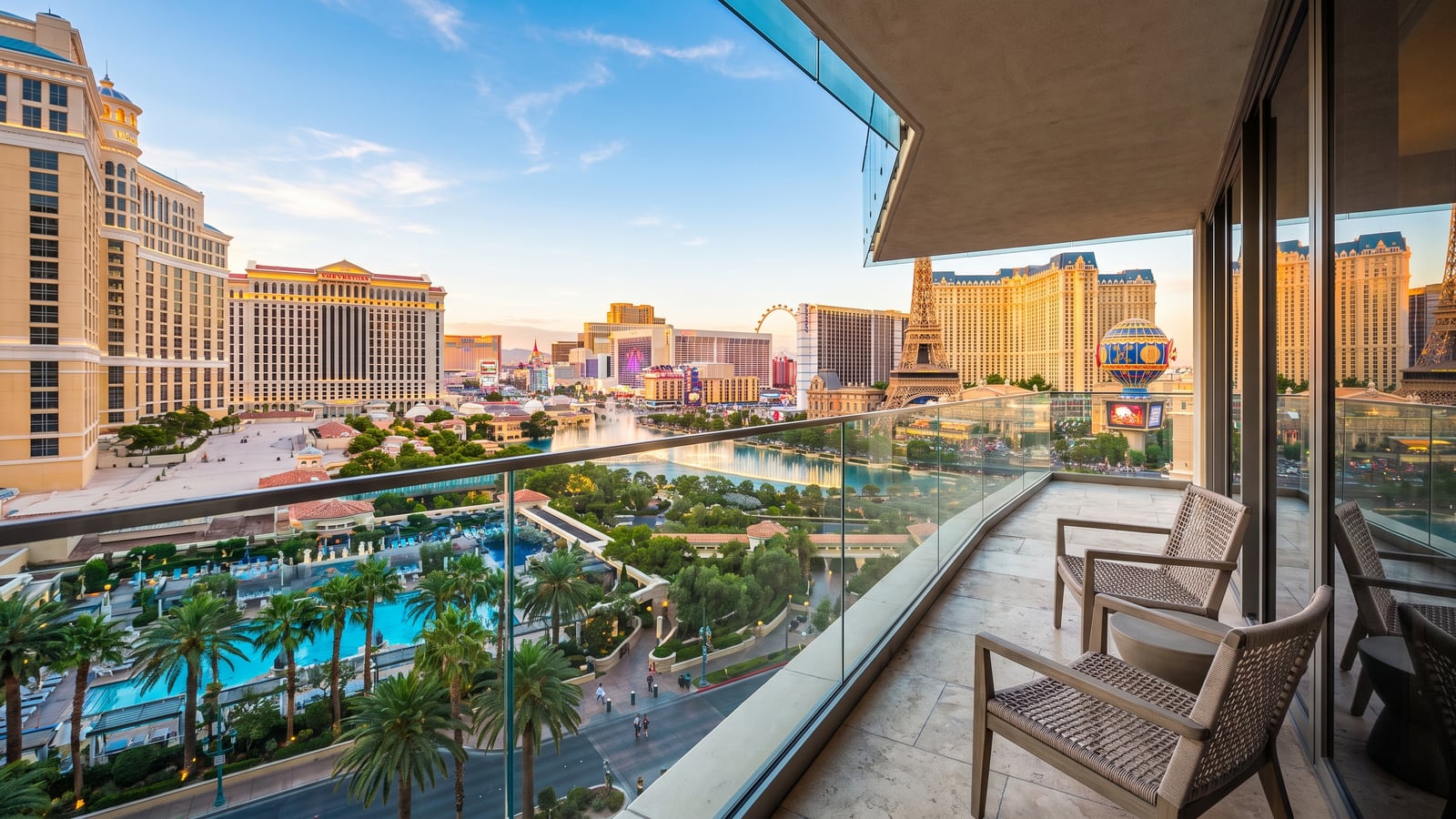
The high-rise corridor — living inside the skyline: the resort-corridor towers (Waldorf Astoria, Veer at CityCenter, the Signature at MGM), the Turnberry and Sky towers on the north Strip, Palms Place west of the corridor, and the downtown towers looking back south. Views here are close-range and cinematic — the Bellagio fountains as television — with the trade-offs of resort-corridor living (traffic, event weekends, HOA fees that fund valet culture).
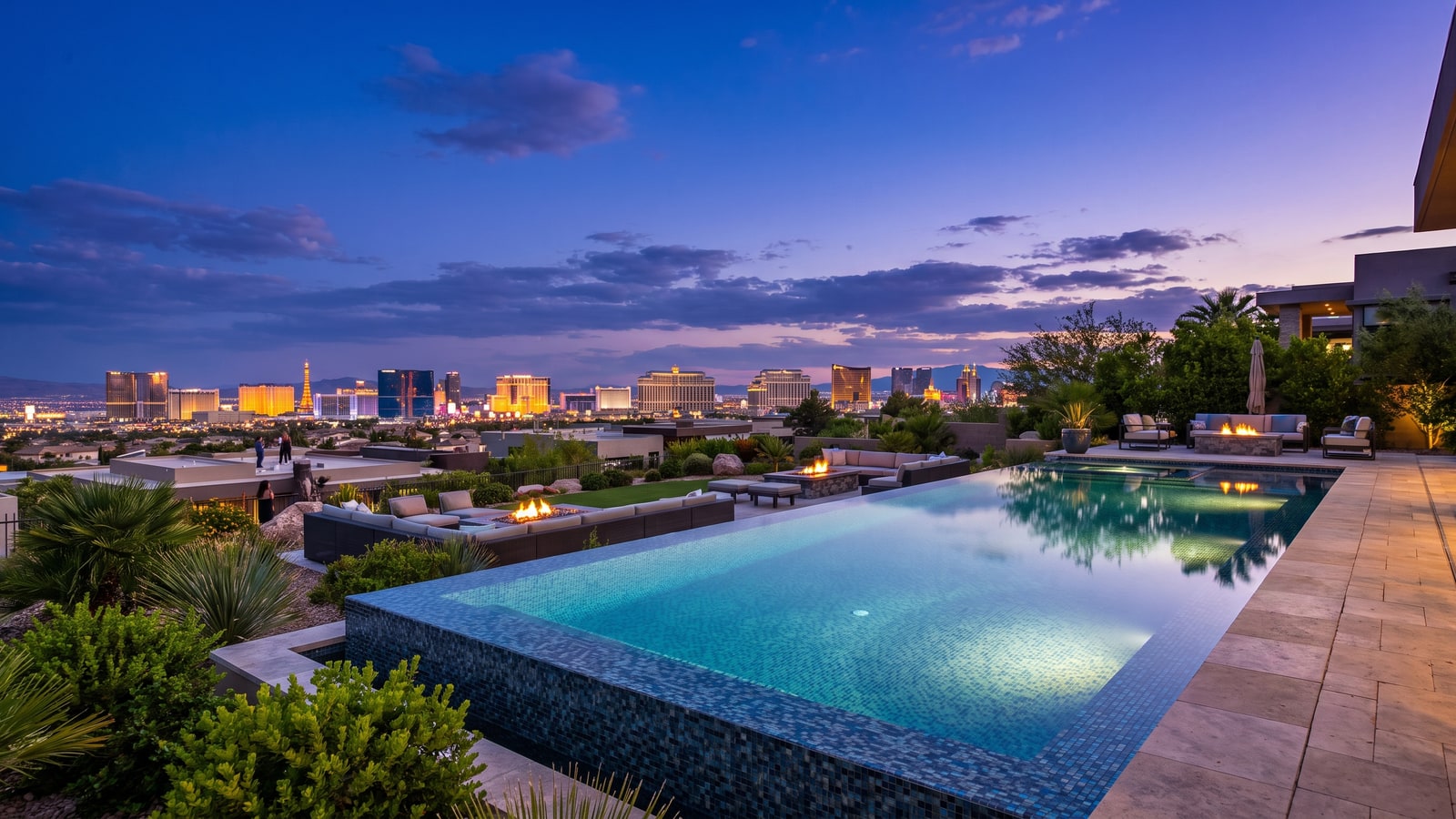
The Henderson hillsides — the valley's balcony: MacDonald Highlands, Ascaya, Seven Hills, and Anthem's upper ridgelines sit hundreds of feet above the valley floor with the entire skyline arranged panoramically ten miles out. This is the trophy-view geography — six of 2026's twenty biggest sales closed here — where the view arrives with acreage, architecture, and guard gates.
The west-side ridges — Summerlin's elevation play: The Ridges, the Summit's slopes, and the higher Summerlin West villages catch the skyline at distance with Red Rock behind you — the two-view arrangement (sunrise skyline, sunset sandstone) that Ridges custom lots price explicitly by sightline.
What's not a view source, despite a thousand listing claims: mid-valley single-story rooftlines, second-floor bonus rooms aimed between two neighbors, and anything described as "peekaboo." If the remark needs a qualifier, the premium shouldn't survive it.
What Does a Strip View Actually Cost in 2026?
The premium is real, measurable, and tiered:
| Property tier | View-less baseline | With verified Strip view | The premium |
|---|---|---|---|
| Mid-tier high-rise condo (1-2BR) | $400,000-550,000 | $450,000-650,000 | 10-20% — facing is everything |
| Luxury tower residence | $800,000-1,500,000 | $950,000-1,900,000 | 15-25% for full-frontal skyline |
| Penthouse tier | — | $2,575-2,965/sqft at 2026's Waldorf closings | The view is the price |
| Henderson hillside custom | $1,200,000-2,000,000 interior lots | $1,500,000-3,000,000+ view lots | $300,000-1,000,000 in lot value alone |
| Summerlin ridge single-family | $700,000-1,000,000 | $800,000-1,200,000 | 10-15% for the distance view |
| Anthem/Seven Hills view streets | $800,000-1,100,000 | $950,000-1,400,000 | The ridgeline tax, worth it at resale |
Two data points anchor the top. According to Las Vegas REALTORS closing data via our MLS feed, two Waldorf Astoria penthouses cracked 2026's twenty biggest sales at $11,800,000 and $10,100,000 — $2,575-2,965 per square foot for two-bedroom floor plans, numbers only the Summit Club exceeded, and the purest measurement of what the skyline itself is worth (the full ranking lives in our top-20 sales analysis). And in the hillside tier, view-lot land in MacDonald Highlands and Ascaya routinely carries $300,000-1,000,000 of the total price — developers there literally price lots by sightline degree.
The resale corollary matters as much as the purchase premium: verified-view properties in our files sell faster and hold value better through soft markets, because the view is the one feature with permanently fixed supply. Which raises the question the next section answers — how fixed?
Which Hillside Communities Own the Panorama?
The Henderson rim deserves its own map, because the panorama tier is where six of 2026's twenty biggest sales closed:
| Dimension | MacDonald Highlands | Ascaya | Seven Hills | Anthem ridgelines |
|---|---|---|---|---|
| View character | Full-valley panorama over DragonRidge golf | Terraced modern lots, engineered sightlines | Skyline over Rio Secco's greens | Distance panorama from the valley's south rim |
| Entry with real view | $1,500,000+ | $2,500,000+ custom | $950,000-1,400,000 | $950,000-1,400,000 |
| 2026 top-20 sales | 4 (incl. the $17M over-ask war) | 3 between $10.5M-12.95M | Adjacent Crystal Ridge placed one | One at $8.26M |
| Gate tier | Guard-gated | Guard-gated | Guard-gated core | Guard-gated country club |
| The buyer | The panorama maximalist | The architecture collector | The value-view entry | The country-club family |
According to the Howard Hughes Corporation, the west side answers with elevation of its own — The Ridges' villages were platted explicitly around Red Rock and skyline sightlines — and according to Clark County's development records, the Henderson hillside communities sit on terrain no future valley-floor project can reach. That structural protection is half of what the guard-gated premium buys at this tier, and why hillside view lots hold value through every cycle we've tracked.
Can Your Strip View Be Built Away — and How Do You Check?
The nightmare scenario: pay the premium, then watch a crane rise between you and the skyline. View protection is a diligence item, and the risk varies sharply by geography. Hillside views are the safest — MacDonald Highlands and Ascaya sit above everything buildable between them and the Strip, with the elevation doing the protecting; nothing zoned for the valley floor reaches their sightlines. Tower views carry real risk on the corridor's soft sides — the resort corridor keeps building, and a north-facing unit's view is only as safe as the parcel across the street; the development pipeline and Clark County's zoning maps are the required reading before paying a facing premium. Summerlin ridge views are distance-protected — ten miles of low-rise valley between you and the skyline can't densify enough to matter. According to the Federal Aviation Administration's obstruction-evaluation framework that governs tall construction near Harry Reid's approach corridors, even the corridor's own vertical ambitions face hard caps in wide swaths of the valley — a quiet structural ally for existing sightlines that most view buyers never learn they have.
The verification protocol we run: pull the zoning and entitlement status on every parcel in the sightline cone (public record, an afternoon's work), check the tower's own association documents for planned phases, and for corridor units, ask the specific question — what is approved, not just what exists. A $60,000 view premium deserves a $0 afternoon of due diligence.
Which Towers Deliver the Best Views per Dollar?
In our experience the tower market's honest hierarchy runs like this:
- The Waldorf Astoria — the benchmark: full-service hotel-branded living inside the skyline, with the 2026 sales record to prove the premium. The view product is close-range CityCenter glamour.
- Veer Towers — CityCenter's leaning twins: the most architectural product on the corridor, all-glass units where the view is the wall.
- The Signature at MGM — the entry point: studio-scale units from the $300,000s with real Strip proximity — the view-per-dollar leader for pied-à-terre buyers, with condo-hotel financing quirks to underwrite first.
- Turnberry Place and Sky — the north-Strip elders: bigger floor plans, established associations, views down the corridor's full length; the value play for full-time residents.
- Palms Place and the west orbit — side-angle skyline at friendlier prices, popular with the lock-and-leave crowd.
- Downtown's towers — the reverse angle: looking south at the whole Strip as a single postcard, from a downtown market priced well under corridor equivalents.
A note on the corridor's rhythm, because tower living has a calendar: F1 week, CES, fight weekends, and New Year's Eve transform the neighborhood — thrilling if you bought for the energy, taxing if you didn't. According to the Las Vegas Convention and Visitors Authority, the visitor calendar now runs essentially year-round, which residents translate as: know your building's event-week parking, elevator, and noise reality before you buy, not after your first Grand Prix. The buildings engineered for residents (Turnberry's setbacks, Waldorf's sky-lobby separation) handle it gracefully; the converted condo-hotels less so.
Tower-buying rule one, worth repeating from every file: facing beats floor. A sixth-floor unit aimed dead at the skyline outranks a thirtieth-floor unit aimed at the parking structure, and floor-plan diagrams lie about angles — which is why the protocol below exists.
How Do You Verify a View Before Paying For It?
The five-step protocol from our view files — twenty minutes that protect five figures:
| Check | When/how | What it catches |
|---|---|---|
| Night visit | 8-10 p.m., second showing | The daytime haze that hides a mediocre view — and the glow that makes a real one |
| Room-by-room sightline map | Stand in every space that claims the view | "Strip views!" that mean one bathroom window |
| Sit-down test | Couch height, balcony chairs | Parapets and rails that erase seated views |
| Sun-load reality | Ask for summer cooling bills on west glass | The $150-300/month view tax nobody mentions |
| Sightline-cone zoning pull | Public records, one afternoon | The crane that eats a $60,000 premium |
In sequence:
- Visit at night. Strip views are nocturnal assets; a daytime showing sells you brown mountains and haze. The 8 p.m. second visit is non-negotiable.
- Stand in every room that claims it. "Strip views!" often means one bathroom window at a neck angle. Map which rooms actually own the sightline — the premium should track the living spaces.
- Check the sit-down view. Balcony rails, rooflines, and parapets erase views at couch height that photograph beautifully standing up. Sit where you'll actually sit.
- Run the seasonal sun. West-facing view units take the full afternoon desert sun through the same glass that frames the skyline — ask about the cooling bills and the blackout-shade reality.
- Pull the sightline-cone zoning (per the section above) — the only step that protects the future view you're paying for.
And the negotiation footnote: because listing-remark view claims are so inflated, a documented verification — your photos, at night, from the living spaces — is also your pricing leverage when the claimed view underdelivers. We've repriced more than one "full Strip view" unit to its actual "corner-of-the-Sphere" reality.
Who Buys Strip-View Homes — and Why Now?
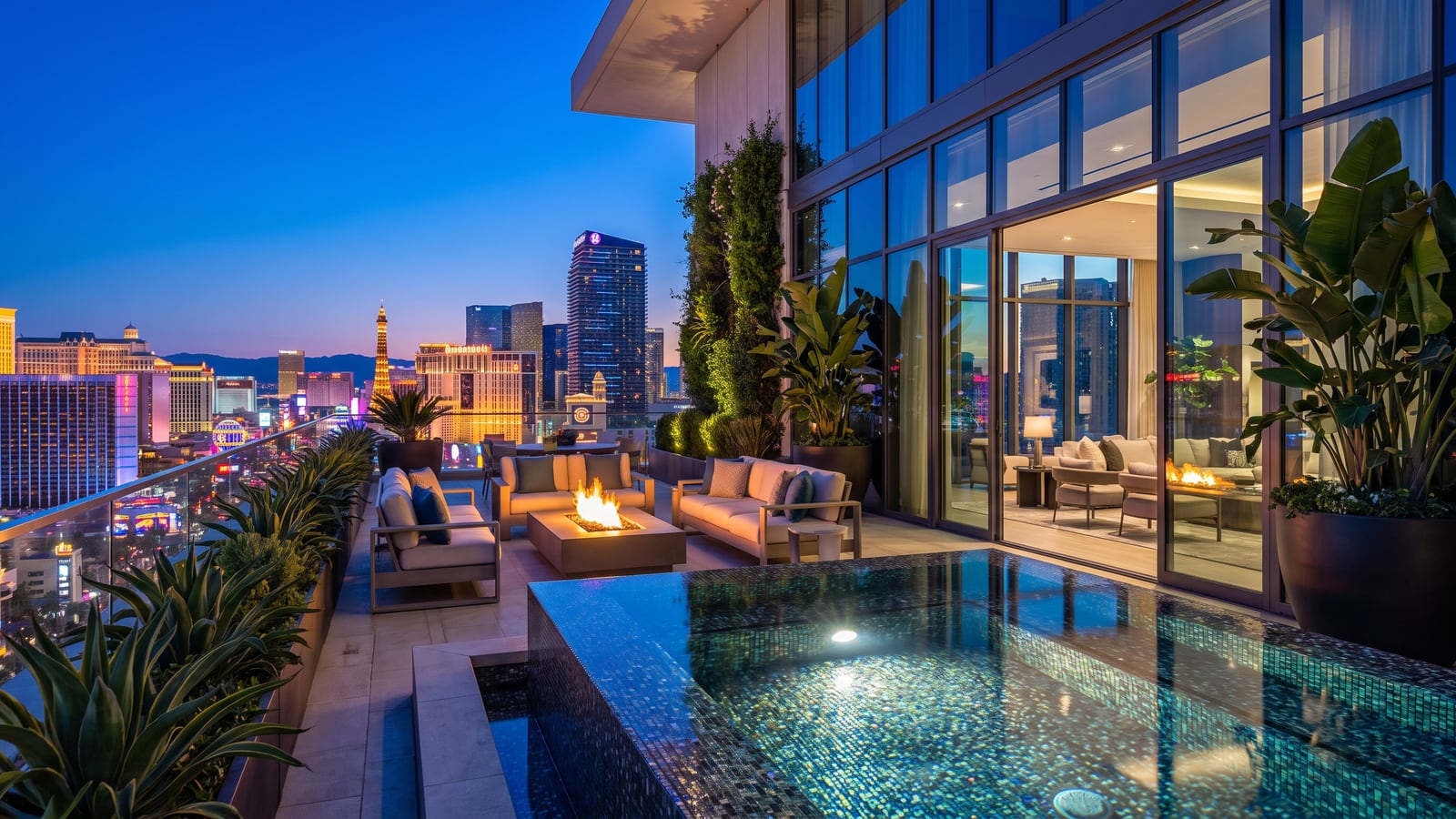
The view-buyer census from our files: relocating executives for whom the skyline is the nightly proof they actually moved somewhere; the residency-and-events class — performers, F1-week hosts, convention-economy principals — whose Vegas identity is the view; empty-nesters trading square footage for scenery in the tower tier; and out-of-state second-home buyers. According to the U.S. Census Bureau's migration patterns, the glowing skyline is the postcard the purchase was always about. The 2026 accelerant: the Sphere's addition to the skyline literally upgraded every east-facing view in the market — the rare event where the view itself appreciated — And according to Harry Reid International Airport's traffic records, the visitor economy that animates the skyline keeps setting records, which is the demand engine under the whole asset class.
Are View Homes Better Investments — or Just Better Sunsets?
Both, with discipline — and financing joins the calculus at this tier: per Freddie Mac's survey rates in the high-6s, a $100,000 view premium costs roughly $660 a month to finance, which is exactly the number to weigh against how many evenings the skyline will actually be your television. The investment case: fixed supply (the hillsides are built out or building out; the sightlines are finite), demonstrated resale velocity (view properties in our files consistently outsell their view-less comps in days-on-market), and a buyer pool that includes the celebrity and executive migration for whom the skyline is the entire point of a Vegas address. The discipline: the premium must be verified (this guide's whole thesis), the property underneath must stand on its own (a great view on a bad floor plan is a bad property with good marketing), and corridor units carry the STR-and-HOA underwriting every Strip-adjacent condo demands. The failure mode we see: paying skyline prices for peekaboo reality — which is a marketing loss, not a market one. The pattern across a decade of these files: view assets underperform expectations only when the view was never real, was never protected, or was financed past the buyer's honest usage of it. Get those three right and the sunset pays dividends in both senses.
For sellers holding real views, the mirror advice: market the view like the asset it is — twilight photography, room-by-room sightline documentation, and pricing against view comps rather than floor-plan comps. Half the view premium lives in how it's presented, and luxury listing strategy at this tier is substantially view strategy.
How Should Sellers Market a Real Strip View?
The mirror playbook, because half our view files are listings. Shoot the twilight — the blue-hour exterior and the lit-skyline interior are the two photographs that justify the premium; a view listing with only daytime media is leaving five figures on the table. Document the sightline room by room — a floor-plan graphic marking which spaces own the view converts the claim into evidence, and evidence prices. Price against view comps, not floor-plan comps — the identical model without the sightline is not your comparable; the last three verified-view sales in your community are, and pulling them correctly is precisely the kind of judgment the top-sales data exists to inform. Time the showings — evening showings for view properties aren't a gimmick; they're merchandising, and we schedule them deliberately. Prep the glass — professionally cleaned windows before photography is the highest-ROI hundred dollars in luxury listing prep, which sounds like a joke until you've seen hard-water spots in a $2,000,000 listing's hero shot.
And the seller-side honesty that builds trust with the market: if the view is partial, angle-dependent, or seasonal, market it precisely ("Strip views from the primary suite and balcony") rather than globally. The buyers this guide trains will verify anyway — accurate claims survive the night visit; inflated ones die there, taking your negotiating credibility with them. In our listing practice the precisely-claimed view outperforms the over-claimed one every time, because the showing confirms instead of disappoints.
What Are the Biggest Strip-View Buying Mistakes?
- Paying for the remark instead of the sightline. A thousand listings claim it; the night visit decides it.
- Buying floor instead of facing. The tower's height is not your view — your unit's angle is.
- Skipping the zoning cone. The corridor keeps building; the parcel between you and the skyline is the whole risk.
- Ignoring the sun tax. The glass that frames the view heats the room — west-facing units need the cooling-cost conversation.
- Underwriting the condo like a house. Warrantability, HOA reserves, and rental rules decide tower value as much as the view does.
- Selling a real view with daytime photos. The twilight shoot is the cheapest five-figure decision a view seller makes.
How Do You Hunt a Real View With NREG?
Tell us the view you want — fountains-close or panorama-far, morning skyline or evening glow — and we'll run the search the way the guide prescribes: verified sightlines only, zoning cones pulled, night visits scheduled, and the premium negotiated against what the window actually delivers. The live inventory: over 1,000 claimed-view condos and 125 houses on our search right now, of which the genuinely-viewed minority is exactly the shortlist worth touring. Nevada Real Estate Group — 150+ agents, 9,061+ verified five-star client reviews, and a luxury practice that treats sightlines as the asset class they are. Call (702) 637-1759, or describe your view and we'll send the verified shortlist this week.
Frequently Asked Questions
Where can you find homes with Las Vegas Strip views?
Three real geographies: the high-rise corridor itself (Waldorf Astoria, Veer, the Signature, Turnberry, Sky), the elevated Henderson hillsides (MacDonald Highlands, Ascaya, Seven Hills, Anthem's ridgelines), and Summerlin's western ridges including The Ridges. Everything else claiming a view deserves the night-visit verification before any premium changes hands.
How much more do homes with Strip views cost?
Verified views run 5-20% premiums by tier: $25,000-60,000 on mid-tier condos, 15-25% on luxury tower residences, and $300,000-1,000,000 of lot value on Henderson hillside customs. At the top, 2026's two Waldorf Astoria penthouse sales closed at $2,575-2,965 per square foot — the skyline priced as the asset itself.
Can a new building block my Strip view?
On the resort corridor, genuinely possible — tower views are only as safe as the zoning on the parcels in the sightline, so pull entitlements before paying a facing premium. Hillside views (MacDonald Highlands, Ascaya) are elevation-protected — nothing buildable on the valley floor reaches them — and Summerlin's distance views are similarly durable.
What's the cheapest way to get a Strip view home?
The Signature at MGM and similar condo-hotel products start in the $300,000s with real proximity views, and downtown's towers offer the full-skyline reverse angle below corridor pricing. Both carry financing and HOA nuances (warrantability, rental rules) that need underwriting before the view math matters — cheap entry with homework attached.
Do Strip-view condos make good investments?
The verified ones, yes: fixed supply, faster resale, and a buyer pool that prizes the skyline. The discipline is the same as buying — premium only for documented sightlines, sound HOA and warrantability underneath, and honest cooling-cost math on west-facing glass. Peekaboo premiums are where view investments go wrong.
Is a high floor or Strip-facing unit more important?
Facing, decisively. A mid-floor unit aimed directly at the skyline delivers more view than a top-floor unit angled away — height adds drama only when the direction is right. Verify per-unit, at night, sitting down; tower marketing sells the building's best angle, not necessarily your unit's.
Which Henderson communities have the best Strip views?
MacDonald Highlands and Ascaya own the panorama tier — hillside elevation with the full skyline ten miles out — with Seven Hills and Anthem Country Club's upper streets close behind. Six of 2026's twenty biggest valley sales closed in that hillside cluster, and the view lots carry explicit six-figure sightline premiums.
Which Sources Inform This Strip-View Guide?
Inventory counts (1,074 view-claiming condo actives, 791 2026 solds, 125 houses) are live queries from NREG's GLVAR MLS feed — the same pipeline behind our Las Vegas data desk — and sale records reference Las Vegas REALTORS reporting including June 2026's record $490,000 valley median. Tower and community context draws on Clark County zoning and development records, the Howard Hughes Corporation (Summerlin), and NREG's luxury-practice transaction experience across 9,600+ statewide closings. View premiums are observed ranges from our closed files at mid-2026 prices — individual sightlines vary by degree, which is the entire reason the verification protocol exists. Verify yours in person, at night, with us.