

Every week a buyer asks me some version of the same question: prices are getting cut everywhere I look — is Las Vegas finally a buyer's market? Instead of answering with a vibe, I answered with the feed. On August 9, 2026, our team pulled every active single-family, condo, and townhome listing on the Las Vegas–area MLS — 11,878 of them — and compared each home's current asking price against its original list price. The result: 43.4% of all active listings have cut their price at least once, 27.1% cut within just the last 30 days, and the median reduction is $18,900, or 3.7% of the original ask.
That is not a normal market. But it is also not a crash, and calling it a "buyer's market" outright would oversell it. The honest answer sits in between — and the difference between those three readings is worth tens of thousands of dollars to anyone buying or selling here in the next twelve months.
Not by the textbook — but this is the most buyer-favorable Las Vegas market in years. Supply hit 3.6 months in July per Las Vegas REALTORS, the median single-family price slipped 1.0% to $480,000, and NREG's scan of all 11,878 active listings found 43.4% have cut price — median cut $18,900. Buyers can negotiate price, credits, and repairs at once; sellers who price to the first 30 days still win.
- 43.4% of 11,878 active Las Vegas–area residential listings have cut price; the median cut is $18,900 (3.7%).
- Southern Nevada supply hit 3.6 months in July 2026 — balanced territory, up 2.9% year over year.
- Median single-family price fell 1.0% to $480,000, the first meaningful annual dip since 2023.
- Luxury cuts run deepest: the $1M-plus tier's median reduction is $100,000, with 37.1% sitting 60-plus days.
- Target listings sitting 60-plus days — 27.8% of the market — where price, credits, and repairs all get negotiable.
Is Las Vegas a Buyer's Market Right Now?
By the classical definition — six or more months of housing supply — no. According to Las Vegas REALTORS, Southern Nevada ended July 2026 with 3.6 months of inventory, up 2.9% from July 2025 and up sharply from the roughly two-month supply that defined the 2021–2022 frenzy. Three-and-a-half months is the textbook's balanced zone, leaning soft.
But months of supply is a lagging, blended statistic. The live inventory tells a sharper story. When 43.4% of everything for sale has already reduced its price — and 27.1% of the entire active pool cut within the last 30 days alone — sellers are competing for buyers, not the reverse. In practice, the market behaves like a buyer's market in specific pockets (luxury, aging listings, heavily built ZIP codes) while staying balanced in the tightest ones (entry-price North Las Vegas, well-priced starter homes anywhere).
So the precise answer I give clients: Las Vegas in August 2026 is a balanced market where the leverage has visibly shifted to buyers — roughly a 6 on a 10-point buyer-leverage scale, versus a 2 in 2022. If the price-cut share keeps climbing past 50% and supply crosses 4.5 months this winter, the textbook label will catch up to the street reality.
What Does the Live Price-Cut Data Show in August 2026?
These figures come from NREG's full scan of the Las Vegas–area MLS feed on August 9, 2026 — all 11,878 active single-family, condominium, and townhome listings, each one's current ask compared against its own original list price. No sampling, no estimates.
| Metric | Reading |
|---|---|
| Active residential listings scanned | 11,878 |
| Share with at least one price cut | 43.4% (more than 5,100 homes) |
| Share that cut within the last 30 days | 27.1% (roughly 3,200 homes) |
| Median cut (among reduced listings) | $18,900 — 3.7% of original ask |
| Share with cuts of $25,000 or more | 16.1% |
| Median days on market (all actives) | 35 days |
| Share sitting 60-plus days | 27.8% |
| Median asking price (all actives) | $470,000 |
Two of those rows matter more than the rest. First, the 30-day figure: more than a quarter of the entire active market repriced in a single month, which means reductions are accelerating, not tapering. Second, the 60-day figure: 27.8% of listings have outlived the median marketing window twice over. Those roughly 3,300 aging listings are where buyer leverage concentrates — a seller 60 days in has usually made one cut already and is emotionally prepared for a below-ask offer with concessions attached.

How Fast Has Las Vegas Inventory Grown in 2026?
Supply is the engine behind every price cut. According to Las Vegas REALTORS, July's 3.6 months of inventory was up 17.2% from June alone, and the association notes the sales pace now equates to nearly a four-month supply — this in a market that spent most of 2021–2022 under one month. Local reporting on the July data confirms sales volume is holding near 2025's pace, which means the supply build is coming from listings arriving faster than they sell, not from demand collapsing.
That distinction is why I push back on crash talk. Demand has cooled from feverish to normal; it has not evaporated. Employment in the valley remains solid by Bureau of Labor Statistics measures, and Clark County's population is still growing — just more slowly than the boom years. More homes chasing a normal number of buyers produces exactly what the scan shows: pervasive small cuts rather than distress selling. The median reduction is 3.7%, not 15%.

What Happened to Las Vegas Home Prices in July 2026?
According to Las Vegas REALTORS, the median price of existing single-family homes sold in July was $480,000 — down 1.0% from July 2025 and down 2.0% from the all-time high of $490,000 set in May and June of this year. Condos and townhomes posted a $290,000 median, flat year over year and still below their October 2024 record of $315,000. Fox5's coverage of the report framed it accurately: a pullback from a record, not a slide.
A 1.0% annual dip after a decade in which valley prices roughly doubled is a rounding error in equity terms — but psychologically it matters enormously. Sellers anchored to their neighbor's 2025 sale price are the ones who end up in our 43.4% cut statistic. Buyers who read "prices falling" as "wait for 20% off" are making the opposite mistake: with long-run FHFA data showing Las Vegas home values compounding through every cycle except 2008's credit collapse, the realistic 2026–2027 range is flat to modestly down, not cliff-shaped.
Which Las Vegas Submarkets Are Cutting Prices the Most?
The valley is not one market, and the scan proves it. Here is the same price-cut analysis split across the three biggest cities in the feed:
| Metric | Las Vegas | Henderson | North Las Vegas |
|---|---|---|---|
| Active listings | 7,656 | 2,342 | 1,001 |
| Share with a price cut | 43.2% | 45.0% | 40.6% |
| Cut within last 30 days | 27.4% | 28.9% | 25.0% |
| Median cut | $19,001 | $20,000 | $10,500 |
| Median asking price | $473,975 | $539,950 | $429,999 |
| Median days on market | 34 | 36 | 26 |
| Sitting 60-plus days | 27.4% | 28.7% | 22.1% |
Three patterns jump out. Henderson is cutting hardest — 45.0% of listings, median $20,000 — because its $539,950 median ask carries the biggest stretch above what payment-constrained buyers can absorb at current rates. North Las Vegas is the valley's tightest submarket — fewest cuts, smallest median cut, and a brisk 26-day median DOM — because entry-priced inventory around $429,999 still draws multiple qualified buyers. And inside Las Vegas proper, the Summerlin ZIP codes run above the metro on every softness measure: 45.7% cut share and a $25,000 median reduction on a $615,000 median ask. Premium submarkets, simply put, are doing the most repricing.
How Do Months of Supply Define a Buyer's Market?
The framework agents use is simple: divide active inventory by the monthly sales pace. Under four months of supply favors sellers, four to six is balanced, six-plus favors buyers. Here is where August 2026 Las Vegas actually sits on each classic indicator:
| Indicator | Seller's market | Balanced market | Buyer's market | Las Vegas now |
|---|---|---|---|---|
| Months of supply | Under 4 | 4–6 | Over 6 | 3.6 — at the balanced line |
| Median days on market | Under 20 | 20–45 | Over 45 | 35 on actives |
| Share of listings cutting price | Under 20% | 20–35% | Over 35% | 43.4% — buyer's-market reading |
| Annual price change | Rising 5%+ | Flat to modest | Falling | Down 1.0% year over year |
| Typical concessions | None | Case by case | Standard ask | Credits increasingly common |
Read the last column top to bottom and the mixed verdict is unavoidable: supply says balanced, price cuts say buyer's market, prices say the transition is just starting. Markets move through exactly this sequence — cuts first, days-on-market second, closed prices last — which is why the live cut data is the leading indicator worth watching, and why waiting for headlines to declare a buyer's market means arriving after the best inventory has been picked over.
What Leverage Do Buyers Actually Have in Negotiations Now?
Concretely, more than at any point since roughly 2019. Across recent NREG buyer closings, the pattern is consistent: on listings past 45 days, our clients are routinely negotiating a combination of price reduction, seller-paid closing credits, and repair concessions — three levers that in 2022 were unthinkable to pull simultaneously.
Put numbers on it. Take the metro-median $470,000 home. The median observed cut of $18,900 brings the ask to about $451,100 before a single offer is written. Finance the purchase with 10% down and, at Freddie Mac's current 6.69% average, that reduction alone trims the loan by roughly $17,000 and the payment by about $110 every month — nearly $39,600 across a 30-year term. Stack a negotiated seller credit on top — $9,000 to $12,000 is a realistic ask on an aging listing — and you can buy the rate down or wipe out most cash-to-close beyond the down payment.
The leverage varies by price band, and the scan quantifies that too:
| Indicator | Under $400K | $400K–$700K | $700K–$1M | $1M-plus |
|---|---|---|---|---|
| Active listings | 4,087 | 5,250 | 1,180 | 1,360 |
| Share with a cut | 43.6% | 44.5% | 45.1% | 36.8% |
| Median cut | $11,500 | $15,900 | $29,356 | $100,000 |
| Median asking price | $310,000 | $502,830 | $820,000 | $1,696,944 |
| Sitting 60-plus days | 28.6% | 24.5% | 29.2% | 37.1% |
| Cuts of $25,000-plus | 9.0% | 14.6% | 27.5% | 33.2% |
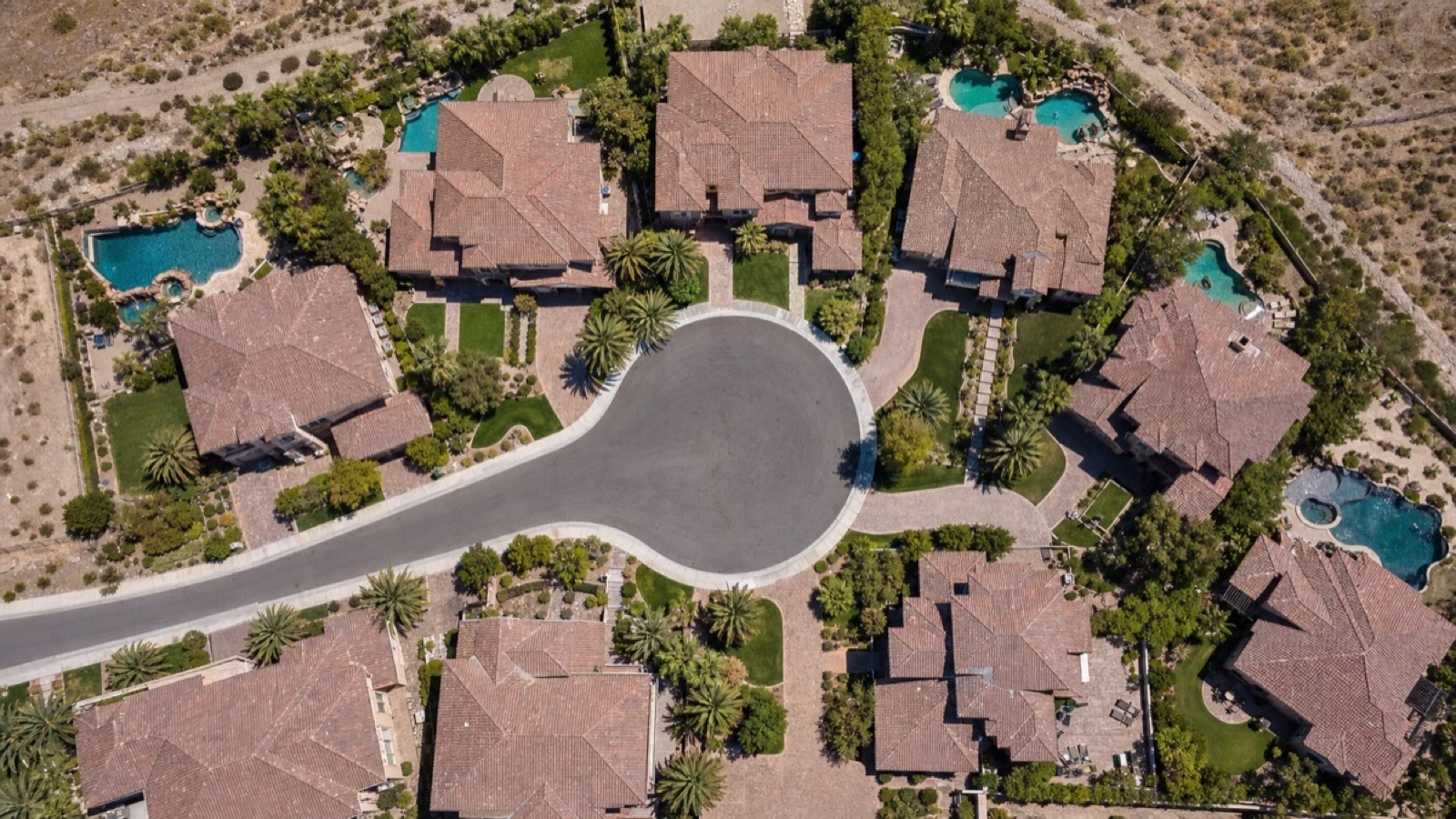
The luxury row deserves its own sentence: the $1M-plus tier cuts least often but by far the most — a median $100,000 reduction, with a third of those listings already down $25,000-plus and 37.1% sitting past 60 days. High-end sellers hold out longer, then capitulate bigger. For a buyer eyeing the valley's luxury communities — and especially its guard-gated enclaves, where 60-day listings are commonplace — patience in this market is literally a six-figure strategy.
Are Sellers Still Getting Their Asking Price?
Well-priced homes, yes — and that qualifier is doing heavy lifting. The scan's flip side is that 56.6% of active listings have never cut, and North Las Vegas's 26-day median DOM proves correctly-priced homes still move fast. What has ended is the 2021-era guarantee that any price finds a buyer eventually.
The math of chasing the market is brutal and I show it to every listing client. A seller who lists $25,000 high, cuts twice, and closes in month four typically nets less than the seller who priced at market on day one — because the eventual buyer of a 90-day listing opens negotiations from the aging, not from the ask. Across NREG's 9,600-plus career closings, the listings that sell inside their first 30 days consistently capture the strongest price-to-ask outcomes; our seller strategy guide is built around that reality. According to the National Association of REALTORS, first-month sales nationally close measurably nearer list price than sales in any later month — Las Vegas in 2026 is a case study of why.
How Do Mortgage Rates Change the Buyer's-Market Math?
Rates are the reason cuts exist at all. According to Freddie Mac's Primary Mortgage Market Survey, the 30-year fixed averaged 6.69% the week of August 6, 2026, up from 6.66% the prior week and stubbornly range-bound in the mid-6s all year. At 6.69%, the metro-median $470,000 purchase with 10% down runs roughly $2,727 monthly in principal and interest; the same house at 2021's 3% rates would have cost about $1,784. That $943-a-month gap is the invisible force compressing what buyers can bid — and therefore what sellers can ask.
This creates a strategic fork. Buyers can take the visible discount (price cut) or the payment discount (rate buydown funded by seller credit) — and the second is often worth more. A two-one buydown on that $423,000 loan costs a seller roughly $9,800 and saves the buyer about $538 a month in year one and $277 in year two, while shopping multiple lenders — which the Consumer Financial Protection Bureau documents can save $100-plus monthly on its own — stacks on top. In a 43%-cut market, a well-advised buyer negotiates the cut and the credit.
Should You Wait for Prices to Drop Further?
The crash question. My honest read of the data: the conditions that produced 2008 — no-doc loans, negative equity, forced selling — do not exist in 2026. Clark County homeowners are overwhelmingly locked into sub-5% mortgages with substantial equity; a seller who does not like today's prices simply does not sell, which self-limits supply growth. That is why the market softens through 43% price cuts averaging 3.7% rather than through foreclosure waves.
Meanwhile, waiting has a running cost. Rent on a comparable single-family home in the valley commonly runs $2,200 to $2,800 a month — money building no equity while you wait for a dip that may total a few percent. If prices drifted down another 3% ($14,100 on the median home) over twelve months but you paid $30,000 in rent to wait for it, the wait lost money even before counting a possible rate move against you. The full framework — including when waiting does win — is in our rent-versus-buy and timing analysis. The short version: buy when the payment fits and the leverage is real. Both are true right now.
How Does New Construction Compete With Resale Right Now?
Aggressively — and every resale buyer should use that. Las Vegas builders respond to slowdowns with incentives rather than sticker cuts: rate buydowns worth $15,000 to $30,000, covered closing costs, design-center credits. When new construction offers an effective 5.25% through a national builder's lender while resale money costs 6.69%, entry-level resale sellers are forced to answer with price — one reason the under-$400K band shows a 43.6% cut share despite the strongest fundamental demand.
For buyers this is a two-way squeeze play: quote builder incentives to resale sellers as your alternative, and quote the 43% resale cut share to builders when negotiating their incentive stack. According to HUD, buyers using FHA financing at 3.5% down can frequently pair the program with either path — and in this market, seller-paid or builder-paid closing help means several thousand dollars less cash to close either way.
Who Wins and Who Loses in a Balanced-to-Buyer Market?
Every market transition redistributes advantage. The clearest winners right now: equity move-up buyers, who sell into a still-firm sub-$500K market and buy into the aggressively-cutting $700K-plus tiers — selling low leverage, buying high leverage; first-time buyers, who face no bidding wars and can actually use FHA and down-payment-assistance programs sellers rejected in 2022; and patient luxury buyers staring at median $100,000 cuts.
The losers: short-hold owners who bought at 2025's peak and must sell now, eating transaction costs against flat appreciation; over-anchored sellers pricing to 2024's comps, who become the 60-day statistic; and wait-for-the-crash renters, who pay $2,400 a month to hold out for a collapse the supply math does not support. Transfer taxes alone reward getting the price right the first time — Nevada's real property transfer tax runs $2.55 per $500 of value in Clark County per the Nevada Department of Taxation, about $2,397 on a median sale, a cost sellers pay whether they priced right or chased the market down.
What Should Sellers Do Differently in This Market?
Selling into a 43%-cut market is entirely winnable — the 26-day North Las Vegas median and the 56.6% of listings that never cut prove it — but the margin for pricing error is gone. Three adjustments matter most. Price to the last 60 days of closed comps, not to your neighbor's spring sale; according to the Clark County Assessor, assessed values lag the live market by design, so neither your tax bill nor a 2025 memory is a pricing tool. Budget for concessions up front — a $8,000 to $12,000 credit engineered into your pricing beats a $20,000 cut made under duress in month two. Make the first 30 days count with condition and presentation, because the data shows that window is where full-price outcomes live; our 7-day listing program exists precisely to concentrate demand early.
And if your home has already sat 60-plus days: reposition decisively. One meaningful reduction that clears the next price band outperforms three $5,000 nibbles that re-alert the same exhausted buyer pool. For owners who need certainty over ceiling — a relocation clock, an estate, a home that shows poorly — a cash offer is the third path worth pricing against the open market before you commit to either.
How Should Buyers Time an Offer on a Price-Cut Listing?
Work the reduction clock. The highest-percentage moment to strike is 7 to 14 days after a cut — the seller has publicly conceded, the post-cut showing bump has faded, and no rival offer has materialized. Offering the day of the cut competes with the bump; waiting past three weeks invites another cut that draws fresh eyes.
On the offer itself, our team's playbook in this market: open 3% to 5% below the reduced ask on listings past 45 days, attach a full pre-approval, and put the concession ask — credit, repairs, home warranty — in the first offer, not the counter. Sellers 60 days in negotiate everything once; they rarely reopen. For the full sequencing, comp-based justification, and the counters to expect, see our companion guide to price reductions and offer strategy, and browse the current Las Vegas homes for sale with fresh eyes on every "price improved" banner — each one is a seller telling you exactly where they stand.
Frequently Asked Questions
Is Las Vegas officially a buyer's market in 2026?
Not by the strict six-months-of-supply definition — Las Vegas REALTORS reported 3.6 months in July 2026, which is balanced territory. But the live behavior says leverage has shifted: NREG's August scan found 43.4% of all 11,878 active residential listings have cut price, with a median reduction of $18,900. Call it a balanced market with buyer's-market negotiating dynamics, strongest on listings aged past 60 days.
How big a discount can buyers actually negotiate right now?
The observed median cut is $18,900 (3.7%) before negotiations even start. On listings past 45 days, NREG buyers are commonly negotiating a further 2% to 4% off the reduced ask plus $8,000 to $12,000 in seller-paid credits. In the $1M-plus tier the median existing cut is $100,000, and aged luxury listings frequently move well below even that repriced level.
Will Las Vegas home prices crash in 2026?
The data does not support a crash. July's median of $480,000 is down just 1.0% year over year, homeowners hold record equity with sub-5% locked rates, and there is no forced-selling mechanism like 2008's credit failure. The realistic path is flat to modestly negative prices while supply normalizes — softening through price cuts, not foreclosures.
Are price cuts a sign something is wrong with a listing?
Usually not. When 43.4% of the entire market has cut, reductions signal mispriced debuts, not defective homes. The diligence rule does not change: inspect thoroughly, review the seller's disclosure, and pull the permit history. Treat the cut as information about the seller's motivation — not the home's condition.
Should I sell my Las Vegas home before prices soften further?
If selling within the next year is already your plan, sooner beats later — supply is building and each month adds competition. Price to the last 60 days of comps and you will be in the 56.6% of listings that never need a cut. If your timeline is three-plus years and your rate is under 5%, holding remains the strong default; a 1.0% annual dip is noise against Las Vegas's long-run appreciation.
Do new-construction builders negotiate more than resale sellers in this market?
They negotiate differently. Builders defend their base prices to protect community comps but load incentives — rate buydowns worth $15,000 to $30,000, closing costs, design credits — often exceeding the typical resale cut in total value. Resale sellers move on price itself. A buyer agent who works both lanes can force each side to beat the other's best offer.
How do I find Las Vegas listings that just cut their price?
Any serious search tool can sort by recent price reductions — and roughly 3,200 valley listings have cut within the last 30 days, so the pool refreshes daily. Our team runs price-cut alerts for active buyers, flagging reductions in target neighborhoods within hours along with the listing's full reduction history, days on market, and a read on how motivated the seller likely is. Call (702) 637-1759 and we will set one up for your search area.
Ready to Turn This Market Into Your Move?
Every statistic in this guide came from the same feed our buyers use in live negotiations — and the leverage it describes is perishable. If the price-cut share keeps climbing, the best-positioned buyers this fall will be the ones who started their search while sellers were still adjusting. If you own a home here, the difference between pricing right and chasing the market down is running about $18,900 and climbing.
Nevada Real Estate Group has closed 9,600-plus transactions and $4.85 billion-plus in volume across every kind of Las Vegas market — frenzy, freeze, and everything between. Call or text (702) 637-1759, email info@nevadagroup.com, or start with a no-pressure strategy conversation. We will pull the live cut data for your exact neighborhood and price band, and build the plan around what the numbers actually say.
Which Sources Inform This Las Vegas Buyer's Market Guide?
The proprietary price-cut, days-on-market, and price-band figures come from NREG's scan of all 11,878 active single-family, condominium, and townhome listings on the Las Vegas–area MLS feed, conducted August 9, 2026, comparing each listing's current asking price against its original list price. Market-level statistics are drawn from the sources below.
- Las Vegas REALTORS — July 2026 existing-home report: $480,000 single-family median, $290,000 condo/townhome median, 3.6 months of supply
- Fox5 Vegas — coverage of the July 2026 LVR report and record-high pullback
- News 3 Las Vegas — July 2026 pricing and supply context
- Freddie Mac Primary Mortgage Market Survey — 6.69% average 30-year fixed, week of August 6, 2026
- FHFA House Price Index — long-run Las Vegas appreciation through market cycles
- U.S. Census Bureau — Clark County population and housing baseline
- U.S. Bureau of Labor Statistics — Las Vegas metro employment conditions
- Nevada Department of Taxation — real property transfer tax rates for Clark County
- Clark County Assessor — assessed valuation methodology and property-tax caps
- National Association of REALTORS — national days-on-market and price-to-list research
- Consumer Financial Protection Bureau — mortgage rate-shopping savings research
- HUD — FHA purchase-program guidance for buyers