

The retiree searching for a warm place to live is usually searching for a warm winter, and every Sun Belt city sells one. What the brochures leave out is the summer that comes with it and the price that comes with both. Fort Myers has a 75-degree January and 120 days over 90 with 57 inches of rain; Palm Springs has a 70-degree January and 115 days over 100; San Diego has a 66-degree January, no hot days, no cold nights and a $1,075,000 median home. This guide measures fifteen warm-weather cities the same way, with NOAA's climate normals for the winter and the summer, the National Association of REALTORS' second-quarter 2026 medians for the house, and the state tax and electricity tables for the rest of the bill.
I sell homes in Las Vegas, and this guide includes it, so weigh my conclusions accordingly; the numbers are cited so you can check every one. The short version is that no warm city is mild in both seasons, cheap and low-tax at once, and the honest choice is which two of those three you want. Las Vegas is the city where dry air, no income tax and a deep 55+ market meet at a median price under $500,000, at the cost of 78 days over 100.
Florida's Gulf Coast has the warmest winters, with January highs of 71 to 75 degrees in Tampa, Sarasota and Fort Myers and fewer than two freezing nights a year, but 85 to 120 days over 90 with 49 to 57 inches of rain. The deserts run hotter and drier: Phoenix averages 111 days over 100, Palm Springs 115 and Las Vegas 78. Cheapest homes: San Antonio ($316,500), Pensacola ($342,000), Houston ($345,200); mildest and priciest: San Diego ($1,075,000).
- Warmest winters: Fort Myers (75.0 January high), Sarasota (72.5), Orlando (71.8), Tampa (71.3), Palm Springs (70.5).
- Hottest summers: Palm Springs 115 days over 100, Phoenix 111, Las Vegas 78, Tucson 68, St. George 63.
- Cheapest homes, Q2 2026: San Antonio $316,500, Pensacola $342,000, Houston $345,200, Tucson $388,500.
- No income tax: Las Vegas, the Texas cities and the Florida cities; Nevada's electricity is 13.11 cents per kWh.
- Las Vegas: $486,300 metro median, 4.2 inches of rain, 10 freezing nights, the West's deepest 55+ market.
Which Cities Are on the Warm-Weather Shortlist, and How Were They Measured?
The fifteen cities here are the ones retirees actually shortlist: the desert Southwest, Las Vegas, Phoenix, Tucson, Palm Springs and St. George; the California coast, represented by San Diego; Texas, with Austin, San Antonio and Houston; Florida, with Tampa, Orlando, Sarasota, Fort Myers and Jacksonville; and the Southeast coast, with Charleston. Each is measured on the same lines. Winter comfort is the January average high and low and the number of nights a year at or below freezing. Summer heat is the July average high and low, the number of days at or above 100 and at or above 90, and annual rainfall as a proxy for humidity. Housing is the metro's median existing single-family price in the second quarter of 2026. Taxes and electricity follow the state.
According to NOAA's 1991 to 2020 climate normals, the thirty-year averages that the National Weather Service uses, the numbers are what they are: Fort Myers averages a 75.0-degree January high, Sarasota 72.5, Orlando 71.8, Tampa 71.3, Palm Springs 70.5, Phoenix 67.6, Tucson 66.5, San Diego 66.4, Jacksonville 65.5, Houston 63.8, San Antonio 63.3, Austin 62.5, Charleston 60.2, Las Vegas 58.5 and St. George 54.0. In July the order flips: Palm Springs averages 108.6, Phoenix 106.5, Las Vegas 104.5, St. George 101.9, Tucson 100.2, Austin 96.1, San Antonio 94.9, Houston 94.5, Orlando 92.0, Jacksonville 91.9, Fort Myers 91.6, Charleston 91.3, Sarasota 91.1, Tampa 91.0 and San Diego 75.3.
According to the National Association of REALTORS, the second-quarter 2026 median existing single-family price was $316,500 in San Antonio, $342,000 in Pensacola, $345,200 in Houston, $385,000 in Cape Coral-Fort Myers, $388,500 in Tucson, $415,000 in Tampa, $417,500 in Jacksonville, $450,000 in Orlando, $470,100 in Charleston, $477,700 in Phoenix, $480,000 in North Port-Sarasota, $485,400 in Austin, $486,300 in Las Vegas, $545,500 in St. George, $605,000 in Riverside-San Bernardino, the metro that contains Palm Springs, and $1,075,000 in San Diego, against a national median of $434,900.
| City | January high and low | July high and low | Days at or above 100 and 90 | Nights at or below 32 | Rain (inches) | Metro median, Q2 2026 |
|---|---|---|---|---|---|---|
| Las Vegas, NV | 58.5 and 40.5 | 104.5 and 82.0 | 78 and 137 | 10 | 4.2 | $486,300 |
| Phoenix, AZ | 67.6 and 46.0 | 106.5 and 84.5 | 111 and 173 | 1 | 7.2 | $477,700 |
| Tucson, AZ | 66.5 and 40.8 | 100.2 and 76.3 | 68 and 158 | 12 | 10.6 | $388,500 |
| Palm Springs, CA | 70.5 and 47.6 | 108.6 and 79.4 | 115 and 177 | 0 | 4.6 | $605,000 (Riverside metro); $1,170,000 city detached |
| St. George, UT | 54.0 and 28.4 | 101.9 and 71.7 | 63 and 128 | 62 | 9.3 | $545,500 |
| San Diego, CA | 66.4 and 50.3 | 75.3 and 66.1 | 0 and 3 | 0 | 9.8 | $1,075,000 |
| Austin, TX | 62.5 and 37.7 | 96.1 and 73.0 | 24 and 124 | 33 | 35.6 | $485,400 |
| San Antonio, TX | 63.3 and 41.0 | 94.9 and 74.7 | 18 and 122 | 14 | 32.4 | $316,500 |
| Houston, TX | 63.8 and 43.7 | 94.5 and 75.7 | 7 and 111 | 10 | 51.8 | $345,200 |
| Tampa, FL | 71.3 and 52.8 | 91.0 and 76.6 | 0 and 94 | 1 | 49.5 | $415,000 |
| Orlando, FL | 71.8 and 49.5 | 92.0 and 73.2 | 0 and 110 | 2 | 51.5 | $450,000 |
| Sarasota, FL | 72.5 and 52.3 | 91.1 and 75.2 | 0 and 85 | 1 | 49.1 | $480,000 |
| Fort Myers, FL | 75.0 and 54.3 | 91.6 and 74.7 | 0 and 120 | 0 | 57.4 | $385,000 (Cape Coral-Fort Myers) |
| Jacksonville, FL | 65.5 and 42.9 | 91.9 and 73.2 | 1 and 80 | 14 | 53.4 | $417,500 |
| Charleston, SC | 60.2 and 38.9 | 91.3 and 73.7 | 1 and 64 | 22 | 52.5 | $470,100 |
Which Cities Have the Most Comfortable Winters?
If winter comfort is the only test, Florida's Gulf Coast wins. Fort Myers' 75.0-degree January high with a 54.3-degree low, Sarasota's 72.5 and 52.3, Tampa's 71.3 and 52.8 and Orlando's 71.8 and 49.5 are the warmest on the sheet, and all four average fewer than two freezing nights a year; a retiree there swims outdoors in January most years. Palm Springs is the desert's answer at 70.5 and 47.6 with fewer than one freezing night, and Phoenix at 67.6 and 46.0 is close behind, with Tucson at 66.5 and 40.8 cooler at night because of its elevation. San Diego's 66.4 and 50.3 is the mildest of all when the whole year is counted, and its January is almost identical to its July.
The next tier is warm by national standards and cool by Florida's. Jacksonville's 65.5 and 42.9, Houston's 63.8 and 43.7, San Antonio's 63.3 and 41.0 and Austin's 62.5 and 37.7 give pleasant afternoons and chilly nights, with 10 to 33 freezing nights a year and the occasional hard freeze that Texas remembers from 2021. Charleston's 60.2 and 38.9 with 22 freezing nights is a genuine mild winter with a few frosts. Las Vegas' 58.5 and 40.5 with 10 freezing nights is the coolest desert winter on the sheet, sunny nearly every day but sweater weather rather than pool weather from December through February, and St. George's 54.0 and 28.4 with 62 freezing nights is a real, if short, winter.
Winter comfort has a cost that the temperature does not show: the same humidity that keeps a Florida January at 52 degrees overnight keeps its July at 76, and the same dry air that drops a Las Vegas January night to 40 drops its July night to 82 after a 104-degree day. A retiree choosing on winter alone should read the next section before signing anything.
Which Cities Have the Hardest Summers?
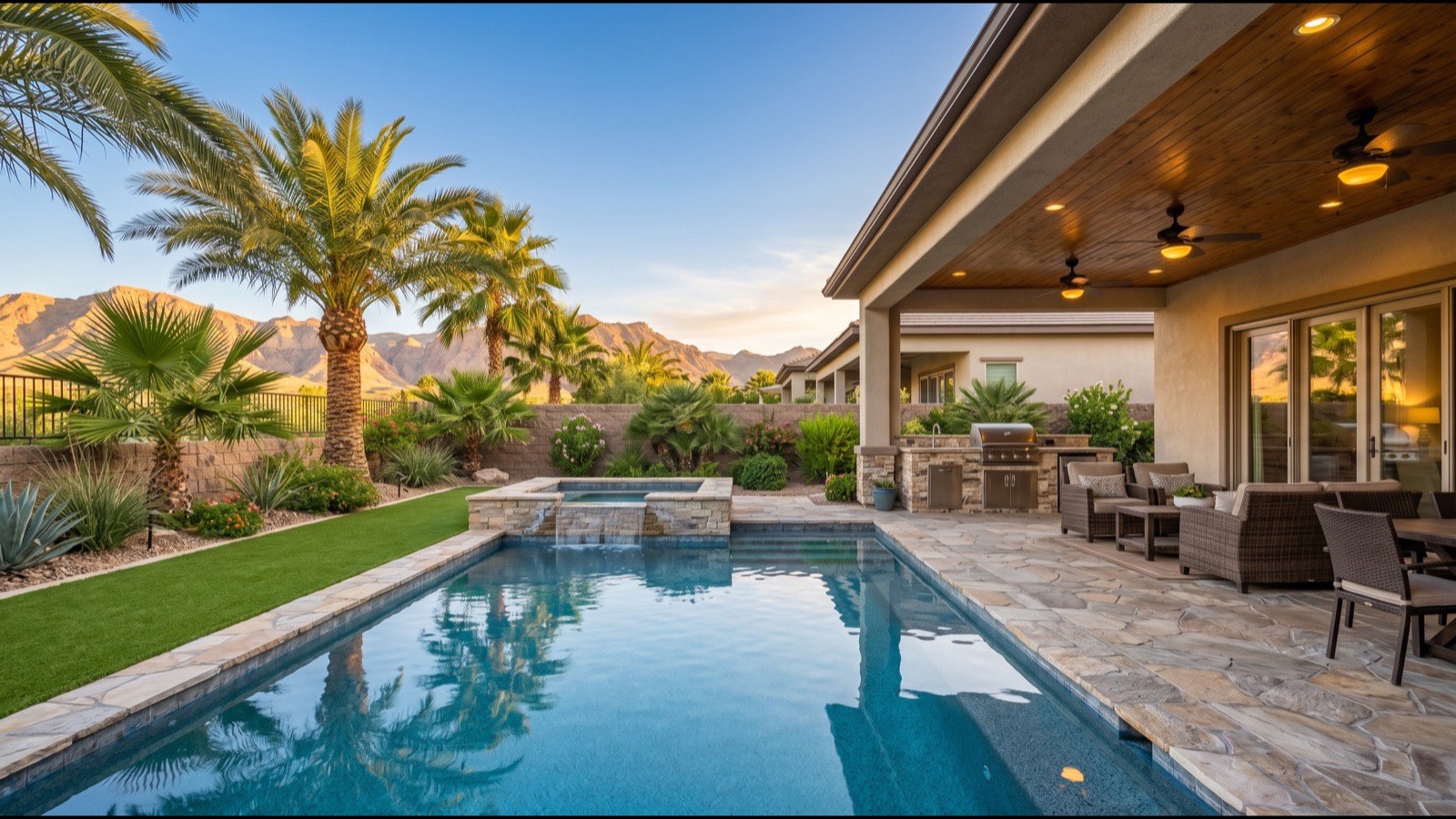
Summer is where the warm-weather cities pay for their winters, and the deserts pay the most in degrees. Palm Springs averages 115 days a year at or above 100 and 177 at or above 90, with a July high of 108.6; Phoenix 111 and 173 with a 106.5-degree July high and an 84.5-degree July low, the warmest nights on the sheet; Las Vegas 78 and 137 with 104.5 and 82.0; St. George 63 and 128 with 101.9 and 71.7; and Tucson 68 and 158 with 100.2 and 76.3, its summer softened by the monsoon that brings 10.6 inches of rain. The desert's compensation is dryness: a 104-degree Las Vegas afternoon at 10% humidity is survivable in shade, evenings cool quickly, and the 4.2 inches of annual rain mean the pool is usable from April through October.
Florida and the Gulf pay in humidity rather than degrees. Tampa averages no 100-degree days but 94 at or above 90, Orlando 110, Sarasota 85, Fort Myers 120 and Jacksonville 80, with July highs of 91 to 92 and July lows of 73 to 77, and 49 to 57 inches of rain, most of it in summer thunderstorms; the heat index on a Fort Myers August afternoon routinely exceeds a Las Vegas thermometer. Houston is the extreme case, with 111 days over 90, a 75.7-degree July low and 51.8 inches of rain. Texas' interior cities split the difference: Austin has 24 days over 100 and 124 over 90 with 35.6 inches of rain, and San Antonio 18 and 122 with 32.4. Charleston's 64 days over 90 and 52.5 inches make it the mildest humid summer on the sheet.
The two cities that escape summer are on the coast. San Diego's 75.3-degree July high, 66.1-degree July low and essentially no 100-degree days are the reason it costs $1,075,000; nowhere else on the sheet has a summer that requires no air conditioning. St. George, at 2,800 feet, is the desert's mildest summer by a small margin. For everyone else, the question is whether you would rather have 78 to 115 dry days over 100 or 85 to 120 humid days over 90, and the honest answer depends on the body you bring to it.
| State (cities) | Income tax | Taxes Social Security | Combined sales tax | Effective property tax | Electricity, cents per kWh |
|---|---|---|---|---|---|
| Nevada (Las Vegas) | None | No | 8.24% | 0.47%, 3% annual cap | 13.11 |
| Arizona (Phoenix, Tucson) | 2.5% flat | No | 8.54% | 0.48% | 15.18 |
| California (Palm Springs, San Diego) | 1% to 13.3%; taxes pensions and IRA withdrawals | No | 9.03% | 0.70% (Riverside County 0.78%) | 34.74 |
| Utah (St. George) | 4.5% flat | Yes, with thresholds | 7.42% | 0.52% | 13.37 |
| Texas (Austin, San Antonio, Houston) | None | No | 8.20% | 1.49% | 15.94 |
| Florida (Tampa, Orlando, Sarasota, Fort Myers, Jacksonville) | None | No | 6.98% | 0.76% | 15.10 |
| South Carolina (Charleston) | up to 6% | No | 7.49% | 0.48% | 15.55 |
How Do Taxes and Electricity Change the Ranking?
The state tax code is the second bill after the house, and it splits the sheet cleanly. According to the Tax Foundation's 2026 state income tax survey, Nevada, Texas and Florida levy no individual income tax, so Las Vegas, Austin, San Antonio, Houston, Tampa, Orlando, Sarasota, Fort Myers and Jacksonville tax a retiree's pension and IRA withdrawals at zero. Arizona's 2.5% flat rate costs a couple drawing $100,000 of pension and IRA income roughly $1,750 a year; Utah's 4.5% about $3,500, with Social Security taxed above income thresholds; South Carolina's rates run to 6% but its retirement deductions soften them; and California taxes pensions and IRA withdrawals at 1% to 13.3% with no retirement exclusion, roughly $2,500 for that couple under 2025 brackets after the standard deduction.
Property tax is the line that catches Texans. Using the Census Bureau's 2020 to 2024 survey, the median owner's tax divided by median value gives an effective rate of 0.47% in Nevada, 0.48% in Arizona and South Carolina, 0.52% in Utah, 0.70% in California, 0.76% in Florida and 1.49% in Texas. According to the U.S. Census Bureau, the median Texas owner paid $4,232 a year on a $283,800 home, more than double the $2,027 the median Nevada owner paid on a $435,400 home. Texas' no-income-tax reputation is real and its property tax claws much of it back; Florida's 0.76% and its rising homeowners-insurance premiums do some of the same. According to the Tax Foundation's midyear 2026 report, sales tax runs from Florida's 6.98% to California's 9.03%, with Nevada at 8.24%, Texas 8.20%, Arizona 8.54%, South Carolina 7.49% and Utah 7.42%.
Electricity is the warm-weather line that no ranking includes and every household pays. According to the U.S. Energy Information Administration, the June 2026 residential average was 13.11 cents per kilowatt-hour in Nevada, 13.37 in Utah, 15.10 in Florida, 15.18 in Arizona, 15.55 in South Carolina, 15.94 in Texas and 34.74 in California. A household using 15,000 kilowatt-hours a year to cool a desert or Gulf home pays about $1,970 in Las Vegas, $2,270 in Florida, $2,280 in Arizona, $2,390 in Texas and $5,210 in Palm Springs or San Diego. Over ten years, the California household pays $32,000 more for the same air conditioning than the Nevada household.
What Does the Same Retiree Pay Per Month in Las Vegas, Tampa and Phoenix?
Put the lines together for a retired couple with $100,000 a year of pension and IRA income buying the metro median at 20% down. According to Freddie Mac, the 30-year fixed averaged 7.40% for the week of October 15, 2026, and that is the rate used. According to Las Vegas REALTORS figures reported by FOX5, the valley's single-family median was $470,000 in September 2026, which at 20% down leaves a $376,000 loan and a $2,603 payment, property tax at 0.47% adds about $184 a month, insurance about $100, electricity about $164 and income tax nothing, for roughly $3,051. In Tampa, the $415,000 median leaves a $332,000 loan and a $2,299 payment, property tax at 0.76% adds $263, insurance runs higher in Florida, call it $350, electricity $189 and income tax nothing, for roughly $3,101. In Phoenix, the $477,700 median leaves a $382,160 loan and a $2,646 payment, property tax at 0.48% adds $191, insurance about $120, electricity $190 and Arizona's income tax about $146, for roughly $3,293.
The three cities land within about $240 a month of each other on the median house, which is the point: the warm-weather choice is not decided by the monthly bill at the median. It is decided by what the median buys, the climate that comes with it and the risks that sit outside the table. Tampa's line carries a hurricane season and an insurance market that has repriced sharply since 2022; Phoenix's carries 111 days over 100 and Arizona's income tax; Las Vegas' carries 78 days over 100 and a water supply managed under the West's strictest conservation rules. Insurance is the line to price with a carrier before choosing, because Florida's spread between a coastal ZIP and an inland one can be thousands of dollars a year.
The cheaper cities change the math more than the tax code does. San Antonio's $316,500 median at 20% down carries a $1,753 payment, and even Texas' 1.49% property tax, about $393 a month, leaves a total near $2,550; Tucson's $388,500 carries a $2,152 payment and Arizona's low property tax for a total near $2,750; Pensacola's $342,000 and Houston's $345,200 land near $2,600 to $2,650 with Florida's or Texas' taxes and Gulf insurance. A retiree whose budget is the constraint should look at those four before the sunnier names.
| City and median | Principal and interest | Property tax | Insurance (estimate) | Electricity | State income tax | Total |
|---|---|---|---|---|---|---|
| Las Vegas, $470,000 | $2,603 | $184 | $100 | $164 | $0 | about $3,051 |
| Tampa, $415,000 | $2,299 | $263 | $350 | $189 | $0 | about $3,101 |
| Phoenix, $477,700 | $2,646 | $191 | $120 | $190 | $146 | about $3,293 |
| San Antonio, $316,500 | $1,753 | $393 | $200 | $199 | $0 | about $2,545 |
| Tucson, $388,500 | $2,152 | $155 | $110 | $190 | $146 | about $2,753 |
| San Diego, $1,075,000 | $5,954 | $609 | $250 | $434 | $208 | about $7,455 |
Where Does Las Vegas Land on the Warm-Weather Sheet?
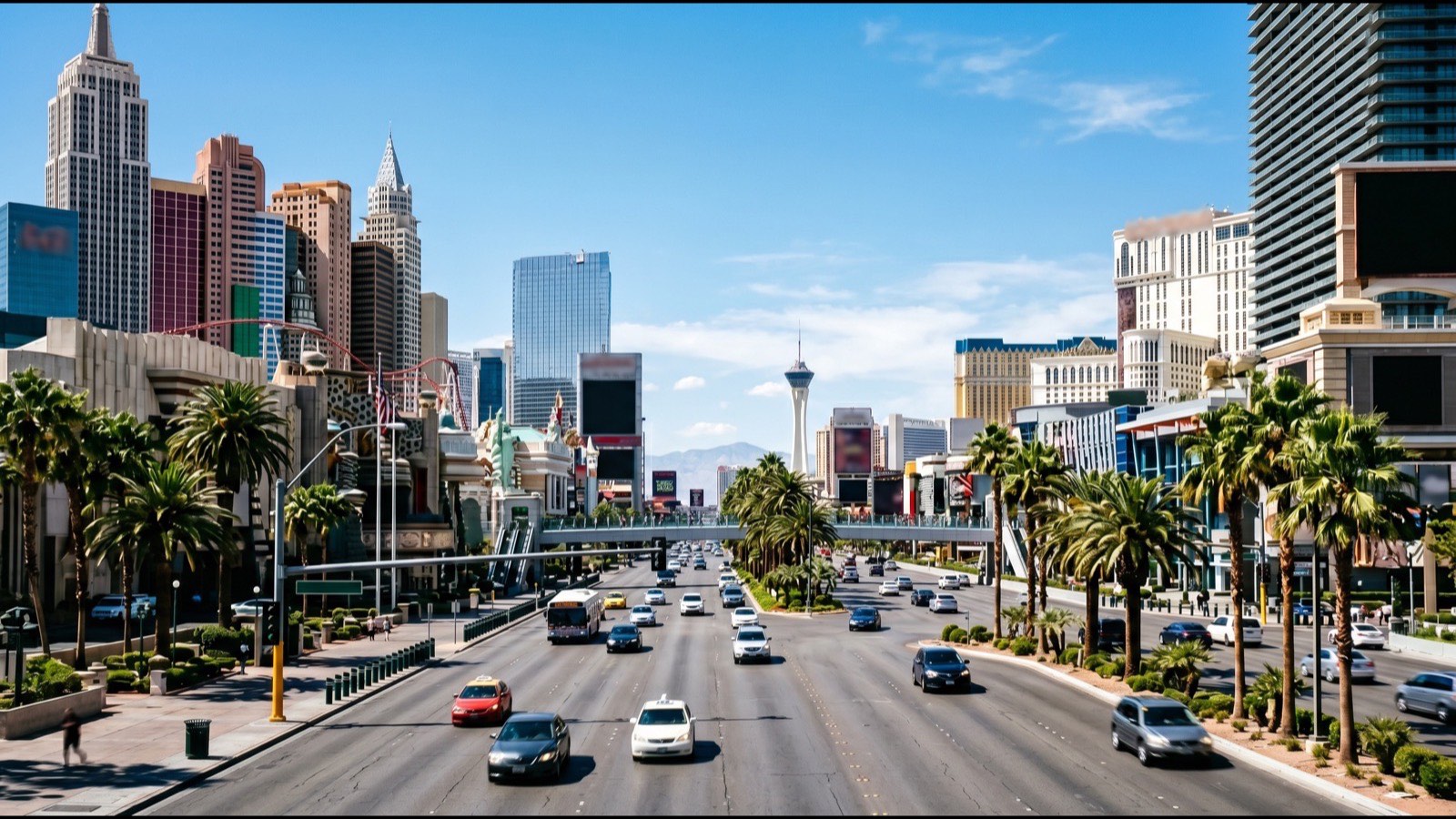
Las Vegas is the middle of the sheet on climate and the top of it on what the climate costs. Its 58.5-degree January high is the coolest desert winter here and warmer than any city north of the Sun Belt; its 78 days over 100 are 33 fewer than Phoenix's and 37 fewer than Palm Springs', and its 4.2 inches of rain and dry air make the heat more tolerable than the numbers suggest to anyone who has spent a July in Houston. Its 10 freezing nights are enough for a frost on the patio furniture and not enough to matter. On the bill, it has no income tax, a 0.47% effective property tax with a 3% annual cap under NRS 361.4723, the cheapest electricity on the sheet and a $486,300 metro median that sits $10,000 below the national median's neighbors Phoenix and Austin and $50,000 above Tampa.
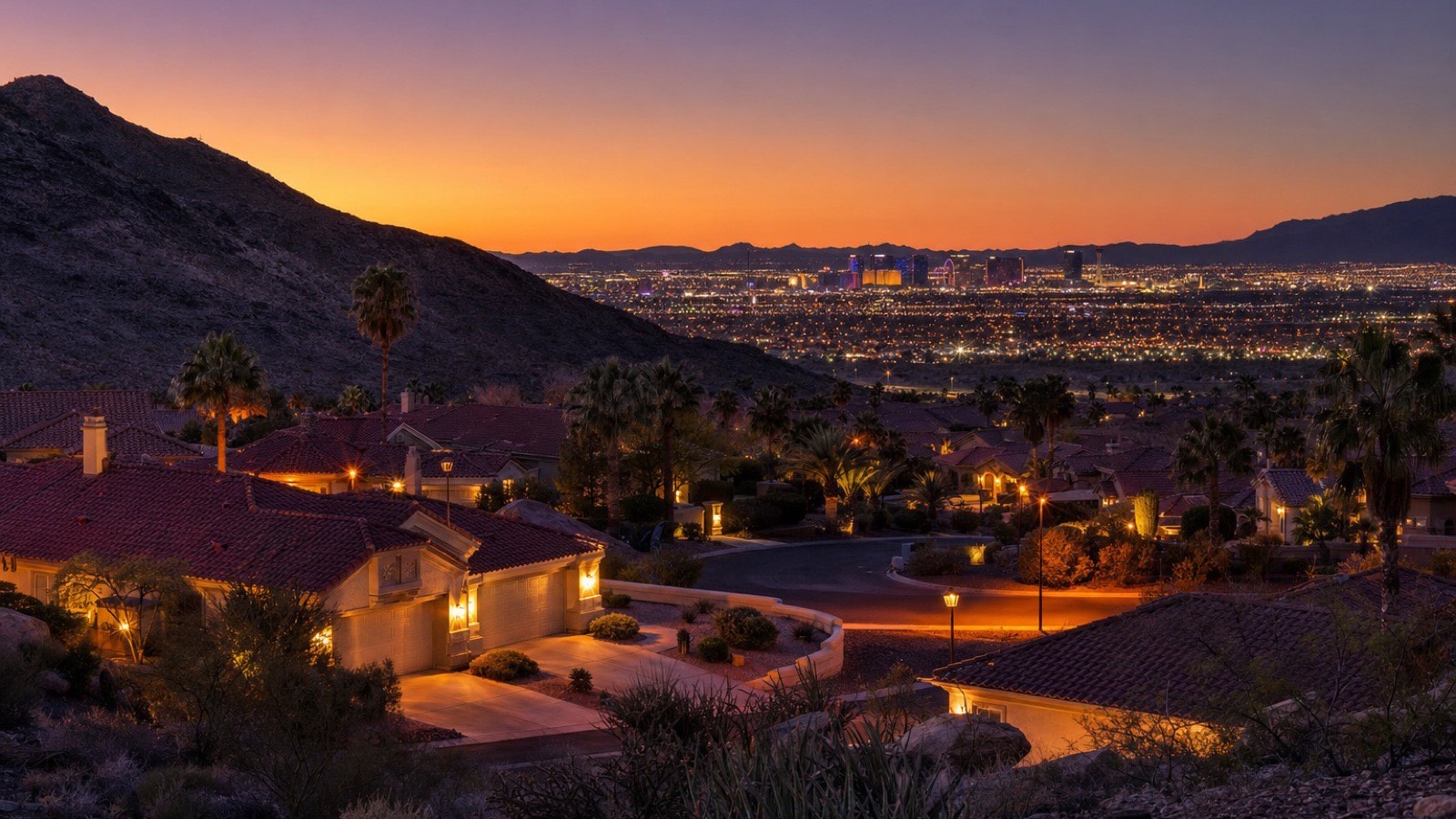
What Las Vegas has that the others do not is depth in the housing a retiree actually wants. Our subdivision-filtered pull of the MLS on September 8, 2026 showed summer resale medians of $355,500 in Sun City Aliante, $445,000 in Sun City Summerlin, $570,000 in Sun City Anthem and $557,500 at Del Webb at Lake Las Vegas, with the gated Summerlin communities from $840,000 to $1.15 million; the Las Vegas 55+ guide lists more than a dozen options, and Henderson alone has five. Phoenix's Sun Cities and Florida's Villages are the only comparable concentrations, and neither pairs them with a no-income-tax state, a 13-cent electricity rate and an airport that served nearly 55 million passengers in 2025.
The honest limits are the summer and the water. A Las Vegas July is 104 degrees at 4 p.m. and 90 at midnight, and a retiree who cannot tolerate that leaves for Mount Charleston, San Diego or the Pacific Northwest for six weeks, as many do; the valley's 55+ communities empty noticeably in July and August. The Colorado River's shortfalls are a long-term policy question that Southern Nevada has handled better than any other user of the river, with per-capita water use down by nearly half since 2002 and turf removal that has become a national model, but it is a question a buyer should understand. Our Las Vegas vs Palm Springs comparison and our Henderson retirement guide cover the valley's specifics.
How Do the Florida Cities Compare With Each Other and With the Deserts?
Florida's five cities are the winter winners and they differ more than outsiders expect. Fort Myers has the warmest January on the sheet at 75.0, the most days over 90 at 120, the most rain at 57.4 inches and the Cape Coral-Fort Myers metro's $385,000 median, the cheapest of the five; it also sits in the path of the 2022 hurricane that reshaped its insurance market. Sarasota, with a 72.5-degree January and 85 days over 90, is the mildest Gulf summer and, at $480,000, the most expensive Gulf city here. Tampa's 71.3 and 94 days over 90 come with a $415,000 median and a big-city hospital system. Orlando's 71.8 and 110 days over 90 are inland, with a $450,000 median and the theme-park economy. Jacksonville's 65.5-degree January and 14 freezing nights are the coolest Florida winter, with 80 days over 90 and a $417,500 median.
Against the deserts, Florida trades degrees for humidity and hurricanes for water restrictions. A Fort Myers August has a heat index that a Las Vegas thermometer never reaches, thunderstorms most afternoons and a hurricane season from June through November; a Las Vegas August has 104-degree afternoons, 10% humidity and a monsoon that produces a few flash-flood days. Florida's property tax at 0.76% is above the deserts' 0.47% to 0.52%, its electricity at 15.10 cents is above Nevada's 13.11 and below Arizona's 15.18, and neither Florida nor Nevada nor Texas taxes income. The line that has moved most since 2022 is Florida homeowners insurance, which in coastal counties can run several times a Las Vegas premium and which a buyer must price by address.
The choice between Florida and the desert is mostly a choice about summer and about family geography: Florida is a two-hour flight from the Northeast and a humid summer; the deserts are a one-hour flight from California and a dry one. Our guide to whether Nevada or Florida is the better retirement, elsewhere on this blog, runs that pair line by line; this sheet's summary is that Florida wins January by 13 degrees and Las Vegas wins July by dryness, taxes on property and electricity, and 55+ supply.
How Do the Texas Cities and Charleston Fit?
Texas is the value play on the warm-weather sheet and the property-tax trap inside it. San Antonio's $316,500 median is the lowest here, Houston's $345,200 is third and Austin's $485,400 matches Las Vegas; all three have no state income tax, mild winters with 10 to 33 freezing nights and the occasional hard freeze, and hot, humid summers, with Houston's 111 days over 90 and 51.8 inches of rain the heaviest and San Antonio's 18 days over 100 and 32.4 inches the lightest. The 1.49% effective property tax, the highest on the sheet by a wide margin, takes back a large share of the income-tax savings: the median Texas owner's $4,232 annual bill on a $283,800 home is more than a Las Vegas owner pays on a home worth $150,000 more. Texas' homestead exemption and its 10% annual appraisal cap soften the bill for owner-occupants; Texas' electricity at 15.94 cents and its grid's 2021 failure are the other lines to know.
Charleston is the Southeast's answer to the sheet: a 60.2-degree January, 22 freezing nights, 64 days over 90, 52.5 inches of rain and a $470,100 median, with South Carolina's income tax running to 6% but softened by retirement deductions, a 0.48% effective property tax that matches the deserts and 15.55-cent electricity. It is the most historic and walkable city here, with a coastal hurricane exposure that its insurance market has priced, and a summer that is humid but shorter than Florida's. Retirees who want four mild seasons, a real downtown and the Atlantic choose it over the deserts; retirees who want no income tax and a dry summer do not.
St. George, the sheet's other outlier, is the desert with a winter: a 54.0-degree January and 62 freezing nights, 63 days over 100 and 9.3 inches of rain, a $545,500 median, Utah's 4.5% income tax with Social Security taxed above thresholds, a 0.52% property tax and 13.37-cent electricity. It is Zion's gateway, a fast-growing small city with a large 55+ market and a Mormon-influenced culture, and its climate is the closest thing on the sheet to a desert without a Phoenix summer. Retirees who find Las Vegas too hot and too big and Prescott too cold often land there.
Which Warm-Weather City Fits Which Retiree?
Pick Florida's Gulf Coast, Fort Myers, Sarasota or Tampa, if January by the pool is the point and a humid summer with a hurricane season is a price you will pay; pick Fort Myers for the warmest winter and the lowest Gulf price, Sarasota for the mildest summer and the arts, Tampa for the hospitals and the airport, Orlando for the inland price and Jacksonville for the coolest Florida winter and the Atlantic. Pick the Texas cities if price is the constraint and humidity is not, with San Antonio the cheapest city on the sheet and Austin the most expensive Texas one; budget for the property tax. Pick Charleston if you want a real city with four mild seasons and can accept an income tax.
Pick the deserts if you want dry air and low taxes and can plan around 60 to 115 days over 100. Pick Phoenix for the largest 55+ market in the country and the Mayo Clinic at a 2.5% income tax and the hottest nights on the sheet; Tucson for a cooler, cheaper desert with a university city's character; Palm Springs for a 70-degree January and a resort town, if a $1.17 million detached median, California's income tax and 35-cent electricity fit; St. George for red rock and a desert winter at Utah's tax code. And pick Las Vegas if you want the desert's dryness with 33 fewer hot days than Phoenix, no income tax, a 0.47% property tax with a 3% cap, the cheapest electricity on the sheet, the West's deepest 55+ market from $355,500 up, and an airport that goes everywhere, at the cost of a sweater in January and a hot July.
Pick San Diego if the weather is the only thing that matters and $1,075,000 is not; nothing else on the sheet has a 75-degree July and a 66-degree January. And whichever city you pick, visit it in its worst month first: a July in Phoenix, an August in Fort Myers, a January in St. George. The retirees who leave a warm-weather city in year two are almost always the ones who toured it in March.
How Do You Test a Warm-Weather City Before You Move?
Price the specific house, not the city. Get the property tax from the county assessor for the address you would buy, the homeowners insurance from a carrier that writes in that ZIP code, which in Florida and coastal Texas can be the largest surprise on the sheet, the electricity at the state's rate for a house that size, and the state income tax on your actual income mix using the state's own calculator. Then add the healthcare line: the specialists you use, the hospital you would go to, and the Medicare Advantage or Medigap pricing in that county, which differs more between Las Vegas, Tampa and Phoenix than most retirees expect.
Then spend a week in the worst month and a week in the best. A Las Vegas July, a Fort Myers August, a San Antonio September and a St. George January will each tell you whether the climate is one you can live in, and a March in any of them will tell you nothing. Talk to residents of the 55+ community or neighborhood on your list, ask what surprised them, and ask the hospital's referral desk how long a new patient waits for a cardiologist. Read the association's documents before the contingency runs; in Nevada, NRS 116.4109 gives a buyer five days to cancel after receiving the resale package, and Florida, Arizona and Texas have their own versions.
Finally, plan the second move. A retiree who buys at 62 usually wants a different home at 80, and the cities with deep senior-care markets, Tampa, Phoenix, Las Vegas, Houston and San Diego among them, make that move easier than the small resort towns do. Our team relocates retirees into Southern Nevada from every warm-weather state on this sheet, and when the sheet says another city fits better, we say so. Call (702) 637-1759 or visit us at 8945 W Russell Rd, Suite 170, and we will run your numbers.
Frequently Asked Questions
Which warm-weather retirement city has the best winter?
Fort Myers, with a 75.0-degree average January high and no freezing nights in NOAA's 1991 to 2020 normals, followed by Sarasota (72.5), Orlando (71.8), Tampa (71.3) and Palm Springs (70.5). Las Vegas averages 58.5 in January with about 10 freezing nights.
Which warm-weather city has the worst summer?
By degrees, Palm Springs (115 days at or above 100 and a 108.6-degree July high) and Phoenix (111 days and 106.5, with 84.5-degree July nights). By humidity, Houston (111 days over 90, 51.8 inches of rain) and Fort Myers (120 days over 90, 57.4 inches). Las Vegas averages 78 days over 100 with 4.2 inches of rain.
Which warm-weather cities have no state income tax?
Las Vegas (Nevada), the Texas cities (Austin, San Antonio, Houston) and the Florida cities (Tampa, Orlando, Sarasota, Fort Myers, Jacksonville). Arizona charges 2.5%, Utah 4.5%, South Carolina up to 6% and California 1% to 13.3%.
Which is the cheapest warm-weather city to buy a home?
San Antonio, with a $316,500 metro median in the second quarter of 2026, followed by Pensacola ($342,000), Houston ($345,200), Cape Coral-Fort Myers ($385,000) and Tucson ($388,500). San Diego, at $1,075,000, is the most expensive.
Is Las Vegas a good warm-weather retirement city?
For a retiree who wants dry heat rather than humidity, no income tax, low property tax with a 3% annual cap, the cheapest electricity on the sheet and the West's deepest 55+ market, yes. Its January is cooler than Florida's or Phoenix's and its July averages 104.5 degrees; many residents leave for part of the summer.
How does Florida's insurance affect the comparison?
Florida homeowners insurance has repriced sharply since 2022, and coastal premiums can run several times a Las Vegas or Phoenix premium; the estimate in this guide's monthly table is $350 a month for Tampa against $100 for Las Vegas. Price the specific address with a carrier before choosing.
What is the best warm-weather city if money is no object?
San Diego. Its 66.4-degree January high, 75.3-degree July high, no freezing nights and no 100-degree days are the mildest climate on the sheet, at a $1,075,000 metro median and California's income tax and 34.74-cent electricity.
Which Sources Inform This Warm-Weather Retirement Cities Guide?
- NOAA National Centers for Environmental Information, 1991 to 2020 U.S. climate normals (primary airport station for each city)
- National Association of REALTORS, metropolitan median area prices, second quarter 2026
- Las Vegas REALTORS market statistics and its September 2026 figures as reported by FOX5
- The Palm Springs Post, Greater Palm Springs REALTORS Desert Housing Report
- Tax Foundation, 2026 state individual income tax rates and 2026 sales tax rates, midyear
- U.S. Census Bureau, American Community Survey 2020 to 2024, state profiles (median home value and median real estate taxes paid)
- U.S. Energy Information Administration, Electric Power Monthly, Table 5.6.A (June 2026)
- Freddie Mac Primary Mortgage Market Survey
- NRS Chapter 361, property tax abatement caps and NRS Chapter 116, resale package
- Southern Nevada Water Authority, conservation
- Harry Reid International Airport, 2025 passengers
- Related reading: our Las Vegas luxury retirement and snowbird guide
Methodology: climate figures are NOAA 1991 to 2020 normals for each city's primary station; home prices are NAR second-quarter 2026 metro medians for existing single-family homes, with the September 2026 Las Vegas REALTORS figure used in the monthly example; effective property tax divides the Census Bureau's median taxes paid by median home value for each state; the monthly example assumes 20% down at 7.40%, Freddie Mac's average for the week of October 15, 2026, 15,000 kilowatt-hours of electricity a year at June 2026 state rates, a married couple with $100,000 of pension and IRA income under 2025 brackets, and insurance estimates that vary widely by address. All figures are planning estimates, not quotes.
To compare a specific Las Vegas community with the warm-weather city you are weighing against it, call (702) 637-1759 or visit us at 8945 W Russell Rd, Suite 170.