

Two questions get asked about Las Vegas wealth more than any others: who are the billionaires, and what does it actually take to be considered rich here? The answers are more concrete than most people expect. Nevada's billionaire roster is led by Miriam Adelson, the richest resident in the state, whose fortune traces to the Las Vegas Sands casino and resort empire. And the statistical bar for the state's top 1% of earners sits at roughly $603,751 in annual income, per SmartAsset's analysis — a figure that says as much about Nevada's tax structure as it does about its economy.
What makes this more than trivia is what sits underneath it: extreme wealth has to live somewhere, and in this valley it concentrates in a remarkably short list of guard-gated addresses. Across the 9,600+ transactions Nevada Real Estate Group has represented statewide — including a luxury practice inside the exact communities where this wealth clusters — we watch that concentration deal by deal. This guide covers who the billionaires are, what the top-1% and top-5% income thresholds look like, why Nevada attracts outsized wealth, and how the wealth map translates into actual neighborhoods.
Miriam Adelson is the wealthiest resident of Nevada, with a fortune from the Las Vegas Sands casino empire, and Nancy Walton Laurie of the Walmart family is also tied to the Las Vegas area. To rank in Nevada's top 1% of earners takes approximately $603,751 in annual income per SmartAsset. Extreme wealth in the valley concentrates in guard-gated communities including The Summit Club, The Ridges, MacDonald Highlands, and Ascaya.
- Miriam Adelson leads Nevada's billionaire list, with wealth from the Las Vegas Sands empire.
- Nevada's top 1% income threshold is roughly $603,751 a year per SmartAsset analysis.
- Zero income tax, no estate tax, and strong entity-privacy law drive wealth migration here.
- Billionaire-tier housing clusters in The Summit Club, The Ridges, MacDonald Highlands, and Ascaya.
- The valley's biggest 2026 sale closed at approximately $22.5 million in the Summit Club.
What Billionaires Live in Las Vegas?
The Las Vegas and broader Clark County area is home to several prominent billionaires, and the roster skews heavily toward gaming, hospitality, and inherited retail fortunes rather than the tech wealth that dominates coastal lists.
Miriam Adelson is the wealthiest resident in Nevada. Her fortune derives from Las Vegas Sands, the casino and resort empire built with her late husband Sheldon Adelson, and she remains among the most prominent figures in both the gaming industry and American philanthropy. She is also a co-owner of the Dallas Mavericks — a reminder that Las Vegas wealth increasingly intersects with professional sports.
Nancy Walton Laurie holds a fortune inherited from the Walmart family and has been publicly tied to the Las Vegas area. Beyond those two, the valley's ultra-wealthy tier includes gaming and hospitality executives, casino founders' families, professional sports ownership groups tied to the Raiders, Golden Knights, and Aces, and an expanding population of relocated wealth from California and the Northeast that keeps a lower public profile by design.
That last category is the one most lists miss and the one we see most in practice. According to the U.S. Census Bureau, Clark County has added residents steadily throughout the decade, and a meaningful slice of that in-migration is high-net-worth households relocating for tax and privacy reasons. They rarely make a billionaire list — but they're buying the same streets.
What Is the Top 1% Income in Nevada?
Approximately $603,751 a year. That's the threshold identified by the personal-finance firm SmartAsset in its state-by-state analysis of what it takes to enter the top 1% of earners, and it's the figure that surfaces most often in search results for this question.
Two things about that number are worth understanding before you use it. First, it's an income threshold, not a wealth threshold — it measures annual earnings, not net worth. Plenty of Nevada households with eight-figure net worths draw far less than $603,751 in taxable income in a given year, particularly retirees living on portfolio distributions. Conversely, a high-earning professional can clear the top 1% income bar without a comparable balance sheet.
Second, Nevada's threshold reflects its tax structure. States with no income tax tend to attract high earners who relocate specifically to shelter income, which pushes the top-1% bar upward relative to what local wages alone would produce. According to the Tax Foundation, Nevada is one of a small group of states with no individual income tax at all — so a $603,751 income here is materially different in take-home terms from the same income in California, where the top marginal rate reaches 13.3%.
| Income tier | Approximate annual income | What it supports in Las Vegas housing |
|---|---|---|
| Top 1% (Nevada) | Approximately $603,751+ | Guard-gated luxury; $2,000,000–$5,000,000+ purchases |
| High earner | $250,000–$600,000 | The Ridges entry, MacDonald Highlands, $1,000,000–$2,500,000 |
| Upper-middle | $150,000–$250,000 | Summerlin and Henderson move-up, $600,000–$1,200,000 |
| Middle class (household) | $49,000–$147,000 | Valley median territory, roughly $350,000–$600,000 |
| Valley median household | Approximately $66,000–$71,000 | Entry to mid-market, $350,000–$490,000 |
The gap between the top-1% line and the valley's median household income of roughly $66,000 to $71,000 per Census data is the real story in that table: Nevada's top 1% earns close to nine times the typical household. That spread is what produces a luxury market deep enough to absorb monthly eight-figure closings in a metro of this size.

Where Does Billionaire-Tier Wealth Actually Live in Las Vegas?
Not scattered across the valley — concentrated in roughly half a dozen guard-gated addresses. The Summit Club in Summerlin sits at the very top: a 555-acre Discovery Land Company enclave of only about 260 homes where membership approval gates the purchase, homesites regularly trade above $10,000,000, and the valley's largest 2026 closing printed at approximately $22,500,000. The Ridges — 793 acres around Bear's Best golf, with custom homes from roughly $2,000,000 to more than $30,000,000 — is the wealthiest address a qualified buyer can actually shop without an invitation.
On the Henderson side, MacDonald Highlands and Ascaya carry the hillside trophy tier, with entry around $1,500,000 and $2,500,000 respectively and ceilings past $20,000,000. Together with lakefront Lake Las Vegas and the Southern Highlands golf enclave, these communities absorb nearly all of the valley's ultra-luxury volume. Our full wealthiest-neighborhoods ranking breaks down each one, and the same map overlaps almost exactly with the celebrity residence map — unsurprising, since both populations buy the identical product: staffed gates, engineered privacy, and protected views.
What Do the Top 5% and Top 10% Earn in Nevada?
The top 1% gets the headlines, but most people asking the question are really trying to locate themselves on the curve. Here is the fuller picture, with the caveat that percentile thresholds vary by source and methodology:
| Percentile band | Approximate annual income | Multiple of valley median |
|---|---|---|
| Top 1% | Approximately $603,751+ | Roughly 9× |
| Top 5% | Roughly $250,000+ | Roughly 3.5× |
| Top 10% | Roughly $180,000+ | Roughly 2.6× |
| Top 25% | Roughly $110,000+ | Roughly 1.6× |
| Median household | Approximately $66,000–$71,000 | 1× |
The percentile bands beneath the top 1% are where most of the valley's luxury housing demand actually originates. A household at the top-5% line — roughly $250,000 — comfortably supports a purchase in the $800,000 to $1,200,000 range, which is precisely the entry tier of the guard-gated communities the billionaires live in. In other words, the buyer pool for the wealth map's front door is far broader than the billionaire roster implies, and it's the segment we transact in most.
One honest note on precision: unlike the widely-cited $603,751 top-1% figure, the top-5% and top-10% lines vary noticeably between data sources and between household-versus-individual measures. Treat them as orientation, not as thresholds to plan around.
How Did Gaming Wealth Build the Las Vegas Fortune Map?
Understanding today's roster requires knowing where the money came from, because the pattern still shapes where it lives. Las Vegas wealth was built in waves. The mid-century casino era created the first concentration of fortunes; Howard Hughes then bought so much of the city from his Desert Inn penthouse that Summerlin — the master plan half of today's wealth map sits inside — is named for his grandmother. The 1990s resort boom produced the modern gaming fortunes, and the Adelson-era Las Vegas Sands expansion internationalized them.
What changed in the last decade is that the wealth stopped being purely local. Professional sports arrived — the Raiders, the Golden Knights, the Aces, with the A's on the way — bringing ownership groups, executives, and athletes who buy at the trophy tier. Formula 1 and the Sphere layered on more. And the tax-migration wave brought high-net-worth households whose money was made entirely elsewhere. In my experience representing sellers in these communities, that shift is visible in the buyer sheets: a decade ago the ultra-luxury buyer was usually a gaming executive; today they're just as likely to be a relocating founder, a fund principal, or an athlete's family office.

Why Does Extreme Wealth Choose Nevada?
Three structural drivers, and they compound at high net worth. Taxes lead. According to the Nevada Department of Taxation, Nevada imposes no individual income tax, no corporate income tax, and no estate or inheritance tax. For a household earning $5,000,000 a year, the income-tax differential against California alone runs into the high six figures annually; at a $50,000,000-plus net worth, the estate-planning delta reaches eight figures. Under Nevada Revised Statutes 361.4722, even the property-tax increase on a primary residence is capped at 3 percent a year.
Entity privacy is second. Nevada's business-entity framework is among the most privacy-protective in the country, which is why ultra-luxury purchases here close through LLCs and trusts rather than personal names — a genuine feature for households with security concerns, and one reason public "who owns that estate" searches so often dead-end. Asset protection and no franchise tax round it out, making Nevada attractive for holding structures well beyond the residence itself.
The result is a wealth-migration pattern the closing data makes plain: the valley's trophy tier now trades monthly rather than a few times a year, and roughly 72 active listings above $10,000,000 sit in the pipeline behind those closings. That's a depth of ultra-luxury inventory this metro simply did not have a decade ago.
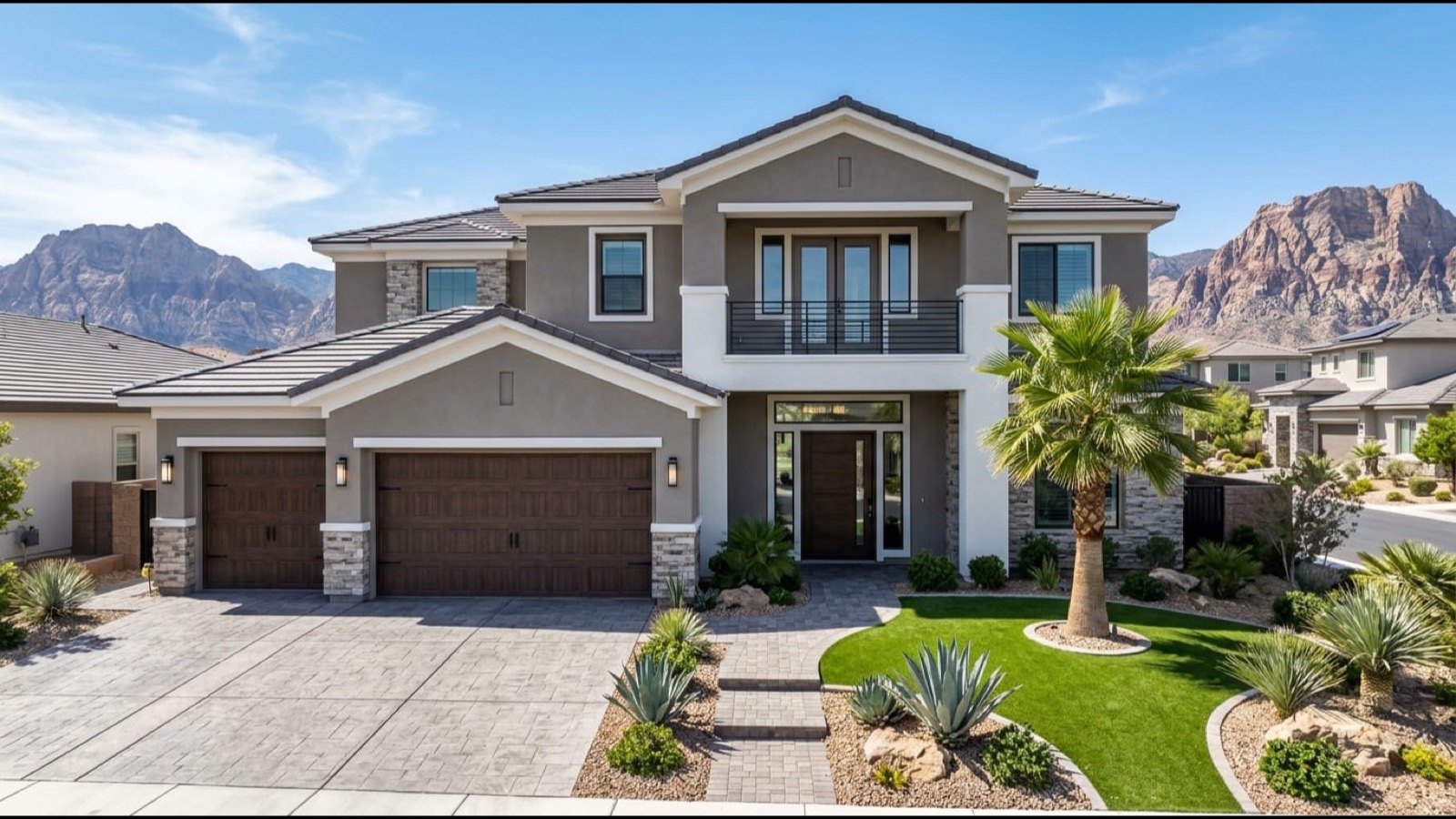
What Income Do You Need to Buy in the Billionaire Neighborhoods?
You don't need billionaire money — that's the part the wealth lists obscure. The communities that house the valley's richest residents also contain entry tiers reachable by successful professionals, because a guard gate doesn't check net worth at the booth.
| Dimension | Accessible gate | High-earner tier | Billionaire tier |
|---|---|---|---|
| Purchase price | $700,000–$1,300,000 | $1,500,000–$4,000,000 | $5,000,000–$22,500,000+ |
| Rough income needed | $180,000–$320,000 | $380,000–$900,000 | Balance-sheet purchase, often cash |
| Communities | Seven Hills, Anthem CC, Southern Highlands, Spanish Trail | The Ridges entry, MacDonald Highlands, Ascaya | Summit Club, Ridges custom, hillside trophy |
| Typical HOA | $200–$450/month | $400–$900/month | $900–$2,500+/month plus club dues |
| How it usually trades | Standard MLS | MLS plus agent network | Largely off-market, LLC-vested |
The income column is deliberately labeled rough — at these price points the conventional debt-to-income model breaks down, because a large share of purchases involve substantial down payments, portfolio-backed lending, or all cash. According to Freddie Mac's Primary Mortgage Market Survey, financing costs still move the monthly math meaningfully at the financed tiers, but above roughly $5,000,000 the buyer pool is largely rate-insensitive. The practical takeaway: the same staffed gate that protects a billionaire protects a household buying at $800,000, and that is the single most useful fact in this entire article for an ordinary buyer.
How Does Nevada's Wealth Compare to Other States?
Nevada's top-1% threshold of roughly $603,751 sits in the upper portion of state rankings, though below the highest-cost coastal states where the bar climbs meaningfully higher. The more interesting comparison isn't the gross threshold but the after-tax one. A $603,751 income in Nevada is taxed federally and then kept; the same income in California faces a top marginal state rate of 13.3% on the upper brackets.
Run that across a decade and the compounding is substantial — which is precisely the calculation driving the California-to-Nevada migration that has reshaped this luxury market. According to Las Vegas REALTORS, the valley's overall single-family median reached a record of approximately $490,000 in mid-2026, meaning the wealth-tier communities trade at multiples of the ordinary market — but multiples that remain a fraction of what equivalent privacy and square footage cost in coastal metros. That arbitrage is the engine.

What Does Concentrated Wealth Do to the Rest of the Market?
Less than the headlines imply, and more than nothing — the effects are structural rather than a valley-wide price premium. The clearest effect is depth at the top. A decade ago, a $10,000,000 Las Vegas closing was a notable event; today that tier trades routinely, with roughly 72 active listings above that mark queued behind the closed sales. That liquidity is self-reinforcing: sellers list at the tier because buyers reliably appear, and buyers appear because they can see an exit.
The second effect is validation. Every high-profile relocation — a Wahlberg moving to the Summit Club, a sports-ownership purchase — produces a measurable wave of inquiry from California and Northeast wealth. It's advertising the market never has to buy, and we feel it directly in call volume after each cycle.
What it does not do is reprice ordinary neighborhoods. A billionaire three miles away does not move the median in Henderson or North Las Vegas; those markets move on jobs, rates, and migration like every other metro. In our experience the practical consequence for ordinary sellers is narrower than people assume — but for sellers inside the gates, it's significant: your buyer pool now includes wealth that arrives by private jet, buys through an LLC, and shops off-market, which changes how a luxury listing should be marketed entirely.

What Should Buyers Know Before Shopping the Wealth Tier?
Four realities govern transactions at this level. The best inventory is invisible. A substantial share of trophy-tier product never reaches the public MLS — it trades through private agent networks specifically to avoid publishing photographs of a principal's home. If you're shopping above roughly $3,000,000 and only looking at public listings, you're seeing a fraction of the market.
Vesting is planned before offers. LLC and trust structures are the norm, and they need to be established before you write, not after. Gate access requires representation — you cannot tour these communities independently, and at the top tier confidentiality agreements often precede a showing. And carrying costs stack. HOA dues, club membership and dues where applicable, insurance appropriate to the replacement cost, and property taxes all layer on top of the purchase; model the full annual figure rather than the price alone.
Nevada Real Estate Group's luxury practice transacts inside every community named in this article — 150+ agents, the #1-ranked team in Nevada by RealTrends, 9,061+ verified five-star reviews, and access to the off-market network the trophy tier actually runs on. Browse the visible layer on our Las Vegas home search, call (702) 637-1759, or tell us what you're looking for and we'll shortlist accordingly.
Frequently Asked Questions
Who is the richest person in Las Vegas?
Miriam Adelson is the wealthiest resident in Nevada, with a fortune derived from the Las Vegas Sands casino and resort empire built with her late husband Sheldon Adelson. She is also a co-owner of the Dallas Mavericks. Nancy Walton Laurie, whose wealth is inherited from the Walmart family, is also tied to the Las Vegas area.
What is the top 1% income in Nevada?
Approximately $603,751 per year, according to SmartAsset's state-by-state analysis. Note that this measures annual income rather than net worth, and Nevada's threshold is influenced by its zero-income-tax structure, which attracts high earners relocating specifically to shelter income from state taxation.
Why do so many wealthy people move to Nevada?
Three structural reasons: no state income tax, no corporate income tax, and no estate or inheritance tax; entity-privacy laws that let purchases and holdings close through LLCs and trusts; and a 3% annual cap on primary-residence property-tax increases under NRS 361.4722. At high income and net worth, those advantages compound into seven- and eight-figure differences versus high-tax states.
Where do billionaires live in Las Vegas?
In a short list of guard-gated communities: The Summit Club (invitation-tier, roughly 260 homes, homesites above $10 million), The Ridges in Summerlin ($2 million to $30 million-plus), and Henderson's hillside enclaves MacDonald Highlands and Ascaya, both with ceilings past $20 million. Lakefront Lake Las Vegas and the Southern Highlands golf enclave round out the tier.
What was the most expensive Las Vegas home sale in 2026?
A Summit Club estate at approximately $22.5 million leads the 2026 tape, with the next two largest closings near $22 million and $21 million. Roughly 72 active listings above $10 million sit in the pipeline behind those sales — the deepest ultra-luxury inventory the valley has ever carried.
How much income do you need to live in a Las Vegas luxury community?
Far less than the billionaire tier suggests. Entry into guard-gated communities such as Seven Hills, Anthem Country Club, Southern Highlands, and Spanish Trail starts around $700,000 to $1,300,000, which conventionally supports incomes in the $180,000 to $320,000 range. The staffed gate and privacy protections are identical to those protecting the trophy tier.
Do wealthy buyers purchase Las Vegas homes under their own names?
Rarely at the top tier. Purchases typically close through Nevada LLCs or trusts, frequently off-market through private agent networks, with confidentiality agreements preceding showings. Nevada's entity-privacy framework is a genuine part of the state's appeal to high-net-worth buyers, and the same vesting tools are available to any buyer working with an attorney.
Which Sources Inform This Nevada Wealth Guide?
Billionaire identification and net-worth context reflect public reporting on Nevada's wealthiest residents, including coverage of the Las Vegas Sands and Walmart-linked fortunes. The top-1% income threshold of approximately $603,751 is from SmartAsset's state-by-state analysis as reported by USA Today. Tax structure is from the Nevada Department of Taxation and Tax Foundation state comparisons, with the property-tax cap at Nevada Revised Statutes 361.4722. Income and demographic data are from the U.S. Census Bureau American Community Survey; market medians and trophy-tier closing data from Las Vegas REALTORS and Clark County Assessor records, cross-referenced against NREG's luxury-practice experience across 9,600+ statewide closings; financing context from Freddie Mac; and long-run appreciation from the Federal Housing Finance Agency. Net-worth figures for private individuals are estimates from public reporting and change continuously; this article identifies no addresses beyond public record. Luxury questions: (702) 637-1759.