

Divorce creates several different house decisions: who owns the equity, who owes the loan, who may live there, and when either person receives usable cash. Resolving one does not automatically resolve the others. A settlement can award the home to one spouse while the lender still holds both borrowers responsible. A sale can produce cash while leaving a dispute about its distribution unresolved.
This Nevada guide was reviewed November 1, 2026. Its financial comparisons are original illustrations, not client cases or current market quotations. Use them to prepare questions for a Nevada family-law attorney, a tax professional, the mortgage servicer and escrow; none of them reviewed this guide. Individual ownership, court orders and loan documents control your transaction.
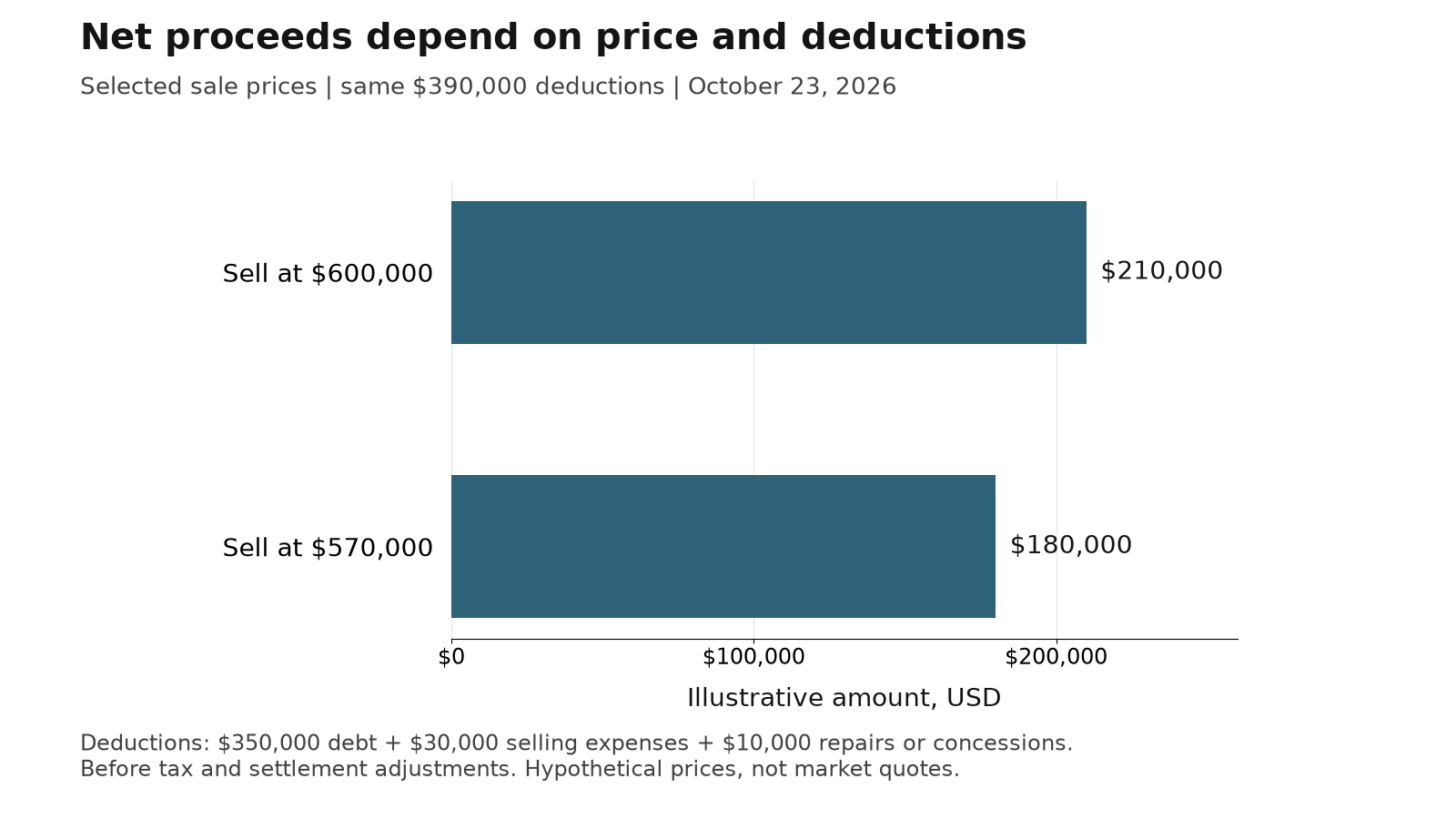
In a Nevada divorce home sale, both spouses generally must sign, because NRS 123.230 requires both to join in conveying community real property, and a decree or court order can change who signs or gets paid. NRS 125.150 directs equal disposition of community property where practicable, not half of every asset. A deed transfer doesn't release mortgage liability. A $600,000 illustrative sale nets $210,000 before tax or settlement adjustments.
- NRS 123.230 generally requires both spouses to join any deed selling community real property.
- NRS 125.150 directs equal division of community property where practicable, not half of every single asset.
- In Clark County, a joint preliminary injunction under EDCR 5.703 can bar selling community property without consent.
- Removing a name from title does not remove it from the mortgage, according to the CFPB.
- Two eligible former spouses can each exclude up to $250,000 of gain, subject to IRS tests.
How does Nevada community property affect the house?
Begin with classification and records, not an automatic half-house calculation. Nevada Chapter 123 generally treats property acquired during marriage as community property, subject to statutory exceptions and agreements. Section 123.130 identifies separate-property categories, including premarital property, gifts and inheritance. A deed alone does not answer every marital-property question.
NRS 125.150 directs equal disposition of community property to the extent practicable, subject to its exceptions, including a compelling reason explained in writing. That concerns the community estate; it is not a promise of identical checks from each asset. The statute also addresses jointly held property and possible reimbursement of traceable separate contributions. Your attorney must apply these rules to the documents and facts.
Build a property file with the purchase closing statement, recorded deed, mortgage history, marital agreements, inheritance or gift records, and improvement invoices. Add statements tracing where the down payment and later principal payments came from. Keep the originals and dated copies. If funds moved through several accounts, provide the sequence rather than selecting only the final transfer. An unsupported memory that one person “paid for everything” is difficult to evaluate against a partial file.
Ask counsel which claims need tracing, whether a valuation date has been agreed, and how the home's allocation interacts with other assets and debts. Do not erase a spouse's interest from your spreadsheet because their name is absent from one document. Conversely, do not presume every dollar of appreciation must be split equally because the marriage lasted a particular number of years. These are legal questions to resolve before making an offer to the other spouse.
When does selling, buying out or holding temporarily fit?
Choose an option by the household's concrete requirements. Someone needing a documented end to joint loan liability has a different problem from someone needing temporary occupancy through a school transition. Someone able to afford the existing payment may still be unable to finance the equity payment. Write those requirements separately so an attractive solution to one problem does not hide another.
| Option and requirement | Evidence needed | Tradeoff and change of plan |
|---|---|---|
| Sell: release usable equity and resolve property debt | Title review, payoff, estimated costs and approved distribution instructions | Both need housing; revise if proceeds or signing authority remain disputed |
| Buyout: one spouse keeps an affordable home | Agreed valuation, funded payment and written loan-release path | Concentrates ownership costs; change course if approval or reserves fail |
| Temporary ownership: postpone a permanent move | Payment budget, occupancy terms, review dates and enforceable exit arrangements | Continues shared exposure; activate fallback if a deadline or payment is missed |
Selling may fit when neither person wants the property or when keeping it would exhaust the available cash. A buyout may fit when the remaining owner can support the full housing budget and the departing owner receives acceptable value and debt relief. Temporary ownership requires more than goodwill: both parties need a plan for insurance, maintenance, access, documentation and the eventual exit. None is the universal best choice.
Compare replacement housing with the home you would actually occupy. Use current Nevada listings for available alternatives, then verify taxes, association charges, insurance and condition for each address. The buyer process can help organize the next purchase, but it does not establish whether a lender will disregard the existing joint obligation. Discuss that obligation with the new lender before treating a future purchase as affordable.
Document the condition that would reverse your preferred choice. Examples include a denied assumption, insufficient buyout funds, an appraisal outside the agreed range, or a monthly budget with no repair reserve. A fallback agreed while options remain open can prevent a missed financing deadline from becoming a new property dispute.
How much cash could a sale actually produce?
Estimate net proceeds before debating how to divide them. Start with a realistic prospective sale price, subtract current payoff amounts and transaction costs, then distinguish sale proceeds from each person's eventual distribution. The payoff may differ from the balance on a recent statement because of interest, fees or other adjustments. Have escrow obtain the amount applicable to the expected closing date.
The following October 23, 2026 example uses chosen inputs. It is not a Nevada median, a property valuation, a fee schedule or a prediction. The $30,000 transaction allowance combines assumed selling expenses; it is not a standard commission. Brokerage compensation and other charges require actual agreements or quotes. The separate $10,000 allowance represents assumed repairs or concessions, counted once.
| Item | Amount | Replace with |
|---|---|---|
| Sale price | $600,000 | Negotiated contract price |
| Mortgage payoff | −$350,000 | Current payoff through closing |
| Selling expenses | −$30,000 | Itemized transaction estimate |
| Repair or concession allowance | −$10,000 | Agreed costs without duplication |
| Net proceeds | $210,000 | Escrow calculation before other claims or tax |
| Each share if an equal split is agreed | $105,000 | Actual settlement or court instructions |
Ask about additional liens, association balances, taxes, assessments, credits and holdbacks. Identify expenses paid before closing so they are not subtracted twice. If one spouse requests reimbursement, keep that disputed allocation separate from the undisputed transaction cost. Escrow needs usable instructions; an agent's net sheet cannot settle a contested legal claim.
Run a lower-price case before spending the expected proceeds. At $570,000 with the same selected deductions, net cash falls to $180,000, or $90,000 each under the same equal-split assumption. The $30,000 price change reduces each assumed share by $15,000. Actual costs may also change. Use the Las Vegas sale process to organize the transaction, then replace every worksheet allowance with the property's real figures.
How should a buyout amount and funding plan be built?
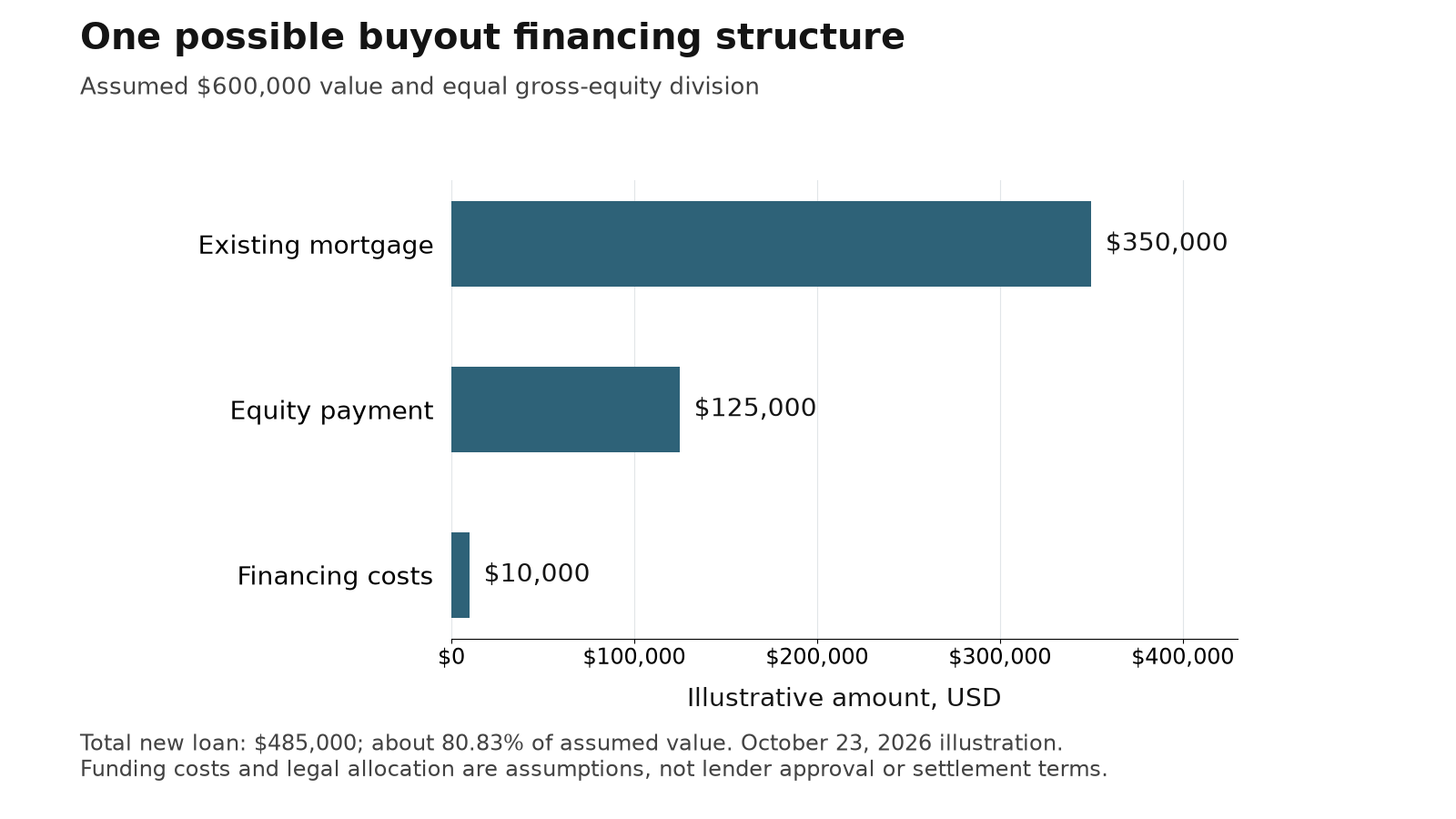
Separate the negotiated value of the departing spouse's interest from the cash needed to finance it. In a simple example, a $600,000 agreed value less $350,000 mortgage debt leaves $250,000 gross equity. An expressly assumed equal division produces a $125,000 buyout. That differs from the $105,000 illustrative sale distribution because the sale example deducts $40,000 in costs. Neither calculation automatically determines a legal entitlement.
Ask the attorneys whether hypothetical selling costs belong in the agreed buyout formula, which debts are included, and whether other property offsets part of the payment. Do not automatically deduct commissions for a sale that is not happening. Equally, do not ignore the receiving spouse's transaction costs or tax basis when comparing proposals. Record the chosen valuation date and how an appraisal disagreement will be resolved before ordering competing reports.
Funding might combine savings, another asset allocation and approved financing. If the retaining spouse instead borrows the entire $350,000 payoff, $125,000 buyout and $10,000 assumed financing costs, the proposed new loan is $485,000. Relative to $600,000 value, that is approximately 80.83% loan-to-value. This arithmetic is not approval: underwriting, appraisal, available products and allowable financed costs determine the actual structure.
According to Fannie Mae's limited cash-out refinance guidance, reviewed October 23, 2026, a qualifying owner-interest buyout can use that classification when its requirements are met, including 12 months of joint ownership, a signed transfer/proceeds agreement, borrower qualification and no refinance proceeds to the acquiring borrower. This is a specific Fannie Mae provision, not a rule for every mortgage or a guarantee of approval.
Have the lender review the proposed settlement structure before a final funding promise. Give counsel the lender's actual conditions and realistic processing milestones. The Nevada mortgage terminology guide can help distinguish balance, payoff, equity and loan-to-value when comparing documents. Agree on what happens if the appraisal, required cash or final approval differs from the initial estimate.
Can an assumption release a spouse without refinancing?
Ask the servicer before accepting a blanket claim that refinancing is the only route. According to the CFPB's December 2024 mortgage-servicing spotlight, successor homeowners can face unnecessary pressure to refinance, and obtaining release of an existing borrower generally involves assumption and applicable underwriting. The practical question is which documented process applies to this loan.
Three events need separate answers: transfer of ownership, assumption of the obligation and release of the departing borrower. An allowed title transfer does not by itself prove that release has occurred. According to Fannie Mae's exempt-transfer servicing guidance, certain divorce transfers are exempt from due-on-sale enforcement; a requested release still requires applicable credit and financial review. Its occupancy conditions include an acquisition-date distinction. Have the servicer identify the actual investor and requirements rather than treating that guidance as universal.
Send a focused request: identify the loan type and investor, the documents needed for the divorce transfer, whether assumption and release are available, applicable qualification requirements, fees, expected processing steps and the document proving release. Keep the dated response and the name of the department handling it. A call-center statement that a name can be “removed” needs clarification about which record changes.
Also solve the equity payment. Keeping an existing loan does not produce the cash owed to the departing spouse. A proposed second loan or other financing creates additional costs and approval questions. Compare the complete arrangement with a refinance and a sale, using the Nevada assumable-mortgage guide for the broader distinction between assumption and seller equity. Have the attorney coordinate the deed and settlement obligations with the lender's written process; do not substitute a verbal promise for a release.
What does signing a deed change about mortgage liability?
A deed concerns ownership. A mortgage obligation concerns what borrowers owe under the loan documents. According to the CFPB's divorce and joint-debt explanation, a decree assigning a debt to one spouse does not automatically change the creditor's rights, and removing a name from title does not remove it from the loan. A contractual release, qualifying replacement financing or payoff must be addressed separately.
Create a document checklist before the transfer. Which deed will be recorded? Who prepares and reviews it? Which debt will be paid off or assumed? What evidence confirms the departing person's release? When does escrow deliver funds? Who verifies the final recorded and loan documents? Ask counsel to coordinate these steps so each person understands the risks of the proposed order. This guide does not instruct you to ignore a court-ordered transfer while waiting for preferred financing.
If the departing spouse remains liable for a defined period, ask their attorney and prospective lender how that affects enforcement rights, credit exposure and a later mortgage application. A private promise to reimburse payments is not the same thing as lender release. Discuss how statements will be shared, how a missed payment will be reported to the parties, and what the court-approved remedy is if the agreed deadline expires.
After completion, retain the payoff or release confirmation, recorded transfer, settlement statement and final distribution records. Check that names, property identifiers and effective dates match. If a servicer's records appear inconsistent, pursue a documented correction through its process. The goal is a verifiable end state, not simply a signed piece of paper whose effect everyone assumes. Bring unresolved discrepancies to the responsible professional before building a new housing commitment around the expected outcome.
Can the retaining spouse afford the entire home?
Qualification and a sustainable personal budget answer different questions. A lender's approval does not reserve money for every repair, childcare change or moving expense. Build the post-divorce budget using the retaining owner's expected obligations and dependable income. Ask the lender how it will document any support income or obligations; do not assume a proposed settlement amount is already usable qualifying income.
For an original illustration using Freddie Mac's 7.24% average 30-year rate (week of October 29, 2026), a $485,000 loan over 30 years has principal and interest of approximately $3,305.27 per month. That rate is a national average, not a refinance quote. Add selected monthly amounts of $350 property tax, $175 insurance, $100 association charges, $300 maintenance reserve and $275 utilities. The resulting housing budget is about $4,505.27 monthly, before other debts and household expenses. Mortgage insurance, if required, would add to it.
| Component | Monthly amount | Evidence to collect |
|---|---|---|
| Principal and interest | $3,305.27 | Actual lender terms and amortization |
| Tax, insurance and association | $625 | Current bill, new policy quote and association statement |
| Maintenance and utilities | $575 | Inspection findings, actual bills and reserve plan |
| Selected housing total | $4,505.27 | Add any omitted property or financing costs |
Use stress cases that reflect your circumstances: a known roof repair, reduced support receipts, an insurance renewal or a period between jobs. Identify which reserve remains after the buyout and closing. At the selected housing total, three months is $13,515.81 and six months is $27,031.62. Those are arithmetic benchmarks, not a lender reserve requirement or a recommendation that one amount fits everyone.
Compare a smaller replacement home with the same completeness. Las Vegas housing, Henderson alternatives and North Las Vegas listings serve different searches; none establishes the budget of a particular property. Include moving and transaction costs in the comparison so staying does not look cheaper merely because the alternative is more fully itemized.

How should temporary payments and occupancy be organized?
Decide who will actually perform each task while the legal and real-estate processes continue. A plan that says “share expenses” leaves unanswered who makes the payment, when the other person contributes and how both confirm it cleared. Use a dated ledger with amounts, due dates, supporting statements and any disputed reimbursements. Separate recordkeeping from the ultimate legal allocation.
According to the Clark County Family Law Self-Help Center's temporary-orders guidance, temporary orders may address support and exclusive possession of the house while a divorce proceeds. These temporary arrangements do not decide every final issue. The page's forms and filing instructions relate to its court context; a Reno or other Nevada case needs the appropriate local procedure. Ask your attorney which existing orders govern payments, occupancy, access and any proposed sale.
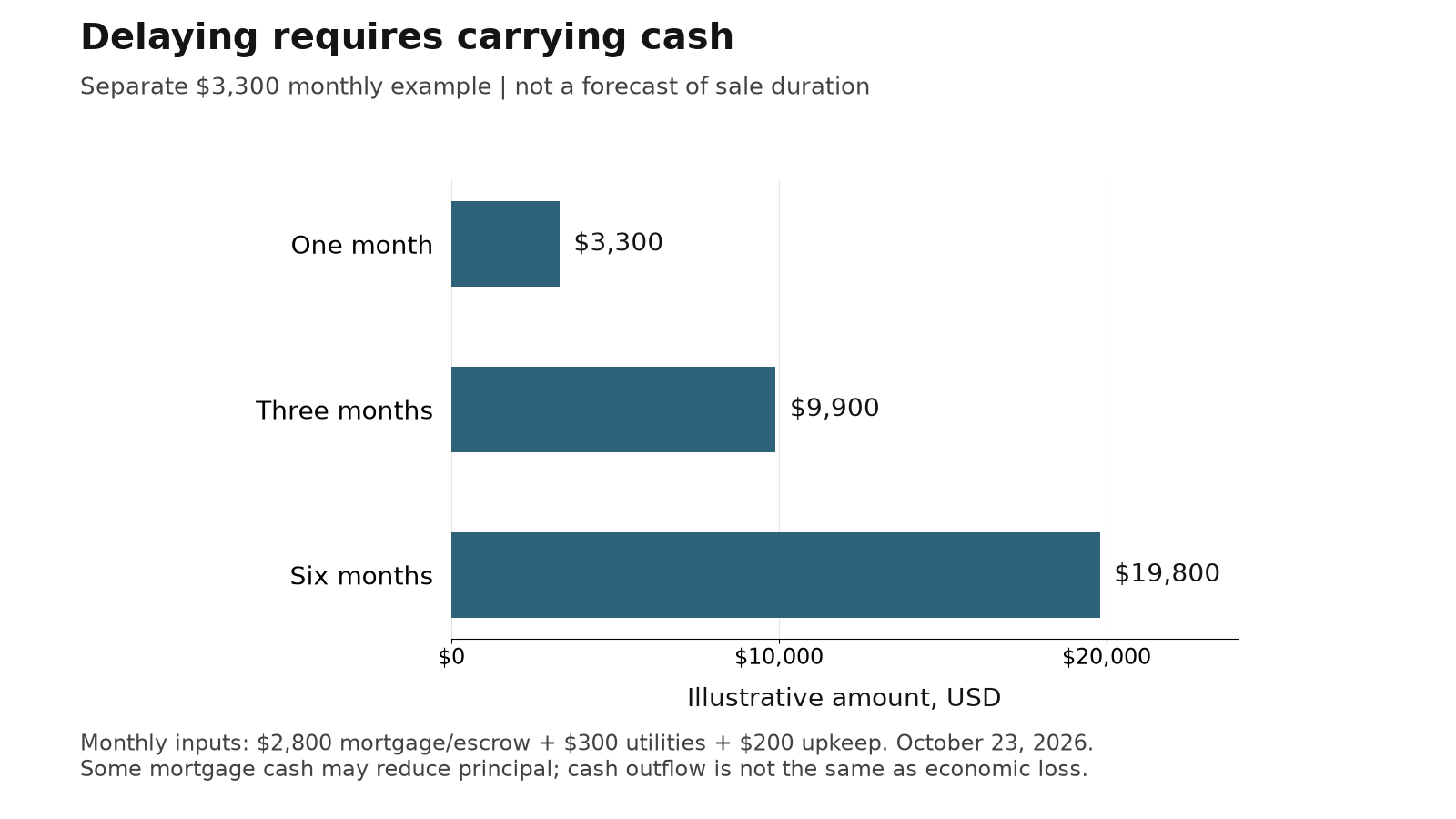
For a shared planning example, assume mortgage and escrow charges total $2,800 monthly, utilities $300 and necessary upkeep $200. Carrying the home for three additional months requires $9,900 of cash, compared with $19,800 for six months. These $3,300 monthly inputs are separate from the retaining-owner refinance example. They are selected planning figures, and some mortgage payment may reduce principal; cash outflow is not identical to economic loss.
Identify the source of that cash before agreeing to delay. Specify how insurance remains appropriate if occupancy changes, how necessary repairs are authorized, and who receives notices. Do not cancel utilities, change access or remove belongings in conflict with an order or agreement. When safety or prohibited contact affects logistics, have counsel establish the communication and access arrangement instead of requiring direct negotiation. A written process can support a sale without making either spouse the other's informal lender or administrator by default.
Should the house sell before or after the divorce for taxes?
Have a tax professional compare both owners' facts before choosing a closing or divorce date. According to the current IRS Publication 523, reviewed November 1, 2026 in its 2025 edition, qualifying home-sale gain exclusions can reach $250,000 per individual or $500,000 on an eligible joint return. Ownership, residence and prior-exclusion rules matter. Two former spouses can each qualify for an individual exclusion; selling before divorce is not automatically better.
IRS Publication 504, also the 2025 edition reviewed on November 1, ties filing status partly to year-end marital status. Its divorce-transfer rules generally preserve basis rather than substituting a negotiated buyout price, subject to exceptions. Obtain advice for the sale year's actual rules and your circumstances. Do not treat these publication editions as completed guidance for every 2026 return issue.
Your tax worksheet should start with original acquisition records, qualifying basis adjustments, ownership dates, residence dates and any prior home-sale exclusion. Ask how a divorce instrument affects a spouse's use of the home. Publication 523 includes special spouse and former-spouse rules, so moving out does not justify an automatic assumption that all eligibility disappears immediately. Conversely, continued ownership alone does not establish every requirement.
Keep gain and cash proceeds separate. A large mortgage payoff can leave limited cash without reducing taxable gain by that same amount. A buyout can transfer valuable equity without giving the retaining owner a fresh purchase-price basis. Ask the tax adviser to show the gain calculation, the exclusion available to each person, any remaining taxable amount, and a reasonable tax reserve. Rental use, depreciation, ownership history and other exceptions may change the answer.
Do not arrange the transaction around an assumed tax saving that no one has calculated. Have the attorney and tax adviser coordinate the settlement language and intended timing. Retain the resulting basis records with the final closing documents so the person who keeps the property can explain a later sale without trying to reconstruct the marriage's financial history from memory.
Who needs authority to approve and sign the sale?
Title and the divorce papers decide together who can sell. The deed shows who holds record title, but NRS 123.230 bars either spouse from selling community real property unless both join in the deed, so "only my name is on the deed" is not a sufficient signing analysis. A decree, settlement agreement or court order can then change who must sign, who gets paid and when: it can award the home to one spouse, order a sale or direct how proceeds are split. Escrow and the title insurer work from recorded title and the orders they can rely on, so what controls shifts by stage.
| Stage | What controls | What escrow needs |
|---|---|---|
| Case pending in Clark County | A joint preliminary injunction under EDCR 5.703, if a party requests it, bars selling joint or community property, or property claimed as community, without the parties' written consent or the court's permission. It lasts until a decree or final judgment, or until the court changes it | Any injunction or temporary order, plus both signatures |
| After a decree or signed settlement | The decree or agreement. NRS 111.781 generally turns survivorship title into equal tenancies in common at divorce, unless a governing instrument, order or contract says otherwise | Certified decree or agreement, signer list and proceeds instructions |
| A spouse refuses to comply | Court enforcement under Rule 70, below | The order naming a substitute signer, or a judgment vesting title |
Ask title and counsel to identify the required signers and acceptable authority before accepting deadlines. Chapter 123 also lets a spouse give the other a written power of attorney, and recorded ownership, marital rights, agreements and orders all require review. Washoe and other Nevada courts have their own rules, so confirm which orders apply to your case. This section can't tell you what your decree means; your attorney reads that.
Court enforcement also makes the statement "a sale can never close without both personal signatures" too absolute. Under Nevada Rule of Civil Procedure 70, a court may order another person to perform a required conveyance when a party fails to comply with a judgment, or vest title by judgment instead. That is a legal process, not permission for an agent or spouse to improvise a substitute signature.
Give escrow the relevant orders early and ask what certified copies, identification or other documents it needs. If a power of attorney is proposed, have it reviewed for this transaction and the title insurer's requirements before relying on it. If a party will be away, arrange the approved signing method and schedule rather than assuming any remote notarization will satisfy every document requirement.
Create an approval map for the listing, price adjustments, offers, repairs, concessions, closing changes and final disbursement. The map should show who decides, who receives documents and which professional resolves ambiguity. An agreed response time can help coordination, but silence should not be treated as consent unless the governing arrangement actually makes it so. If spouses disagree about authority, get clarification before issuing instructions that escrow or a buyer cannot rely on.
Existing court restrictions can also affect the timing or permissibility of a transfer. NRS 125.050 provides for restraining orders that preserve the status quo, and EDCR 5.703 covers Clark County's joint preliminary injunction. Counsel should check the actual case, not merely these general rules. Keep copies of modifications together so the transaction team does not rely on an earlier order after a later one changes it.
How can an agent support both sellers without becoming their lawyer?
Define representation and communication clearly. The agent's role is to help carry out the authorized real-estate transaction within the brokerage relationship. It does not include deciding marital-property rights, promising a tax result or mediating every divorce dispute. According to Nevada's real-estate agency statutes, disclosure, reasonable care, confidentiality and client duties matter; representation involving adverse interests has specific requirements and exceptions. Have the brokerage explain the applicable forms and who its clients are.
Ask for a concrete communication plan: who receives each offer, how questions reach counsel, which channels are appropriate, and how instructions will be documented. Copying everyone on every message is not automatically appropriate where confidentiality or protective arrangements apply. Agree on a lawful process with the people responsible for those constraints. Keep factual transaction updates separate from private legal advice.
Both spouses need to believe the agent is treating them evenly. The operational aim is a process both clients understand: the same property evidence, documented choices and clear escalation of disputes. An agent's approachable manner cannot replace the authority needed to sign or disburse funds.
For pricing, request comparable properties and an explanation of differences rather than a number selected to satisfy either spouse. For preparation, compare the expected usefulness of work with cost, cash availability and permission to proceed. Our home-improvement guide can help frame questions, but no project should be treated as guaranteed profit. If counsel recommends an appraisal, understand that a marketing analysis and an appraisal serve different purposes. Select professionals for the decisions they are qualified and authorized to make.
What milestones make a divorce sale manageable?
Build a sequence with owners and dependencies instead of promising a statewide number of days. Start with property and title review, the payment plan, authority to list, the valuation approach and proceeds instructions. Then address preparation, marketing, offer approval, buyer contingencies, title clearance and closing. Any unresolved dependency can change timing even when the home attracts a buyer quickly.
Use a shared milestone sheet with the responsible professional, required document, intended date and next decision if it is late. For example, an intended buyout can have an application milestone, document-completion milestone, appraisal milestone and final funding deadline. Have counsel define a fallback rather than assuming a missed date automatically authorizes a sale. The lender should validate its processing estimates before they become settlement promises.
Once a buyer is under contract, coordinate the contract's actual inspection, appraisal, financing and closing terms with the divorce obligations. An agent should not promise a concession solely because it would simplify communication. Make sure the people with authority receive the request and understand its effect on net proceeds. Keep a running revision of the net sheet so a changed price or repair credit does not surprise either seller at signing.
If an impasse arises, identify whether it concerns value, legal rights, financing, access or disbursement. Each issue has a different owner. Attorneys may use negotiated terms, appropriate dispute resolution or court procedures; the agent supplies property and transaction information. Do not assume a “neutral” agent can overrule a court order or guarantee agreement. Safety concerns and prohibited contact need their own professional handling.
At closing, check the final settlement statement against the approved distribution instructions, verify any holdback, and confirm how each person receives their funds. Obtain transfer and debt-resolution records afterward. A completed sale is one milestone in the larger settlement; keep any remaining legal or tax obligations on a separate list instead of treating the closing as proof that every divorce issue is finished.
What questions should Nevada divorcing homeowners ask first?
Does each spouse automatically get half of the house?
No. Nevada generally requires equal division of community property, subject to legal exceptions, but classification, agreements and other assets affect a particular settlement. Separate-property claims and traceable contributions need document review. Have an attorney determine the relevant interests before treating half the home's gross equity as an agreed cash obligation.
Does a quitclaim deed remove my mortgage responsibility?
No. Title transfer and loan liability are separate. Identify the actual payoff, refinance or lender-approved assumption and release process. Have counsel coordinate the documents and comply with applicable orders. Keep written confirmation of the resulting loan status; a decree or a changed name on one record does not itself prove creditor release.
Must a divorce buyout use a new refinance?
Not necessarily. Savings, other asset allocations or an eligible assumption arrangement may be relevant. The equity payment and departing borrower's release still need separate solutions. Ask the servicer about the existing loan and have a lender evaluate any additional financing before assuming either that refinancing is mandatory or that the old rate can definitely be retained.
Is selling before divorce always better for capital gains?
No. Each owner's gain, basis, ownership and use history, filing status and prior exclusions matter. Two eligible former spouses may each have an individual exclusion. Have a tax professional compare the actual alternatives, including special spouse-use provisions and the later tax position of someone who keeps the home.
Can we deduct selling costs when pricing a buyout?
That is a settlement question, not an automatic arithmetic rule. The illustration shows why gross equity and net sale proceeds differ. Ask counsel which hypothetical costs, reimbursements, debt balances and valuation date belong in your agreement. Document the formula so the financing request and promised payment describe the same transaction.
Can one spouse refuse to sign indefinitely?
Do not assume refusal resolves the legal outcome. Counsel can explain available court remedies and whether an existing judgment requires an act. Rule 70 provides enforcement mechanisms in appropriate circumstances. Title and escrow must review the actual authority; the other spouse or agent cannot simply sign on someone's behalf without valid authorization.
Who pays while the house is waiting to sell?
Follow applicable orders and obtain advice about any unresolved allocation. Operationally, name the person making each payment, its funding source and how proof is shared. Track disputes separately. The lender's rights do not pause while spouses disagree, and a private expense arrangement does not necessarily change responsibility under the loan.
How long will the sale take?
There is no reliable universal duration in this guide. For scale, 5,275 single-family closings in Las Vegas, Henderson, North Las Vegas and Boulder City from July to September 2026 took a median 62 days from list date to closing, before any divorce issue. Authority, preparation, buyer demand, contract contingencies, financing and title conditions all affect the schedule. Ask the transaction team for dates tied to completed prerequisites, and compare the cash required by a delay with the written fallback if a milestone is missed.
Which evidence and records should support your next decision?
The November 1, 2026 review used the Nevada statutes and court rules linked beside their claims, the Clark County temporary-orders page, CFPB explanations of debt and successor servicing, Fannie Mae's two distinct financing and transfer provisions, Freddie Mac's weekly rate survey, and IRS Publications 523 and 504 in their available 2025 editions. These authorities answer different questions. A mortgage investor's policy does not decide marital ownership, and a tax publication does not authorize a deed transfer.
The financial examples were calculated for this guide using explicitly selected inputs. They are not current listing prices, market medians, observed divorce outcomes or quotes from a lender, insurer or escrow company, and they do not represent an analysis of Nevada Real Estate Group's transactions. The one market figure, in the FAQ, is our count of MLS closings by closing date. Obtain property-specific evidence before using any illustration to negotiate a settlement.
Prepare a concise meeting packet: property and loan records, relevant orders, a proposed decision timetable, actual ownership bills, competing net-proceeds and buyout worksheets, and the questions each professional must answer. Mark unresolved figures visibly. If you are evaluating a different city after the sale, use Reno housing information and current listings for that decision rather than importing the Southern Nevada example into a new local budget.
Nevada Real Estate Group is the #1 real estate team in Nevada by RealTrends Verified, with 9,600+ closed transactions statewide, serving Las Vegas, Henderson, North Las Vegas, and Reno. For the real-estate portion, review our seller services and 7-day listing agreement, including the actual terms; the agreement's name is not a seven-day sale promise. Bring your attorney's requirements to the discussion. Contact the Las Vegas team at (702) 637-1759, Northern Nevada at (775) 277-2120, or use our contact page to discuss valuation, marketing and transaction coordination within the agreed representation.