
Selling a family ranch or a 10-acre horse property in Carson Valley is not the same job as selling a three-bedroom house in a subdivision. Fewer buyers can afford it, fewer lenders like it, and the buyer's due diligence covers wells, water rights, fences, zoning and tax status as well as the house. Most advice on that is general. We wanted numbers for this valley.
So we pulled every closed sale in the four Carson Valley ZIP codes, 89410 (Gardnerville), 89423 (Minden), 89460 (Gardnerville Ranchos) and 89411 (Genoa), from the Northern Nevada Regional MLS for the 36 months from October 1, 2023 through September 30, 2026. That gave 1,996 closings, of which 100 were homes on 5 acres or more and 69 were vacant parcels of 5 acres or more. We compared them with 1,181 houses on lots under an acre in the same ZIPs and the same months, then looked at the 75 acreage listings for sale on November 19, 2026.
In Carson Valley, homes on 5 acres or more took a median 39 days to reach an accepted offer and closed at 94.6% of their first asking price from October 2023 through September 2026, against 27 days and 97.4% for houses on under an acre. Vacant parcels of 5 acres or more took a median 108.5 days and closed at 92.4%.
- 169 acreage sales closed in Carson Valley, October 2023 to September 2026.
- 30 of 100 acreage homes sold 10% or more below their first asking price.
- Acreage homes over $2.5 million took a median 123.5 days to an offer.
- Water rights need a recorded deed and a State Engineer filing; plan for both.
- Ag tax deferral can carry back up to seven fiscal years if the land converts.
How long does it take to sell acreage in Carson Valley?
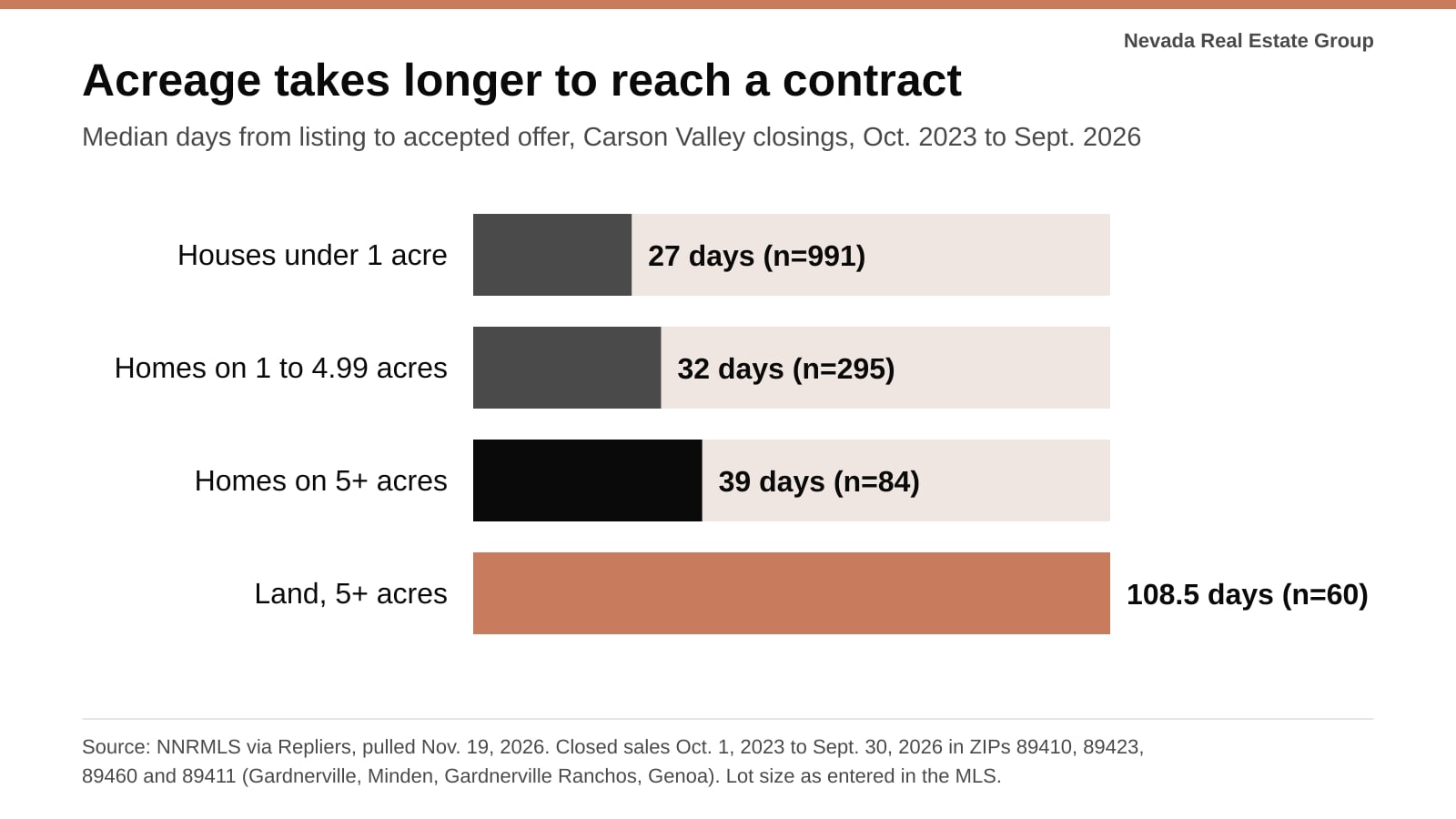
Longer than a subdivision home, and much longer for bare land. We measured the time from the listing date to the accepted purchase contract, which is the part a seller controls through pricing and preparation. Escrow on top of that adds its own weeks. Across the 36 months ending September 30, 2026, a house on a lot under an acre in the four Carson Valley ZIPs went under contract in a median 27 days. A home on 1 to 4.99 acres took 32 days. A home on 5 acres or more took 39 days. A vacant parcel of 5 acres or more took 108.5 days, four times the subdivision figure.
| Measure | Houses under 1 acre | Homes on 1 to 4.99 acres | Homes on 5+ acres | Land, 5+ acres |
|---|---|---|---|---|
| Closings | 1,181 | 359 | 100 | 69 |
| Median sale price | $615,000 | $950,000 | $1,454,000 | $425,000 |
| Median lot size | 0.21 acre | 1.16 acres | 6.43 acres | 9.98 acres |
| Median days, listing to accepted offer | 27 | 32 | 39 | 108.5 |
| Median sale price as share of first asking price | 97.4% | 97.2% | 94.6% | 92.4% |
| Sold at or above first asking price | 358 (30.3%) | 121 (33.7%) | 22 (22.0%) | 18 (26.1%) |
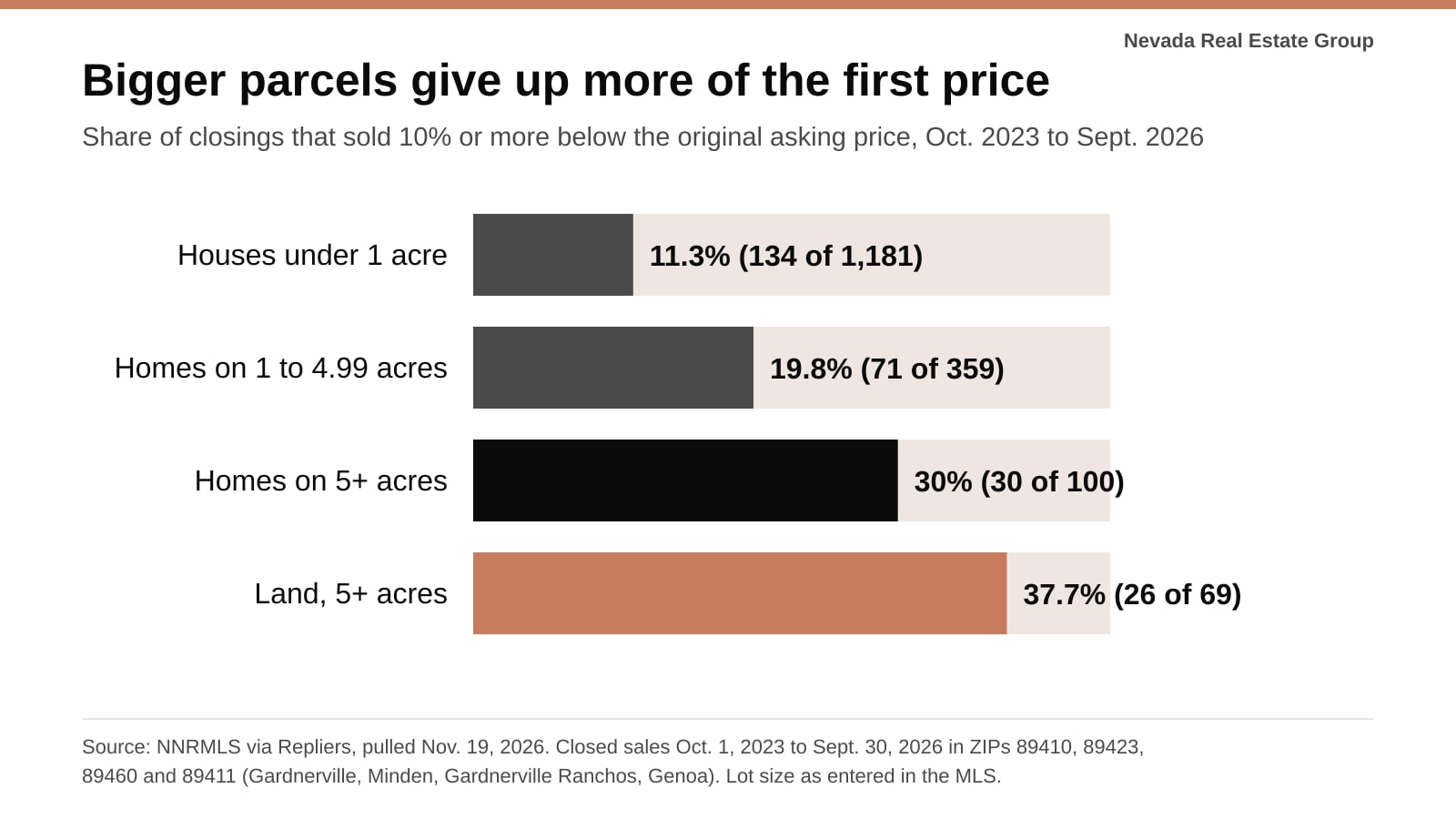
| Sold 10% or more below first asking price | 134 (11.3%) | 71 (19.8%) | 30 (30.0%) | 26 (37.7%) |
The spread matters more than the median. Of the 84 acreage homes with a recorded contract date, 38 went under contract within 30 days, 11 took more than 180 days and 4 took more than a year. Of the 60 land sales with a contract date, 25 found a buyer inside 30 days, 22 took more than 180 days and 11 took more than a year. Acreage either meets a waiting buyer quickly or sits for a long time, and there is less middle ground than in a subdivision. For a broader look at the valley's prices and inventory, our Carson Valley housing market guide tracks the town-by-town numbers each month.
How far below the first asking price does acreage usually sell?
Further than a subdivision home. A house on under an acre in Carson Valley closed at a median 97.4% of its original asking price over the 36 months to September 2026, and only 11.3% of them sold 10% or more below the first number. For homes on 5 acres or more, the median was 94.6% and 30 of the 100 sold at least 10% under where they started. For vacant parcels of 5 acres or more, the median was 92.4% and 26 of 69, or 37.7%, gave up 10% or more.
The reason is not that acreage buyers negotiate harder. It is that acreage is harder to price. A subdivision home has a dozen near-identical sales within a mile in the last six months. A 12-acre parcel with a barn, a well and a mile of fence may have two loose comparables in three years, each with different water, zoning and improvements. Sellers and their agents start high when the evidence is thin, and the market corrects them over the following months. The first price is a guess more often than it is a measurement.
That has a cost beyond the final discount. A listing that starts too high collects days on the market, and buyers read a long listing history as a sign that something is wrong with the property. The listings that sold fastest in our data were the ones that sold near their first price: of the 22 acreage homes that closed at or above their original asking price, 17 of the 21 with a recorded contract date went under contract within 30 days. A price set from real comparables, with the differences explained, tends to cost less than a price set high and cut twice. If you are weighing what a sale will actually leave you after costs, our Nevada seller net sheet guide walks through each line.
Does the price tier change how long a Carson Valley ranch takes to sell?
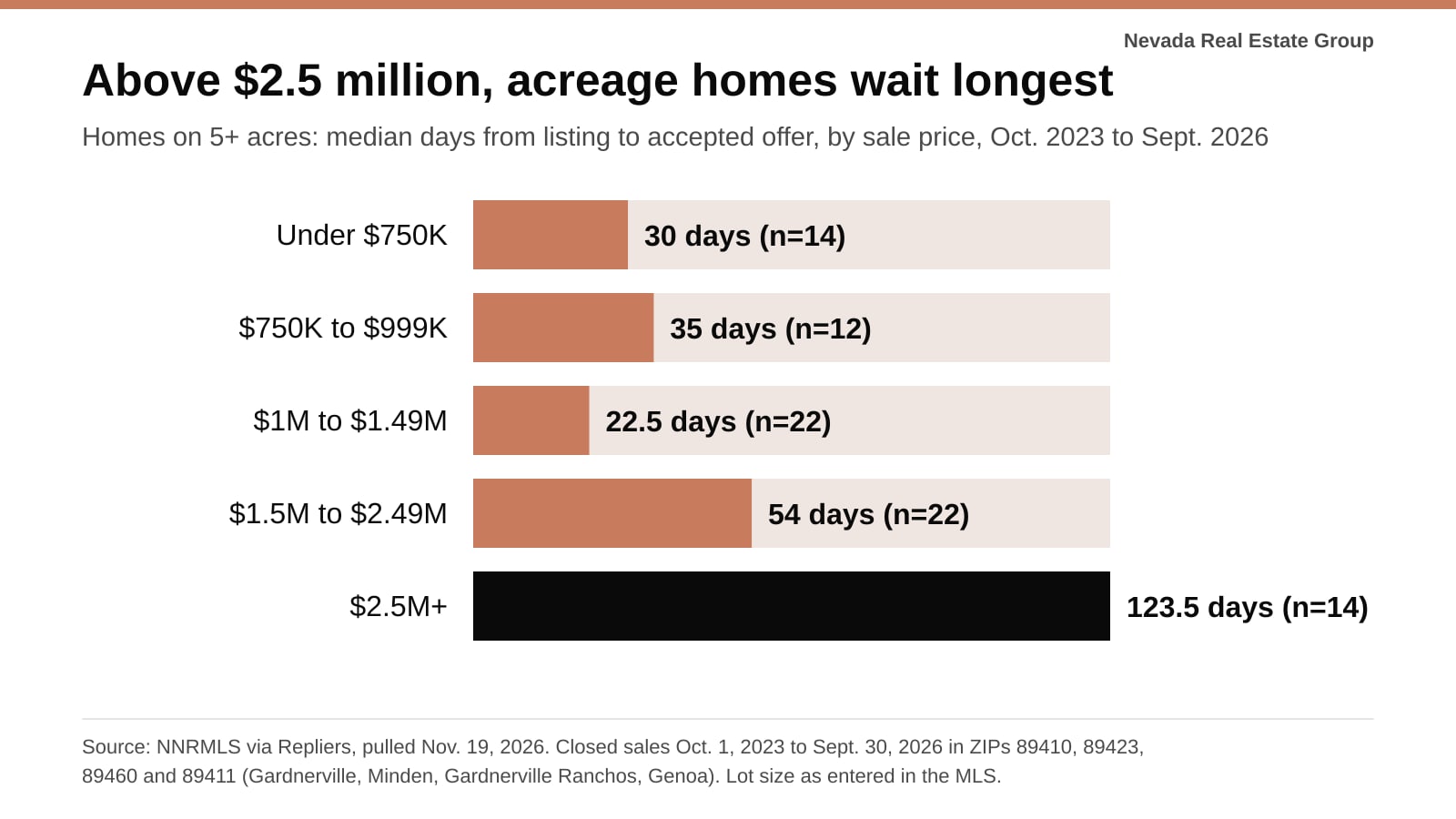
Yes, sharply at the top. Splitting the 100 acreage-home sales from October 2023 to September 2026 by price shows a fairly steady market up to $1.5 million and a much slower one above $2.5 million. Homes on 5 acres or more that sold for $1 million to $1.49 million were the quickest, at a median 22.5 days to an accepted offer. Homes that sold for $2.5 million or more took a median 123.5 days and closed at 92.2% of their first asking price.
| Sale price | Closings | Median price | Median acres | Median days to offer | Median share of first price | Sold 10%+ below first price |
|---|---|---|---|---|---|---|
| Under $750,000 | 14 | $637,000 | 5.96 | 30 | 96.2% | 4 |
| $750,000 to $999,999 | 15 | $860,000 | 5.38 | 35 | 95.5% | 2 |
| $1 million to $1.49 million | 23 | $1,265,000 | 5.54 | 22.5 | 95.0% | 6 |
| $1.5 million to $2.49 million | 28 | $1,807,500 | 5.63 | 54 | 93.7% | 11 |
| $2.5 million and up | 20 | $2,862,500 | 18.9 | 123.5 | 92.2% | 7 |
Two things drive the top tier. The buyer pool is small: across three years, only 20 acreage homes in the four ZIPs sold for $2.5 million or more, fewer than seven a year. And the properties are the least alike. The median top-tier sale had 18.9 acres, against 5.4 to 6.0 acres in every lower band, so each one carries its own mix of pasture, water, outbuildings and views that a buyer has to value from scratch. A seller in that tier should plan for a listing that runs through more than one season and budget the carrying costs for it.
The lower bands behave more like the wider market. A home on five or six acres at $1 million to $1.5 million competes with the valley's newer large-lot subdivisions and moved in about three weeks at the median. For the property features buyers in that band ask about first, see our Carson Valley horse property guide, written for the other side of the same sale.
Do Minden, Gardnerville, the Ranchos and Genoa sell acreage differently?
They sell different acreage. ZIP 89410, Gardnerville, had the most acreage-home sales over the 36 months, 52 of the 100, mostly parcels near 5 acres (a median 5.36), at a median $1,169,500. ZIP 89423, Minden, had 18, on larger parcels (a median 10.1 acres), at a median $1,085,000, and they were the quickest to go under contract. ZIP 89460 had 27 sales at a median $2,650,000 on 10.6 acres. That ZIP carries the Gardnerville Ranchos name, though its acreage sales sit outside the small-lot Ranchos neighborhoods by definition.
| ZIP (area) | Homes sold | Median home price | Median home acres | Median days to offer, homes | Land sold | Median land price per acre | Median days to offer, land |
|---|---|---|---|---|---|---|---|
| 89410 (Gardnerville) | 52 | $1,169,500 | 5.36 | 46 | 40 | $29,808 | 36 |
| 89423 (Minden) | 18 | $1,085,000 | 10.1 | 22 | 14 | $40,324 | 99 |
| 89460 (Gardnerville Ranchos) | 27 | $2,650,000 | 10.6 | 56 | 8 | $54,203 | 210 |
| 89411 (Genoa) | 3 | $1,715,000 to $2,875,000 (range) | 6.0 | 1 recorded | 7 | $75,251 | 164 |
The land column tells a different story from the homes. Gardnerville's 40 land sales had the lowest price per acre ($29,808) because they include large outlying range parcels, some of 40 acres selling for under $100,000. Genoa's seven parcels were small and expensive per acre ($75,251), and slow, at a median 164 days. A seller in one ZIP learns little from the valley-wide median. Genoa homes are covered in more depth in our Genoa neighborhoods comparison, and the grid of current listings is on our Minden homes for sale and Gardnerville homes for sale pages. Groups under 10 sales, such as Genoa homes, are shown as a range rather than a trend.
Why does vacant land sit longer than acreage with a house?
Because the buyer of bare land has to solve problems the buyer of a house does not. A house comes with a working well, a septic system, power and a driveway. A bare parcel often comes with none of them, and the buyer has to price a well, a septic permit, a power extension and a road before they can price the land. Most of them pay cash for that privilege: of the 12 land sales from October 2023 to September 2026 with a recorded financing type, 10 were cash.
Water status showed up clearly in the numbers. Of the 69 land sales of 5 acres or more, 37 were listed with a well still needed or no water source, 13 with a private well already in place, and 11 with public or community water. The parcels that already had a well went under contract in a median 30 days and closed at 94.3% of their first asking price. The parcels that still needed a well took a median 108.5 days and closed at 92.4%, and 15 of the 37 sold 10% or more below their first asking price. The groups are small and differ in size and location, so read this as a pattern, not a price on a well.
| Parcel size | Sales | Median price | Median acres | Median price per acre | Median days to offer | Median share of first price |
|---|---|---|---|---|---|---|
| 5 to 9.99 acres | 36 | $415,000 | 6.16 | $72,071 | 139.5 | 94.3% |
| 10 to 19.99 acres | 8 | $672,500 | 19.0 | $42,834 | 9.5 | 95.5% |
| 20 to 39.99 acres | 11 | $458,000 | 25.6 | $17,468 | 18.5 | 90.6% |
| 40 acres and up | 14 | $167,000 | 42.4 | $2,972 | 195 | 90.0% |
The 40-acre row is the clearest warning against per-acre thinking. Half of those parcels (7 of 14) carried FR19 forest-and-range zoning in the MLS, and their median price per acre was $2,972, against $72,071 for parcels of 5 to 10 acres closer to services. Price per acre is a way to compare like with like, not a way to value a parcel. If you own land and are deciding whether to drill a well before listing, our Nevada well and septic guide explains what buyers check.
What did 5-acre, 10-acre and larger Carson Valley homes sell for per acre?
Per acre, less as the parcel grows, because the house carries most of the value. Across the 100 acreage-home sales from October 2023 to September 2026, homes on 5 to 9.99 acres sold for a median $1,316,000, or $225,561 per acre. Homes on 10 to 19.99 acres sold for a median $1,600,000, or $142,105 per acre. The 10 homes on 20 to 39.99 acres sold for a median $2,150,000, and the five on 40 acres or more for a median $2,700,000, with a range from $434,000 to $10,350,000.
Those per-acre figures are not land values. They divide the whole price, house, barn, fences and well included, by the acreage. They show that doubling the land does not double the price: the step from about 5 acres to about 12 added roughly $284,000 at the median, not the roughly $1.5 million that multiplying the extra acres by the smaller parcels' $225,561 per acre would suggest. Buyers pay for usable land, and an extra 5 acres of sagebrush without irrigation adds less than an extra 5 acres of fenced, watered pasture.
The useful comparison for a seller is the specific one. A 10-acre home with irrigated pasture and decreed water belongs with other irrigated parcels, not with a 10-acre lot in the eastern foothills that shares its acreage and little else. For an acreage listing, choose comparables for water, use and access first and acreage second, and write down every difference so a buyer and an appraiser can follow it. The houses on these parcels also varied: the median acreage home had 2,930 square feet and was built in 2000, but the top tier's homes were far larger, at a median of about 4,490 square feet among sales of $2.5 million and up. For broader context on land pricing across the region, see our Northern Nevada acreage guide.
What happens to water rights when you sell Carson Valley acreage?
They do not simply follow the land the way a garage does, and the paperwork takes longer than the escrow. Under NRS 533.382, a conveyance of a water right must be made by deed, acknowledged and recorded with the county recorder where the water is used or diverted. Under NRS 533.384, the person receiving the right must then file a report of conveyance with the State Engineer, with an abstract of title and copies of the conveyance documents.
The Nevada Division of Water Resources' water right ownership FAQ (dated August 2024, read November 19, 2026) sets the filing fee at $120 for a single water right plus $20 per conveyancing document, says processing takes about six months on average, and notes that the transfer of ownership is complete once the deed is executed and recorded. It also says the Division does not determine what water rights are worth and points owners to local real estate agents or a licensed water rights surveyor. The Division's ownership forms page holds the report of conveyance and abstract of title forms.
For a seller, three steps matter before listing. First, find the permit or decree numbers for any rights tied to the parcel and confirm the State Engineer's records show you as owner; if they show a previous owner, the chain of title is incomplete and the buyer's lender or attorney will find it. Second, decide whether the rights are included in the sale and say so in the listing and the contract. Third, make sure the deed names the rights. From October 2023 to September 2026, 19 of the 100 acreage-home listings and 6 of the 69 land listings mentioned water rights, irrigation rights or ditch rights in their public remarks. A mention is not proof that rights transferred; the recorded deed and the State Engineer's file are.
Domestic wells are a separate matter. Under NRS 534.180, a domestic well that draws no more than 2 acre-feet a year does not need a water-right permit, and 79 of the 100 acreage homes in our data (October 2023 to September 2026) listed a private well.
Does a barn, shop or horse setup help an acreage home sell?
In our data the homes with recorded outbuildings sold faster and closer to their first price, but the comparison cannot separate the barn from everything else about those properties. Of the 100 Carson Valley acreage-home sales from October 2023 to September 2026, 51 listed a barn, stable, shop, arena or similar structure in the MLS outbuildings field. Those 51 went under contract in a median 33 days and closed at a median 95.0% of their first asking price, and 11 of them sold 10% or more below it. The 49 without a recorded outbuilding took a median 51 days, closed at 93.8%, and 19 sold 10% or more below the first price.
That gap looks large, but the two groups differ in other ways. The homes with outbuildings sat on more land (a median 8.9 acres against 5.9) and were older (a median build year of 1997 against 2004), and 48 of the 51 were listed as horse properties. The likeliest reading is that working horse and ranch properties have a defined buyer who goes looking for them, while a large house on bare acreage has to find a buyer who wants the land without a use for it. That is a statement about buyers, not a promise that building a barn before listing will pay for itself.
What a seller can control is how clearly the setup is documented. Buyers of working properties ask for the size and age of each structure, whether it was permitted, how many stalls and paddocks there are, what the fencing is made of, how irrigation is delivered and whether any equipment conveys. A listing that answers those questions in writing saves a round of showings and a round of renegotiation. The Gardnerville horse properties on the market now show how competing sellers present the same features.
What happens to agricultural tax deferral when you sell?
A sale by itself does not end it, but the new owner has to act, and a change in use can bring back years of deferred tax. Nevada lets qualifying agricultural land be assessed at its agricultural value rather than its full taxable value under NRS chapter 361A. Under NRS 361A.030, the land must be used in a business that produced at least $5,000 of gross income from agricultural pursuits in the preceding calendar year.
Four rules in that chapter matter when a ranch changes hands. Under NRS 361A.150, a sale or transfer to a new owner does not disqualify the land, as long as it stays in agricultural use and the new owner applies. Under NRS 361A.110, that application is due on or before June 1 following the change in ownership. Under NRS 361A.280, if the land is converted to a higher use, the deferred tax for the year of conversion and the preceding six fiscal years becomes due, up to seven years in all, and NRS 361A.283 adds a 20% penalty for each year an owner failed to give the required notice. Under NRS 361A.290, a seller whose land carries unpaid deferred tax must tell the buyer in writing that the lien exists.
For a seller, the practical point is to know the parcel's status before pricing. Three of the acreage sales from October 2023 to September 2026 had an agricultural-deferral note in the MLS zoning field, and a buyer who plans to stop farming will price the recapture into the offer. Ask the Douglas County Assessor's office for the parcel's assessment status and an estimate of the deferred amount before you list. If the buyer will keep the land in agriculture, the contract can say who files the new application and by when. If the buyer will not, the deferred tax becomes a negotiating item, and both sides should know its size before the inspection period ends rather than after.
Who buys Carson Valley acreage, and how do they pay?
The MLS says less about this than it should: the buyer's financing type was recorded on only 7 of the 100 acreage-home sales and 12 of the 69 land sales from October 2023 to September 2026. Of those 12 land sales, 10 were cash, which fits how hard it is to finance bare land. For the acreage homes, the seven recorded sales split between cash and conventional loans, too few to call a pattern. What we can say is that a seller of bare land should expect a cash buyer and price for a smaller pool.
Seller financing appeared at the margins. Over the same 36 months, five acreage-home listings and five land listings mentioned owner financing or an owner carry in their listing terms. Carrying a note can widen the pool for land that lenders will not touch, but it turns the seller into a lender with a lien on the property, and the terms should come from an attorney. Our seller financing guide covers how those arrangements work in Nevada.
Financing costs also shape what a mortgaged buyer can pay. Freddie Mac's Primary Mortgage Market Survey put the average 30-year fixed rate at 7.11% for the week of November 12, 2026. At that rate, every $100,000 borrowed costs about $673 a month in principal and interest, so a $1.45 million acreage home with 20% down carries a loan payment near $7,800 a month before property tax and insurance. Buyers who can pay that are few. Sellers who accept an offer contingent on the buyer's own home sale should set a firm date for that sale to close.
Should a ranch sale use the home-sale exclusion or a 1031 exchange?
Often both, split by how each part of the property was used. The IRS Publication 523 rules for tax year 2025 let a seller exclude up to $250,000 of gain on a main home, or $500,000 for a married couple filing jointly, after owning it and living in it for at least two of the last five years. Publication 523 also lets vacant land next to the home count if the seller owned and used it as part of the home and sold the land and the home within two years of each other. It says gain on a separate portion used for business or rental generally cannot be excluded.
A working ranch is often partly a home and partly a business. The house and its immediate grounds may qualify for the exclusion, while pasture leased to a neighbour, a rental cabin or a hay operation may not. That portion may instead qualify for a like-kind exchange. The instructions for Form 8824 (tax year 2026) say the replacement property must be identified within 45 days after the old property is transferred and received within 180 days or by the tax return's due date with extensions, whichever is earlier, and that section 1031 does not apply to property used solely as a personal residence. The IRS's real estate exchange tax tips confirm that since 2018 only real property qualifies, so tractors and equipment sold with the ranch cannot be exchanged.
The allocation between home, business land and equipment affects both taxes and the contract, and it should be settled with a tax adviser before the purchase agreement is written, not after. Nevada has no state income tax on the gain, but federal tax on a long-held ranch can be the largest cost of the sale.
What closing costs and disclosures come with an acreage sale?
The transfer tax is smaller in Douglas County than in Reno or Las Vegas, and the disclosure rules depend on whether there is a house. Nevada's real property transfer tax is $1.95 for each $500 of value, and the Nevada Department of Taxation's transfer tax FAQ lists additions only for Washoe, Churchill and Clark counties, so Douglas County sales pay the base rate. On the $1,454,000 median acreage-home sale in our data, that comes to $5,670.60. The FAQ says the buyer and seller are jointly and individually liable for the tax. Our Nevada transfer tax guide has the county-by-county rates.
Disclosure follows the house. Under NRS 113.130, a seller of residential property must deliver the completed disclosure form at least 10 days before the property is conveyed, and NRS 113.120 says the form covers the condition of the electrical, heating, cooling, plumbing and sewer systems and any other aspect affecting use or value. NRS 113.100 defines residential property as land with one to four dwelling units, so a bare parcel falls outside that form, though a seller still should not conceal known defects.
On acreage, the systems that draw the most questions are the ones a subdivision home does not have. From October 2023 to September 2026, 77 of the 100 acreage homes listed a septic system and 79 a private well. Have the well's flow and water quality tested, have the septic pumped and inspected, and gather the permits for every structure before listing, so the buyer's inspection confirms what you disclosed rather than discovering it. Our documents checklist for Nevada sellers lists the rest.
What are you competing with on the Carson Valley market right now?
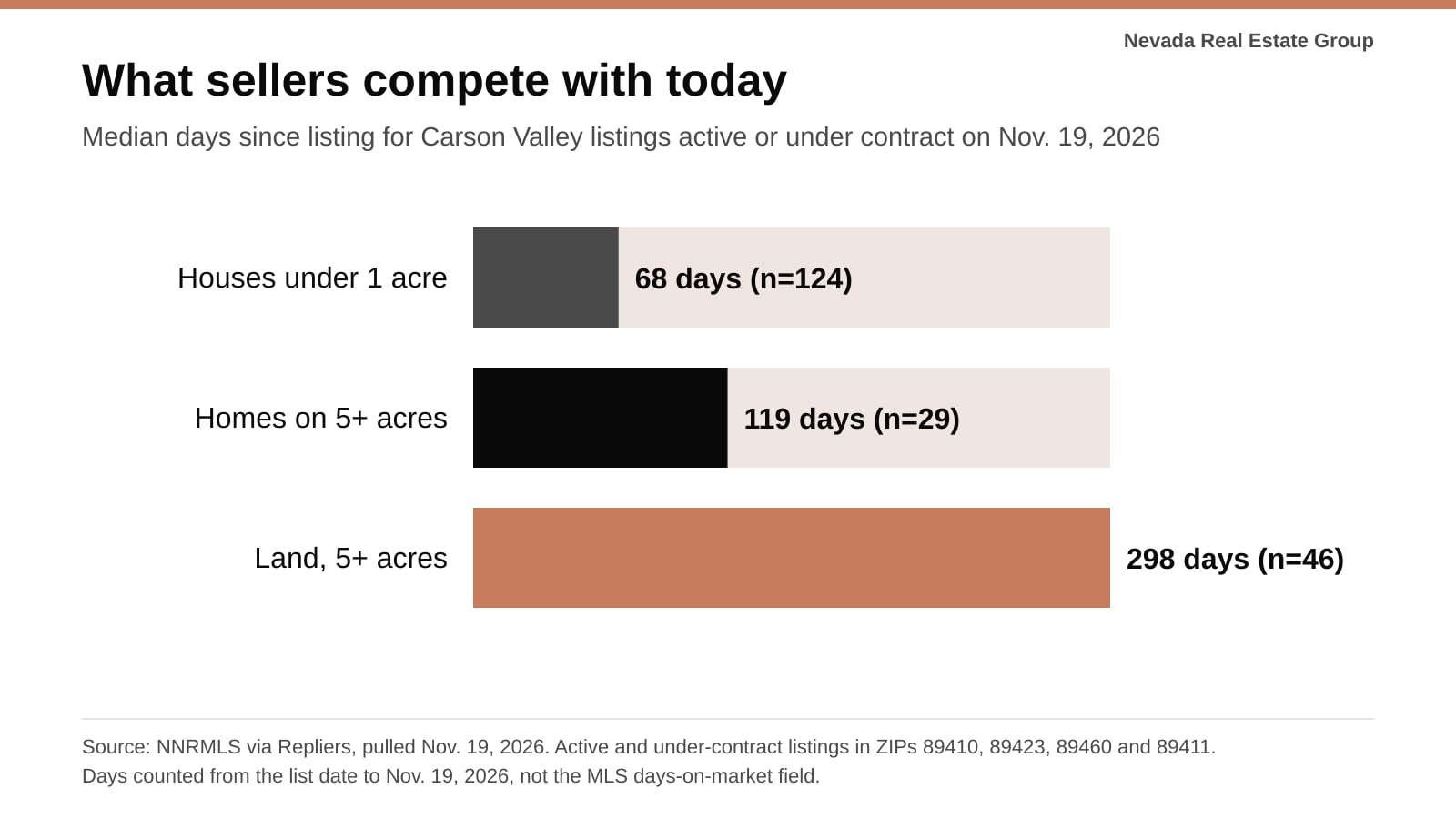
Long-listed acreage, especially land. On November 19, 2026, the four Carson Valley ZIPs had 29 homes on 5 acres or more listed for sale or under contract, at a median asking price of $1,795,000 on 8 acres. Their median listing had been up for 119 days, counting from the list date, six were under contract and 11 had already cut their price from the original. There were also 46 land listings of 5 acres or more, at a median asking price of $655,000 on 12.3 acres, with a median age of 298 days; six were under contract and 17 had cut their price.
For comparison, the 124 houses on lots under an acre listed in the same ZIPs that day had a median age of 68 days and a median asking price of $699,000. A new acreage listing therefore joins a group of older listings whose sellers have already been through a season of showings. Buyers see the whole group at once, and the older listings set expectations for price.
That cuts two ways for a seller. A well-priced new listing stands out against stale ones, and buyers who have been watching the market often move on it quickly. A listing priced at the level of the stale ones joins them. Before you set a price, look at how long each competing listing has been on the market and what it has cut, not just its asking price. The median land asking price of $53,171 per acre on November 19, 2026 was above the $43,941 median that land actually closed for over the previous three years, and that gap is a reasonable estimate of how much the current list prices may still have to give.
Has the Carson Valley acreage market changed over the last three years?
Land got faster and acreage homes got a little slower in the latest year, while subdivision homes held steady. The table splits the 36 months into three October-to-September years. The number of acreage-home sales fell from 42 in the first year to 28 in the second and 30 in the third, and the median time to an accepted offer rose from 30 days in the middle year to 51 days in the year ending September 2026. Land went the other way: 35 parcels of 5 acres or more sold in the latest year, more than in the two years before combined, and the median time to an offer fell from 240 days to 39.5.
| Year | Homes on 5+ acres sold | Median price | Median days to offer | Land, 5+ acres sold | Median land days to offer | Houses under 1 acre sold | Median days to offer, under 1 acre |
|---|---|---|---|---|---|---|---|
| October 2023 to September 2024 | 42 | $1,476,500 | 34 | 20 | 240 | 348 | 30 |
| October 2024 to September 2025 | 28 | $1,518,000 | 30 | 14 | 137 | 398 | 23 |
| October 2025 to September 2026 | 30 | $1,340,750 | 51 | 35 | 39.5 | 435 | 27 |
These are small numbers, and a handful of sales can move a median, so read direction rather than precision. The drop in the acreage-home median price in the latest year mostly reflects smaller parcels selling (a median 5.4 acres against 8.5 the year before), not a fall in value for the same property. The land surge is worth noting for anyone holding a parcel: more buyers closed on land in the latest year than in either year before, and half of them went under contract within about six weeks of listing. Whether that holds through the winter is something the next few months of closings will show; the monthly town figures are in our Carson Valley market guide.
How should you price and prepare a Carson Valley acreage listing?
Start from the evidence in this guide and the specific comparables for your parcel, and put the paperwork in order before the first showing. The three years of Carson Valley sales to September 2026 point to a few practical steps.
Price from like properties. Pick comparables by water, use, access and improvements first and acreage second, and write down each difference. The data shows that acreage that sold near its first price sold fastest, and that 30 of 100 acreage homes gave up 10% or more after starting too high.
Document the water. Pull the State Engineer's records for any permitted or decreed rights, confirm the owner of record, decide whether the rights convey, and make sure the deed will name them. Test the domestic well's flow and quality.
Know the tax status. Ask the Douglas County Assessor's office whether the parcel carries agricultural deferral and roughly how much would be due on conversion, so the buyer's plans and the contract can account for it.
Plan the tax side early. Decide with a tax adviser how the price splits between home, business land and equipment, and whether part of the sale belongs in a like-kind exchange.
Plan for time. Budget carrying costs for several months, more for bare land or a property above $2.5 million, and set firm dates in any contingent offer.
Nevada Real Estate Group lists and sells homes across Northern Nevada, including Gardnerville, Minden, Genoa and the rest of our Northern Nevada communities. See how we market and sell homes, browse the Carson Valley homes with land you would be competing with, or read our guide to retiring in Carson Valley if you are selling to downsize nearby. When you are ready to talk about your property, reach our Northern Nevada team at (775) 277-2120 or through our contact page.
Frequently Asked Questions
How long does it take to sell a ranch or acreage in Carson Valley?
From October 2023 through September 2026, homes on 5 acres or more in the Gardnerville, Minden, Gardnerville Ranchos and Genoa ZIPs took a median 39 days from listing to an accepted offer, and vacant parcels of 5 acres or more took 108.5 days. Escrow adds its own time. Homes selling for $2.5 million or more took a median 123.5 days to reach an offer.
How much below asking do Carson Valley acreage properties sell?
Homes on 5 acres or more closed at a median 94.6% of their original asking price over the 36 months to September 2026, and vacant land of 5 acres or more at 92.4%. Thirty of the 100 acreage homes and 26 of the 69 land parcels sold 10% or more below their first price.
Do water rights transfer automatically when I sell land in Nevada?
Not without paperwork. NRS 533.382 requires a water right to be conveyed by a recorded deed, and NRS 533.384 requires the person receiving it to file a report of conveyance with the State Engineer. The Division of Water Resources' FAQ lists a $120 filing fee plus $20 per document and about six months of processing.
What is the transfer tax on selling acreage in Douglas County?
Nevada's base rate of $1.95 per $500 of value applies, with no Douglas County addition listed by the Nevada Department of Taxation. On a $1,454,000 sale that is $5,670.60. The buyer and seller are both liable for it.
Will selling my ranch end its agricultural tax assessment?
Not by itself. Under NRS 361A.150, a sale does not disqualify land that stays in agricultural use, but the new owner must apply by June 1 after the change in ownership. If the land is converted to a higher use, up to seven fiscal years of deferred tax can become due under NRS 361A.280.
Is it harder to sell vacant land than a house on acreage in Carson Valley?
Yes. Vacant parcels of 5 acres or more took a median 108.5 days to reach an offer from October 2023 to September 2026, against 39 days for homes on similar acreage. Parcels that still needed a well took a median 108.5 days, against 30 for parcels that already had one, and 10 of the 12 land sales with a recorded financing type were cash.
Can I use a 1031 exchange when I sell my Carson Valley ranch?
Possibly for the part used for business or investment, not for a home used solely as a personal residence. The Form 8824 instructions require the replacement to be identified within 45 days and received within 180 days or by the return's due date, whichever is earlier. The home itself may qualify for the IRS Publication 523 exclusion instead.
Which sources inform this Carson Valley acreage guide?
MLS study. Closed sales and active listings come from the Northern Nevada Regional MLS through Repliers, pulled November 19, 2026, for ZIP codes 89410, 89423, 89460 and 89411. A record counts as a closing only when its raw MLS status is Closed and its closing date falls between October 1, 2023 and September 30, 2026; September 2026 is the newest month at least 40 days old. Records were deduplicated on MLS number. Lot size, water source, zoning, outbuildings and financing are as entered by listing agents. Days to offer run from the listing date to the purchase contract date and are missing for 321 closings, 320 of which arrived without full MLS fields (25 of the 169 acreage sales). Two non-residential sales, a golf course and a 10.5-acre commercial listing, are excluded. Remarks were read only to count mentions of water rights, irrigation or ditch rights; no remark text, owner, agent or exact address is stored. Sales outside the MLS, including many family ranch transfers, are invisible to this study. Groups under 10 sales are shown as counts or ranges. The script is scripts/carson-valley-acreage-selling-study.ts, and its output is kept with this post's records.
Law and agency sources, all read November 19, 2026: Nevada Revised Statutes chapter 533 (water rights conveyance), chapter 534 (domestic wells), chapter 361A (agricultural assessment and deferred tax) and chapter 113 (seller disclosure); the Nevada Division of Water Resources water right ownership FAQ and ownership forms; the Nevada Department of Taxation real property transfer tax FAQ.
Tax and rates: IRS Publication 523 (2025), the Instructions for Form 8824 (2026) and the IRS like-kind exchange real estate tax tips; Freddie Mac's Primary Mortgage Market Survey for the week of November 12, 2026.
This guide is general information, not legal or tax advice. Water rights, agricultural assessment and exchange rules turn on the facts of each property, so confirm them with the State Engineer's office, the Douglas County Assessor and a qualified attorney or tax adviser.