
Published June 27, 2026 · By Chris Nevada, Nevada Real Estate Group · NV License S.181401
Before you tour a single home, the smartest move you can make as a Nevada buyer is to figure out — honestly — how much house you can actually afford. Not the number a banner ad promises, and not the maximum a lender will approve, but the payment you can carry comfortably while still living your life. Get this right and house hunting becomes focused and stress-free. Get it wrong and you either waste months looking above your range or, worse, buy at the top of your approval and feel the squeeze every month.
Affordability in Nevada has a twist that works in your favor: there is no state income tax, so more of every paycheck stays in your pocket and converts to buying power. But it also has local realities — property taxes, HOA fees that are heavy in master-planned communities, and home prices that swing from the mid-$400,000s in North Las Vegas to $750,000-plus in Summerlin. This guide shows exactly how lenders calculate what you can borrow, how to find your own comfortable number, and what income it takes to buy in each of the nine Nevada markets we serve.
We have helped buyers close more than 9,600 Nevada transactions worth over $4.85 billion, and affordability is where every one of them started. To get your real number with a pre-approval, call our Southern Nevada team at (702) 637-1759 or our Northern Nevada team at (775) 277-2120, or start with our buyer resources.
How much house you can afford in Nevada depends on your income, debts, down payment, and mortgage rate. Lenders use the 28/36 rule: no more than 28% of gross monthly income on housing and 36% on total debt. On a $100,000 income with modest debt, that supports roughly a $400,000 to $480,000 home in 2026. Nevada's lack of a state income tax stretches that buying power further than in most states.
- The 28/36 rule caps housing at 28% of gross income and total debt at 36% — your true affordability anchor.
- A $100,000 Nevada household income typically supports a $400,000 to $480,000 home, depending on debt, down, and rate.
- No state income tax means more take-home pay and more buying power than in California or Oregon.
- Don't forget property tax, insurance, HOA, and PMI — they cut into the payment you can afford.
- Get your real number free with a pre-approval: (702) 637-1759 south, (775) 277-2120 north.
- Add up gross monthly income. Use total household income before taxes — the figure lenders start from.
- Apply the 28/36 rule. Cap housing near 28% of gross income and all debt near 36%.
- Subtract taxes, insurance, and HOA. Your principal-and-interest budget is what's left after these.
- Factor your down payment and rate. More down and a lower rate both raise the price you can reach.
- Get pre-approved. A lender confirms your real number and makes your offer competitive.
How Much House Can You Really Afford in Nevada?
There is a difference between what a lender will approve you for and what you can comfortably afford — and the gap between them is where buyers get into trouble. A lender looks at your income and debts and calculates a maximum. You should look at your whole life — savings goals, childcare, travel, the cushion you want — and pick a payment that leaves room to breathe.
A useful rule of thumb: your comfortable home price is roughly three to four times your gross annual household income, adjusted up for a large down payment or down for heavy existing debt. On a $100,000 household income, that points to a $300,000 to $480,000 range depending on your situation. But this is only a starting estimate. The real number comes from your specific debts, down payment, credit score, and the current mortgage rate — and the only way to lock it in is a pre-approval.
According to the Consumer Financial Protection Bureau, the most common affordability mistake is focusing on the maximum approval rather than the sustainable payment. In our experience, the buyers who are happiest a year after closing are the ones who bought a little below their ceiling, not at it — because life brings surprises, and a payment with breathing room survives them. Affordability is not about stretching to the biggest house; it is about buying the right house at a payment you will still be glad you chose in year three.

What's the 28/36 Rule and How Does It Work in Nevada?
The 28/36 rule is the framework lenders use to decide how much you can borrow, and it is the single most useful tool for estimating your own affordability.
The "28" is your front-end ratio: your total monthly housing payment — principal, interest, property taxes, homeowners insurance, and HOA, often abbreviated PITI plus HOA — should not exceed 28% of your gross monthly income. The "36" is your back-end ratio: all of your monthly debt payments combined, including the housing payment plus car loans, student loans, credit-card minimums, and other obligations, should not exceed 36% of gross monthly income. Some loan programs allow higher ratios — FHA can stretch toward 43% to 50% back-end with strong compensating factors — but 28/36 is the comfortable target.
Here is how it works in practice. On a $100,000 household income, gross monthly income is about $8,333. Twenty-eight percent is roughly $2,333 for housing, and 36% is about $3,000 for total debt. If you have a $400 car payment and $200 in other minimums, that $600 comes out of the $3,000, leaving about $2,400 for housing — but you are still capped at the $2,333 front-end figure. That $2,333, after carving out property taxes, insurance, and any HOA, is what is left for principal and interest, which the rate then translates into a loan amount.
| Household Income | Max Housing (28%) | Max Total Debt (36%) | Rough Home Price |
|---|---|---|---|
| $75,000 | $1,750/mo | $2,250/mo | $300,000–$350,000 |
| $100,000 | $2,333/mo | $3,000/mo | $400,000–$480,000 |
| $125,000 | $2,917/mo | $3,750/mo | $500,000–$600,000 |
| $150,000 | $3,500/mo | $4,500/mo | $600,000–$725,000 |
| $200,000 | $4,667/mo | $6,000/mo | $800,000–$975,000 |
These ranges assume a moderate down payment and 2026 rates; your exact number shifts with both. Use them to orient, then confirm with a lender.
What Factors Determine How Much You Can Afford?
Five inputs drive your affordability, and changing any one of them moves your number meaningfully.
Income. Lenders use gross (pre-tax) household income, including salary, stable bonus, and other documented income. More income raises both the 28% and 36% ceilings.
Debt. Your existing monthly obligations eat into the 36% back-end. A $500 car payment can reduce your home budget by $50,000 to $75,000 in borrowing power, which is why paying down or paying off debt before buying is one of the most powerful affordability levers.
Down payment. A larger down payment reduces your loan amount and monthly payment, and at 20% it eliminates private mortgage insurance. But you do not need 20% — and our down payment assistance in Nevada guide covers programs that lower the cash barrier.
Interest rate. Rate has an outsized effect. According to Freddie Mac, even a half-point rate change shifts the payment on a $400,000 loan by roughly $130 a month — which can move your affordable price by $20,000 to $30,000.
Credit score. A higher score earns a lower rate, which raises affordability. According to the Consumer Financial Protection Bureau, improving your score before applying is one of the cheapest ways to expand your budget.
Together these explain why two households with the same income can afford very different homes — and why a personalized pre-approval beats any online calculator.
How Does Nevada's No Income Tax Affect Your Buying Power?
This is Nevada's quiet affordability advantage, and it is real money. Because the state has no personal income tax, more of every paycheck reaches your bank account — and lenders qualify you on gross income while you make the payment from take-home pay.
Consider a household earning $120,000. In a high-tax state like California or Oregon, state income tax might claim several thousand dollars a year — money that would otherwise be available for a mortgage payment, savings, or simply breathing room. According to the Nevada Department of Taxation, Nevada imposes no state income tax at all, so that money stays with the household. For a relocating buyer, the practical effect is that the same salary supports a more comfortable payment in Nevada than it did back home.
Nevada's property taxes add to the advantage. The state's property-tax structure is relatively low, and a constitutional cap limits how fast the tax bill on an owner-occupied home can rise each year, which keeps the tax portion of your payment predictable over time. Lower, more stable carrying costs mean more of your 28% housing budget goes toward principal and interest — and therefore toward a larger home — than in states with higher property taxes. According to the U.S. Census Bureau, this tax profile is a major reason Nevada continues to draw households from higher-cost states. For buyers weighing a move, the no-income-tax math often means you can afford more here than the raw price difference suggests.
How Much Income Do You Need to Buy a Home in Each Nevada City?
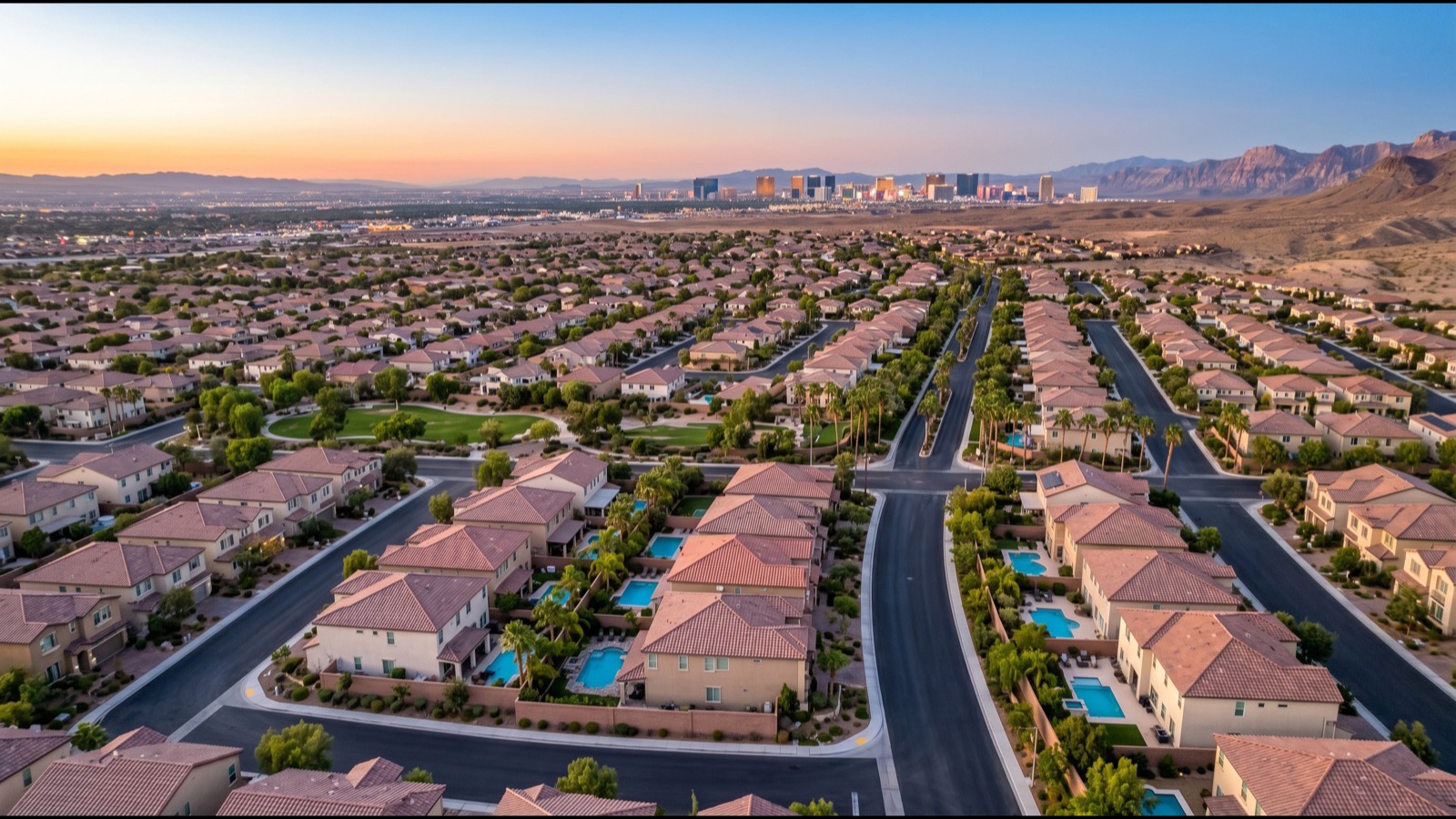
Because median prices vary widely across Nevada, the income you need to comfortably buy differs by city. The figures below are rough guidelines for the income that supports each market's typical home under the 28/36 rule, assuming a moderate down payment and 2026 rates — your exact number depends on your debt, down payment, and rate.
In the south, North Las Vegas is the most accessible, where a household income in the low six figures supports the median. Las Vegas is similar at its mid-$400,000s median. Henderson and especially Summerlin require more, reflecting their higher medians and amenity premiums, while Boulder City sits in between. In the north, Sparks and Carson City are more attainable than Reno, which carries Northern Nevada's highest medians outside the luxury tier. Rural Pahrump is the most affordable in the state.
| City | Typical Median | Rough Income Needed |
|---|---|---|
| Pahrump | $300,000–$400,000 | $75,000–$95,000 |
| North Las Vegas | Low-to-mid $400,000s | $95,000–$110,000 |
| Las Vegas | Mid-$400,000s | $100,000–$115,000 |
| Sparks | $500,000s | $115,000–$130,000 |
| Carson City | $450,000–$550,000 | $105,000–$130,000 |
| Henderson | $550,000–$700,000 | $130,000–$165,000 |
| Reno | $600,000s | $140,000–$160,000 |
| Summerlin | $750,000-plus | $175,000-plus |
These are guidelines, not gates — a larger down payment, lower debt, or down payment assistance can put a market within reach at a lower income. The medians come from Las Vegas REALTORS and the Reno/Sparks Association of REALTORS.
How Do Down Payment and Interest Rate Change Affordability?
Two levers move your affordable price more than almost anything else: how much you put down and the rate you lock.
A larger down payment does two things — it shrinks the loan you need to support with your monthly budget, and at 20% it removes private mortgage insurance, freeing more of your payment for principal and interest. Going from 5% to 20% down on a $450,000 home lowers your loan by about $67,500 and cuts the monthly payment meaningfully, which can either reduce your payment at the same price or let you reach a higher price at the same payment.
The interest rate is the lever you control least but feel most. On a $400,000 loan, a move from, say, 6.5% to 6.0% lowers the monthly principal-and-interest payment by roughly $130, which translates to about $20,000 to $30,000 in additional home price at the same monthly budget. This is why locking a rate when it dips, improving your credit to earn a better rate, and considering points can all be worthwhile. It is also why the common advice holds: marry the house, date the rate — buy when the home and payment work, and refinance later if rates fall.
The interaction matters too. A buyer with strong credit and 20% down at a competitive rate can afford a noticeably larger home than a buyer with the same income but a smaller down payment, more debt, and a higher rate. That is the whole reason a pre-approval — which prices in all of these at once — beats any rule of thumb. For the full purchase process once you know your number, see our how to buy a house in Nevada guide.
| Scenario | Down Payment | Rate | Approx. Home Price |
|---|---|---|---|
| Baseline | 5% | 6.5% | $400,000 |
| Bigger down | 20% | 6.5% | $435,000 |
| Lower rate | 5% | 6.0% | $425,000 |
| Both | 20% | 6.0% | $465,000 |

What's the Difference Between Pre-Qualified, Pre-Approved, and Affordable?
These three terms get used interchangeably, and the confusion costs buyers offers. They mean very different things.
Pre-qualified is an informal estimate based on information you tell a lender, with nothing verified. It is a useful first gut-check but carries little weight with sellers. Pre-approved is the real thing: the lender verifies your income, assets, and credit and commits, in writing, to a loan amount. According to the Consumer Financial Protection Bureau, a verified pre-approval is what makes your offer credible — many Nevada sellers will not accept showings or offers without one. Affordable is your number — the payment you have decided you can comfortably carry, which is often below your pre-approved maximum.
The smart sequence is to figure out your affordable payment first, then get pre-approved to confirm it and to compete, and then shop at or below that number. Buyers who skip straight to "what's my max approval" and shop at the ceiling are the ones who feel house-poor later. In our experience, the strongest buyers walk in pre-approved, know their comfortable number, and never let a great-looking listing pull them above it. You can set up saved searches at your target price on our home search while you finalize financing.
What Costs Do Buyers Forget When Calculating Affordability?
The mortgage payment is only part of the cost of owning a Nevada home, and the forgotten extras are exactly what turn an "affordable" purchase into a tight one.
Property taxes and insurance. These are usually escrowed into your payment, but buyers estimating affordability from principal-and-interest alone understate the real monthly cost. Build them in from the start.
HOA fees. In Nevada's many master-planned communities — Henderson, Summerlin, Anthem, and most newer developments — HOA dues can run $50 to $300-plus a month, and guard-gated communities more. That comes straight out of your 28% housing budget.
Private mortgage insurance. With less than 20% down on a conventional loan, PMI adds to your monthly payment until you reach 20% equity. FHA loans carry their own mortgage insurance. Factor it in.
Maintenance and repairs. A common guideline is to budget about 1% of the home's value per year for upkeep — roughly $4,500 annually on a $450,000 home. It is not a monthly bill, but it is real.
Closing costs and reserves. Beyond the down payment, buyers need 2% to 3% for closing costs, detailed in our closing costs in Nevada guide. Lenders also like to see reserves left over after closing.
Account for all of these and your true affordable price may be a bit lower than the calculator suggests — which is exactly the kind of honest number that keeps you comfortable after you move in.
How Can You Afford More House in Nevada?
If the number you can comfortably afford is below the home you want, you are not stuck — there are several levers that genuinely raise your buying power, and most are within your control.
Pay down debt. Because the 36% back-end ratio counts all your monthly obligations, eliminating a payment frees room for housing. Paying off a $400 car loan can add roughly $50,000 to $75,000 to your borrowing power — often the single fastest lever.
Raise your credit score. A higher score earns a lower rate, and a lower rate buys more home at the same payment. According to the Consumer Financial Protection Bureau, paying balances below 30% of their limits and fixing report errors can move your score up a tier within a quarter.
Increase your down payment — or use assistance. More money down lowers the loan and the payment, and at 20% it removes PMI. If saving more is not realistic, Nevada's down payment assistance programs can bridge the gap; see our down payment assistance in Nevada guide.
Add a co-borrower. A spouse, partner, or family member's income added to the application raises the qualifying income — as long as their debts and credit help rather than hurt.
Consider the right loan and location. An FHA loan's higher allowable ratios can stretch affordability for the right buyer, and choosing a market like North Las Vegas, Sparks, or Pahrump — or a home with lower HOA dues — puts more house within reach at the same income.
Buy points to lower your rate. Paying discount points up front can lower your rate and monthly payment, which raises the price you can support — worthwhile if you will stay in the home long enough to recoup the cost.
In our experience, buyers who combine two or three of these — paying off a car, nudging up their credit, and using assistance — frequently move their comfortable budget up by $50,000 to $100,000 without straining their monthly finances. The goal is never to stretch to the maximum; it is to responsibly expand what "comfortable" means.
Frequently Asked Questions About Nevada Home Affordability
How much house can I afford on a $100,000 salary in Nevada?
With a $100,000 household income, modest debt, a moderate down payment, and 2026 rates, you can typically afford a home in the $400,000 to $480,000 range under the 28/36 rule — roughly a $2,333 monthly housing budget. Nevada's lack of a state income tax helps, since more take-home pay supports the payment. Your exact number depends on debt, down payment, and rate.
What is the 28/36 rule for buying a house in Nevada?
It is the lender guideline that your monthly housing payment should not exceed 28% of gross income and your total monthly debt should not exceed 36%. On a $100,000 income (about $8,333/month), that is roughly $2,333 for housing and $3,000 for all debt. Some loans allow higher ratios, but 28/36 is the comfortable target for sustainable affordability.
How does Nevada's lack of income tax affect what I can afford?
It increases your real buying power. Lenders qualify you on gross income, but you make the payment from take-home pay — and with no state income tax, more of each paycheck stays with you than in California or Oregon. Combined with Nevada's relatively low, capped property taxes, the same salary supports a more comfortable payment here than in higher-tax states.
How much income do I need to buy a house in Las Vegas or Reno?
Roughly $100,000 to $115,000 supports the Las Vegas Valley median (mid-$400,000s), while Reno's higher median (in the $600,000s) typically needs $140,000 to $160,000. North Las Vegas and Pahrump need less; Henderson and Summerlin need more. These are guidelines under the 28/36 rule — a larger down payment or lower debt can lower the income required.
Does my down payment change how much house I can afford in Nevada?
Yes, significantly. A larger down payment lowers your loan and monthly payment, and 20% removes private mortgage insurance — both let you afford more home or a lower payment. Going from 5% to 20% down on a $450,000 home reduces the loan by about $67,500. You do not need 20%, though; Nevada assistance programs can lower the cash barrier.
Should I buy at the top of my pre-approval amount in Nevada?
Usually not. Your pre-approval is a maximum, not a target. Buying at the ceiling leaves no room for property taxes rising, maintenance, or life changes. The buyers who stay comfortable typically purchase below their max, keeping a cushion in the monthly budget. Decide your affordable payment first, then shop at or below it even if approved for more.
What's the difference between pre-qualified and pre-approved in Nevada?
Pre-qualified is an informal estimate from information you provide, with nothing verified — a rough gut check. Pre-approved means the lender verified your income, assets, and credit and committed in writing to a loan amount. Nevada sellers take pre-approvals seriously and often require one before showings, so a verified pre-approval is what makes your offer competitive.
What hidden costs should I include when figuring affordability in Nevada?
Beyond principal and interest, include property taxes, homeowners insurance, HOA dues ($50 to $300-plus monthly in master plans), private mortgage insurance if you put less than 20% down, and about 1% of home value per year for maintenance. Also budget 2% to 3% for closing costs. Including these gives you a true, comfortable affordability number rather than an optimistic one.
Ready to Find Out What You Can Afford in Nevada?
The honest answer to "how much house can I afford?" is the payment you can carry comfortably while still living your life — usually a notch below your maximum approval. Start with the 28/36 rule, factor your debt, down payment, and rate, remember the taxes, insurance, HOA, and maintenance the calculators skip, and lean on Nevada's no-income-tax advantage that quietly stretches every paycheck. Then confirm it all with a pre-approval.
Nevada Real Estate Group helps buyers find their real number and a great home in all nine markets we serve, #1 in Nevada and #44 in the nation, backed by more than 9,600 closings and $4.85 billion-plus in volume. Whether you are buying in North Las Vegas, Reno, or Henderson, we will connect you with a trusted lender and run your real affordability for free. Call our Southern Nevada team at (702) 637-1759 or our Northern Nevada team at (775) 277-2120, learn more on our about page, or contact our team to get started. Then explore the full process in our how to buy a house in Nevada guide and lower your cash barrier with down payment assistance in Nevada.
Which Sources Inform This Nevada Affordability Guide?
This guide draws on Nevada Real Estate Group's direct buyer experience plus public data from regulatory and industry authorities. Rates, prices, and rules change — confirm current specifics with a lender or qualified professional before acting. This is general educational information, not legal, financial, or tax advice.
- Consumer Financial Protection Bureau — affordability and debt-to-income
- Freddie Mac — Primary Mortgage Market Survey
- Nevada Department of Taxation — no state income tax
- Las Vegas REALTORS — Southern Nevada market data
- Reno/Sparks Association of REALTORS — Northern Nevada market data
- National Association of Realtors — buyer affordability research
- Nevada Housing Division — homebuyer programs
- U.S. Department of Housing and Urban Development — Nevada
- U.S. Census Bureau — Nevada QuickFacts
- Nevada Real Estate Division — licensing and consumer resources