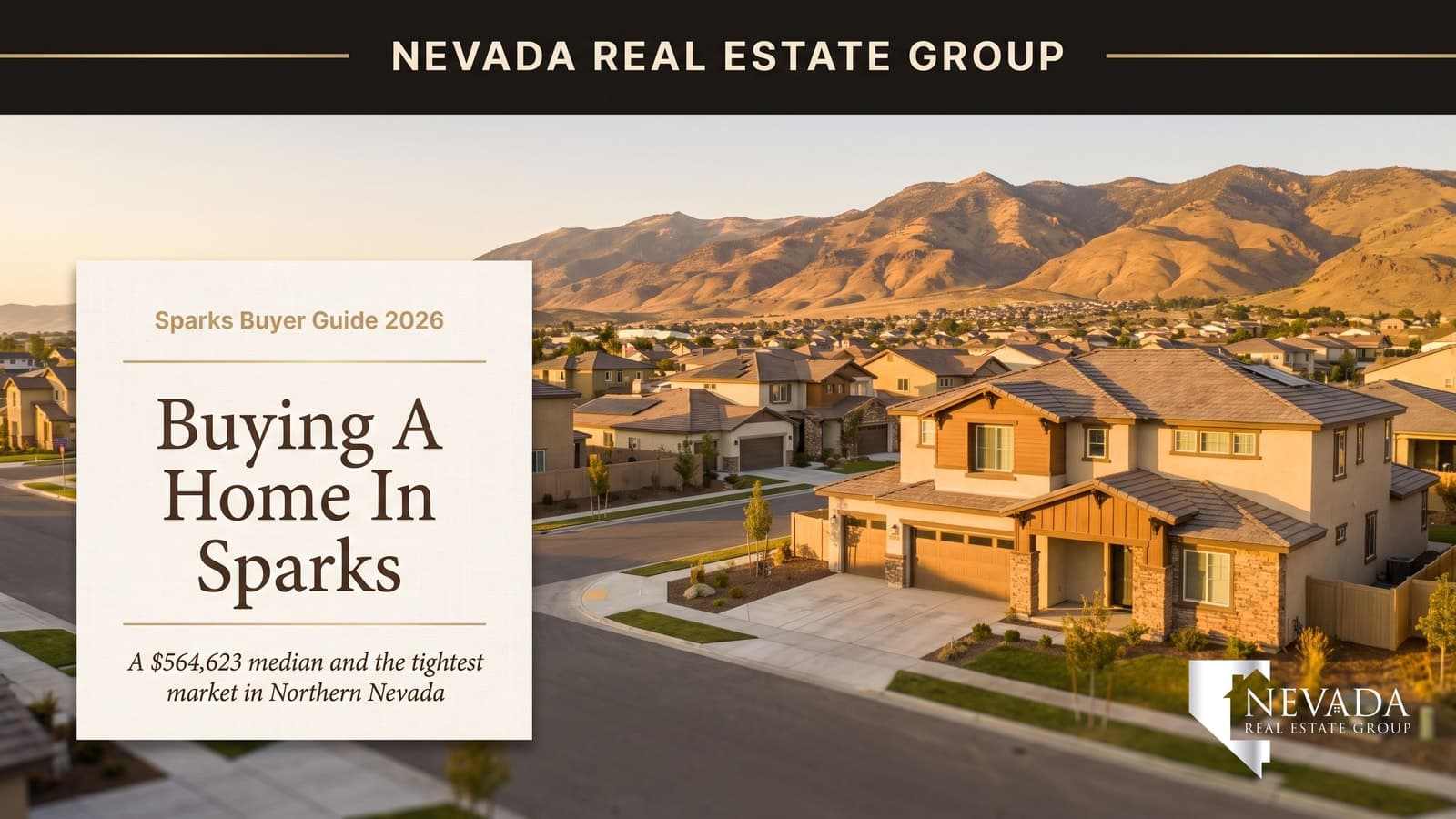

Sparks is where Northern Nevada buyers go when Reno prices stop working, and the assumption that usually travels with them is that a cheaper market must be an easier one. The data says the opposite. Sparks homes sold at a $564,623 median this summer against Reno's $675,450, but 64 percent of Sparks sales closed at or above the asking price against half in Reno. It is the cheaper city and the tighter one.
This guide is built from that board. Across the 358 closings recorded in Sparks between June 1 and August 31, 2026 — 306 of them single-family — the numbers below describe how the process actually runs here and where a buyer's leverage genuinely sits.
Buying a home in Sparks takes about 46 days to find one plus 30 to 45 days to close. The median Sparks home sold for $564,623 between June and August 2026 at $308 per square foot, and 197 of 306 sales — 64 percent — closed at or above asking. Plan on 3.5% down for FHA, roughly $19,762 on the median, or zero down with VA.
- Sparks' median single-family sale was $564,623 across 306 closings from June to August 2026.
- 64 percent closed at or above asking, the tightest ratio of any Northern Nevada market measured.
- Sparks costs about $111,000 less than Reno and $55 less per square foot.
- Only 2 of 306 homes sold within a week, so speed matters less than offer quality.
- Half the market trades between $500,000 and $650,000 — 151 of 306 sales.
What Does the Sparks Market Look Like for Buyers?
Concentrated, competitive on price, and unhurried on timing — an unusual combination that rewards preparation over speed.
Across the 306 single-family homes that closed in Sparks between June 1 and August 31, 2026, the median sale was $564,623 at $308 per square foot on a median 1,851 square feet built around 2002. The median home took 46 days to sell, with a mean of 63.
Then the number that defines this market: the median sale closed at exactly 100 percent of the asking price, and 197 of 306 sales — 64 percent — closed at or above list. For comparison, Reno ran 50 percent and Henderson 39 percent over the same window. Sparks sellers are getting their number more reliably than sellers anywhere else in the region.
| Measure | Sparks | Reno | Carson City |
|---|---|---|---|
| Median sale price | $564,623 | $675,450 | $560,760 |
| Price per square foot | $308 | $363 | $333 |
| Median home size | 1,851 sq ft | 1,958 sq ft | 1,746 sq ft |
| Median days on market | 46 | 48 | 49 |
| Median sale to list | 100.0 percent | 99.8 percent | 99.9 percent |
| Closed at or above asking | 197 of 306 (64 percent) | 311 of 626 (50 percent) | 74 of 148 (50 percent) |
| Single-family closings | 306 | 626 | 148 |
Read that table across the Sparks column and the strategy becomes clear. You are not going to win on speed — only 2 of 306 homes went under contract within a week, so the panic-offer instinct is misplaced. You are also unlikely to win on a low offer, because two in three homes are getting asking or better.
What you win on in Sparks is offer quality: verified financing, clean terms, a realistic close date, and a price that respects the comparables. The 46-day median means you have time to prepare properly before you write — use it.
What Does Your Budget Actually Buy in Sparks?
The market is unusually concentrated, which makes budgeting straightforward.
| Price band | Homes sold | Share of market |
|---|---|---|
| Under $400,000 | 14 | 5 percent |
| $400,000 to $500,000 | 73 | 24 percent |
| $500,000 to $650,000 | 151 | 49 percent |
| $650,000 to $850,000 | 52 | 17 percent |
| $850,000 to $1.2 million | 13 | 4 percent |
| Above $1.2 million | 3 | 1 percent |
Half the market sits in one band. 151 of 306 sales landed between $500,000 and $650,000, and another 73 between $400,000 and $500,000 — so nearly three-quarters of Sparks trades between $400,000 and $650,000. If your budget is in that range you have real choice; if it is outside it, inventory thins fast in both directions.
At the top, Sparks effectively stops. Only 16 homes sold above $850,000 in three months. A buyer wanting a large or luxury home is better served looking at Reno, where 190 homes cleared $850,000 over the same period.
At the bottom, 14 single-family sales under $400,000 is thin, but the condo and townhome market fills some of that gap at a $322,500 median across 41 sales, and manufactured homes sold at a $361,825 median.
Lot sizes are small and consistent — a median 0.16 acres, with only 2 of 306 sales on an acre or more. Sparks is a subdivision market, not an acreage one. Buyers wanting land should look toward Spanish Springs and the valley edges, or across to the rural fringes of Washoe County.
How Do You Get Pre-Approved, and What Will It Cost Monthly?
Standard documentation, and a price point that keeps most buyers comfortably inside conventional financing.
Your lender will want two years of W-2s or 1099s with tax returns if self-employed, two months of pay stubs, two to three months of bank statements, identification and a credit authorization. They assess debt-to-income, credit score and employment stability from there.
According to Freddie Mac's Primary Mortgage Market Survey, the 30-year fixed averaged 6.76 percent and the 15-year 6.09 percent in the week ending September 10, 2026.
Down payment on the $564,623 median:
- FHA at 3.5 percent: $19,762, with a 580 credit score
- Conventional at 3 percent: $16,939, with 620 and PMI until 20 percent equity
- Conventional at 5 percent: $28,231
- Conventional at 20 percent: $112,925, eliminating PMI
- VA: zero down for eligible veterans, no monthly mortgage insurance
One genuine advantage Sparks has over Reno: at this median, most purchases sit comfortably within conforming loan limits, so buyers avoid the jumbo underwriting that a large share of Reno's inventory triggers. According to the Federal Housing Finance Agency, those limits govern which loans Fannie Mae and Freddie Mac will buy, and staying under them generally means easier qualification and better pricing.
Get quotes from two lenders. A quarter-point difference on a $545,000 loan is meaningful over thirty years, and the hour it takes to compare is the best-paid hour in the process.
How Does Buyer Representation Work Now?
You sign an agreement before you tour, and the fee is stated in it.
Under the practice changes following the National Association of Realtors settlement, a written buyer-representation agreement is required before touring a home with an MLS participant. It must state the compensation amount or rate conspicuously and make clear the fee is negotiable. Offers of buyer-broker compensation were also removed from the MLS, so listings no longer advertise what they will pay your agent.
Sellers may still contribute, and most still do — but it is negotiated directly, usually as a term of your offer.
Here is where Sparks differs from Reno on this point, and it matters. In a market where 64 percent of homes sell at or above asking, your leverage to extract a buyer-agent contribution is weaker than it is across the city line. A seller with a well-priced Sparks home and multiple interested parties has little reason to absorb it. On the 54 of 306 homes that sat past ninety days, the calculation changes entirely.
So budget honestly. Ask your agent what they charge, what happens if the seller contributes less, and whether the shortfall falls to you — and assume in Sparks that on a desirable home it may.
What Should You Check on a Sparks Home?
Five things, weighted toward what this specific housing stock and climate produce.
Heating and cooling both. Sparks shares Reno's elevation and winters. The median home was built around 2002, which puts many systems at or past twenty years. Get the age of the furnace and the air conditioner, and ask for service records.
Roof and drainage with snow in mind. Pitched roofs, ice damming, flashing and gutters are real inspection items here in a way they never are in Southern Nevada.
HOA structure in the master plans. Much of Sparks' newer inventory sits inside master-planned communities like Wingfield Springs, Spanish Springs and the D'Andrea area. Several carry both a sub-association and a master association. Confirm the combined monthly figure for the specific address, and read the reserve study rather than the dues line.
Flood and drainage on the valley floor. Parts of the Truckee Meadows and north Sparks have documented drainage considerations. According to the Federal Emergency Management Agency, flood hazard is mapped parcel by parcel and those maps are public — check the designation on any property you are serious about, because it affects both insurance cost and lender requirements.
Wildfire insurability toward the edges. Less acute than in Reno's foothills, but on the northern and eastern fringes it is worth getting a quote on the specific address during your contingency period.
How Should You Write an Offer in a Market Where Two in Three Sell at Asking?
Cleanly, with verified financing, and with your negotiating energy spent on the right listings.
Sort by days on market first. With only 2 of 306 homes selling inside a week but 54 sitting past ninety days, the listing's age tells you which game you are playing. Under thirty days, expect to meet the number. Past sixty, ask.
Lead with financing strength. A fully underwritten pre-approval beats a prequalification decisively, and in a market where sellers are getting asking anyway, the deciding factor between two offers at the same price is which one closes without drama.
Do not waive inspection. A 46-day median means you rarely need to, and the housing stock here is old enough that you should not want to.
Earnest money at 1 percent — about $5,646 on the median — is standard; 2 percent signals seriousness without much risk.
Price appraisal gap risk deliberately. With 64 percent of sales at or above asking, appraisal shortfalls are more likely here than in a softer market. If you are going above list, state in writing what gap you will cover in cash.
Ask for credits rather than price on aged listings. A seller at day seventy-five who has already reduced will often prefer giving 2 to 3 percent in closing costs, because a further price cut is visible to every future buyer while a credit is not.
What Happens After Acceptance in Nevada?
Escrow opens with a neutral title and escrow company — Nevada is an escrow state, and no attorney is required for a standard residential purchase. Then three documents drive the timeline.
The Seller's Real Property Disclosure. According to NRS 113.130, the seller must complete the form personally — their agent is prohibited from doing it for them — and serve it on you at least 10 days before conveyance. If it is not properly served, you may rescind at any time before conveyance without penalty. The seller's duty continues: a defect discovered or worsening during escrow must be disclosed in writing as soon as practicable.
The HOA resale package. Under NRS 116.4109, any home in a common-interest community comes with the declaration, bylaws, rules, current budget, reserve-study summary and disclosure of pending assessments or litigation — and a five-day right to cancel from receipt. Given how much Sparks inventory sits inside master plans, this applies to most purchases here.
The title commitment, where easements and exceptions surface. Read the exceptions, not just the vesting.
Alongside those, Nevada's agency paperwork runs in the background. According to NRS Chapter 645, licensees owe statutory duties to their clients and must provide the duties-owed disclosure, with a separate consent form where one brokerage represents both sides. Read who represents whom before you sign anything, particularly on a new-construction purchase where the on-site agent works for the builder rather than for you.
The loan runs in parallel with all of it. Submit your application immediately rather than waiting for the inspection to clear — underwriting drives every downstream date, and a queue that resets because a document arrived late is the most common cause of a delayed closing. Once conditions are cleared you receive a Closing Disclosure at least three business days before signing; compare it line by line against your original Loan Estimate rather than skimming the bottom number.
Your inspection window is the only period where new information gives you renegotiating power, and it closes on a date rather than on a feeling.
What Does Closing Cost in Sparks?
Two to three percent of the price for a buyer, on top of the down payment.
| Cost | Who pays | Typical amount |
|---|---|---|
| Real property transfer tax | Seller by custom | About $2,202 in Washoe County |
| Lender's title insurance | Buyer | $800 to $1,300 |
| Owner's title insurance | Negotiable, often seller | $1,000 to $1,500 |
| Escrow and settlement | Usually split | $650 to $1,000 buyer share |
| Loan origination | Buyer | 0 to 1 percent of loan |
| Appraisal | Buyer | $600 to $900 |
| Home inspection | Buyer | $400 to $700 |
| Recording fees | Buyer | $125 to $200 |
| HOA transfer and setup | Buyer, varies | $200 to $600 |
| Prepaid taxes and insurance | Buyer | Several months impounded |
According to the Nevada Department of Taxation, the real property transfer tax has a statewide base of $1.95 per $500 of value, with counties permitted to add. On the Sparks median that is roughly $2,202, paid by the seller under Nevada custom though both parties are liable under the statute.
On property taxes, according to NRS 361.4723 the annual increase on an owner's primary residence is capped at 3 percent, and only one Nevada property can be claimed as that residence. The county mails a claim card after closing — return it, or the property can be billed under the higher cap applying to other property.
First-time buyers should look hard at Home Is Possible here, because Sparks prices fit it better than Reno's do. According to the program page, it offers up to 4 percent of the loan amount for down payment and closing costs, needs a 640 credit score and first-time buyer status, and requires a homebuyer education course. Critically, it is a 30-year non-forgivable second mortgage — repaid, not gifted, despite being widely described as a grant. Purchase-price limits are set by county, and at a $564,623 median a meaningful share of Sparks inventory sits within them.
Should You Buy in Sparks or Reno?
The honest answer depends on whether you are optimising for price or for ease of purchase, because Sparks wins the first and loses the second.
Sparks wins on price. A $564,623 median against $675,450 is about $111,000 less for a home only about 100 square feet smaller, and $308 per square foot against $363 is a 15 percent lower rate. For the same monthly payment you buy a materially better house in Sparks.
Reno wins on choice and on negotiating room. It sold 626 single-family homes to Sparks' 306 in the same quarter, so inventory is roughly double. And with 50 percent of Reno sales at or above asking versus 64 percent in Sparks, a Reno buyer has meaningfully more room to negotiate.
Reno wins decisively above $850,000, where it recorded 190 sales to Sparks' 16.
Sparks wins for first-time buyers, both because the price point fits assistance-program limits and because the $400,000 to $650,000 band where most first purchases happen is where three-quarters of the Sparks market actually trades.
Most buyers looking at both should simply search them together — they are one metro, fifteen minutes apart, sharing an MLS, schools districts and employers. Our Northern Nevada communities hub covers both sides, and the Sparks homes for sale page carries current inventory.
What Do Sparks Buyers Most Often Get Wrong?
Five things.
Assuming cheaper means easier. Sixty-four percent of Sparks homes sell at or above asking — the tightest ratio in the region. Arriving with a lowball strategy because the median is lower than Reno's wastes weeks.
Shopping above $850,000 here. Sixteen sales in three months is not a market. That search belongs in Reno.
Skipping the HOA reserve study. Much of the newer inventory carries two association layers, and an underfunded reserve becomes a special assessment you inherit.
Underestimating the age of systems. A 2002 median build year means furnaces, air conditioners and water heaters are frequently at end of life.
Ignoring flood designation on the valley floor. It is public, parcel-level information that affects insurance and financing, and it takes minutes to check.
Writing without verified financing. In a market where two in three homes reach asking, the tiebreaker between similar offers is which one the seller believes will actually close. A fully underwritten pre-approval does that work; a prequalification letter does not.
Treating new construction like a resale. Sparks has active builder inventory, and on those transactions the on-site representative works for the builder. Bring your own agent to the first visit — most builders honour representation only if it is disclosed at initial registration, and showing up alone can forfeit it permanently.
If you want the current picture on a specific Sparks neighbourhood — what is listed, what closed in the last ninety days, and how much room a particular home has — call Nevada Real Estate Group at (775) 277-2120 or start with our Sparks homes for sale listings.
Frequently Asked Questions
How much does a house cost in Sparks NV in 2026?
The median single-family home sold for $564,623 between June 1 and August 31, 2026, at $308 per square foot on a median 1,851 square feet built around 2002, across 306 closings. The market is concentrated: 151 of those sales landed between $500,000 and $650,000 and another 73 between $400,000 and $500,000, so nearly three-quarters of Sparks trades between $400,000 and $650,000. Condos and townhomes sold at a $322,500 median and manufactured homes at $361,825.
Is Sparks cheaper than Reno?
Yes, by roughly $111,000 at the median — $564,623 against Reno's $675,450 over the same summer — for a home only about 100 square feet smaller. On a per-square-foot basis Sparks runs $308 against Reno's $363, about 15 percent lower. The trade-off is competition and choice: Sparks sold 306 single-family homes to Reno's 626, and 64 percent of Sparks sales closed at or above asking against 50 percent in Reno, so you have less inventory and less negotiating room.
Is Sparks a competitive market for buyers?
More competitive than its price suggests. Of 306 single-family sales from June to August 2026, 197 — 64 percent — closed at or above the asking price, with a median sale-to-list ratio of exactly 100 percent. That is the tightest of any Northern Nevada market measured, ahead of Reno at 50 percent and well ahead of Henderson at 39 percent. What Sparks is not is fast: only 2 of 306 homes went under contract within a week and the median took 46 days, so you have time to prepare a strong offer rather than a rushed one.
How much do you need for a down payment in Sparks?
On the $564,623 median: $19,762 for FHA at 3.5 percent, $16,939 for a conventional 3 percent loan, $28,231 at 5 percent, or $112,925 at 20 percent to eliminate mortgage insurance. VA requires nothing down for eligible veterans with no monthly mortgage insurance. Add 2 to 3 percent in closing costs. An advantage over Reno: at this price point most Sparks purchases stay inside conforming loan limits, avoiding the jumbo underwriting that a large share of Reno inventory triggers.
Does Nevada down payment assistance work in Sparks?
It fits Sparks better than it fits Reno. Home Is Possible provides up to 4 percent of the loan amount for down payment and closing costs, requires a 640 credit score, first-time buyer status meaning no ownership in the past three years, owner occupancy and a homebuyer education course. It is a 30-year non-forgivable second mortgage, so it is repaid rather than gifted — a detail frequently misreported. Purchase-price limits are set by county, and at a $564,623 median a meaningful share of Sparks inventory falls within them, which is less true across the city line.
What should I inspect on a Sparks home?
The heating system as much as the cooling, because Sparks shares Reno's elevation and real winters, and the median home was built around 2002 so many systems are at or past twenty years. The roof with snow load in mind, including flashing and any ice-damming history. The HOA documents and reserve study, since much of the newer inventory carries both a sub-association and a master association. And the parcel's flood designation, which is public through FEMA and affects both insurance cost and lender requirements on parts of the valley floor.
Are there acreage properties in Sparks?
Very few. The median lot was 0.16 acres and only 2 of 306 summer sales sat on an acre or more — Sparks is a subdivision market rather than an acreage one. Buyers wanting land should look toward the Spanish Springs edge, north toward Palomino Valley, or into unincorporated Washoe County, where acreage is genuinely available. Bear in mind that moving outside the municipal service area usually means a well and septic system, each carrying its own inspection, cost and diligence.
How long does it take to buy a house in Sparks?
About 46 days to find and go under contract, plus 30 to 45 days of escrow on a financed purchase — call it two and a half to three months. The 46-day figure is the median across 306 summer closings, and the distribution is telling: only 2 homes went under contract within a week, 43 within thirty days, 143 between 31 and 60 days, and 54 took more than ninety. So you rarely need to decide in a day, but you do need your financing verified before you write.
Which Sources Inform This Sparks Home Buying Guide?
Every market figure above was measured directly from the NNRMLS-fed listing data covering all closings recorded in Sparks between June 1 and August 31, 2026 — 358 transactions, of which 306 were single-family, 41 condo or townhome and 4 manufactured. Sales were pulled month by month and deduplicated so no server-side result cap could truncate the counts. The single-family set produced a $564,623 median at $308 per square foot on a median 1,851 square feet built around 2002, a 46-day median time on market with a 63-day mean, a 100.0 percent median sale-to-list ratio, and 197 of 306 sales at or above asking. Price bands and lot-acreage figures come from the same set, and the Reno, Carson City and Henderson comparisons from the same pull over the same window. Live inventory changes daily; the Sparks homes for sale page carries current listings.
Statutory and financing sources: NRS 113.130 for the Seller's Real Property Disclosure and the buyer's rescission right; NRS 116.4109 for the common-interest resale package and five-day cancellation right; NRS 361.4723 for the 3 percent primary-residence tax abatement; the Nevada Department of Taxation for transfer tax rates; the Nevada Housing Division's Home Is Possible program for assistance terms; Freddie Mac for the 6.76 percent 30-year average in the week ending September 10, 2026; the Federal Housing Finance Agency for conforming loan limits; the Federal Emergency Management Agency for parcel-level flood mapping; and the National Association of Realtors settlement FAQs for buyer-representation practice changes.
For the other side of the transaction, see our guide to selling your Sparks home. Buyers weighing the two cities should read living in Reno versus Sparks, and first-time buyers will find the Sparks first-time homebuyer guide a useful companion.