
The question arrives almost every week at our Plumb Lane office, usually from someone who has just seen a listing that looks impossible: forty acres outside Reno for less than the price of a used truck. They want to know what the catch is. The honest answer is that there usually is not a catch, exactly — there is a location, a water situation and a power bill, and those three things explain nearly the entire spread between a $15,000 parcel and a $1.9 million one inside the same county.
This guide is built on a count rather than an impression. On the morning of September 12, 2026, I pulled every active vacant-land listing on the NNRMLS-fed board for Reno and Sparks, along with every land sale that closed between March 1 and August 31, 2026, and read the structured water-source, zoning and acreage fields on all of them. What follows is what those 281 active parcels and 48 closed sales actually say, and the diligence sequence I run before a client writes an offer on dirt.
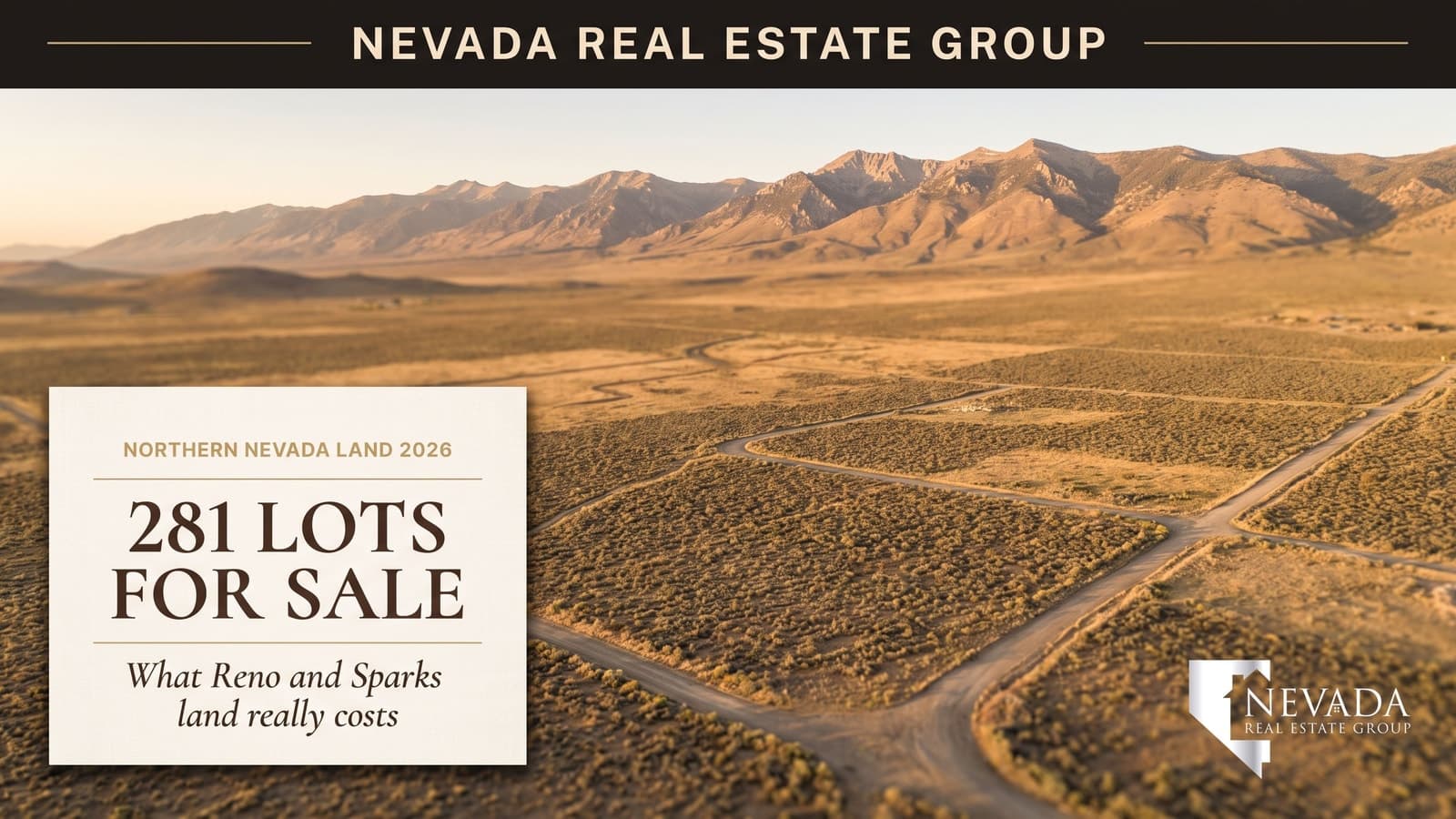
Reno and Sparks had 281 vacant parcels listed on September 12, 2026, with a median asking price of $230,000 and a median size of about four and a half acres. Prices ran from $15,000 to $10 million. The median price per acre was roughly $48,000, but that number hides everything: sub-acre building lots ran about $731,000 an acre while parcels over forty acres ran about $3,500 an acre.
- 281 active parcels on September 12, 2026: 253 in Reno, 28 in Sparks, median ask $230,000.
- ZIP 89511 in south Reno ran about $417,500 an acre; ZIP 89510 ran about $3,000 an acre.
- Only 99 of 281 parcels reported a public water source; 73 were flagged well needed.
- Land closed at a median 96.2 percent of list in 37 days, well under what houses fetch.
- Verify water, septic, power distance, legal access and zoning before the offer, not after.
How Much Vacant Land Is Actually for Sale in Reno and Sparks?
Two hundred eighty-one parcels, which is a larger number than most buyers expect and a smaller one than the listing portals imply. Of those, 253 carry Reno addresses and 28 carry Sparks addresses, though a meaningful share of the Reno-addressed parcels sit well outside city limits in unincorporated Washoe County or across the line in Storey County. A Reno mailing address on a vacant parcel tells you where the mail goes, not which government issues the building permit, and that distinction shapes every cost in this guide.
The asking prices span a range wide enough to be almost useless as a single figure. The cheapest active parcel was $15,000 for 1.44 acres off Flanigan Road in the far north of ZIP 89510. The most expensive was a $10 million holding. Between them, the twenty-fifth percentile sat at $134,500, the median at $230,000 and the seventy-fifth percentile at $425,000. Median parcel size was 4.88 acres in Reno and almost exactly one acre in Sparks, which is itself a useful signal: Sparks land is mostly infill and subdivision lots, while Reno-addressed land is mostly acreage in the surrounding valleys.
Size distribution matters more than the headline count. Fifty-seven parcels were under an acre, which is the set most buyers actually mean when they search for a lot to build on. Eighty-six ran from one to five acres, the ranchette band. Fifty-eight fell between five and twenty acres, nine sat between twenty and forty, and seventy-one were forty acres or larger. That last group is what produces the eye-catching cheap listings, and it is also the group least likely to have a road, a well or a power line anywhere near it.
Turnover is modest. Forty-eight parcels closed across the six months from March through August 2026, roughly eight a month against an active inventory of 281. That is a standing supply of about thirty-five months at the current absorption rate, which is why land negotiates differently from housing in this market. You are rarely the only buyer, but the seller is rarely in a hurry either.
What Does a Building Lot Cost Compared With Forty Acres of High Desert?
This is the single most important table in the guide, because the median price per acre across all 281 parcels was about $48,000 and that figure describes almost no actual parcel. Price per acre in Northern Nevada is a step function driven by whether the land is inside a service area, not a smooth curve driven by size.
| Parcel size | Active parcels | Median asking price | Median price per acre | Sales Mar–Aug | Median sale price |
|---|---|---|---|---|---|
| Under 1 acre | 57 | $315,000 | About $731,000 | 9 | $210,000 |
| 1 to 5 acres | 86 | $275,000 | About $179,000 | 24 | $362,500 |
| 5 to 20 acres | 58 | $165,000 | About $19,400 | 11 | $125,000 |
| 20 to 40 acres | 9 | $171,950 | About $4,950 | 0 | No sales |
| 40 acres or more | 71 | $200,000 | About $3,500 | 4 | $235,000 |
Read down the price-per-acre column and the whole market becomes legible. A sub-acre lot costs roughly two hundred times per acre what a forty-acre parcel costs. You are not buying dirt at either end; you are buying a connection. The sub-acre lot comes with a street, a water main, a sewer lateral or a proven well, a recorded address and a jurisdiction that has already decided a house belongs there. The forty-acre parcel comes with a legal description and a view.
Notice also that median asking price barely moves across the size bands — $315,000, $275,000, $165,000, $171,950, $200,000 — while price per acre collapses by a factor of two hundred. Sellers of raw acreage are not pricing by the acre. They are pricing to a number a buyer will write a check for, and the acreage is thrown in. That is worth remembering when you negotiate, because it means the per-acre comparison that feels so damning to a seller is not the frame they are using.
The closed sales confirm the pattern rather than contradicting it. The nine sub-acre closings ran a $210,000 median, while the eleven closings between five and twenty acres ran $125,000. Buyers paid more for less land, repeatedly, because the smaller parcels were the ones a house could go on within a year.
Why Does an Acre in 89511 Cost More Than Forty Acres in 89510?
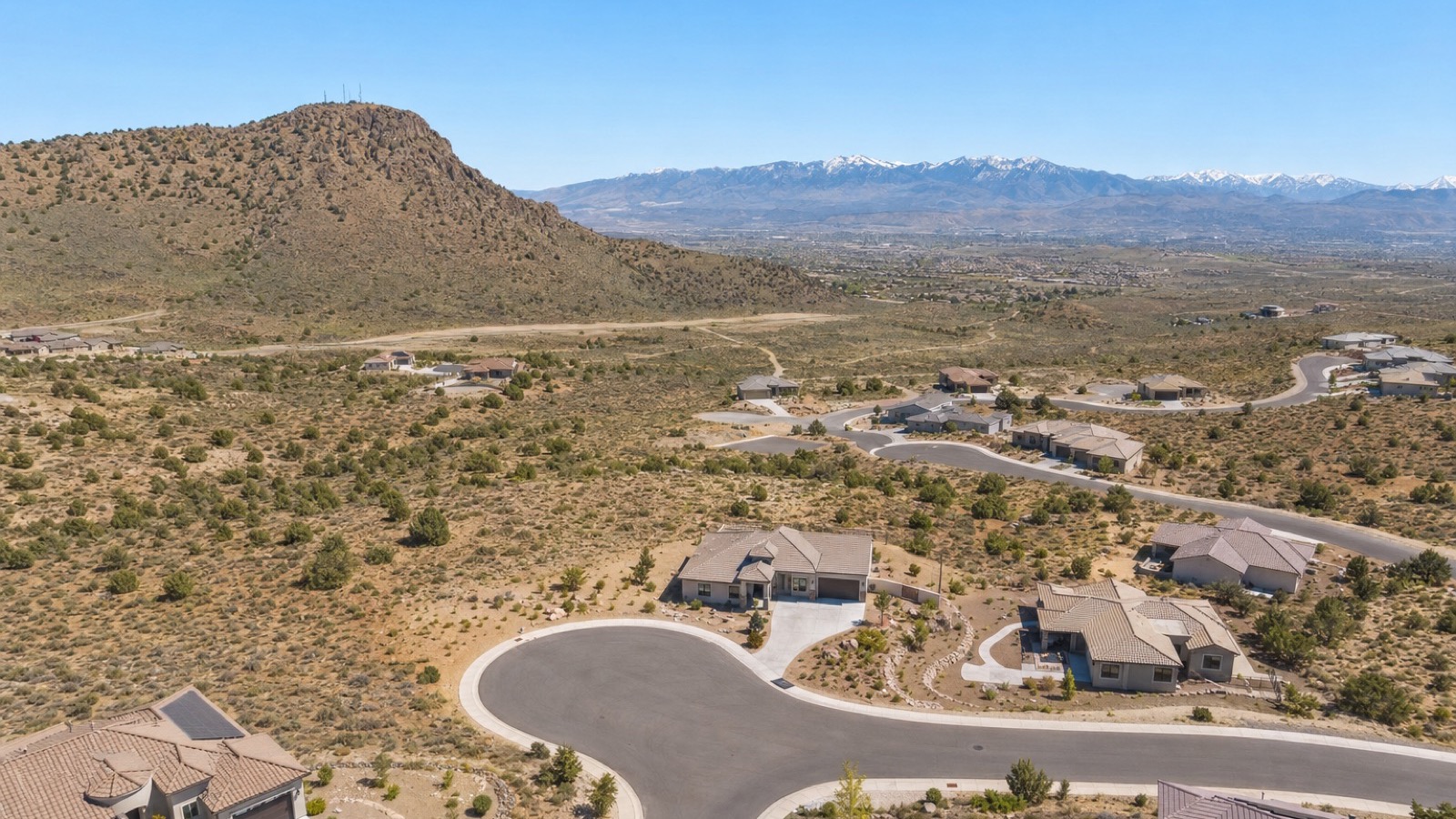
Because one is inside the Truckee Meadows and the other is not. ZIP 89511 covers south suburban Reno along the Mount Rose corridor, where parcels sit on paved county roads inside or adjacent to the water utility's service territory and where the surrounding houses are worth $1 million and up. ZIP 89510 covers the far northern county, out past the Pyramid Highway toward Flanigan and the Golden Highlands, where the nearest distribution line can be measured in miles rather than feet.
The numbers make the gap concrete. Across the 42 active parcels in 89511, the median asking price was $547,500 on a median size of one acre, which works out to roughly $417,500 an acre. Across the 58 active parcels in 89510, the median asking price was $147,000 on a median size of 41 acres, or roughly $3,000 an acre. Same county, same assessor, same state, and a hundred-and-thirty-fold difference in what an acre costs.
What you are paying for in 89511 is the removal of uncertainty. A one-acre parcel there is very likely to have water available, a road the county maintains, a septic design that will pass, power at the property line and neighbors whose finished houses establish what an appraiser will support when your construction loan converts. Every one of those is a risk the 89510 buyer keeps.
The closed sales in 89511 tell you the market agrees. Between March and August 2026, that ZIP produced closings at $1,075,000 for 1.39 acres, $1,100,000 for 1.03 acres, $1,300,000 for one acre, $1,550,000 for 2.5 acres, $1,650,000 for 2.82 acres and $1,995,000 for 2.46 acres. Those are not land prices in the usual sense. They are the cost of a building envelope in a neighborhood where the finished product clears $3 million, and the buyers paying them were not comparison-shopping against the high desert.
None of which makes 89510 a bad purchase. It makes it a different purchase, with a different holding period and a different exit. Buyers who do well out there tend to have a specific use — recreation, a shop and a manufactured home, a long-horizon hold near a growth corridor — rather than a vague plan to build someday.
Which Reno and Sparks ZIP Codes Are the Real Land Markets?
Nine ZIP codes carried substantially all of the inventory, and they sort into three clear tiers that behave differently enough to deserve separate strategies.
| ZIP | Area | Active parcels | Median ask | Median size | Median price per acre |
|---|---|---|---|---|---|
| 89521 | South Reno, Damonte and Steamboat | 60 | $119,000 | 10 acres | About $30,300 |
| 89510 | Far north county, Flanigan and Golden Highlands | 58 | $147,000 | 41 acres | About $3,000 |
| 89511 | South suburban, Mount Rose corridor | 42 | $547,500 | 1 acre | About $417,500 |
| 89508 | Lemmon Valley and the North Valleys | 25 | $175,000 | 10.11 acres | About $17,300 |
| 89523 | Northwest Reno, Somersett and Mogul | 17 | $345,000 | 1.46 acres | About $236,300 |
| 89506 | Stead and north valleys | 16 | $316,950 | 4 acres | About $146,100 |
| 89436 | Sparks, Spanish Springs | 13 | $205,000 | 0.3 acres | About $689,700 |
| 89509 | Old Southwest and central Reno | 13 | $250,000 | 0.56 acres | About $536,700 |
| 89441 | Sparks, north Spanish Springs | 11 | $250,000 | 11.11 acres | About $15,000 |
The infill tier is 89436, 89509 and 89523, where median parcels are under an acre and a half and price per acre runs from roughly $236,000 to $690,000. These are finished-subdivision lots and teardown-adjacent parcels in built neighborhoods. Diligence here is short and mostly about utilities at the street, setbacks and whether the lot is legally buildable rather than a remnant. Buyers in this tier are usually building a custom home for themselves in an area like Old Southwest Reno or on the Somersett edge of northwest Reno.
The transition tier is 89521, 89506 and 89511, and it is the most interesting one because it contains both extremes. ZIP 89521 shows a $119,000 median on ten-acre parcels — cheap, because much of that inventory sits on the Geiger Grade side toward Storey County rather than in the Damonte Ranch and South Meadows corridor where the houses are. ZIP 89511 is the opposite. Same general part of the map, radically different products, and a buyer who searches by ZIP alone will end up comparing parcels that have nothing to do with each other.
The high-desert tier is 89510, 89508 and 89441, where the median parcel runs ten to forty-one acres at $3,000 to $17,300 an acre. This is Lemmon Valley, Cold Springs, Palomino Valley and the country past them. Land is genuinely cheap here in the way that matters, and the diligence list is at its longest.
Does the Parcel Have Water, or Will You Be Drilling a Well?
This is the question that decides more Northern Nevada land deals than price, and the good news is that the MLS answers it in a structured field rather than leaving it to the remarks. Across all 281 active parcels on September 12, 2026, the water-source field reported: Public on 99 parcels, None on 76, Well Needed on 73, and an existing Well on 25, with a handful of combined or blank entries making up the rest.
Read that carefully, because it is the most actionable single statistic in this guide. Barely more than a third of the market — 99 of 281 — comes with a public water source. Another 25 have a well already drilled, which is a different and generally weaker guarantee, since an existing well can be low-yield, shallow or in need of a new pump. That leaves roughly 149 parcels, more than half the market, where a buyer is either drilling a well or has no water plan at all.
Drilling is a depth gamble, not a fixed cost. In the Truckee Meadows fringe a well might come in at a few hundred feet; in parts of the high desert it can go far deeper, and the bill scales with the footage plus casing, a pump, a pressure tank and the electrical to run it. The way to convert that gamble into an estimate is the well log of the nearest neighbors. According to the Nevada Division of Water Resources, well logs are public records searchable by location, and reading three or four logs within a mile of your parcel tells you the likely depth, the static water level and the yield the driller reported. A parcel surrounded by 200-foot wells producing 20 gallons a minute is a very different purchase from one surrounded by 600-foot wells producing 4.
One more caution specific to this state. A domestic well in Nevada serves a single-family home with defined limits on use, and it is not the same thing as owning water rights. In basins the State Engineer has designated, new domestic wells can face conditions, and some areas require relinquishing water rights to drill. Ask the listing agent for the basin designation before you assume a well is available as a matter of course.
What Do Nevada Water Rights Actually Convey?
Fifteen of the 281 active parcels mentioned water rights in their public remarks, and those fifteen listings tend to price at a visible premium. Buyers frequently misread what that premium buys.
A Nevada water right is a permit to divert and beneficially use a specified quantity of water from a specified source, administered under the state's prior-appropriation doctrine — first in time, first in right. According to the Nevada Division of Water Resources, rights are property that can be bought, sold and transferred separately from the land, which is precisely why you cannot assume they convey with a parcel just because a previous owner irrigated it. The right has a permit or certificate number, a priority date, an annual duty in acre-feet, a manner of use and a place of use, and every one of those fields can constrain what you are allowed to do.
Three practical consequences follow. First, a right for irrigation is not automatically a right for domestic or commercial use; changing the manner or place of use requires a change application to the State Engineer, which can be protested and is not guaranteed. Second, priority date matters enormously in a dry year, because in a fully appropriated basin junior rights get curtailed first. Third, rights can be lost through non-use — abandonment or forfeiture — so a right that has sat idle for years may be worth considerably less than the seller believes.
The diligence is straightforward if you insist on it. Get the permit or certificate numbers in writing, verify their current status directly with the Division rather than from the listing, confirm the priority date and duty, and have your title company address the rights specifically in the commitment rather than relying on a general conveyance. On any parcel where water rights are a material part of the price, this is worth a consultation with a Nevada water-rights attorney before removing contingencies. The cost of that call is trivial against the cost of discovering the right does not permit the use you planned.
How Do You Know the Lot Will Pass a Septic Perc Test?
Twenty-three of the active parcels mentioned septic in their remarks and seventeen mentioned a percolation test, which means the overwhelming majority said nothing about either. On any parcel outside a sewer service area, that silence is the buyer's problem to solve.
A septic system needs soil that absorbs effluent at an acceptable rate, adequate separation from groundwater and bedrock, and enough room to site both a primary and a replacement leach field at the required setbacks from wells, property lines, waterways and structures. The test that establishes this is the percolation test, and in Washoe County the permitting authority is the Health District's Environmental Health Services division. According to the Washoe County Health District, onsite sewage disposal systems require a permit, and the evaluation includes soil and site conditions before a design is approved.
Two site conditions cause most of the failures we see locally. Shallow bedrock is common on the foothill parcels where the views are, and it can eliminate a conventional leach field entirely, pushing you toward an engineered or mound system at substantially higher cost. High groundwater is the equivalent problem in the valley bottoms, particularly in parts of the North Valleys, where seasonal water tables are a documented issue. A parcel can fail on either and still look perfect from the road.
The right way to handle this is structural, not hopeful. On a raw parcel, write the offer with a feasibility contingency long enough to get a licensed evaluator out to do the soil work, and make the contingency explicitly cover a passing perc result and an approvable system design, not just "inspection." If the seller will not allow access for testing before closing, that is information. On parcels where a system already exists, treat it as a used mechanical asset: get it pumped, inspected and certified, and find out the age, the tank material and whether the leach field has ever been replaced.
What Does It Cost to Get Power to a Remote Parcel?
Sixty-two of the 281 active listings mentioned power or electricity in their remarks, usually to advertise that it is available. The silence of the other 219 is not proof that it is absent, but it is a prompt to go find out, because a line extension is billed by distance and can easily exceed what you paid for the land.
The mechanics are the same everywhere: the utility prices an extension from the nearest adequate distribution line to your meter, you pay a share of that cost, and the quote depends on terrain, easements, whether the run is overhead or underground and whether neighbors might share it. On a parcel a few hundred feet from an existing line, this is a manageable line item. On a high-desert parcel more than a mile out, it can be the single largest number in the project, and it is the reason so many forty-acre listings price at a few thousand dollars an acre.
Get the number rather than estimating it. According to NV Energy, a service-extension estimate is prepared for a specific parcel on request, and that request should go in during your feasibility window alongside the perc test and the well-log research. A verbal assurance that power is "at the road" means very little until someone identifies which pole, on which side, and whether it carries the capacity you need.
The alternative worth pricing in parallel is going off-grid. Solar with battery storage and a generator backup has become a genuinely common choice on remote Washoe and Storey County parcels, and on a long enough extension quote it is simply the cheaper answer. Run both numbers before you decide the parcel is unbuildable. What you should not do is buy on the assumption that you will "figure out power later," because the extension quote can invalidate the whole project and it is knowable before you close.
Which Zoning Code Is on the Parcel, and What Does It Let You Build?
The zoning field on the active listings is a useful map of what this market actually is. Across the 281 parcels, the most common designations were GR at 57 parcels, LDS at 23, GRA at 22, HDR at 14, SF3 at 13, PD at 11, LDR at 9 and NUD at 8, with a long tail beyond that.
The important structural fact is that those codes come from different rulebooks. Parcels inside Reno city limits carry City of Reno designations; parcels in unincorporated Washoe County carry county designations; parcels in Sparks carry Sparks designations; and parcels across the line in Storey County carry that county's. The same three-letter abbreviation can mean different things depending on which jurisdiction issued it, which is why reading a zoning code off a listing and looking it up in the wrong ordinance is a recurring and expensive mistake.
What you actually need from the zoning is a short list of answers: the minimum parcel size for a dwelling, the permitted and conditional uses, the setbacks, the maximum height and lot coverage, and whether what you intend — a shop, a second dwelling, horses, a short-term rental, a home business — is allowed by right, allowed with a special use permit, or not allowed at all. According to the City of Reno, zoning and permitted uses are verifiable through the planning division, and the equivalent county function will do the same for unincorporated parcels.
Two traps deserve naming. The first is the unbuildable remnant: a legally described parcel that fails the minimum size, has no legal access or was created in a way the jurisdiction will not recognize for a building permit. These do appear on the MLS, priced attractively. The second is the parcel that is buildable but not for what you want — the classic version being a large lot where the county's minimum parcel size for a dwelling is bigger than the parcel, or where a second dwelling for family is not permitted. Confirm in writing, from the jurisdiction, before your contingency expires.
How Do You Finance Vacant Land When a Mortgage Will Not Work?
A conventional mortgage is an instrument for buying an improved property, and vacant land does not qualify. That surprises buyers who have been pre-approved for a house and assume the approval travels. It does not, and the alternatives each carry different terms.
A land or lot loan is the direct substitute, usually from a local bank or credit union that knows the Northern Nevada market rather than a national lender. Expect a larger down payment than you would put on a house, a shorter term, and a rate above prevailing mortgage rates, with the gap widening as the parcel gets rawer. An improved lot in a recorded subdivision with utilities at the street is the easiest version of this loan; forty acres with no access is the hardest, and some lenders decline it entirely.
A construction-to-permanent loan is usually the better structure if you intend to build within a reasonable window. It funds the land purchase and the build in one facility and converts to a permanent mortgage at completion, which saves you a second set of closing costs and a second underwriting. The trade-off is that you need approved plans, a licensed builder and a budget before you can close, so it does not fit a buyer who wants to hold the parcel first and design later.
Seller financing is more common in this market than in the housing market, and it is worth knowing how common: 21 of the 281 active listings — roughly one in thirteen — mentioned owner or seller financing in their remarks. That concentration sits mostly in the high-desert bands, where conventional lending is hardest, which is exactly why sellers offer it. The terms are negotiable and frequently favorable on the down payment, but read the note carefully for the balloon date, the prepayment terms and what happens on a late payment, and record the transaction properly through a title company rather than handling paper directly with the seller.
Cash remains the dominant method at the bottom of the market, and it is worth being realistic that a $15,000 to $50,000 parcel is usually a cash purchase because the loan costs more to originate than it is worth.
What Does It Cost to Build a House in the Truckee Meadows in 2026?
The land is the opening bid. What turns a parcel into a house is a stack of costs that buyers routinely underestimate by more than the price of the lot itself, and the honest way to approach it is to build the estimate from quotes rather than from a per-square-foot rule of thumb.
The stack has five layers. Site work covers the driveway or access road, grading, and the trenching for utilities, and it scales with slope and distance. Utilities cover the well or water connection, the septic system or sewer lateral, and the power extension or off-grid system discussed above. Permits and fees cover the building permit itself plus the jurisdiction's impact or connection fees, which vary meaningfully between the City of Reno, the City of Sparks and unincorporated Washoe County. Vertical construction is the house. Financing costs cover interest during construction, which on a twelve- to eighteen-month build at today's rates is a real number rather than a rounding error.
On rates: According to Freddie Mac's Primary Mortgage Market Survey, the 30-year fixed averaged 6.76 percent in the week ending September 10, 2026, with the 15-year at 6.09 percent. Construction financing prices above that, and the spread is part of why build-versus-buy math has tightened. A buyer comparing a build against the roughly $620,000 median that resale single-family homes fetched in Reno and Sparks between March and August 2026 should price the whole stack, not just the contractor's bid.
Two Nevada-specific items belong on the checklist. First, verify your contractor's license before you sign anything. According to the Nevada State Contractors Board, every licence carries a classification and a monetary limit, and both are searchable by licence number or business name — confirm the limit covers your project size. Second, get your builder to quote the site work as a line item rather than an allowance, because on a sloped foothill parcel the difference between an assumed allowance and an actual excavation bid is where custom-build budgets break. Our Reno new construction page tracks what the production builders are charging for finished homes, which is the useful benchmark for deciding whether a custom build pencils at all.
How Long Does Land Take to Sell, and How Much Below List Does It Close?
Land negotiates better than housing here, and the closed data says so precisely. Across the 48 parcels that closed between March 1 and August 31, 2026, the median sale came in at 96.2 percent of the last asking price, with a mean of 94.6 percent. Thirty of the 48 closed below list and 18 closed at or above it. Median days on market was 37 and the mean was 41.
Set that against the rest of the board over the same window. The 1,573 single-family resales in Reno and Sparks closed at a median of exactly 100 percent of list, with 936 at or above asking and a median 42 days on market. Same market, same period, same agents, and a four-point difference in negotiating outcome. Land sellers discount and house sellers do not.
The reason is the supply-to-absorption ratio described at the top. Eight land closings a month against 281 active parcels means a seller who needs to transact is competing with a large, slow-moving pool of substitutes, while a house seller in the same six months was facing a buyer pool that cleared over fifteen hundred homes. It also reflects that land buyers are discretionary in a way that house buyers are not. Nobody has to buy a parcel this year.
What that means tactically: your first offer on raw land can reasonably start below asking without insulting anyone, particularly on a parcel that has been listed for months. The spread on individual closings supports it — sales in the dataset closed at $8,500 against a $10,000 ask, $71,000 against $90,000, $75,000 against $99,000, $1,200,000 against $1,425,000 and $1,650,000 against $1,800,000. Those are not outliers; they are the normal texture of the land market.
| Measure | Vacant land | Single-family resale |
|---|---|---|
| Closings in the window | 48 | 1,573 |
| Median sale price as a share of list | 96.2 percent | 100.0 percent |
| Mean sale price as a share of list | 94.6 percent | 99.4 percent |
| Closed at or above asking | 18 of 48 | 936 of 1,573 |
| Closed below asking | 30 of 48 | 637 of 1,573 |
| Median days on market | 37 | 42 |
| Median sale price | $230,000 | $620,000 |
The exception is the infill lot in a desirable, supply-constrained pocket. Several sub-acre closings in the dataset went at full asking with zero days on market, which is what happens when a buildable lot appears in a neighborhood where none have been available. Know which of the two markets your parcel is in before you pick a number.
What Should You Verify Before You Write an Offer on a Reno Lot?
Ten items, in the order I run them. This sequence exists because each one can kill a deal, and you want the cheap disqualifiers first.
Confirm the jurisdiction. According to the Washoe County Assessor, parcel records are searchable by assessor's parcel number, and that record is what establishes whether the parcel sits in the City of Reno, the City of Sparks, unincorporated Washoe County or Storey County. Every rule below depends on this answer, and the mailing address does not determine it.
Confirm legal access. A parcel needs a recorded, legal route to a public road. Ask for the easement documents rather than accepting that there is a dirt track. Landlocked parcels exist in this inventory and they trade at a discount for a reason.
Confirm the water source. Read the structured field, then verify it. If it says Public, confirm with the provider that the parcel is inside the service territory and get the connection cost. If it says Well or Well Needed, pull the neighboring well logs from the Division of Water Resources.
Confirm the septic path. Establish whether sewer is available, and if not, plan on the perc test and an approvable design as an explicit contingency.
Price the power. Get the line-extension estimate in writing for the specific parcel, and price the off-grid alternative alongside it.
Verify the zoning and minimum parcel size against the correct ordinance, and get the permitted use you intend confirmed by the planning counter.
Check for flood and hazard designations. According to the Federal Emergency Management Agency, flood hazard is mapped parcel by parcel and the maps are public, and a parcel's position relative to mapped floodplain affects both insurance and where a structure can sit.
Order a title commitment early and read the exceptions, not just the vesting. Easements, mineral reservations, access agreements and water-right conveyances all live in the exceptions.
Price the whole build stack, not the lot. Site work, utilities, permits, construction and construction-period interest.
Build the contingency period around the slowest item, which is almost always a soil or utility answer rather than anything a lender needs.
Frequently Asked Questions
How much does an acre of land cost in Reno?
It depends almost entirely on location rather than acreage. Across all 281 active parcels in Reno and Sparks on September 12, 2026, the median price per acre was about $48,000, but that median is the midpoint of an enormous range. Sub-acre building lots ran roughly $731,000 an acre, parcels between one and five acres about $179,000, parcels between five and twenty acres about $19,400, and parcels of forty acres or more about $3,500. By ZIP, south Reno's 89511 ran roughly $417,500 an acre while the far-north 89510 ran about $3,000.
What is the cheapest land for sale near Reno?
The cheapest active parcels on September 12, 2026 were in ZIP 89510, the far northern part of Washoe County. The lowest asking prices were $15,000 for 1.44 acres and $15,000 for 1.32 acres off Flanigan Road, $18,000 for 10.05 acres, $20,000 for 3.64 acres, $21,250 for a five-acre parcel in Flanigan and $26,500 for 40 acres in Golden Highlands. These are genuinely remote, generally without wells, power or paved access, and buyers there are typically after recreational use or a long-horizon hold rather than a near-term build.
Can you get a mortgage on vacant land in Nevada?
Not a conventional mortgage, which requires an improved property. You would use a land or lot loan, typically from a local bank or credit union, with a larger down payment, a shorter term and a higher rate than a home loan, with terms getting harder as the parcel gets rawer. If you plan to build soon, a construction-to-permanent loan is usually the better structure because it funds the land and the build together and converts to a permanent mortgage at completion. Seller financing is also comparatively common here — 21 of 281 active listings mentioned it.
Do I need a well if I buy land outside Reno?
Often, yes. Of the 281 active parcels on September 12, 2026, only 99 reported a public water source and 25 reported an existing well. Another 73 were flagged as needing a well and 76 reported no water source at all. That means more than half the market requires drilling or has no water plan. Before you buy, pull the well logs for neighboring parcels from the Nevada Division of Water Resources to estimate likely depth and yield, and confirm the basin designation, because some areas impose conditions on new domestic wells.
Is buying land in Reno a good investment?
It behaves differently from buying a house, and the honest answer is that it rewards a specific plan and punishes a vague one. Land produces no income, carries property tax while you hold it and is less liquid — 48 parcels closed in six months against 281 listed, and closings averaged 94.6 percent of asking. Against that, it requires no maintenance, has no tenants and no depreciation. Buyers do well when they are building a home, holding adjacent to a growth corridor or splitting a larger holding. Buyers do poorly when they buy cheap acreage with no utility diligence.
How long does it take to build a house on land near Reno?
Plan in two phases. The pre-construction phase covers feasibility, design, the septic and well work, the utility extension and permitting, and on a raw parcel that phase routinely takes longer than buyers expect because the soil and utility answers gate everything else. Vertical construction follows. The practical advice is to build your purchase contingency around the slowest approval rather than the lender's timeline, and to price construction-period interest as a real cost — with the 30-year fixed at 6.76 percent in the week ending September 10, 2026 per Freddie Mac, carrying a build is not cheap money.
What is the difference between a domestic well and water rights in Nevada?
They are separate legal things and conflating them is a costly error. A domestic well permit allows a single-family home to draw water for household use within defined limits. A water right is an appropriated property interest with a permit number, a priority date, an annual duty in acre-feet, and a specified manner and place of use, administered under prior appropriation — first in time, first in right. A right can be sold separately from the land, can be lost through non-use, and changing its use requires a change application to the State Engineer that can be protested. Fifteen active parcels advertised water rights; verify every one directly with the Division rather than from the listing.
Should I buy a lot in Sparks or in Reno?
They are different products more than different cities. Sparks had 28 active parcels at a $231,250 median on a median size of about one acre, concentrated in ZIPs 89436 and 89441 — mostly infill and subdivision lots where utilities are near and diligence is short. Reno had 253 active parcels at a $230,000 median on a median 4.88 acres, spanning everything from half-acre lots in 89509 to forty-acre high-desert holdings in 89510. If you want to build soon with fewer unknowns, the Sparks and Spanish Springs inventory is the simpler path; if you want acreage and privacy, the Reno-addressed county land is where it lives.
Which Sources Inform This Reno and Sparks Land Guide?
Every count, price and ratio above was measured directly from the NNRMLS-fed listing data for Reno and Sparks on September 12, 2026, covering all 281 active vacant-land parcels and the 48 land sales that closed between March 1 and August 31, 2026, with the structured water-source, zoning and acreage fields read listing by listing. The single-family comparison figures come from the 1,573 resale closings in the same cities over the same window. Live inventory changes daily; the Reno land listings and acreage pages carry current numbers.
Regulatory and market sources: the Nevada Division of Water Resources for well logs, basin designations and the appropriation of water rights; the Washoe County Health District for onsite sewage permitting and percolation requirements; the City of Reno planning division for zoning designations and permitted uses; Washoe County for unincorporated parcel rules and assessor records; NV Energy for service-extension estimates; the Nevada State Contractors Board for license verification; Freddie Mac for the Primary Mortgage Market Survey rate of 6.76 percent in the week ending September 10, 2026; the Nevada Legislature for the statutory framework governing disclosures and common-interest communities; and the Federal Emergency Management Agency for flood-hazard mapping.
For related Northern Nevada reading, see our guide to homes with acreage in Reno, which covers built homes on an acre or more rather than vacant parcels, and the Nevada well and septic buyer guide for inspecting existing systems. Buyers weighing a build against a finished home should also read the Reno new construction builders guide.
Ready to look at parcels with someone who will pull the well logs and the utility quotes before you write? Call Nevada Real Estate Group at (775) 277-2120, or start with the Reno land listings and tell us which ones caught your eye.