

For as long as I have sold real estate in this valley, Los Angeles has been both the source of our buyers and the reason some of them hesitate — close enough to feel connected, far enough that a weekend drive across the desert is a chore. Brightline West is about to erase that hesitation. The privately-built high-speed rail line now under construction along Interstate 15 is engineered to run electric trains up to 186 mph and cover the Las Vegas-to-Greater-Los-Angeles trip in roughly two hours and ten minutes — about half a typical drive, and a fraction of a bad-traffic one. When it opens, it does not just move tourists faster. It quietly rewrites the demand map for Las Vegas homes. This is the honest 2026 guide to what that means for prices, second-home buyers, and where to position ahead of the ribbon-cutting.
Brightline West is a privately-funded high-speed rail line, now under construction, connecting Las Vegas to the Los Angeles metro in about two hours and ten minutes at up to 186 mph. For Las Vegas real estate it does three things: strengthens the California-to-Nevada migration, makes a Vegas second home a realistic weekender for Southern Californians, and concentrates demand near the south-valley station. Expect gradual upward pressure on well-located homes, not an overnight spike.
- Brightline West runs about 218 miles along I-15 from a south-Strip Las Vegas station to Rancho Cucamonga, with a Metrolink link toward LA.
- Top speed near 186 mph puts LA roughly two hours away — about half the drive.
- The station near Las Vegas Boulevard and Warm Springs concentrates upside in the southern valley: Enterprise, the southwest, the Strip corridor.
- It reinforces Nevada's no-income-tax draw for California relocators, already driving valley demand.
- Buy for fundamentals first; treat the train as an accelerant to a good location, not a bad one.
What Exactly Is Brightline West?
Brightline West is a privately-led, roughly $12 billion high-speed passenger rail project connecting Las Vegas with the Los Angeles metropolitan area. According to Brightline West, the system will run fully electric trainsets at speeds up to 186 mph along a dedicated line in the median of Interstate 15, covering roughly 218 miles between a new Las Vegas station and a terminus in Rancho Cucamonga, California. From Rancho Cucamonga, riders connect to the regional Metrolink system toward downtown Los Angeles.
The project broke ground in April 2024 and is targeting an opening later this decade, with the developer publicly aiming to be running before the 2028 Los Angeles Summer Olympics. According to the U.S. Department of Transportation, the project was awarded a federal grant of roughly $3 billion under the Bipartisan Infrastructure Law in late 2023, layered on top of private financing. It is the first true high-speed rail line of its kind built in the United States, and Las Vegas sits at one end of it. That single fact is why every serious buyer and investor in this valley should understand what it does to demand.
Where Will the Las Vegas Brightline Station Be?
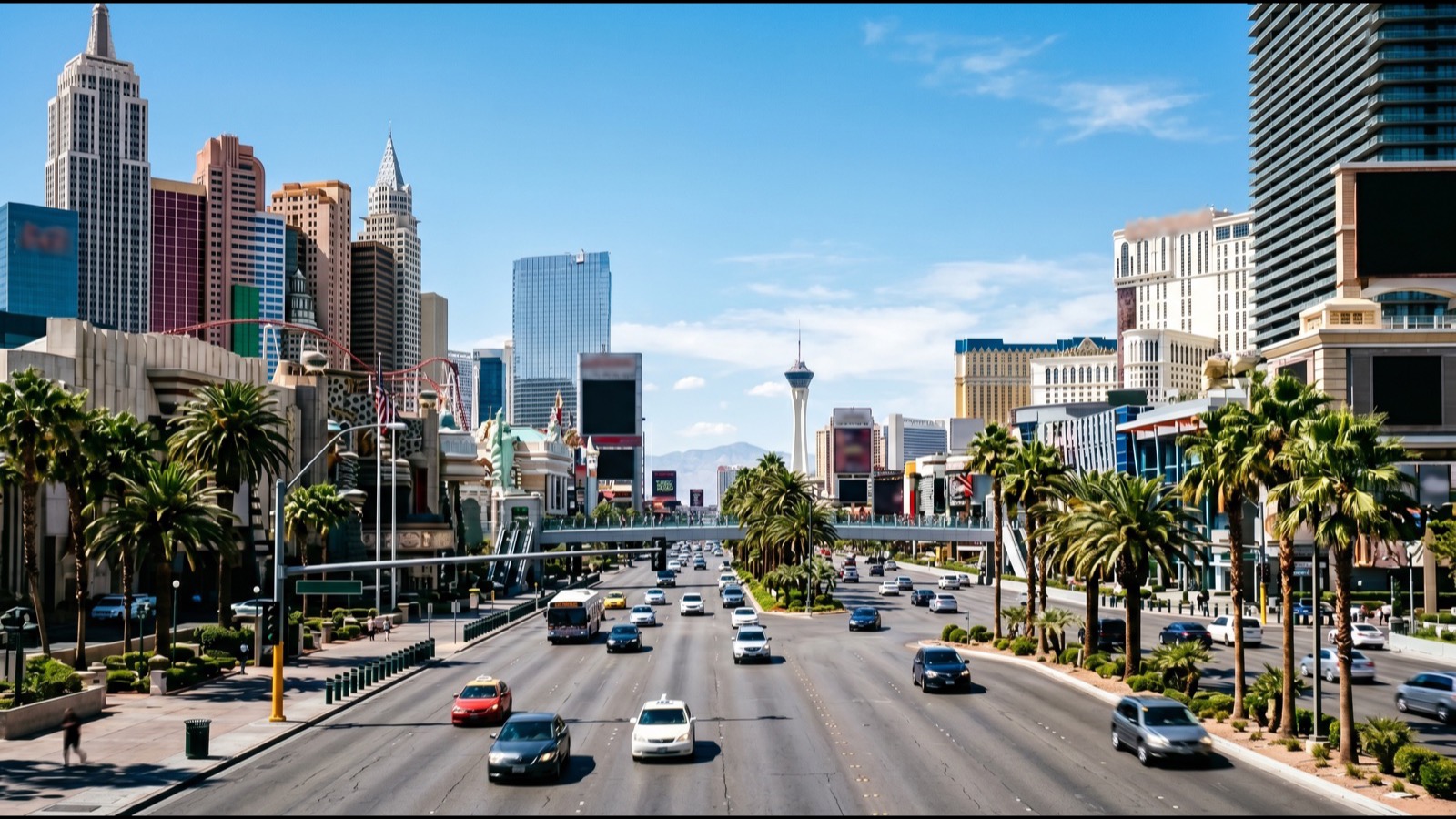
Location is the whole story for real estate, and the Las Vegas station sits where it matters most. According to Brightline West, the Las Vegas terminal is planned for the south end of the resort corridor, near Las Vegas Boulevard and Warm Springs Road — a short distance from the southern Strip and directly adjacent to the fast-growing southern valley. That places it within easy reach of Enterprise, the southwest submarket, Henderson via the I-15 and 215 interchanges, and the Strip's hotels and stadiums.
Why does the station site matter so much? Because rail value accrues in rings. The properties that benefit most are the ones close enough to the station to make the train genuinely convenient — think a fifteen-minute drive or a rideshare hop — without sitting in the noise and congestion of the corridor itself. According to the Regional Transportation Commission of Southern Nevada, the southern valley is already the region's fastest-growing quadrant for both housing and employment, so the station lands on top of demand that was building anyway. Browse current Las Vegas homes for sale with the station's south-valley location in mind and the geography of the opportunity becomes obvious.
How Fast and How Convenient Will the Trip Actually Be?
The honest numbers are genuinely impressive, with one asterisk. According to Brightline West, the end-to-end Las Vegas-to-Rancho Cucamonga run is designed to take about two hours and ten minutes at up to 186 mph — roughly half of a typical four-plus-hour drive, and far better than the five-, six-, or seven-hour crawl the I-15 becomes on a holiday Sunday. For a Southern Californian, that turns a Las Vegas home from a grueling desert drive into a nap-length train ride where you can work, sleep, or simply not white-knuckle the wheel through Baker.
The asterisk is the Los Angeles end. The line terminates in Rancho Cucamonga, in the Inland Empire, not at LA Union Station — so a rider bound for downtown or the Westside adds a Metrolink connection on top of the high-speed segment. That makes Brightline West spectacular for the tens of millions of Southern Californians in the Inland Empire and eastern LA basin, and merely very good for those deeper into the coastal city. Understanding that nuance is the difference between overpaying on a "two hours to LA" headline and pricing the real convenience for the buyers who will actually use it.
| Factor | Driving the I-15 | Brightline West |
|---|---|---|
| Typical time | 4 to 5+ hours (worse on holidays) | About 2 hours 10 minutes |
| Top speed | 65 to 70 mph (when moving) | Up to 186 mph |
| Productivity en route | None — you are driving | Work, sleep, or relax |
| LA-basin access | Direct but slow | Rancho Cucamonga + Metrolink transfer |
| Effect on a Vegas second home | A chore to reach | A realistic weekender |
How Does Brightline West Change Las Vegas Home Demand?
The mechanism is demand, and it arrives through three doors. First, second homes: when a Las Vegas property becomes a two-hour train ride rather than a punishing drive, a whole tier of Southern California households that would never have bought a desert weekender reconsiders. A condo near the Strip becomes a plausible Friday-night-to-Sunday retreat you reach without a car. Second, relocation: for the Californian already weighing a permanent move, the train removes the last emotional objection — you can leave the traffic and the income tax behind and still be back in the LA basin for a birthday or a board meeting by lunch.
Third, tourism and jobs: the line is projected to move millions of passengers a year, and every one of them is a potential future buyer, renter, or employee. Construction alone injects thousands of jobs, and operations, hospitality, and the broader visitor economy compound it. In my experience, infrastructure of this scale does not produce a single dramatic price jump; it produces a durable, multi-year tailwind that lifts well-located homes faster than the metro average. Across the 9,600-plus closings Nevada Real Estate Group has handled since 2011, the pattern with every major valley catalyst — the stadiums, the arenas, the corporate relocations — has been the same: the announcement moves sentiment, and the opening moves prices.
What Does It Cost to Buy Near the Brightline Station Today?
Pricing the opportunity in real dollars is how you separate a thesis from a purchase. According to Las Vegas REALTORS, the valley-wide median existing-home price sits near $478,000 in 2026, and the submarkets in the station's orbit span a wide band around it. Here is the honest 2026 range, drawn from local MLS activity — directional, not a guarantee, so always price a specific address against current comps.
| Submarket | Typical 2026 range | Format |
|---|---|---|
| Enterprise / southwest (entry) | $425,000 – $550,000 | Newer single-family |
| Strip-corridor condo (entry) | $300,000 – $475,000 | Lock-and-leave high-rise |
| Strip-corridor condo (premium) | $650,000 – $1,200,000+ | View, concierge, larger floor plans |
| Henderson (relocation) | $500,000 – $750,000 | Master-plan single-family |
| Summerlin / luxury | $650,000 – $2,000,000+ | Move-up and executive |
Run the carrying math before you fall for the map. On the $478,000 median, a 5% down payment is about $23,900 and a 3.5% FHA down payment is roughly $16,730; at a mortgage rate near 6.7%, that pencils out to a principal-and-interest payment in the neighborhood of $2,900 to $3,100 a month before taxes and insurance. A Strip-corridor condo priced at $400,000 with $650 monthly HOA dues carries very differently than a $500,000 Henderson single-family with $75 dues — the sticker price alone never tells the story. For a second-home buyer, budget Nevada's comparatively modest property tax (commonly in the 0.5% to 0.8% band on assessed value, or roughly $2,500 to $4,000 a year on a $478,000 home) plus any HOA on top. Against those numbers, remember the scale of the catalyst: a roughly $12 billion project, seeded with a $3 billion federal grant, does not get built to move a handful of people. The dollars that matter most, though, are the ones on your specific closing statement — which is exactly what we model at (702) 637-1759 before anyone writes an offer.
Which Las Vegas Neighborhoods Benefit Most From the Train?
Not every submarket gains equally, and matching the neighborhood to the catalyst is where buyers make or lose money. The clearest beneficiaries are the southern-valley communities closest to the station. Enterprise — the vast, new-construction-heavy township south of the airport — sits practically on top of the station's catchment and already draws relocating families for its newer stock and value. The southwest valley and the Strip-corridor high-rise market are next, because a car-free weekender wants to be near both the train and the entertainment.
Beyond the immediate ring, the train reinforces demand across the whole valley by strengthening the California pipeline. Henderson, reachable from the station via the I-15 and 215 in minutes, benefits from its safety-and-schools reputation for permanent relocators. Summerlin and the luxury tier benefit from the second-home and executive-relocation money the train unlocks. Even the high-rise condos along and near the Strip gain a new, structural buyer: the Southern Californian who wants a lock-and-leave place reachable without a steering wheel. The common thread is that the train amplifies the fundamentals a location already has — it does not manufacture them where they are absent.
| Submarket | Station proximity | Primary demand driver | Best-fit buyer |
|---|---|---|---|
| Enterprise / southwest | Closest — inside the catchment | New construction + station access | Relocating families, value buyers |
| Strip-corridor high-rise | Very close — car-free to the station | Lock-and-leave weekenders | California second-home buyers |
| Henderson | Short drive via I-15 / 215 | Safety, schools, master plans | Permanent relocators |
| Summerlin / luxury | Cross-valley drive | Executive relocation + second homes | Move-up and luxury buyers |
Will Brightline West Actually Raise Las Vegas Home Prices?
Probably yes, gradually — and the honest framing matters more than the hype. According to Las Vegas REALTORS, the valley-wide median existing-home price sits near $478,000 in 2026 in a market that has cooled from the 2021-2022 frenzy into a balanced, sustainable phase. A single infrastructure project does not override that cycle; it adds a persistent demand tailwind on top of it. The realistic expectation is that well-located homes near the station and along the California-relocation path appreciate somewhat faster than the metro average over the years surrounding the opening, not that the whole valley reprices overnight.
History supports the measured view. Transit and stadium projects tend to move real estate in two waves — a sentiment bump around the announcement and groundbreaking, then a firmer, demand-driven lift as the opening nears and materializes. We are currently in the first wave. According to the U.S. Census Bureau, Nevada remains one of the fastest-growing states, so the train is pouring fuel on a fire that was already lit. For a buyer, that means the window to position ahead of the second wave is now, while the project is a construction site rather than a ribbon-cutting — but only if the underlying home is sound. A great location made greater by the train is a buy; a weak location is still weak, train or no train.
How Does Brightline West Compare to the Valley's Other Growth Catalysts?
Brightline West does not arrive in a vacuum — it lands on a valley that has spent a decade stacking demand catalysts, and understanding the pattern is how you calibrate expectations. Allegiant Stadium brought the Raiders and a wave of relocations and investment to the southern valley; T-Mobile Arena and the Golden Knights reshaped the Strip's south end; the Sphere put a global spotlight on the corridor; and the incoming Athletics ballpark on the old Tropicana site is already moving sentiment in the Paradise and Strip-adjacent submarkets. Each of these, according to the Las Vegas Convention and Visitors Authority, reinforced the visitor economy that underwrites so much of our housing demand.
What sets Brightline West apart is that it is not an event or a venue — it is permanent infrastructure that changes the fundamental math of distance. The Formula 1 Grand Prix fills hotels for a weekend; the train changes who can own here every weekend of the year. Allegiant Stadium draws fans on game days; the train draws a structural new class of second-home buyer and relocator year-round. According to the Nevada Governor's Office of Economic Development, the same forces pulling companies and logistics operations across the state line — no income tax, lower costs, a central-West location — are the forces the train amplifies by shrinking the one variable those employers and their people still complained about: the distance back to Southern California. Among every catalyst this valley has landed, a two-hour rail link to the nation's second-largest metro is the one with the longest and most durable tail for real estate.
| Play | Target area | Core thesis | Main risk |
|---|---|---|---|
| Second home / weekender | Strip-corridor condo, south valley | Car-free reach from SoCal at pre-opening prices | Timeline slip; HOA + carrying cost |
| Permanent relocation | Henderson, Summerlin, Enterprise | No income tax + family stays a ride away | Overpaying for a catalyst on a weak home |
| Investment / rental | Station catchment, near-Strip | Rising visitation and structural demand | Short-term-rental rules; rate environment |
Compare the train proposal with the status distinctions in our Las Vegas megaprojects guide, keeping proposed and completed work separate.
Is a Las Vegas Second Home a Smart Play Before the Train Opens?
For the right buyer, it is one of the more compelling setups in the region — with eyes open. The thesis is straightforward: a Southern California household that buys a lock-and-leave Las Vegas condo or single-story home today locks in pre-opening pricing on an asset whose convenience, and therefore whose desirability, steps up materially the day the train runs. According to the Clark County Assessor, Nevada's property-tax structure is comparatively modest, and Nevada's lack of a state income tax sweetens the math for anyone who later converts the second home into a primary residence.
The caveats are real and worth stating plainly. Timelines on megaprojects slip, so underwrite the purchase as a home you would be happy owning even if the opening moves a year; do not pay a premium today for a convenience that is not yet running. Factor in the full carrying cost: a Strip-corridor condo can run $650 to $950 a month in HOA dues alone, a second-home insurance policy often adds $1,200 to $2,500 a year, and the short-term-rental rules that govern the specific building or neighborhood must be checked before you assume a dollar of rental income. In our experience, the buyers who do best treat the train as a tailwind on a property they would want regardless, not as the sole reason to buy. Run the real numbers with a local agent before you act — call Nevada Real Estate Group at (702) 637-1759 and we will model the carrying cost and the realistic upside on a specific address.

How Does the Train Fit the California-to-Nevada Migration?
Brightline West is best understood not as a standalone event but as an accelerant to a migration that is already reshaping this valley. According to the U.S. Census Bureau, Nevada continues to absorb tens of thousands of net new residents a year, with California the single largest source. The drivers are familiar: no state income tax, a lower cost of housing, and a business climate that keeps pulling companies and their payrolls east across the state line. We cover that shift in depth in our California to Las Vegas migration analysis, and the train slots directly into it.
Here is why the train matters to that trend specifically: the single most common hesitation I hear from California relocators is not money — it is distance from family, friends, and the coast. Brightline West dissolves that objection. A parent who moves to Henderson for the taxes and the schools can be back in the Inland Empire for a grandchild's game in an afternoon, without a five-hour drive. That psychological shift is worth more to the migration than any single dollar figure, because it removes the last reason to stay. For the buyer weighing the move, the moving to Las Vegas relocation guide pairs naturally with this one: the train is the bridge that makes leaving California feel less like cutting ties and more like gaining an hour.
What Are the Risks and Caveats Buyers Should Know?
Honesty about the downside is what separates a smart position from a speculative one. First, timeline risk: megaprojects routinely open later than their targets, and a delay pushes the second demand wave further out — so never overpay today for a convenience that is still a construction schedule. Second, the LA-end transfer: the Rancho Cucamonga terminus plus a Metrolink connection is fantastic for the Inland Empire and the eastern basin but adds a leg for coastal-LA riders, which tempers the "two hours to LA" shorthand.
Third, the benefit is concentrated, not universal. A home far from the station and off the relocation path gains little direct lift from the train, so do not pay a valley-wide premium for a hyper-local catalyst. Fourth, macro conditions still rule the near term: according to Freddie Mac, mortgage rates in the mid-to-high 6% range remain the biggest swing factor for affordability and will shape prices more than any single project until the train actually opens. None of these are reasons to dismiss Brightline West; they are reasons to buy the right home in the right ring for the right price, rather than chasing a headline.
How Should Buyers Position Ahead of Brightline West in 2026?
Start with fundamentals, then layer the catalyst on top. Decide first whether you want a permanent relocation home, a lock-and-leave second home, or an investment property, because each points to a different part of the valley. For a second home you will reach by train, prioritize proximity to the south-valley station and the Strip; for a permanent move, prioritize the schools, safety, and community that fit your life in Henderson, Summerlin, or Enterprise, and treat the train as a bonus. Get fully underwritten so you can move on the right listing while the market is balanced and negotiable rather than frenzied.
Then think in rings and in time. The station's immediate catchment is the highest-conviction location play; the broader California-relocation path is the highest-conviction demand play; and the pre-opening window is the highest-conviction timing play. In my experience, the buyers who win on infrastructure are the ones who buy a genuinely good home slightly early and hold through the opening, not the ones who wait for the ribbon-cutting and pay the premium the news creates. Browse current Las Vegas homes for sale, map the station and the corridor against your budget, and when a specific home fits the thesis, call Nevada Real Estate Group at (702) 637-1759 for the honest read on that address and that ring.
Frequently Asked Questions
When will Brightline West open?
Brightline West broke ground in April 2024 and is targeting an opening later this decade, with the developer publicly aiming to run before the 2028 Los Angeles Summer Olympics. As with any megaproject, the date can move, so buyers should treat the opening as a range rather than a fixed day and underwrite any purchase as a home worth owning even if the timeline slips.
How long will the train take from Las Vegas to Los Angeles?
The Las Vegas-to-Rancho Cucamonga run is designed to take about two hours and ten minutes at speeds up to 186 mph — roughly half a typical drive. Riders headed to downtown or coastal Los Angeles add a Metrolink connection from Rancho Cucamonga, so the full trip depends on your final destination in the LA basin; it is fastest for the Inland Empire and eastern basin.
Where is the Las Vegas Brightline station?
The Las Vegas station is planned for the south end of the resort corridor near Las Vegas Boulevard and Warm Springs Road, adjacent to the southern Strip and the fast-growing southern valley. That location puts Enterprise, the southwest, and the Strip corridor in the station's natural catchment, and keeps Henderson within a short drive via the I-15 and 215.
Will Brightline West raise Las Vegas home prices?
Most likely gradually, not overnight. A single project does not override the broader market cycle, but it adds a durable demand tailwind that tends to lift well-located homes near the station and along the California-relocation path faster than the metro average. Expect a sentiment bump now during construction and a firmer, demand-driven lift as the opening nears.
Is buying a Las Vegas second home before the train a good idea?
For a Southern California household that wants a car-free weekender, it can be a compelling setup — you lock in pre-opening pricing on an asset whose convenience steps up when the train runs. The caveats: underwrite it as a home you would happily own even if the opening slips, factor in HOA and carrying costs, and verify short-term-rental rules before assuming rental income.
Does Brightline West help California buyers relocate to Nevada?
Significantly, and not just financially. Nevada's lack of a state income tax and lower housing costs already pull California residents east; the train removes the last emotional objection by keeping relocators a short ride from family and the coast. That psychological shift reinforces a migration the Census Bureau already ranks among the nation's largest state-to-state flows.
Which Las Vegas neighborhoods benefit most from Brightline West?
The southern valley closest to the station benefits most — Enterprise, the southwest, and the Strip corridor — followed by the broader relocation-driven markets of Henderson and Summerlin. The train amplifies the fundamentals a location already has rather than creating value where none exists, so proximity to the station plus sound local fundamentals is the winning combination.
Which Sources Inform This Brightline West Analysis?
This analysis draws on the project developer, federal transportation records, local market and transit data, and federal population and rate figures. According to the sources below, every figure cited is accurate as of mid-2026; project details and timelines can change, so confirm current specifics before making a transaction.
- Brightline West — project overview, route, and speeds
- U.S. Department of Transportation — federal grant and infrastructure funding
- Federal Railroad Administration
- Las Vegas REALTORS — local market statistics
- Regional Transportation Commission of Southern Nevada
- Clark County Assessor — property data and tax rates
- U.S. Census Bureau — Nevada QuickFacts and migration
- Freddie Mac — Primary Mortgage Market Survey
- Las Vegas Convention and Visitors Authority — visitor economy
- Nevada Governor's Office of Economic Development
- Bureau of Labor Statistics — Las Vegas metro employment