
Reno's new-construction market is a different animal from the resale market that gets all the headlines — different pricing, different negotiation rules, different neighborhoods, and a completely different way of making mistakes expensive. As of September 19, 2026, Nevada Real Estate Group's Northern Nevada MLS feed pulled through Repliers shows 118 active new-construction listings in Reno (single-family and attached homes built 2024 or later) carrying a median list price of $714,950 — about $73,950 above the $641,000 median ask across all 1,258 active residential listings in the city on that same pull.
That premium is real, but so is what it buys: current snow-load and energy code, a 1/2/10 warranty backed by Nevada statute, and a lot in one of the master plans that will define the next decade of the Truckee Meadows. I've spent 16 years walking buyers through framing sites from Somersett to Spanish Springs, and this guide is the map I wish every relocating buyer had before their first model-home visit. It was rebuilt on September 19, 2026 against a fresh MLS pull and a community-by-community check of what each builder is actually publishing today.
Reno has 118 active new-construction listings built 2024 or later at a $714,950 median list price as of September 19, 2026, about 12% above the citywide $641,000 median. Six builders are verifiably selling across South Reno, Sparks, and the Lyon County corridor, from $406,990 in the North Valleys to $1,484,995 in the foothills. Register your own agent at the first model-home visit; the builder pays either way.
- Reno holds 118 active new-build listings at a $714,950 median as of September 19, 2026.
- Talus Valley leads volume: its East Village phases carry 35 of Reno's 118 new-construction actives.
- D.R. Horton's Wolf Ridge townhomes near the university start at $539,990 on its September 2026 pricing.
- Toll Brothers runs eight Northern Nevada communities, from Regency at Stonebrook's $495,000 to Ascente's $1,484,995.
- Register your own agent at the first model-home visit; the builder pays the co-op regardless.
What Does Reno's New-Construction Market Look Like in September 2026?
Here are the live numbers, pulled from Nevada Real Estate Group's Northern Nevada MLS feed through Repliers on September 19, 2026. The methodology matters, so read it once: closings cover the twelve months from September 19, 2025 through September 18, 2026 with land excluded, actives are counted as of September 18, 2026, and "new construction" means a recorded year built of 2024 or later — the same definition the feed behind our site search uses.
| Segment | Count | Median price | What it tells you |
|---|---|---|---|
| Reno new construction, active | 118 | $714,950 ask | About 9% of the active residential board |
| Reno all residential, active | 1,258 | $641,000 ask | The citywide baseline, 30-day median age |
| Reno closings, 12 months | 3,801 | $585,000 sold | What the whole market actually paid |
| Reno new-construction closings | 330 | $577,096 sold | Held down by 102 attached townhome closings |
| Reno new-build single-family closings | 228 | $679,975 sold | The honest new-build comparison number |
| Sparks closings, 12 months | 1,614 | $534,990 sold | 521 active listings on the same pull |
Three things jump out of that table, and the third one surprises most buyers. First, the asking premium on new construction runs about $73,950 over the citywide median ask — call it 12% — which is squarely in the historical range for a market where builders compete on incentives rather than base price. Second, new construction in Reno now sells at $316 per square foot against $330 for the market as a whole, because production floor plans are efficient in a way 1990s custom homes are not.
Third, and this is the one worth slowing down for: the median new-construction closing at $577,096 sits below the citywide closing median of $585,000. That is not a discount, it is mix. Of the 330 new-construction closings in the twelve months ending September 18, 2026, fully 102 were attached townhomes closing at a $452,175 median — the Legacy Village, Grand Point, and Cityview product that has quietly become Reno's most affordable new housing. Strip the townhomes out and new single-family closed at $679,975, roughly $95,000 above the citywide median. Whichever number you quote, quote the matching one. For the broader resale picture — months of inventory, rate effects, and the price-cut geography — see the live Reno market report. The short version: balanced conditions, which is exactly the environment where builder incentives get generous.
Which Reno and Sparks New-Home Communities Are Actually Selling Right Now?
Builder rosters go stale faster than any other fact in a real estate guide, because a community that was taking reservations in spring can be closed out by Labor Day. So on September 19, 2026 our team checked every builder community in the region against the builder's own published pages rather than trusting last quarter's notes. Here is what was genuinely open and publishing a price that day.
| Community | Builder | Where | Published starting price |
|---|---|---|---|
| Phoenix | D.R. Horton | Reno | From $406,990 |
| Trailside | D.R. Horton | Reno | From $475,990 |
| Wolf Ridge | D.R. Horton | Reno, near the university | From $539,990 (townhomes) |
| Golden Eagle | D.R. Horton | Sparks | From $537,990 |
| Woodbridge | D.R. Horton | Dayton | From $467,990 |
| Rivercrest | Toll Brothers | Reno, Old Southwest | From $572,995 (townhomes) |
| Regency at Caramella Ranch (55+) | Toll Brothers | South Reno | Claymont from $677,995 |
| Quilici | Toll Brothers | Verdi | $906,995 to $1,174,995 |
| Ascente | Toll Brothers | South Reno foothills | $1,049,995 to $1,484,995 |
| Regency at Stonebrook (55+) | Toll Brothers | Sparks | Glenridge from $495,000 |
| Toll Brothers at Stonebrook | Toll Brothers | Sparks | Cordoba $648,995, final opportunity |
| Harris Ranch | Toll Brothers | Sparks | Magnolia from $608,995 |
| Cinnamon Ridge | Toll Brothers | Sparks | From $674,995 |
| The Heights | Ryder Homes | Sparks | From $609,990 |
| Shadow Hills | Ryder Homes | Sparks | From $709,990 |
| Cross Creek | Ryder Homes | Carson City | From $504,990 |
| Gold Sky | Lennar | Dayton | $474,950 to $519,950 |
| Brae Retreat | Desert Wind Homes | Somersett | From $1,019,990, two homes left |
A few of those deserve a sentence of their own. According to D.R. Horton's Nevada community pages, Wolf Ridge is the one to know if you want new construction within reach of the University of Nevada, Reno without buying a foothill lot — attached product from $539,990 in a submarket where the Downtown and university ZIPs closed at a $375,000 median over the last twelve months. I've written the full floor-plan and HOA breakdown in our Wolf Ridge townhomes guide. Woodbridge, meanwhile, is a community rather than a builder — a Tamarack Land development of 81 homes on 115 acres in Dayton that broke ground in August 2025, with D.R. Horton delivering the houses from $467,990.
According to Toll Brothers' Nevada community list, the builder now runs eight open Northern Nevada communities spanning almost a million dollars of price range, from the $495,000 Glenridge plan in the gated 55+ Regency at Stonebrook to the $1,484,995 Platinum Heights plan at Ascente in the South Reno foothills. According to Ryder Homes, the regional builder is concentrated in Sparks with The Heights and Shadow Hills, holds Cross Creek in Carson City, and has Pine Street Townhomes listed as coming soon in downtown Reno. According to Lennar, its open Northern Nevada offering on the day we checked was Gold Sky in Dayton with seven homes available; its Sparks community pages would not load, so I am not quoting prices I could not see. Jenuane Communities, which publishes at jcommunities.com, carries Golden Mesa, Sierra Vista, Ladera Ranch, and Legacy Trails alongside its Carson City work — and the MLS backs that up, with Sierra Vista Phase 1 closing 17 new homes at a $523,990 median and Golden Mesa North closing six at $779,990 over the last twelve months.
What is not selling matters just as much, because half the "Reno new construction" lists online are quoting communities that closed out. Toll Brothers' two Rancharrah neighborhoods, Cantaro and Latigo, now redirect to the company's state-level list, as does The Cliffs at Somersett — all three are done. Regency at Damonte Ranch is sold out. Tri Pointe Homes shows no Reno-area communities on its own site, and KB Home, Century Communities, and Woodside Homes are building only at the southern end of the state right now, despite appearing on plenty of stale regional roundups. For what is coming next rather than what is open today, our Reno and Sparks development pipeline tracks the entitled projects behind the 2027 and 2028 releases.
Which Builders Are Actively Building in Reno and Northern Nevada?
Six builders were publishing live prices on Northern Nevada communities when we checked on September 19, 2026, and they split cleanly by role. D.R. Horton owns the entry and attached tiers and is the only builder with communities in Reno, Sparks, and Lyon County simultaneously. Toll Brothers owns the move-up, luxury, and active-adult tiers, and is the volume leader in Sparks through the Stonebrook master plan. Ryder Homes is the regional mid-market specialist. Lennar and Jenuane Communities work the value corridor and the North Valleys. Desert Wind Homes is the last builder still selling inside Somersett.
| Builder | Role | Published price range | Active areas |
|---|---|---|---|
| D.R. Horton | National entry and attached | $406,990 to $539,990 | Reno, Sparks, Dayton |
| Toll Brothers | National move-up, luxury, 55+ | $495,000 to $1,484,995 | South Reno, Verdi, Old Southwest, Sparks |
| Ryder Homes | Regional mid-market | $504,990 to $709,990 | Sparks, Carson City, downtown Reno soon |
| Lennar | National volume | $474,950 to $519,950 verified | Dayton confirmed; Sparks pages unavailable |
| Jenuane Communities | Regional mid-market | MLS closings $523,990 to $779,990 | North Valleys, Carson City |
| Desert Wind Homes | Regional luxury | From $1,019,990 | Somersett only |
One important note on how the Northern Nevada MLS works: unlike some systems, the feed does not carry a structured builder field on most new-build listings, so builder identity has to be confirmed community by community — which is exactly the legwork above. Never assume the builder on a spec home from the listing photos alone, because a community's active phase may have changed hands since the sign went up. And treat any roundup that still lists six or seven nationals building in Reno as what it is: a page nobody has re-checked since the last closeout.
Where Are Reno's New Homes Actually Being Built?
The 118 active Reno new-builds aren't scattered evenly — they cluster hard. Sorting the September 19, 2026 feed by recorded subdivision, the Talus Valley East Village phases together account for 35 of the 118 active new-construction listings, making it the single busiest new-home neighborhood in the city by a wide margin. East Village 26 alone holds 23 actives at an $839,950 median, with East Village 24S adding ten at $703,943. The next tier of activity: Sierra Vista Phase 1 (7 actives at $554,990), the Vista Enclave phases (6 at $568,000), Legacy Village Townhomes (5 at $411,990), Cityview Townhomes (4 at $615,000), Quilici Ranch in Verdi (4 at $1,165,000), and Montreux 4 South (4 at $2,637,500).
Zoom out and those subdivisions resolve into three broad corridors:
- South Reno and the Damonte Ranch corridor — the volume center, and the single busiest new-home ZIP in the region with 40 of the 118 actives at a $787,450 median. South Meadows, Damonte Ranch, Caramella Ranch, and Talus Valley deliver the bulk of mid-tier single-family product, with quick access to the I-580 and Mt. Rose junction and the South Meadows employment core.
- The North Valleys — the affordability engine, carrying 26 actives at a $534,890 median. This is where Sierra Vista, Vista Enclave, Arroyo Crossing, and the Legacy Village townhomes put brand-new keys in a buyer's hand below the citywide resale median.
- Northwest Reno, Somersett, and the foothill tier — the move-up and luxury end, plus the custom estates in 89511 where the 17 active new-construction listings carry a $2,400,000 median. If attached product fits your budget instead, browse new condos and townhomes for sale in Reno for the live inventory.
For a deeper comparison of how the established master plans stack up on HOA structure, schools, and lifestyle, my Reno master-planned communities comparison walks through each one in detail — or browse the full roster of Northern Nevada communities we cover.
What Does South Reno Offer — Damonte Ranch, Caramella Ranch, and Talus Valley?
South Reno is where most relocating families should start, and the live listing counts back that up. The corridor runs from the Double Diamond and South Meadows employment core east and south through Damonte Ranch toward the Virginia Range, and it holds the busiest new-home communities in the region. Over the twelve months ending September 18, 2026, the combined South Reno ZIPs closed 1,279 homes at an $810,000 median and $370 per square foot, with 450 listings still active — about 4.2 months of supply, the textbook definition of a balanced market.
Damonte Ranch is the mature anchor, a family-focused master plan with its own town center, newer schools, and a housing stock that skews post-2005; the 89521 ZIP that contains it closed 693 homes at a $709,950 median. New phases still deliver, but much of Damonte's value now is that a new build there drops into a finished neighborhood: parks built, retail open, HOA seasoned. Caramella Ranch is the newer master plan just west, where Toll Brothers' gated 55+ Regency villages sit alongside family product — the Regency Village Unit 5B phase closed five homes at a $998,000 median and still shows three actives at $949,000, with the Claymont plan opening at $677,995. Talus Valley is the volume story of 2026: 35 active listings and 81 closings across its East Village phases, mostly mid-tier single-family, on the southeast edge where Reno's next decade of growth is mapped.
In my experience, the South Reno trade-off is simple: you give up the drama of a foothill view lot and get back commute time, flatter streets, and more house per dollar. A family buying at $690,000 in Talus Valley East Village 24S is typically getting 2,400 to 2,800 square feet and a three-car garage at about $379 per square foot; the same money in the foothills buys less house on a hillside, with a view that may be worth every penny to you, or may not. The one number to watch in this corridor is days on market: South Reno's 63-day median is the slowest of the major Reno areas, because it is the relocation corridor where the most listings compete for the same arriving households.
What Do Somersett and Northwest Reno Offer New-Build Buyers?
Somersett is Northern Nevada's flagship master plan — 2,700 acres in the northwest foothills wrapped around a championship golf course, 27 miles of trails, and the Sierra views that end up on every Reno postcard. But the new-construction story there has changed, and anyone quoting you a roster of nationals building in Somersett is working from an old page. Toll Brothers' Cliffs at Somersett has closed out, and as of September 19, 2026 the only builder publishing an open Somersett community is Desert Wind Homes at Brae Retreat, from $1,019,990, with two homes remaining. The MLS agrees: just two active new-construction listings sit in the Somersett village phases, at a $1,762,500 median.
What that means practically is that Somersett is becoming a resale market again rather than a builder market, and the buying strategy flips accordingly. Northwest Reno as a whole — the 89523 and 89503 ZIPs — closed 779 homes at a $569,999 median and $337 per square foot over the twelve months ending September 18, 2026, moving in a 52-day median and holding only 3.4 months of supply, the tightest of the major Reno areas alongside the Sparks core. That is a meaningfully faster market than South Reno, and it is where I tell buyers to be ready to move rather than to shop leisurely.
Lot premiums remain the number to watch anywhere in the foothills. A Sierra-view lot can carry a premium well into six figures over an interior lot with the identical floor plan, and premiums reprice with every release, so the base price on a builder's website is the beginning of the conversation rather than the end of it. Above Somersett, the custom foothill tier — ArrowCreek, Montreux, and Galena Forest — delivers architect-driven estates, and the Montreux 4 South phase alone shows four active new-construction listings at a $2,637,500 median. Rancharrah, the gated former Wingfield estate in central Reno, splits the difference with new luxury inside the city grid: Village 4 closed 18 homes at a $2,250,000 median over the last year, though Toll's two neighborhoods there have now sold through.
How Does Sparks Compare for New Construction?
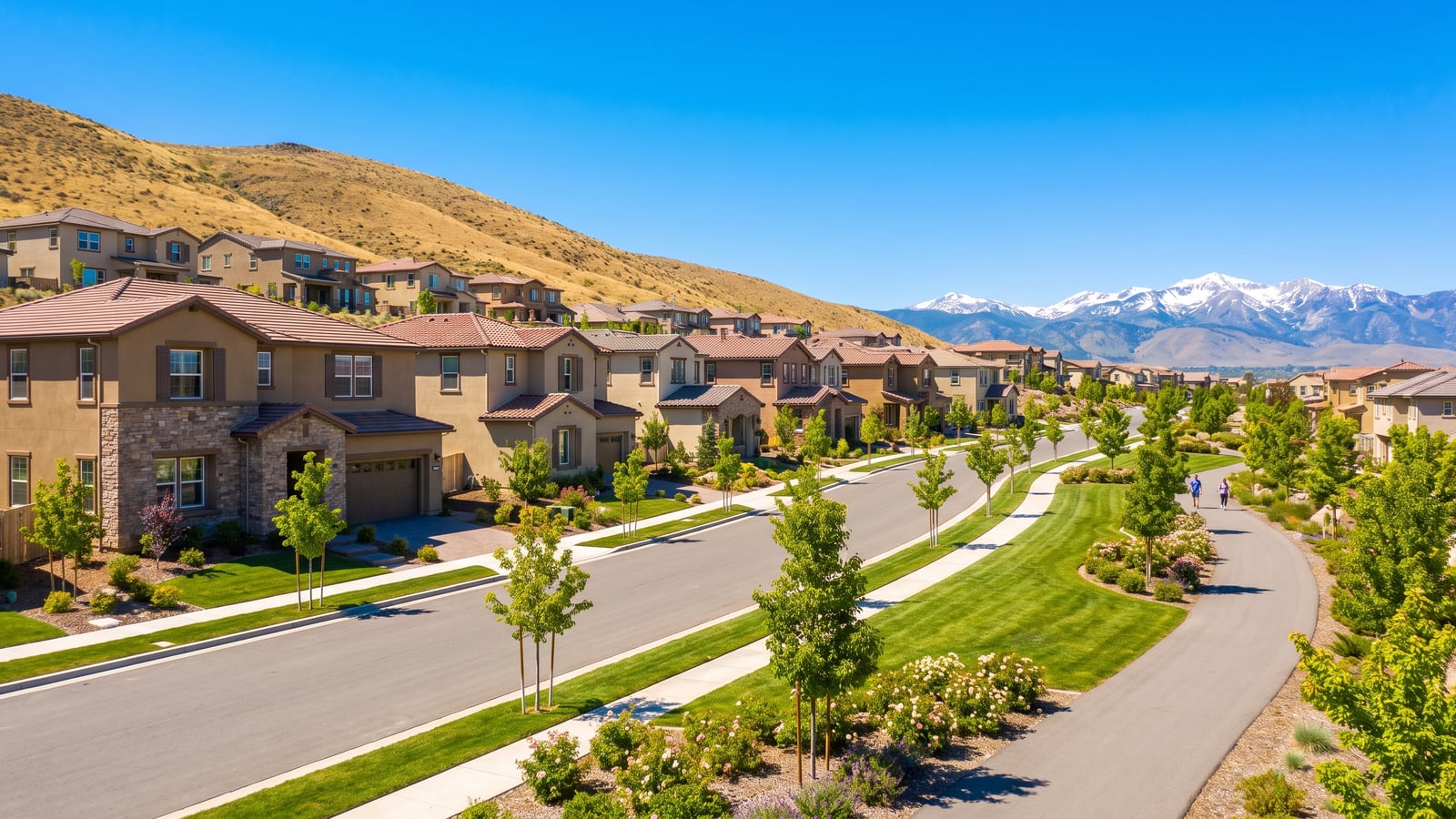
Sparks is the value engine of the metro and the city closest to the Tahoe-Reno Industrial Center jobs, and in 2026 it is also where the region's new-home builders have concentrated hardest. Over the twelve months ending September 18, 2026, Sparks closed 1,614 homes at a $534,990 median against 521 active listings — roughly $50,000 below Reno's median on a market moving at a similar clip. The split inside the city is stark. The Sparks core ZIPs closed 622 homes at a $439,000 median in a 49-day median with just 3.4 months of supply, the fastest major submarket in the region. The Spanish Springs and north Sparks corridor closed 992 at $585,000 with 347 actives and 4.2 months of supply, and 17% of those closings were homes built in 2025 or later — the highest new-build share anywhere in the Truckee Meadows.
That new-build concentration shows up community by community. Toll Brothers alone runs four open Sparks communities: Stonebrook with the Cordoba plan at $648,995 on a final opportunity and Tavira at $697,995, the gated 55+ Regency at Stonebrook from $495,000, Harris Ranch with Magnolia at $608,995 and Willows at $639,995, and Cinnamon Ridge at $674,995. Ryder Homes adds The Heights from $609,990 and Shadow Hills from $709,990. D.R. Horton's Golden Eagle opens at $537,990. The MLS confirms the depth: Wingfield Commons Unit 2 closed 38 new homes at a $545,890 median, the 5 Ridges phases closed 32 more between $519,950 and $617,005, and the Pioneer Meadows villages closed 28 across three phases in the $539,950 to $583,475 band.
Retirees and downsizers should also know Sierra Canyon by Del Webb, the region's established active-adult community on the northwest side, and buyers who want the amenity-rich trail-and-open-space package should look at Kiley Ranch and Wingfield Springs, where new-build volume moves with phase releases rather than running steady. Browse the full picture on our Sparks new-construction guide, and buyers comparing both sides of the metro can review the dedicated new construction in Sparks breakdown alongside the Reno builder choices here.
Should You Look at Dayton, Fernley, or the Carson Valley for a Lower Entry Price?
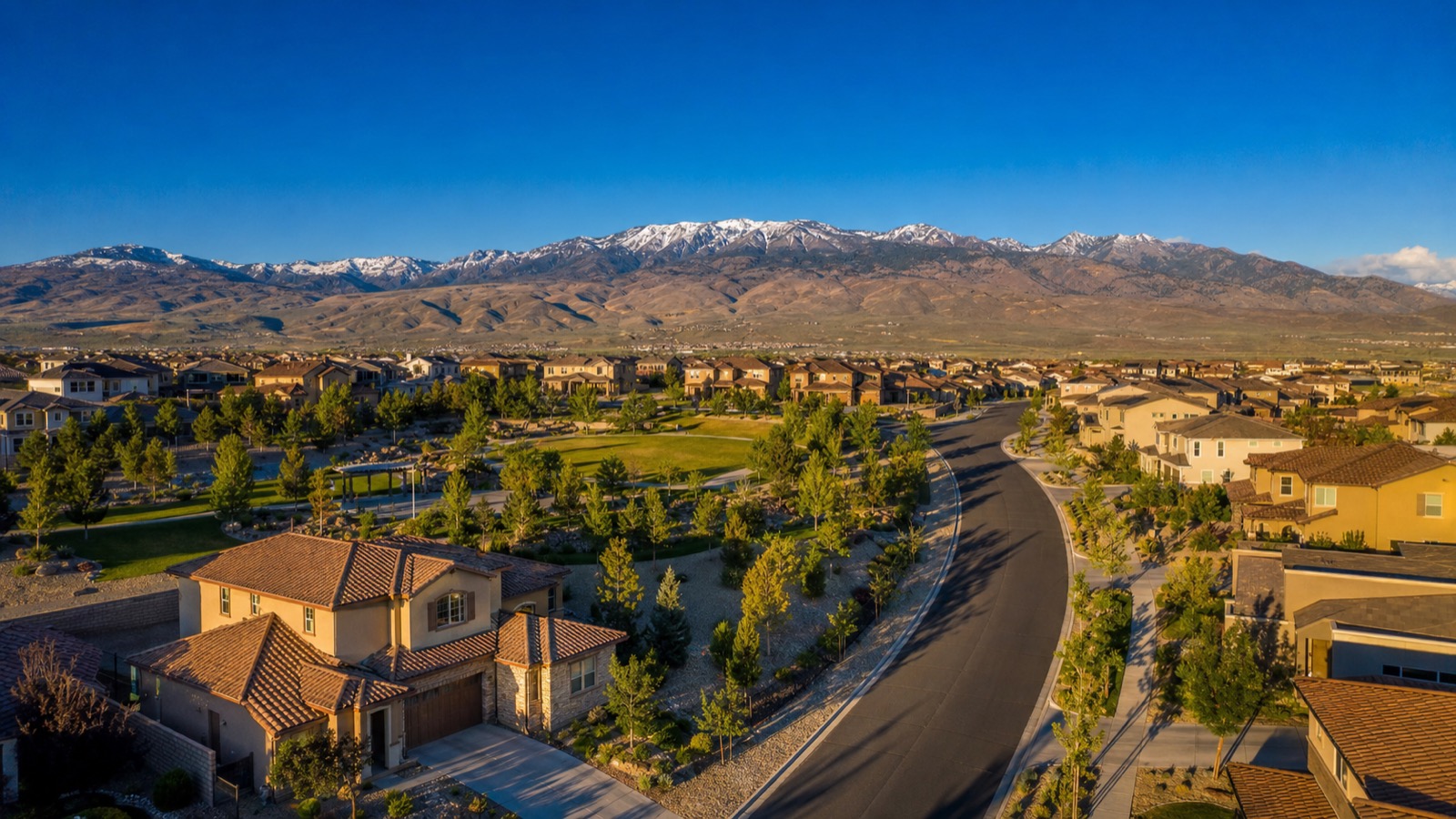
If the Reno-Sparks core has priced you out, Lyon County and the Carson Valley are the honest answer rather than a consolation prize — and in 2026 they are where two national builders are putting their most aggressively priced product. Dayton is the clearest example: Lennar's Gold Sky community runs $474,950 to $519,950 with seven homes available, and D.R. Horton is delivering the Woodbridge community from $467,990. Woodbridge is worth understanding structurally, because buyers confuse the name for a builder — it is a Tamarack Land development of 81 homes on 115 acres that started construction in August 2025, which means you are buying into a small, finite community rather than an open-ended master plan with a decade of construction traffic ahead of it.
Fernley, east on I-80, plays the same role on the industrial side of the map. The commute math is the point: Fernley sits about 20 minutes from the Tahoe-Reno Industrial Center warehouses, which means a logistics or manufacturing household can buy new there with a shorter drive to work than a considerably more expensive house in South Reno would give them. Dayton trades I-80 access for the US-50 corridor and proximity to Carson City government and healthcare employment, where Ryder Homes is selling Cross Creek from $504,990 — the cheapest new product from that builder anywhere in its Northern Nevada lineup.
The Carson Valley deserves a note even though it sits outside Reno proper. Gardnerville and Minden, 30 to 45 minutes south, are where local custom builders deliver larger-lot, single-story product — often the right answer for buyers who want shop space, RV parking, or a few acres that no Truckee Meadows master plan will ever offer. Across all three value corridors the same trade-off applies: you are buying commute minutes and thinner retail in exchange for a house that would cost six figures more inside Washoe County, and you are buying into a smaller resale pool when you eventually sell. See the dedicated Dayton new-construction page and Fernley new-construction page for live inventory in each.
How Much Does New Construction Cost by Northern Nevada Corridor?
Rather than quote builder billboard ranges, here is what each corridor actually did over the twelve months ending September 18, 2026 — closings, medians, price per square foot, speed, and months of supply, all from the September 19, 2026 pull. Months of supply is active listings divided by the monthly closing pace, and the four-to-six-month band is what economists generally treat as balanced.
| Corridor | Closings | Median sold | Per sq ft | Median DOM | Active | Months supply |
|---|---|---|---|---|---|---|
| South Reno | 1,279 | $810,000 | $370 | 63 | 450 | 4.2 |
| Damonte Ranch and Double Diamond | 693 | $709,950 | $346 | 64 | 240 | 4.2 |
| Spanish Springs and north Sparks | 992 | $585,000 | $298 | 62 | 347 | 4.2 |
| Northwest Reno | 779 | $569,999 | $337 | 52 | 220 | 3.4 |
| Old Southwest and Midtown | 719 | $585,000 | $333 | 56 | 280 | 4.7 |
| North Valleys | 779 | $459,000 | $288 | 56 | 224 | 3.5 |
| Sparks core | 622 | $439,000 | $293 | 49 | 174 | 3.4 |
| Downtown and university | 218 | $375,000 | $300 | 69 | 106 | 5.8 |
| Verdi and Somersett west | 11 | $829,000 | $345 | 71 | 5 | 5.5 |
Read that table as a map of leverage rather than a price list. The three corridors sitting at 3.4 to 3.5 months of supply — Northwest Reno, the North Valleys, and the Sparks core — are the ones where a well-priced listing still moves in under two months and where a builder has the least reason to sweeten a deal. The corridors at 4.2 months and above, especially South Reno at a 63-day median and the Downtown and university area at 5.8 months, are where standing inventory accumulates and where the incentive conversation gets real. Verdi is its own case: only 11 closings all year at an $829,000 median, so Toll's Quilici pricing between $906,995 and $1,174,995 is effectively setting the market rather than following it.
Remember that a builder's advertised "from the $500s" is a base price for the smallest floor plan on the least desirable lot with builder-grade finishes. The realistic all-in number is base price plus lot premium plus design-center selections — which is why the live MLS medians above run meaningfully higher than the billboard numbers on Pyramid Highway.
Is New Construction Worth the Premium Over a Reno Resale?
The honest answer depends on which trade-offs you value, so here is the whole decision in one table:
| Decision dimension | New construction | Resale |
|---|---|---|
| Asking price | $714,950 median ask, about a 12% premium | $641,000 median ask citywide |
| What it closed at | $679,975 for new single-family; $452,175 attached | $585,000 across all 3,801 closings |
| Price per square foot | $316 on new-build closings | $330 across the market |
| Warranty | 1/2/10 structure backed by Nevada NRS 40 | None unless negotiated or transferable |
| Snow load and energy code | Built to current Sierra snow-load and efficiency code | Varies by decade — verify insulation and roof detail |
| Customization | Design center and structural options before drywall | Renovate after close, at retail cost |
| Negotiability | Incentives, not price: buydowns, credits, upgrades | Direct price and repair negotiation |
| Landscaping and window coverings | Usually not included — budget for them after close | Included, mature |
| Timeline | 30 to 60 days on specs; 6 to 12 months build-to-order | 30 to 45 day close |
| HOA track record | Unknown — new association, builder-controlled board | Years of financials and minutes to review |
Across the 9,600+ closings our team has represented, the buyers happiest with the new-build premium are the ones who monetize the warranty and the code vintage: households planning to hold seven-plus years, buyers who'd otherwise spend heavily renovating a 1990s resale, and anyone who values the first-owner certainty of knowing exactly what's behind the drywall. The buyers who regret it are usually the ones who forgot the after-close costs — backyard landscaping on a Reno production lot is a real four-or-five-figure line item that no builder includes — or who paid a view-lot premium they didn't actually care about. The per-square-foot column is the underrated row in that table: at $316 against a $330 market, new construction in Reno is not expensive per foot, it is simply bigger.
How Does the Tesla and TRIC Commute Shape Where You Buy?
The Tahoe-Reno Industrial Center — home to Tesla's Gigafactory, Switch, Google, Panasonic, and a deep bench of logistics operators — sits east of Sparks on I-80, and it quietly re-ranks every new-home corridor in the region. According to the Economic Development Authority of Western Nevada (EDAWN), the industrial corridor's expansion has been the region's dominant jobs story for a decade. According to the U.S. Bureau of Labor Statistics, the Reno-Sparks MSA has kept adding employment through 2026 on the strength of manufacturing, logistics, and healthcare.
Practical commute rankings to the industrial center from the new-build corridors: Fernley is the shortest run at roughly 20 minutes eastbound against traffic. Spanish Springs and east Sparks — Stonebrook, Harris Ranch, Wingfield Springs — run 25 to 35 minutes via Pyramid and I-80, which is exactly why that corridor carries the region's highest new-build share. South Reno is 35 to 45 minutes depending on where in the corridor you start. Somersett and northwest Reno sit at the back of the pack at 40 to 50 minutes, which is why the northwest skews toward remote workers, healthcare and university commuters, and retirees rather than industrial-corridor households.
Match the corridor to the commute before you fall in love with a model home. The arithmetic is unforgiving: a $50,000 price advantage spread over a 30-year loan is worth a few hundred dollars a month, and 90 extra minutes of round-trip driving five days a week is roughly 375 hours a year. Buyers routinely optimize the first number and ignore the second, then list the house in three years. If you're weighing the move from out of state, my honest pros and cons of moving to Reno covers the tax math too — Nevada's zero state income tax remains the single biggest line item for relocating households.
What Do Altitude, Snow Load, Water, and Wildfire Mean for a New Build?
Reno sits at 4,500 feet with real winters, and Northern Nevada new construction carries site-specific realities that most national how-to articles never encounter:
- Snow load and roof detail. Truckee Meadows homes are engineered for Sierra-influenced snow loads, and foothill communities like Somersett, Galena, and Montreux carry higher design loads than the valley floor. On a pre-drywall inspection, roof framing and ice-dam detailing are the items I have my inspectors slow down on.
- Winter build timelines. Concrete doesn't cure well below freezing, and framing crews lose days to storms. A build-to-order contract signed in October will realistically deliver later than the same contract signed in March — plan rate locks and lease-back timing around it, and get the builder's delay provisions in writing.
- Water is metered policy, not vibes. According to the Truckee Meadows Water Authority, new development connects only where dedicated water resources are committed — one reason approved-lot supply in the Truckee Meadows is structurally tighter than in fast-growing desert markets elsewhere, and one reason entitled master plans like Talus Valley matter so much to future supply.
- Wildfire and defensible space. Foothill communities are built to modern defensible-space and best-management-practice standards, a genuine advantage over 1980s foothill resale, but insurance pricing still varies block by block. Get your homeowner's insurance quote during the contingency window, not the week before closing.
- Property taxes stay tame. According to the Nevada Department of Taxation, owner-occupied primary residences are capped at a 3% annual property-tax increase under NRS 361.4723 — one more line in Nevada's favor against the coastal states most of our relocating buyers arrive from.
How Do You Negotiate a Builder Contract and Its Incentives in Nevada?
According to Freddie Mac's Primary Mortgage Market Survey, the 30-year fixed averaged 6.76% for the week of September 10, 2026 — which is exactly why builders are competing on incentives rather than base price. In Northern Nevada this fall, the packages we're seeing across active communities include closing-cost credits usually tied to using the builder's affiliated lender, temporary 2-1 buydowns that cut your first-year rate by two points, permanent buydowns, design-center allowances most common on standing inventory the builder wants moved before quarter-end, and lot-premium waivers or appliance packages on specs that have sat more than 60 days. To size the buydown: on a $650,000 purchase with 20% down, moving the rate from 6.76% to 5.76% cuts principal and interest by roughly $340 a month, every month, for as long as you hold the loan.

The negotiating leverage hierarchy is simple. Standing inventory at quarter-end is where builders bend the most, and the "final opportunity" language now on Toll's Cordoba plan at Stonebrook is exactly the signal to look for. A to-be-built home in a hot phase is where they bend least. And always price the builder-lender tie-in honestly — a large credit that requires a loan priced above market can be a wash or worse over a seven-year hold. We run that math on every builder deal we represent.
Builder purchase agreements are also not Nevada's standard resale forms — they're drafted by the builder's counsel, for the builder. Nevada law gives you a floor: NRS 40 provides the constructional-defect framework behind the standard 1/2/10 warranty of one year workmanship, two years systems, and ten years structural. According to the Nevada State Contractors Board, every general contractor building your home must hold an active Nevada license you can verify online in about two minutes. Everything above that floor is negotiation:
- Get pre-approved with an independent lender first, then let the builder's lender compete. The independent letter is your pricing benchmark and your leverage.
- Cap the escalation and delay exposure. Push for defined outside-completion dates and remedies, and understand exactly what the material-substitution clause allows the builder to swap.
- Negotiate the earnest money and default terms. Builder contracts often make deposits harder to recover than resale escrows — know what happens to your money if your loan falls through in month eight.
- Put every model-home feature in writing. The staged model is loaded well above base price. Get the base-elevation spec sheet and reconcile line by line.
- Order third-party inspections at pre-pour, pre-drywall, and final. Builders in this market accept them routinely; it is the cheapest insurance in the deal.
- Watch the HOA and special-assessment disclosures. Some newer communities carry special assessment districts on top of HOA dues, and an assessment materially changes the monthly payment on an otherwise identical house.
Do You Need Your Own Agent to Buy New Construction in Reno?
You aren't required to bring one — and that's exactly why the builder's sales office would prefer you didn't. The on-site agent works for the builder, full stop. Your own buyer's agent costs you nothing, because the builder pays the co-op and walking in unrepresented does not lower the price; the co-op simply stays with the builder's side. But most builders require your agent to register with you at your first visit. Show up alone on Saturday, and you may have waived representation for that community before you knew you wanted it.
What representation actually gets you on a new build: release-calendar intelligence on which phases are opening and at what pricing, lot-premium history across the community, incentive comps from the builder's other buyers, a professional read on the purchase agreement, inspection scheduling at the right construction milestones, and a negotiator who isn't emotionally invested in the model home's kitchen. It also gets you the check we ran for this guide on September 19, 2026 — a live confirmation of which communities are genuinely open, because three of the region's best-known Toll Brothers neighborhoods closed out without the roundup articles noticing.
Nevada Real Estate Group is the #1-ranked team in Nevada with 9,600+ closings and 789 transactions in 2025 alone, and our Northern Nevada agents work builder releases from Somersett to Spanish Springs every week. Start with the live inventory on Reno homes for sale or the statewide search, tell us what you're looking for through our contact page, or call our Northern Nevada office at (775) 277-2120 before your first model-home tour — we're at 1755 E Plumb Ln in Reno. And if a current home has to sell before the build closes, start with our home value estimator and seller playbook so the two timelines actually meet in the middle.
Frequently Asked Questions
Which builders are actively selling in Reno right now?
Six builders were publishing open Northern Nevada communities when we checked their own websites on September 19, 2026: D.R. Horton, Toll Brothers, Ryder Homes, Lennar, Jenuane Communities, and Desert Wind Homes. Toll Brothers runs the most communities at eight, concentrated in Sparks and South Reno. D.R. Horton is the only builder with open communities in Reno, Sparks, and Lyon County at once. Tri Pointe Homes shows no Reno-area communities, and KB Home, Century Communities, and Woodside Homes are building only at the southern end of the state.
What do new-construction homes in Reno start at in 2026?
The lowest published base price we verified in Reno on September 19, 2026 was $406,990 at D.R. Horton's Phoenix community, with Trailside at $475,990 and the Wolf Ridge townhomes near the university at $539,990. Across the MLS, the 118 active new-construction listings in Reno carry a $714,950 median ask, and the cheapest active new-build listing sits at $406,990 with the most expensive at $5,285,000. Dayton starts lower still, with Lennar's Gold Sky from $474,950 and D.R. Horton's Woodbridge from $467,990.
How long does a new build take in Reno's climate?
Plan on six to twelve months for build-to-order production homes, and add winter cushion: concrete pours and framing slow between December and March at 4,500 feet, so a fall contract typically delivers later than a spring one. Standing inventory and spec homes close on a normal 30-to-60-day timeline. Get outside-completion dates and delay remedies written into the contract rather than relying on the sales office's verbal estimate, and time your rate lock to the contractual date rather than the optimistic one.
Do I need my own agent to buy a new-construction home?
It's not required, but it costs you nothing and the builder's on-site agent represents the builder, not you. The critical detail is timing: most builders only honor buyer representation if your agent registers with you at your first visit. Bring your agent, or at least name them on the sign-in sheet, before you tour, and you keep professional contract review, incentive comps, and inspection scheduling on your side of the table. Walking in alone does not reduce the price by a dollar.
Are builder incentives really negotiable in 2026?
Yes, considerably more than base price is. With the 30-year fixed at 6.76% for the week of September 10, 2026 per Freddie Mac, Northern Nevada builders are competing through closing-cost credits, temporary and permanent rate buydowns, and design-center allowances, with the deepest deals on standing inventory near quarter-end. Watch for explicit closeout language: Toll Brothers' Cordoba plan at Stonebrook was flagged as a final opportunity at $648,995 on September 19, 2026, and final-opportunity homes are where builders concede most.
Is new construction or resale the better buy in Reno's 2026 market?
The live spread is a $714,950 median ask on new construction against $641,000 citywide, about 12%. But new construction actually closed at $316 per square foot against $330 for the market as a whole, so the premium is size rather than unit cost. New construction wins if you'll hold long enough to monetize the warranty, current snow-load and energy code, and zero-renovation entry; resale wins on mature landscaping, established HOA track records, and the ability to negotiate on price directly rather than through incentives.
Where in Reno is most of the new construction happening?
South Reno dominates: the 89521 ZIP holds 40 of the city's 118 active new-construction listings at a $787,450 median, and the Talus Valley East Village phases alone carry 35 of them. The North Valleys are second with 26 actives at a $534,890 median, where Sierra Vista, Vista Enclave, Arroyo Crossing, and Legacy Village townhomes deliver the region's most affordable new keys. The foothill ZIP 89511 carries 17 actives at a $2,400,000 median, and Verdi's Quilici Ranch adds four at $1,165,000.
Which Sources Inform This Reno New-Construction Guide?
Live inventory counts, medians, price per square foot, days on market, and months of supply come from Nevada Real Estate Group's Northern Nevada MLS feed via Repliers IDX, pulled September 19, 2026 — closings cover September 19, 2025 through September 18, 2026 with land excluded, actives are as of September 18, 2026, and new construction is defined as a recorded year built of 2024 or later. Community names, availability, and every published base price in this guide were verified against the builders' own websites on September 19, 2026; where a builder's community page would not load, the price is marked unavailable rather than estimated. Additional context draws on these authorities:
- D.R. Horton — Reno, Nevada communities — community roster and published base pricing
- Toll Brothers — Nevada communities — open communities, plan pricing, and closeouts
- Lennar — Nevada — Northern Nevada availability
- Ryder Homes — regional community roster
- Jenuane Communities — Reno and Carson City communities
- Northern Nevada Regional MLS (NNRMLS) — the listing data backbone for the region
- Sierra Nevada REALTORS (SNR) — regional market statistics and context
- U.S. Bureau of Labor Statistics — Reno-Sparks MSA — employment trends
- Economic Development Authority of Western Nevada (EDAWN) — industrial corridor and regional jobs pipeline
- Nevada Department of Taxation — property-tax caps and abatements
- Nevada Revised Statutes Chapter 40 — constructional-defect and warranty framework
- Nevada State Contractors Board — contractor licensing verification
- Truckee Meadows Water Authority — water-resource commitments for new development
- Freddie Mac Primary Mortgage Market Survey — mortgage-rate benchmarks
- City of Reno — planning, permitting, and development context
Ready to walk a framing site instead of a spreadsheet? Call or text Nevada Real Estate Group's Northern Nevada office at (775) 277-2120, browse the full new-construction hub, or start with everything currently listed among Reno's new homes for sale.