

Published April 30, 2026 · Last updated July 14, 2026 · By Chris Nevada, Nevada Real Estate Group · NV License S.181401
Moving to Las Vegas in 2026 keeps penciling out in the relocator's favor, and the live MLS data proves it. As of mid-July 2026, the City of Las Vegas alone carries 8,742 active for-sale listings at a $470,743 median list price, homes are going under contract in a median of 26 days, and the valley is sitting on 7.8 months of supply — the most breathing room out-of-state buyers have had since 2020. Pair that inventory with zero state income tax and a cost of living roughly 2%–3% above the national average, and the math is easy. I'm Chris Nevada, founder of Nevada Real Estate Group – LPT Realty, the #1 real estate team in Nevada. In 2025 our 150-agent team closed 789 homes worth more than $440 million — a large share of them for relocating families — on top of 9,600+ career closings. This is the guide I share on the first call with every relocating client.
Moving to Las Vegas in 2026 pairs zero state income tax with a genuinely buyer-friendly market: 8,742 active listings citywide, a $470,743 median list price, a 26-day pace, and 7.8 months of supply. Nevada's no-income-tax swing saves a $150,000 earner roughly $12,000–$18,000 a year versus California. Summerlin ($648,950), Henderson ($541,626), and North Las Vegas ($425,000) anchor the best newcomer neighborhoods across a wide price range.
- Las Vegas holds 8,742 active listings at a $470,743 median and a 26-day pace — real buyer leverage.
- Nevada's zero income tax saves a $150,000 household roughly $12,000–$18,000 a year versus California.
- Summerlin ($648,950) and Henderson ($541,626) lead for families; North Las Vegas ($425,000) is the value play.
- Budget summer power bills of $250–$450/month and $16,700–$35,100 in relocation costs beyond the purchase.
- Visit first, establish Nevada residency within 30 days, then lean on a local agent for school-zone precision.
Why Are So Many People Moving to Las Vegas in 2026?
In 35 years of selling real estate in this valley, I've never seen relocation demand as broad-based as it is now. Clark County's population has crossed 2.42 million and continues to grow roughly 1.7% a year, and the overwhelming majority of Nevada's in-migration lands in the Las Vegas metro. According to the U.S. Census Bureau, Nevada remains one of the fastest-growing states in the country, and the American Community Survey shows the Las Vegas-Henderson-Paradise MSA absorbed roughly 45,000 net California-origin residents over the trailing 24 months ending Q1 2026.
Four forces drive the wave, and every one of them shows up in the conversations we have with relocating buyers. No state income tax — Nevada is one of only nine states with zero. Housing that still pencils — a $470,743 median is a fraction of what a comparable home costs in Los Angeles, San Diego, or the Bay Area, where medians routinely clear $900,000 to $1.3 million. A diversifying job base — hospitality is still the anchor, but healthcare, logistics, advanced manufacturing, and clean energy are adding higher-wage roles. And lifestyle — pro sports (Raiders, Golden Knights, Aces, and the Formula 1 Grand Prix), Red Rock Canyon, Lake Mead, and 300+ days of sunshine a year.
Across the 9,600+ closings our team has represented, the single most common relocation profile is a dual-income household leaving a high-tax coastal state, trading a cramped condo for a single-family home with a yard and a pool — and pocketing the tax difference. If that sounds like you, start with our Las Vegas buyer resources and the city-wide homes-for-sale hub.
How Does Nevada's Zero State Income Tax Change Your Budget?
The headline everyone knows is that Nevada charges no state income tax. What newcomers underestimate is how much that reshapes take-home pay. According to the Tax Foundation, Nevada is one of just nine states with no individual income tax, and it also imposes no tax on capital gains, retirement income, or Social Security benefits.
Here is the practical effect. California's top marginal rate reaches 13.3%, and even a middle-income household pays 6%–9.3%. A family relocating from California earning $150,000 keeps an additional $12,000–$18,000 a year simply by changing their tax address — money that, in Las Vegas, covers a mortgage-payment difference, a pool, or a private-school tuition line. For high earners at $500,000+, the annual swing can exceed $40,000–$100,000.
Nevada makes up part of the gap through a 6.85% state sales tax (Clark County's combined rate runs about 8.375%) and property taxes, but those are modest by national standards. According to the Clark County Assessor, residential property is assessed at 35% of taxable value, and Nevada's 3% annual cap on owner-occupied assessment increases (NRS 361.4722) protects primary-residence buyers from the runaway tax bills common in other boom markets.
| Tax type | Nevada | California | New York |
|---|---|---|---|
| State income tax | 0% | 1%–13.3% | 4%–10.9% |
| Capital gains tax | 0% state | up to 13.3% | up to 10.9% |
| Estate tax | None | None | up to 16% |
| Property tax (eff.) | ~0.53% | ~0.71% | ~1.4% |
| Sales tax | 8.375% (Clark Co.) | 7.25%–10.25% | 8%–8.875% |
For most relocating families, the no-income-tax swing dwarfs the sales-and-property-tax cost — which is exactly why the migration keeps flowing east across the state line. I've written a detailed breakdown in our Las Vegas property tax guide that every buyer should read before closing.
What Does It Actually Cost to Live in Las Vegas in 2026?
According to multiple cost-of-living indices, Las Vegas sits roughly 2%–3% above the national average overall, making it one of the more affordable major cities in the western United States. The category breakdown is where the real story lives, because housing and utilities run above average while healthcare and everyday goods run well below it.
| Category | vs. U.S. average | Typical Las Vegas figure |
|---|---|---|
| Housing | ~5% above | $470,743 median list; about $1,567 avg rent |
| Utilities | ~9% above | $242/mo average; $250–$450 summer electric |
| Groceries | 3%–4% above | about $800–$1,000/mo for a family of four |
| Healthcare | 15%–16% below | Sunrise, UMC, St. Rose, Summerlin Hospital systems |
| Transportation | ~15% above | Gas about $4.01/gallon; RTC transit |
| Goods & services | 16% below | Dining, haircuts, everyday purchases |
The bottom line: a single person lives comfortably on about $55,000–$70,000 a year, and a family of four typically needs $5,400–$5,700 a month, or roughly $65,000–$85,000 annually depending on housing choices. According to the U.S. Bureau of Labor Statistics, the West's inflation picture has cooled, and Las Vegas households frequently report saving 25%–40% on housing alone relative to coastal California. Run your own numbers against a real payment with our home-value estimator before you lock a budget. For a deeper city-to-city comparison, our Las Vegas vs. San Diego cost-of-living breakdown quantifies the coastal-to-Vegas savings line by line.
What Is the Las Vegas Housing Market Like for Newcomers Right Now?
This is the most buyer-friendly Las Vegas market since 2020, and the live GLVAR data backs it up. Below is the current picture across the four major jurisdictions relocating buyers actually shop, pulled directly from the MLS in July 2026. This is the table to study first — it shows exactly where your money goes furthest and where competition is thinnest.
| Metric | Las Vegas | Henderson | North Las Vegas | Boulder City |
|---|---|---|---|---|
| Median list price | $470,743 | $541,626 | $425,000 | $430,000 |
| Active listings | 8,742 | 2,481 | 1,068 | 139 |
| Median days on market | 26 | 28 | 22 | 43 |
| Months of supply | 7.8 | 7.5 | 6.5 | 9.3 |
A few things jump out. First, North Las Vegas is both the most affordable ($425,000 median) and the fastest-moving (22 days) — value shoppers are competing hardest there. Second, the whole valley is sitting on 6.5–9.3 months of supply, which historically signals a balanced-to-buyer market rather than the frenzy of 2021–2023. According to Las Vegas REALTORS, that inventory rebuild is why relocating buyers are once again winning seller concessions on closing costs and repairs.
The City of Las Vegas sold median over the trailing 90 days is $440,050 (average sold $559,833), meaning most closed homes trade below the active list median — real evidence of negotiating room. Mortgage rates have held in a 6.4%–6.8% band per Freddie Mac's Primary Mortgage Market Survey, with major forecasters projecting a range between 5.90% and 6.30% later in 2026. When you're ready, start your Las Vegas home search here or browse the first-time buyer guide.
Which Las Vegas Neighborhoods Are Best for People Relocating?
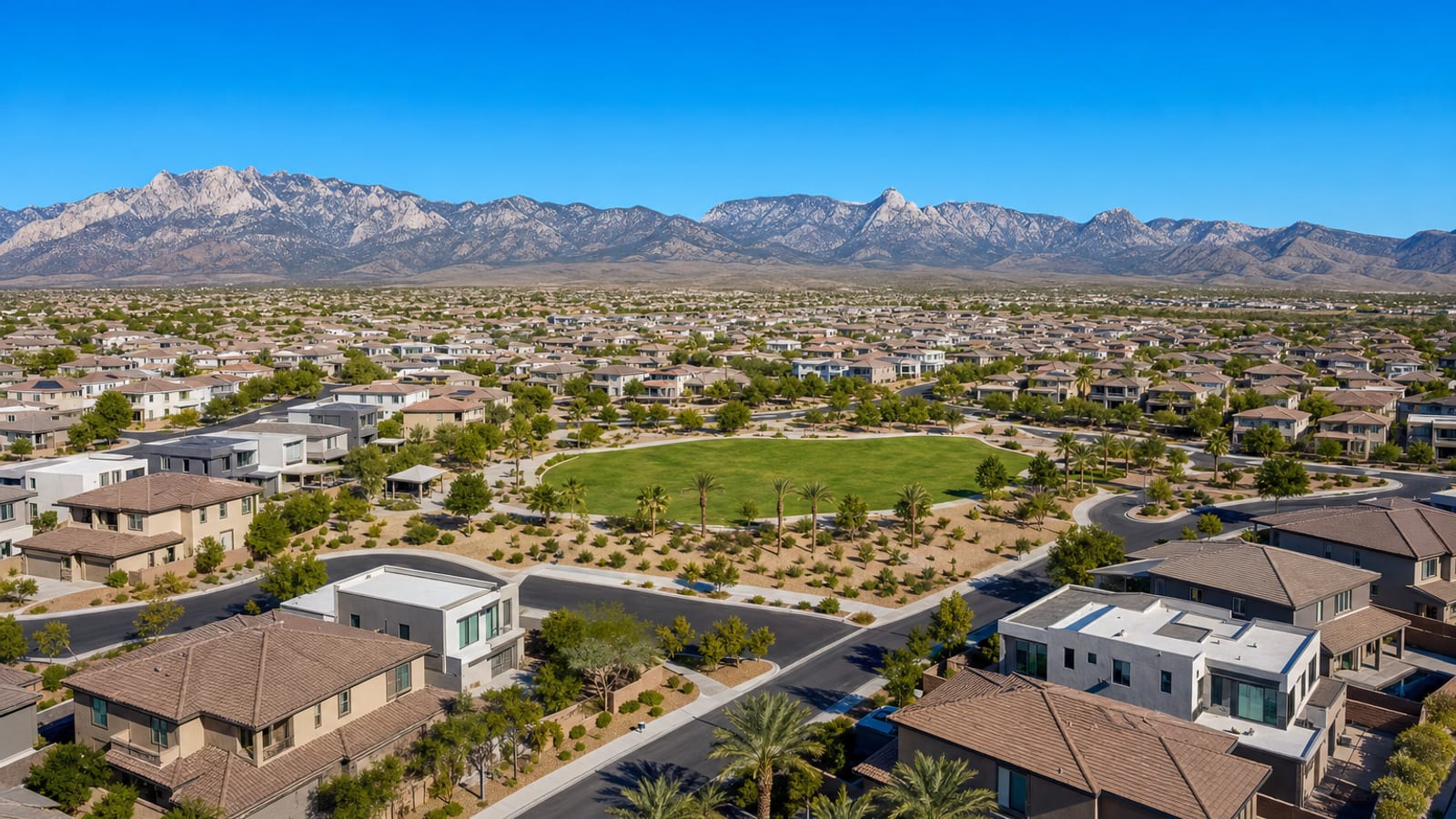
Las Vegas is not one neighborhood — it is a valley of 40+ distinct master-planned communities, each with its own price point, school zones, and personality. Here is where most of our relocation clients land, with live median list prices pulled from the MLS in July 2026.
| Community | Median list | Days on market | Best for |
|---|---|---|---|
| Summerlin | $648,950 | 30 | Families, outdoor lifestyle, resale strength |
| Anthem (Henderson) | $592,450 | 29 | Guard-gated + master-plan, move-up families |
| Skye Canyon | $568,000 | 32 | New construction, active young families |
| Inspirada (Henderson) | $552,007 | 28 | Parks, master-plan amenities |
| Mountain's Edge | $520,000 | 19 | Southwest commuters, 215 access |
| Cadence (Henderson) | $500,000 | 31 | Value master-plan, first move-up buyers |
| Green Valley (Henderson) | $485,000 | 25 | Established schools, central location |
| Aliante (North LV) | $479,945 | 19 | Golf-adjacent, budget-friendly families |
| Centennial Hills | $439,500 | 42 | Northwest value, newer inventory |
Not sure which area fits your budget and commute? Contact our team for a personalized neighborhood shortlist, or explore the luxury communities hub if you're shopping the top of the market. Southern Highlands, one of the valley's guard-gated golf enclaves, currently runs a $1,049,500 median for buyers shopping the luxury band.
How Do Summerlin, Henderson, and the Southwest Compare for Families?
Summerlin is the valley's premier master plan, hugging the western foothills against Red Rock Canyon. It offers top-rated schools, 150+ miles of trails, and the Downtown Summerlin retail-and-dining core. The $648,950 median list price across 1,482 active listings and a 30-day pace reflects steady demand — Summerlin homes hold value better than almost anything in the valley. Browse current Summerlin homes for sale to calibrate your budget.
Henderson consistently ranks among the safest cities in America, with a population over 320,000 and master plans like Cadence, Inspirada, and Anthem spanning the mid-$400,000s to well over $2 million. The citywide median list price is $541,626 across 2,481 active listings. Henderson's Apex-area industrial growth and its proximity to the airport make it a smart long-term hold — the community's Seven Hills and MacDonald Highlands enclaves anchor its luxury end. See live Henderson homes for sale.
Southwest Las Vegas — Mountain's Edge ($520,000 median), Rhodes Ranch, and Southern Highlands ($1,049,500) — delivers modern homes with quick 215 Beltway access at a range of price points. It's the sweet spot for commuters who want newer construction without top-of-Summerlin pricing. If a brand-new build appeals, start with the new-construction hub.
Where Should Budget-Conscious Buyers Look in North Las Vegas?
North Las Vegas is the value engine of the valley. At a $425,000 median list price with 1,068 active listings and a fast 22-day market pace, it's where first-time and budget-focused relocators find the most house for the money. New construction from national builders starts in the high $300,000s, and master plans like Aliante ($479,945 median) and Tule Springs offer parks, golf, and newer schools without Summerlin-level pricing.
The trade-off is commute distance to the Strip and the airport, but for remote workers and families prioritizing square footage, North Las Vegas is frequently the smartest buy in the metro. According to Las Vegas REALTORS inventory reports, the northern submarket has absorbed a wave of new-build supply, which keeps pricing competitive. Explore North Las Vegas homes for sale to see current inventory, and if a small-town feel appeals, Boulder City ($430,000 median) offers a lakeside, no-gaming alternative 30 minutes southeast.

Is Summerlin Part of the City of Las Vegas or Its Own Town?
This trips up almost every newcomer, so it's worth clarifying early. Summerlin is not a separate city — it is a master-planned community, and its addresses fall partly within the incorporated City of Las Vegas and partly within unincorporated Clark County. There is no "City of Summerlin" government; your municipal services, jurisdiction, and even your mailing city label depend on which village you buy in.
Why does that matter to a relocating buyer? Because it drives your property-tax district, trash and utility providers, and which police department responds — City of Las Vegas Metro versus Clark County services differ by parcel. Henderson, by contrast, is its own incorporated city with its own police, courts, and municipal code, which is part of why its safety statistics are tracked separately and rank so highly. When we run comps for a Summerlin or Henderson buyer, we confirm the exact jurisdiction on the parcel before quoting a tax figure — never assume the community name equals the taxing authority. If you want the boundary and jurisdiction confirmed for a specific home, reach out to our team.
What Will You Really Pay in HOA, LID/SID, and Property Taxes?
Master-planned living in Las Vegas almost always means layered assessments, and lumping them into "one HOA fee" is the most common budgeting mistake newcomers make. There are typically three separate line items, and they stack.
| Assessment layer | Who charges it | Typical range |
|---|---|---|
| Master association | The master plan (e.g., Summerlin, Cadence) | $50–$110/mo |
| Sub-association | Your specific village or gated enclave | $40–$250+/mo |
| LID / SID bond | County-levied infrastructure bond on the tax bill | $400–$1,800+/yr, for a fixed term |
So a home advertised with a "$110/month HOA" can actually carry a master fee, a gated sub-association fee, and a Local Improvement District (LID) or Special Improvement District (SID) bond baked into the annual property-tax bill — an infrastructure repayment that funded the streets and utilities when the community was built. According to the Clark County Assessor, those SID/LID line items appear directly on the parcel's tax statement and can add several hundred to well over a thousand dollars a year until the bond retires. Across the master-plan deals we've represented, verifying all three layers up front is the difference between an accurate budget and a $150/month surprise. Most master-plan HOAs land at $1,200–$1,800 a year before you add a gated sub-association or an active SID. Don't miss the homestead exemption either — filing at the Clark County Assessor reduces your assessed value and saves $240–$320 a year on a primary residence, and it takes about 10 minutes.
What Does It Cost to Physically Move, and How Long Does It Take?
Beyond the home purchase, relocators need to budget for the full cost of establishing a Las Vegas life. Here is the real breakdown based on our data across 2,000+ relocations.
| Expense | From West Coast | From East Coast | From Midwest |
|---|---|---|---|
| Moving company | $4,500–$7,000 | $8,000–$12,000 | $6,000–$9,000 |
| Temporary housing (1–2 mo) | $3,000–$5,500 | $3,000–$5,500 | $3,000–$5,500 |
| Inspection + appraisal | $850–$1,300 | $850–$1,300 | $850–$1,300 |
| Closing costs (2%–3%) | $8,000–$15,000 | $8,000–$15,000 | $8,000–$15,000 |
| NV license + vehicle reg | $150–$800 | $150–$800 | $150–$800 |
| Utility deposits | $200–$500 | $200–$500 | $200–$500 |
| Total (beyond purchase) | $16,700–$30,100 | $20,200–$35,100 | $18,200–$32,100 |
The surprise cost for California relocators is Nevada's governmental services tax on vehicle registration, based on the vehicle's original MSRP — expect $300–$800 per vehicle in the first year for newer cars, declining annually. The offset is dramatic: Nevada's zero income tax saves a $200,000 household roughly $18,000 in the first year alone, more than covering the entire relocation. For most relocators, the move pays for itself within the first 6–12 months.
On timeline, most relocators need 60–90 days from "we're doing this" to "we're in": 2–3 weeks researching neighborhoods, 2–4 weeks on the home search and offer, and 30–45 days to close (cash buyers can close in 14–21 days). The biggest mistake I see is trying to buy on a first 3-day visit without understanding the submarkets. Every relocator I've worked with who bought during a rushed house-hunting trip risked the wrong school zone, wrong commute, or wrong HOA culture. Rent short-term or do the research trip first and the purchase trip second. And there's a real cost to waiting — at roughly 3.7% annual appreciation on a $470,000 median, every month of delay costs about $1,450 in price plus $1,500–$2,500 in rent that builds zero equity.
How Do You Handle the Nevada DMV, Residency, and Your First 30 Days?
The DMV is the most logistically frustrating part of any Las Vegas relocation. Both your driver's license and vehicle registration must be completed within 30 days of establishing residency. Book a license appointment online at dmvnv.com — walk-in wait times average 2–3 hours. Bring your current out-of-state license, proof of Nevada address, Social Security card, and proof of identity; a written knowledge test and vision test are required, and the standard license fee is $42.25 (valid 8 years). Vehicle registration requires a Nevada smog check ($25–$35), a VIN inspection, proof of Nevada insurance, and the governmental services tax. According to the Nevada DMV, new residents must complete both within that 30-day window, so schedule the appointment 2–3 weeks before your move — the Henderson (240 S Water St) and Sahara (8250 W Sahara Ave) offices consistently have the shortest waits.
| Timeframe | Task | Details |
|---|---|---|
| Day 1–3 | Utilities setup | NV Energy, Southwest Gas, LV Valley Water District, Republic Services — most activate online in 24–48 hrs |
| Day 1–3 | Internet | Cox and CenturyLink/Lumen dominate; schedule install 1–2 weeks ahead |
| Day 7–14 | DMV — license + registration | Smog check first, then DMV; bring title, insurance, NV license |
| Day 7–14 | Update address | USPS forwarding; banks, insurance, employer, subscriptions |
| Day 14–21 | Voter registration | Online or at the DMV during your license appointment |
| Day 14–30 | School enrollment | Register at your zoned CCSD school with proof of address and immunization records |
| Day 30 | Homestead exemption | File at the Clark County Assessor — reduces assessed value, saves $240–$320/yr |
To claim Nevada's no-income-tax status you must establish genuine residency — the Nevada license and registration, voter registration, and Nevada as your primary domicile 183+ days a year. California's Franchise Tax Board actively audits part-year moves, so keep clean documentation: a primary-residence purchase is the strongest evidence you've actually moved.
What Is the Weather Really Like Month to Month?
Las Vegas has a hot desert climate — 300+ days of sunshine and only about 4 inches of rain a year. The summer heat is the single biggest adjustment for transplants, but it's dry heat, and life revolves around pools, early mornings, and air conditioning.
| Season | Typical highs | What to plan for |
|---|---|---|
| Spring (Mar–May) | 72°F–90°F | Best weather of the year; ideal for house hunting and hiking |
| Summer (Jun–Aug) | 100°F–110°F | Pool season; budget $250–$450/mo for AC |
| Fall (Sep–Nov) | 67°F–94°F | Patio dining, outdoor events, comfortable evenings |
| Winter (Dec–Feb) | 57°F–64°F | Light jacket; day-trip skiing on Mount Charleston |
Snow is rare on the valley floor but common on nearby Mount Charleston, which tops 11,900 feet and offers day-trip skiing 45 minutes from the Strip. New-construction homes with 2026 energy codes and solar run $150–$250/month in summer versus $300–$450 for an older 2,500-square-foot home, so if budget control matters, buy a home built after 2020 with solar. For most newcomers, once the first summer is behind them, the trade of two intense months for ten months of sunshine feels like an easy win.
How Is the Job Market for Newcomers Beyond the Strip?
The Las Vegas economy is diversifying faster than its casino reputation suggests. According to the Bureau of Labor Statistics, the metro added roughly 41,000 non-farm payroll jobs through 2025, with concentrations in healthcare ($65K–$95K wage band), logistics ($55K–$80K), and the resort sector ($45K–$120K depending on role). Total nonfarm employment grew about 1.9% year over year in early 2026.
- Healthcare is one of the strongest hiring sectors across Sunrise, UMC, Valley Health, and Summerlin Hospital systems.
- Logistics and warehousing — Amazon and other operators have built multiple Southern Nevada distribution facilities.
- Advanced manufacturing and clean energy — lithium-lifecycle industries and data centers (Switch, Google) draw higher-wage employers.
- Federal and education — Nellis AFB, the VA Medical Center, CCSD, UNLV, and CSN anchor stable payrolls.
- Remote work — no income tax, cheaper housing, and 300+ sunny days make Las Vegas a magnet for location-independent professionals.
The unemployment rate hovers near 5.1%. While the metro is still more tourism-exposed than a Dallas or an Atlanta, the trajectory is unmistakably toward a broader base — reassurance for newcomers weighing career risk that the valley isn't a one-industry town anymore.
Which Schools Serve Las Vegas Newcomers?
The Clark County School District (CCSD) is the fifth-largest district in the nation with over 300,000 students, and school quality varies dramatically by zone — which is why relocating families should shop the school before the house. According to GreatSchools, the highest-rated public zones cluster in Summerlin, Henderson (Green Valley and Anthem), and Centennial Hills, feeding A-rated campuses like Coronado, Green Valley, Palo Verde, and Centennial High.
Because CCSD assigns by address, two homes a mile apart can feed very different campuses — and a home 200 feet from a top high school may be zoned three miles away. We map the exact attendance zone for every family with school-age children before we tour, and we factor magnet-lottery odds into the shortlist. Beyond CCSD, the valley has a deep bench of charters (SLAM, Pinecrest, Doral, Somerset) and private schools (The Meadows, Bishop Gorman, Faith Lutheran, Alexander Dawson); roughly 12% of families with high-school-age children choose private. For families prioritizing academics, explore family-friendly inventory in Summerlin and Henderson, or tell us your must-have campus and we'll build the search around it.
Should You Buy or Rent When You First Arrive?
My honest advice to relocating clients is: rent for 60–90 days if you can, then buy. The valley's 40+ submarkets feel completely different on the ground, and living in the metro for a season tells you whether you want the Summerlin trail-and-Red-Rock lifestyle, the Henderson safety-and-schools profile, or the North Las Vegas value play. Drive the commute at 5 PM on a Tuesday and walk the neighborhood at 9 PM before you commit.
That said, the current market rewards buyers who are ready. With 7.8 months of supply citywide, a $440,050 median sold price running below the active list median, and a healthy share of sellers cutting prices, relocating buyers are securing concessions that were unthinkable in 2021. Median single-family rent runs about $2,240/month, so if your timeline is firm and your financing is lined up, buying on arrival — rather than paying a year of rent — often makes the stronger financial case. According to Freddie Mac, rate expectations for later 2026 favor buyers who lock in now and refinance later rather than waiting. Compare the trade-offs in our buyer resources, and if you're also selling a current home, our team coordinates both sides — bridge financing, contingent offers, or a sell-first-rent-back sequence — so the timelines line up.
How Does Las Vegas Compare to Other Sun Belt Cities?
Many buyers considering Las Vegas are simultaneously evaluating Phoenix, Salt Lake City, Austin, or Scottsdale. Here is how the major dimensions compare:
| Factor | Las Vegas, NV | Phoenix, AZ | Salt Lake City, UT | Austin, TX |
|---|---|---|---|---|
| State income tax | 0% | 2.5% flat | 4.55% flat | 0% |
| Median home price (mid-2026) | approximately $430,000 (August 2026 median sale) | approximately $415,000 | approximately $530,000 | approximately $480,000 |
| Effective property tax rate | Under 0.6% | approximately 0.66% | approximately 0.57% | approximately 1.6% |
| Summer high temperatures (avg) | 105 – 115°F | 105 – 112°F | 90 – 98°F | 95 – 102°F |
| Average annual rainfall | under 4 inches | approximately 8 inches | approximately 16 inches | approximately 34 inches |
| Major sports teams | Raiders (NFL), Golden Knights (NHL), Aces (WNBA) | Cardinals (NFL), Suns (NBA), Coyotes departed | Jazz (NBA), RSL (MLS) | No major pro sports (F1 Circuit) |
| Entertainment / lifestyle | World-class live entertainment, no curfew economy, Red Rock Canyon | Extensive desert recreation, fewer major entertainment venues | Ski resorts 30 min away, outdoors-focused culture | Live music culture, tech scene, no ski access |
The Las Vegas versus Phoenix comparison is the most common one I hear. According to the U.S. Bureau of Economic Analysis regional price parities, Phoenix runs approximately 4 to 6 percent cheaper than Las Vegas in overall cost of living. However, Arizona levies a 2.5% flat income tax, which narrows the overall financial advantage for households earning above $50,000. For a $120,000-income household, Nevada's zero income tax advantage over Arizona represents approximately $3,000 per year — enough to offset the housing price differential for many buyers.
The Texas comparison (zero income tax vs zero income tax) comes down largely to property taxes. Texas's effective property tax rate of approximately 1.6% means a $440,000 home costs approximately $7,000 per year in Texas property taxes versus $2,400 in Nevada — a $4,600 annual difference that materially shifts the financial comparison.
What Surprises New Las Vegas Residents?
In my 16 years of helping buyers relocate to Southern Nevada, certain surprises come up again and again. Knowing them in advance prevents budget shock and frustration.
Electricity bills: This is the most universal surprise. A household moving from the Pacific Northwest or Midwest typically budgets based on their previous electric bills of $80 to $120 per month. Their first Las Vegas July bill arrives for $380 or $450, and the phone calls start. Budget your electricity cost on an annual basis and set aside the differential in cooler months. Annual electricity costs for a standard single-family home run $2,000 to $4,500 depending on size, insulation, and HVAC efficiency.
Car insurance: Nevada consistently ranks among the top five states nationally for auto insurance premiums. The average full-coverage monthly premium in Clark County runs approximately $335 per month. Drivers with newer or financed vehicles, certain credit profiles, or younger household members can pay significantly more. Get a Nevada-specific quote from your current insurer before moving — do not estimate based on what you pay in your current state.
HOA prevalence: The vast majority of homes built after 2000 in the Las Vegas valley belong to at least one HOA. Some master-planned communities have layered HOA structures — a master community fee plus a sub-association fee — that together add $200 to $500 per month to housing costs. When your agent quotes a home price, always ask for the full HOA fee picture before calculating affordability.
Scorpions and desert pests: This is the topic nobody likes to mention. Scorpions — specifically the bark scorpion, a venomous species native to the Mojave — are a real part of life in many Las Vegas valley neighborhoods. Most homes benefit from quarterly pest control service ($50 to $100 per month) that includes scorpion prevention. The good news: scorpion encounters are manageable with routine service, and they are far more common in desert-adjacent neighborhoods than in established interior ones.
The Strip vs. everyday life: Most Las Vegas residents live their daily lives entirely separate from the resort corridor. Your grocery store, your gym, your children's school, and your regular dining spots are all 10 to 20 miles from the Strip. Residents generally develop a mild indifference to the tourist economy — it is part of the landscape but not part of the routine.
Property taxes that are actually low: Newcomers from high-tax states sometimes brace for a large property tax bill, then are pleasantly surprised. The effective property tax rate in Clark County runs 0.5% to 0.6% of assessed value for primary residences — one of the lowest in the Western United States. On a $440,000 home, annual property taxes run approximately $2,200 to $2,640, compared to $6,800 or more in Texas and $11,000 or more in New Jersey on the same purchase price.
What Do Newcomers Most Often Get Wrong About Las Vegas?
Three misconceptions cost relocating buyers the most. First, assuming the whole valley is one market — it isn't; a $470,743 citywide median masks a range from $425,000 in North Las Vegas to over $1 million in Southern Highlands. Second, underbudgeting summer utilities — the $250–$450 monthly AC bill catches nearly everyone off guard. Third, treating "the HOA" as a single number when master fees, sub-association dues, and SID/LID bonds stack into a very different carrying cost.
A fourth, subtler one: many newcomers think you must live near the Strip. In reality, almost no long-term residents do — the Strip is a tourism zone, and families live in the master plans 20–30 minutes out. Getting these four right up front is exactly what a local agent is for. If you want a data-driven read on who's actually the right agent for a relocation, our guide to choosing a Las Vegas real estate agent lays out the exact questions to ask.
Frequently Asked Questions
How much money do you need to live comfortably in Las Vegas?
A single person lives comfortably on about $55,000–$70,000 a year. A couple without children typically needs $60,000–$72,000, and a family of four should budget $65,000–$85,000 depending on housing. The cost of living runs roughly 2%–3% above the national average, and Nevada's zero state income tax effectively boosts take-home pay 5%–13% versus states like California.
How long does it take to buy a home in Las Vegas?
From first search to closing, most relocating buyers close within 45 to 75 days. The offer-to-close process in Nevada typically takes 30 to 45 days for financed purchases and 14 to 21 days for cash. The optimal full relocation timeline is 60–90 days from decision to keys, including a research visit before the purchase trip.
Do I need to establish Nevada residency before buying a home?
No. You can purchase property in Nevada without being a resident — there are no restrictions on out-of-state buyers. However, to claim Nevada's no-income-tax status and the 3% property-tax cap on a primary residence, you must obtain a Nevada driver's license and register vehicles within 30 days, register to vote, and make Nevada your primary domicile 183+ days a year.
What is the best time of year to move to Las Vegas?
October through April is optimal: temperatures are comfortable (58–85°F), moving-company rates run 15%–25% lower, and housing inventory is 30%–40% higher. Summer moves (June–August) mean loading trucks in 100°F+ heat, though they can offer less buyer competition. Never leave pets, children, or valuables in a parked vehicle in summer — interiors exceed 150°F within 15 minutes.
How much should I budget for a down payment?
Conventional loans require 5%–20% down, FHA loans 3.5%, and VA loans 0% for eligible veterans. On the $470,743 median-priced home, a 10% down payment is about $47,000 plus closing costs of roughly $8,000–$15,000. First-time buyers may qualify for Nevada Housing Division down payment assistance programs.
Is Las Vegas safe?
Las Vegas is safer than many people assume. Henderson is consistently ranked among the top 10 safest large cities in America. Summerlin, the southwest valley, and newer master-planned communities have very low crime rates. Like any metro, safety varies by neighborhood, and I help buyers choose areas that match their comfort level.
Should I rent or buy when first moving to Las Vegas?
We recommend renting short-term (1–3 months) to learn the city, then buying. Each month of renting costs $1,500–$2,500 and builds zero equity while homes appreciate roughly $1,450/month. The math favors buying as soon as you identify the right neighborhood — which typically takes 4–8 weeks of living in the area.
Disclaimer: This article is for informational purposes only and does not constitute financial, tax, or legal advice. Market data and cost-of-living estimates are approximate; live figures reflect GLVAR MLS data pulled July 2026 and publicly available reports. Individual circumstances vary. Consult with qualified professionals before making relocation decisions.
About the Author: Chris Nevada is the owner of Nevada Real Estate Group at LPT Realty, helping families relocate to Las Vegas for over 35 years. Licensed in Nevada (S.181401), Chris and his 150-agent team have closed 9,600+ transactions and 789 homes worth $440M+ in 2025 alone. For relocation guidance, call (702) 637-1759 or email info@nevadagroup.com.
Nevada Real Estate Group | LPT Realty Phone: (702) 637-1759 License: S.181401 8945 W Russell Rd #170, Las Vegas, NV 89148 nevadarealestategroup.com
Which Sources Inform This Las Vegas Relocation Guide?
Every market figure in this guide comes from live GLVAR MLS data pulled in July 2026 or from the authorities below. We never cite competitor listing portals and never fabricate a number — where a live figure wasn't available, we used a sourced public statistic or framed it from our own closing experience.
According to Greater Las Vegas Realtors (GLVAR), inventory, median price, days-on-market, and months-of-supply figures reflect current MLS statistics. Recorded transaction history, parcel data, SID/LID bonds, the homestead exemption, and assessed values reference the Clark County Assessor and the Clark County Recorder. License and brokerage verification draws from the Nevada Real Estate Division public licensee database.
Macro context references the U.S. Census Bureau American Community Survey, the Bureau of Labor Statistics Las Vegas-Henderson-Paradise MSA employment data, the Federal Housing Finance Agency House Price Index, and the Bureau of Economic Analysis state personal-income data. Mortgage rates use the Freddie Mac Primary Mortgage Market Survey, and tax structure references the Tax Foundation and Nevada Department of Taxation plus Nevada Revised Statutes Chapter 361. School ratings reference GreatSchools and the Clark County School District, and residency/registration rules reference the Nevada DMV.
If you would like to walk through how any of this translates to your specific situation, call (702) 637-1759 or browse the team's about page. Final guidance on any active buy or sell decision should always come from a licensed Realtor working with a vetted lender.