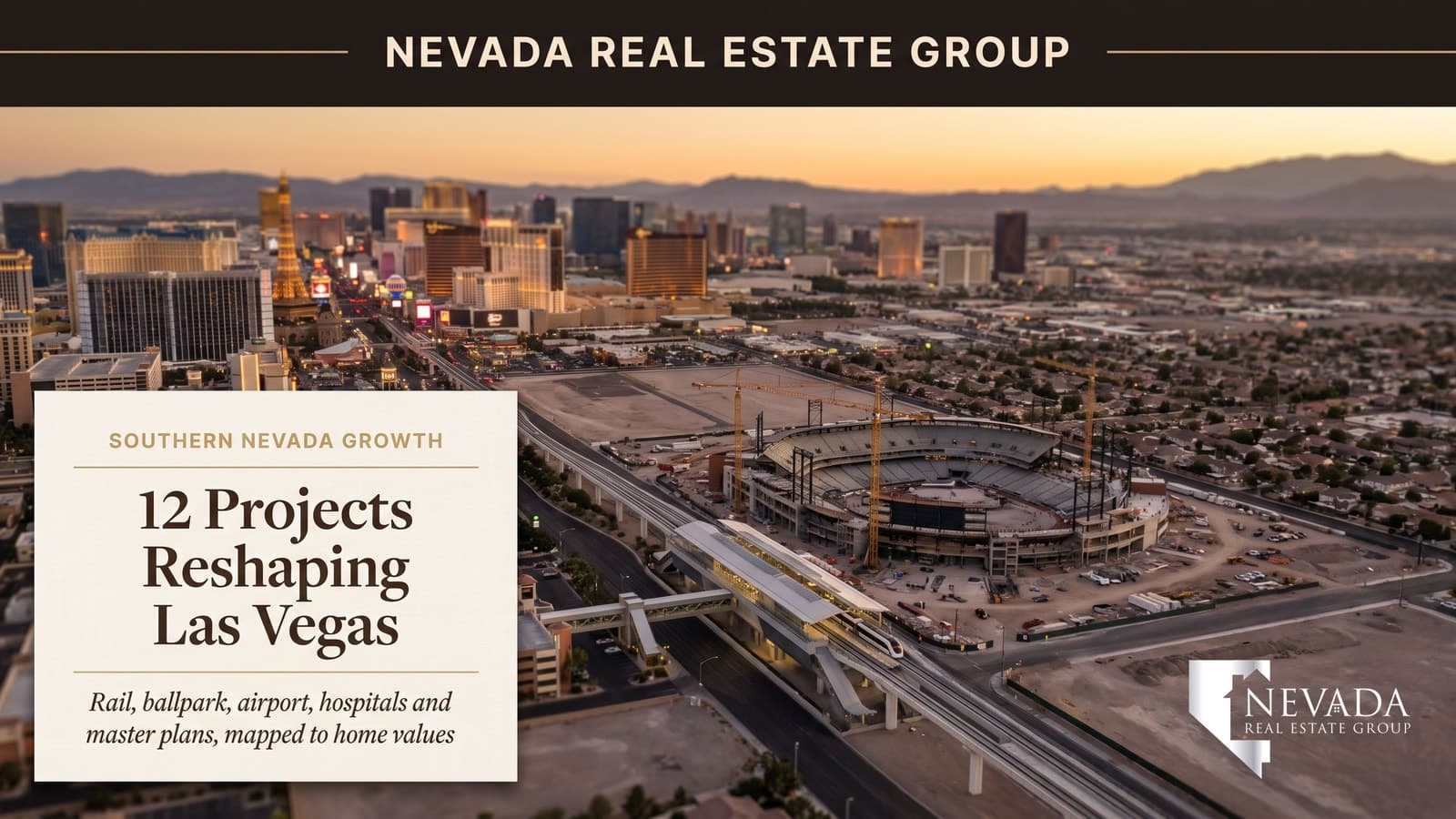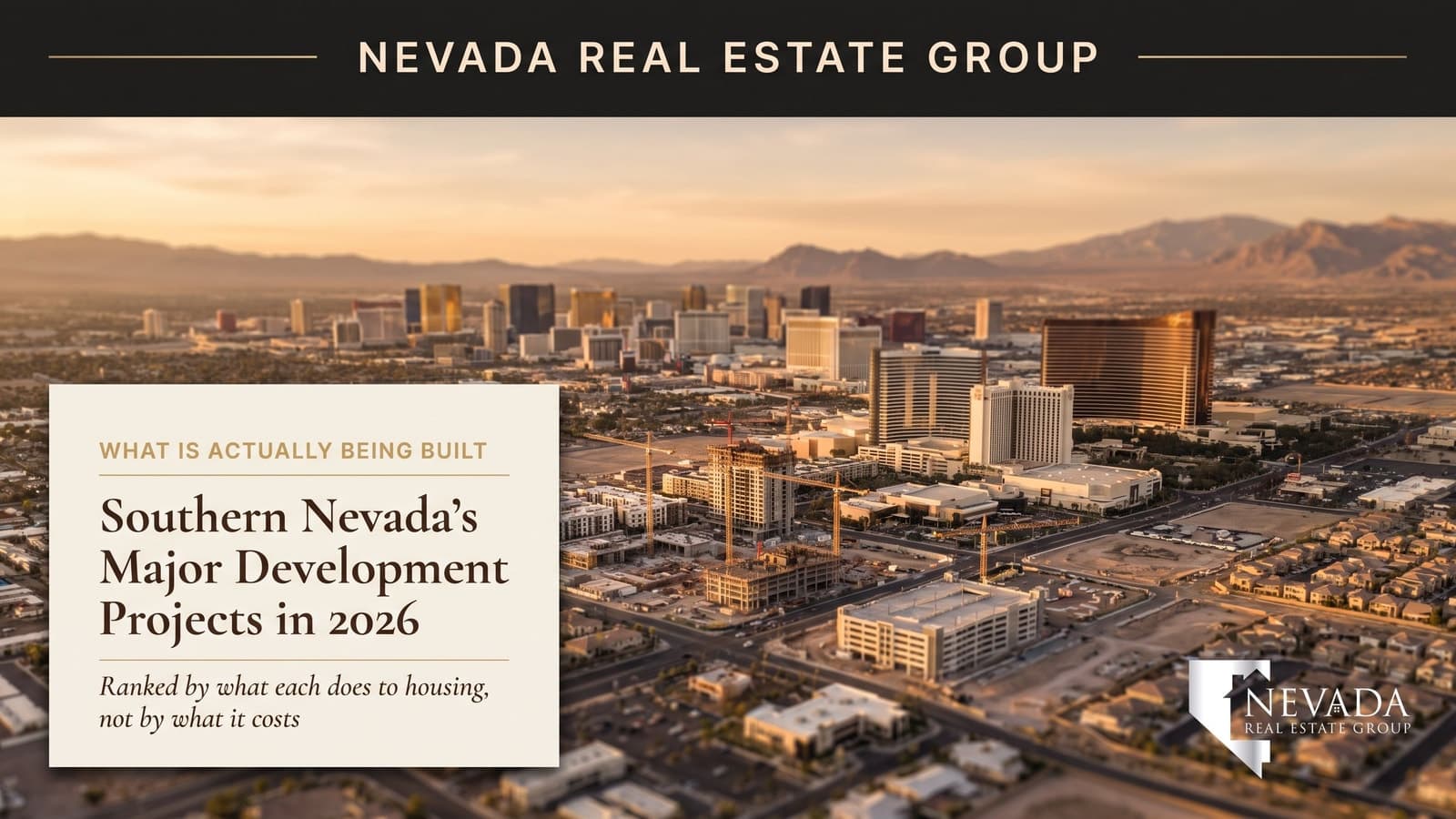

Southern Nevada currently has something on the order of $40 billion in announced major projects in various stages of motion. A $21.5 billion high-speed railroad. A $2 billion domed ballpark on the Strip. An 18,000-acre industrial park with roughly 30 million square feet built or permitted. A second commercial airport that may not open until 2037.
Every one of those gets written about as though it will transform where people live. Ranked by capital cost, that is the order above. Ranked by what each actually does to housing demand in the next five years, the order very nearly reverses — and the project that moves housing most is the one with the least glamorous press.
The Athletics ballpark ($2B, spring 2028) and Brightline West ($21.5B, late 2029) dominate coverage but create modest permanent employment. Apex Industrial Park in North Las Vegas — 18,000 acres, roughly 30 million square feet built or permitted, a projected 15,000 to 20,000 permanent jobs by 2029 — is the project actually forming households. The Ivanpah airport is a 2029-start, 2037-completion project and should not affect a purchase decision today.
- Apex projects 15,000–20,000 permanent jobs by 2029 — more than every other project combined.
- The A's ballpark is $2 billion for 33,000 seats, on schedule for spring 2028 at Tropicana and the Strip.
- Brightline West slipped to late 2029: 218 miles in the I-15 median, roughly two hours to Los Angeles.
- The Ivanpah airport may not start construction until 2029 or open before 2037 — too far out to price.
- Rank projects by permanent headcount and completion date, never by announced capital.
Nevada Real Estate Group has closed 9,600+ transactions statewide and 789 homes in 2025, and "should I buy near the new [project]" is one of the most common questions we field. The answer depends almost entirely on which project — and the reasoning below is the same one we use on the phone.
Which Southern Nevada Projects Are Actually Under Construction Right Now?
Announced, approved, and under construction are three very different states, and the press rarely distinguishes them. Here is where each major project actually stands.
| Project | Location | Scale | Status | Target |
|---|---|---|---|---|
| Athletics ballpark | Tropicana Ave & Las Vegas Blvd | $2B, 33,000 seats | Under construction | Spring 2028 |
| Brightline West | I-15 median, station south of Strip | $21.5B, 218 miles | Civil construction | Late 2029 |
| Apex Industrial Park | North Las Vegas | 18,000 acres, ~30M sq ft | Active build-out | Rolling through 2029 |
| West Henderson corridor | West Henderson | Google $1.2B; Haas 2.4M sq ft | Active | Rolling |
| Las Vegas Medical District | Adjacent to downtown | 640 acres | Active, phased | Rolling |
| Supplemental airport (Ivanpah) | Jean to Primm, east of I-15 | $6B–$14B est. | Environmental review | Start ~2029, open ~2037 |
Note the bottom row carefully. The Ivanpah airport has been discussed for decades, its environmental impact statement process was cancelled and restarted in 2025, and construction is not expected to begin until roughly 2029 with completion as late as 2037. It is a real project. It is not a 2026 buying consideration, and anyone using it to sell you land today is selling you a decade of carrying cost.
Why Does Capital Cost Tell You Almost Nothing About Housing Impact?
Because housing demand comes from households, and households come from permanent jobs — not from dollars spent.
A railroad is capital-intensive and, once running, employs relatively few people relative to its cost. A domed stadium employs a large seasonal and game-day workforce, much of it part-time, plus a modest permanent front-office and operations staff. An industrial park full of distribution, manufacturing, and logistics tenants employs thousands of people, full-time, every day, for decades.
Construction employment muddies this further. Every one of these projects employs a substantial construction workforce during build-out — but those jobs are temporary by definition and are largely filled from the existing Southern Nevada trades workforce. A trades worker moving from one valley jobsite to another does not form a new household. That is the distinction that separates a headline from a housing effect.
This is the same analytical spine we applied to the valley's technology employers, where a $1.2 billion data center campus projects roughly 220 to 240 permanent positions while a single machine-tool plant plans 1,400. Capital and headcount are simply different variables, and only one of them buys houses.
Why Is Apex the Project That Moves Housing Most?
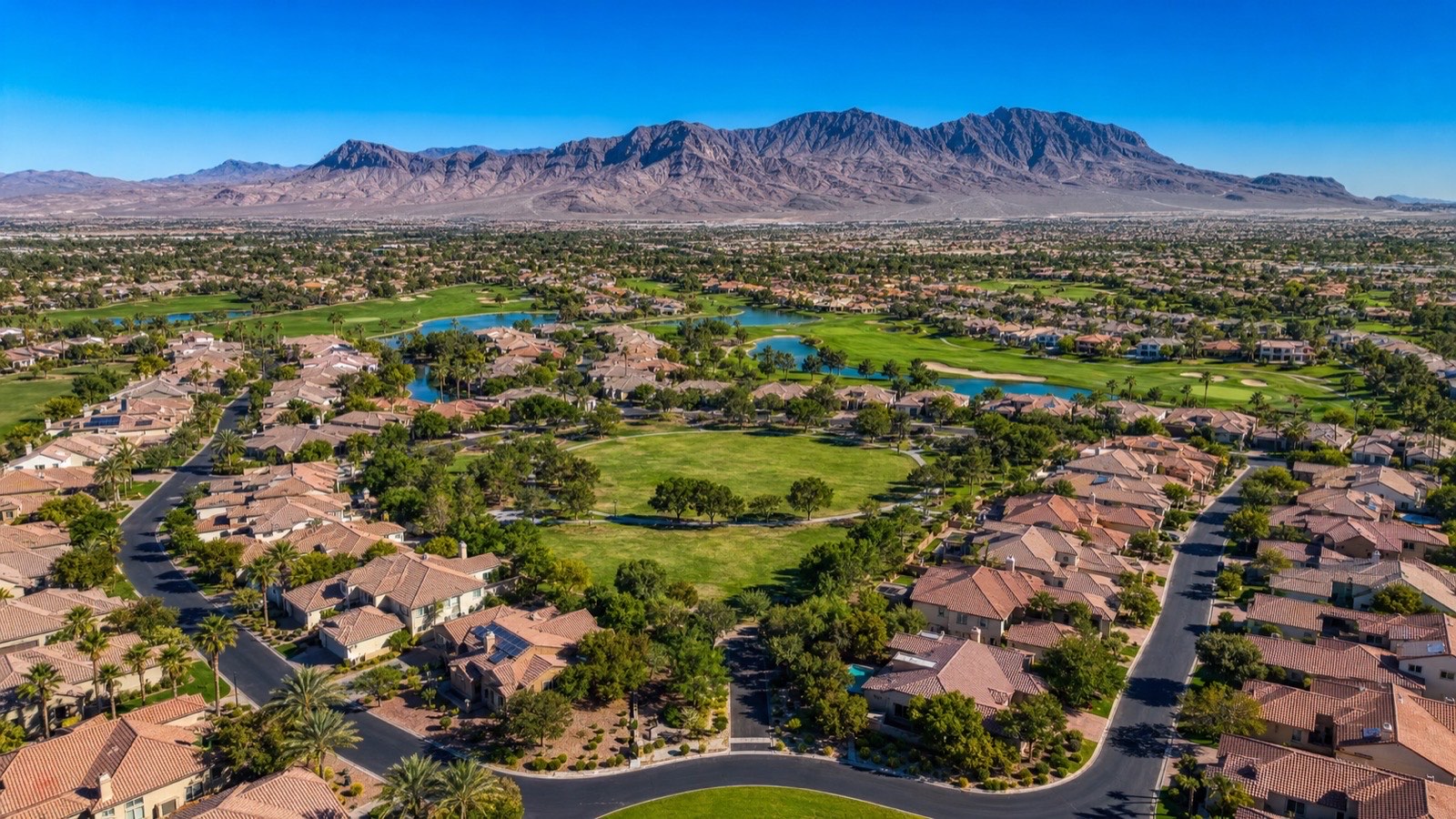
Because it is the only one of these whose entire purpose is to house employers.
According to the City of North Las Vegas, Apex Industrial Park spans roughly 18,000 acres and is the largest shovel-ready industrial site in the western United States. As of early 2026 it carried close to 30 million square feet of commercial and industrial development under construction or permitted, against a development pipeline exceeding $8 billion, with projections of 15,000 to 20,000 permanent jobs by 2029.
Compare that headcount to everything else on the list and the ranking stops being arguable. Fifteen to twenty thousand permanent positions is more than every other project in this article combined, several times over.
The housing consequence is concentrated and geographically obvious: these are workers who need to live within a sane commute of North Las Vegas. That pressure lands on North Las Vegas housing stock first — Aliante, the 89031 and 89084 corridors, and the newer northern subdivisions — and it lands on wage bands that map to the valley's entry and lower-middle price tiers rather than its luxury end.
Our dedicated analysis, what 30 million square feet of Apex development means for housing, works through the neighborhood-level detail, wage bands, and the risks of buying adjacent to an industrial corridor.
What Will the Athletics Ballpark Actually Do to Nearby Housing?
Something real, but different from what most people assume — and the mechanism is not jobs.
The $2 billion, 33,000-seat domed stadium sits at Tropicana Avenue and Las Vegas Boulevard on the former Tropicana site. Groundbreaking was June 2025, private investment passed $600 million as of the August 20, 2026 Stadium Authority board meeting, the first roof trusses went up mid-2026, and the project remains on schedule for a spring 2028 opening.
Its permanent employment is modest relative to its cost. What it changes instead is the character and desirability of the surrounding corridor: foot traffic, dining and retail investment, short-term rental demand on roughly 81 home dates a year, and the general re-rating of a stretch of the Strip's south end that had been aging.
That makes the ballpark primarily an investor and condo-corridor story rather than a family-housing story. Proximity cuts both ways — event traffic, parking pressure, and noise on game nights are genuine, and a unit that is a superb short-term rental can be a mediocre primary residence. Our A's ballpark real estate impact guide covers the corridor block by block.
How Much Will Brightline West Change Where People Live?
Less than the headline suggests in the near term, and possibly quite a lot in the long term — but the long term keeps moving.
According to the U.S. Department of Transportation, Brightline West is a 218-mile high-speed line running largely in the Interstate 15 median between Las Vegas and Rancho Cucamonga, with a Las Vegas station south of the Strip. A U.S. Department of Transportation document dated October 2025 put the cost estimate at $21.5 billion. The project is in civil construction, the Las Vegas station's parking structure has been taking shape through 2026, and completion has been pushed to late 2029 — a slip from the earlier target of opening ahead of the 2028 Los Angeles Olympics.
The theoretical housing effect is significant: roughly two hours between metro Los Angeles and the Strip makes Las Vegas viable as a second-home and weekend market for a much larger Southern California population, and it strengthens the case for walkable, station-adjacent product over conventional suburban housing.
The practical caution is the date. A 2029 completion is three years out on a project that has already moved once, and buying today on a benefit that arrives in 2029 means carrying the asset for three years for a premium that is not yet earned. Our Brightline West real estate guide covers which submarkets stand to gain and on what timeline.
How Does the Las Vegas Medical District Change Downtown?
Quietly, steadily, and with the most durable kind of demand of anything on this list.
According to the City of Las Vegas, the Las Vegas Medical District covers roughly 640 acres directly adjacent to downtown, and it is advancing through phased projects rather than a single opening date. A $44 million laboratory facility has been under construction since 2025 with a target to open by the end of 2026, and a 256-unit housing project aimed at healthcare workers and students broke ground to address staffing shortages and the cost of living near the district.
According to the U.S. Bureau of Labor Statistics, healthcare employment is the least cyclical major employment category in the valley, and it is professional, credentialed, and geographically sticky — a nurse or technician working in the district needs to live within a reasonable commute of the district. That produces steady, unspectacular, extremely reliable housing demand of exactly the kind that does not generate headlines.
For buyers, this makes the downtown and near-downtown submarkets a different proposition than they were a decade ago, and it strengthens the case for the walkable urban product that Las Vegas has historically been short of.
Who Is Paying for These Projects, and Does It Touch Your Taxes?
A fair question, and one that gets argued loudly and explained rarely. The funding structures differ enormously across these projects, and only one of them involved a meaningful direct public commitment.
The ballpark is the one people mean. Nevada's Senate Bill 1, signed in June 2023, capped public financing at $380 million toward the project. According to the enrolled text of SB1, the public contribution is the lesser of $380 million or what the pledged revenues can support: up to $180 million of it can come as transferable state tax credits, Clark County bonds repaid from taxes generated inside a sports and entertainment improvement district around the ballpark supply the rest, and the county must also give the developer a credit of at least $25 million against development-agreement costs. The balance of the roughly $2 billion project is private.
Brightline West is a private project supported by federal funding instruments rather than local ones — the October 2025 Department of Transportation documentation reflected a $6 billion federal loan sought against the $21.5 billion estimate. There is no Clark County property tax mechanism attached to it.
Apex is almost entirely private tenant capital on land the city has spent years making shovel-ready, with public involvement concentrated in infrastructure — roads, water, and power extensions — rather than in subsidizing individual buildings.
What this means for a homeowner's bill. None of these projects creates a line item on your property tax statement. According to the Nevada Department of Taxation, Nevada property tax is driven by assessed value against the applicable district rate, with NRS 361.4723 capping the annual increase on an owner-occupied primary residence at 3%. Where new development does reach your bill is indirectly and slowly: successful development raises assessed values across a district over time, and the 3% cap is what limits how fast that reaches you — provided the abatement claim is on file.
The exception to watch is at the neighborhood level rather than the project level. New master-planned subdivisions frequently carry special improvement district bonds that fund their own infrastructure, and those absolutely appear as a separate line from HOA dues. That is a subdivision question, not a stadium question, and the answer is always parcel-specific.
Which Submarket Does Each Project Actually Touch?
Mapping projects to geography is where the analysis becomes actionable, because a project three exits away on the wrong side of the valley is not your project.
| Submarket | Primary project driver | Type of demand | Timing |
|---|---|---|---|
| North Las Vegas | Apex Industrial Park | Entry and lower-mid households | Now through 2029 |
| Henderson (west) | Google, Haas Automation | Mid-career professional | Now |
| South Strip corridor | Athletics ballpark | Investor and short-term rental | Building to 2028 |
| Downtown / near-downtown | Las Vegas Medical District | Healthcare professional, steady | Rolling now |
| Station-adjacent / valley-wide | Brightline West | Second home, Southern California | Late 2029+ |
| Summerlin / west valley | None material | Amenity and schools, not projects | N/A |
| Jean / Primm corridor | Supplemental airport (proposed) | Speculative land only | 2029 start at earliest |
The last two rows are the ones worth internalizing. Summerlin appears in no project narrative in this article, and that is not a weakness — it means Summerlin pricing rests on amenity, schools, and inventory rather than on any development thesis that could slip. Conversely, the Jean and Primm corridor appears only as speculation, and speculation with a 2037 horizon is a different asset class from a house.
Which Projects Create Permanent Jobs Versus Temporary Ones?
This is the single table worth keeping if you keep nothing else from this article.
| Factor | Apex | West Henderson | Ballpark | Brightline West |
|---|---|---|---|---|
| Announced capital | $8B+ pipeline | $1.2B+ (Google alone) | $2B | $21.5B |
| Permanent jobs | 15,000–20,000 by 2029 | ~1,600–1,900 at maturity | Modest; heavily part-time | Modest relative to cost |
| Job type | Logistics, manufacturing | Manufacturing, tech ops | Event, hospitality | Rail ops, maintenance |
| Household formation | Very high | High | Low | Low near-term |
| Primary housing effect | Entry / lower-mid demand | Mid-career demand | Investor / STR corridor | Second-home demand |
| Submarket affected | North Las Vegas | Henderson | South Strip corridor | Station-adjacent, valley-wide |
| Timeline to effect | Now through 2029 | Now | 2028 | Late 2029+ |
| Schedule risk | Low — incremental | Low — incremental | Moderate | Elevated — already slipped |
Read the "announced capital" row against the "permanent jobs" row. Brightline West carries more than twice the capital of every other project combined and sits near the bottom on household formation. Apex carries a fraction of Brightline's budget and sits at the top by an order of magnitude. If you rank by press coverage you get roughly the opposite of the correct answer.
What Should You Do If a Project Is Announced Near a Home You Own?
Four things, in order, and the first one is the one people skip.
Find out what stage it is actually in. Announced, entitled, permitted, financed, and under construction are wildly different probabilities. A project in environmental review is years from dirt and may never happen; a project with steel going up will happen. The Ivanpah airport and the A's ballpark are both real projects, and only one of them should influence a decision this year.
Find out what it employs, not what it costs. Ask for the permanent operating headcount. It is nearly always public and it is nearly always smaller than people assume.
Find out what it does to your specific parcel. Traffic pattern, sightline, noise, and access matter enormously and are entirely local. A home four streets from a stadium and a home backing to its parking structure have almost nothing in common.
Do not sell into an announcement. Announcement-driven price movement is frequently front-run and frequently reverses when timelines slip — as Brightline's has. If the fundamentals of your home and your reason for owning it have not changed, a press release is not a reason to transact.
What Do the Affected Submarkets Look Like Today?
Announcements move slowly; the housing around them is priced now. Here is where each corridor actually stands as of August 26, 2026.
| Corridor | Nearest project | Active listings | Median asking |
|---|---|---|---|
| 89119 — south Strip | Athletics ballpark | 194 | $229,450 |
| 89101 / 89106 — downtown | Medical district | 260 | $379,900 |
| 89081 / 89084 — north valley | Apex industrial | 430 | $445,000 |
Read alongside the capital-cost argument earlier in this article, the table makes the point better than the argument does. The ballpark carries the largest headline number of the three and sits in the cheapest corridor at a $229,450 median. Apex, which generates the most permanent jobs, sits in the most expensive at $445,000 — nearly double.
If capital cost drove housing prices, that ordering would be reversed. It is not, because what moves a housing market is durable payroll within commuting distance, not the size of the construction budget.
Which Projects Are Most Likely to Slip?
Schedule risk is not evenly distributed, and it correlates with financing complexity more than with construction difficulty.
Brightline West carries the most. It has already moved from a pre-2028-Olympics target to late 2029, and DOT documentation from October 2025 showed the project seeking an additional $6 billion federal loan against a $21.5 billion estimate. None of that means it will not be built; it means the date should be treated as a range, not a promise.
According to the Federal Aviation Administration, the supplemental airport carries more still, on a longer horizon — a restarted environmental impact statement, a construction start not expected before roughly 2029, and completion possibly not until 2037.
The ballpark carries the least of the headline projects, because it is comparatively simple, comparatively funded, and visibly on schedule with steel and roof trusses in place.
Apex is a special case: it is not one project but hundreds of individual tenant developments on a rolling basis, which means it cannot slip as a unit. Individual buildings may be delayed; the corridor keeps absorbing regardless. That structural difference is exactly why it is the most reliable of the group.
How Should Buyers Time a Purchase Around a Major Project?
The general rule is that you should buy for the home and the neighborhood, and treat a project as a tiebreaker rather than a thesis.
Where a project is already operating or clearly imminent — Apex tenants that are open, West Henderson employers that are hiring — the effect is largely in the price already, and you are buying a known quantity. That is fine; it is simply not a discount.
Where a project is three or more years out, you are being asked to pay today for a benefit that arrives later, while carrying taxes, insurance, maintenance, and opportunity cost in the interim. That trade can work, but only if the price genuinely has not moved yet, and only if you would be content owning the home if the project slipped another two years.
Where a project is in review rather than construction, assign it no value at all. Not a small value — none. Then you cannot be disappointed, and you may be pleasantly surprised.
If you want to see what is currently available in any of these corridors, start with our Las Vegas homes for sale search or our buyer resources, or call (702) 637-1759 to talk through a specific submarket.
What Does This Mean for Each Part of the Valley?
Briefly, by geography.
North Las Vegas is the biggest structural winner, and it is not close. Apex is the valley's dominant permanent-employment story and North Las Vegas holds the closest housing stock at the price points those wages support.
Henderson benefits from the West Henderson employment corridor, with advanced manufacturing and technology operations concentrated near Via Inspirada. The demand there skews to mid-career professional wages, which lands on Henderson master plans rather than entry inventory.
The south Strip corridor is the ballpark story: investor-driven, short-term-rental-driven, and re-rating for reasons that have little to do with permanent employment.
Downtown and near-downtown ride the Medical District — slow, durable, professional demand plus the walkable product that follows it.
Summerlin and the established west valley are largely unaffected by all of this, which is itself worth saying. Summerlin trades on its own amenity, schools, and inventory rather than on any project in this article, and buyers there should not be sold a development narrative that does not apply.
The far south valley toward Jean and Primm is the airport speculation zone, and it is a decade-out proposition. Treat land pitches there accordingly.
Frequently Asked Questions
Which Southern Nevada project will affect home prices the most?
Apex Industrial Park in North Las Vegas, by a wide margin. Its projected 15,000 to 20,000 permanent jobs by 2029 exceed every other project on this list combined, and permanent jobs are what form households. The projects with far larger budgets — Brightline West at $21.5 billion, the ballpark at $2 billion — generate significant attention but comparatively modest permanent employment, so their housing effects are narrower and more localized.
When will the Athletics ballpark open in Las Vegas?
Spring 2028, and it remains on schedule. The $2 billion, 33,000-seat domed stadium sits at Tropicana Avenue and Las Vegas Boulevard on the former Tropicana site. Groundbreaking was June 2025, private investment passed $600 million as of the August 20, 2026 Stadium Authority board meeting, and roof truss installation began mid-2026. Of the headline projects it carries the lowest schedule risk because it is comparatively simple and visibly progressing.
Has Brightline West been delayed?
Yes. Completion has moved to late 2029, a slip from the earlier goal of opening ahead of the 2028 Los Angeles Olympics. The 218-mile line runs largely in the I-15 median with a Las Vegas station south of the Strip, and a Department of Transportation document from October 2025 put the estimate at $21.5 billion with an additional $6 billion federal loan being sought. It is in civil construction, but treat the date as a range.
Should I buy land near the proposed Ivanpah airport?
Not on the airport's account. The Southern Nevada Supplemental Airport between Jean and Primm has been discussed for decades, its environmental impact statement process was cancelled and restarted in 2025, construction is not expected to begin until roughly 2029, and completion could be as late as 2037. That is potentially a decade or more of carrying costs on a speculative thesis. Anyone selling land on this timeline is selling the timeline.
Does living near a stadium help or hurt home value?
Both, depending on distance and use. A condo positioned for short-term rental within walking distance of roughly 81 home dates a year can perform very well as an investment. The same unit as a primary residence means event traffic, parking pressure, and game-night noise. The effect drops off quickly with distance, so the question is never "near the stadium" in general — it is about your specific block, sightline, and access route.
Which Las Vegas neighborhoods benefit most from Apex jobs?
North Las Vegas absorbs the demand first, particularly Aliante and the 89031 and 89084 corridors plus the newer northern subdivisions, because those are the closest housing to the corridor at the price points Apex wage bands support. The effect concentrates in the entry and lower-middle tiers rather than the luxury end, which is typical of logistics and manufacturing employment.
How much construction employment do these projects create?
A great deal, but it is temporary by definition and largely drawn from the existing Southern Nevada trades workforce. A trades worker moving from one valley jobsite to another does not form a new household, so construction headcount — which is the number most often quoted in announcements — is close to irrelevant for housing demand. Always ask for permanent operating headcount instead.
Is the Las Vegas Medical District worth considering as a buyer?
Yes, and it is underrated precisely because it advances quietly. The district spans roughly 640 acres adjacent to downtown, with a $44 million laboratory targeted to open by the end of 2026 and a 256-unit housing project for healthcare workers and students under way. Healthcare employment is the least cyclical major category in the valley and it is geographically sticky, which produces unusually reliable demand for near-downtown housing.
Which Sources Inform This Southern Nevada Development Guide?
- City of North Las Vegas — Apex Industrial Park acreage, pipeline, and employment projections
- City of Henderson — West Henderson employment corridor and Haas Automation announcements
- U.S. Department of Transportation — Brightline West cost estimate and federal loan documentation
- Federal Aviation Administration — Southern Nevada Supplemental Airport environmental review process
- Clark County — Assessor parcel records, permitting, and county planning
- City of Las Vegas — Las Vegas Medical District master plan and phased projects
- U.S. Bureau of Labor Statistics — metro employment concentration and sector growth
- U.S. Census Bureau — household formation and population data
- Nevada Governor's Office of Economic Development — statewide business attraction and incentives
- Las Vegas REALTORS — Southern Nevada monthly market statistics
- Regional Transportation Commission of Southern Nevada — valley road network and transit planning
- Nevada Department of Taxation — state tax structure and property tax abatement