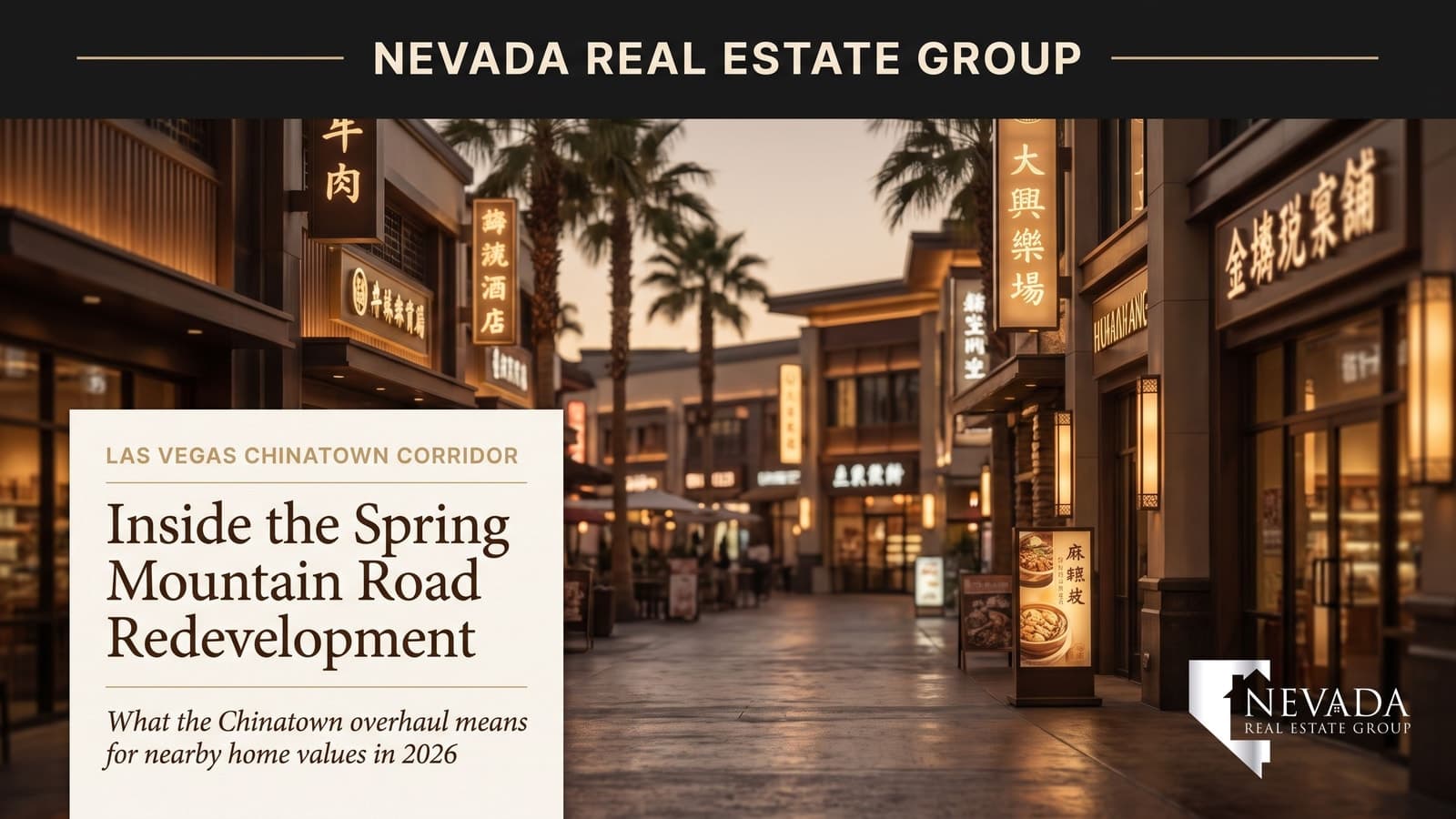

Las Vegas Chinatown is not a single block. It is roughly four miles of Spring Mountain Road, and Clark County has now committed real money to rebuilding it: $12.5 million for the roadway itself, a business grant fund doubled to $1.5 million, and a Chinatown Overlay District being drafted to govern what gets built there. Behind the public spend, a developer has described roughly $70 million in private retail and apartment projects. The question for a homeowner or investor is narrower than the headlines: does any of that reach residential values in the neighborhoods around it? Here is what the corridor actually looks like in the MLS today, and where the leverage is.
Clark County is investing $12.5 million to rebuild Spring Mountain Road from Rainbow to Decatur starting summer 2026, plus a $1.5 million Corridor Improvement Grant fund and a proposed Chinatown Overlay District. Roughly $70 million in private retail and apartment development is lined up behind it. The four ZIP codes along the corridor hold 861 active listings, and three of the four still price below the valley median.
- $12.5 million rebuilds Spring Mountain Road from Rainbow to Decatur beginning summer 2026.
- The Corridor Improvement Grant fund doubled to $1.5 million, capped at $75,000 per applicant.
- Corridor ZIPs 89102, 89103, and 89146 all carry median list prices below the valley's $478,000.
- 1,356 homes sold across the four corridor ZIPs in the past year, averaging 52 to 55 days on market.
- Infrastructure premiums arrive at construction, not announcement — the window is now, not 2028.
What Exactly Is the Spring Mountain Road Redevelopment?
It is a coordinated public investment in the Spring Mountain corridor, run by Clark County rather than the City of Las Vegas — a distinction that matters, because Chinatown sits in unincorporated Clark County near Spring Valley, not inside city limits.
According to Clark County's Office of Community and Economic Development, the Chinatown Redevelopment Area covers the Spring Mountain corridor and surrounding commercial districts, and the county has published an "Inspiring Spring Mountain Redevelopment Plan" governing it. The implementation package was announced in February 2026 by Commissioner Justin Jones at Shanghai Plaza.
The components, separating what is funded from what is proposed:
| Component | Amount | Status |
|---|---|---|
| Corridor Improvement Grant fund | $1.5 million (doubled) | Funded |
| Per-applicant grant cap | Up to $75,000 matching | Funded |
| Spring Mountain Rd rebuild, Rainbow to Decatur | $12.5 million | Planned, summer 2026 |
| ZAP! Chinatown public art | 69 utility box murals, 13 artists | Funded |
| Chinatown Overlay District | Development standards + branding | Proposed |
| Private retail center | Approximately $40 million | Private, plaza groundbreaking targeted Q4 2026 |
| Private apartment complex | Approximately $30 million | Private, proposed |
Read that status column carefully. The grants and the public art are funded and moving. The roadway is planned with a date. The overlay district and the private projects are proposals — real ones with money behind them, but proposals. I will come back to why that distinction decides your timing.
Where Is the Corridor and Which ZIP Codes Does It Touch?
Spring Mountain Road runs east-west just west of the Strip. The redevelopment focus — Rainbow Boulevard to Decatur Boulevard — is the densest stretch of restaurants, plazas, and retail. Residential neighborhoods on either side fall into four ZIP codes: 89102, 89103, 89146, and 89117.
Those four are not interchangeable. 89103 south of the corridor is condo-heavy and the most affordable. 89117 to the west runs into more established single-family neighborhoods and prices well above the others. 89146 sits north and carries the widest spread between what is listed and what actually sells.
If you are comparing the corridor against the rest of the metro, the useful reference points are Las Vegas homes for sale valley-wide, the Las Vegas condo market specifically — since condos are the most corridor-sensitive product — and the master plans on either side of the valley, Summerlin to the northwest and Henderson to the southeast. Browse the full set on our communities index.
What Do Homes Along the Corridor Actually Cost Right Now?
This is where the story gets interesting, because the corridor is absorbing significant investment while still pricing below the valley as a whole.
| ZIP | Active listings | Median list | Median $/sq ft | Sold, past 12 mo | Median sold | Avg days on market |
|---|---|---|---|---|---|---|
| 89102 | 131 | $415,000 | $284 | 230 | $392,500 | 54 |
| 89103 | 335 | $294,500 | $312 | 448 | $307,500 | 53 |
| 89146 | 91 | $380,000 | $237 | 178 | $512,500 | 55 |
| 89117 | 304 | $532,500 | $271 | 500 | $515,000 | 52 |
Across all four: 861 active listings and 1,356 closed sales in the past twelve months. According to Las Vegas REALTORS, the valley median sits near $478,000 — which means 89102, 89103, and 89146 are all below the metro median while sitting on a corridor absorbing more than $80 million in combined public and private commitment.
Two numbers in that table deserve explanation rather than a gloss:
89103's median list ($294,500) sits below its median sold ($307,500). That is a mix effect, not a declining market. The active pool skews heavily toward condos and smaller units while the closed pool includes more single-family product. Do not read it as sellers cutting.
89146 shows the widest gap — a $380,000 median list against a $512,500 median sold. Same cause, larger spread. In 89146 especially, the ZIP-level median is close to useless for pricing an individual house. You need the comps for the specific street and product type.
Which Neighborhoods Sit Closest to the Corridor?
The corridor does not have a single residential character, and knowing which pocket you are in matters more than the ZIP code on the listing.
Immediately south and west, the corridor bleeds into Spring Valley, the unincorporated township that contains most of Chinatown. Spring Valley is where the majority of the walkable, lower-priced condo and townhome product sits, and it is the pocket most directly exposed to the corridor improvements. Further west along Sahara and Charleston, the neighborhoods turn established and considerably more expensive — Queensridge and Peccole Ranch are the recognizable names, and both function as their own markets rather than corridor-dependent ones.
North of the corridor, The Lakes offers a genuinely different product — waterfront and lake-adjacent homes inside a master plan — while Rhodes Ranch to the southwest is a gated golf community far enough out that the redevelopment is a nice-to-have rather than a value driver.
The practical rule I give clients: the closer you are to the Rainbow-to-Decatur stretch, the more the redevelopment matters to your value, and the more the construction period will matter to your daily life. Those two facts point in opposite directions for the same property, which is why timing the purchase is as important as picking it.
What Have We Actually Seen in Corridors Like This?
Across the 9,600+ closings our team has represented statewide, corridor-improvement projects follow a pattern consistent enough to plan around, and it is not the pattern most buyers expect.
The announcement phase produces inquiries, not transactions. Sellers hear the news and raise expectations; buyers hear it and wait. Volume actually thins. That is roughly where the Spring Mountain corridor sits today — a lot of attention, no repricing.
The construction phase is where sellers get hurt and patient buyers get paid. Properties fronting active work sit longer and trade at a discount, because a buyer touring during roadwork discounts what they see. In our experience that discount is real but temporary, and it is the single best entry window a corridor offers.
The completion phase is when the premium finally appears, and it concentrates hard on walkability. The properties that capture it are the ones a person can walk from — not the ones that merely share a ZIP code.
I have watched buyers get this backwards in the stadium corridor: they paid an announcement premium, then endured the construction years anyway, and only broke even once the venue opened. If you like this corridor, the disciplined play is to buy during the mess, not before it.
Why Does Road Reconstruction Move Home Values at All?
Because walkability and safety are among the few neighborhood variables that reliably show up in price, and a road rebuild is the mechanism that delivers both.
The $12.5 million project targets smart traffic technology and pedestrian safety along a stretch that is currently hostile on foot — wide, fast, and difficult to cross. A smart crosswalk installed in early 2026 was the visible first step. When a commercial corridor becomes genuinely walkable, the residential blocks within about a half mile capture the benefit: the restaurants become an amenity rather than a driving destination.
According to the Federal Highway Administration, pedestrian safety improvements at crossings measurably reduce crash rates, and safety is the precondition for the foot traffic the rest of the plan depends on. The overlay district matters for the same reason — it is what prevents the corridor from being rebuilt into something generic.
How Much Should You Expect Values to Move?
Less than the headlines imply, and later than you would like. I want to be direct about this because the temptation with any infrastructure announcement is to assume an immediate premium.
Public-investment effects on nearby residential values typically show up as a modest lift concentrated within roughly a half mile of the improvement, and they arrive during and after construction rather than on announcement day. A $12.5 million road project is meaningful for a corridor; it is not a stadium. The private development — the approximately $40 million retail center and $30 million apartment complex — will move things more than the road will, and those are the pieces that are still proposals.
In our experience with the Allegiant Stadium and Brightline West corridors, the sequence is consistent: announcement produces speculation and thin volume, groundbreaking produces the first real repricing, and completion produces the durable premium. Buyers who paid an announcement premium in those corridors generally waited years to be right.
The honest framing: this corridor is attractive today because it is priced below the valley median and has committed public money behind it, not because a redevelopment premium already exists. If you would not want the property at today's price without the redevelopment, the redevelopment is not the reason to buy it.
Who Actually Benefits From This Redevelopment?
Four groups, in descending order of how much:
- Commercial property owners and tenants on the corridor. They are the direct target — $1.5 million in matching grants at up to $75,000 each for facade, lighting, and security work.
- Condo and townhome owners within walking distance. The most leveraged residential position. Walkability improvements matter most to product that is already dense and already discounted.
- Small-lot single-family owners just off the corridor. Real benefit, smaller magnitude, mostly through neighborhood perception.
- Investors holding rentals in 89103 and 89102. A more walkable, better-lit corridor supports rents on units that currently trade at some of the lowest prices per square foot in the central valley.
A note on the grant program, because it is the piece most often misread. The $1.5 million Corridor Improvement Grant fund is for commercial property owners and tenants — facade work, lighting, security. It does not send money to residential owners, and no homeowner near the corridor should expect a check. Its relevance to residential value is entirely indirect: better-maintained storefronts and better-lit parking lots make the surrounding blocks more desirable, which is a slower and softer mechanism than a direct subsidy. If you own a commercial building on the corridor, though, matching funds of up to $75,000 against a facade project is meaningful money and worth an application.
Who benefits least: anyone directly on Spring Mountain Road during construction. Summer 2026 through completion means noise, dust, and access disruption. If you are selling a property fronting the work, that is a real timing consideration, not a small one.
What Are the Risks Worth Naming?
Four, and I would rather state them than let the optimism run unchecked.
The overlay district is not adopted. It is proposed. Development standards and branding protections are the piece that preserves what makes the corridor valuable, and they are the piece least locked in.
The private projects are proposals. Roughly $70 million in retail and apartments with a Q4 2026 target on the plaza — targets move. Do not underwrite a purchase on a groundbreaking that has not happened.
Construction is disruptive before it is beneficial. A corridor rebuild is a multi-quarter inconvenience for the businesses and residents nearest it.
Rising commercial rents cut both ways. The independent, family-run restaurants are the actual draw. If facade improvements and new retail push rents past what those operators can carry, the corridor risks losing the character the plan exists to protect. According to the Clark County plan framing, that concentration of Asian, Native Hawaiian, and Pacific Islander–owned small businesses is precisely what the overlay is meant to safeguard — the tension is acknowledged, not solved.
What Makes This Corridor Worth Investing In at All?
Strip away the funding announcements and the underlying asset is unusual for Las Vegas: a genuinely dense, genuinely walkable, genuinely distinctive commercial district that grew organically rather than being master-planned into existence.
Spring Mountain's restaurant concentration is the deepest in the state and one of the more significant in the western United States — hundreds of independent operators across Chinese, Korean, Japanese, Vietnamese, Thai, Filipino, and Taiwanese kitchens, most of them family-run, packed into strip plazas along a few miles of road. That density is the durable asset. It took decades to accumulate and it cannot be replicated by a developer with a site plan.
This is the part I would emphasize to anyone weighing the investment case. Public money can rebuild a road. It cannot manufacture the reason people drive across the valley to be there. The corridor already has the demand driver; what it has lacked is infrastructure worthy of it — sidewalks that connect, lighting that works after dark, crossings that are not a gamble. That is precisely the gap the $12.5 million addresses.
There is a second, quieter asset: the corridor is one of very few places in the valley where a household can live without a car for most daily needs. Groceries, restaurants, services, and personal care are all within a walkable radius in a metro built almost entirely around driving. As construction and insurance costs push total ownership costs up, that optionality has value most Las Vegas listings simply cannot offer.
The demographic tailwind is real too. According to the U.S. Census Bureau, the Las Vegas metro has grown steadily and its Asian American population is among the faster-growing segments in the region. A cultural district with this much established infrastructure sits directly in the path of that growth — which supports both the commercial rents underpinning the district and the residential demand around it.
None of this guarantees appreciation. It does mean the corridor is not a speculative bet on something that might get built. It is an established district getting overdue maintenance, which is a materially different risk profile than buying near a proposed arena or a rumored campus. You are underwriting an improvement to something that already works, not the creation of something that does not yet exist.
How Does This Compare to Other Las Vegas Corridor Projects?
Spring Mountain is one of several valley corridors in play, and they are not equivalent bets.
| Dimension | Spring Mountain / Chinatown | Stadium district / south Strip | Downtown / Fremont East |
|---|---|---|---|
| Public investment scale | $12.5M roadway | Billions in venues | Sustained, incremental |
| Entry price nearby | Below valley median | At or above median | Wide range, condo-heavy |
| Primary driver | Walkability, culture, food | Sports and tourism | Nightlife and offices |
| Certainty of delivery | Road funded; overlay proposed | Venues largely committed | Ongoing, project-by-project |
| Timeline to visible change | Summer 2026 to 2028 | Already underway | Continuous |
| Best fit | Value buyers, small investors | Appreciation buyers | Urban lifestyle buyers |
The distinguishing feature is entry price. The stadium corridor already repriced. Spring Mountain has not, which is the entire argument for looking now — and also a reminder that unpriced usually means unproven.
For how the venue corridors have actually behaved, see our breakdown of how sports are reshaping Las Vegas real estate.
Is the Corridor a Good Rental Investment?
It is one of the more defensible rental theses in the central valley, for three reasons.
Entry cost is low — 89103's $294,500 median list is among the most accessible in the core. The tenant pool is deep and stable: hospitality, restaurant, and service workers who need proximity to both the Strip and Chinatown employment, plus students. And the corridor improvements target exactly what renters notice — lighting, sidewalks, safety.
Run the numbers conservatively. At a $294,500 purchase in 89103 with 25% down, you are financing roughly $220,875. Model your actual rate, taxes, insurance, HOA where applicable, vacancy, and management, and require the deal to work at today's rents. If it only works on projected post-redevelopment rents, it is a speculation, not an investment.
Nevada helps the math. According to the Nevada Department of Taxation, there is no state income tax on rental income, and under NRS 361.4723 property-tax increases are capped — 3% on owner-occupied primary residences and up to 8% on other property, including rentals. That cap is a genuine advantage for a long hold. Verify assessed values through the Clark County Assessor.

What Should Buyers Do About It Right Now?
Six steps, in order:
- Walk the corridor at night, not midday. Lighting and pedestrian conditions after dark are what the plan is fixing and what a tenant or resident actually experiences.
- Pull comps by street and product type, not by ZIP. In 89146 the ZIP median misses by roughly $130,000 depending on which side of the gap your property sits.
- Confirm the construction schedule for the block you are considering. Rainbow-to-Decatur work beginning summer 2026 will affect access unevenly.
- For condos, read the HOA reserve study. Older corridor complexes carry deferred maintenance, and a special assessment can erase a redevelopment premium.
- Underwrite at today's rents and today's values. Treat any redevelopment lift as upside, never as the basis for the deal.
- Check zoning and the overlay status before assuming what can be built next door. The City of Las Vegas and Clark County maintain separate jurisdictions here, and Chinatown is county.
If you are early in the process, our buyer and seller guides cover the mechanics, and you can filter the corridor yourself on our Las Vegas search.
Then get real numbers on a specific property. Call me at (702) 637-1759 or start at our contact page, and I will pull street-level comps rather than the ZIP median — in this corridor the difference between those two is frequently six figures.
Frequently Asked Questions
How much is Clark County spending on Spring Mountain Road?
$12.5 million for the roadway rebuild between Rainbow Boulevard and Decatur Boulevard, planned to begin in summer 2026, with smart traffic technology and pedestrian safety improvements. Separately, the Corridor Improvement Grant fund was doubled to $1.5 million, awarding up to $75,000 in matching funds per applicant.
Will the Chinatown redevelopment raise home values nearby?
Probably modestly, and mostly during and after construction rather than now. Public roadway investment typically produces a measurable but limited lift concentrated within about a half mile. The larger mover would be the roughly $70 million in proposed private retail and apartment development — and those remain proposals, not groundbreakings.
Which ZIP codes cover the Spring Mountain corridor?
89102, 89103, 89146, and 89117. Together they hold 861 active listings with 1,356 closed sales in the past twelve months. Median list prices run from $294,500 in 89103 to $532,500 in 89117.
Is Las Vegas Chinatown in the city or the county?
Unincorporated Clark County, near Spring Valley — not inside City of Las Vegas limits. That is why the redevelopment is being run by a county commissioner and the Clark County redevelopment agency. It also determines which jurisdiction's zoning and permitting apply to a given parcel.
Is the Spring Mountain corridor a good place to buy a rental?
It has a credible case: low entry cost, a deep service-worker tenant pool, and improvements aimed at the lighting and walkability renters notice. Underwrite it at current rents rather than projected ones, and for condos read the HOA reserve study before you commit — deferred maintenance is the most common way these deals go wrong.
What is the Chinatown Overlay District?
A proposed framework of development standards and branding protections intended to preserve the corridor's cultural character as it is rebuilt. It has not been adopted. Because it governs what can be built and how it must look, its adoption is the single most important open variable for anyone underwriting long-term value here.
When will construction actually start and finish?
The roadway work is planned to begin in summer 2026. A completion date has not been fixed publicly, and corridor projects of this scale typically run multiple quarters. Expect disruption to arrive before benefit — a real consideration if you plan to sell a property fronting the work.
Are prices along the corridor below the rest of Las Vegas?
Three of the four corridor ZIPs are. Against a valley median near $478,000, median list prices sit at $415,000 in 89102, $294,500 in 89103, and $380,000 in 89146. Only 89117, at $532,500, prices above the metro median.
Which Sources Inform This Spring Mountain Corridor Analysis?
Inventory, pricing, days-on-market, and sales-count figures come from NREG's analysis of Repliers GLVAR MLS data for ZIP codes 89102, 89103, 89146, and 89117, pulled July 2026 — 861 active listings and 1,356 closed sales over the trailing twelve months. Redevelopment figures come from Clark County announcements and local reporting. Supporting sources:
- Clark County Office of Community and Economic Development — Chinatown Redevelopment Area and the Inspiring Spring Mountain Redevelopment Plan
- Clark County — commission actions, grant programs, and public art
- Clark County Assessor — assessed values and parcel records
- Las Vegas REALTORS — valley-wide median price and monthly statistics
- Nevada Department of Taxation — no state income tax; property tax administration
- Nevada Revised Statutes Chapter 361 — the 3% and 8% property-tax abatement caps
- Federal Highway Administration — pedestrian and bicyclist safety research
- City of Las Vegas — municipal jurisdiction boundaries and planning
- U.S. Census Bureau — population, household, and commute data
- Bureau of Labor Statistics — Nevada employment and wage context
- Nevada Real Estate Division — licensing verification and advertising rules
Redevelopment components are labeled funded, planned, or proposed above because the distinction changes the investment case; statuses and timelines move, and readers should verify current status with Clark County before transacting. MLS figures are a July 2026 snapshot. Nevada Real Estate Group is a licensed Nevada brokerage team (license S.181401) with LPT Realty. Nothing here is a guarantee of value, appreciation, or outcome.