

The financing question is whether a lender will make the loan. The investment question is whether you want to own the property on those terms. A debt-service coverage ratio loan can make those questions look deceptively similar because rental income plays a central role in the application. Your own analysis still needs to include expenses the qualifying ratio may leave out.
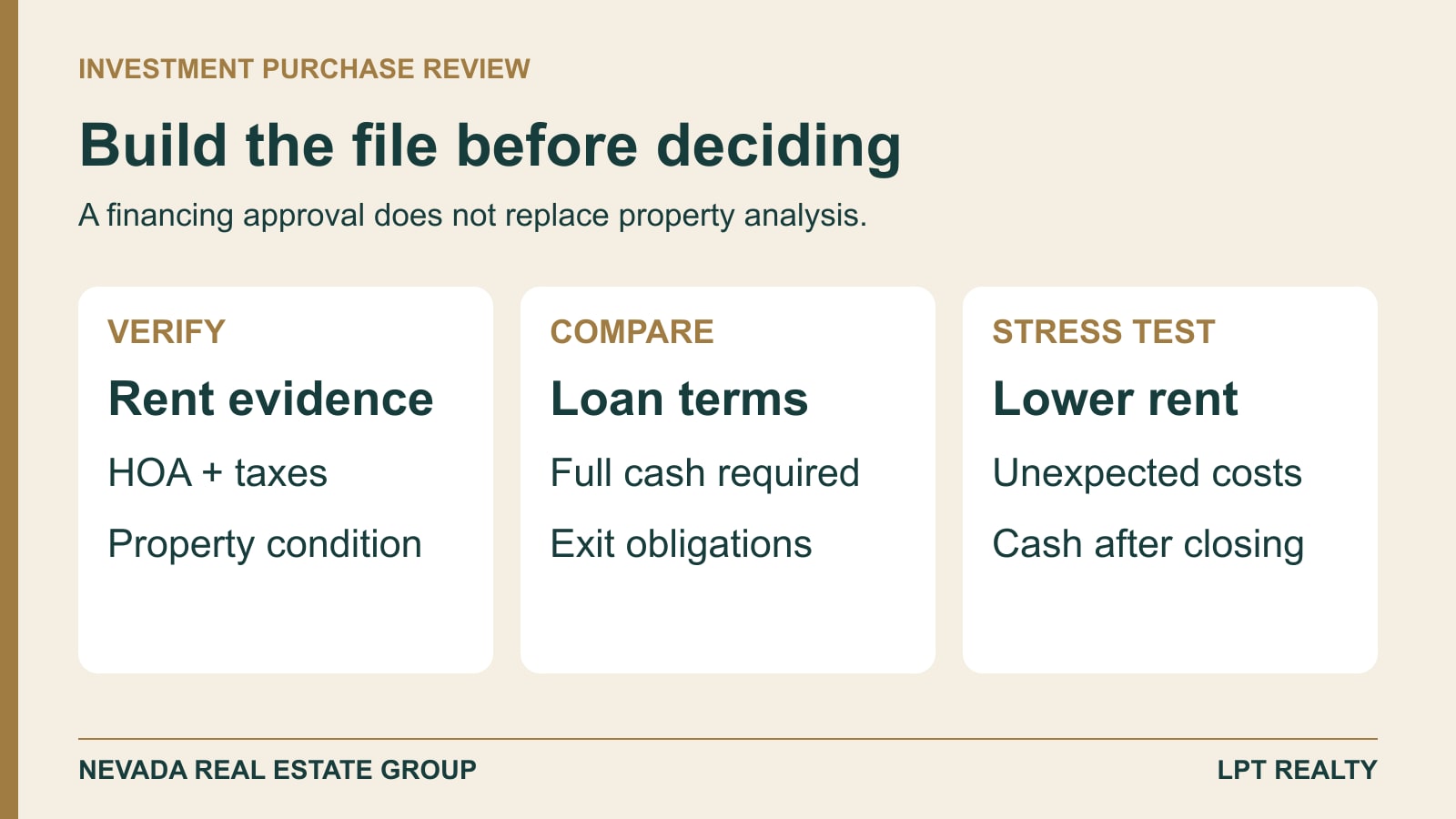
I would start with the property and its records, then compare financing. That means checking rent evidence, association restrictions, physical condition and the complete monthly cost before treating a loan product as the reason to buy. A property does not become a sound investment simply because a lender has a way to finance it.
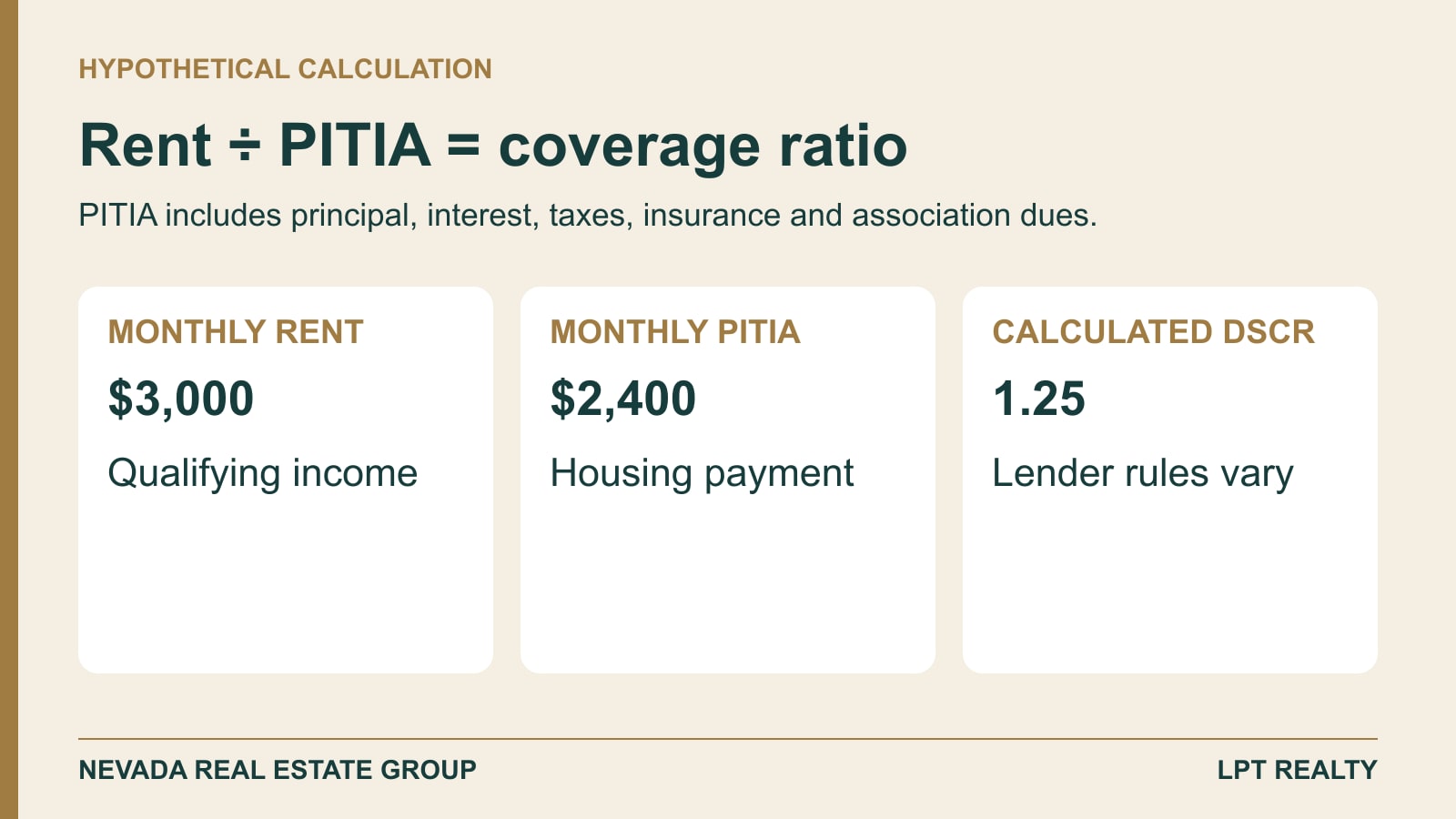
DSCR loans in Las Vegas are investment-property loans that use rental income in underwriting. A common residential calculation divides qualifying monthly rent by principal, interest, taxes, insurance and association dues. For example, $3,000 divided by $2,400 equals 1.25. That ratio does not subtract every ownership expense or guarantee positive cash flow; lender definitions and requirements vary.
- Confirm the lender's exact definitions: a common formula divides qualifying rent by PITIA, so $3,000 over $2,400 is 1.25.
- Use supported market rent, not the ad: at a 1.25 requirement, $2,200 qualifying rent caps PITIA at $1,760.
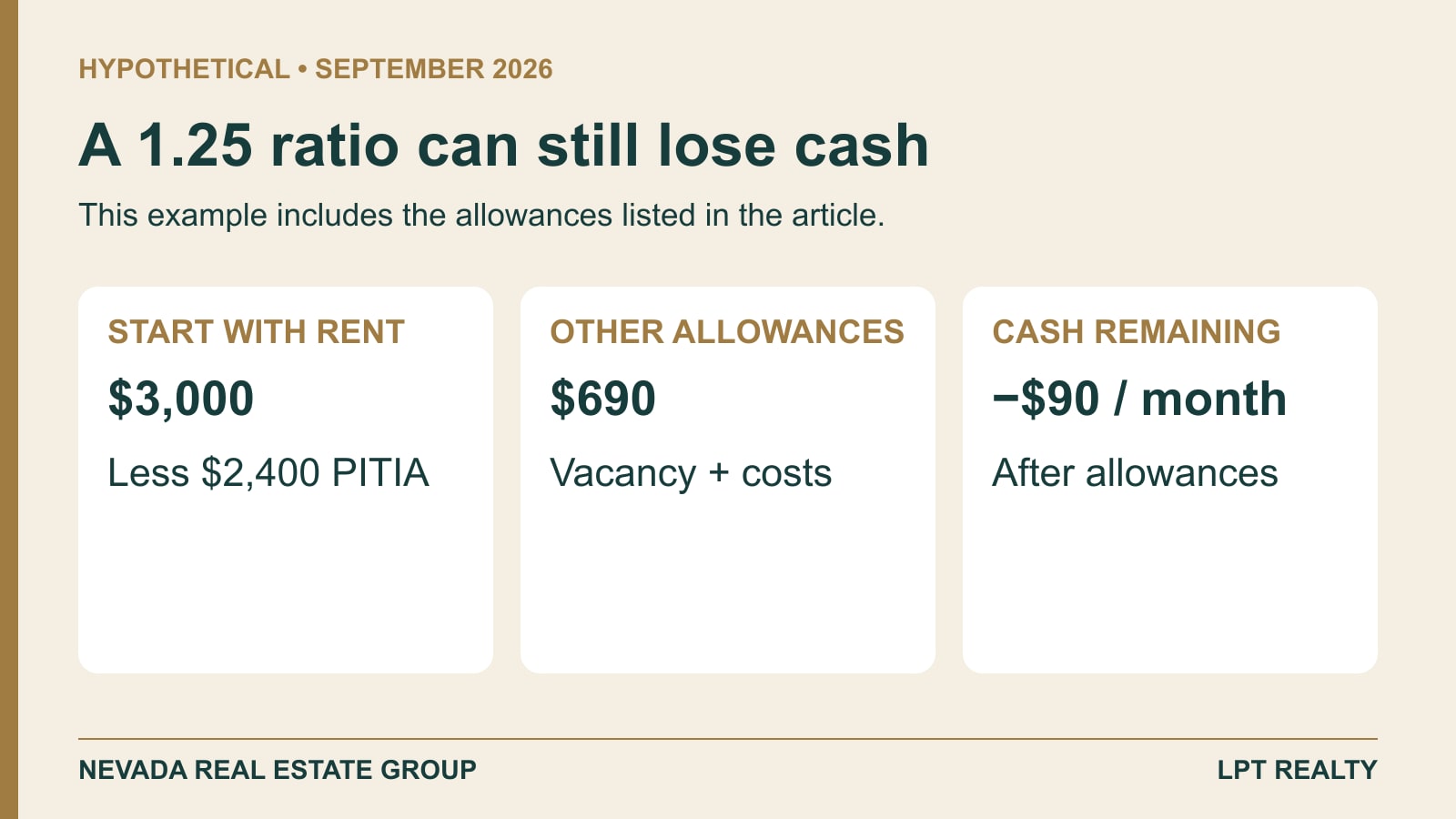
- A passing ratio can still lose money: 5% vacancy, 8% management and $300 allowances leave the example $90 short.
- On a $450,000 purchase, 20% down is $90,000 and 25% is $112,500; get reserves and prepayment terms in writing.
- Pull the parcel's tax record and NRS 116.4109 HOA resale documents, and confirm rental use, before removing contingencies.
This guide was researched September 7, 2026. It concerns long-term residential investment purchases in the Las Vegas area. Actual listings below are dated asking-price observations. Other financial examples are explicitly hypothetical; they are not lender offers, personalized loan advice, appraisals or promised investment returns.
What Is a DSCR Loan, and Who Is It Designed For?
A DSCR loan is a property-focused investment financing product, but the borrower still has to satisfy the lender's requirements. Rental income can replace or reduce reliance on personal-income documentation in particular programs. Credit, liquidity, property condition, ownership structure and other underwriting requirements do not disappear.
According to Valley West Mortgage's Las Vegas DSCR guide, its discussion of these loans centers on investment-property financing supported by rent and property expenses, with program-specific reserve, down-payment and prepayment terms. That establishes an available financing category, not automatic eligibility for every applicant or property.
The product may be relevant to someone buying a separate rental, expanding a portfolio or comparing ways to finance investment property when conventional personal-income underwriting is a poor fit. An owner planning to live in the property needs a financing path that permits the intended occupancy. Do not sign an investment-use representation that conflicts with your actual plan.
Begin by writing a short borrower-and-property summary: purchase or refinance, intended rental use, property type, proposed owner, approximate available cash and existing financing obligations. Ask the lender which program it is evaluating and which facts would disqualify the application. The answer should identify the actual program rather than rely on the generic label “DSCR.”
A useful lender conversation also identifies what happens when the property is vacant at purchase, the current lease is below market or the appraisal's rent conclusion differs from the investor's assumption. Those details can alter the loan amount and cash requirement. Understanding them before making an offer prevents a financing strategy from being built around a rent number the lender never agreed to use.
How Is the Residential DSCR Calculation Different From Investment Profit?
Ask the lender to put the formula in writing. In a common residential rental-loan version, monthly qualifying rent is divided by principal, interest, taxes, insurance and association dues, often abbreviated PITIA. Other contexts use net operating income divided by debt service. Ratios from different definitions should not be compared as if they measure the same thing.
For a location-specific application of the investment analysis, review Henderson rental-property due diligence before relying on a rental projection.
According to Visio Lending's long-term rental guide, its published residential formula uses monthly rent divided by PITIA. That is the formula used in this article's labeled examples. It is not a statement that every lender uses identical inputs, thresholds or treatment of interest-only payments.
| Monthly qualifying rent | Monthly PITIA | Calculated ratio | Meaning within this formula |
|---|---|---|---|
| $2,400 | $2,400 | 1.00 | Rent equals the listed housing payment |
| $3,000 | $2,400 | 1.25 | Rent is 25% above that payment |
| $3,600 | $2,400 | 1.50 | Rent is 50% above that payment |
The amount above PITIA is not automatically spendable profit. It may have to cover vacancy, management, repairs, owner-paid services, leasing costs and future replacements. Those costs need their own schedule. Do not add taxes or association dues again if they are already included in the denominator; a complete worksheet should avoid both omissions and double counting.
Also distinguish loan amortization from cash flow. A principal payment can increase equity while reducing cash available that month. Appreciation is another separate component and is uncertain. When reviewing a rental, keep operating cash, principal reduction, changes in market value and eventual sale costs in different lines. That gives you a clearer explanation of how the investment would work than combining every possible benefit into a single optimistic return.
What Can Two Current Rhodes Ranch Listings Tell an Investor?
They can provide a starting point for questions, not a completed rent valuation. According to GLVAR listing data accessed through Repliers IDX on September 7, 2026, the following two three-bedroom properties were advertised in the Rhodes Ranch area of ZIP code 89148. One was offered for sale and one for lease; both showed active status in the retrieved records.
| Property | Advertised amount | Size in MLS | Listing attribution |
|---|---|---|---|
| 333 Cart Crossing Way, Las Vegas NV 89148 | $439,000 asking sale price | 3 bedrooms; 1,715 sq ft | MLS 2816000; Leading Vegas Realty |
| 191 Wicked Wedge Way, Las Vegas NV 89148 | $2,200 per month asking rent | 3 bedrooms; 1,714 sq ft | MLS 2813743; BHHS Nevada Properties |
See the Rhodes Ranch community page, which carries the live listing grid, for the current public property records; the two examples were 333 Cart Crossing Way (MLS 2816000) and 191 Wicked Wedge Way (MLS 2813743). Availability and asking amounts can change. Information is provided by the respective listing brokerages through the MLS and is not independently guaranteed.
Their similar advertised size makes the pair useful for an initial discussion. It does not make them interchangeable. Compare condition, floor plan, lease inclusions, lot, location within the community and any other feature that affects rent. A rental advertisement is not evidence that a tenant signed at that price, and one offered rental is not a sufficient set of rent comparables.
Here is the limited mathematical insight: if a lender accepted $2,200 as qualifying rent and required a 1.25 ratio, the corresponding maximum PITIA under that formula would be $1,760. That is $2,200 divided by 1.25. It is not a lender's approval, a payment quote or a rent estimate for Cart Crossing Way.
The next step is to obtain a proper rent analysis and property-specific financing figures. This pair illustrates why the real work begins after finding an attractive listing. Our Las Vegas rental-market guide provides broader investor context; the financing test here is deliberately focused on an individual purchase.
Which Rent Evidence Should You Use Before Making an Offer?
Use several relevant observations and identify what each one proves. An executed lease documents contractual rent for that property. Collection records show whether the stated income was received. An active advertisement shows what an owner is asking today. A leased comparable can show a completed rental outcome, subject to the quality of its records and its similarity to the subject.
According to Visio Lending's long-term rental guide, leases and market rents are part of its long-term rental evaluation. Ask the actual lender how it treats the current lease, appraiser-supported market rent and any difference between them. Do not assume it will select whichever number makes the loan easiest to qualify.
For a local comparison, record the date, property type, size, bedroom count, condition, community, included services and lease term. Separate furnished accommodation from an unfurnished long-term lease. A property with a pool or different service obligations can have a different expense profile even when the advertised rent looks similar.
Review concessions and recurring charges. A waived month changes effective income over the lease term. A quoted base rent may not describe every mandatory payment or owner expense. The underwriting worksheet should identify which amount is rent, which items reimburse actual services and which costs remain with the owner. Get clarification rather than silently increasing the income line.
If evidence is weak, test a range and identify what would confirm it. For example, retain the existing lease as the documented current case and place a separately supported future-rent scenario beside it. Do not model an immediate rent increase without checking the lease and applicable rules. A conservative assumption is useful because it exposes uncertainty; calling an unsupported number conservative does not make it evidence.
Compare the assumptions with the dated figures in our Las Vegas average-rent guide, then obtain comparable evidence for the actual property.
Can a Property Pass the Ratio Test and Still Lose Money?
Yes. The result depends on what the ratio includes and what the owner must pay outside it. Use a separate cash-flow worksheet that begins with collected rent expectations and subtracts every relevant cash cost. Treat reserves as money deliberately set aside for future expenses, rather than profit available for immediate spending.
In this hypothetical September 2026 example, gross rent is $3,000 and PITIA is $2,400, producing a 1.25 ratio. Assume vacancy reserves equal 5% of gross rent, management equals 8%, and monthly repair and capital-replacement allowances are $150 each. These percentages and dollar amounts are invented modeling assumptions, not local industry averages or service quotes.
| Monthly line | Calculation | Amount |
|---|---|---|
| Gross scheduled rent | Assumed | $3,000 |
| PITIA | Assumed complete housing payment | −$2,400 |
| Vacancy allowance | 5% of $3,000 | −$150 |
| Management allowance | 8% of $3,000 | −$240 |
| Routine repairs allowance | Assumed | −$150 |
| Capital replacements allowance | Assumed | −$150 |
| Cash remaining after allowances | $3,000 − $3,090 | −$90 |
This calculation includes principal in PITIA and is therefore a cash-budget illustration, not an accounting net-income calculation. It also excludes income taxes, future appreciation and sale proceeds. Any additional owner-paid services would reduce the remaining cash further. Its purpose is to reveal what a headline coverage ratio does not answer.
Customize the repair assumptions to the actual property. An inspection finding about a major system deserves a specific estimate and timeline, not a small generic monthly placeholder. Similarly, a management proposal may charge separately for leasing, renewals, inspections or maintenance coordination. Read the contract before deciding which costs the advertised management percentage includes. The investment analysis gets stronger as each assumption becomes a dated quote, record or documented estimate.
How Much Cash Should You Plan to Bring Beyond the Down Payment?
Separate the down payment, transaction costs, lender-required reserves and the operating cushion you choose to retain. Some items are spent at closing; reserves may need to remain available afterward. Combining everything into “cash to close” can hide whether the owner will have enough liquidity to handle a vacancy or repair immediately after buying.
For a hypothetical $450,000 purchase, a 20% down payment is $90,000, 25% is $112,500 and 30% is $135,000. Those are arithmetic examples, not claims that a lender offers any of those loan-to-value levels for your application. The permitted amount depends on the written program terms and underwriting.
Create a separate line for quoted loan fees, title and escrow costs, appraisal charges, prepaid items and any other required expenses. Identify whether a lender's quote includes points, broker compensation and third-party charges. A lower advertised rate can come with a different upfront cost, so compare written offers for the same property and assumptions.
Then build an opening operating budget. Include immediate repairs, a possible initial vacancy, utility setup, any association charges and the funds you want available for an unexpected expense. Avoid using the same dollars simultaneously as the down payment, required reserves and a planned renovation fund. Ask the lender how it verifies reserves and which assets qualify.
The right cash cushion is property- and borrower-specific. A newly inspected house with documented recent replacements presents a different immediate spending problem from a home with multiple aging systems. Your tolerance for supporting the property through a weak rental period matters as well. The lender's minimum is an underwriting condition; your own cash plan should reflect how you would keep the property functioning if the optimistic assumptions fail.
How Do Clark County Taxes and HOA Rules Change the Analysis?
Use the actual parcel and association documents. A Las Vegas mailing address does not supply a complete tax, jurisdiction or rental-use analysis, and a neighborhood name does not establish every assessment attached to a home. Check the assessor and treasurer records, title information and applicable association materials together.
According to the Clark County Assessor's tax-abatement explanation, qualifying primary residences and certain qualifying rentals can receive a 3% cap on annual tax-bill increases; other treatment can apply to other properties. The cap is not a tax rate applied to the home's purchase price. Confirm the property's actual classification and projected bill rather than copying the seller's situation into a new investor budget.
For association costs, identify every applicable layer and its billing frequency. A maintenance amount in a listing feed may need clarification before it becomes a monthly underwriting expense. Check master and sub-association obligations, special assessments and separate service charges. Do not treat a missing field as proof that the expense is zero.
According to NRS 116.4109, common-interest-community resale information includes specified association records. Use the applicable resale package to review rental restrictions and financial obligations, and ask the association for clarification of ambiguous provisions. A neighbor renting a home does not establish that your proposed lease will comply.
The Rhodes Ranch sale example above includes listing-level tax and association fields, but this article does not convert them into a buyer payment quote because their current application and all components have not been independently reconciled. That is a useful discipline: a spreadsheet should show a field as needing confirmation until the correct source supports it, rather than gain apparent precision from an unverified input.
Review Las Vegas property taxes and the association's own documents before completing the expense calculation.
Which Loan Terms Deserve Attention Besides the Interest Rate?
Review the loan's rate structure, amortization, maturity, fees, reserves, recourse and prepayment provisions as a connected package. A monthly payment can look attractive because of interest-only treatment, a shorter introductory period or upfront points. Those features need to be understood before comparing it with another offer.
According to the Consumer Financial Protection Bureau's Regulation Z commentary, credit for acquiring, improving or maintaining non-owner-occupied rental property is deemed business-purpose credit for that provision. Consumer-mortgage disclosure protections should not simply be assumed to apply in the same way. Ask what disclosures and contractual protections apply to the actual loan.
Request the written prepayment terms and examples of what an early sale or refinance would cost at several dates. A property you intend to hold for years may still need to be sold earlier because circumstances change. If refinancing is part of the plan, include the existing loan's exit cost and the new transaction's cost rather than assuming a lower future rate is a free improvement.
Clarify whether there is a balloon payment, when an adjustable rate can change, how any adjustment is determined and what the fully amortizing payment would be after an interest-only period. Have a qualified adviser review unfamiliar provisions before signing. The objective is to understand obligations, not to choose the loan with the most complicated feature list.
Also confirm who is borrowing and guaranteeing the debt. An LLC name on title does not itself establish the absence of personal liability. Ask the lender, attorney and insurer to coordinate the ownership structure before closing. An entity formed at the last minute can create avoidable document and timing problems if it does not match the approved application.
Should You Compare DSCR With a Conventional Investment Loan?
Yes, when both are plausible options for the borrower and property. Compare actual written terms rather than assuming that one product is always cheaper, easier or better. A borrower who can satisfy conventional underwriting may have a useful alternative; another borrower may value a property-focused program despite a different cost structure.
Use the same purchase price, down payment, lock period and property assumptions when requesting comparisons. A quote based on a larger down payment is not directly comparable with one preserving more cash. A rate without its points and fees is not a complete offer. Note which conditions remain outstanding and whether the quote depends on a particular rent conclusion.
| Question | DSCR program | Conventional investment program |
|---|---|---|
| What supports qualification? | Ask how property rent and borrower factors are evaluated | Ask how personal income, debts and rental income are evaluated |
| What cash must remain? | Request the exact reserve rule | Request the exact reserve rule |
| What happens on early exit? | Read prepayment and payoff terms | Read prepayment and payoff terms |
| What ownership is permitted? | Confirm entity and guarantor requirements | Confirm approved borrower and vesting |
According to the CFPB's loan-comparison guidance, interest rates can change daily, so offers obtained on different days can reflect market changes. Its consumer Loan Estimate discussion should not be mistaken for a promise that a business-purpose DSCR loan uses the same disclosure process. The general comparison discipline remains useful: align the assumptions and obtain the full written cost.
Choose based on the transaction you intend to complete and the risks you can manage. The existing cash-flow investing guide addresses the wider investment strategy; this comparison is about financing one property without losing sight of that strategy.
For the broader acquisition decision, read buying a Las Vegas rental property alongside the loan comparison.
What Stress Tests Should You Run Before Removing Contingencies?
Change one assumption at a time, then test a combined downside case. Lower rent, higher insurance, a repair expense and an extended vacancy affect the investment differently. A spreadsheet that only works at the asking rent with no unexpected costs is showing the narrowness of the margin, even if its formulas are correct.
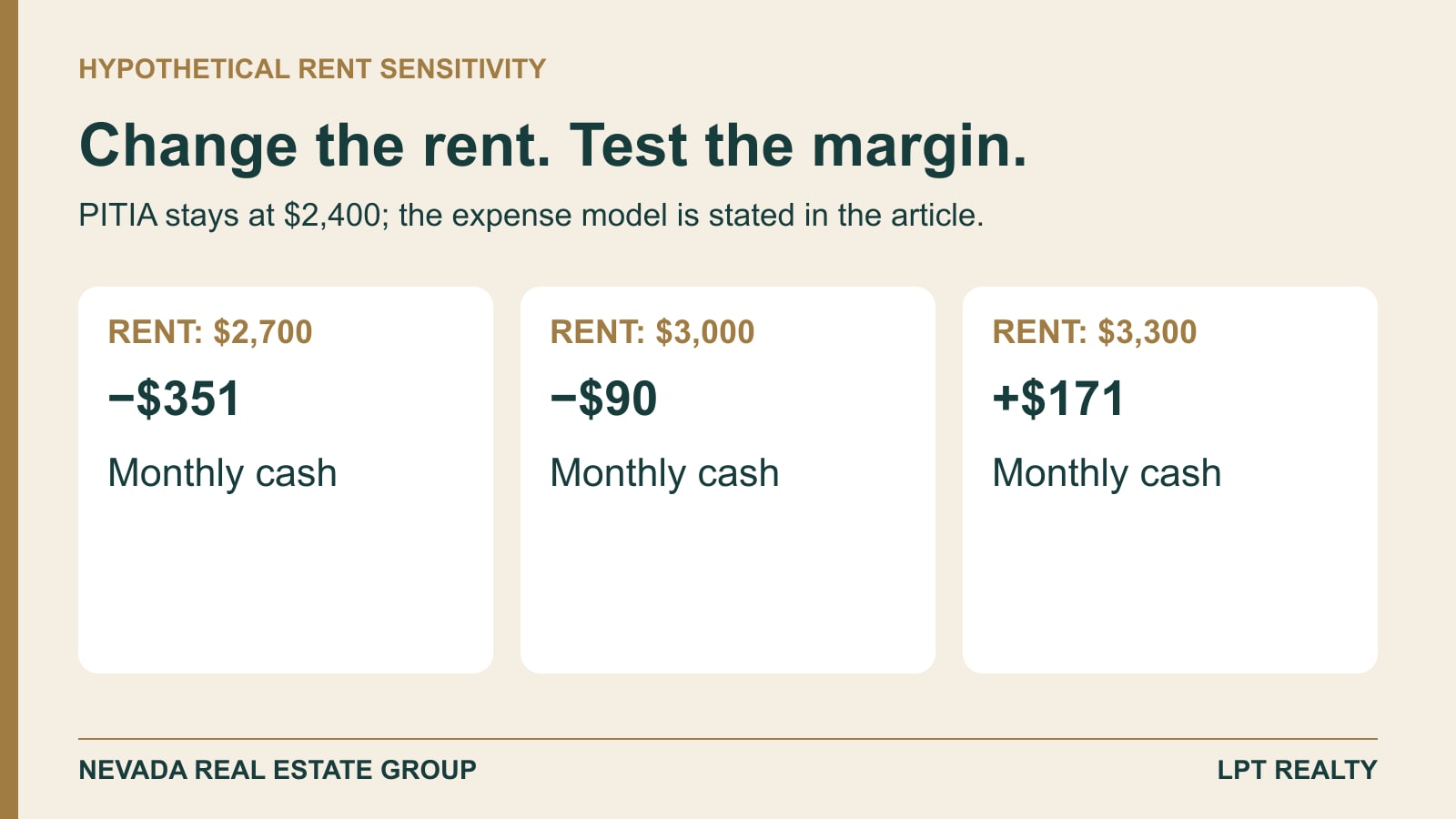
Return to the hypothetical September 2026 example with $2,400 PITIA, 5% vacancy, 8% management and $300 combined monthly repair and capital allowances. At $2,700 rent, cash after those allowances is negative $351. At $3,000 it is negative $90. At $3,300 it is positive $171. None of these rent amounts is an estimate for the actual Rhodes Ranch sale listing.
| Assumed rent | Rent ÷ $2,400 PITIA | Cash after stated allowances |
|---|---|---|
| $2,700 | 1.125 | −$351 per month |
| $3,000 | 1.25 | −$90 per month |
| $3,300 | 1.375 | +$171 per month |
This simple version changes the vacancy and management allowances with rent while leaving repair and replacement allowances fixed. Your actual management contract might use a different basis. Model it accurately. Also distinguish a percentage vacancy reserve spread across the year from a specific initial period with no rent; adding both without explanation can double count the same event.
Use inspection results for a separate immediate-repair scenario. Ask what happens to the cash remaining after closing if a major expense arrives in the first month. Decide in advance which findings would lead you to renegotiate, change financing or stop pursuing the property within the contract's terms. A pre-agreed decision rule makes it easier to respond to evidence without rationalizing a purchase simply because time has already been invested.
How Should You Sequence the Property Search, Loan Review and Inspections?
Start with a financing discussion broad enough to establish the likely program and cash requirement, then narrow the home search using the property's actual economics. Once a candidate is identified, move from preliminary assumptions to written property-specific information. A general prequalification should not be treated as final approval of an address, lease or association.
Before making an offer, identify obvious restrictions, intended occupancy and the initial rent evidence. During the contractual review period, obtain the lender's property requirements, appraisal and rent analysis, inspections, insurance quote, association documents and title information. Track the dates on which you need each item to make a decision within the purchase agreement.
Use one shared worksheet with source dates and an owner for every unresolved item. The agent may coordinate listing information and transaction milestones; the lender determines underwriting; the inspector evaluates within the inspection scope; the insurer quotes coverage; an attorney or tax professional handles the questions within their practice. Do not allow a number to change in one person's email while the decision spreadsheet retains the old version.
For an occupied property, add the signed lease, amendments, deposit records, rent collections and possession arrangements. A tenant being in place does not eliminate the need to inspect or understand the lease. For a vacant property, investigate whether the proposed rent and lease-up schedule are supported, and whether the lender requires repairs before funding.
Make the final decision with the complete cost and document set. If the rent analysis, appraisal or insurance quote changes the transaction materially, revisit both financing and investment suitability. The purpose of due diligence is to improve or change the decision when new information arrives, not simply to produce a folder of documents after the decision has become emotionally fixed.
Use the Las Vegas home-inspection guide to plan the property review without allowing a loan ratio to substitute for due diligence.
How Do You Build a Las Vegas Rental Shortlist That Fits Your Numbers?
Start with the limits you can explain: available purchase cash, desired operating cushion, property type, management approach and the amount of downside you can carry. Then compare homes using the same worksheet. This makes it easier to see whether a lower price is being offset by higher expenses, immediate work or a weaker rent case.
Use Las Vegas listings and the Rhodes Ranch community page as starting points for current property research. A community page provides context and available inventory; it does not certify rental permission or investment performance for every home shown. The parcel, association and lease evidence still control your individual analysis.
For each finalist, keep a short investment memo: why this property fits, which rent evidence was used, the full payment assumptions, nonloan expenses, immediate repairs and the result of the downside test. Include the assumptions that would have to improve for a marginal deal to work. A seller concession or different down payment may change the calculation, but it should be modeled rather than asserted.
I would rather see a small shortlist with complete, comparable records than a large list ranked only by asking price. The most useful next conversation is about an address and a clearly stated plan. Nevada Real Estate Group can help organize the property search, local comparisons and purchase process while your chosen lender confirms financing.
To discuss an investment purchase, request a consultation or call (702) 637-1759. Nevada Real Estate Group is brokered by LPT Realty; Chris Nevada's license is S.181401. Ask for a property comparison built around your rent, cost and cash requirements. No loan approval, investment return or future refinance outcome is guaranteed.
Frequently Asked Questions
What does DSCR stand for?
DSCR means debt-service coverage ratio. In the residential rental-loan example used here, it is qualifying monthly rent divided by principal, interest, taxes, insurance and association dues. Other lending contexts use different definitions, so confirm the actual lender's formula before comparing a ratio or applying a threshold.
Is 1.25 the minimum ratio for every DSCR loan?
No. The 1.25 ratio in this guide is an illustrative calculation, not a universal lending requirement. Program thresholds, pricing, reserves and permitted leverage vary. Ask the lender for the current written requirement for your borrower profile, property type, loan structure and rent evidence.
Does a DSCR loan mean there is no borrower underwriting?
No. Property rent can play a central role without eliminating credit, liquidity, identity, ownership and other lender requirements. A program that does not use a conventional personal-income calculation can still require substantial documentation. Get the actual document list and conditions from the lender reviewing your application.
Can I use a rental advertisement as the rent for a home I want to buy?
Use it as one observation, not a completed rent appraisal. The September 7, 2026 Rhodes Ranch example includes an asking rent for a different property; it does not establish achievable rent for the home offered for sale. Review relevant leases and comparables, then confirm the rent amount the lender accepts.
Can a 1.25 DSCR still produce negative cash flow?
Yes. In the hypothetical September 2026 example, $3,000 rent divided by $2,400 PITIA equals 1.25, but $690 of additional monthly allowances leaves negative $90. The result follows from stated assumptions for vacancy, management, repairs and replacements. Actual costs and lender definitions may differ.
Can I live in a home financed with an investment DSCR program?
Do not use an investment-only program for an intended owner-occupied purchase. Tell the lender your actual plan and select financing that permits it. If circumstances change later, review the loan documents and obtain appropriate advice before changing use; do not assume the original occupancy representation stops mattering after closing.
Does a 3% Nevada property-tax cap mean I pay 3% of the purchase price?
No. The Clark County Assessor describes a cap on annual tax-bill increases for qualifying properties, not a tax rate applied to purchase price. Confirm the actual parcel's classification, tax bill and applicable treatment when preparing the investment budget.
What should I send an agent before starting a DSCR property search?
Share your intended use, property preferences, available purchase cash, desired reserves and lender's preliminary program requirements. For a specific listing, bring the written financing assumptions and rent evidence already obtained. Avoid sending identity numbers or full financial statements through ordinary public forms; use your lender's secure document process.
Which Sources Inform This DSCR Buying Guide?
Sources and listings reviewed September 7, 2026. No lender has approved the examples or reviewed this article as a borrower application. No interest rate is quoted. The article's role is property-purchase education and comparison.
- Valley West Mortgage, Las Vegas DSCR guide: local program category and questions to verify with the lender.
- Visio Lending, long-term rental guide: a published residential DSCR formula and rental-evidence discussion; lender-specific terms are not universal requirements.
- CFPB, Regulation Z commentary on exempt transactions: business-purpose treatment of non-owner-occupied rental financing.
- CFPB, comparing loan offers: dated offer comparison; its consumer disclosure process is not assumed to apply identically to business-purpose loans.
- Clark County Assessor, tax abatement: tax-bill caps and property classification.
- Nevada Legislature, NRS 116: association resale information and the need to inspect actual governing documents.
- GLVAR through Repliers IDX: MLS 2816000 (333 Cart Crossing Way, listed by Leading Vegas Realty) and MLS 2813743 (191 Wicked Wedge Way, listed by BHHS Nevada Properties) — see the live Rhodes Ranch listing grid. Snapshot taken September 7, 2026, at 9:35 a.m. Pacific. Asking prices and rent are not completed sale or lease results; availability may change.
The two MLS records were selected from separate active sale and lease searches for three-bedroom properties in ZIP code 89148. They illustrate a comparable-research starting point, not a representative market sample or an appraisal. Original diagrams and cash-flow scenarios use disclosed hypothetical inputs; no private client results are claimed.