

Las Vegas air quality changes with weather, dust, ozone and transported wildfire smoke. Clark County identifies April 1 through September 30 as ozone season. Before moving, check official daily readings and longer-term records, then evaluate the actual home, cooling system and surroundings. A citywide ranking or one clear afternoon cannot describe every neighborhood or your year-round experience.
- Read the AQI with its pollutant, location and timestamp.
- Dust, ozone and wildfire smoke require different questions.
- Use official monitoring data for conditions, not listing photographs.
- Compare homes by documented condition and observable surroundings.
- Match filtration decisions to the equipment and household's needs.
- Review personal health concerns with a qualified clinician.
The desert sky is part of the appeal of Southern Nevada, but visibility and air quality are different things. Buyers deserve a practical way to investigate both outdoor conditions and the home they would live in. That starts with understanding what the available data can tell you and which questions still require a property visit or professional evaluation.
This guide explains the monitoring tools, seasonal issues and home-search decisions in one place. Sources were checked in September 2026. It does not assign a health rating to any community or substitute a real estate recommendation for individual medical advice.
Is Las Vegas Air Quality Good or Bad for Someone Moving Here?
There is no single permanent answer that describes every day, pollutant and address in the valley. The more useful question is how conditions change, what those changes mean for your routines and how you would manage the home you choose. A relocation decision should use that fuller picture instead of a citywide label by itself.
According to AirNow's explanation of the Air Quality Index, the AQI organizes outdoor air conditions into categories associated with health guidance. It is designed to help people interpret current or forecast conditions. It is not a real estate score, an indoor-air measurement or a guarantee about a particular person's response.
Start by identifying what you are trying to learn. A parent planning outdoor activities may need daily forecasts and alerts. A buyer comparing homes may also want to understand nearby activity, building condition and cooling equipment. Someone with asthma or another health concern should discuss personal precautions with a clinician who understands their circumstances.
Avoid using a vacation memory as the entire evidence base. A pleasant week in one season may be accurate as a personal experience and still say little about a different season. Similarly, one smoky day can be important without proving that the same condition persists throughout the year.
Build a simple research file for the move. Save official monitoring links, note when you visited and record the questions raised by each home. Keep observations distinct from conclusions. “Dust visible on the patio during a windy visit” is an observation; “this neighborhood always has poor air” is a much broader claim that the observation does not establish.
This approach makes the subject less abstract. You can compare daily needs, the information available and the property features you can investigate. It also leaves room for a sensible decision when the evidence is mixed, rather than forcing every location into a universal good-or-bad category that hides the details you actually need.
What Does the AQI Number Actually Mean?
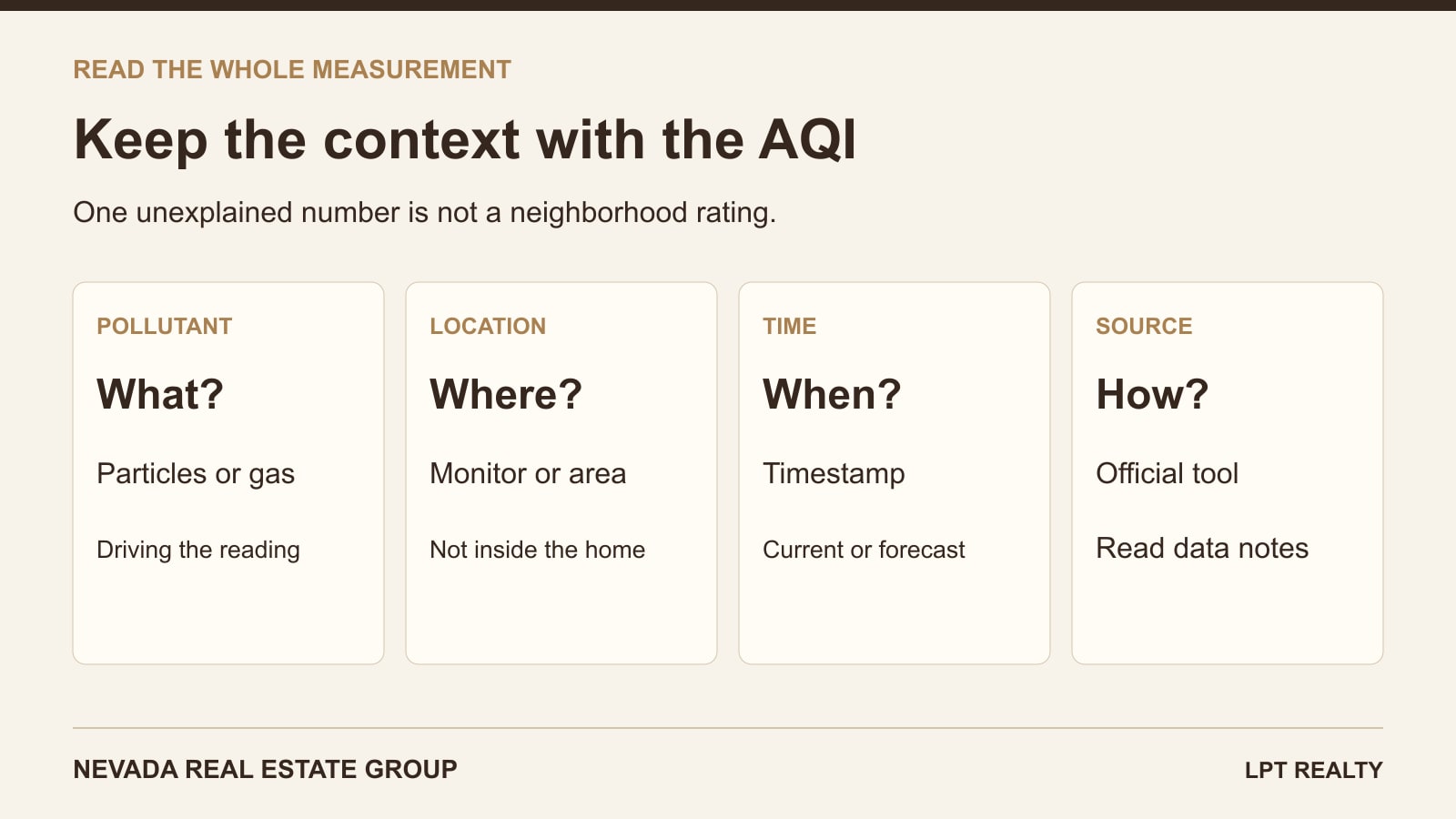
Read the number together with the category, reporting location, time and pollutant. A screenshot showing only a colored number omits context that may change how you use it. Check whether the display is reporting a current estimate, a daily value or a forecast before comparing it with another tool.
According to the EPA's explanation of the AQI, the index covers five major air pollutants: ground-level ozone, particle pollution, carbon monoxide, sulfur dioxide and nitrogen dioxide. The overall reported value can be driven by different pollutants on different days. That is why knowing what is driving the reading matters.
| AQI range | Category | How to use it in planning |
|---|---|---|
| 0–50 | Good | Check the time and location of the reading |
| 51–100 | Moderate | Review guidance if you are unusually sensitive |
| 101–150 | Unhealthy for sensitive groups | Consult the relevant sensitive-group guidance |
| 151–200 | Unhealthy | Use current public-health activity guidance |
| 201–300 | Very unhealthy | Pay close attention to official alerts |
| 301 and higher | Hazardous | Follow official emergency guidance |
The table is a reference for interpreting a display, not a prediction of how often Las Vegas falls into each category. Frequency requires an actual historical dataset, a defined period and a clear counting method. A current reading cannot answer that historical question by itself.
When comparing two readings, check whether they represent the same pollutant and time window. One device may report particles near a home while a regional display reflects the area's highest reported pollutant. Different values do not necessarily mean one source is malfunctioning; they may be describing different things.
Save the full context when a reading affects a decision. Note the source, location, timestamp and pollutant along with the number. That small habit makes your research easier to interpret later and avoids turning an isolated screenshot into a misleading comparison between homes or communities.
Why Are Dust, Ozone and Wildfire Smoke Different Issues?
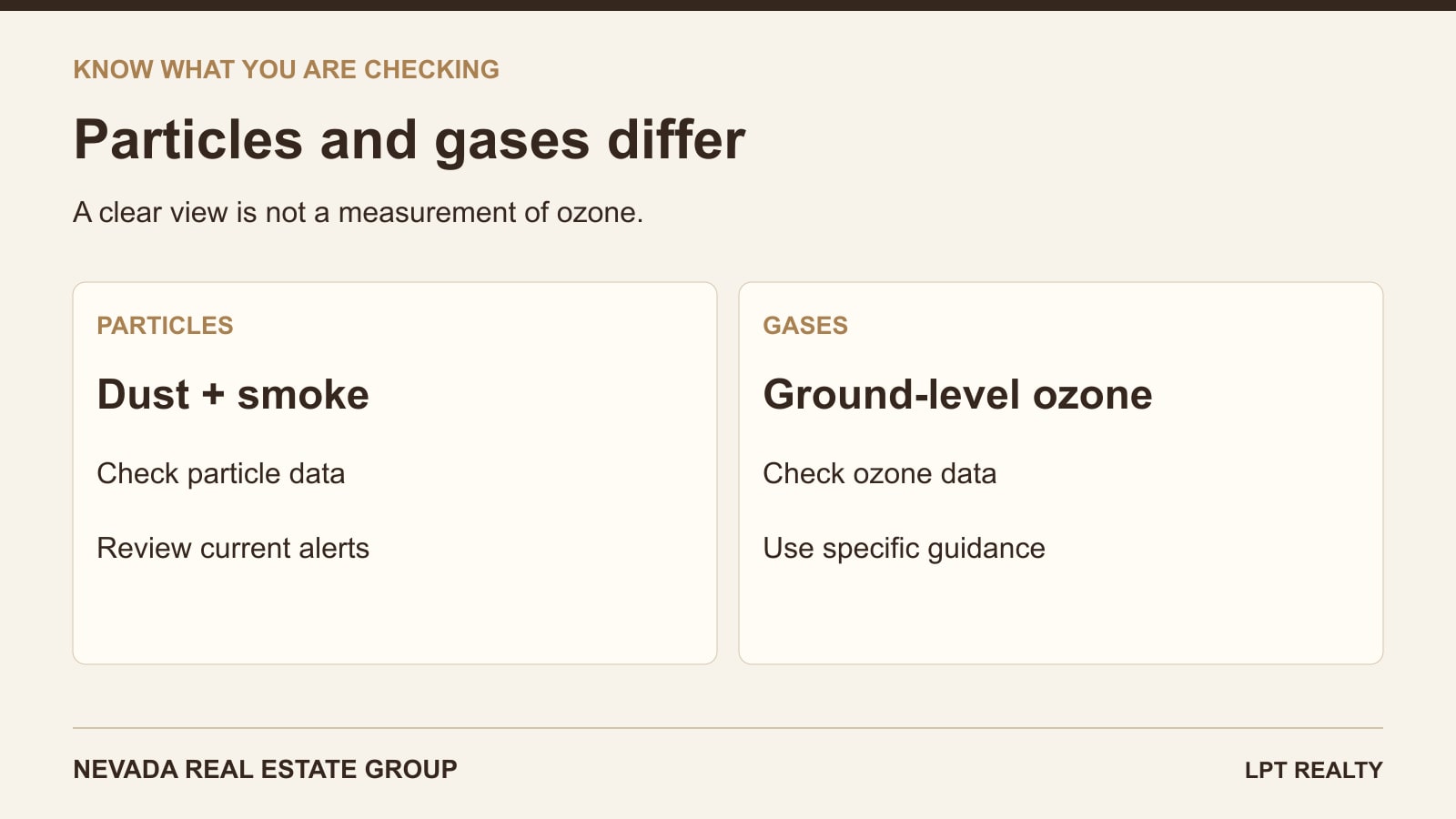
They can all affect an outdoor-air discussion, but they are not interchangeable. The source, weather pattern, monitoring information and practical response can differ. A homebuyer gets a clearer picture by asking which issue is present instead of using “dusty” as a catchall description for every air-quality concern.
Dust is associated with airborne particles and can accompany wind, disturbed ground or nearby activity. Ozone is a gas, so the fact that the sky looks clear does not tell you whether the ozone reading is low. Wildfire smoke can arrive from fires outside the valley and change conditions independently of how tidy or developed a neighborhood appears.
According to Clark County's Ozone 101 information, the county's ozone season runs from April 1 through September 30. Use that seasonal context to plan research, while checking actual conditions throughout the year. A calendar window does not mean every day inside it has the same reading or every day outside it is free of other concerns.
| Concern | Useful information | What appearance alone cannot establish |
|---|---|---|
| Windblown dust | Wind alerts, particle readings and observed nearby activity | The concentration or duration of exposure |
| Ground-level ozone | Ozone monitoring and official forecasts | A low ozone level on a clear day |
| Wildfire smoke | Smoke information, particle data and local alerts | That a distant fire cannot affect the valley |
| Indoor-air concern | Building evaluation and appropriate indoor assessment | The condition inside from a regional outdoor reading |
For a property visit, write down what you actually noticed and seek the corresponding evidence. If you saw disturbed land nearby, investigate current work and dust controls. If an official alert identifies ozone, use the ozone guidance rather than assuming a dust filter solves the entire issue. If smoke is present, consult the relevant current reports.
Keep the distinctions visible in conversations with inspectors and equipment professionals too. A product designed to capture particles is answering a different question from treatment of gases. Understanding the concern first makes the next purchase or home-improvement decision more focused and less likely to rely on a broad marketing promise.
When Should You Pay Extra Attention to Las Vegas Ozone?
Use the county's April-through-September ozone-season designation as a reason to include warm-season conditions in relocation research. It should prompt better observation and use of forecasts, not a conclusion that outdoor life is impossible for half the year. The actual reading and official guidance remain the useful tools for a particular day.
Plan a scouting visit with enough flexibility to learn something beyond the photographs. Check the forecast before arriving, then review the conditions while you are here. If your usual routine includes a long outdoor workout, commuting by bicycle or spending afternoons outside, consider how you would use daily information to adjust that routine when needed.
Avoid treating early morning or a particular elevation as a guaranteed solution. Time of day, weather and location can affect conditions, but a general pattern does not establish the reading at a specific address. Verify the relevant forecast and monitor information rather than turning a rule of thumb into a promise.
It is also useful to separate household preferences from medical needs. Some people are primarily deciding how often they would change outdoor plans. Others need individualized guidance about symptoms, medication or activity. A real estate agent can help organize a visit and property evaluation; a clinician should address personal health decisions.
Keep a small observation log during the search. Include the date, the official source checked, the reported pollutant, the planned activity and whether the conditions changed your plans. Over multiple visits, that record can show what the information means for your lifestyle without claiming to be a scientific exposure study.
If your only visit falls outside the warm season, do additional research rather than pretending the visit covered every condition. Review the official historical tools and ask targeted questions about how the home is maintained and cooled. A well-informed purchase can acknowledge seasonal variation while still identifying a property that fits your priorities and a daily routine you are comfortable adopting.
What Should You Know About Wind and Desert Dust Before Choosing a Home?
Pay attention to both regional weather and the immediate surroundings of the property. A home may be near an active construction area, an unpaved surface or another visible source of disturbed soil. Those observations deserve investigation, but they should not be exaggerated into a permanent air-quality ranking for the whole community.
According to the National Weather Service's dust-storm safety guidance, blowing dust can create serious visibility hazards. Use weather warnings when planning travel and property visits. A day with active hazardous conditions is not the time to continue a tour schedule simply because appointments have already been arranged.
On an ordinary visit, inspect the places where maintenance tells a useful story: window tracks, door weatherstripping, patios, the garage and visible filter access. Dust accumulation alone does not establish an air-quality violation or a health diagnosis. It can, however, lead to practical questions about cleaning, sealing, filtration and how frequently the owner services the home.
Ask about nearby construction using current information. What work is underway? Is the site active now or merely vacant? Can the city or county identify the applicable project? A salesperson's statement that all construction will end soon should be checked before you rely on it in a purchase decision.
Think about outdoor preferences. A household that wants to use a patio frequently may care about wind exposure, shade and how easy the space is to maintain. Another household may prioritize an enclosed garage and a straightforward entry area. These are property-fit decisions you can evaluate directly without assigning a medical label to the location.
If you observe a concern that appears to need official attention, use the relevant local reporting process and describe the location and event accurately. Keep that separate from the home-purchase negotiation. The useful outcome is reliable information about the issue and the property, rather than an assumption based on a single dusty surface or an undated neighborhood comment.
How Can Wildfire Smoke Affect a Las Vegas Relocation Visit?
Smoke is a reason to check current regional information even when there is no visible fire near the home you are touring. A neighborhood's architecture or distance from a local construction site does not tell you whether transported smoke is affecting the area that day. Use the relevant monitoring and smoke information before interpreting the view.
According to AirNow's guide to using its site, the area AQI display and the Fire and Smoke Map serve different purposes. The smoke-focused tool provides additional context for particle conditions. Look at the tool's explanations so you understand what is being measured or estimated and how recent the information is.
If a visit coincides with smoke, record the event rather than treating it as a normal photograph of the community. You can still learn about the floor plan, property condition and daily logistics, but an outdoor comparison may need another visit or more historical research. Conversely, a smoke-free visit does not establish that the area never experiences transported smoke.
Consider how the home would support an indoor day when outdoor conditions are unfavorable. Is cooling functional? Are there rooms that can be used comfortably with windows closed? What filter system exists, and can a qualified professional explain its capabilities? These are questions about the building and equipment, not guarantees that indoor air will meet a particular standard.
Avoid spending money on an air-cleaning product solely because a dramatic smoke image appeared during your search. Identify the room size, the pollutant concern, the equipment specifications and the maintenance required. If a household member has a health condition, incorporate their clinician's guidance into that decision.
Build flexibility into the travel plan. If current alerts make outdoor touring or a planned excursion unsuitable, shift the schedule and use the time for document review or indoor appointments. The goal of a relocation visit is a sound decision, not completing every planned activity regardless of the conditions reported that day.
Where Can You Check Reliable Las Vegas Air-Quality Information?
Start with the local monitoring network and AirNow, then use each tool for the question it is designed to answer. Current conditions, forecasts, monitor details and historical reports are different products. Bookmarking the right pages makes daily use easier than searching for a new third-party summary every time you want an update.
According to Clark County's air-quality monitoring portal, readers can review local monitoring information and reports. When examining a value, identify the site, parameter and time period. A nearby monitor can provide useful context without being a sensor inside the house you are considering.
According to AirNow's description of its data, its near-real-time reporting is preliminary and differs from the fully validated data used for regulatory purposes. That distinction matters when a buyer moves from checking today's conditions to making a historical claim about a city or a neighborhood.
Use a short routine. First check the area forecast or current AQI. Then identify the pollutant driving the concern. If conditions or the purpose of your visit call for more detail, review the relevant local monitors, smoke tools or weather alerts. Save the source and timestamp when the information becomes part of your relocation notes.
Be cautious when two apps disagree. Compare the data source, location, averaging method and update time before concluding that one number is wrong. A privately operated particle sensor and an official ozone monitor are not measuring the same pollutant. A forecast for tomorrow and a reading from this afternoon also answer different questions.
For an address-level concern, ask what information is actually available. Do not imply that a regional monitor measures every street with equal precision. If a purchase depends on understanding a particular indoor or site-specific issue, an appropriate professional assessment may be needed.
Reliable research is not about collecting the most screenshots. It is about connecting a source to a question, preserving its context and recognizing the limits of the answer. That produces a much stronger home-search file than a collection of unexplained colored numbers.
How Should You Compare Air Quality Across Seasons or Years?
Define the comparison before choosing the numbers. Decide which pollutant, geography and time period you want to study, then use a dataset suited to that question. A daily AQI count, an annual concentration and a ranking from a report can each be meaningful while describing different things.
According to Clark County's average-report tool, users can review information by site and parameter across report periods. Check the available coverage and definitions before summarizing it. Missing observations should not be silently treated as good-air days, and one monitor's record should not be described as a measurement at every property in the valley.
For a year-to-year comparison, keep the method consistent. Use comparable months, the same pollutant and a clear geographic definition. If the monitoring coverage or calculation method changed, note that change before interpreting a difference as a trend. A precise percentage is only useful when its denominator and data quality are understood.
Read the underlying dates in any ranking article. The publication year may differ from the years measured. A newly shared link can contain an older report, and an old press release may remain easy to find in search results. Record both the release date and the actual observation period before calling a ranking current.
For a household move, turn the research back into practical questions. How often might you need to adjust a routine? Which season deserves another visit? What official alerts would you use? Historical data can inform those questions, but it does not predict the exact conditions on your future moving day.
If you compare Las Vegas with another city, use the same measurement and period for both. Comparing one city's best month with another city's annual worst-day statistic produces a dramatic but unhelpful result. A fair comparison may be less simple, yet it is much more useful for choosing where and how you want to live.
Keep the underlying report with any summary you create. That allows you to revisit the conclusion when newer information becomes available without having to reconstruct which numbers were used originally.
Does Summerlin, Henderson or Another Neighborhood Have Better Air?
A community name alone is not enough evidence to assign a dependable air-quality advantage. Conditions vary with pollutant, weather, monitoring coverage and local circumstances. A higher elevation, newer development or attractive mountain view should not be converted into a health promise without appropriate evidence for the specific claim.
Compare the information that is actually available for the locations you are considering. Are the readings from the same time? Do the monitors measure the same pollutant? How far are they from the properties? Are you looking at a recurring pattern in a suitable dataset or a single day's difference? Those questions help distinguish a useful comparison from an appealing story.
During visits, focus on observable surroundings and your daily route. Note major roads, visible construction, nearby land uses and where you would spend time outdoors. These observations can guide further investigation, but they should remain observations until supported by the right records or assessment.
Ask for evidence when a listing or sales conversation makes a broad environmental claim. What was measured, where and when? Who collected the data? Does the claim refer to outdoor conditions, the interior of one home or a regional average? A buyer should be able to understand the basis before relying on it.
You can still compare Summerlin, Henderson and other Las Vegas homes on well-defined housing priorities. Evaluate the floor plan, property condition, actual costs, amenities and travel needs alongside the air-quality research. There is no need to invent an environmental ranking to decide that a particular home fits your life better.
If an air-related concern is central to your move, allow time for more than one visit and discuss the issue with an appropriate professional. The resulting decision may involve a combination of location, building features and daily habits. It should be based on the household's needs and the evidence available, rather than a blanket claim that one community is universally the cleanest or healthiest place to live.
What Should You Check Inside a Home Before Buying?
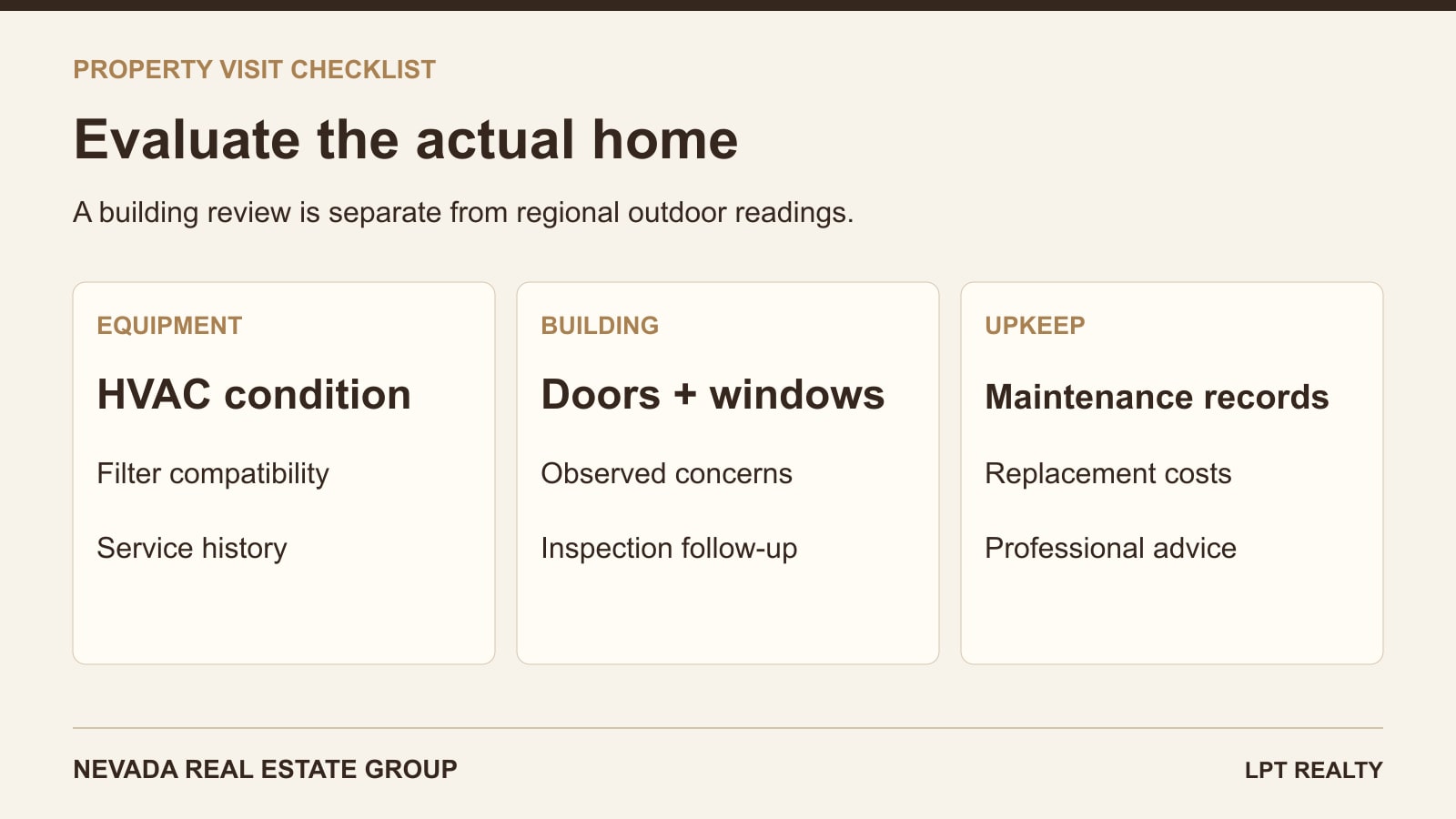
Outdoor monitoring does not describe the inside of a house. Evaluate the building on its own terms, including its cooling equipment, visible condition, maintenance records and any signs that merit further inspection. A regional AQI reading cannot tell you whether a home's filter fits correctly or whether a past leak was repaired properly.
Begin with the standard inspection process and request appropriate follow-up when a specific concern appears. Ask about HVAC service history, filter location and replacement practices. Look at accessible weatherstripping, windows and doors. If you notice an odor, staining or unusual dust accumulation, describe it accurately and investigate rather than assigning a cause from appearance alone.
| Item to review | Evidence to request | Useful follow-up |
|---|---|---|
| Cooling and filtration | Equipment details and service records | Qualified HVAC assessment of condition and compatibility |
| Windows and doors | Visible condition and inspection findings | Evaluate sealing or repair needs |
| Water-related concerns | Disclosures, repair records and inspection findings | Appropriate specialist review when warranted |
| Nearby activity | Observed conditions and current project information | Confirm the activity and its expected scope |
| Recurring maintenance | Filter specifications and owner records | Include realistic upkeep in the ownership budget |
Use our Las Vegas HVAC buying guide and desert home-inspection guide to organize the broader property review. The equipment and building should be evaluated together; a premium filter label does not establish that an aging system is in good condition.
Ask the inspector to distinguish what was observed from what requires specialized testing. A general home inspection has a defined scope. If your concern falls outside it, decide what additional evaluation is appropriate before your contractual investigation period ends.
Keep maintenance and improvement costs visible in the purchase decision. If a home needs work, obtain a practical scope and estimate rather than assuming a small allowance will solve every issue. A documented building review gives you information you can use in budgeting and negotiation, while an unexplained “air quality” label offers little guidance about what to do next.
Will an Air Purifier or Better HVAC Filter Solve the Problem?
Start with the pollutant concern and the equipment specifications. An air cleaner is a tool with a defined capability, not a blanket promise that every indoor-air issue will disappear. The room, airflow, operating settings, filter condition and sources inside the home all affect the practical decision.
According to the EPA's guide to home air cleaners and filters, filtration can supplement efforts to reduce indoor sources and use appropriate ventilation, but it does not remove all pollutants. Discuss the actual concern before buying equipment, especially when the issue involves gases rather than particles.
For a portable unit, review the area it is intended to serve, its particle-cleaning performance, operating noise and replacement-filter cost. Decide where it can run without obstructing a walkway or being routinely switched off because the sound is disruptive. A device that is suitable on paper still needs to be practical in the room where you plan to use it.
For central HVAC filtration, ask a qualified professional which filter types the system can accommodate. Do not assume the highest advertised rating is automatically appropriate for every existing system. The filter must fit and work with the equipment; maintenance and installation matter as well as the label on the package.
According to the EPA's information on ozone generators sold as air cleaners, buyers should not confuse ozone-producing devices with a proven safe solution for occupied spaces. Review the technology carefully and avoid relying on vague claims about “freshening” or “purifying” air.
Treat the equipment purchase as part of a household plan. Include filter replacements, maintenance and instructions for changing operation when outdoor conditions are poor. Ventilation decisions also depend on outdoor conditions and the building, so follow appropriate guidance rather than applying one rule in every situation.
If the goal is managing a particular health concern, discuss the plan with the appropriate clinician. An agent can help you investigate the property, and an HVAC professional can assess equipment. Neither role should be used to guarantee a medical outcome from a neighborhood or filtration product.
How Can You Build Air-Quality Research Into a Las Vegas Home Search?
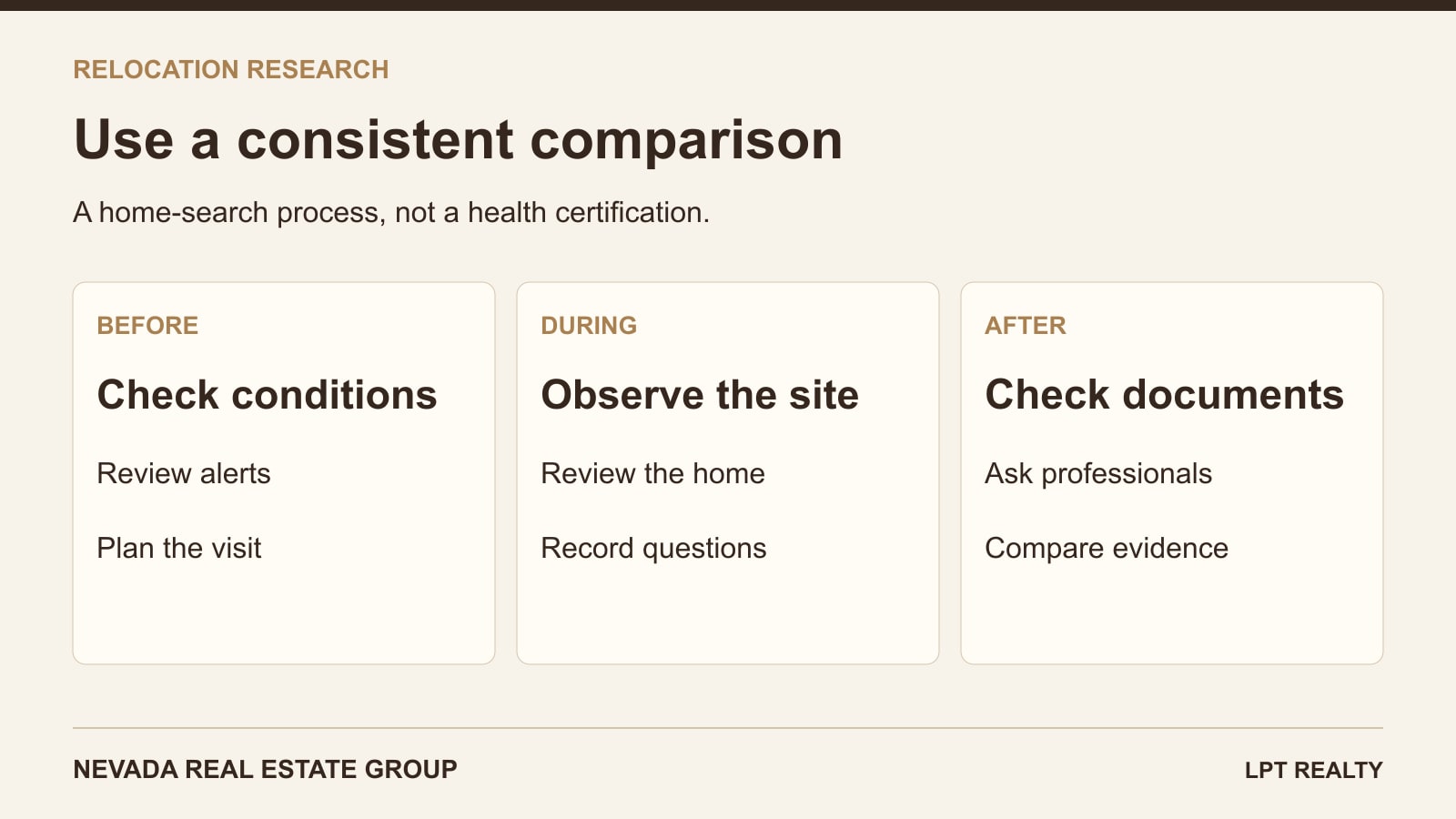
Create a repeatable process that fits the rest of the move. Before a visit, check official forecasts and any relevant alerts. During the visit, record observable conditions and inspect the property. Afterward, connect unanswered questions to the right source or professional rather than deciding from memory alone.
Use the same short checklist for each serious property. Record the address, visit date, weather context, nearby activity, equipment questions and documents requested. If you saved an AQI reading, include its location, pollutant and timestamp. This makes the comparison consistent without pretending that a home tour is a scientific air-monitoring study.
Plan around the routines that matter to your household. Consider work, outdoor recreation, pets, school activities and the rooms where you spend the most time. Identify which decisions depend on daily alerts and which depend on the home's physical condition. That distinction helps you focus money and effort on the things you can investigate or manage.
Bring unresolved building questions into the inspection period. Bring individual health questions to a clinician. Bring data questions back to the official monitoring explanations or an appropriate environmental professional. Clear roles make it easier to get a useful answer instead of expecting one person to certify every aspect of the move.
For the wider relocation picture, our honest guide to moving to Las Vegas covers additional lifestyle and housing considerations. Air quality belongs alongside the budget, home condition and practical daily needs in that decision.
To plan a property search, contact Chris Nevada with Nevada Real Estate Group at LPT Realty, (702) 637-1759, at 8945 W Russell Rd, Suite 170, Las Vegas, NV 89148. Nevada license S.181401. We can help organize tours and property questions while you use the official air information and professional advice relevant to your household. The goal is a home choice based on clear observations, reliable sources and a realistic plan for living here.
Frequently Asked Questions
Does Las Vegas have bad air quality all year?
Conditions vary by day, season, pollutant and location. Use current official readings for daily decisions and appropriate historical records for longer-term questions. A poor-air event does not describe every day, while a clear visit does not establish year-round conditions. Review the actual period and measurement behind any broad claim.
When is ozone season in Las Vegas?
Clark County identifies April 1 through September 30 as ozone season. Use that period as context for planning and research, then check the actual forecast or reading. Other concerns, including particles, can matter outside that window. A seasonal designation should not be treated as a daily AQI prediction.
Can the sky look clear when ozone is elevated?
Yes. A clear view does not establish a low ground-level ozone reading. Check the reported pollutant and official guidance rather than using visibility as the measurement. Photographs are useful for understanding a property's setting, but they cannot establish the air concentration present when the image was taken.
Is Summerlin's air always better than Henderson's?
This guide does not establish that claim. A fair comparison would need appropriate measurements, locations, pollutants and time periods. Community names, elevation or an attractive view are not enough. Evaluate the available data and the actual homes without turning a single reading or visit into a permanent neighborhood ranking.
Which website should I use to check conditions today?
Start with AirNow and Clark County's monitoring portal. Identify the reporting location, pollutant, time and whether the value is current or forecast. For smoke or wind events, consult the related official tools and alerts. Save the complete context if you use a reading in your relocation notes.
Will a HEPA air purifier remove ozone?
A particle filter should not be assumed to remove a gas such as ozone. Read the device's actual specifications and the EPA's guidance, and ask an appropriate professional about the concern you are trying to address. Filtration does not replace source control, suitable ventilation decisions or individual medical advice.
Can a home inspection tell me whether the indoor air is healthy?
A general inspection can identify building or equipment issues within its scope, but it is not a universal indoor-air or health certification. Discuss specific concerns before scheduling and determine whether additional specialist evaluation is warranted. Preserve the distinction between an observed condition, a test result and a medical conclusion.
What should someone with asthma do before moving to Las Vegas?
Discuss the move and individual precautions with a qualified clinician. Bring useful context about expected activities, official conditions and the home under consideration. Investigate the building and equipment through the appropriate property professionals. A real estate agent should not promise that a particular neighborhood or device will prevent symptoms.
Which Sources Support This Guide?
- AirNow: AQI basics and categories, how to use its tools and data limitations.
- EPA: pollutants and the Air Quality Index.
- Clark County: Ozone 101 and ozone season.
- Clark County: monitoring portal and average reports.
- National Weather Service: dust-storm safety.
- EPA: home air cleaners and filters and ozone-generating devices.
Source review: September 11, 2026. This guide does not calculate historical poor-air days, reproduce an undated city ranking or claim a neighborhood health advantage. All diagrams are original educational illustrations; the cover does not document an actual air-quality event.