
A price cut on a builder's finished home is not the same event as a price cut on a resale listing, and buyers routinely misread it in both directions.
Some see $35,000 off and assume something is wrong with the house. Others see it and assume they have found a bargain nobody else noticed. Usually neither is true. What a cut on a completed spec home almost always means is that the builder has capital tied up in a finished asset and a fiscal calendar that does not care how you feel about it.
That is worth understanding before you walk into the sales office, because it is the one situation in new construction where the buyer is holding the better end of the clock — and as of October 8, 2026, the builders' own websites show the clock is running.
A $35,000 reduction on a finished Las Vegas spec home is a large cut, and the market has moved further since. Of 829 homes built in 2025 or 2026 and active on the Las Vegas MLS on September 19, 2026, 48.5% carried a reduction and the median cut was $20,000, or 3.3%. In September, Toll Brothers advertised savings up to $185,000 on select Crestwood Ranch homes. That is real leverage — verify why the home sat first.
- Of 829 homes built in 2025 or 2026 and active on September 19, 2026, 48.5% carried a price cut.
- The median cut on those new builds was $20,000, about 3.3% off original; 30% were cut $35,000 or more.
- Toll Brothers advertised savings up to $185,000 at Crestwood Ranch and $150,000 at Elkhorn Grove in September.
- Finished spec homes carry builder carrying costs, which is the leverage a buyer actually holds at the table.
- Appliances, window coverings and the backyard are commonly excluded even on move-in ready homes, so price them.
What Is the Birch at Lexington Chase?
The Birch is a Richmond American plan at Lexington Chase in southwest Las Vegas. The specific home in the tour is a completed quick move-in: roughly 2,300 square feet, four bedrooms, three bathrooms, a two-car garage, and — the detail that matters most in this layout — a bedroom with a full bathroom downstairs.
According to Richmond American's grand-opening announcement, Lexington Chase is a community of two-story homes on Kinleigh Poulson Street in southwest Las Vegas, and the street sits in ZIP 89148, the same ZIP as the Durango Casino corridor along the 215 Beltway. That is a useful thing to know before you evaluate the cut, because 89148 is one of the most actively traded ZIPs in the valley, and I come back to what it is doing right now below.
The main level runs an open kitchen, dining and living space. The kitchen carries quartz countertops, stainless appliances, 42-inch cabinets, a tile backsplash, black hardware and a walk-in pantry. Upstairs there is a loft, secondary bedrooms, a laundry room with cabinets and a sink, and a primary suite with a freestanding tub, a glass-enclosed shower, dual sinks and a large walk-in closet.
At the time of filming, late August 2026, it carried a $35,000 price reduction and was described as the last home on the block, ready for a quick close.
Why the downstairs bedroom is the feature to price: it is the most flexible room in the plan. A ground-floor bedroom with a full bathroom next to it works as a guest suite, an office or a bedroom that never requires the stairs, and that flexibility carries into resale, because a four-bedroom plan with a downstairs suite offers something a four-bedroom plan with all bedrooms upstairs does not. If you are weighing this specific plan against a competitor offering more total square footage with everything upstairs, price that difference deliberately rather than by square footage alone.
Then the question the tour raises directly, because it catches people every time: what is not included. "Move-in ready" describes the construction status, not the contents. On many Las Vegas quick move-ins the refrigerator, washer, dryer and sometimes the microwave are excluded, and window coverings frequently are as well. Those are not trivial line items — a full appliance package plus blinds across a 2,300 square foot home is commonly a four-figure sum, and occasionally five. Ask for the inclusion list in writing, item by item, and confirm it against what you saw in the home. What is physically installed in a model or a decorated spec is not automatically what conveys, and on a finished home the builder has usually already decided which of the staged items are leaving with the furniture.
Buyers comparing across the valley usually start from Las Vegas homes for sale before narrowing to a single community.
How Big Is a $35,000 Price Cut in This Market?
Large. This is the part I can answer with data rather than impression.
I sampled 800 active listings across the southwest Las Vegas ZIP codes on 2026-08-30 and compared each one's current list price to its original. 214 of them — about 27% — carried a price reduction. The median reduction was $15,000, which works out to roughly 2.8% off the original list price.
Against that distribution, a $35,000 cut is more than double the median, and only 37 of the 214 reduced listings — 17% — had been cut by $35,000 or more.
| Measure | Figure |
|---|---|
| Listings sampled | 800 |
| Carrying a price cut | 214 (26.8%) |
| Median reduction | $15,000 |
| Median reduction as a percentage | 2.8% off original |
| Cut by $35,000 or more | 37 listings (17% of reduced) |
One honest caveat on that sample: the 800 were drawn newest-first out of 1,682 southwest actives, so they skew toward more recent listings. Older inventory has had more time to be reduced, which means the true share carrying a cut across the whole pool is probably higher than 27%, not lower. I would rather give you the number I can defend than the one that sounds better.
Three weeks later the full pool confirmed it. Per Las Vegas MLS data pulled through Repliers on September 19, 2026 — every active listing in Las Vegas, Henderson, North Las Vegas and Boulder City, 13,117 in all, not a newest-first sample — 43.6% carried a reduction, the median cut was $20,000 and the median percentage was 3.8%. The southwest ZIPs ran slightly hotter at 44.8%. So the $35,000 cut that looked more than double the median in August now looks about 1.75 times the median, and the share of reduced listings cut $35,000 or more has climbed from 17% to 27% valley-wide. The cut is still large. It is just less unusual, which is the more important fact for a buyer.
What Are Builders Actually Cutting Right Now?
The MLS tells you what has been reduced. The builders' own websites tell you what they are advertising, and this fall the two have pointed the same way.
Toll Brothers put dollar figures on its September sales event. According to archived copies of its community pages captured September 4, 2026, Crestwood Ranch advertised "Savings Up to $185,000 + Up to $50,000 in Closing Costs with Toll Brothers Mortgage on Select Homes" for September 5–6, Elkhorn Grove advertised "Savings up to $150,000 on Select Quick Move-in Homes," and Toll Brothers at Skye Canyon advertised "Reduced Pricing on Final Home + Up to $25,000 Toward Closing Costs," each next to a 3.99% first-year rate with a 2-1 buydown.
By October 8, 2026, the same pages had moved to an October 3–18 sales event. Elkhorn Grove advertised "Up to $60,000 Flexible Incentive + Home Site Premium Savings on Select Home Sites" and listed nine quick move-ins, eight of them priced from $745,000 to $875,000; three were move-in ready and six carried completion dates from November 2026 to April 2027. Crestwood Ranch advertised a 4.75% first-year rate (7.39% APR) on a jumbo 5/1 adjustable-rate loan with a 2-1 buydown and a 6.75% note rate, for contracts signed by October 19 and closed by November 20, and listed two homes: the move-in-ready 3,313-square-foot Arroyo at $1,210,000 and a 4,000-square-foot Portwood dated June 2027 at $1,430,000. Toll Brothers at Inspirada, in Henderson, advertised "Final Opportunities | Up to 6% Toward Closing Costs on Select Homes" on eight quick move-ins from $515,000 to $840,000, two of them move-in ready. And Toll Brothers at Skye Canyon listed one quick move-in, its decorated model, a move-in-ready 2,543-square-foot home at $795,000, a last-home-on-the-block situation, which is the exact scenario this article is about. Toll does not print the pre-discount price on those pages, so the "up to" figures are ceilings on specific homes rather than the typical deal; ask which home carries the maximum and what the number is on the one you want.
The other builders are less explicit about dollar cuts. On October 8, 2026, Lennar's Las Vegas page listed 116 available homes across 30 communities, and its Fall Super Sale advertised a conventional 2-1 buydown at 2.875% in year one, 3.875% in year two and 4.875% for the rest of the term (4.968% APR) on select homes for buyers who sign between October 5 and 11 and close by November 20, through Lennar Mortgage. KB Home's Las Vegas page flagged Reserves at Alton at Summerlin as a "Final Opportunity To Own" from $684,990, with no reductions published, and its move-in-ready list warns that "current time frames before closing may be longer than originally anticipated." Most builders would rather negotiate a finished home than post the discount, which is why the MLS view matters.
| Builder and community | What was advertised | Price context on the page |
|---|---|---|
| Toll Brothers — Elkhorn Grove | Up to $60,000 flexible incentive plus homesite premium savings on select homesites, deposits October 3–18 | Nine quick move-ins, eight priced $745,000–$875,000; three move-in ready, six dated November 2026 to April 2027 |
| Toll Brothers — Crestwood Ranch | 4.75% first-year rate (7.39% APR) on a jumbo 5/1 ARM with a 2-1 buydown; sign by October 19, close by November 20 | Move-in-ready Arroyo, 3,313 sq ft, $1,210,000; Portwood dated June 2027, $1,430,000 |
| Toll Brothers at Inspirada (Henderson) | Up to 6% toward closing costs on select homes | Eight quick move-ins, $515,000–$840,000; two move-in ready |
| Toll Brothers at Skye Canyon | "Final Opportunity | Furnished Model for Sale," October 3–18 sales event | Decorated model, 2,543 sq ft, move-in ready, $795,000 |
| Lennar — Las Vegas area | Fall Super Sale: 2-1 buydown at 2.875%, 3.875%, then 4.875% (4.968% APR) through Lennar Mortgage; sign October 5–11, close by November 20 | 116 available homes across 30 communities |
| KB Home — Reserves at Alton | No reduction published; flagged as a final opportunity | From $684,990 |
The MLS adds the markdowns the websites do not print. Among the 829 active homes built in 2025 or 2026 on September 19, 2026, the largest reductions were on high-end product: a 5,649-square-foot home in Mello at Stonehaven (89131) listed at $3,575,000 and now $3,025,000, a $550,000 cut; a home in Fairview at Summerlin Village 29 (89138) from $2,459,050 to $1,962,568, about $496,000; a home in Ashland at Summerlin Village 25 (89138) from $1,648,960 to $1,349,990, about $299,000; and several homes in Southshore Parcel 34 at Lake Las Vegas (89011) cut $200,000 to $330,000 from original prices in the $1.6 million to $1.8 million range. Those original figures — $2,459,050, $1,648,960 — are builder-style pricing to the dollar, and the pattern is the one this article describes: finished or nearly finished inventory at the top of a community's range, repriced to move.
Why Do Builders Cut Prices on Finished Homes?
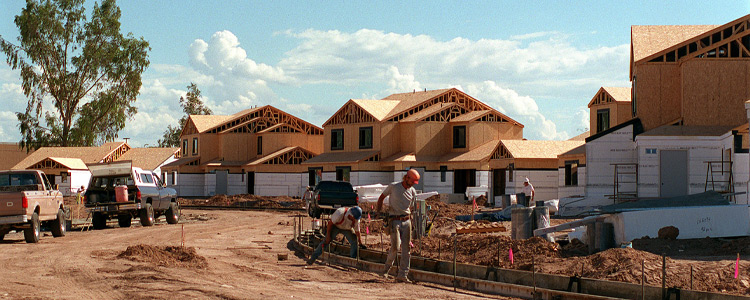
Because a finished home is the most expensive thing a builder can own.
A production builder's model is velocity. Capital goes into land, horizontal development and vertical construction, and it only comes back at closing. A completed house that has not sold is capital sitting still — and it is still accruing property tax, insurance, utilities to keep it presentable, HOA dues, and the interest cost on whatever financed it.
That is why the discount behaves differently than a resale seller's price drop. A homeowner reducing their price is usually responding to feedback. A builder reducing a finished spec is usually responding to a balance sheet and a sales calendar. Toll's own pages show the rhythm: a September 5–6 sales event, then an October 3–18 one, each with its own deposit window.
According to the Census Bureau's new houses sold and for sale by stage of construction, 134,000 completed new homes were for sale nationally at the end of 2025, the most at any year-end since 2008, and 396,000 of the 678,000 new homes sold in 2025 were already completed when they sold. That is the macro version of the same pressure showing up on one cul-de-sac in southwest Las Vegas; the bureau does not publish the figures for Las Vegas.
"Last home on the block" is a real signal inside that, and it cuts in your favor more often than not. When a builder is closing out a phase or a community, the remaining homes stop being inventory and start being an obstacle. The sales office wants to redeploy staff, close the trailer, and stop reporting an open community. That produces motivation that a mid-phase home simply does not have. It also means the comparison set is about to disappear. Once the builder is gone, the next buyer in that neighborhood is buying resale, and resale pricing in a brand-new community tends to hold up well precisely because there is no builder undercutting it with incentives.
The caution: last home on the block sometimes also means last home chosen. Every buyer before you passed on this specific lot. That is not disqualifying — plenty of perfectly good homes are simply the last of their kind — but it is a reason to walk the lot deliberately rather than only the house.
So is the cut a bargain or a warning? Both are possible, and the way to tell them apart is to ask what changed. A cut that reflects time on market is leverage. The house is fine, the market moved, the builder wants it closed. A cut that reflects the specific home is information. Backs to a busy road. Sits below grade so the backyard collects runoff. Faces west with no shade on a valley where afternoon sun is a real cost. Has a utility easement running through the usable yard. None of those are visible in a photo set, and all of them are visible in twenty minutes on site at the right time of day. Go at 4pm in summer if you want to know what west-facing means here.
What Will the Backyard Cost After Closing?
Budget for it, because a discount on the house does not landscape the yard.
Las Vegas new construction — including finished quick move-ins — is commonly delivered with bare dirt in the back, and most associations require completion within 30 to 180 days of closing. Basic desert landscaping runs $10,000 to $25,000 across the valley. Pavers add $4,500 to $12,000 depending on size and pattern. Fines for blowing the deadline typically start at $50 to $200 a month and escalate.
| Item | Typical range | Timing |
|---|---|---|
| Backyard desert landscaping | $10,000 to $25,000 | After close, on an HOA clock |
| Pavers and hardscape | $4,500 to $12,000 | After close |
| Refrigerator, washer, dryer | Frequently excluded | Before move-in |
| Window coverings | Frequently excluded | Before move-in |
| Missed landscape deadline | $50 to $200 per month | Escalating |
The mechanics of those deadlines are covered in our HOA landscape requirements guide. The practical version: a $35,000 discount can be substantially consumed by a yard, appliances and blinds if you did not plan for them.
There is a quick move-in wrinkle worth knowing. On a finished home that has been sitting, the association's landscape clock may already be running against the builder rather than against you — which means the yard is one of the most natural things to ask the builder to finish as part of the deal, since they may be facing the same deadline. The front yard is almost always already in, because the association requires a finished streetscape and the builder needed it for the photographs. What you are buying is the back and the sides.
Two rules shape what you can put there. According to the Southern Nevada Water Authority, development codes have barred grass from new single-family front yards since 2004, and since 2021 irrigated grass has been prohibited in all new development, back yards included, so the design has to be desert-adapted from the start; desert landscaping substantially reduces outdoor water use compared with turf, and conversion rebates have historically been available. And the association's design review will want to approve a pool, a shade structure or a pergola before it goes in — get the design guidelines with the HOA documents and read them during the review window rather than after you have paid a deposit to a pool company.
What Are the HOA, SID and LID on This Home?
Three separate numbers, and buyers routinely conflate the first with the other two.
The HOA is the association's operating budget divided across the homes. It funds whatever the community actually maintains.
A SID or LID is different in kind. Under Nevada Revised Statutes Chapter 271, local governments finance new infrastructure — streets, sewer, utilities — by bonding against the parcels that benefit, and the homeowner repays that bond through an assessment attached to the property. Amounts vary by district and parcel: in our SID and LID guide, five Skye Canyon, Summerlin and Inspirada parcels sampled as of October 6, 2026 showed next installments of $172.57 to $360.65.
An SID is amortizing debt on your parcel, not a fee for services. According to the Clark County Treasurer, special assessments are billed separately from property taxes, typically twice a year, and the assessment is a lien on the property until it is paid off. Under NRS 271.405, the owner may pay the whole unpaid principal at any time, with interest accrued to the next interest payment date plus any prepayment premium of up to 5%, and some buyers do exactly that at closing to make the home cleaner at resale.
Assessment Management Group publishes a schedule of first and final payment dates for the City of Las Vegas, North Las Vegas, Henderson and Clark County districts it lists (Inspirada's T-18 district, for example, makes its final payment June 1, 2035), and according to AMG's FAQ, the payoff amount on the front of each bill includes any prepayment penalty, which makes verifying this a ten-minute check.
The association's own documents are the other half. According to Nevada Revised Statutes Chapter 116, a buyer in a common-interest community is entitled to the declaration, bylaws, rules, current budget and reserve information before the purchase becomes final, and on a new community those arrive as the public offering statement. Read the budget line for what the dues actually fund, and read the reserve figure for whether the number is stable or simply young. A brand-new association with a small budget and no reserve history is not a bad thing, but it is a number that has only one direction to move in, and the first special assessment usually lands on the second or third owner.
How Does a Quick Move-In Differ From Building?
Almost entirely, and the differences run in both directions.
| Dimension | Quick move-in | Build to order |
|---|---|---|
| Timeline to close | Finished: your loan's schedule (CFPB: rate locks typically 30, 45 or 60 days). Unfinished: the builder's date, which on the four Toll pages above ran to June 2027 | KB Home: 30 to 50 days before groundbreaking, then four to five months on average; Toll Brothers: 6 to 12 months on average |
| Price certainty | Fixed, and discountable | Exposed to escalation clauses |
| Finish selections | Already made for you | Yours at the design center |
| Structural options | None — it is built | Casita, loft conversion, layout |
| Negotiating leverage | Strong — builder is carrying it | Weak — you are the one waiting |
| Rate lock exposure | Short and predictable | Months, with extension fees |
The leverage row is the one that matters here. On a dirt start you are asking a builder for a favor. On a finished home that has been sitting, the builder is asking you for a closing. Our breakdown of spec versus custom versus production homes works through where each model fits.
Three things change in the buyer's favor on a finished home that people do not always notice. The inspection is a real inspection: on a dirt start the most valuable look is the pre-drywall walk, when everything inside the wall is visible, and on a completed spec that window has closed — but you can hire an independent inspector to walk the finished house top to bottom before you close, exactly as you would on a resale, and the builder should expect it. The rate lock is short: a finished home can close inside a standard lock, which the CFPB says is typically available for 30, 45 or 60 days, rather than the extended lock a build requires, which on a bought-down rate is the difference between the buydown surviving and evaporating. And the price is fixed: there is no escalation clause on a house that is already built.
Two things run the other way. The deposit is still a builder deposit, usually a percentage of the price rather than the flat few thousand dollars a resale seller accepts, and the contract is still the builder's paper — read the default and cancellation language before you write it. And the warranty clock starts at your closing, not at completion, which is a quiet advantage: the workmanship year runs from the day you move in, even if the home was finished seven months earlier. Ask for the written terms, and expect the industry's common one-year workmanship, two-year systems, ten-year structural shape.
How Should You Compare a Price Cut Against a Rate Buydown?
Because the builders are offering both at once — Toll's dollar incentives alongside its jumbo buydown, Lennar's buydown on a below-market note rate — you need one arithmetic that puts them on the same page. Here it is, at the mortgage benchmark of the week.
According to Freddie Mac's Primary Mortgage Market Survey, the average 30-year fixed rate was 7.40% for the week of October 8, 2026, up from 7.28% the week before. At 7.40%, every $100,000 borrowed costs about $692 a month in principal and interest. At a 4.875% note rate, the permanent rate under Lennar's October 2026 Las Vegas buydown, the same $100,000 costs about $529. Take a $600,000 home with 20% down (Lennar's conventional offer requires at least 20% down and a 740 credit score), a $480,000 loan, and the payment gap between the two rates is about $783 a month, or about $9,400 a year.
| Measure | $35,000 price cut at 7.40% | Full price at a 4.875% builder note rate | $35,000 cut and 4.875% rate |
|---|---|---|---|
| Purchase price | $565,000 | $600,000 | $565,000 |
| Loan at 20% down | $452,000 | $480,000 | $452,000 |
| Monthly principal and interest | About $3,130 | About $2,540 | About $2,392 |
| Difference versus full price at 7.40% ($3,323) | About $194 a month | About $783 a month | About $931 a month |
| Five-year payment savings, before any 2-1 layer | About $11,600 | About $47,000 | About $55,900 |
| Years 1 and 2 with a 2-1 layer at 2.875% and 3.875% | Not applicable | About $1,991, then $2,257 | About $1,875, then $2,125 |
| What you own at resale | $35,000 less basis, same house | Full basis; rate does not transfer | Both |
Read the table with the caveats it deserves. In Lennar's offer, 4.875% is the note rate for the balance of the term, with a temporary 2-1 layer on top for the first two years; a builder rate that is only a temporary buydown steps up after two years and the arithmetic collapses. Lennar's offer covers select homes for contracts signed October 5 to 11 and closed by November 20, its disclaimer says the APR is "achieved by Lennar paid discount points," and it requires Lennar Mortgage for the offer, though "use of Lennar Mortgage, LLC is not required to purchase a home." So price an outside lender at the market rate and compare total cost on the Loan Estimate, not the headline. Our 2-1 buydown guide runs the same offer on the sales price in Lennar's own disclaimer. And a price cut is the only incentive that survives resale: your basis is lower and your future buyer inherits nothing of your rate. Over a five-year hold the buydown wins the payment race; over a fifteen-year hold with a refinance somewhere in the middle, the price cut can win. The right answer depends on how long you will own the home, and the sales office has no idea.
What Does Southwest Las Vegas Inventory Look Like Right Now?
Deep, which is why builders are cutting.
The southwest carried 1,682 active listings at a $520,000 median when I pulled it on 2026-08-30. In the $500,000 to $650,000 band this home competes in, there were 415 active listings at a $560,300 median. Valley-wide there were 15,599 actives at a $438,013 median.
By September 19, 2026, per Las Vegas MLS data pulled through Repliers, the southwest ZIPs carried 2,565 active listings with 596 in the $500,000 to $650,000 band at a $565,000 median, and the four-city pool ran 13,117 actives at a $470,000 median. The count differences between the two pulls reflect how each was scoped — the September pull covers the four incorporated cities by price band rather than a single ZIP set — so read the direction, not the delta: the band this house competes in is deeper than it was in August, not thinner.
Five hundred and ninety-six competitors in one price band is the context for a $35,000 reduction. The builder is not being generous; they are being priced by a market with a lot of alternatives in it.
The community's own ZIP tells the same story. ZIP 89148 carried 300 active listings at a $516,500 median as of September 19, 2026, and 117 closings in the 90 days ending September 17 at a $462,000 median and 28 median days on market — nearly unchanged from the 323 actives, $509,000 median and 28 days I reported on September 6. Those figures cover every property type and price, so they are the ZIP's center of gravity rather than comps for this house — but they say two useful things. Correctly priced homes in 89148 are going under contract in about four weeks, so a spec that has sat long enough to earn a $35,000 cut has been sitting longer than the neighborhood. And the ZIP's median closing sits well below where this home is priced, which means the buyer pool for a $600,000-class new build in 89148 is real but not the whole ZIP.
That also tells you something useful about your own position: a buyer in this band has real choice, and choice is the precondition for negotiating. It is worth walking three or four comparable homes — including resale — before you decide this one is the deal. Start from the live property search rather than a single sales office.
Where the community sits is part of why the band is so deep. Lexington Chase is in the southwest Las Vegas corridor west of the 215 Beltway — the same quadrant that has absorbed most of the valley's production building for a decade, with the Durango Casino and Resort and the retail that followed it a short drive away. Buyers get a new home, a freeway, and a shopping corridor, and so do the other listings in the band. That is a good place to live and a competitive place to sell, and both halves of that sentence are why the cut exists.

How Should You Negotiate on a Reduced Spec Home?
The reduction is the opening position, not the conclusion.
A builder who has already cut $35,000 has demonstrated the price is movable. What is usually still available after a price reduction is the other side of the ledger: closing cost credits, a rate buydown, the appliance package, window coverings, or the backyard landscaping itself. Toll's September pages showed exactly that structure — a dollar savings figure and a separate closing-cost credit and a separate rate, stacked — and the stack is negotiable piece by piece.
That last one is worth asking for directly and specifically. Builders resist further price reductions because a recorded price sets a comparable for every remaining home in the community. They are considerably more flexible on credits and included items, which do not appear in the recorded sale price. Understanding that distinction is most of the negotiation.
The other lever is timing. If the community is genuinely closing out, the builder's willingness to deal can rise as the calendar runs. Ask when they need it closed by, and listen carefully to the answer. A sales event with a deposit window and a close-by date, like Toll's October 3–18 event or Lennar's offer for homes that close by November 20, is the calendar telling you the answer out loud.
There is a version of this that buyers talk themselves out of, and it is worth naming. A discount does not obligate you to move quickly. Builders are very good at implying that a reduced home will be gone this weekend, and occasionally that is true — but in a band with nearly 600 active competitors it usually is not. If the home has been finished and unsold for months, the honest read is that the urgency belongs to the seller, not to you. Verify the completion date, and let that decide the pace rather than the sales office.
The corollary matters too: leverage is not permission to lowball a fair price. A home that was priced correctly, reduced once decisively, and is genuinely the last of its kind in a closing community may simply be worth the current ask. Recognising that is part of the same skill as recognising when it is not.
For the resale side of the same question — how to read a seller's reduction and structure an offer against it — our price reduction offer strategy guide covers the approach.
What Do I Check Before Letting a Client Write on a Discounted Spec?
In my experience walking these, the checklist narrows to five things that actually change the answer.
The reduction history, not the reduction. One cut of $35,000 and three cuts totalling $35,000 are different stories. Three cuts means the builder has been chasing the market down and has not found the floor yet, which argues for waiting or for offering below the current ask. One decisive cut usually means they have repriced to sell.
How long it has been finished. A home completed six weeks ago is priced optimistically. A home completed seven months ago is a carrying-cost problem for the builder, which is why I ask for the completion date before I ask for the price.
The lot, at the wrong time of day. I go back at four in the afternoon in summer. According to the National Weather Service, the Las Vegas valley averages triple-digit highs through June, July and August, and a west-facing rear yard with no mature shade is a materially different house in those months than it is in a March showing.
The neighbours that are not built yet. If the community is closing out, that is one thing. If there is undeveloped land behind the fence, I want the future phase plat for the surrounding radius, because the view a client is paying a premium for today may be a two-story elevation in eighteen months.
Whether the discount survives contact with the closing costs. According to the Consumer Financial Protection Bureau, the loan estimate is the document that makes lender fees comparable across quotes, and a builder credit tied to an affiliated lender can quietly return through the rate. I price an outside lender first, every time, and compare total cost rather than the headline concession.
That is not a long list, and any one item can change the answer. According to Las Vegas REALTORS' August 2026 report, as summarized by VEGAS INC, 7,590 single-family homes were listed without an offer at the end of August, up 5.3% from a year earlier, and the sales pace equaled just over four and a half months of supply. In a market with that much choice, the cost of spending an extra afternoon on diligence is close to zero.
Who Is This Home Actually Right For?
The buyer who needs to be in a house soon and values certainty over customization.
A finished quick move-in closes on a financing timeline instead of the roughly five to seven months that KB Home's published figures add up to for a to-be-built home (30 to 50 days of loan, design and permit steps, then a four-to-five-month average build), as our build-timeline guide details. For a buyer with a lease ending or a relocation start date, that is not a convenience — it is the whole requirement. Confirm the home really is finished, though, as the Toll completion dates above show. And unlike a dirt start, the price cannot escalate under you between contract and completion, because there is nothing left to build.
It also suits the buyer who would rather have the discount than the design center. Every finish in this house was chosen by someone else. If that genuinely does not bother you, you are being paid to accept it. It suits the buyer who wants the plan's ground-floor bedroom and full bath, for the reasons above. And it suits the buyer who wants a warranty and current code rather than a 2005 roof: against the resale alternatives in the same band, a new build carries a builder warranty, current wiring, current insulation and a HERS-rated envelope, which is a real difference in what the house costs to run through a summer.
Who it is not for: anyone who wants a specific lot, a structural option, or a particular finish package. Those decisions are gone. Anyone who cannot fund the yard, the appliances and the blinds on top of the purchase should treat the discount as smaller than it looks. And anyone whose horizon is two or three years should think hard about buying into a community the builder is still selling out of — if you need to sell while the sales office is open, you are the resale option next to a brand-new one with incentives attached. On a closing-out block that risk is smaller than usual, which is one more reason the last-home situation favors the buyer.
What Should You Ask Before You Sign?
Six questions, each attaching a number to something otherwise vague:
What was the original list price, and what is the full reduction history on this specific home? How long has it been finished and unsold? Exactly which appliances and window coverings convey, in writing? Is there a SID or LID on this parcel, what is the annual assessment and what is the payoff balance? What credits or a rate buydown are still available on top of the reduction — and is the rate permanent or temporary? And what does the builder need to close by?
Then the contract items that separate a builder purchase from a resale, even on a finished home. The deposit. Builder earnest money is usually a percentage of the price rather than the flat sum a resale seller accepts, and builder contracts are far less forgiving about returning it — read the default language before you write the check. The appraisal gap. A reduced spec usually appraises, because the cut brought it toward the market; but a $35,000 reduction on a home that was priced above its neighbors may still leave a gap, and the builder's contract will typically make that your problem. Know how much cash you could bring before you waive anything. The five-day window, and its limit. When you buy from the developer in a common-interest community, NRS 116.4108 requires the public offering statement by the time your offer becomes binding and lets you cancel by written notice until midnight of the fifth calendar day after you sign, unless you have personally inspected the unit. On a finished quick move-in you usually have inspected it, so don't count on that window; read the CC&Rs, the design guidelines and the budget before you sign. NRS 116 does not cover a home outside a common-interest community. The inspection. Hire an independent inspector to walk the completed house before closing. According to the Nevada State Contractors Board, any contractor's license, classification and bond status can be verified on its public lookup, and the same check works for whoever lands your yard; inspectors are certified by the Real Estate Division under NRS 645D. The warranty. Get the terms in writing and confirm the start date is your closing.
If you want those answers checked against what is actually closing nearby before you sit down with a sales agent, call our team at (702) 637-1759 or reach out directly. If a current home has to sell to fund the move, the sellers side of the timing is worth planning in parallel — and if you are still comparing communities, Henderson and Summerlin price very differently for the same square footage.
Frequently Asked Questions
Is a $35,000 builder price cut a good deal?
It is a large one by local standards, though less unusual than it was in August. Across 800 active southwest Las Vegas listings sampled on 2026-08-30, the median reduction was $15,000 and only 17% of reduced listings had been cut $35,000 or more; by September 19, 2026, the median cut across all 13,117 actives had risen to $20,000 and 27% of reduced listings were cut $35,000 or more. Whether it is a good deal still depends on why the home did not sell.
How common are price reductions on new construction right now?
Very. Of the 829 homes built in 2025 or 2026 and active on the Las Vegas MLS on September 19, 2026, 48.5% carried a reduction from the original list price, with a $20,000 median cut and 30% cut $35,000 or more. That is a higher share than the 43.6% across all active listings, which is what you would expect from inventory a builder is carrying.
What are builders advertising on quick move-ins in fall 2026?
Archived copies of Toll Brothers' pages show its September 5–6 event advertised savings up to $185,000 plus up to $50,000 in closing costs at Crestwood Ranch, up to $150,000 at Elkhorn Grove, and reduced pricing on the final home at Skye Canyon. On October 8, 2026, Toll advertised up to $60,000 in flexible incentives at Elkhorn Grove, up to 6% toward closing costs at Inspirada and a 4.75% first-year jumbo ARM rate at Crestwood Ranch, while Lennar advertised a 2-1 buydown at 2.875% in year one on a 4.875% note rate.
Why do builders reduce prices on finished homes?
A completed unsold home is capital sitting still while still accruing property tax, insurance, utilities, HOA dues and financing cost. Builders run on velocity, so a finished spec that is not moving becomes a balance-sheet problem — often on a quarter-end or year-end timeline.
Does "move-in ready" mean appliances are included?
No. Move-in ready describes construction status, not contents. Refrigerators, washers, dryers and sometimes microwaves are commonly excluded, and window coverings frequently are too. Get the inclusion list in writing item by item.
Is the backyard included on a quick move-in?
Usually not. Las Vegas new construction is typically delivered with bare dirt in the back, and most associations require completion within 30 to 180 days of closing. Basic desert landscaping runs $10,000 to $25,000, with pavers adding $4,500 to $12,000.
Should I take the price cut or the builder's rate?
Run both at the current benchmark. At the 7.40% Freddie Mac average for the week of October 8, 2026, a $35,000 cut on a $600,000 home with 20% down saves about $194 a month; a 4.875% builder note rate on the full price, like the one in Lennar's October 2026 Las Vegas offer, saves about $783 a month but does not transfer at resale and requires the builder's lender for the offer. Short hold favors the rate; long hold with a likely refinance favors the cut. Ask for both, and price an outside lender.
Can I still negotiate after the builder already reduced the price?
Usually yes, but on credits rather than price. Builders resist further recorded reductions because the price sets a comparable for every remaining home in the community. They are typically more flexible on closing cost credits, rate buydowns, appliances, window coverings and landscaping.
Which Sources Inform This Guide?
Price-reduction figures for August come from a sample of 800 active listings across the southwest Las Vegas ZIP codes, pulled from the GLVAR feed on 2026-08-30 and compared list price against original list price: 214 carried a reduction (26.8%), the median reduction was $15,000 or 2.8% off original, and 37 of the reduced listings — 17% — had been cut by $35,000 or more; the 800 were drawn newest-first from 1,682 southwest actives. September figures are Las Vegas MLS data pulled through Repliers on September 19, 2026, covering all 13,117 active listings in Las Vegas, Henderson, North Las Vegas and Boulder City: 43.6% carried a reduction at a $20,000 median (3.8%); of the 829 actives built in 2025 or 2026, 48.5% carried a reduction at a $20,000 median (3.3%) and 30% were cut $35,000 or more; the southwest ZIPs held 2,565 actives, 596 of them in the $500,000 to $650,000 band at a $565,000 median; ZIP 89148 held 300 actives at a $516,500 median with 117 closings in the 90 days ending September 17 at a $462,000 median and 28 median days on market. These are not official Las Vegas REALTORS statistics. Builder incentives, listings and build-time statements were read on the builder pages linked below on October 8, 2026; Toll Brothers' September offers come from Internet Archive copies of its pages captured September 4, 2026. All apply to select homes for limited periods. Home details for the Birch at Lexington Chase come from touring the home in late August 2026 and are represented as of the tour date. Pricing, incentives, appliances, HOA fees, availability, lot premiums, included features and builder terms change by homesite, contract and buyer qualification.
- Richmond American Homes — Lexington Chase grand-opening announcement — community location and product description
- Toll Brothers — Crestwood Ranch, Elkhorn Grove, Toll Brothers at Inspirada and Toll Brothers at Skye Canyon — offers, quick move-in prices and completion dates read October 8, 2026
- Internet Archive copies of Toll Brothers' Crestwood Ranch, Elkhorn Grove and Skye Canyon pages, captured September 4, 2026 — the September 5–6 offers
- Toll Brothers FAQ — the 6-to-12-month average build
- Lennar — Las Vegas and Fall Super Sale — available-home count and the 2-1 buydown terms, read October 8, 2026
- KB Home — Las Vegas, move-in-ready homes and homebuilding timeline — Reserves at Alton status, the closing-time disclaimer and the 30-to-50-day and four-to-five-month figures
- Freddie Mac Primary Mortgage Market Survey — the 7.40% 30-year average for the week of October 8, 2026 and 7.28% for October 1
- Consumer Financial Protection Bureau, rate locks — typical 30-, 45- and 60-day locks
- Nevada Revised Statutes Chapter 271 — special improvement district authority and prepayment under NRS 271.405
- Nevada Revised Statutes Chapter 116 — common-interest community governance, public offering statement and the NRS 116.4108 cancellation right
- Clark County Treasurer, Understanding SIDs, Assessment Management Group schedule and AMG FAQ — how assessments are billed and paid off
- VEGAS INC, September 9, 2026 — Las Vegas REALTORS' August 2026 listings without offers and months of supply
- U.S. Census Bureau, houses sold and for sale by stage of construction — completed new-home inventory and sales, 2025
- National Weather Service, Las Vegas — summer temperature normals
- Consumer Financial Protection Bureau — rate buydown and loan estimate disclosures
- Nevada State Contractors Board license search — contractor licensing verification
- Southern Nevada Water Authority — desert landscaping requirements, the grass prohibition in new development and rebates
- Durango Casino and Resort — southwest valley amenity context