

Selling a rental home starts with a different question than selling your own residence: what are you actually able to deliver to a buyer, and when? A home with a documented lease and reliable rent may be appealing to an investor. A buyer who wants to move in needs a possession date that works with the tenancy, the purchase agreement and the buyer's financing.
I would compare both paths before choosing a listing date. The useful comparison is the money and obligations remaining at the end of each path, including the time it takes to get there. A higher vacant-home offer can lose its advantage after preparation, missed rent and carrying costs. An occupied offer can also be too low to justify avoiding that work.
Selling a house with tenants in Las Vegas usually presents 2 planning paths: sell with the tenancy continuing, or arrange lawful vacancy before delivering possession. Compare the lease, buyer financing, showing access and net proceeds before choosing. Listing the home does not itself establish a tenant move-out date; the tenancy and applicable Nevada rules need their own review.
- Read the full lease and rent ledger first; NRS 118A.200 lists what a Nevada rental agreement must cover.
- Compare occupied and vacant proceeds on one timeline: the worked example turns a $20,000 gap into $3,400.
- Nonemergency showings need 24 hours' notice at reasonable times under NRS 118A.330; agree access before listing.
- Deposits and prepaid rent carry NRS 118A.244 transfer-or-return duties when ownership changes; document them before closing.
- Deliver the NRS 113 disclosure at least 10 days before conveyance, and NRS 116.4109 resale documents for any HOA.
This September 2026 guide concerns ordinary sales of residential rentals in the Las Vegas area. Foreclosure, subsidized housing, bankruptcy, manufactured-home tenancies and active disputes can involve additional rules. The examples are planning illustrations, not a valuation of your home or a substitute for a Nevada attorney's review of a particular tenancy.
Can You Sell a Las Vegas House While a Tenant Still Lives There?
An occupied home can be marketed and sold, but selling ownership and obtaining vacant possession are separate parts of the transaction. A purchase agreement should describe the actual occupancy arrangement rather than leave the buyer to discover it after making an offer. Start by identifying who occupies the property, what agreement controls the occupancy and whether the buyer intends to continue the rental.
According to the Nevada Legislature's NRS 118A.244, a transfer of a dwelling comes with specific security-deposit responsibilities between the former landlord, the successor and the tenant. That provision is an immediate practical reminder that ownership can change while tenant-related obligations still need to be handled.
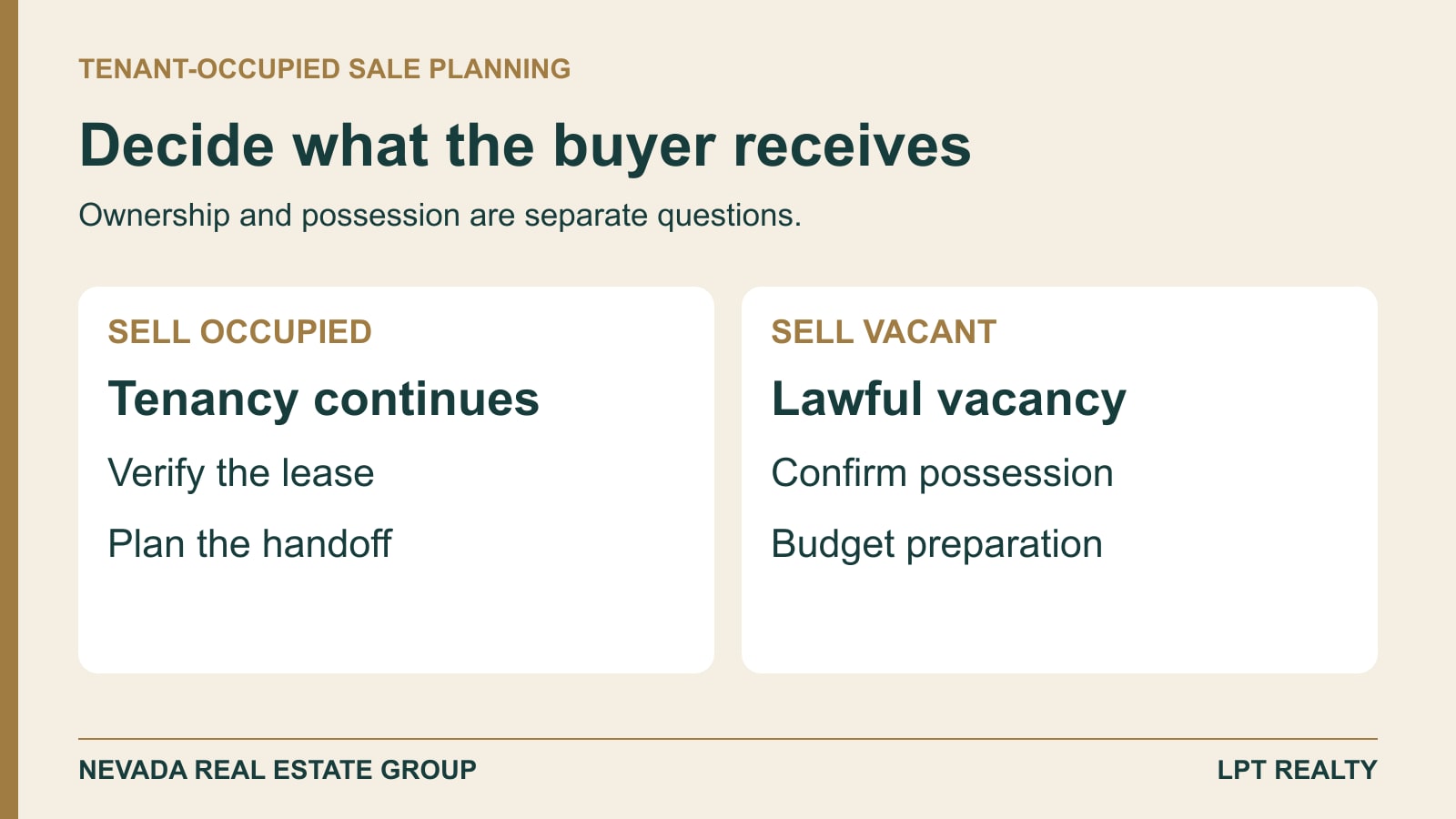
Build the sale around the existing facts. If a lease has substantial time remaining, an investor may be the most straightforward audience. If lawful vacancy can be established before closing, an owner-occupant may also be a realistic buyer. Neither possibility should be represented as certain until the lease, notices, any agreements and the buyer's requirements have been checked.
The listing should accurately distinguish “tenant occupied,” “subject to existing lease” and “vacant possession at closing.” Those descriptions communicate different things. A seller who promises the third while only having evidence for the first creates an avoidable closing problem.
My first planning question would be simple: are we offering an income-producing property with a tenant staying, or a home that will be available for the buyer's own use? If the answer is still undecided, price and timing should remain provisional. Resolving that issue early makes the subsequent marketing, inspections and negotiation much more coherent.
What Should You Check in the Lease Before Choosing a Listing Date?
Read the signed agreement and every amendment together. An old lease PDF may not reflect a later renewal, pet addendum, parking agreement, rent change or promise about repairs. The records should identify the current term, renewal language, payment obligations, security deposit and any provision addressing access or a sale.
According to NRS 118A.200, Nevada's required written rental-agreement provisions address subjects including duration, rent, deposits, inspection rights and utility responsibilities. Use those categories to organize the file; do not assume a clause is enforceable merely because someone signed it.
Next, reconcile what the paperwork says with what has actually happened. Has a tenant stayed after the original term? Was a renewal agreed by email? Does the manager's ledger show the same rent as the lease? Are there unpaid balances, concessions or recurring charges that a buyer needs to understand? An attorney should resolve legal ambiguity; the sale file should preserve the relevant documents rather than smooth over disagreements.
Create a one-page lease summary with links to the underlying records. Include the term, current payment, deposit held, included services, outstanding repair items and who is authorized to communicate with the tenant. Mark unanswered questions visibly. This is a preparation tool, not a replacement lease or a new tenant agreement.
Avoid changing the rent or renewal arrangement simply to make an investment spreadsheet look stronger. A buyer can evaluate the actual lease and a separately researched future-rent scenario. Presenting those as different figures is more credible than describing a possible future rent as income the property already produces. The distinction also protects the seller from having to explain inconsistent numbers during due diligence.
Which Buyers Are Most Likely to Consider an Occupied Rental?
An investor can assess a tenant as part of the purchase, including the lease terms, documented collection history and remaining obligations. An owner-occupant is evaluating a different outcome: a home they can occupy when their own move and loan require it. The relevant distinction is intended property use, not assumptions about a buyer's personal background.
A tenant with a clear lease and orderly records can make an investor's review easier. That does not prove the property is worth more occupied. Below-market contractual rent, deferred repairs, limited access or uncertainty about the tenancy can change the buyer's offer. Some investors value immediate income; others prefer to prepare and lease a property themselves.
Ask interested buyers to explain the basis of their offer. Are they underwriting the current rent, an assumed increase or a vacant resale? Will they keep the tenant? Does their lender accept the existing lease and condition? These questions reveal whether an attractive price is attached to a workable transaction.
| Decision | Buyer continuing the rental | Buyer planning to occupy |
|---|---|---|
| Primary concern | Verified income, expenses and tenancy | Lawful possession and move-in condition |
| Important records | Lease, ledger, deposits and repair history | Possession documentation and inspections |
| Financing question | Does the property meet investment-loan requirements? | Can the occupancy requirement be met? |
| Contract focus | Assignment and ownership handoff | Actual delivery of agreed possession |
Use this distinction to choose the marketing package. The occupied investor package needs clear income and expense records. The owner-occupant package needs a dependable possession plan. Both need accurate property information and reasonable inspection access. Neither is improved by labeling the tenant a problem or promising a return that the records do not support.
When Could Waiting for Vacancy Produce a Better Result?
Waiting may be worth considering when it makes a meaningful improvement possible: broader access, repairs that are difficult during occupancy, better presentation or a possession date suitable for buyers who want to live in the home. The expected benefit has to be large enough to cover the additional costs and timing risk.
Work backward from a realistic preparation schedule. What would need to happen after lawful possession is obtained? Include cleaning, contractor availability, inspections, photographs and the listing process. A tenant's departure does not mean the property becomes market-ready the same afternoon. If the plan depends on substantial work, price the work before treating it as a reason to wait.
Then compare likely buyer behavior using relevant local sales. A renovated vacant home is a poor comparison for an occupied property needing repairs unless the differences are explicitly accounted for. Likewise, an unusually discounted investor sale is not evidence that every occupied home should receive the same discount. Condition, location, lot, layout and transaction terms still matter.
Vacancy can create flexibility, but it also moves costs onto the seller. Utilities, landscaping, insurance arrangements and security need attention. Tell the insurer about the intended occupancy change and ask what applies to that property; do not assume the existing policy treats every vacancy period the same way.
I would choose this route only with a written reason for expecting the extra work to pay off. “It will show better” is a starting observation. “Here are the specific improvements, the quoted cost and the comparable-sale evidence for the expected benefit” is a decision that can be assessed. If the benefit disappears under a modest delay or repair overrun, the occupied-sale alternative deserves a serious look.
How Do You Compare Occupied and Vacant Sale Proceeds Fairly?
Compare both routes from the same starting date through their expected closing dates. Include sale proceeds, actual cash paid during the hold, rent received during that period and the loan payoff at each closing. Otherwise it is easy to count the vacant route's higher price while ignoring the time and cash needed to reach it.
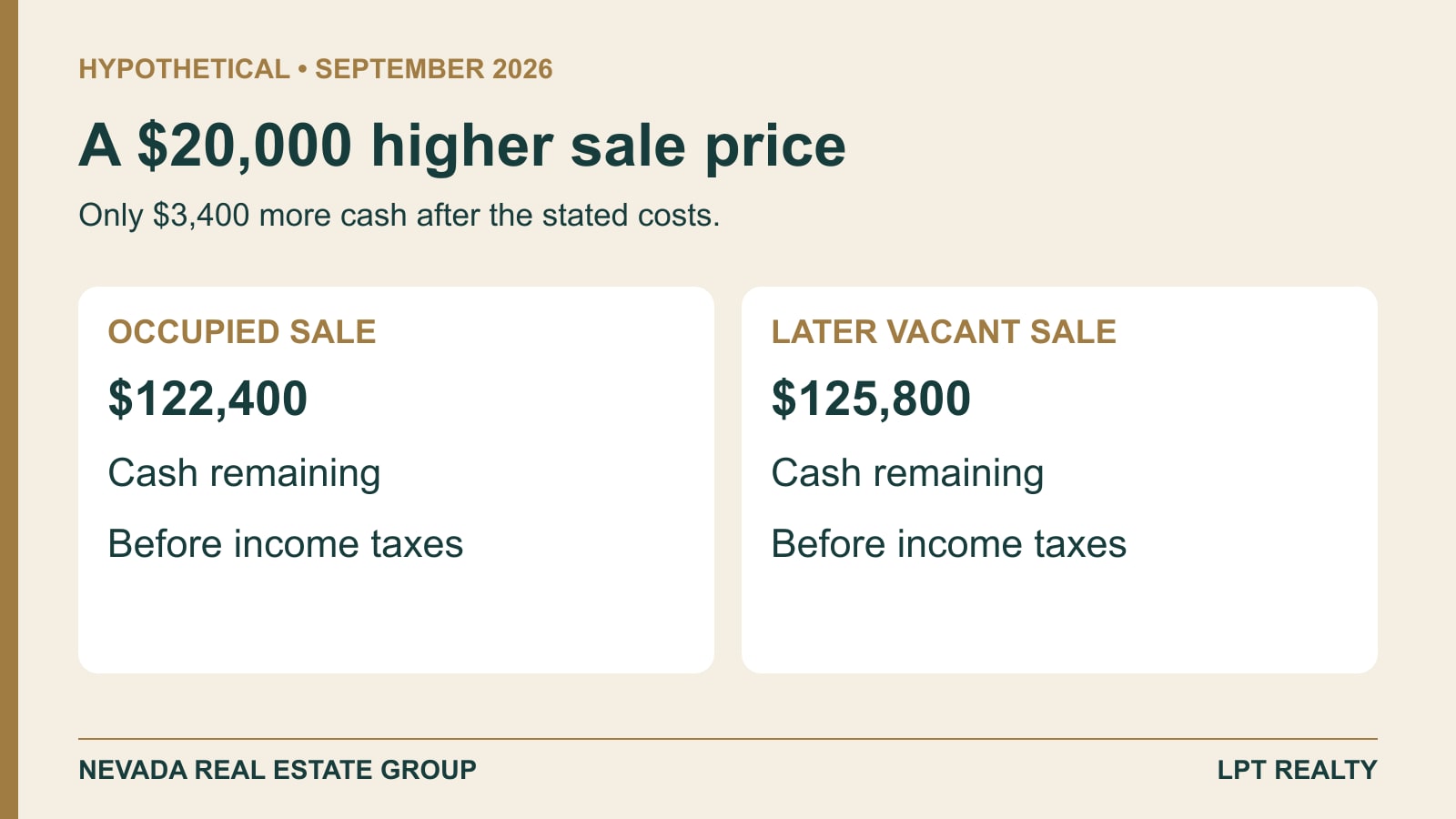
Consider this hypothetical September 2026 worksheet. It is not a Las Vegas price forecast, an offer, a fee quote or a property valuation. Assume an occupied sale at $450,000 and a later vacant sale at $470,000. The second route has additional preparation and holding costs. Selling costs are invented dollar allowances for this illustration; actual brokerage compensation and other charges are negotiated or quoted separately.
| Cash item | Occupied sale | Later vacant sale |
|---|---|---|
| Assumed sale price | $450,000 | $470,000 |
| Selling and closing costs | −$25,000 | −$26,000 |
| Preparation and repair costs | −$2,000 | −$12,000 |
| Cash holding costs through closing | −$3,000 | −$12,000 |
| Rent collected during the hold | +$2,400 | +$4,800 |
| Loan payoff at each closing | −$300,000 | −$299,000 |
| Illustrative cash remaining | $122,400 | $125,800 |
The later sale's assumed price is $20,000 higher, but the calculated cash advantage is only $3,400. An additional expense or a lower offer could erase it. This does not favor occupied sales universally; it shows why the price difference alone is incomplete.
For your own version, reconcile the mortgage payments in holding costs with the payoff at the corresponding closing date. Payments may reduce principal as well as pay interest. Use actual projected payoffs so the comparison captures that change instead of treating the entire payment as an expense while holding the debt balance artificially constant.
Keep tenant deposits outside the seller's profit calculation unless the settlement treatment is explicitly accounted for. Money held for someone else is not a bonus return from selling. Include seller credits, assessment payoffs and any agreed relocation payment as distinct lines. Finally, ask the tax adviser to calculate after-tax results separately; the closing statement cannot answer that question by itself.
Work through the Nevada seller net-sheet framework using separate assumptions for vacancy, repairs and sale timing.
How Should You Arrange Showings Without Creating Unnecessary Conflict?
A showing plan should respect the tenant's home while giving a genuine buyer a useful opportunity to inspect. Start with a clear point of contact, a notice procedure and a schedule that is workable for the parties. Last-minute requests and conflicting messages from multiple people can turn a manageable sale into a frustrating experience.
According to NRS 118A.330, nonemergency entry generally requires at least 24 hours' notice and reasonable times during normal business hours; the tenant can expressly consent to shorter notice or nonbusiness-hour entry for a particular visit. The statute also addresses reasonable access to show a property and prohibits abuse or harassment. Review the facts before treating notice as permission for any proposed entry.
A practical written plan can specify how appointments are requested, who confirms them, what happens if a visitor is late and how access is secured afterward. Discuss pets, work schedules and photography separately. Do not promise a buyer that the tenant will leave during showings or make the home look like a staged model unless there is an actual agreement.
Limit public exposure of personal belongings and information. Photographs should not reveal documents, medications, family photographs or security details unnecessarily. If older photographs are used, label their timing and verify that they still represent the property accurately. Do not digitally remove defects or imply that a furnished room is currently vacant.
Group appointments where the parties agree, but allow enough time for a serious buyer to understand the property. A rushed tour that prevents inspection of important rooms is not necessarily an efficient tour. Clear access records and realistic expectations help the seller, tenant and buyer spend less time arguing about what was promised.
Coordinate access with the broader Las Vegas selling process so marketing and contract deadlines remain workable.
What Documents Make an Occupied Property Easier to Evaluate?
A useful investor package lets the buyer trace each important claim back to a document. Assemble the lease, renewals, rent ledger, deposit accounting, repair records, warranties, insurance information and applicable association documents. Keep a summary at the front, with the source files organized behind it.
Show rent actually collected separately from rent contractually due. A ledger that records a charge is not proof of payment. Explain concessions, late balances and credits without distributing unnecessary personal information. Redact bank account details, identification numbers and unrelated tenant data before providing a marketing or early diligence package.
According to IRS Publication 527, rental-property records distinguish income, expenses and depreciation. Those categories are useful when preparing an expense history, although the buyer's underwriting and the seller's tax accounting are different tasks. A tax deduction should not automatically become a recurring operating-cost assumption, and a future capital replacement should not disappear because it has not yet been paid.
Organize costs by purpose. Recurring expenses include items such as taxes, insurance and agreed owner-paid services. Repairs already completed show property history. Future work belongs in a separate list supported by inspection findings or quotes. Personal financing costs describe this seller's loan and may not resemble the buyer's financing.
A simple document index can assign an owner and a status to each item: received, needs clarification or not applicable. This avoids repetitive requests and exposes missing information before the buyer's contingency deadline approaches. An orderly file cannot cure a legal or physical defect, but it helps everyone identify the issue early enough to make a considered decision. If you are still organizing the rental operation itself, the existing Las Vegas landlord guide covers that separate task.
The Nevada home-sale document checklist complements the tenant and lease records a buyer will review.
What Happens to the Security Deposit, Prepaid Rent and Keys at Closing?
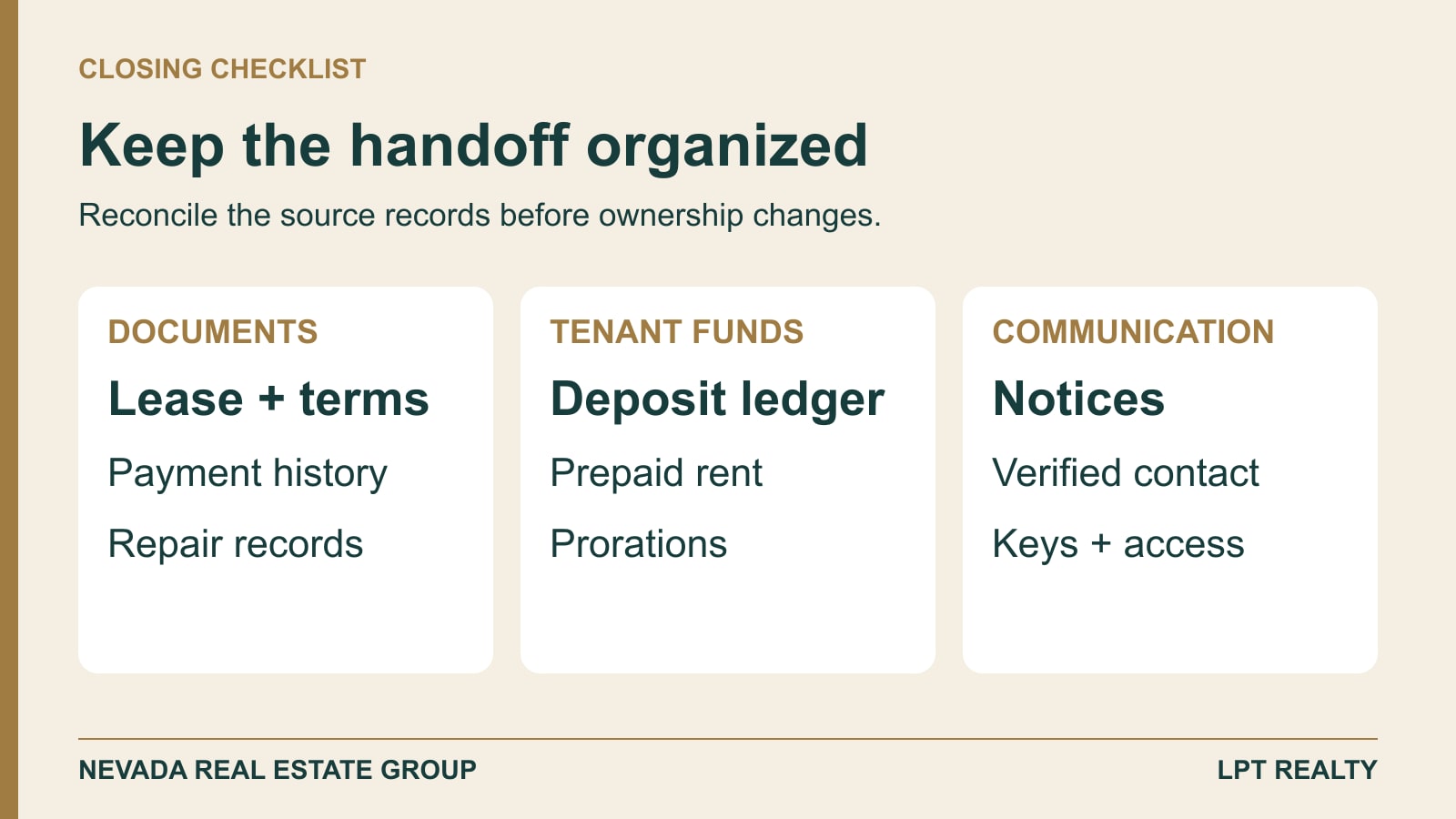
Treat the ownership handoff as a separate closing workstream. Identify each amount held, why it is held, where it appears in the records and how it will be transferred or returned. The lease, manager's ledger and escrow instructions should tell a consistent story.
According to NRS 118A.244, the former landlord has written notice and transfer-or-return duties when ownership changes, including steps required before recording the deed. Have the attorney, manager and escrow holder coordinate the applicable procedure instead of relying on an informal promise that the buyer will handle everything later.
Separate the deposit from prepaid rent, current-month rent and other money held. Rent prorations address which owner receives income for which part of a period. Deposit accounting addresses obligations to the tenant. They may appear on the same settlement statement, but they are not interchangeable.
| Item | What to reconcile | Written evidence |
|---|---|---|
| Security deposit | Amount held and lawful transfer or return | Ledger, instructions and required notices |
| Rent and prepayments | Period covered and closing prorations | Payment history and settlement statement |
| Lease documents | Current signed terms and amendments | Complete file acknowledged by buyer |
| Property access | Keys, remotes and management authority | Inventory and handoff confirmation |
Plan the tenant communication as carefully as the financial entries. The tenant should receive verified information about the new owner or manager and the applicable payment instructions through the proper process. A confusing last-minute email requesting a different payment destination is a poor client experience and creates avoidable fraud risk.
Keep completion records after closing. An email acknowledging receipt of the lease file, a key inventory and the documented treatment of deposits are more useful than relying on memory months later. Confirm who handles a maintenance issue reported immediately before the transfer and who responds immediately afterward. A clear handoff prevents a routine request from falling between two owners.
The explanation of how escrow works in Nevada helps separate the closing team's role from continuing landlord obligations.
Which Property and HOA Disclosures Still Matter for a Rental Sale?
Selling to an investor does not make property condition irrelevant. Gather the seller's disclosure materials, repair history, notices from the association and any known unresolved issues before presenting the home as an uncomplicated rental investment. A property can collect rent and still have a defect that matters to the buyer.
According to NRS 113.130, covered residential sellers must provide the applicable completed disclosure form at least 10 days before conveyance; the form itself is published by the Nevada Real Estate Division. The chapter includes exceptions and remedies, so the sale team should apply the current requirements to the actual transaction. An “as-is” description is not a reason to ignore the disclosure review.
According to NRS 116.4109, resale of a unit in a common-interest community involves specified resale information and documents. For an occupied rental, review the association's actual rental provisions, current assessments and any open violation or balance. Do not assume that a tenant already living there proves every leasing requirement was satisfied.
Keep physical and financial questions connected. A pending exterior repair could affect timing, cost and the association's requirements. A roof or air-conditioning concern may affect inspection negotiations, insurance and a buyer's reserves. A recurring service included in the lease can also become an ongoing obligation for the buyer.
If you have never lived in the property, collect what you actually know from records and management communications. Do not fill gaps with a guess or direct a manager to describe an unknown condition as satisfactory. The buyer should be able to distinguish what was observed, what was repaired and what remains uninspected. Clear boundaries make the disclosure package more useful than confident but incomplete assurances.
Use our explanation of HOA reserves and condo financing when association finances may affect a buyer's loan.
Should You Offer a Voluntary Move-Out Agreement?
A voluntary agreement may be worth discussing when both the tenant and owner want a different schedule. It should be an actual negotiated arrangement, with a clear written record, rather than a promise to the buyer that someone will eventually agree to move. Have a Nevada attorney prepare or review terms that affect possession, payment, releases or existing tenant rights.
Start by understanding the tenant's practical concerns. Moving expenses, finding another home and coordinating a work schedule can all affect whether a proposed date is realistic. The owner should evaluate any agreed payment alongside the possible financial benefit of vacancy. Neither side benefits from an arrangement that looks convenient on paper but cannot be performed.
An agreement needs to address what counts as completed surrender, how keys are returned, when any payment occurs and how the deposit is treated separately. The parties should understand what happens if the agreed schedule changes. Do not improvise legal remedies or assume that signing a voluntary agreement permits self-help removal.
The seller should also avoid making the purchase contract depend on an unexecuted arrangement. If a buyer requires vacant possession, the sale timeline needs enough room for the actual agreement and its performance. An extension or contingency is more transparent than repeatedly telling the buyer that departure is almost certain.
Evaluate this route as one option within the wider comparison. It may work for an owner and tenant who both want flexibility; it may not fit a tenant who wants to remain under the existing terms. A tenant declining a proposal is not evidence of misconduct. Keep communication professional and route any dispute to the appropriate adviser. The objective is a workable sale, not pressure that creates a larger problem than the timing issue it was meant to solve.
How Can Federal Taxes Change the Best Sale Strategy?
The cash wired after closing is not necessarily the seller's after-tax result. Before choosing the timing and structure, ask a tax professional to review purchase basis, improvements, depreciation records, selling expenses, prior personal use and the planned use of the proceeds. Those facts can materially change the comparison between selling now, holding or pursuing an exchange.
According to IRS Publication 544, dispositions of business and investment assets can require analysis of adjusted basis, gain and depreciation-related tax treatment. A rental's loan payoff and taxable gain are different calculations. A heavily refinanced property may leave relatively little cash at closing without producing a correspondingly small taxable gain.
According to the IRS's like-kind exchange guidance, selling an investment property and buying another does not by itself establish a qualifying exchange. The transaction must satisfy the applicable Section 1031 requirements. If an exchange is under consideration, involve the tax adviser and qualified intermediary before closing and before taking control of proceeds.
Keep the tax worksheet separate from the listing-price discussion. An agent can help evaluate property evidence and transaction costs; a tax professional needs the owner's individual records to assess the tax consequences. A broad article cannot calculate those consequences from the asking price alone.
For the hypothetical September 2026 sale comparison above, the reported cash figures exclude income taxes. That exclusion matters: different timing, expense treatment or basis information could change the owner's preferred path. Ask for a written explanation of the assumptions and which figures remain estimates. If the tax plan requires a specific closing sequence, build that requirement into the transaction schedule before accepting an offer that conflicts with it.
Owners planning another investment purchase can review the questions in our Las Vegas rental-investment guide before obtaining transaction-specific tax advice.
How Do You Choose an Offer and Prepare a Workable Sale Plan?
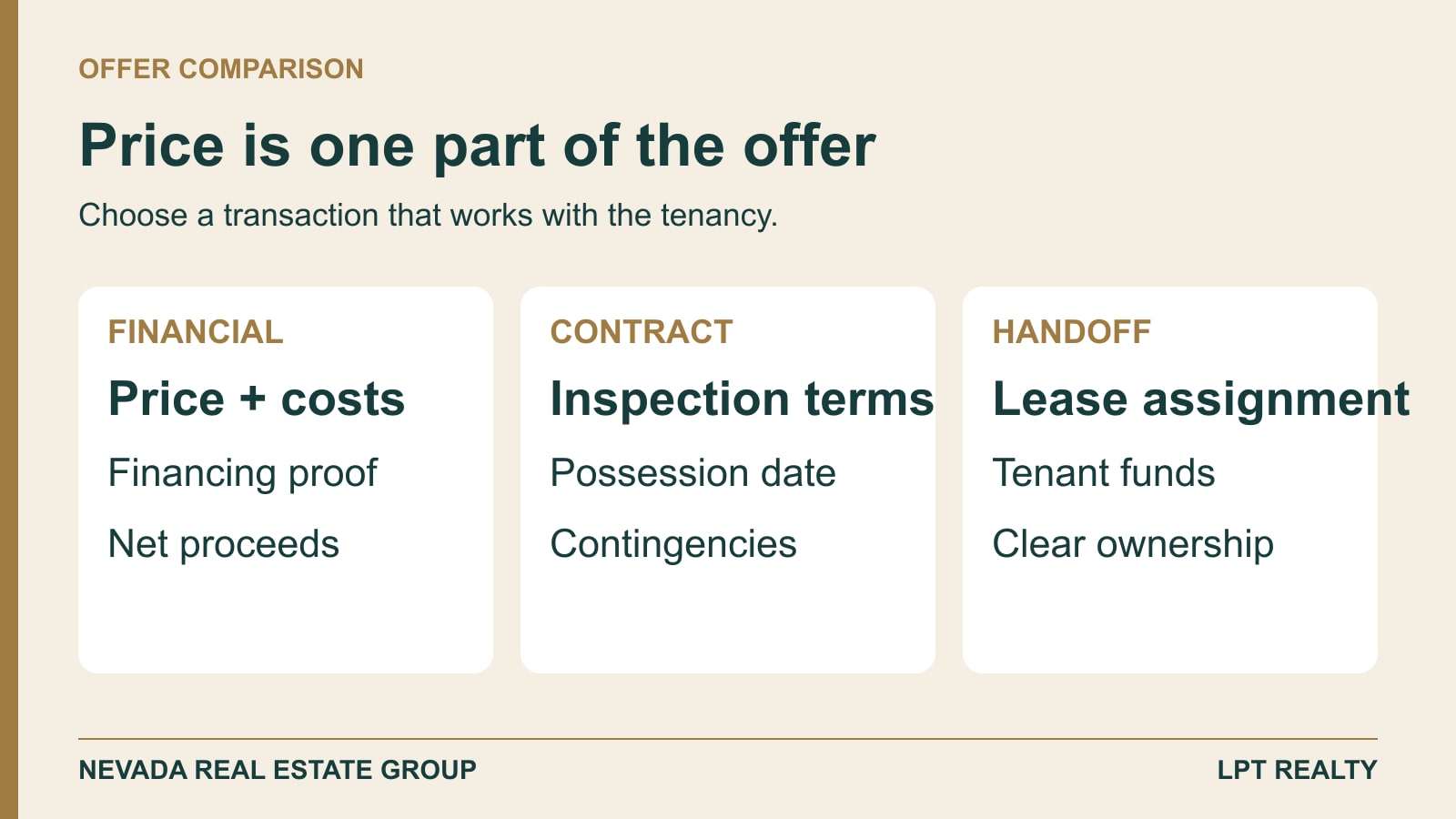
Compare offers on price, net proceeds, financing, inspection terms, possession and the buyer's plan for the tenancy. A higher offer that depends on an impossible vacancy date can be less useful than a lower offer that fits the documented situation. A cash label alone does not establish that the buyer has verified funds or will accept every property condition.
Ask for the same core information from each serious buyer: the actual purchasing entity, proof of funds or financing position, intended occupancy, requested access and proposed handling of tenant-related records and money. Evaluate legitimate financial and transaction terms consistently. Avoid assumptions about who will be a desirable buyer or tenant based on personal characteristics.
Your working file should contain three connected pieces. First is the lease and possession review. Second is a price and net-proceeds comparison grounded in relevant sales and quoted costs. Third is a calendar assigning responsibility for showings, documents, inspections, tenant communication and closing. When one assumption changes, update the other two pieces rather than letting them drift apart.
For a property in Las Vegas, I would start with its address, the complete lease, the current rent ledger and the owner's preferred timeline. From there, our seller services can help compare the occupied-sale and vacant-sale strategies and identify where legal, lending or tax input is needed. Browse the current market for context, but use the subject property's actual condition and tenancy to build its plan.
To discuss your rental sale, request a consultation or call (702) 637-1759. Nevada Real Estate Group is brokered by LPT Realty; Chris Nevada's license is S.181401. The first useful outcome is a documented decision about what to sell, to whom and on what schedule—not a promised occupied-property discount or a guaranteed vacant-home premium.
Frequently Asked Questions
Does putting my Las Vegas rental up for sale end the lease?
No. A listing is a marketing action, not a tenant termination notice or move-out agreement. Review the actual tenancy, lease provisions and applicable Nevada landlord-tenant law before promising vacant possession. The buyer's preferred move-in date does not itself establish when the tenant must leave.
How much notice is generally required before a showing?
Under NRS 118A.330, nonemergency entry generally requires at least 24 hours' notice and reasonable times during normal business hours. A tenant can expressly consent to shorter notice or a nonbusiness-hour entry for that particular visit. The law also prohibits abusing access or using it to harass a tenant.
Will selling occupied automatically reduce my home's price?
There is no universal occupied-home discount established by this guide. The offer depends on the property's condition, documented rent, lease terms, access, costs and buyer demand. Compare relevant local sales and complete net proceeds. An assumed price premium for vacancy is meaningful only after subtracting the costs and time needed to obtain it.
Can an owner-occupant buy a tenant-occupied property?
Possibly, but the buyer's required occupancy schedule must work with the lawful possession plan and financing. Do not assume an owner-occupied loan will accommodate a tenant staying indefinitely. The buyer should get the lender's requirements in writing, and the purchase agreement should address the actual delivery of possession.
Can I keep the tenant's deposit as part of my sale proceeds?
Treat the deposit as a tenant-related obligation, not additional sale profit. NRS 118A.244 establishes transfer-or-return and notice duties when ownership changes. Have the deposit ledger, required notices and settlement treatment reconciled by the appropriate closing and legal professionals.
Should I repair the home before listing it occupied?
Address maintenance and legal obligations while separately evaluating optional sale preparation. For discretionary work, compare cost, likely buyer benefit and practical access. Document quotes and completed work. Extensive remodeling may be better assessed within a lawful vacancy plan, but vacancy should not be assumed merely because the work would be easier.
What information should I bring to the first sale consultation?
Bring the address, signed lease and amendments, rent ledger, deposit records, repair history, HOA documents if applicable and your preferred timeline. Include any known disputes or promised work. These materials let the sale team identify whether the occupied and vacant options are both realistic before building a pricing strategy.
Are the proceeds in this article actual Las Vegas sale results?
No. The September 2026 example uses invented sale prices, costs, rent receipts and payoff amounts to demonstrate a comparison method. Its $3,400 difference is arithmetic from those stated inputs. It is not an appraisal, client transaction, offer, fee schedule, tax calculation or forecast for your property.
Which Sources Inform This Las Vegas Rental-Sale Guide?
Sources reviewed September 7, 2026. Statutory summaries are limited to the points cited; the actual tenancy and transaction may require additional analysis. No attorney or tax adviser is represented as having reviewed this article.
- Nevada Legislature, NRS 118A: rental agreements, access and security-deposit obligations.
- Nevada Legislature, NRS 40: possession and eviction proceedings; foreclosure situations are outside this guide's ordinary-sale scope.
- Nevada Legislature, NRS 113: applicable seller property disclosures.
- Nevada Legislature, NRS 116: common-interest-community resale information.
- IRS Publication 527: residential rental income, expenses and records; the reviewed publication is the 2025 edition.
- IRS Publication 544: business and investment property dispositions; the reviewed publication is the 2025 edition.
- IRS like-kind exchange guidance: why a sale followed by a purchase is not automatically a qualifying exchange.
- Nevada Real Estate Division: publisher of the seller's real property disclosure form that NRS 113.130 requires.
- HUD Office of Fair Housing and Equal Opportunity: federal fair-housing obligations that govern how tenants and prospective buyers are treated during showings and sale.
- Clark County Recorder: where the deed transferring ownership is recorded, the event NRS 118A.244's deposit-transfer duties attach to.
- Las Vegas REALTORS market statistics: current pricing and market-time context for the occupied-versus-vacant comparison; the worked example's figures are illustrative.
The financial worksheet and diagrams are original educational illustrations prepared for this article. They use no private tenant records or client transaction data. Actual listing figures, tax consequences, legal requirements and third-party costs should be checked for the property and transaction date.