

You stopped at a model on a Saturday because the flags were out. The sales counselor was friendly, handed you a floor plan, and asked you to sign in. You wrote your name, your email, and — because there was no reason not to — nothing in the box asking who referred you.
Now you want an agent on your side, and someone has told you it might be too late. Sometimes that is true. Often it is not. What decides it is almost entirely how quickly you move and what exactly you say, and both of those are still in your hands today.
Signing a builder's visitor sheet without naming an agent does not automatically end your representation, but it starts a clock. Most Las Vegas builders treat first contact as registration, and many will refuse to recognize an agent introduced later. Recovery is common when you act within days, before you have submitted an application, made a deposit, or signed a purchase agreement. Call an agent today, and do not sign anything else first.
- Act before you apply, deposit, or sign — after that, recovery is genuinely unlikely.
- Builder policies vary by company and by sales manager; "no" from a counselor is not always final.
- Online VIP and interest-list forms count as registration at several Las Vegas builders.
- Representation is worth real money — incentive packages commonly run $10,000 to $35,000.
- Registration is per community, so the next builder you visit is a clean slate.
Nevada Real Estate Group has closed more than 9,600 transactions across the state and 789 homes in 2025, a large share of them new construction. This exact call comes in most weeks, and the answer is almost never "nothing can be done" — it is "here is what we try, in this order, starting now."
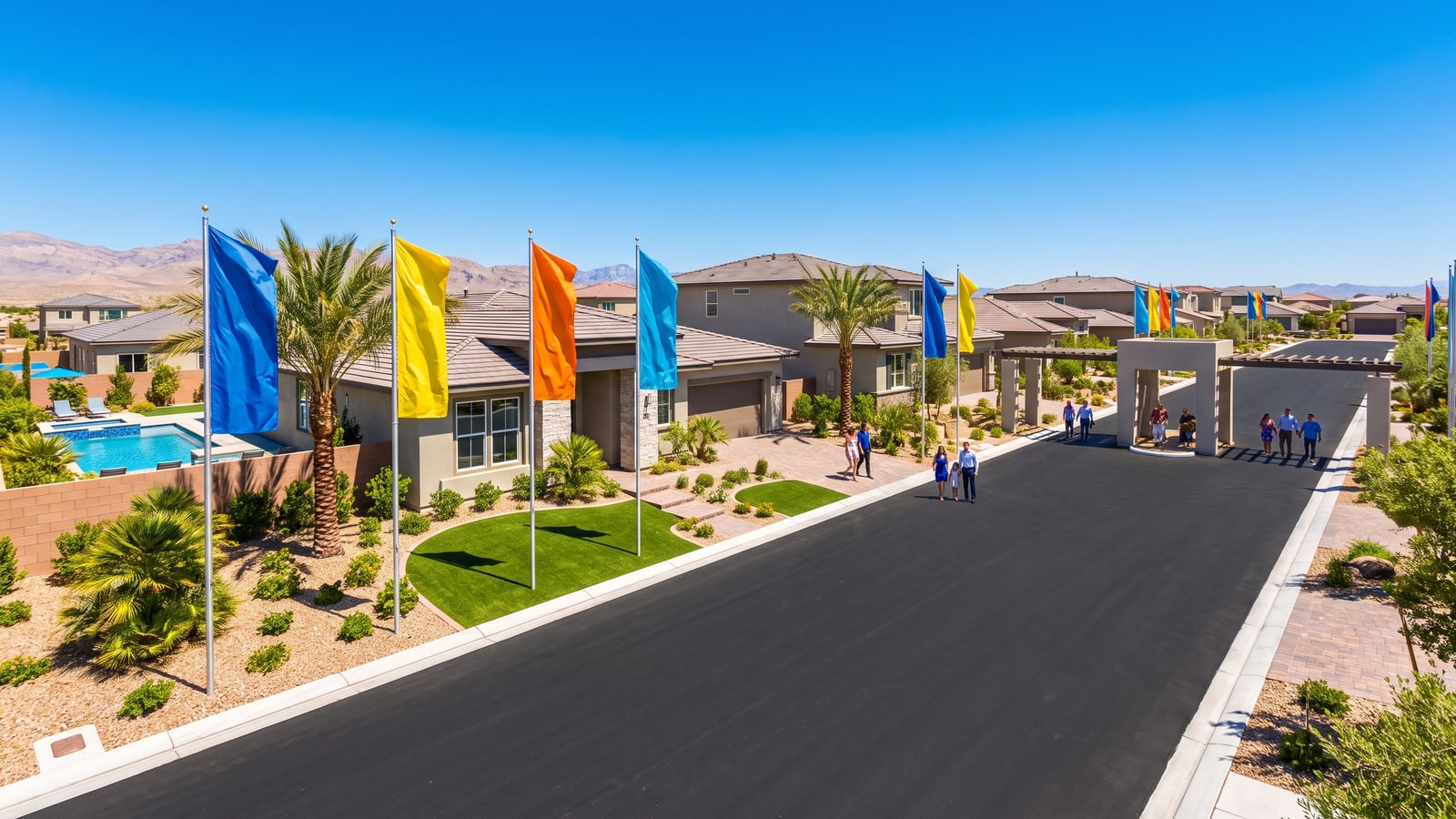
What Actually Happens When You Sign In at a Model Home?
The visitor sheet is not a courtesy list. It is a registration record, and at most Las Vegas builders it is the moment your file is created.
That record establishes who introduced you to the community. If the referral field is blank, the builder's position is that they introduced you to themselves — no outside broker participated, so no outside broker gets paid. The sales counselor who greeted you is compensated by the builder to sell that community's inventory, and from the builder's accounting perspective your file now belongs entirely to them.
Two things follow from that, and buyers usually only learn the second one later. First, the fee the builder had budgeted for a cooperating broker does not come back to you as a discount. It is simply not spent. Second, the person walking you through the contract, the design studio, and the closing is the same person whose employer is on the other side of the transaction.
According to the Consumer Financial Protection Bureau, independent representation matters in any real estate transaction, and new construction is the case where the asymmetry is widest — the builder does this several hundred times a year with their own attorneys and their own contract, and you are doing it once.
Does Registering Without an Agent Always Lock You Out?
No, and this is the part worth hearing clearly, because plenty of buyers give up on a phone call with a sales counselor who said no.
Builder registration policies are internal business rules, not statutes. They vary by builder, they vary by division, and within a single company they are frequently applied at the discretion of a sales manager rather than the counselor at the desk. Some builders operate a stated grace window measured in days. Some will honor an agent introduced before a purchase agreement is signed. Some will not budge at all.
The counselor at the model is often not the decision-maker and, in many cases, has a personal incentive in the answer — an unrepresented buyer can mean a larger share for the on-site team. That is not a scandal, it is compensation design, but it does mean the first "no" you hear is not necessarily the company's final position.
What consistently improves the odds: speed, a clean record of what happened, and having your agent make the request through the sales manager rather than you making it at the desk.
What Should You Do in the First 48 Hours?
Order matters more than eloquence here. This is the sequence.
Stop signing things. Do not complete a loan application with the builder's affiliated lender, do not put down an earnest money deposit, do not sign a reservation agreement or a purchase agreement. Every one of those hardens the file and moves you from "visitor" to "buyer under contract," which is the point after which recovery becomes very unlikely.
Write down exactly what happened, today, while it is fresh. The date you visited, which community, the counselor's name, whether you signed a paper sheet or a tablet, whether you had already filled in an online form before arriving, and whether anyone asked if you were working with an agent. That last detail matters more than buyers expect.
Call an agent before you go back. Not after one more visit to "just look at the other floor plan." A second unrepresented visit strengthens the builder's position, not yours.
Let your agent make contact. They will approach the sales manager, not the counselor, and they will ask a specific question rather than a general one.
| When | Do this | Why it matters |
|---|---|---|
| Immediately | Stop all paperwork | An application or deposit hardens the file |
| Today | Write down date, community, counselor, form type | Details fade and they decide the argument |
| Today | Call an agent — before returning to the model | A second solo visit weakens your position |
| Within 24h | Agent contacts the SALES MANAGER | The counselor is usually not the decision-maker |
| Within 48h | Get the answer in writing | Verbal approval does not survive staff turnover |
| Before any offer | Sign your buyer-broker agreement | Required in 2026, and it documents the relationship |
What Exactly Should Your Agent Say to the Builder?
Specific beats apologetic. A vague "can we get registered on this one" invites a vague no.
The request that works is narrow: confirm whether the buyer, who visited on a stated date and has not applied, deposited, or contracted, can be registered to this broker for this community, and ask for that confirmation by email. Naming the absence of an application and a deposit is doing real work in that sentence, because it tells the sales manager the file is still soft.
Two supporting facts help. If nobody asked whether you were working with an agent — and often nobody does — that is worth stating plainly. And if you had filled in an online form before arriving, whether the referral field even existed on that form is relevant, because a form with no place to name an agent is a weaker basis for the builder's claim than a sheet you left blank by choice.
Get the answer in writing. A sales manager's verbal yes has a way of evaporating three months later when a different manager is at that desk and a commission is being processed.

Which Factors Decide Whether Representation Is Recoverable?
It is not random, and it is not purely the builder's mood. A handful of variables do most of the deciding.
| Factor | Recovery likely | Recovery unlikely |
|---|---|---|
| Time since visit | Days | Weeks or months |
| Loan application | None submitted | Submitted with builder lender |
| Earnest money | None | Deposit taken |
| Purchase agreement | Not signed | Signed |
| Number of solo visits | One | Several, over time |
| Who asks | Agent to sales manager | Buyer at the front desk |
| Lot selected | Not chosen | Specific homesite held |
| Design studio | Not started | Selections underway |
Read that as a clock rather than a checklist. Almost every row is really the same variable expressed differently: how far into the builder's process you have travelled. One Saturday visit and nothing signed is a soft file. A held lot and a submitted application is not.
What Are You Actually Losing If It Cannot Be Recovered?
Worth being honest about the number rather than gesturing at it, because the loss is real but it is not the whole purchase price.
Builder incentive packages in the current Las Vegas market commonly run $10,000 to $35,000 on standing inventory, weighted toward rate buydowns and closing cost credits rather than price reductions. Design studio allowances of $10,000 to $25,000 appear regularly. Closing cost credits of $10,000 to $20,000 are ordinary on a home the builder wants moved before a quarter ends.
An unrepresented buyer can still be offered those. What they lose is someone who knows which of them this builder actually gives, which are theatre, and which get better in the last week of a quarter — and someone whose job is to ask for the one the builder can give rather than the one that sounds biggest.
The second loss is the contract. According to the Nevada Real Estate Division, licensees owe statutory duties to the party they represent, and a builder's counselor owes those duties to the builder. On a $500,000 purchase the difference between a well-negotiated and a poorly-negotiated builder contract is rarely the price — it is the lot premium, the completion date remedy, the warranty terms, and what happens if the appraisal lands under.
| Item | Typical range | Who usually raises it |
|---|---|---|
| Closing cost credit | $10,000–$20,000 | Agent |
| Design studio allowance | $10,000–$25,000 | Agent |
| Rate buydown | Varies by loan size | Builder offers, agent prices it |
| Lot premium | $5,000–$150,000+ | Rarely challenged by buyers |
| Appliance / blinds package | $5,000–$12,000 | Agent |
| Backyard landscaping | $15,000–$40,000 | Agent |
| Base price | Rarely moves | Neither — it sets the comps |
Note the bottom row, because it explains why the rest of the table exists. Builders resist cutting base price since a recorded lower sale affects the comparable sales for every remaining home in the community. They will move on incentives instead. Knowing that is most of the negotiation.
Can You Still Negotiate Without an Agent?
Yes, and you should — being unrepresented is a disadvantage, not a surrender.
Ask for the incentive sheet in writing rather than accepting a verbal summary. Ask what is available on standing inventory specifically, since a finished or framed home represents capital the builder wants to recover. Ask whether the incentive changes if you use the builder's affiliated lender, then price that against an outside quote instead of assuming — the incentive is real and so is the rate spread, and only comparing both tells you which wins.
Ask for the lot premium in writing with an explanation of what you are paying for, and ask whether future phases will build out the view you are paying a premium to have.
And get an independent inspection regardless. A brand-new home is not an inspected home; municipal inspection certifies code compliance, not workmanship. That is worth doing whether or not anyone represents you.
Does the Buyer-Broker Agreement Change Any of This in 2026?
It changes the paperwork and it changes the timing, and buyers are often confused about which.
Since the 2024 industry settlement, a written buyer-broker agreement is signed before an agent tours homes with you. In Nevada that sits alongside the state's own disclosure requirements, including the Duties Owed form. According to the National Association of REALTORS, the practice changes were designed to make representation and compensation explicit to the consumer rather than assumed.
The practical effect for your situation: your agent will ask you to sign a representation agreement before they take you to the builder, and the compensation conversation happens up front rather than at closing. That is a feature here, because it forces the question "who is paying, and how much" into the open at the start, which is exactly the question an unrepresented buyer never gets asked.
It does not, by itself, override a builder's internal registration policy. A signed agreement between you and your broker does not obligate a third party who believes they introduced you to the community.
What If You Registered Online Rather Than in Person?
Increasingly common, and slightly better ground for you.
Several Las Vegas builders treat a website registration — a "VIP interest list", a "join for community updates" form, a floor plan download that asks for your email — exactly as they treat the model-home sign-in sheet. If you filled one in months ago and forgot, you may be registered somewhere you have never physically visited.
Two things work in your favour. Many of those forms have no field for an agent at all, which weakens the claim that you chose to come unrepresented. And an online form usually predates any real engagement — no tour, no counselor relationship, no lot discussion — so the file is soft even if it is old.
Before you create any builder account going forward, put your agent's name in the referral field. If the form has no such field, let your agent submit the registration on your behalf. Our full guide to new construction representation covers the registration mechanics in more depth, and it is the piece to read before your next community.

How Do You Protect Yourself at the Next Community?
This is the part most buyers miss: registration is per community, not per buyer. Whatever happened at one builder does not follow you across the valley.
You are almost certainly touring several. Everything from this point forward is a clean slate, so the protection is simple and it costs nothing.
Name your agent on every sign-in sheet and every online form, at every community, on the first contact. If you are driving out on a whim and your agent cannot meet you, tell the counselor at the door that you are working with an agent and write their name and brokerage on the sheet before you tour. That single sentence at the threshold preserves the entire arrangement.
If you are shopping Henderson, Summerlin, North Las Vegas and Boulder City in one weekend — a completely normal Las Vegas Saturday — that is three separate registrations, and each one is its own decision.
What Do Builders Say Versus What Actually Happens?
A few phrases come up often enough to be worth translating.
"We just need your info for our records." True, and it is also the registration. Both things are the case at once.
"You'll get the same price either way." Usually accurate on base price, and largely beside the point — base price is the number builders protect. The variance lives in the incentives, and that is where representation earns its keep.
"Your agent has to be with you on the first visit." Frequently stated as an absolute and frequently applied with discretion. It is the starting position, not always the ending one.
"It's too late, you're already in our system." Sometimes true. Worth one direct request from your agent to the sales manager before you accept it, because being in the system and being under contract are different states.
"You don't need an agent, we handle everything." They do handle everything. The question is for whom.
When Is It Genuinely Too Late?
There is a point where the honest answer is yes, and pretending otherwise wastes your time.
If you have signed a purchase agreement, representation for that transaction is effectively settled. If you have submitted a loan application with the builder's lender and put money down, you are very likely past it. If months have passed with several visits and a lot on hold, the builder's position is strong and reasonable.
What is still worth doing even then: have an agent or a real estate attorney read the contract before your contingency windows close, engage an independent inspector for the pre-drywall and final walkthroughs, and treat the next community — our guard-gated communities and luxury communities pages are good places to start the next search — because most buyers end up looking at more than one — as the clean slate it actually is.
According to the Nevada Revised Statutes, Nevada real estate practice is governed by statutory duties that attach to representation, so being unrepresented is a real status with real consequences, not a technicality. Knowing that early is what makes the first sign-in sheet worth thirty seconds of attention.

What Does This Look Like on a Real Purchase?
Abstract percentages are easy to shrug at, so here is the arithmetic on an ordinary Las Vegas new build rather than a dramatic one.
Take a $525,000 to-be-built home in a valley master plan. Base price $499,000, a $16,000 lot premium for a north-facing rear yard, and $10,000 of structural options selected at contract. The builder's posted incentive that month is $15,000 toward closing costs when financing through their affiliated lender.
The unrepresented version of that purchase generally takes the posted $15,000 and moves on. Nothing has gone wrong, exactly — the buyer got the advertised offer.
The represented version asks four questions. Is there more available on standing inventory than on a to-be-built home, given a finished house is capital the builder wants recovered? Does the incentive improve near a quarter end? Is the $15,000 better taken as a rate buydown than as closing costs, given how long this buyer actually intends to hold the loan? And is the $16,000 lot premium buying a view that a later phase is going to build out?
Those four questions do not always produce money. When they do, the range is ordinary rather than heroic: another $5,000 to $15,000 in credits, a design studio allowance of $10,000 to $25,000 that was never mentioned, or a lot premium reduced by $5,000 because the plat shows two-storey homes going in behind. Against a $525,000 purchase, that is roughly 2 to 6 percent — not life-changing, and not nothing either.
The larger figure is usually the one nobody sees. Backyard landscaping that the base contract excludes runs $15,000 to $40,000 on a typical lot. Window coverings and appliances add $5,000 to $12,000. A buyer who budgets $525,000 and discovers $45,000 of unbudgeted finishing after closing has not been defrauded — those exclusions are in the contract — but they were reading a document written by the other side's attorneys without anyone pointing at the relevant paragraph.
According to the Federal Trade Commission, material terms in a consumer transaction should be disclosed clearly rather than buried, and builder contracts generally are compliant on that point. Compliant and obvious are different standards, which is the entire argument for having someone read it with you. Our guide to new construction and the first-time buyer resources both cover the exclusion list in more detail, and current inventory across the valley is on the Las Vegas homes for sale search.
What Should You Do Right Now?
If you visited in the last few days and have signed nothing further, call (702) 637-1759 today, or reach us through contact. That is the window where this is most often recoverable, and it closes as you keep engaging with the builder.
If you are further along, call anyway — there is usually something worth salvaging in the contract review, the inspection schedule, or the next community you were already planning to see. And if you have not visited anything yet, read the new construction representation guide first and start with our new construction overview or the buyer resources.
Frequently Asked Questions
I signed a builder's visitor sheet without my agent. Is it automatically too late?
No. It starts a clock rather than closing a door. Most Las Vegas builders treat first contact as registration, but the policies are internal business rules applied with discretion, not statutes. Recovery is common when nothing further has been signed — no loan application, no earnest money, no purchase agreement — and when an agent asks the sales manager within days rather than weeks. What makes it genuinely unlikely is depth of engagement, not the sign-in sheet by itself.
The sales counselor told me my agent cannot be added. Is that final?
Not necessarily. The counselor at the model is often not the decision-maker, and on-site teams can have a compensation interest in an unrepresented buyer — that is how the pay structure works, not a scandal, but it means the first answer may not be the company's position. Have your agent make a specific written request to the sales manager: buyer visited on a stated date, has not applied, deposited or contracted, can they be registered for this community.
Does registering on a builder's website count the same as visiting?
At several Las Vegas builders, yes. VIP interest lists, "community updates" sign-ups and gated floor-plan downloads are frequently treated exactly like the model-home sheet. The good news is that many of those forms have no field for an agent at all, which weakens the builder's claim, and an old online form usually predates any real engagement. Going forward, put your agent's name in the referral field, or have them submit the registration.
How much is representation actually worth on a new build?
The negotiation is rarely about base price — builders protect that because a recorded lower sale affects comps for every remaining home. It is about incentives, which commonly run $10,000 to $35,000 in the current market: closing cost credits of $10,000 to $20,000, design studio allowances of $10,000 to $25,000, rate buydowns, appliance and blind packages of $5,000 to $12,000, and backyard landscaping of $15,000 to $40,000. Plus the contract terms, which cost nothing to negotiate and a great deal to get wrong.
Does the builder charge me more if I bring an agent?
No. The builder budgets a cooperating broker fee into the community's marketing costs whether or not one is used. If you arrive unrepresented, that money is simply not spent — it does not come back to you as a discount. That is the single most common misunderstanding on this topic.
Can I just hire an agent for the contract review only?
Sometimes, and it is worth asking, but understand what you are buying. Some agents will do a limited-scope engagement or you can engage a real estate attorney for the contract. What that does not recover is the builder-paid representation for the purchase itself, since the builder has already recorded the file as unrepresented. Treat it as damage control rather than a substitute.
If I already toured one community alone, am I locked out everywhere?
No — registration is per community, not per buyer. Whatever happened at one builder has no bearing on the next one. Since most buyers tour several communities, the majority of your options are usually still completely clean. Name your agent at the door of every subsequent community, on the first visit, before touring.
What should I avoid doing while this is being sorted out?
Do not submit a loan application with the builder's affiliated lender, do not place an earnest money deposit, do not sign a reservation or purchase agreement, and do not make a second solo visit. Each of those moves you from visitor to buyer in the builder's file and materially weakens the case for adding representation. Pausing for forty-eight hours costs you almost nothing; signing costs you the argument.
Which Sources Inform This New-Construction Representation Guide?
- Nevada Real Estate Division — licensing, statutory duties owed, and agency disclosure requirements
- Nevada Revised Statutes — NRS 645 real estate practice and representation
- Consumer Financial Protection Bureau — buyer representation and mortgage shopping guidance
- National Association of REALTORS — 2024 practice changes and written buyer agreements
- U.S. Department of Housing and Urban Development — homebuyer protections and settlement cost guidance
- Federal Trade Commission — advertising and disclosure standards in consumer transactions
- Clark County Department of Building and Fire Prevention — permitting and municipal inspection scope
- Nevada State Contractors Board — builder licensing and residential recovery fund
- Las Vegas REALTORS — Southern Nevada monthly market statistics
- Freddie Mac — Primary Mortgage Market Survey rate reference for buydown math
- U.S. Census Bureau — new residential construction data
- Nevada Department of Taxation — property tax structure on new construction