

Buying near TPC Las Vegas starts with identifying the golf course, the residential property and the rights attached to that property. A listing that mentions TPC may have a direct fairway boundary, a distant view, or simply a convenient location. Those are different purchases. The July 2026 figures retained below describe the original keyword searches; they do not prove a resale premium for a particular backyard.
I have represented buyers and sellers across Summerlin's golf villages for years. This guide now separates the historical market snapshot from information reviewed October 23, 2026, including the two course addresses, current operator access descriptions, a dated builder offering and the documents needed to evaluate a home. Start with the features you will actually use, then decide what those features justify within your budget.
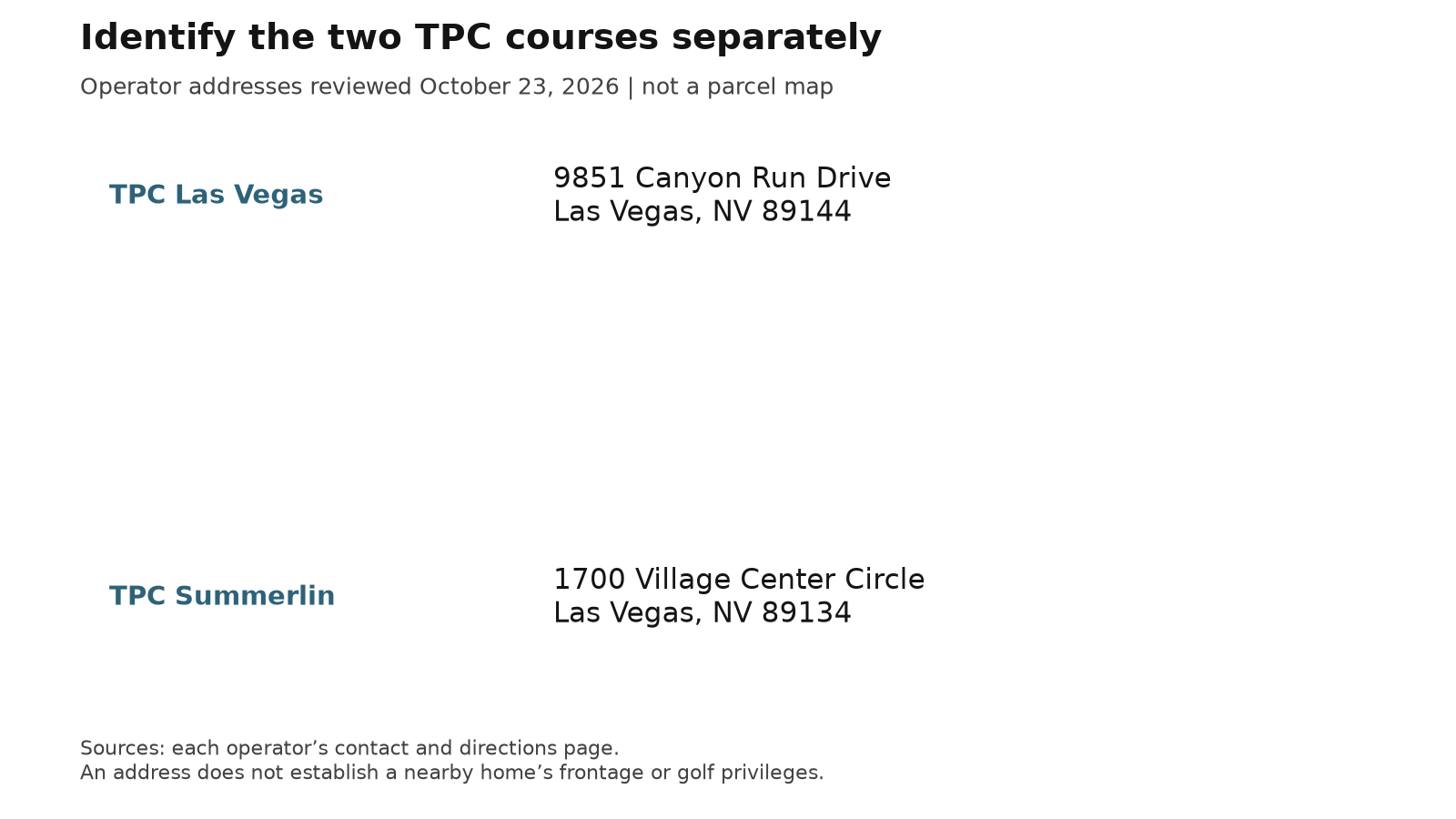
TPC Las Vegas is a public-access golf course at 9851 Canyon Run Drive in ZIP 89144; TPC Summerlin is a separate private club in 89134. Compare 2 different purchases: the home and any golf access. Verify the actual lot, association obligations and course-facing boundary before paying for a view. The July 2026 keyword statistics below are historical, not a measured frontage premium or today's inventory.
- TPC Las Vegas and TPC Summerlin have different locations and access arrangements.
- A TPC keyword, golf view and direct frontage do not identify the same property feature.
- Figures here date from July 12, 2026, so verify them against current listings.
- Compare total ownership costs, recorded rights and property condition before choosing.
- Course proximity does not guarantee membership, permanent views or resale returns.
Where is TPC Las Vegas, and how is it different from TPC Summerlin?
According to TPC Las Vegas's contact and directions page, reviewed October 23, 2026, its address is 9851 Canyon Run Drive, Las Vegas, Nevada 89144. According to TPC Summerlin's separate directions page, that club is at 1700 Village Center Circle, Las Vegas, Nevada 89134. These addresses provide a reliable starting point for a search. Neither makes every home within the surrounding ZIP a golf-course property.
According to the TPC Las Vegas course overview, the course opened in 1996 and was previously called TPC at The Canyons. The operator identifies Bobby Weed and Raymond Floyd as its designers and describes access for the public and resort guests. Those details help distinguish older listing references from a different course. They do not establish the boundary of a residential lot or a right to enter course land from a backyard.
The previous version of this guide extended TPC geography into 89135. That ZIP contains other Summerlin housing and golf-related searches, but it is not the address ZIP of either TPC course. Keep its historical data in the broader comparison where it belongs. Search Summerlin homes by the actual community and address, then verify the parcel. Use the Las Vegas golf living guide for a wider course search. A course name is a useful clue; an address, map and property documents turn it into a usable shortlist.
Which nearby communities should a TPC-area buyer investigate?
According to Summerlin's developer article, golf, location and lifestyle in The Canyons, published February 25, 2020, TPC Las Vegas is associated with The Canyons village. That is historical geographic context, not a current inventory release. The article also places Mira Villa beside Angel Park. This matters because two homes described as near TPC can overlook different land, have different ownership structures and belong to different associations.
According to Toll Brothers' Mira Villa page, reviewed October 23, 2026, the community offers single-level condominium living between TPC Las Vegas and Angel Park. The builder describes elevator access, private garages and shared amenities. Confirm the specific unit's view, elevator arrangement, garage rights and association obligations in its documents. A development description does not make every unit directly adjacent to the same fairway, and a condominium purchase differs from a detached house even when their asking prices overlap.
For a separate TPC Summerlin search, compare the actual properties shown in Tournament Hills and the Tournament Hills buyer guide. Use those pages to orient your questions, then verify the individual boundary and club arrangements. This refresh does not repeat the former unsupported claim that every named enclave fronts a TPC course or shares a particular gate policy. The golf communities hub and guard-gated communities page provide other search paths when your real priority is golf access, a staffed entrance or a particular home layout.
What do the July 2026 asking-price figures actually describe?
The original article reported a July 12, 2026 pull from Nevada Real Estate Group's GLVAR feed using TPC and golf keywords, ZIP filters, active listings and a trailing 90-day closed-sales window. Its underlying listing export was not available for this refresh. The numbers are preserved as the historical record, with the original method's limits made explicit. They are not an October inventory count, a verified collection of direct-frontage properties or a valuation for a house you are considering.
The valley-wide TPC keyword search recorded 43 active listings, a $985,000 median asking price and a $1,543,010 average. Its reported asking range was $269,900 to $6,499,000. That broad span is a reason to inspect property types and locations, not to call the lowest result a typical TPC-frontage entry price. The word TPC can appear in marketing for proximity or lifestyle without describing a shared property boundary.
The original 89144 and 89135 golf searches likewise differ from a lot-by-lot frontage study. The all-home rows include a wider mix of sizes, conditions, associations and locations; they are not a separate set of matched interior homes. Use the preserved table to understand how broad the original searches were. To price a current purchase, request a fresh, dated list of the relevant homes and closed comparables, including exclusions and verified frontage. Start with current Las Vegas homes and narrow the search before calculating anything from it. An asking-price median describes sellers' positions within that sample, not the price buyers have agreed to pay.
| Original search group | Active listings | Median asking price | Average asking price |
|---|---|---|---|
| TPC keyword, valley-wide | 43 | $985,000 | $1,543,010 |
| Golf keyword, 89144 | 31 | $1,275,000 | $1,680,956 |
| Golf keyword, 89135 | 131 | $1,949,000 | $4,219,840 |
| All homes, 89144 | 144 | $654,450 | $1,066,291 |
| All homes, 89135 | 322 | $1,037,500 | $2,647,472 |
Do closed-sale comparisons prove a golf-frontage premium?
No. The July article called the differences a 21% to 33% frontage premium, but a keyword group compared with an entire ZIP does not isolate the value of frontage. The full ZIP can include the golf-tagged homes themselves. Price per square foot also does not control for age, condition, lot size, floor plan, renovations, condominium ownership or the particular course. The table below retains the original figures while correcting what they can establish.
The original valley-wide TPC keyword result reported 16 closings during its trailing 90-day window, with a $990,000 median sold price, $376 per square foot and median market time of 28 days. That is a separate search from the two ZIP comparisons. The July record did not provide their individual closed-sale sample sizes or a complete list of exclusions. Combining the searches would create a new unsupported dataset, so this guide does not do that.
For a current offer, ask which closed properties actually share the feature you want to value. A useful comparison starts with similar ownership type, location, condition, living area and sale timing, then discusses remaining differences. A nearby interior sale may still be informative; a golf-tagged sale on another course may be less comparable than its description suggests. Have the relevant appraiser or valuation professional assess the evidence rather than multiplying a purchase price by an old percentage. The buyer resources explain the broader purchase process, while the home value service can be a starting point for a property conversation. Neither substitutes for supported, property-specific comparable analysis.
| Reported metric | 89144 golf keyword | 89144 all homes | 89135 golf keyword | 89135 all homes |
|---|---|---|---|---|
| Median sold price | $932,500 | $527,500 | $1,545,000 | $875,000 |
| Reported price per square foot | $381 | $314 | $621 | $466 |
| Median days on market | 46 | 22 | 38 | 36 |
What current price evidence can you use without confusing it with a market average?
One current public example is a builder's advertised offering. On October 23, 2026, Toll Brothers' Mira Villa community page displayed three move-in-ready condominiums at $900,000, $945,000 and $950,000. Those are dated advertised prices for particular offerings. Availability, terms, included features and additional charges require a current written confirmation. The page is affiliated sales material, not an independent appraisal or a census of nearby homes.
This example supplies a practical comparison question: would a condominium's layout and shared responsibilities meet your needs better than a detached golf-area home? It does not establish a $900,000 floor for TPC frontage. Review the unit's actual orientation, exclusive-use areas, shared systems and governing documents. A builder description of nearby courses is not confirmation that the offered unit faces TPC Las Vegas or conveys golf privileges.
Keep the evidence date visible when comparing an advertised new offering with resale listings. Ask whether the quoted price includes selected features, whether incentives affect financing or the cash price, and which fees remain outside the advertised amount. Then compare the same cost categories for each property. Use new-construction searches when a new home is a serious alternative, and Las Vegas luxury homes when the relevant requirement is a larger detached home. These are different search routes, not price tiers that automatically rank ownership choices. A useful shortlist can include both while keeping their physical features, documents and carrying costs separate.
How should you compare public golf access with private membership?
According to Summerlin's golf directory, reviewed October 23, 2026, TPC Las Vegas and TPC Summerlin fall into different public-access and private-club categories. According to TPC Summerlin's membership page, the club describes several membership categories, including personal and social options. A course-facing home is a real-estate purchase; eligibility, privileges, costs and availability of a membership require a separate review of the operator's current terms.
Start with the golf routine you actually expect. Someone playing occasionally may want convenient public tee-time access. A frequent player may prioritize a particular club's arrangements, guest rules, practice facilities or social program. Ask about the specific category under consideration, application requirements, ongoing charges and any transfer restrictions. Do not assume that home ownership confers membership, or that selling the home will transfer a separate club interest to the next buyer.
Put golf costs beside housing costs without merging the contracts. An association assessment can be mandatory under the property's governing documents even when golf participation is optional. Conversely, a club-related obligation needs to be verified for that address; a gate or course view alone does not establish one. Ask the seller, association and club to identify the controlling documents rather than relying on a listing shorthand such as golf community. If your priority is a private-club environment, broaden the comparison through Red Rock Country Club and the luxury communities overview. Compare each option's actual terms before deciding that the better home and the better golf arrangement are the same choice.
What should you inspect to distinguish a golf view from direct frontage?
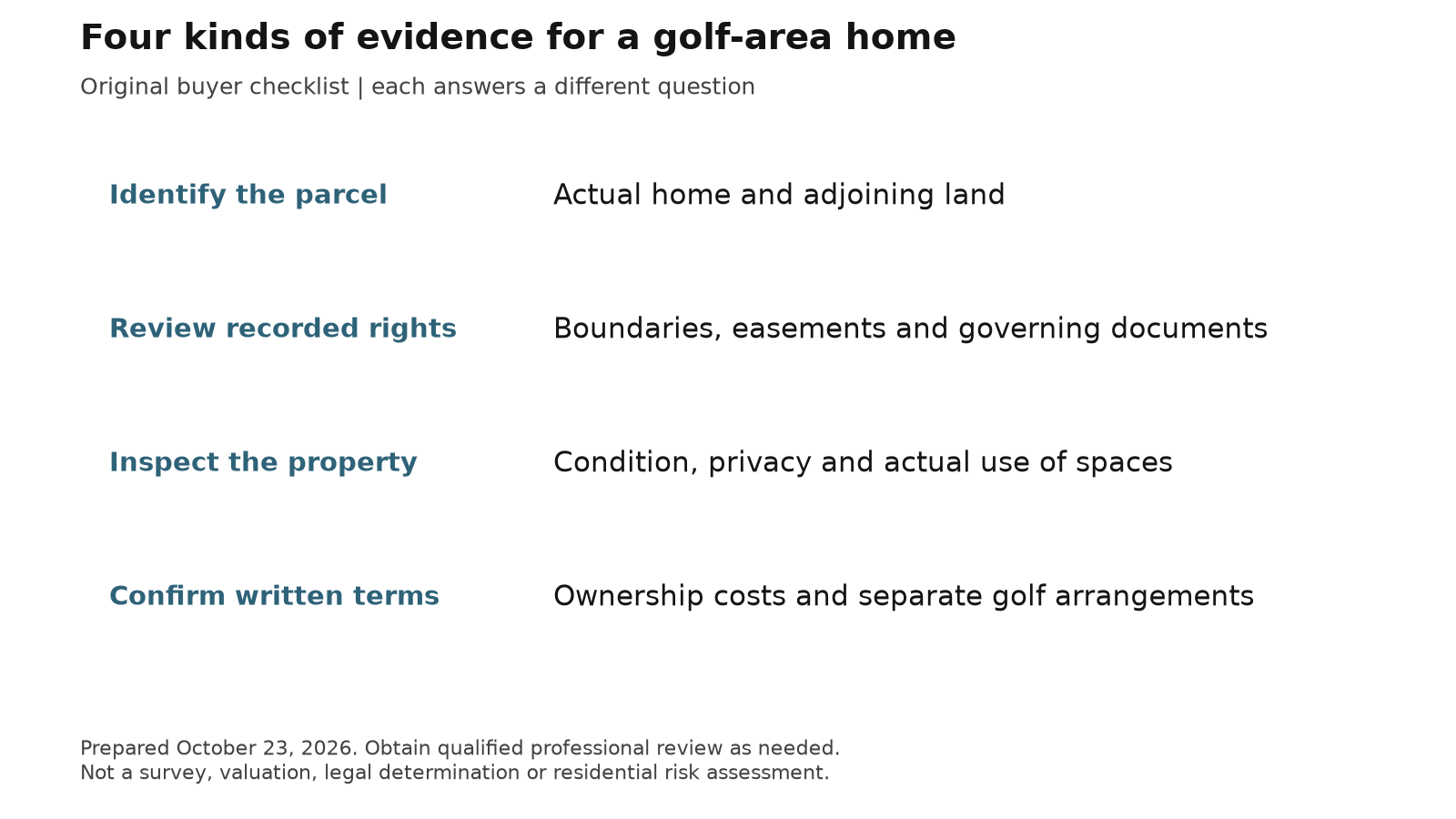
According to the Clark County Assessor's property-search guidance, assessor maps serve assessment purposes and are not surveys. They help identify parcels and point a buyer toward records, but they do not establish every property line, easement or enforceable view right. Begin with the residential parcel number and the adjoining parcel, then have the relevant title documents and any needed survey reviewed for the purchase.
Walk through the actual spaces from which you will enjoy the view. A photograph taken from a balcony does not show the kitchen sightline, ground-level privacy or the effect of a nearby wall. Ask which areas are owned, shared or subject to an exclusive-use arrangement. For a condominium, a terrace, garage and common landscaping can have different maintenance and use rules. For a detached home, a fence or planted strip may not coincide with the legal boundary.
Use three distinct labels in your notes: direct adjacency, visible course scenery and convenient golf access. A property can offer one without the others. Request documents supporting any advertised permanent view or access right. If the evidence is incomplete, treat the feature as an unresolved purchase question rather than assuming permanence from today's landscape. Also identify who maintains the strip between the house and course and whether anyone has an access easement. This is a reason to involve qualified title, survey or legal professionals when the documents are unclear. It is not a claim that every golf-area home has a boundary problem, or that an attractive view is automatically protected against future change.
How can you evaluate golf activity, privacy and damage exposure at a particular home?
A course diagram can orient a conversation, but it cannot certify residential safety. The TPC Las Vegas scorecard page links an operator scorecard whose printed revision is February 2020. It illustrates the golf layout for players. It is not a residential boundary survey, a record of ball strikes or a model of the chance that a particular window will be hit. This guide does not treat a fixed distance from a tee or green as a safe-home threshold.
During an authorized property visit, observe the spaces you expect to use: patio, pool area, bedrooms and work space. Ask about the timing and location of course maintenance, cart traffic and play. A quiet visit at one time does not answer what happens during a different operating period. Request the seller's available repair and insurance-claim records, and ask a qualified inspector to evaluate visible damage and installed protective features. A neighbor's comment can suggest a question; it does not replace the seller's disclosures or professional inspection.
If you would need screening, glazing, fencing or netting, obtain both feasibility advice and the required approvals before relying on the change. Ask the insurer about the exact property and proposed improvements. Product names alone do not establish protection or coverage. According to Nevada's NRS 113.130, covered residential transfers have seller-disclosure requirements, with statutory exceptions. Have your transaction professionals confirm what applies and how concerns should be documented. The goal is to make an informed property decision using actual evidence, without promising that any lot position eliminates exposure.
Which association documents matter before you commit to the purchase?
According to NRS 116.4109, covered common-interest-community resales require a package that includes governing documents, assessments and fees, financial information, reserve information, certain legal matters and association insurance evidence. The statute contains exceptions and distinguishes resales from transactions requiring a public offering statement. Ask your transaction professionals which documents and deadlines apply to the particular purchase rather than applying one rule to every property near a course.
Read the documents against your intended use of the home. If you need to park a particular vehicle, keep a pet, rent the property or alter an outdoor area, identify the relevant rule and any approval process. For a condo, ask who is responsible for the roof, elevator, terrace waterproofing, windows and garage systems. For a detached house, check landscape, exterior and boundary responsibilities. The correct allocation comes from the applicable records; appearance and neighborhood branding are insufficient.
Then review the financial position with qualified help when needed. A low monthly assessment alone does not show whether reserves are adequate for the association's responsibilities. Ask about identified projects, current assessments, disclosed disputes and which costs might fall to an individual owner. The statute provides a cancellation period for covered resales tied to receipt of the package, subject to its terms; have the actual deadline confirmed promptly. Keep a written questions list and resolve material uncertainties before the relevant contractual decision. An association's financial or legal complexity can change your preferred property even when the view, layout and asking price still appeal. The purchase decision needs both the home inspection and the ownership-document review.
How can two similar homes produce different monthly ownership costs?
Use the same categories for both homes: principal and interest if financed, property taxes, insurance, every applicable association charge, utilities and an allowance for maintenance you will fund. Add golf separately if you intend to use it. According to the Consumer Financial Protection Bureau's Loan Estimate guide, some property costs may be paid outside escrow. A monthly mortgage transfer therefore does not necessarily represent the complete housing budget, and some bills arrive as larger periodic payments.
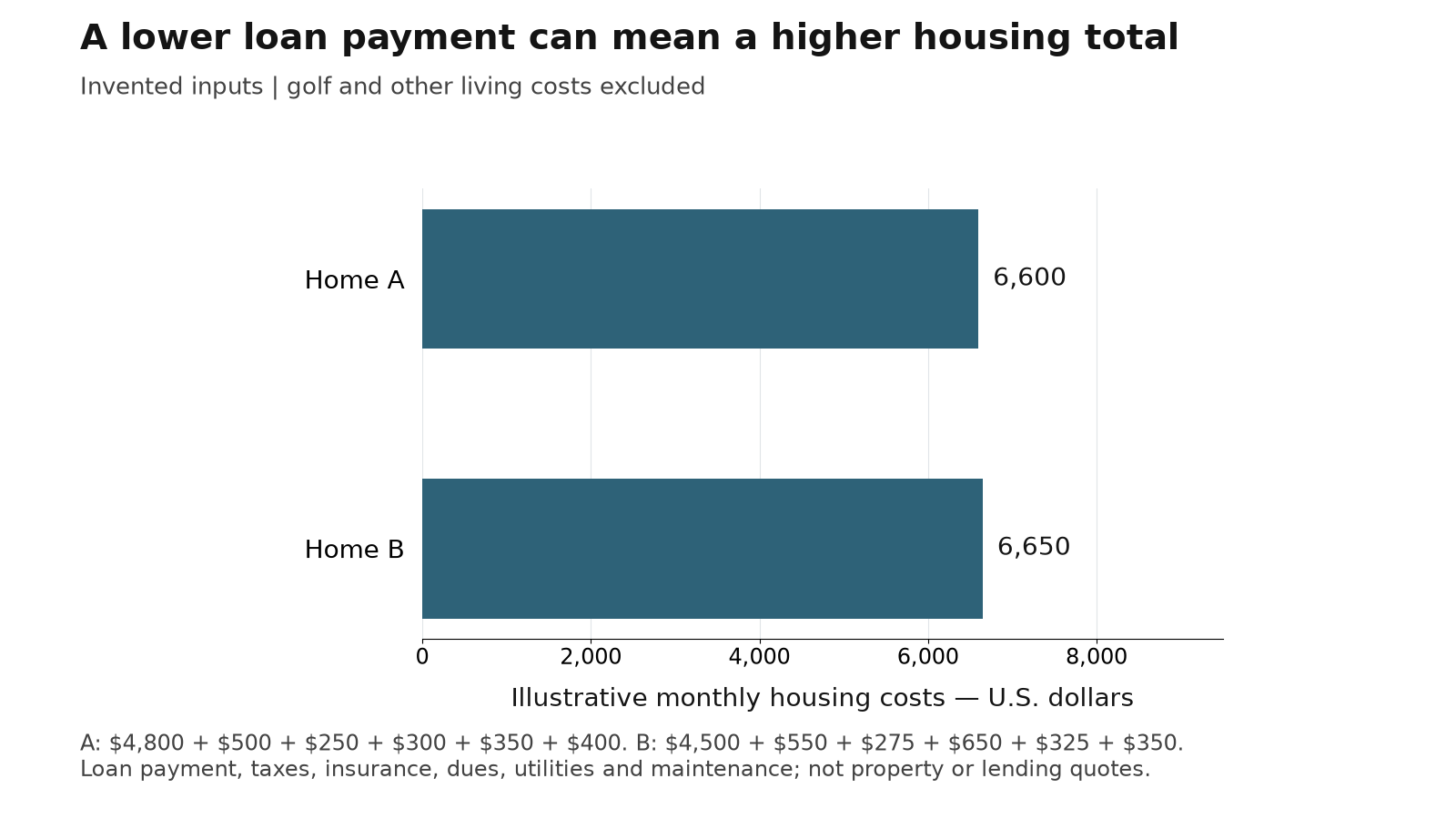
The following worksheet uses invented inputs to show the comparison method. It is not a lender quote, HOA schedule, local average or estimate for a listed property. Home A has an assumed $4,800 loan payment, $500 tax allowance, $250 insurance, $300 dues, $350 utilities and $400 maintenance allowance: $6,600 monthly. Home B has a $4,500 loan payment but $550 taxes, $275 insurance, $650 dues, $325 utilities and $350 maintenance: $6,650 monthly. B's loan payment is $300 lower, yet its modeled housing total is $50 higher, or $600 over twelve months.
Replace each input with the relevant written quote, tax information, association statement or documented estimate. Check what dues actually cover so that the same service is not counted twice. Separate a maintenance savings allowance from a bill due now, while still recognizing the need to fund future work. Include cash needed at closing and a reserve for identified repairs outside this monthly table. The useful result is a budget you understand, not a claim that one property type is always cheaper.
| Assumed monthly category | Home A | Home B |
|---|---|---|
| Principal and interest | $4,800 | $4,500 |
| Property tax allowance | $500 | $550 |
| Insurance | $250 | $275 |
| Association dues | $300 | $650 |
| Utilities | $350 | $325 |
| Maintenance allowance | $400 | $350 |
| Illustrative housing total | $6,600 | $6,650 |
How should you compare financing and cash needed before writing an offer?
According to the Consumer Financial Protection Bureau's Loan Estimate comparison guide, borrowers should compare loan costs and the relevant terms across offers. Its five-year comparison distinguishes the amounts paid from the principal reduced. A lower escrow estimate by itself does not make a loan better. For a golf-area purchase, keep the property assumptions consistent while asking lenders to explain differences in rate, points, fees, cash to close and payment risk.
Make a separate cash worksheet for the down payment, transaction costs, prepaid items, initial reserves, inspections and any planned work. Do not put every one-time item into the recurring monthly column, or omit it because it does not recur. When comparing a builder offer with a resale, identify whether an incentive is tied to a lender, whether it changes the purchase price or loan terms, and which costs you still pay. Obtain current written terms; an advertised incentive is not your approved financing.
Ask the lender early whether the particular property and ownership structure create additional requirements. A condo application may involve association or project information as well as the buyer's finances. A larger loan or unusual property can raise different documentation questions. This guide makes no approval promise and does not assign an assumed interest rate to an actual home. Keep appraisal and financing contingencies aligned with the contract advice you receive. The practical sequence is to identify the home, establish realistic financing and cash requirements, then decide what price and terms fit. It is harder to correct a mistaken cost assumption after a contractual deadline has passed.
How much extra can you justify paying for the view you want?
Separate personal enjoyment from an expected financial return. A view may be important enough that you choose to spend more for it, but the amount you willingly pay is not evidence that a future buyer will repay it. The historical keyword comparisons above cannot establish that recovery. Decide first whether the property works without assuming appreciation or a guaranteed resale premium, then examine how the additional purchase price affects your cash and financing.
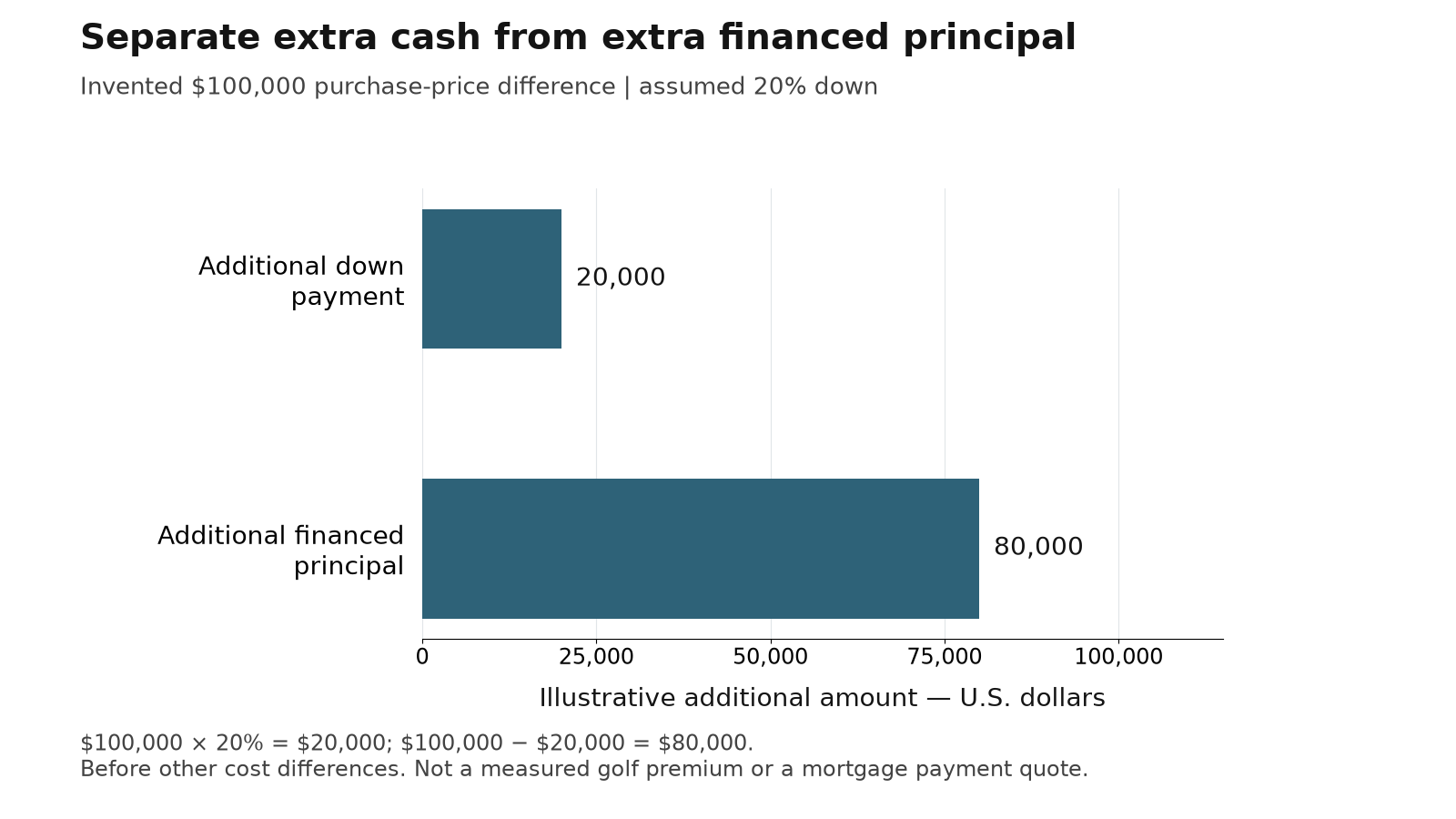
Consider an invented comparison between otherwise acceptable homes priced at $1,000,000 and $1,100,000. The difference is $100,000. With the same assumed 20% down-payment structure, that difference would add $20,000 to the down payment and $80,000 to the financed principal before any other transaction differences. The resulting payment depends on actual loan terms; this example does not calculate a rate or quote. A cash buyer would still have the $100,000 purchase-price difference and the opportunity cost of committing it to the home.
Now list what the extra price purchases: a specific sightline, privacy, outdoor usability, location or another feature. Identify any drawbacks and unresolved evidence. If the only support is a broad claim that golf homes always outperform, the comparison is incomplete. If you value the view and can carry the cost under conservative assumptions, that is a clearer personal decision. Ask for property-specific comparable analysis and consider how the same budget performs elsewhere in Summerlin. Avoid borrowing a percentage from another ZIP to settle a negotiation. A supported offer reflects the actual home, current alternatives and your financial limits.
What should a seller or future seller consider about liquidity and resale?
The July 2026 record does not support a promise that golf-related homes always sell faster. Its 89144 golf-keyword group showed median market time of 46 days compared with 22 days across the ZIP; its 89135 figures were 38 and 36 days. Those are historical, unmatched groups with unavailable underlying exports. They cannot predict your sale timeline, but they directly contradict treating a course reference as an automatic shortcut to a quick sale.
Prepare for resale by retaining useful records during ownership. Keep permitted-improvement documentation, warranties, association correspondence, maintenance records and relevant property information. When selling, describe the actual feature accurately: a view from a particular room, adjacency to identified land, or convenient access to a course. Avoid advertising guaranteed membership or permanent views unless the relevant rights and conditions support the statement. A buyer should be able to distinguish the home's documented features from lifestyle language.
Across the 9,600+ closings our team has represented statewide, the individual property's evidence remains essential to its pricing discussion. The statewide experience figure does not establish a separate TPC resale study or a return guarantee. For a current sale, ask the seller team to compare relevant closed transactions and competing inventory, with a clear date and explanation of differences. Plan for the costs and timing of the move without assuming the house will sell within an old median. If you are buying now, test whether a longer holding period or an unexpected repair would still fit your finances. Resale flexibility is part of the decision even when the immediate purpose is enjoying the home.
How can you build a useful shortlist without repeating misleading golf labels?
Use a small written comparison that connects each requirement to evidence. For direct frontage, identify the parcel boundary and adjoining land. For golf access, obtain the operator's current arrangements. For lower maintenance, examine who is responsible for the actual systems and what the association charges. For a quiet work space, inspect the room at relevant times and ask about nearby activity. A general label such as luxury, gated or golf community cannot answer all four questions.
Keep the tradeoff beside the advantage. Shared amenities may reduce some personal upkeep while adding dues and association governance. A broad view may bring less privacy from nearby play. A detached home may provide more control over certain features but leave more maintenance with the owner. These are questions to resolve for the property, not fixed judgments about all condos, all gates or all course lots. Note which answer would cause you to change your choice before you become committed to one listing.
When alternatives are materially different, use the relevant guides for their own purposes. The Tournament Hills article explores a particular enclave; the broader golf-living guide supports a valley-wide search. This page focuses on identifying the TPC-area home, interpreting the old data and establishing the purchase evidence. Keep a dated record of listings and written answers because availability and terms change. A shortlist is useful when it tells you why a property meets a requirement, what remains unresolved and what cost or condition would make another option preferable.
What should you do before scheduling the next tour or making an offer?
Bring the exact address, price, ownership type and listing materials to the next discussion. Identify the golf course being referenced and whether your priority is a view, a particular course, a home layout or a budget. Request the available disclosures and association information early, and arrange professional review appropriate to the property's condition and documents. Use the tour to answer questions that photographs cannot: room-level sightlines, access, privacy, grade, parking and the practical use of outdoor space.
Keep this guide's evidence periods separate. The July 12 market figures are a preserved historical snapshot with stated limitations. The October 23 operator and builder observations describe the information reviewed on that date. The cost charts are invented planning examples with transparent arithmetic. None is a substitute for fresh comparable sales, a property inspection, current association documents or your own financing terms. The four original decision graphics are explanatory tools, not maps, appraisals or reports of field measurements.
Nevada Real Estate Group can help organize a current Summerlin home search, narrow the relevant golf-area alternatives and identify the questions needing specialist input. Call (702) 637-1759 or contact the team with the property or requirements you want to discuss. Ask for the evidence and costs behind the recommendation before choosing a home. The aim is a purchase whose location, obligations and financial demands you understand. A good decision can include paying for a view you value, provided that you distinguish that preference from an unsupported promise about safety, permanent access or future returns.
Frequently asked questions
Is TPC Las Vegas public or private?
The operator describes TPC Las Vegas as available to the public and resort guests. TPC Summerlin is a separate private club. Confirm current playing arrangements directly with the relevant operator; purchasing a nearby home does not by itself document golf privileges.
Which ZIP code should I use for TPC Las Vegas homes?
The TPC Las Vegas course address is in 89144. TPC Summerlin's is in 89134. A ZIP search is only an initial filter: verify the home's actual location and the course referenced in its marketing. The retained 89135 statistics are broader historical golf-keyword context.
Is the July 2026 golf premium a reliable valuation adjustment?
No. The original comparison used golf keywords and whole-ZIP groups rather than matched frontage and non-frontage sales. It cannot isolate the value of a view or support automatically adding 21% to 33% to a home's value. Obtain current property-specific analysis.
Does a Mira Villa condo necessarily overlook TPC Las Vegas?
Do not assume that. The builder describes the community in relation to both TPC Las Vegas and Angel Park. Confirm the exact unit's orientation, views, ownership rights and documents. A community-level description does not establish every unit's relationship to either course.
Are golf membership charges included in HOA dues?
That requires the property's governing documents and the club's current written terms. Association obligations and golf arrangements are separate questions. Confirm all mandatory charges, optional services, eligibility and any transfer restrictions; a staffed gate is not proof of membership.
Can a parcel map prove that a golf view will remain forever?
No. The assessor says its maps are not surveys. Use parcel information to identify the land, then obtain the relevant recorded documents and professional review. Current course operation and a visible fairway do not themselves establish an enforceable permanent-view right.
How do I assess golf-ball damage concerns?
Review available seller disclosures, repair and claim records, inspect the property and discuss coverage and proposed protection with qualified professionals. Check any approval requirements. This guide does not certify a safe distance or treat a course scorecard as a residential risk assessment.
What should I budget beyond the mortgage payment?
Consider taxes, insurance, all applicable association charges, utilities, maintenance, golf if selected, closing cash and reserves. Some costs may sit outside escrow. Replace the article's invented examples with written property and financing information before relying on a monthly total.
Sources and evidence periods
- TPC Las Vegas directions and course overview: address, identity and access description, reviewed October 23, 2026.
- TPC Summerlin directions and membership information: separate club and arrangements, reviewed October 23, 2026.
- Summerlin's Canyons article: February 25, 2020 geographic context; current golf directory, reviewed October 23, 2026.
- Toll Brothers Mira Villa: affiliated offering and dated advertised prices, October 23, 2026; availability and terms can change.
- Clark County Assessor property search: parcel research and map limitations.
- TPC Las Vegas scorecard: operator layout reference; linked PDF revision February 2020, not a residential survey or risk study.
- Nevada NRS 113 and NRS 116: applicable disclosure and common-interest-community provisions reviewed October 23, 2026.
- CFPB Loan Estimate guide and comparison guidance: loan and ownership-cost distinctions.
- Original July 12, 2026 NREG article: preserved GLVAR keyword/ZIP snapshot, not newly extracted or independently reproduced. Original listing export unavailable; no matched-frontage premium or current inventory inference.