

Summerlin can be a useful place to compare rental properties, but the neighborhood name does not settle the investment decision. A home must support a permitted rental use, a defensible rent estimate and a cost budget that you can carry. Attractive surroundings and an expensive purchase price do not guarantee cash flow, appreciation or a tenant's payment history.
This guide uses dated MLS figures through September 2026 from NREG's market reports, plus a property-level review whose sources were rechecked November 15, 2026. The financial scenarios are invented teaching examples. They are not current listings, loan offers, rental appraisals or reported client results. Begin with the actual address, then use the calculations to identify which records would change your decision.
Investing in Summerlin requires checking the property's rental permissions, rent evidence, association bills, assessment balance and financing together. Summerlin West's posted 2026 association assessment is $69 monthly, but other property costs need separate verification. In this guide's invented $600,000 purchase, $2,700 monthly rent produces a cash shortfall after the stated operating costs, reserves and a 25%-down mortgage at 7.5%.
- Market figures here cover sales and leases through September 2026; ZIP medians are not a rental appraisal.
- Confirm city or county jurisdiction and every applicable association before choosing a lease.
- Reconcile bills: avoid counting the same association charge twice.
- Separate gross yield, operating income and cash after debt and reserves.
- Test vacancy and an early sale without assuming appreciation or refinancing will solve a shortfall.
What Should a Summerlin Investment Property Accomplish for You?
Define the job before choosing the village. An investor seeking regular spendable income has a different decision from someone willing to contribute cash during a long hold. Write down the amount available for purchase, the reserve that must remain untouched and the maximum monthly contribution you can sustain. A vague preference for appreciation does not replace those limits.
The Nevada Real Estate Group has closed 9,600+ transactions statewide, but the relevant question here is what the particular Summerlin home can support. A transaction count is not the rent roll, lease history or operating statement for an address you are considering. Request that evidence for the actual property.
Separate expected income from hoped-for resale value. Your base budget should work with today's documented terms, even if your reason for owning includes a longer view. If the plan needs prices to rise, state that assumption and calculate how much cash you would contribute before selling. An owner can like the location and still reject a purchase whose expenses exceed the available budget.
The Summerlin community guide provides the geographic starting point. For this article, a useful shortlist has a specific property type, permitted lease plan, cash requirement and review deadline. That makes an investor's priorities testable. It also helps distinguish a real tradeoff, such as more purchase cash for a smaller payment, from a promise about performance that the property records cannot establish.
Which Jurisdiction and Associations Govern the Actual Property?
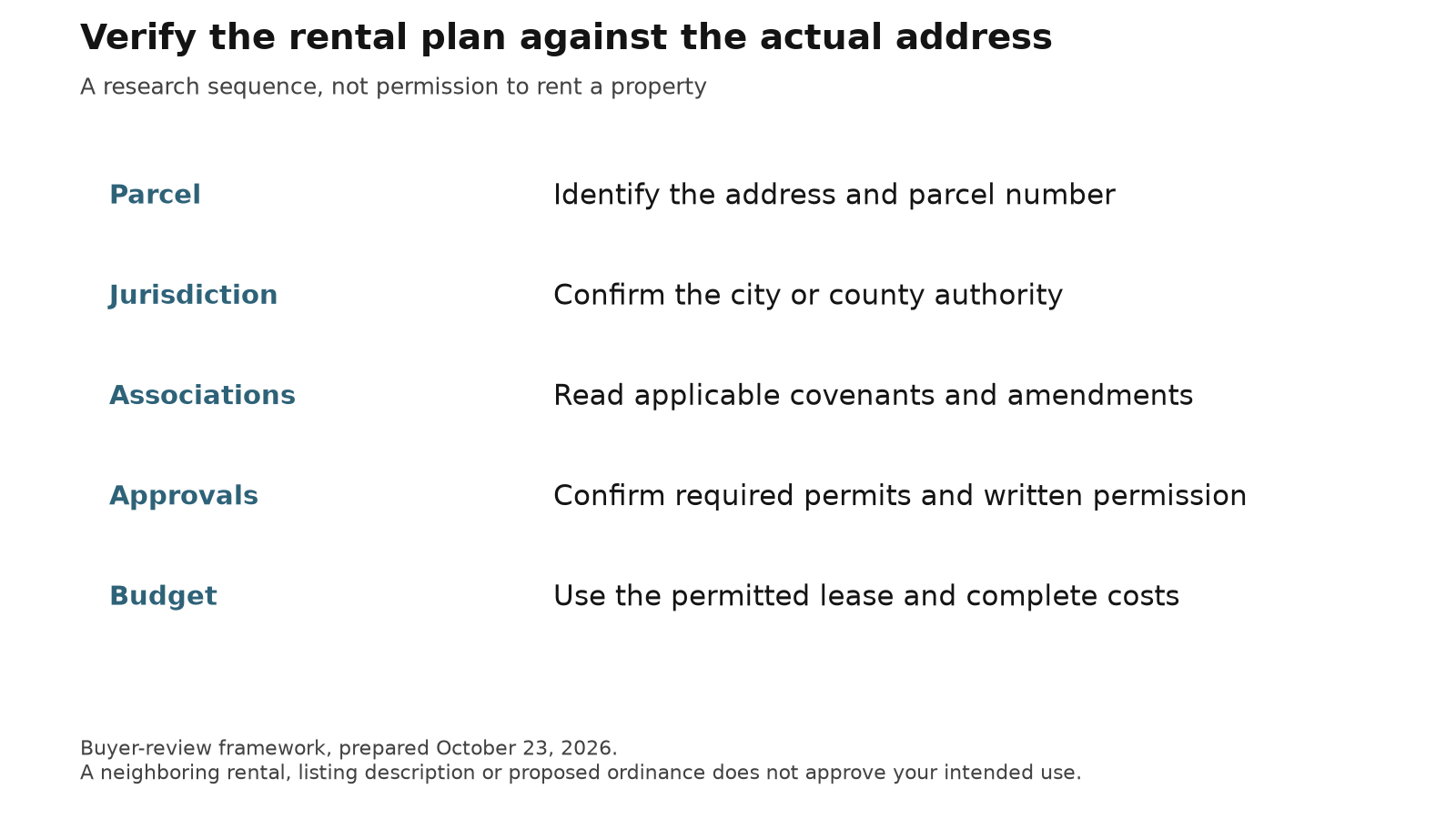
Start with the parcel number and the authority responsible for the address. A Las Vegas mailing address does not by itself establish City of Las Vegas jurisdiction. Likewise, the word Summerlin does not identify every association or covenant attached to a home. Record the jurisdiction and association names as separate fields so one cannot silently substitute for the other.
According to the City of Las Vegas short-term-rental page, the city uses its own short-term-rental definition and approval framework. Clark County's program page addresses the county process. Those are separate sources to consult after confirming which authority covers the property; neither page proves that an individual Summerlin address is approved.
Build a small record file with the parcel identification, zoning information, title materials and applicable association declarations. Include amendments and supplemental declarations rather than relying on a general community brochure. Ask the relevant office or association to resolve an ambiguity in writing before it becomes an assumption in the rental budget. An existing online rental advertisement is not that confirmation.
For a comparison spanning Summerlin Centre and other villages, keep the same fields for every finalist. Two nearby properties may have different obligations, even when their listing photos and asking prices look similar. The practical benefit is a cleaner decision: you can see whether a home fails the intended-use test before spending time optimizing a loan payment for a use that has not been confirmed.
What Do Recent Summerlin Prices and Rents Actually Tell You?
An earlier version of this section showed July 2026 figures that could not be traced to a saved MLS export or search filter, so they were removed on November 15, 2026. The table below uses NREG's dated reports built from Las Vegas REALTORS MLS records via Repliers: the Summerlin and Las Vegas market reports for November 2026 and the Summerlin rent guide. Each row states its own window.
| Metric and window | Summerlin | Las Vegas (MLS city) |
|---|---|---|
| Median closed price, September 2026 | $635,000 (227 closings) | $435,000 (1,437 closings) |
| Closed price per square foot, September 2026 | $305 | $252 |
| Median days from listing to contract, September 2026 closings | 29 | 28 |
| Sale-to-list ratio, September 2026 | 97.7% | 98.8% |
| Active listings, November 11, 2026 | 1,146 | 8,144 |
| Median rent paid, closed leases, October 2025 to September 2026 | $2,500 (2,224 leases) | $1,995 (16,897 leases) |
The Summerlin sale and listing rows cover ZIP codes 89134, 89135, 89138, 89144 and 89145, a corridor that includes some homes outside the master plan; the rent row uses the first four. The Las Vegas column follows the MLS city field, which goes by mailing address, so it includes most Summerlin homes. The table compares groups of properties, not the same home in two places. A higher median can reflect differences in size, age, property type and the mix of sales. It does not measure an individual home's location premium or prove that Summerlin suffers smaller losses in a downturn. The days row also counts only homes that sold, so it says nothing about a home still waiting for a buyer or a tenant.
The rent row is closer to evidence than an asking price, because it counts closed MLS leases, but it is still a median across condos, townhomes and houses of every size. Asking rents run separately: on November 1, 2026, the 412 active rentals in the four ZIP codes asked a median of $2,700, and an asking rent is not proof of a signed lease, rent collected or the time needed to find a tenant. Do not divide two unrelated medians and present the result as a measured return on a typical property. The Summerlin housing market guide supplies a place to follow newer market context, but the purchase still needs matched evidence for the particular address.
Use this table to frame questions, not to price a home. Ask which property types a figure includes, what period it covers and whether rent observations reflect furnished or unfurnished homes. If those questions cannot be answered for a figure someone hands you, leave it out of the underwriting inputs.
How Should You Compare Entry, Core and Luxury Price Bands?
Compare the total capital requirement and the property's likely costs, rather than assigning each price tier an investment personality. A lower purchase price can help the budget, but a large assessment or repair can offset that benefit. A luxury home can command a higher advertised rent while still requiring a much larger cash contribution to purchase and carry.
| Metric | Under $500K | $500K to under $1M | $1M to $2M | $2M or more |
|---|---|---|---|---|
| Closings | 664 | 1,147 | 412 | 226 |
| Share of 2,449 closings | 27.1% | 46.8% | 16.8% | 9.2% |
The counts come from our Summerlin master-plan guide, which reports 2,449 closings at a $649,000 median in ZIP codes 89134, 89135, 89138 and 89144, with 664 under $500,000, 412 from $1 million to $2 million and 226 at $2 million or more. The $500,000 to $1 million column is the remainder, and the shares are rounded. By home type, single-family homes closed at a $731,250 median on 1,915 sales and attached homes at $438,162 on 526. The 226 sales at $2 million or more spread across very different homes over a full year, so an exit price there rests on fewer comparisons.
The listing side shows how much competition sits at the top. On November 11, 2026, 428 of the 1,146 corridor listings asked $850,000 or more, per the November market report. The 229 asking $1.5 million or more had been listed a median 63 days, about the same as the 62 days for listings between $650,000 and $850,000, and 41.9% of them had cut their price, against 49.1% across all corridor listings. Those counts do not establish a lease-up period or a resale timeline for your chosen home.
For rent evidence by home type, our rent guide found third-quarter 2026 closed-lease medians of $1,950 for condos, $2,500 for townhomes and $2,655 for single-family homes in the four ZIP codes. Those are type medians, not rents for a price band, so they cannot be paired with the closing counts to produce a yield.
A gross-yield check is simple arithmetic. A hypothetical $435,000 purchase receiving $2,600 monthly rent has $31,200 annual scheduled rent. Dividing that by price gives approximately 7.17% gross yield; an earlier version of this guide stated 6.5% for the same pairing. The figure still excludes expenses, and the price and rent are invented, not a matched transaction.
An earlier tier-yield row was replaced by the transparent property calculations below. For a luxury comparison, the luxury community directory can help identify locations, but a higher price does not establish better tenant credit, more reliable appreciation or a protected resale floor. Keep those outcomes out of the base case unless you have evidence suited to the specific claim.
How Can You Compare Summerlin Villages Without Inventing a Winner?
Use village names to organize comparable properties, then narrow by features that affect cost and rent. The MLS has no standard village field, so the table below uses ZIP codes and plat names from our master-plan guide (sales) and rent guide (leases). ZIP codes cross village and association lines, and the sale and lease columns cover different windows. The table is not a ranking, a matched rent-to-price study or proof that one area delivers the best return.
| Area | Closings, 12 months | Median sold, 12 months | Closed leases, third quarter | Median rent paid, third quarter |
|---|---|---|---|---|
| ZIP 89134 (Sun City and older Summerlin) | 731 | $487,550 | 107 | $2,200 |
| ZIP 89144 (The Crossing and The Arbors) | 308 | $552,500 | 109 | $2,200 |
| ZIP 89138 (Summerlin West) | 745 | $769,000 | 202 | $2,850 |
| ZIP 89135 (Summerlin South and The Ridges) | 665 | $850,000 | 149 | $2,650 |
| Sun City Summerlin plats (55+), within 89134 | 517 | $446,000 | 44 | $2,100 |
| Red Rock Country Club, within 89135 | 68 | $2,012,500 | 5 | $6,500 |
| The Ridges (sales: gated plats; leases: Village 18 plats) | 39 | $3,250,000 | 8 | $12,275 |
The last two rows rest on five and eight leases, which is too few to budget from; the rent guide treats them as ranges, with Village 18 leases in The Ridges closing from $6,000 to $22,000.
For a current shortlist, compare similar bedroom counts, interior size, condition, parking and outdoor maintenance. A furnished property with a pool has a different cost and service profile from an unfurnished home without one. If comparable evidence is thin, use a wider range and explain the uncertainty rather than treating a single advertisement as the market.
The Paseos community page and Summerlin neighborhood guide can help establish the search geography. They do not establish a property's bond payoff, lease permission or future rent. Verify those independently, especially when a listing uses a broad community label that may not match the association name on title.
Choose finalists by the strength of their records and their fit with your budget. A property that has a clear association statement, supported rent range and documented condition is easier to assess than one promoted chiefly through a village's reputation. If two candidates have similar expected cash results, compare the uncertainty and cash reserve each requires. That is a more useful distinction than assigning an unsupported investment winner to an entire village.
Which HOA Charges Belong in a Summerlin Rental Budget?
Reconcile the actual association statements before adding a standard set of fees. According to Summerlin West's posted 2026 assessment notice, its assessment is $69 per month per unit. That is a specific association charge for the stated year. It is not a complete estimate of the dues, special assessments or other expenses attached to every Summerlin West property.
According to the Summerlin South assessment brochure, the community associations contribute a prorated share of Council expenses. That explains why a buyer should not automatically invent an additional Council bill on top of every association figure. Identify what the statement already includes, then add only separately documented obligations.
Request the billing frequency, amount, payee and coverage for each charge. A condominium association may be the sub-association already shown in a listing; adding another generic condo fee could double count it. Conversely, a blank listing field does not prove that a charge is absent. The Summerlin HOA guide offers broader context, while the actual statements resolve the property's budget.
According to NRS 116.4109, applicable resale packages include governing documents, specified financial information, assessment and fee information, and other disclosures. Use that material to identify current obligations and issues needing clarification. Keep regular dues, a one-time transfer cost and a special assessment on separate lines. Then record whether each is due at closing, monthly or later, so a correct annual total does not hide an immediate cash requirement.
How Should You Verify a SID or LID Before Making an Offer?
A Special Improvement District or Local Improvement District can create an obligation distinct from ordinary association dues. According to the City of Las Vegas engineering explanation, SIDs finance improvements such as roads, sidewalks and utilities through municipal bonds, with benefiting properties included in the district. The city describes the mechanism; it does not establish a balance for a home you have selected.
Match the district and parcel to the current account record. Ask for the remaining balance, installment amount, due dates, interest terms and payoff information. Confirm whether a proposed seller payoff is actually reflected in the closing instructions. The age of a neighborhood is not a payoff receipt, and new construction alone does not tell you the amount of an assessment.
According to Clark County's SID payment instructions, SID payments use the parcel and district information and a Treasurer-SID payment process. The Treasurer's SID overview adds that special assessments are billed separately from real property taxes and are typically billed and collected semiannually. Do not assume a mortgage servicer's ordinary property-tax escrow automatically handles a separate assessment. Ask the applicable district administrator and servicer how the particular obligation will be billed and paid.
For planning, convert the installment schedule to an annual and monthly allowance, but retain its actual payment dates. A semiannual or quarterly bill can create a cash need that a smooth monthly spreadsheet disguises. Keep assessment payments visible even if you classify part of the obligation below operating income. The investor still needs the cash. Our Summerlin home-cost guide connects these charges to a broader ownership budget, while your purchase decision should use the current parcel statement and confirmed closing treatment.
How Do Gross Yield, Operating Income and Cash Flow Differ?
Gross yield is scheduled annual rent divided by purchase price. It is useful as a first calculation, but it does not subtract vacancy or any expense. Net operating income, or NOI, subtracts the operating costs defined in the analysis before mortgage debt service. Cash remaining after debt, reserves and other obligations answers a different question: how much the owner must contribute or can retain.
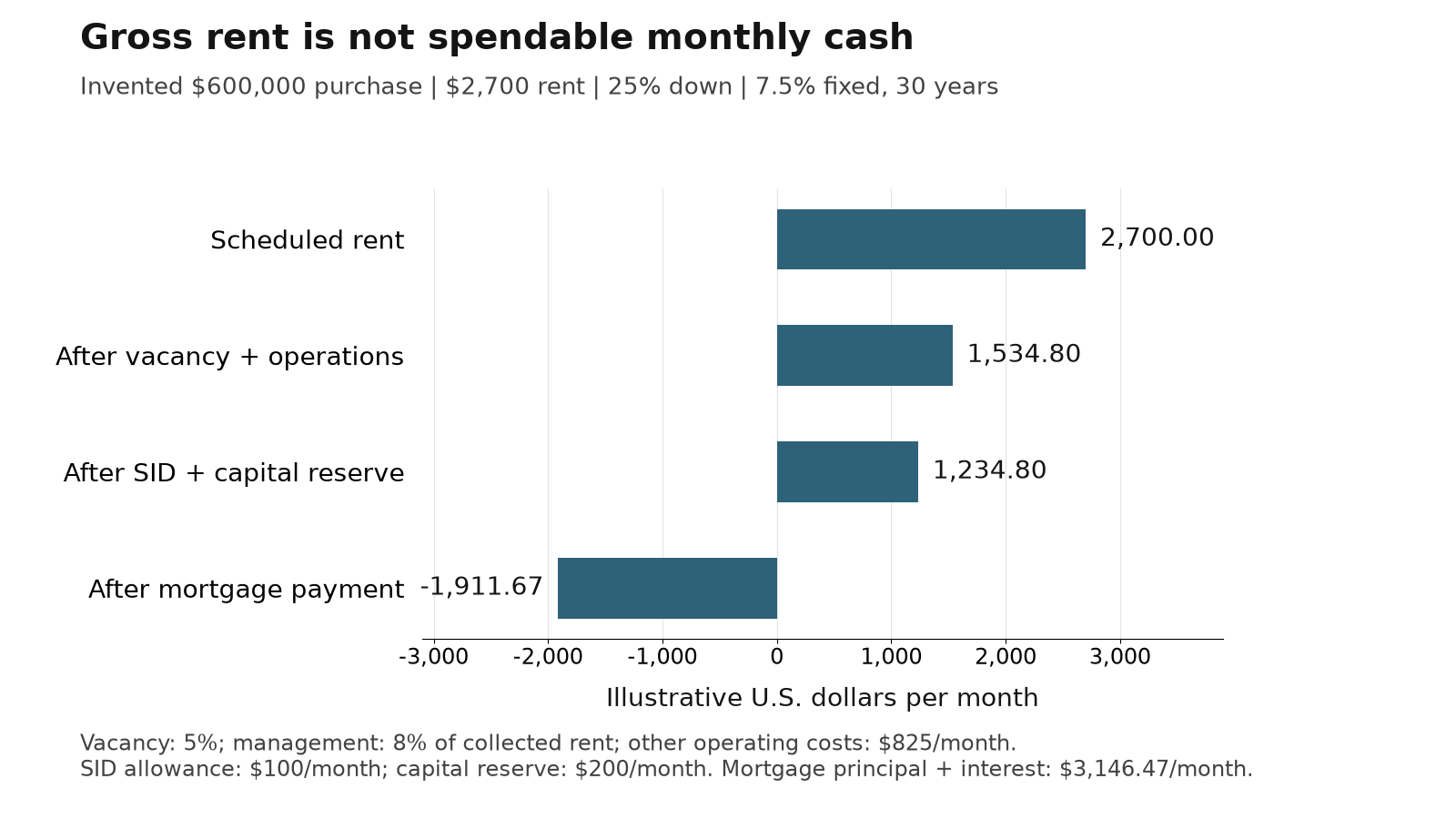
Use explicit definitions rather than relying on a label. In the invented October 2026 scenario below, price is $600,000 and scheduled rent is $2,700 monthly. Annual scheduled rent is $32,400, giving a 5.4% gross yield. A 5% vacancy allowance leaves $30,780. Management is assumed to cost 8% of collected rent, or $2,462.40 annually.
Other invented annual operating costs are $3,600 property tax, $1,800 insurance, $2,400 association dues and $2,100 maintenance. These total $9,900. Subtracting them and management from collected rent leaves $18,417.60 NOI, approximately 3.07% of the purchase price. None of these amounts is a quote for an actual Summerlin property, and the tax amount is not a percentage-based tax rule.
This model then subtracts a $1,200 annual assessment-payment allowance and a $2,400 capital-replacement reserve below NOI, leaving $14,817.60 before mortgage payments. That convention makes the cash requirement visible without presenting assessment principal or a reserve transfer as ordinary operating expense. Different analysts may classify components differently. Compare their formulas and supporting bills before comparing cap rates, and keep the complete cash budget available alongside any headline return.
What Does Financing Do to the Same Hypothetical Property?
Continue the same $600,000 purchase with an invented 25% down payment and a $450,000 loan. At an assumed 7.5% fixed note rate amortized over 360 monthly payments, principal and interest are approximately $3,146.47 monthly. The rate is a modeling assumption, not a lender offer, a current investor-rate average or an adjustment to an owner-occupied mortgage survey.
According to Freddie Mac's November 12, 2026 PMMS, the national 30-year fixed average was 7.11%. Its borrower profile concerns owner-occupied home purchases, so that average is background context rather than an investment-property quote. The model's 7.5% assumption is 0.39 percentage points higher, but that difference is not a claimed investor pricing spread. Obtain terms for the actual borrower, property and rental use.
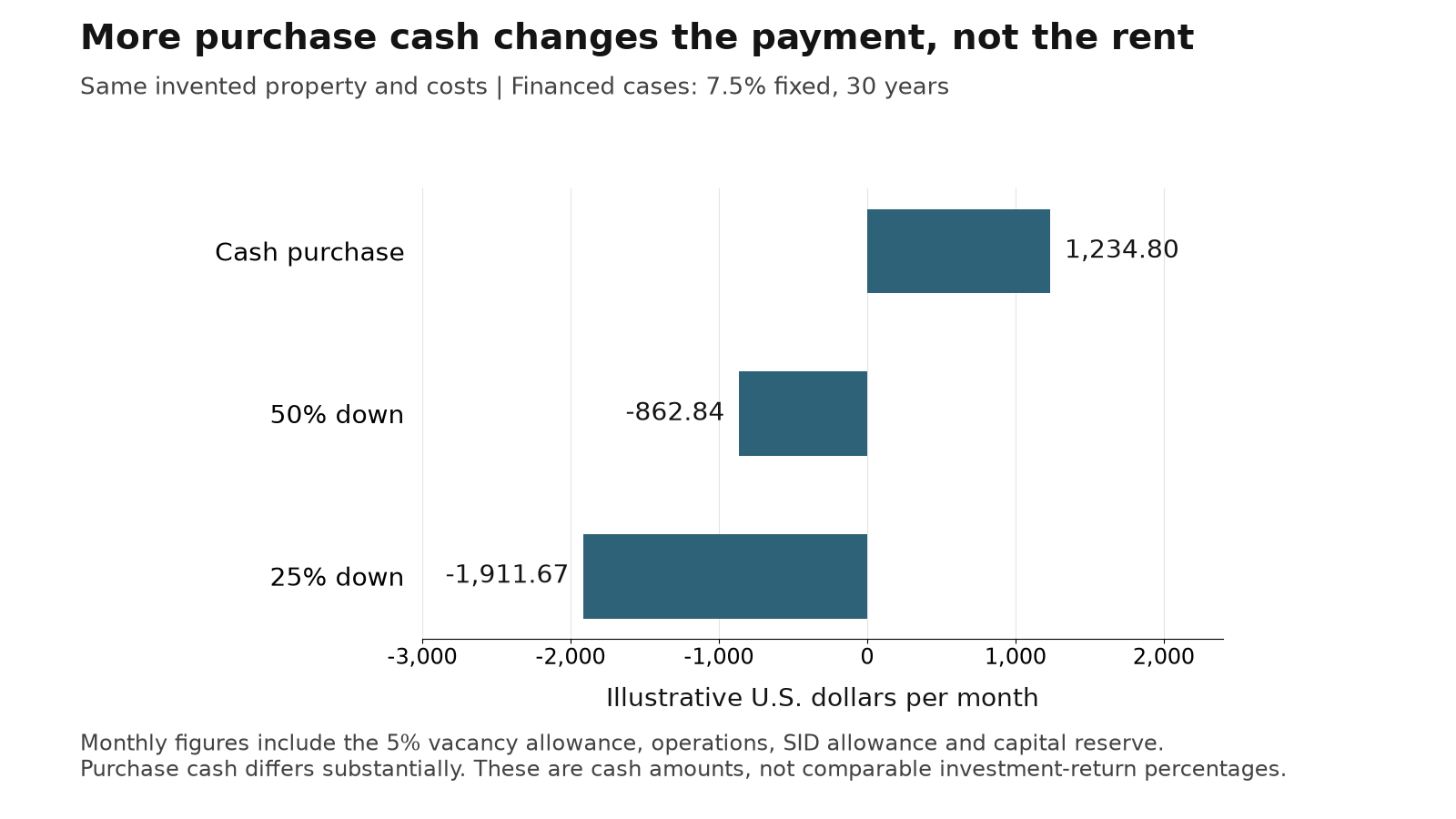
The example has $1,234.80 monthly after its vacancy, operating costs, assessment allowance and capital reserve, before mortgage payments. Subtracting the calculated loan payment leaves approximately negative $1,911.67 monthly. The annual shortfall is $22,939.98 using the unrounded payment formula. Multiplying rounded monthly figures can create a few cents of difference; it does not change the decision this scenario illustrates.
At 50% down, the $300,000 loan has approximately $2,097.64 monthly principal and interest under the same assumed terms. Cash after the stated costs remains approximately negative $862.84 monthly. A cash purchase removes that loan payment and leaves $1,234.80 monthly in the model, while requiring substantially more purchase capital. These are cash amounts, not comparable cash-on-cash return percentages.
Ask lenders for written terms that match your intended rental use, including points, fees, reserves, maturity and prepayment provisions. Do not assume a future refinance will be available or that a larger down payment is automatically the best use of your cash. The Las Vegas DSCR loan guide explains why a lender's qualifying ratio can differ from investment profitability. Compare the actual loan contract with the property's full cost budget before selecting either the financing or the home.
Which Rent and Tenant Records Should Support Your Assumptions?
For an occupied property, request the signed lease, amendments, deposit accounting, rent collection history and any unresolved notices or payment arrangements through the appropriate transaction process. Match the records to the unit and period. A lease's stated rent, the amount actually collected and a listing agent's proposed future rent can be three different numbers with different uses.
For a vacant home, build a comparable set with relevant size, condition, parking, furnishings and maintenance responsibilities. Note the date of each observation and whether it is an advertised price or a completed lease. Ask what concessions or included services affect the comparison. If a proposed rent depends on furnishing the home, include the furnishing cost and replacement plan in the budget.
Do not use a neighborhood's household income or owner-occupancy rate as a substitute for evaluating an applicant. Those area statistics do not establish an individual's credit, ability to pay or treatment of a home. Use a lawful, consistently applied screening process with a qualified property manager or adviser. Avoid assumptions based on family status, occupation stereotypes or a village's reputation.
The Las Vegas rental-investor guide can help frame broader research, but keep the final rent conclusion tied to your property's evidence. Also review the management agreement's fee basis: collected rent, scheduled rent and separate leasing charges produce different cash results. In this article's model, the 8% fee applies only to collected rent and is an invented assumption. Add actual leasing, renewal or inspection fees only when the proposed agreement supports them, and make their timing visible.
Which Vacancy and Repair Stress Tests Matter Most?
Test the amount of cash you would need when the property does not perform as expected. Start with a specific vacancy period, then add a separate repair scenario. This is more informative than a general statement that a neighborhood has stable tenants. A reserve helps only if it remains available after the down payment, closing costs and initial work.
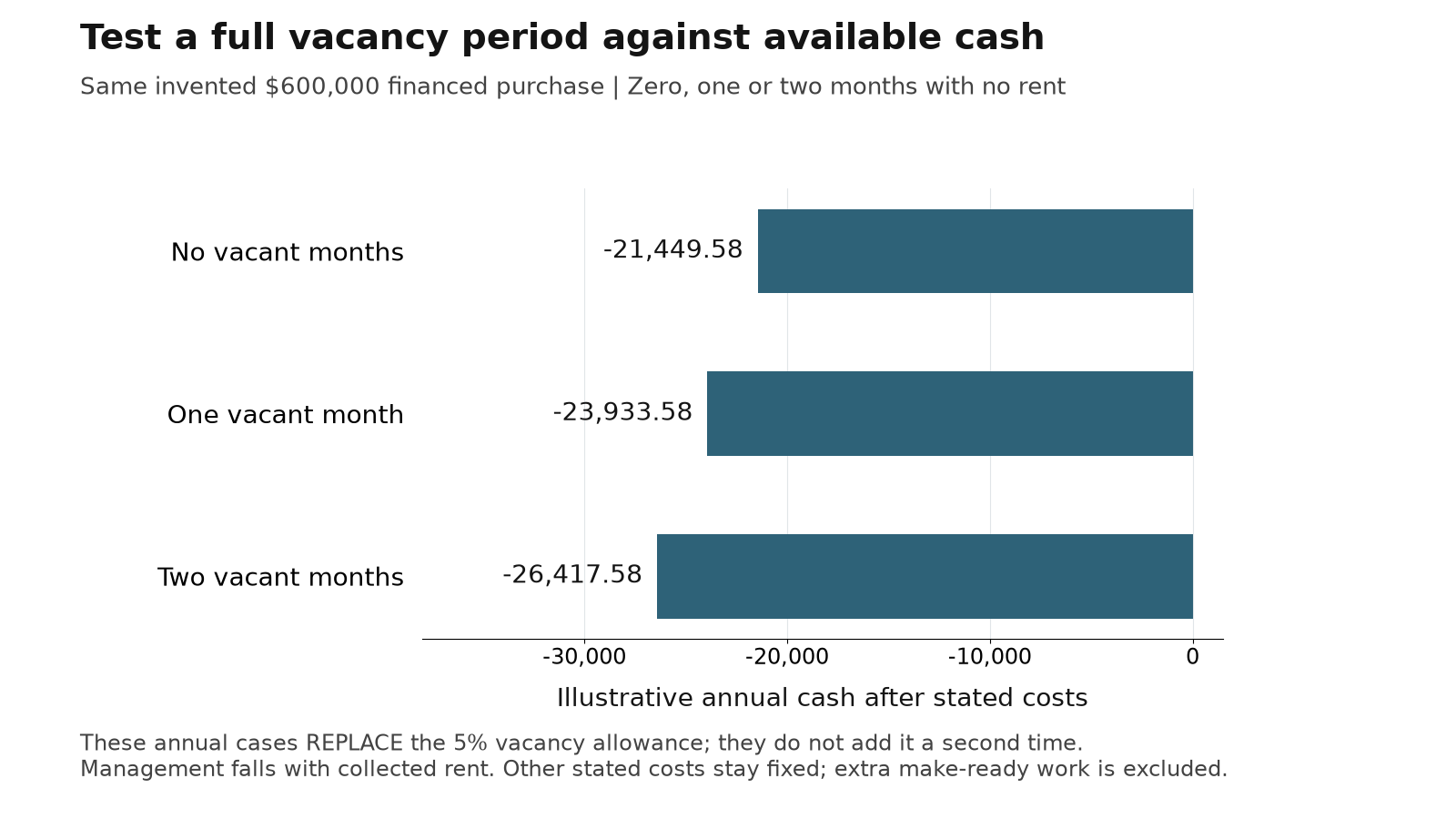
For the same invented $600,000 financed purchase, replace the 5% vacancy allowance with zero, one or two full months without rent. Keep the 8% management fee on collected rent and all other stated annual costs unchanged. Cash after mortgage payments is approximately negative $21,449.58 with no vacant month, negative $23,933.58 with one and negative $26,417.58 with two.
Each additional vacant month reduces cash by $2,484 in this model: $2,700 lost rent less the $216 management fee no longer charged under the assumed agreement. These scenarios do not add the original 5% allowance again. They also exclude extra cleaning, leasing fees, damage and make-ready work, which would need separate property-specific allowances. Counting the same vacancy twice would distort the result.
Use inspection findings to identify a distinct repair cash need. A roof, cooling system or pool issue may require a payment before the property can be rented, while a reserve accumulated over future months will not fund work due immediately. The Las Vegas home-inspection guide helps organize that review. Decide what shortfall or unresolved condition exceeds your limits before an offer becomes emotionally difficult to reconsider, and align any response with the actual purchase contract.
Can a Short-Term or Furnished Rental Support the Purchase Plan?
Confirm permission before using a vacation-rental revenue estimate. According to the City of Las Vegas February 2026 one-page guide, possible short-term-rental eligibility includes owner occupancy throughout the stay, no more than three bedrooms including the owner's, location and spacing conditions, and written HOA permission where applicable. Its short-term definition includes stays of 31 days or fewer. The city guide is not an approval for a particular address.
For county jurisdiction, the posted Clark County program notice includes an April 2024 update and an earlier application deadline. It should not be treated as a complete account of every later rule or court development. Confirm the current application, licensing and enforcement position directly for the property and intended use before committing to a rental strategy.
The county rules are changing. The ordinance introduced October 20, 2026 as item 26-2315 was heard November 3 as item 26-2339, and the Board's action summary records a 7–0 vote approving it as Ordinance 5427, effective November 18, 2026. The executed text was not posted on the hearing item's Legistar page as of November 15, 2026. The County's hearing presentation plans in-person applications by appointment starting January 5, 2027, and lists the 1% cap and the 1,000-foot and 2,500-foot separation rules as unchanged. Separately, the Ninth Circuit's October 7, 2026 memorandum directed the district court to narrow the preliminary injunction it issued in December 2025, and the district court then adopted the County's narrowing proposal, FOX5 reported on November 13, 2026: the County may resume some fines, and homeowners who have already applied for a license are exempt. Read the narrowed order on the case docket before relying on either the injunction or the county's enforcement. Adoption is a reason to recheck a specific address, not a rental permission.
A furnished or corporate lease also needs review of its actual duration and governing documents. Calling a stay mid-term does not make a 30-day stay fall outside the city's definition. Likewise, a longer lease does not automatically satisfy every association restriction. The Las Vegas short-term-rental guide is a companion; written property-specific confirmation should control the purchase assumptions.
How Should New Construction and an Established Resale Be Compared?
Compare a new home and a resale using the same cost categories and evidence standard. New finishes do not establish a lower total cost, and a mature neighborhood does not establish that every assessment is paid off. Obtain the actual purchase terms, association obligations, assessment account, condition information and realistic rental plan for both properties.
For Summerlin new construction, separate the base home price from lot charges, options, landscaping, window coverings, appliances and other completion needs. Ask what is included in the contract and what remains the buyer's responsibility before the home can be occupied or leased. A quoted incentive should be evaluated with its eligibility conditions, financing terms and purchase price rather than treated as free cash.
For a resale, use inspection and maintenance records to distinguish work needed immediately from later replacements. An existing tenant introduces a lease and possession review; a vacant home introduces a lease-up and operating-cost period. A cosmetic improvement may help presentation without solving a more expensive mechanical issue, so prioritize the work based on condition and the intended use.
Compare timing as well as totals. If delivery or repairs delay rent, carrying costs begin before income. Ask what happens if completion shifts and whether the financing terms remain available. The broader new-construction guide provides a search starting point, but no development phase guarantees appreciation. Evaluate the property on supported terms today, then describe future amenities or resale gains as uncertain assumptions rather than income already earned. This keeps the comparison useful even if the surrounding market changes during construction.
Which Tax Questions Need a Separate Investment Review?
Tax treatment and cash flow should be reviewed together without confusing their definitions. According to the Nevada Department of Taxation's income-tax explanation, Nevada does not impose an individual state income tax. That narrow statement does not eliminate property taxes, federal income-tax obligations or the need to evaluate an owner's residence and business circumstances.
According to IRS Publication 527 for 2025, residential rental reporting covers income, expenses and depreciation, with separate treatment for personal use and other situations. The publication distinguishes ordinary rental expenses from capital treatment. Its local-benefit discussion also distinguishes improvement charges from maintenance, repair or interest components. Give the actual assessment statement and property records to the tax professional deciding the treatment.
Maintain a cash worksheet alongside the tax records. A reserve transfer in the model is money set aside for future work; it is not automatically a current tax deduction. A mortgage payment includes principal as well as interest, and a future sale requires its own basis and gain analysis. Do not assume that every cash outflow appears as an immediate deductible expense or that depreciation produces cash to pay next month's bills.
For an out-of-state owner, ask a qualified adviser to review residency, ownership structure, rental use and the relevant filing obligations before projecting after-tax returns. The capital-gains guide offers a separate starting point for an eventual sale. This investment comparison deliberately uses before-income-tax cash results. It does not assign a tax saving, deduction amount or exchange outcome to the hypothetical purchase, because those conclusions require facts the example does not supply.
How Much Cash and Exit Flexibility Should You Preserve?
Start with all cash needed to reach a rentable property, then keep the ongoing reserve separate. In an invented 25%-down purchase at $600,000, a $150,000 down payment plus $12,000 closing allowance, $8,000 initial work and $20,000 retained reserve calls for $190,000 available cash. These are assumptions for planning, not local fee quotes or a required lender reserve.
The retained $20,000 is still your liquidity, not money already spent on the home. It also cannot be counted repeatedly as a down-payment source, repair fund and emergency reserve. In the financing scenario above, the modeled annual shortfall alone exceeds that amount. A buyer would need to revise the property terms, funding plan or purchase decision rather than describe the reserve as sufficient by default.
Next test an early sale. Estimate a range of sale proceeds after documented transaction costs, loan payoff, assessment treatment and any prepayment charge. Keep those estimates separate from the original down payment. A flat resale price can still produce a loss after buying and selling costs, while principal paydown does not guarantee that the property's value will cover the debt at the time you need to exit.
The Summerlin selling guide can help frame the exit process, and the home-value tool is a preliminary research aid rather than an appraisal. Do not assign a permanent price floor to proximity to conservation land, a guard gate or a village name. The useful question is whether you can hold or sell under a range of outcomes without relying on a guaranteed future refinance or appreciation rate.
What Should Your Final Summerlin Investment File Contain?
Bring the decision together in a concise property memo. Identify the address, parcel, jurisdiction, association names and intended rental use. List the evidence supporting rent, the full operating costs, assessment obligations, financing terms and immediate work. Date the inputs and identify unresolved questions so another person can understand how the conclusion was reached without reconstructing a series of conversations.
Keep the base case and downside case next to each other. State the cash needed to close, the cash retained afterward and the contribution required if the downside occurs. If a property only works with a higher rent or a price concession, show that dependency plainly. A condition that must improve before the purchase makes sense is a decision point, not a reason to quietly replace a documented number with an optimistic one.
The sources behind this guide were rechecked on November 15, 2026: city and county rental records, association notices, Nevada law, municipal and county assessment guidance, the state tax explanation, IRS rental-property guidance and Freddie Mac's rate survey. The market tables now come from NREG's dated MLS reports, replacing July figures whose export could not be traced. Original diagrams use the disclosed assumptions and have no connection to private client outcomes. Recheck property records and rules when you make an offer, and read the published text of Ordinance 5427 before relying on the county's new process.
For help comparing actual homes, Nevada Real Estate Group can organize the property search and purchase process around those records. Review Summerlin homes or request a consultation at (702) 637-1759 with the address, intended use and budget you want to evaluate. Your lender, inspector, association and qualified legal or tax advisers should confirm the matters within their roles before you commit to the final terms.
Frequently Asked Questions
Is Summerlin real estate a good investment in 2026?
That depends on the property, permitted rental use, supported rent, expenses and purchase terms. Summerlin's $635,000 September 2026 median sale and $2,500 median lease over the year to September do not establish a current return or guaranteed appreciation for any one home. Build a property-specific cash budget and downside test; the invented financed purchase in this guide produces a shortfall despite positive gross rent.
What is the 2026 Summerlin West association assessment?
The posted 2026 notice states $69 per month per unit. That is one association's charge, not every cost attached to a home. Reconcile any sub-association, special assessment and separate obligation using the current property documents, without counting the same charge twice.
Do older Summerlin homes always have paid-off SIDs?
No such conclusion follows from a home's age or village name. Obtain the current district and parcel account, balance, payment schedule and any payoff information. Confirm closing treatment if a seller proposes to pay an obligation, and ask the servicer whether a separate assessment is included in escrow.
Is a 30-day furnished rental automatically allowed?
No. The City of Las Vegas definition includes stays of 31 days or fewer, and the actual jurisdiction and association documents still matter. Calling the lease corporate or mid-term does not establish permission. Confirm the intended duration, required approvals and written association position for the specific address.
Did Clark County adopt the October 20 rental proposal?
Yes. The Board's November 3, 2026 action summary records a 7–0 vote approving the ordinance as Ordinance 5427, effective November 18, 2026. A change sheet was posted for the hearing, and the executed text was not on the hearing item's Legistar page as of November 15, 2026, so read the final text rather than the October 20 draft. The County's hearing presentation plans appointment-only applications starting January 5, 2027. Confirm current property-specific requirements before relying on the new process.
Does a 5.4% gross yield mean positive cash flow?
No. In the invented example, $32,400 annual rent divided by a $600,000 price is 5.4% gross yield. After the stated vacancy, costs, reserves and a $450,000 loan at an assumed 7.5% fixed rate over 30 years, monthly cash is approximately negative $1,911.67 before income taxes.
Which Summerlin village has the best rental return?
The ZIP table in this guide cannot answer that question, because its sale prices and lease rents are medians for different homes and windows, not a matched property-return dataset. Compare current property-specific rent evidence, fees, condition, financing and rental restrictions. A village's median price or reputation does not establish an individual tenant's payment history or a future sale price.
How much cash should an out-of-state investor keep available?
Separate the down payment, transaction costs and initial work from the reserve retained after closing. The guide's invented $190,000 cash plan includes a $20,000 reserve, which is smaller than the modeled annual financed shortfall. Actual liquidity needs depend on the property, financing, work and downside you can carry.