

A Las Vegas bidding war in October 2026 is not the 2021 version. Freddie Mac's 30-year fixed average was 7.40% on October 15, up from 6.27% a year earlier, and Las Vegas REALTORS reported a five-month housing supply in September. Most homes now sell at or below list. The well-priced ones still draw competing offers, though, and when they do, the winner is not always the buyer who bid the most. It is often the buyer whose offer looks most certain to close.
To see where competition is still real, we pulled every single-family, condo and townhome sale in our GLVAR MLS feed with a closing date from July 1 to September 30, 2026: 6,951 closings. This guide shows where above-list sales cluster by price, city, ZIP code and days on market, then walks through the terms in the Las Vegas REALTORS purchase agreement that win without overpaying: pre-approval, escalation, appraisal-gap coverage, due diligence, earnest money and the terms that cost you little.
Las Vegas bidding wars still happen, but they are the exception. Of 6,951 Southern Nevada closings from July 1 to September 30, 2026, 17.1% sold above list and 57.1% below. Competition concentrates in single-family homes under $500,000, in North Las Vegas and in a listing's first two weeks, and the median above-list sale closed $5,000 over list. Win without overpaying: set a comp-based ceiling, cap escalation and appraisal-gap promises inside it, and keep due diligence.
- From July through September 2026, 17.1% of Southern Nevada closings sold above list and 57.1% below.
- Single-family homes listed at $300,000 to $400,000 sold above list 32.4% of the time; $1.2 million-plus, 6.5%.
- Above-list sales went under contract in a median 17 days, against 34 days for below-list sales.
- Bidding wars are won by small margins: 71% of above-list sales closed within 2% of list price.
- With rates at 7.40%, cap every escalation and appraisal-gap promise inside a ceiling the comps support.
How Competitive Is the Las Vegas Market in October 2026?
Competitive in pockets, soft overall. According to Las Vegas REALTORS' September 2026 report, as covered by FOX5 and News 3, the median existing single-family home sold for $470,000, down 1.1% from August and the same as September 2025. LVR reported 2,169 existing homes, condos and townhomes sold, a five-month supply against roughly four months a year earlier, and 7,995 single-family homes listed without any offer, up 6.6% from a year before. The association's own statistics page still showed July when we checked it on October 18. Rates are the headwind: according to Freddie Mac's Primary Mortgage Market Survey, the 30-year fixed averaged 7.40% on both October 8 and October 15, 2026.
Our closing data tells the same story month by month, and each month lines up with its neighbours and with the association's counts. Our September total of 2,176 closings sits within 0.4% of LVR's 2,169, August's 2,222 is within 1.4% of its 2,252, and July's 2,553 is within 1.4% of its 2,587, so the feed is close to complete for the window.
| Closing month | Closings | Median sale-to-list | Sold above list | Sold below list | Price cut before contract |
|---|---|---|---|---|---|
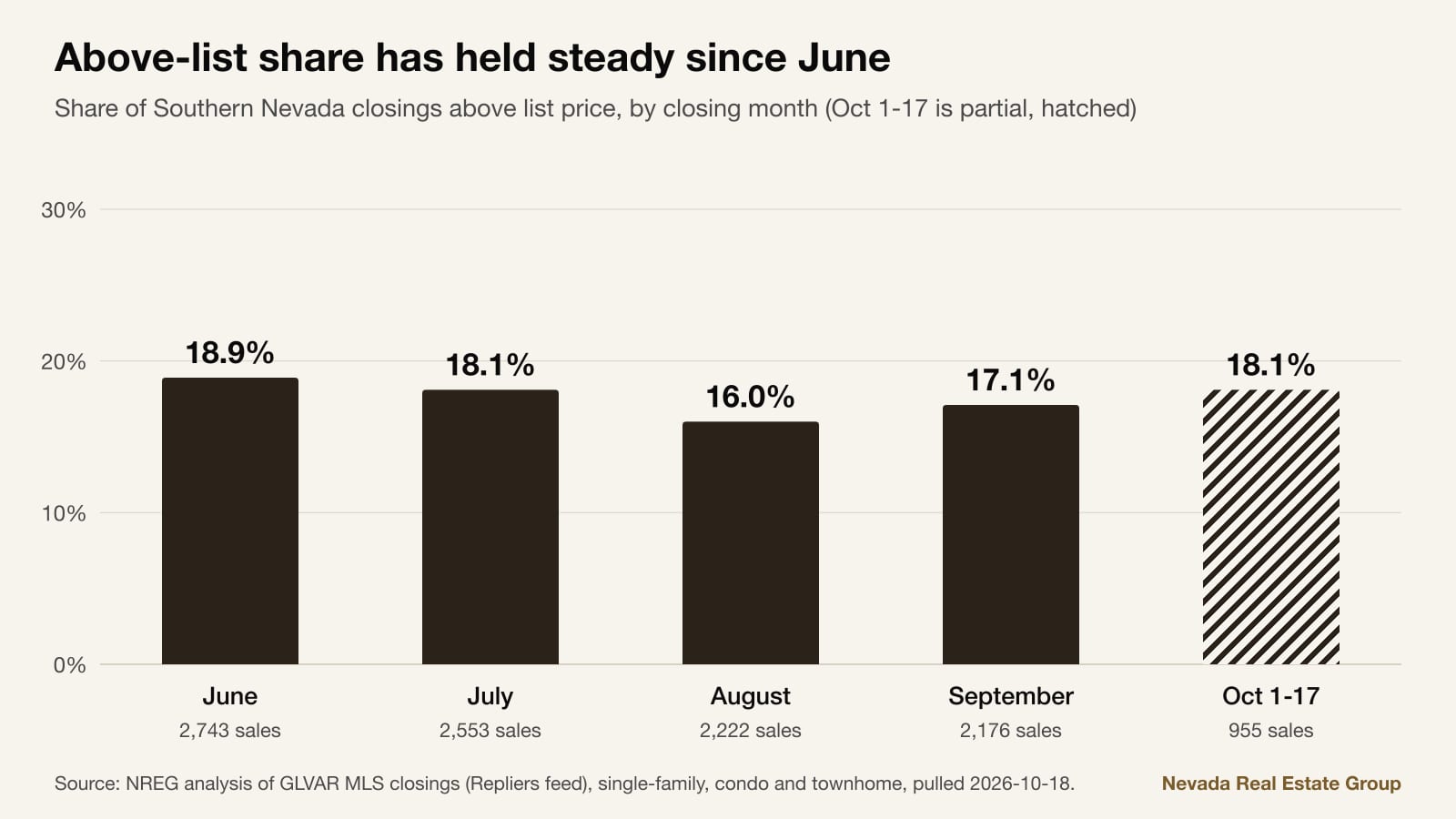
| June 2026 | 2,743 | 99.1% | 18.9% | 55.5% | 37.6% |
| July 2026 | 2,553 | 99.0% | 18.1% | 56.6% | 40.3% |
| August 2026 | 2,222 | 99.0% | 16.0% | 57.0% | 45.7% |
| September 2026 | 2,176 | 99.0% | 17.1% | 57.8% | 43.6% |
| October 1–17, 2026 (partial) | 955 | 98.7% | 18.1% | 60.3% | 45.8% |
Two things stand out. First, the share of homes selling above list has held between 16% and 19% every month since June; there is no fall surge and no collapse. Second, price cuts are now routine: 43.0% of the July-to-September closings had their list price reduced at least once before they went under contract. That makes a price cut a negotiating signal rather than a red flag, and our guide to reading Las Vegas price reductions shows how to use it.
The newest contracts are a little slower still. Among single-family homes that went under contract between September 18 and October 17, 2026 (1,476 contracts that were still pending on October 18 or had already closed), the median listing took 32 days to find a buyer, against 27 days for the summer's single-family closings. Of those new contracts, 16.9% came within a week of listing, against 18.5%, and 46.8% followed a price cut, against 42.0%. Our September Las Vegas market report has the full inventory picture.
Where Do Las Vegas Bidding Wars Still Happen?
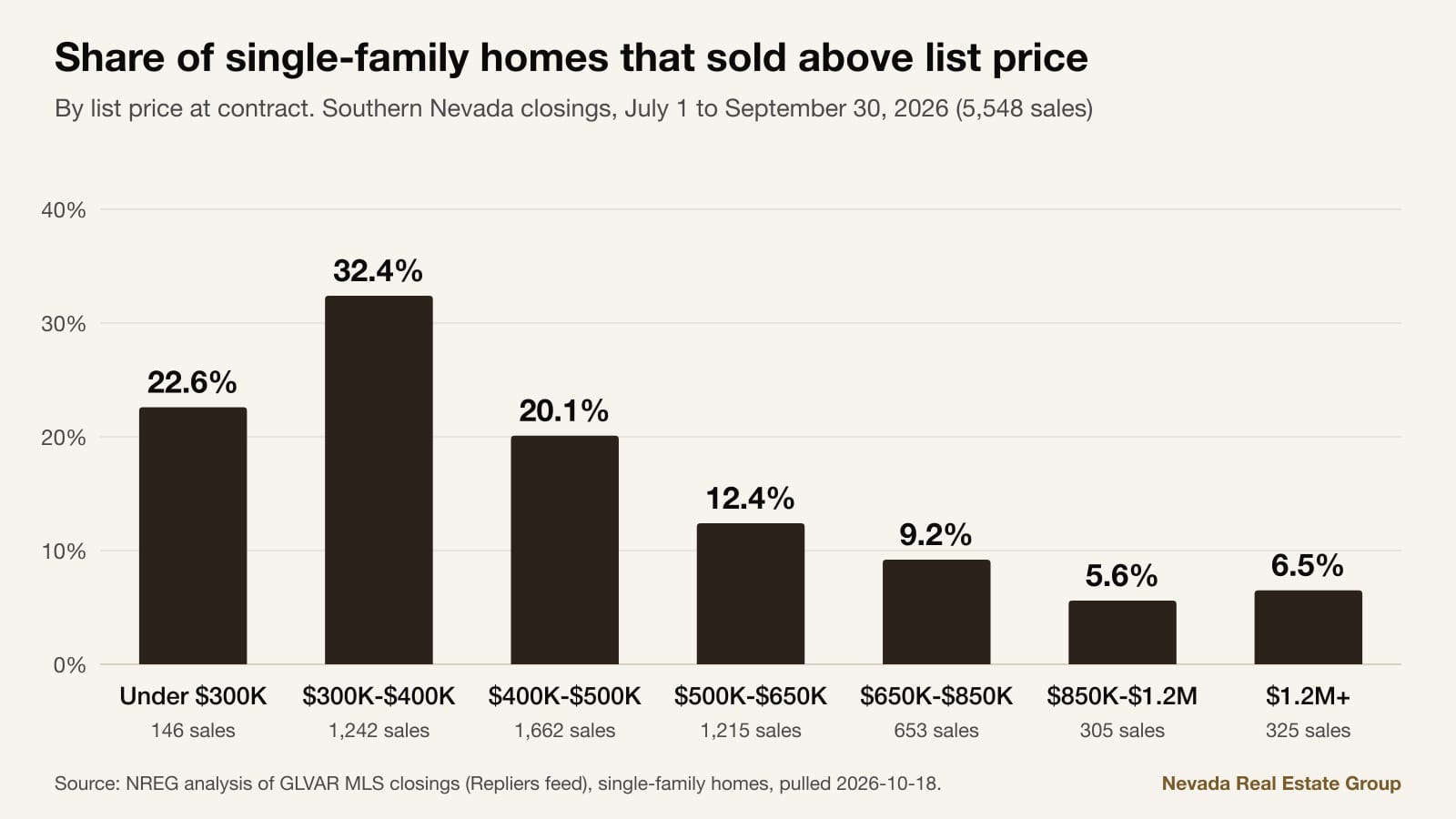
Mostly in three places: the entry price bands, North Las Vegas and a handful of lower-priced Las Vegas ZIP codes, and the first two weeks a listing is live. Price is the strongest divider. Among single-family homes that closed from July 1 to September 30, 2026, a home listed at $300,000 to $400,000 was nearly six times as likely to sell above list as one listed at $850,000 to $1.2 million.
| List price at contract | Closings | Sold above list | Sold below list | Median sale-to-list | Median days on market |
|---|---|---|---|---|---|
| Under $300,000 | 146 | 22.6% | 56.2% | 98.3% | 18 |
| $300,000–$400,000 | 1,242 | 32.4% | 40.3% | 100.0% | 21 |
| $400,000–$500,000 | 1,662 | 20.1% | 49.3% | 100.0% | 26 |
| $500,000–$650,000 | 1,215 | 12.4% | 61.0% | 99.1% | 30 |
| $650,000–$850,000 | 653 | 9.2% | 72.3% | 98.3% | 30 |
| $850,000–$1.2 million | 305 | 5.6% | 78.4% | 97.3% | 30 |
| $1.2 million and up | 325 | 6.5% | 82.8% | 95.9% | 34 |
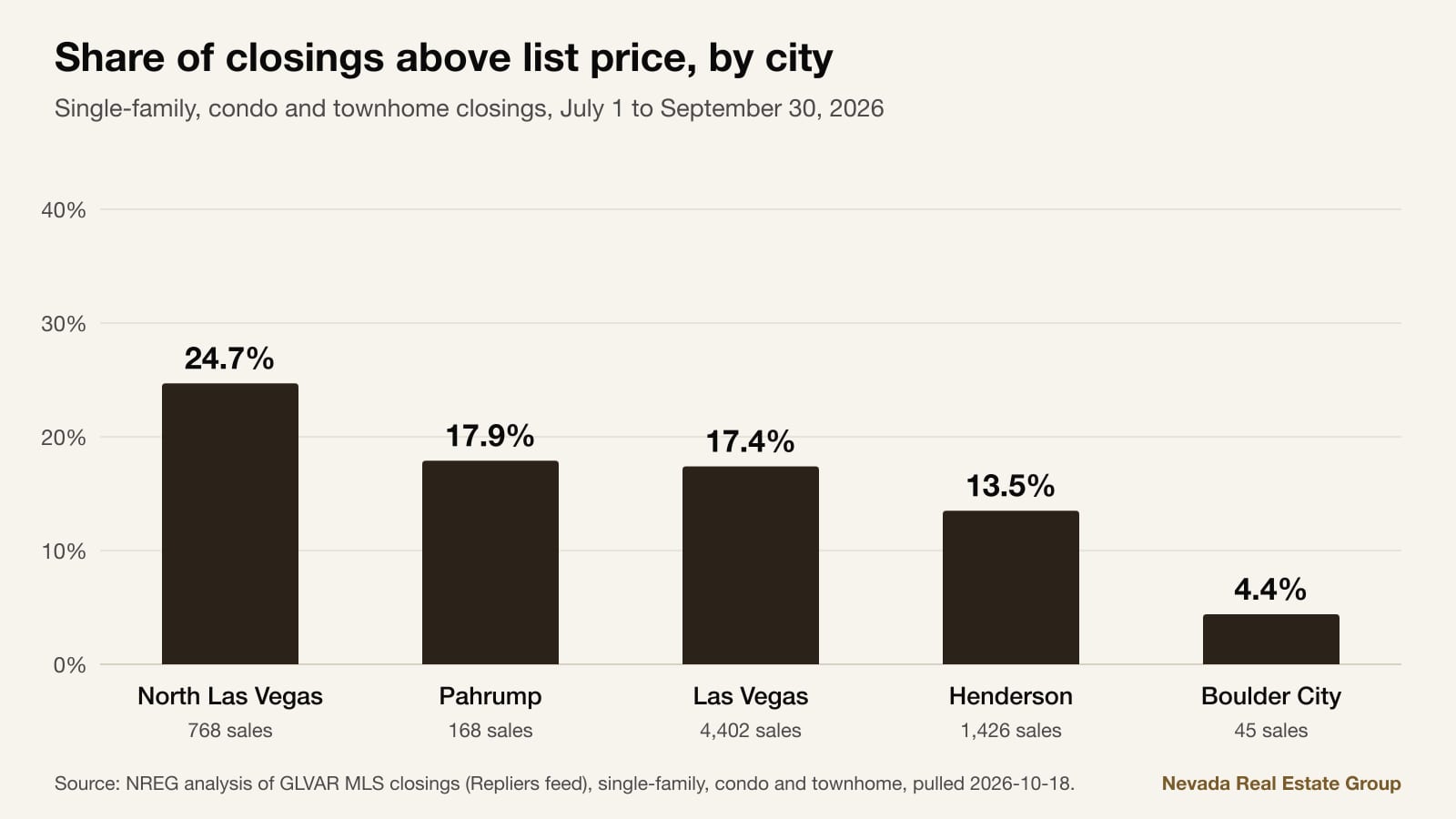
By city, across all three home types, North Las Vegas led at 24.7% of 768 closings above list, with a median of 21 days on market. Las Vegas came in at 17.4% of 4,402, Pahrump at 17.9% of 168, and Henderson at 13.5% of 1,426, where the median home took 34 days and 49.1% had taken a price cut. Boulder City had just 2 above-list sales out of 45. ZIP codes split the valley more sharply still.
| ZIP code (MLS city) | Closings | Sold above list | Median sale price | Median days on market |
|---|---|---|---|---|
| 89108 (Las Vegas) | 156 | 31.4% | $365,000 | 21 |
| 89032 (North Las Vegas) | 102 | 30.4% | $410,400 | 18.5 |
| 89031 (North Las Vegas) | 235 | 28.9% | $412,000 | 21 |
| 89183 (Las Vegas) | 105 | 26.7% | $390,000 | 29.5 |
| 89107 (Las Vegas) | 91 | 26.4% | $350,000 | 21 |
| 89052 (Henderson) | 204 | 8.3% | $623,750 | 34 |
| 89138 (Las Vegas) | 198 | 7.6% | $750,000 | 37 |
| 89134 (Las Vegas) | 203 | 7.4% | $470,000 | 32 |
| 89113 (Las Vegas) | 136 | 5.1% | $535,000 | 31 |
| 89135 (Las Vegas) | 169 | 4.1% | $880,000 | 37 |
Three of the five least competitive ZIPs (89134, 89135 and 89138) cover much of Summerlin, where buyers in the window had room to negotiate. Of the 38 ZIP codes with at least 80 closings, the five most competitive all had median sale prices under $415,000. If your search is in those ZIPs and price bands, plan to compete; if it is in the $650,000-plus bands or the ZIPs at the bottom of the table, plan to negotiate.
How Do You Win a Bidding War in Las Vegas?
You win by being the offer the seller trusts to close, priced inside a ceiling you set before you see the competition. Every seller's real fear is accepting an offer that falls apart weeks later: the loan fails, the appraisal comes in low, or the buyer renegotiates after the inspection and the home goes back on the market looking stale. The levers that answer those fears are proof you can close, a competitive price, appraisal protection, a meaningful deposit, terms that fit the seller's move, and speed.
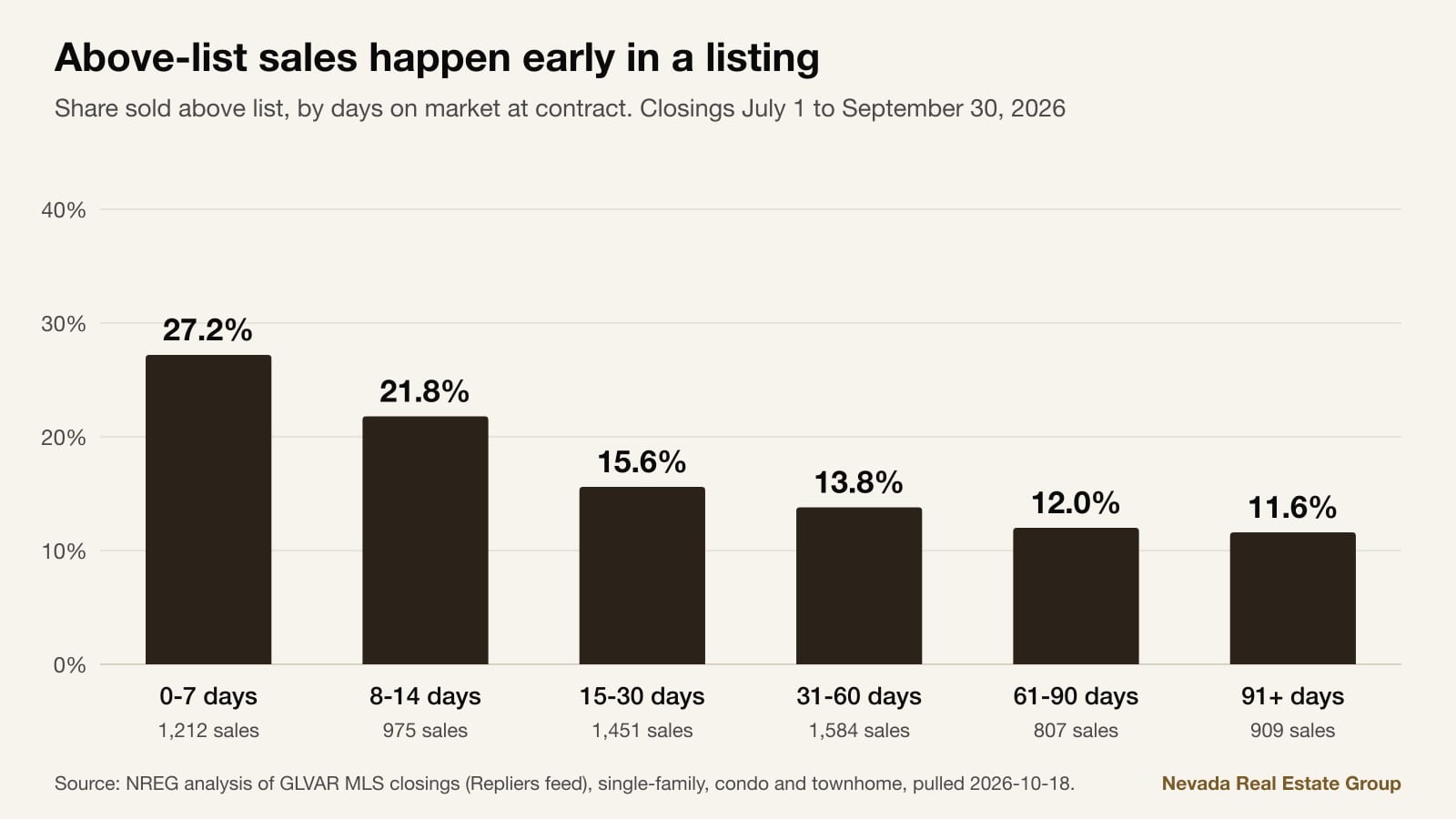
Speed matters more than most buyers think. In our July-to-September data, homes that sold above list went under contract in a median of 17 days, at-list sales in 22 and below-list sales in 34, and more than a quarter (27.7%) of above-list sales went under contract within a week of listing. The first week is when above-list sales are most common, so the buyer who is already underwritten and has studied the comps can write a clean offer the day the home appears.
One honest limit on the data: 25.8% of closings in the window sold at exactly list price, and the MLS does not record how many offers each home drew. Some of those were contested homes where the winner matched the asking price and won on terms. The numbers show where prices were bid up; they cannot show every multiple-offer situation.
Why Is a Fully Underwritten Pre-Approval Your Strongest Weapon?
Because financing failure is the seller's biggest fear, and paperwork is how you remove it. According to the Consumer Financial Protection Bureau, lenders use "prequalification" and "preapproval" differently: some issue a prequalification on unverified information and a preapproval only on verified information, and neither letter is a guaranteed loan offer. What persuades a listing agent is not the label but how much the lender has actually checked: income, assets, credit and, ideally, a full underwriting review before you find the house. Our guide to pre-approval versus pre-qualification in Nevada explains what each lender letter means.
The Nevada contract builds this in. According to Section 3(A) of the Las Vegas REALTORS Residential Purchase Agreement (Rev. 10/24), a financed buyer must, within a number of business days written into the contract, submit a loan application and furnish the seller a preapproval letter "based upon a standard factual credit report and review of debt-to-income ratios." A cash buyer must provide written evidence of funds from a bona fide financial institution under Section 3(D). Arrive with both already in hand and the seller's agent can see on day one what other buyers only promise to deliver later.
Rates raise the stakes. At the 7.40% PMMS average, principal and interest on a $470,000 home with 10% down ($423,000 borrowed) is about $2,929 a month, roughly $319 more than at last October's 6.27%. Make sure your approval covers your ceiling price at today's rate, not last spring's, and read how Treasury yields drive mortgage rates if you are deciding when to lock.
How Much Should You Offer Over Asking Price?
Less than the old rules of thumb suggest. The familiar "offer 2% to 5% over" advice describes a small minority of today's winning offers. Of the 1,190 Southern Nevada sales that closed above list from July through September 2026, the median closed $5,000 (1.22%) over; a quarter closed within $1,000 of list, and three-quarters within $10,000.
| Amount over list price | Share of above-list sales | Share of all 6,951 closings | On a $450,000 list price |
|---|---|---|---|
| Up to 1% | 40.6% | 6.9% | Up to $4,500 over |
| 1% to 2% | 30.3% | 5.2% | $4,500 to $9,000 over |
| 2% to 3% | 13.8% | 2.4% | $9,000 to $13,500 over |
| 3% to 5% | 9.5% | 1.6% | $13,500 to $22,500 over |
| More than 5% | 5.9% | 1.0% | More than $22,500 over |
Only 2.6% of all closings in the window sold more than 3% over list. The other side of the ledger matters too: the 3,968 homes that sold below list closed a median 2.7% ($12,478) under it. So the right number depends on which kind of listing you are looking at. Anchor it to recent sales of comparable homes nearby, adjust for condition, then add the smallest premium the competition requires. Even in the $300,000 to $500,000 single-family bands, where competition is heaviest, the median above-list sale closed $5,000 over list.
What Is an Escalation Clause and Should You Use One?
An escalation clause raises your price automatically to beat a competing offer, by a set increment, up to a cap you choose. According to the National Association of REALTORS, it "lets sellers know that buyers are willing to increase their offer if other, higher offers come in," and its main drawback is that it reveals "exactly how much they're willing to pay above asking price."
In a Las Vegas contract, there is no escalation box to check. The Las Vegas REALTORS purchase agreement has a single purchase-price line, and Section 28 says no change or amendment is binding unless it is in writing and signed by each party. An escalation term therefore has to be written into Section 30 (Additional Terms) or into an addendum listed in Section 29. According to Nevada attorney Kathryn Holbert, speaking in a June 2021 CRES Insurance risk-management webinar, an escalation addendum "is not put out by either association," North or South; the forms in circulation were drafted by individual brokerages, and the Nevada Real Estate Division "isn't saying you can't use it, but they're saying use it with caution." Have the language drafted or reviewed by your brokerage or an attorney, and make it answer four questions: the increment, the cap, what counts as a bona fide competing offer and what proof the seller must show, and whether seller credits in the competing offer count against its price.
| Element | Example on a $440,000 list price |
|---|---|
| Base offer | $440,000 |
| Escalation increment | $1,000 above the highest verified competing offer |
| Cap (your ceiling) | $450,000 |
| Best competing offer | $445,000 |
| Your resulting price | $446,000 |
The cap is the number that matters. Set it where the comps and your appraisal-gap cash both run out, not where your emotions do, and remember the data: three-quarters of above-list winners in the window paid $10,000 or less over list. A listing agent may instead ask every buyer for a highest and best offer, so a clean, strong flat offer at your ceiling is sometimes the better tool.
Should You Waive Contingencies to Win?
Shorten them before you waive them. The Nevada purchase agreement gives a buyer three separate exits, each on its own deadline counted in calendar days from acceptance, and each one deemed waived if the deadline passes without your written notice.
| Contingency | What it lets you do | Competitive move | Your risk if you give it up |
|---|---|---|---|
| Due diligence (Section 8) | Cancel in your sole discretion within the period and recover the deposit | Keep it, with a shorter period | You buy the home's problems as is |
| Appraisal (Section 3(B)) | Renegotiate or cancel after a written Notice of Appraised Value | Pair it with a capped gap promise | A low appraisal becomes cash you must bring |
| Loan (Section 3(C)) | Cancel if you cannot obtain the loan | Shorten it with a fully underwritten file | Your deposit is exposed if the loan fails |
Due diligence is the one to protect. Section 8 lets you cancel in your sole discretion during the period, and under Section 8(D), if an inspection is not completed and your repair requests are not delivered within the period, you are deemed to have waived that inspection, so a short period only works if your inspector is booked before you write the offer. Section 8(F) already treats cosmetic and general-maintenance items that do not materially affect value or use as accepted, which lets you tell a seller, in Section 30, that you will not ask for small repairs while keeping your right to walk over a failing roof or a major system problem. The issues that matter most here are covered in our guide to Las Vegas desert home inspection issues, and our Nevada contingencies guide explains every clock in the contract. Waiving the loan contingency outright is a cash-strong buyer's move only, because it puts your earnest money on the line if the loan fails.
How Does an Appraisal Gap Guarantee Work?
It is your written promise to cover some or all of the difference in cash if the home appraises below your price. It matters because lenders lend on the lower figure. According to the Fannie Mae Selling Guide, which governs the conventional loans Fannie Mae buys, for a purchase "the property value is the lower of the sales price or the current appraised value." Section 3(B) of the purchase agreement makes your obligation contingent on an appraisal of at least the purchase price, and lets you renegotiate or cancel after a written Notice of Appraised Value, by a deadline written into the contract.
Here is the math on an escalated offer. You agree to $456,000 on a $450,000 list price and put 20% down, and the home appraises at $450,000. The lender lends 80% of $450,000, or $360,000, so you bring $96,000 instead of the $91,200 you planned: 20% of the appraised value plus the whole $6,000 difference. A gap promise caps how much of that difference you will cover, for example "Buyer will cover up to $6,000 of any shortfall between the appraised value and the purchase price." Size it to your cash after closing costs and reserves, and to the data: since three-quarters of above-list winners paid $10,000 or less over list, coverage above that buys protection most winners never needed. Our Las Vegas home appraisal guide explains how appraisers choose comparable sales.
FHA and VA buyers have an extra layer. Section 27 of the agreement, the HUD/VA/FHA escape clause, says the buyer is not obligated to complete the purchase or to forfeit earnest money unless the appraised value is at least the contract price, while keeping "the privilege and option of proceeding" anyway. An FHA or VA buyer can still choose to cover a gap, but a seller weighing that promise is relying on the buyer's choice, not on the deposit.
How Does Your Earnest Money Strengthen a Competitive Offer?
A larger deposit tells the seller you have more to lose, which is why it reads as commitment. On a $470,000 home, 1% is $4,700, 2% is $9,400 and 3% is $14,100. Under Section 1(A) of the purchase agreement, the deposit goes to escrow or a broker's trust account within one business day of acceptance, or within a number of business days you write in if it is wired, and Nevada regulation NAC 645.657 likewise requires a licensee to pay a deposit over within one business day of a fully executed contract.
Two clauses decide your risk. Section 1(B) lets you add an additional deposit by a later date and check whether it counts as part of the earnest money. Section 19(C) says that if the buyer defaults, the seller's sole remedy is to keep the earnest money as liquidated damages, and any additional deposit marked as not part of it is released to the buyer. So the deposit is refundable through a timely cancellation while your due diligence, appraisal and loan windows are open, and at risk once they close. Size it to how confident you are about clearing those windows, not to the competition. Our Nevada earnest money guide covers who holds it and what happens in a dispute.
What Non-Price Terms Win Las Vegas Bidding Wars?
Once your price is competitive, the terms often decide it, and most of them cost you little. Ask the listing agent what the seller needs, then write it into the contract.
| Term | Where it goes | Why sellers value it |
|---|---|---|
| Closing date that fits the seller's move | Section 6(C), close of escrow date | No double move or bridge loan |
| Seller stays after closing | Section 15 possession date, with written terms in Section 30 or an addendum | Time to move after the sale funds |
| Shorter due diligence period | Section 8, calendar days from acceptance | Less time for the deal to unravel |
| Larger or earlier deposit | Sections 1(A) and 1(B) | More at stake for the buyer |
| Preapproval or proof of funds up front | Sections 3(A) and 3(D) | Financing risk visible on day one |
| No requests for minor repairs | Section 30, alongside Section 8(F) | Fewer renegotiations after inspection |
A seller who needs sixty days to move may value a matching close of escrow date or a short stay after closing more than an extra few thousand dollars, and a seller worried about the market wants the cleanest, most certain offer. If competition for resale homes in your band is fierce, also compare new construction homes across Las Vegas, where the negotiation is with a builder rather than against other offers on a single resale home.
Do Personal "Love Letters" Help, and Are They Legal?
They carry fair-housing risk and add little that a strong offer cannot. According to the National Association of REALTORS, buyer letters "often contain personal information about the buyer, such as their race and culture or traditions," and NAR has advised agents to "avoid helping their buyers draft them" and to tell sellers to "view an offer objectively on pricing and timing."
The federal Fair Housing Act prohibits housing discrimination because of race, color, national origin, religion, sex, familial status or disability. Nevada goes further: according to NRS 118.100, the state's list also covers sexual orientation, gender identity or expression and ancestry, and the law bars refusing to sell, or setting different terms of sale, because of any of those characteristics. The purchase agreement says it too: Section 13 states that all properties are offered without regard to race, color, religion, sex, national origin, age, gender identity or expression, familial status, sexual orientation, ancestry or handicap.
A letter with a household photo or a mention of a place of worship hands the seller exactly the information the law says cannot drive the decision. NAR also suggests that a seller who insists on reading buyer letters talk to a lawyer and document how the decision was made, which tells you how much risk a letter adds for so little gain. Let the offer speak, and if you write anything, keep it to the transaction: your timeline, your financing and your commitment to close.
How Do You Win a Las Vegas Bidding War Without Overpaying?
Decide your limits before you see the other offers, then build every term so it cannot push you past them. The data gives you a realistic frame: most above-list winners paid a few thousand dollars over list, not tens of thousands.
Set your ceiling from comps, not from the bidding. Your ceiling is the price recent comparable sales support plus the premium you are willing to pay in cash if the appraisal disagrees. In the $300,000 to $500,000 single-family bands, the median above-list sale from July through September 2026 closed 1.1% to 1.4% over list. A ceiling far beyond that should be a deliberate choice about one specific home.
Make financing strength visible. A fully underwritten preapproval at today's rate, plus bank statements showing your gap cash, answers the seller's first question before it is asked.
Cap the escalation clause at your ceiling. Use a small increment, since a quarter of above-list winners closed within $1,000 of list, and require the seller to show the competing offer that triggers it.
Size appraisal-gap coverage to what you can lose. Your true exposure is your escalation cap minus the likely appraised value, paid in cash. If you cannot write that check and still keep your reserves, lower the cap.
Keep due diligence and shorten it. A short Section 8 period with an inspector already booked reassures the seller and still lets you walk if the inspection turns up a major problem.
Use earnest money while it is still refundable. A larger deposit is a strong signal during your contingency windows; know the dates on which it stops being refundable.
Know when to negotiate down instead. Above-list sales fell to 13.8% for homes that took 31 to 60 days to go under contract and 11.6% after 90 days, and homes with a price cut sold above their reduced price only 14.9% of the time. In the $650,000-plus bands, 72% to 83% of single-family homes sold below list. On those listings, an offer under list backed by comps is the normal opening, and our price reductions offer strategy shows how to build it. If you lose a home you wanted, a backup offer in Nevada can keep you in line if the first buyer's contract fails.
Walking away is part of not overpaying. With a five-month supply and 7,995 single-family homes listed without offers at the end of September, another home in your price band is often already on the market. Browse Las Vegas homes for sale or run a valley-wide search to see how many fit before you stretch on one. First-time buyers can start with our first-time buyer resources.
Winning without overpaying is where an agent's preparation shows: reading the comps, the listing's history and the seller's needs before the offer is written, and drafting escalation, appraisal-gap and deposit terms that hold up in a Nevada contract. Nevada Real Estate Group is the #1 real estate team in Nevada, with 9,600+ closed transactions, and whether the home you want is in Las Vegas, Henderson or North Las Vegas, the same discipline applies. If there is a home you are watching, call our team at (702) 637-1759 or contact us here. We will go through the comparable sales and the listing's history with you, and help you set a ceiling and terms before you write the offer.
Frequently Asked Questions
Are there still bidding wars in Las Vegas in October 2026?
Yes, but on a minority of homes. Of 6,951 Southern Nevada single-family, condo and townhome closings from July 1 to September 30, 2026, 17.1% sold above list price and 57.1% sold below. The share above list held between 16% and 19% every month from June through mid-October. Competition is heaviest for single-family homes listed at $300,000 to $400,000, where 32.4% sold above list, in North Las Vegas, and in a listing's first week, when 27.2% sold above list.
Does the highest offer always win a bidding war?
No. Sellers choose the offer most likely to close on terms they can live with, and price is only one factor. A slightly lower offer with a fully underwritten preapproval, a meaningful deposit, capped appraisal-gap coverage, a short due diligence period and a closing date that fits the seller's move can beat a higher offer that is shaky on financing. The seller's fear is a contract that collapses and sends the home back on the market.
How much over asking price should I offer in Las Vegas?
Usually less than you think. Of the 1,190 sales that closed above list from July through September 2026, the median closed $5,000, or 1.22%, over list, and 71% closed within 2% of list. Only 2.6% of all closings in the window sold more than 3% over. Anchor your price to recent comparable sales, add the smallest premium the competition requires, and make sure any amount above the likely appraised value is cash you can actually bring.
Can I use an escalation clause in a Nevada purchase agreement?
Yes, but you have to write it in. The Las Vegas REALTORS Residential Purchase Agreement (Rev. 10/24) has a single purchase-price line and no escalation provision, so the term goes in Section 30 (Additional Terms) or an addendum listed in Section 29, and Section 28 requires any change to be in writing and signed by each party. Spell out the increment, the cap, what counts as a bona fide competing offer and the proof the seller must show.
What is appraisal-gap coverage?
It is a promise in your offer to cover, in cash and up to a stated limit, the difference if the home appraises below your price. It matters because Fannie Mae's guide measures a purchase loan against the lower of the sales price or the appraised value. If you pay $456,000 with 20% down and the home appraises at $450,000, you bring $96,000 instead of $91,200. FHA and VA buyers keep the contract's escape clause, so for them the coverage is a choice, not an obligation backed by the deposit.
Should I waive my inspection to win a bidding war?
Rarely. Keep the Section 8 due diligence condition and shorten the period instead, with an inspector booked before you write the offer. Section 8(F) already treats cosmetic and general-maintenance items as accepted, so you can promise in Section 30 not to ask for minor repairs while keeping your right to cancel and recover your deposit over a major problem. Waiving due diligence entirely means buying the home as is.
Are buyer love letters to sellers legal in Nevada?
Nevada's Fair Housing Law does not mention buyer letters, but it bars refusing to sell, or setting different terms, because of protected characteristics, and NRS 118.100 adds sexual orientation, gender identity or expression and ancestry to the federal list. A personal letter can put exactly that information in front of the seller. NAR advises agents not to help buyers draft them and to tell sellers to judge offers on price and timing. A clean, certain offer persuades without that risk.
Which Sources Inform This Las Vegas Bidding War Guide?
The closing figures are NREG's analysis of the GLVAR MLS feed (via Repliers), pulled on October 18, 2026. They cover every single-family, condo and townhome sale with a closing date from July 1 to September 30, 2026 (6,951 closings), with June 2026 and October 1–17, 2026 pulled for the month-to-month check. Windows are by closing date, not contract date. Five closings in the window with no recorded sale or list price are left out. "Above list" compares the sale price with the list price at contract; "price cut" means the original list price was higher than the list price at contract; days on market run from listing to contract. The September 18 to October 17 contract cohort combines single-family listings still pending or under contract on October 18 with those that had already closed; contracts that were cancelled are not in it. Thirteen closings with no days-on-market value are excluded from the days-on-market figures only. Offer and escalation examples are illustrative.
- Las Vegas REALTORS housing market statistics: association data and territory (the page showed July 2026 on October 18, 2026)
- FOX5: Las Vegas REALTORS September 2026 report: $470,000 median, 2,169 sales, five-month supply
- News 3: September 2026 Las Vegas home sales: the same September release
- FOX5: Las Vegas REALTORS August 2026 report: 2,252 August sales, used to check our feed
- FOX5: Las Vegas REALTORS July 2026 report: 2,587 July sales, used to check our feed
- Freddie Mac Primary Mortgage Market Survey: 7.40% 30-year average on October 8 and 15, 2026; 6.27% a year earlier
- Las Vegas REALTORS Residential Purchase Agreement, Rev. 10/24: Sections 1, 3, 6, 8, 13, 15, 19, 27, 28, 29 and 30
- Consumer Financial Protection Bureau: prequalification and preapproval letters
- Fannie Mae Selling Guide B2-1.2-01, Loan-to-Value Ratios
- National Association of REALTORS: escalation clauses (December 2, 2021)
- CRES Insurance: escalation clauses webinar for Nevada licensees (June 10, 2021)
- Nevada Administrative Code Chapter 645: NAC 645.657, payment of deposits
- National Association of REALTORS: buyer love letters (September 8, 2021)
- HUD: Housing Discrimination Under the Fair Housing Act
- Nevada Revised Statutes Chapter 118: NRS 118.020 and 118.100, the Nevada Fair Housing Law