
"Which suburb should we look at?" is the first question in almost every relocation call we take, and most of what ranks online answers it with tourist-blog filler — lists written from a thousand miles away that put a casino district next to a school-zone decision. This is the local version: ten suburbs ranked the way Nevada Real Estate Group actually compares them for clients, with live median prices and inventory pulled from today's MLS feed, school context, commute reality, and the honest "who this fits / who should skip it" that a ranking owes you.
One framing note before the list: "suburb" in Las Vegas means something looser than back east. Henderson and North Las Vegas are full incorporated cities; Summerlin and Green Valley are master-planned districts; Enterprise, Spring Valley, and Centennial Hills are unincorporated Clark County townships that function as suburbs in everything but paperwork. We rank them all, because that's how buyers actually choose. Across 9,600+ closings, these ten are where the overwhelming majority of our valley families land.
The best Las Vegas suburbs for 2026: Summerlin leads for schools, trails, and long-term value (median about $750K on today's MLS); Henderson's Green Valley and Anthem corridors lead for family infrastructure ($535K–$610K); Centennial Hills wins the northwest at $622K; Enterprise/Southwest is the new-construction growth pick ($550K); Spring Valley and Aliante anchor the value tier at $455K and under. Match the suburb to your commute, school, and budget triangle — each fits a different buyer.
- Summerlin tops the ranking — a $750K live median buys the valley's deepest school-trail-village infrastructure.
- Green Valley ($535K) and Anthem ($610K) give Henderson two family corridors at very different price points.
- Enterprise/Southwest ($550K median, 548 actives) is the growth pick — new construction still opening monthly.
- Value tier is real: Spring Valley $455K, Aliante/North $450K, North Las Vegas citywide $425K on live inventory.
- All medians below are live MLS pulls on the publication date — not year-old survey numbers.
How Do the Las Vegas Suburbs Compare on Live Data?
The scoreboard first — every number pulled from our GLVAR feed the day this published:
| Suburb | Live median list | Actives | One-line read |
|---|---|---|---|
| Summerlin | $750,000 | 1,111 | The premium master plan — schools, trails, Red Rock |
| Centennial Hills | $622,500 | 518 | Northwest value-luxury blend, newer stock |
| Anthem area (Henderson) | $609,900 | 642 | Hillside villages, views, top Henderson schools |
| Enterprise / Southwest | $550,000 | 548 | The growth corridor — newest construction |
| Henderson (citywide) | $542,200 | 2,461 | The full-city index across all its corridors |
| Green Valley (Henderson) | $534,900 | 729 | Mature parks-and-schools heart of Henderson |
| Spring Valley | $455,000 | 522 | Central value, 15 minutes to everything |
| Aliante / North (NLV) | $449,900 | 522 | North valley's polished master-plan pocket |
| Boulder City | $429,000 | 135 | Small-town outlier — no-growth charm by law |
| North Las Vegas (citywide) | $425,000 | 1,071 | The affordability engine, new builds included |
Prices tell the entry cost; the ranking below adds what the money buys. According to Las Vegas REALTORS June reporting, the valley-wide median sits near $490,000 — so read everything above $550K as a premium choice and everything under $460K as the value tier.
For an elevation and lifestyle alternative to the valley's suburban master plans, review the ownership considerations of buying a home near Mount Charleston. For another established valley location, compare our guide to living in Whitney and east Las Vegas with the master-planned options.
1. Why Does Summerlin Top the Ranking?
Because it wins the most categories at once. Summerlin is a 22,500-acre Howard Hughes master plan with three decades of build-out discipline: over 250 parks connected by 200-plus miles of trails, the valley's strongest public-school cluster plus its marquee private campuses, its own downtown (shopping, dining, a ballpark, an NHL practice rink), and Red Rock Canyon as the permanent western backdrop. The live median of $750,000 is the valley's stiffest suburb-wide entry — and the townhome-condo layer from the $400Ks is the workaround most rankings forget to mention.
Fits: school-driven families with premium budgets, buyers who want infrastructure certainty, luxury and view buyers in the Ridges-Reverence tier. Skip if: your budget stretches to reach it — a strained Summerlin entry usually buys less house than a comfortable Green Valley or Centennial Hills purchase, and the strip-side commute from the west rim runs 25–35 minutes at rush.
2. What Makes Green Valley the Family Benchmark?
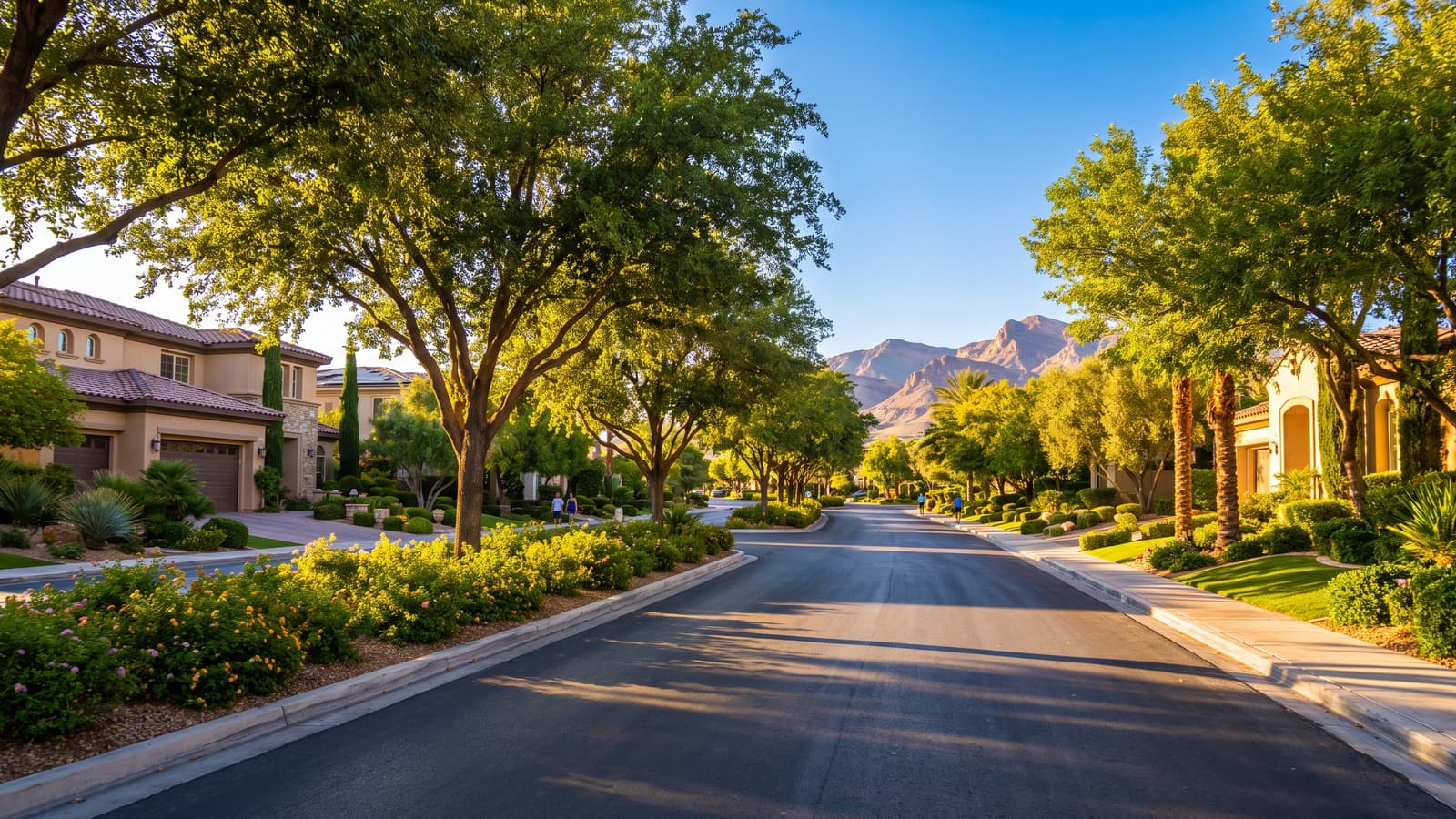
Green Valley is what three decades of maturity looks like: Henderson's original master plan, tree-lined by desert standards, wrapped around parks, pools, and the school cluster that made Henderson's reputation. The live median of $534,900 buys 1990s–2000s housing stock with real yards on real lots — larger than what the same money gets in newer corridors — and The District at Green Valley Ranch supplies the walkable retail evening. Healthcare density is a quiet bonus: the St. Rose corridor makes this the strongest hospital-per-resident geography in the metro.
Fits: families optimizing schools-per-dollar, buyers who want established over new, anyone working the airport/Strip south corridors (15–20 minutes against traffic). Skip if: you want 2020s construction — Green Valley's newest neighborhoods are twenty years old, and renovation budgets belong in the math. Our Henderson buying guide goes street-level on the sub-corridors.
3. Where Does Anthem Fit — and Who Pays Its Premium?
The Anthem area stacks Henderson's hillside villages — Anthem Country Club, Anthem Highlands, Solera's 55+ enclave, Seven Hills next door — up the McCullough foothills, trading elevation for views across the entire valley. The live median of $609,900 spans that mix: guard-gated golf estates at the top, family villages in the middle, and the 55+ communities that give the hill its multigenerational texture. Schools rank with Henderson's best; the grade to get home adds five minutes and subtracts ten degrees on summer evenings, which residents will tell you about unprompted.
Fits: view buyers, golf-and-gate buyers, 55+ downsizers, families who want Green Valley's schools with newer housing stock. Skip if: commute minutes rule you — Anthem sits at the valley's southern edge, and the 20–30 minute runs to the Strip or west side are the price of the view.
4. Why Is Centennial Hills the Northwest's Answer?
Centennial Hills is what the northwest built while everyone watched the southwest: newer stock (mostly 2000s-2020s), bigger lots at the rural-preservation edges, horse property pockets, and a live median of $622,500 that reflects how much house the corridor delivers rather than a status premium. Mount Charleston is 35 minutes up the hill for summer relief and winter snow days; the 95 and 215 give it clean runs to both the Strip and Summerlin's employment. The ZIP-level texture matters here — 89131's half-acre streets and 89149's newer villages behave like different markets.
Fits: buyers wanting new-ish construction with land, Mount Charleston weekenders, anyone priced out of Summerlin who still wants the west-side feel. Skip if: you need the airport often — the diagonal cross-valley run is the longest routine commute on this list.
5. Is Enterprise/Southwest the Best Growth Bet?
The southwest — Enterprise township plus the Mountain's Edge and Southern Highlands master plans — is where the valley is literally being built: the live feed shows 548 actives at a $550,000 median, and new-construction releases still open monthly. It's the youngest housing stock on this list, the newest school buildings (capacity growing pains included — verify zoning on every purchase), and the fastest-improving retail map. The Raiders' headquarters and the emerging sports-industrial corridor anchor its job story; the 215 beltway does the commuting.
Fits: new-build buyers, equity-growth hunters, healthcare and stadium-corridor workers, anyone who wants 2020s floor plans without Summerlin pricing. Skip if: construction living isn't your season — parts of this corridor are dust-and-cranes for two more years, the exact trade our master-plan pipeline guide prices out.

6-10. Who Should Look at the Value Tier?
6. Spring Valley — $455,000, 522 actives. The valley's centrality play: 15 minutes to the Strip, Summerlin, and Chinatown's food scene from 1990s-2000s stock with honest yards. Schools are pocket-by-pocket — this is the suburb where street-level diligence pays most. Fits commute-optimizers and value hunters; skip if you want master-plan polish.
7. Aliante / North Valley — $449,900, 522 actives. North Las Vegas's showcase: the Aliante master plan's golf, parks, and casino-resort amenity core with 2000s-2020s stock, plus the VA hospital anchor. The value-per-square-foot leader among true master plans. Fits federal/base workers, first-move-up families; skip if south-valley jobs make the cross-town math ugly.
8. Boulder City — $429,000, 135 actives. The outlier by choice: a controlled-growth law caps building, so this is small-town Nevada — historic downtown, Lake Mead at the doorstep, no new-build churn. Fits retirees, lake people, and anyone allergic to sprawl; skip if you need inventory choice (135 actives citywide) or big-city services.
9. North Las Vegas citywide — $425,000, 1,071 actives. The affordability engine: Tule Springs' new villages, Craig Ranch's park, and the widest sub-$450K selection in the metro. The corridor's trajectory is up — logistics jobs, the VA, new masterplans. Fits first-time buyers and yield investors; pick streets with our block-level notes because the city varies fast by pocket.
10. Whitney/East side honorable mention. The east valley's established pockets trade at the metro's friendliest entries and shortest downtown runs; they're the right answer for specific budgets and the wrong default for school-first families — ask us street by street.
Three notes that make the value tier work harder. First, Spring Valley rewards sub-neighborhood knowledge more than anywhere on this list — the same $455,000 buys a tired 1992 tract house on one street and a renovated one backing a park two blocks away, and the Chinatown-adjacent west corridors have quietly become some of the valley's best food-and-commute living for buyers who never read a rankings page. Second, Aliante's master-plan discipline is real: its parks, golf course, and HOA standards deliver Summerlin-style order at 60% of the entry price, which is why its resale days-on-market consistently run tighter than the North Las Vegas citywide numbers around it. Third, North Las Vegas deserves its trajectory read: the city's newest villages — Tule Springs' phases, Sienna Square's 229 closings since 2023 — are selling at a velocity the price column doesn't capture, and buyers who anchor on the $425,000 citywide median while shopping only the new corridors will be pleasantly recalibrated. The value tier isn't the consolation bracket; for a large share of our clients it's simply the correct answer, chosen with open eyes and a shorter mortgage.
And a word for the tier we didn't rank: the true outliers. Mesquite (an hour northeast, golf-retirement economics), Pahrump (the commuter-rural valley over the pass), and Lake Las Vegas (Henderson's resort enclave) all serve real buyers with specific briefs — they're covered in their own guides because forcing them into a suburbs ranking misleads more than it informs. If your brief sounds like one of them, skip the list and start there.
For an established west-valley comparison, review Spring Valley versus Las Vegas using the same budget and commute priorities.
How Do the Top Suburbs Compare Head to Head?
The five finalists most buyers end up choosing among, dimension by dimension:
| Dimension | Summerlin | Green Valley | Anthem | Centennial Hills | Enterprise/SW |
|---|---|---|---|---|---|
| Live median | $750,000 | $534,900 | $609,900 | $622,500 | $550,000 |
| Housing era | 1990s–new | 1988–2005 | 1998–2015 | 2000s–new | 2005–new |
| Schools | Valley's deepest bench | Henderson's proven core | Top-rated, hillside zones | Strong, newer campuses | Newest buildings, growing pains |
| Strip commute | 25–35 min | 15–20 min | 20–30 min | 25–35 min | 15–25 min |
| Signature asset | Trails + Red Rock | Parks + The District | Views + golf gates | Land + Mt. Charleston | New construction pipeline |
| Watch-out | Entry price | Aging stock | Southern-edge commutes | Airport cross-town | Construction years |
In our experience the head-to-head resolves fastest on the row people skip: the watch-outs. Every suburb on this list is genuinely good — the differences that generate regret live in the last row, not the first.
What Do the Suburbs Cost Beyond the Purchase Price?
The ownership stack varies more than sticker prices suggest. According to the Nevada Department of Taxation, property tax runs on assessed value with the primary-residence cap holding annual increases to 3% — and effective rates land near 0.5–0.75% of market value across the valley, roughly $2,500–$3,700 a year on a median suburb home and among the gentlest property-tax loads in the country. HOA structure is where suburbs really diverge:
| Cost line | Master-plan suburbs (Summerlin/Anthem/Aliante) | Established suburbs (Green Valley/Spring Valley) | Growth corridors (Enterprise/NLV new) |
|---|---|---|---|
| HOA (master + village) | $60–$300+ | $0–$120 | $50–$180 (any SID/LID billed separately) |
| Property tax (median home) | $230–$350/mo | $190–$260/mo | $210–$300/mo (SID/LID not included) |
| Summer power (Jul–Aug) | $250–$450 | $280–$500 (older HVAC) | $200–$380 (newer builds) |
| Homeowners insurance | $90–$160/mo | $100–$180/mo (roof age) | $75–$110/mo |
Two lines earn commentary. Special improvement districts: several growth-corridor communities carry SID/LID assessments that finance their own roads, billed separately from property tax; North Las Vegas's Valley Vista and Villages at Tule Springs districts, for example, run to 2049 and 2052 on the Assessment Management Group schedule. The amount is parcel-specific, so ask for the payoff balance on every new-corridor home, because sellers can retire it at closing. And the insurance line tracks roof age, which quietly favors the newer suburbs — the full mechanics are in our homeowners insurance guide. According to the U.S. Census Bureau's American Community Survey, the valley's overall cost of homeownership still sits well below coastal metros even after adding every line above — the suburbs argument is a national-comparison argument as much as a local one.
Which Suburbs Are Rising Fastest Right Now?
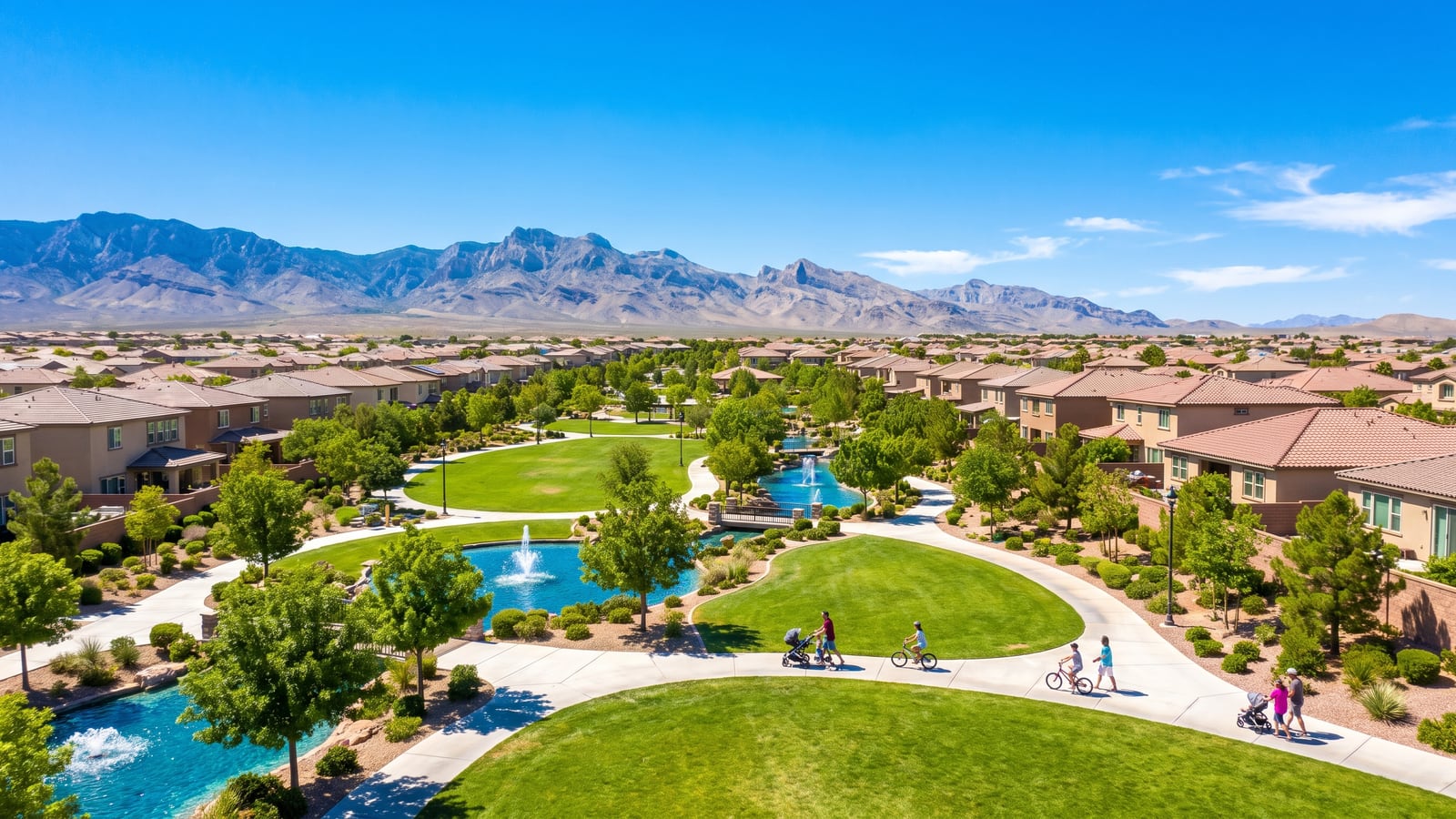
Rankings freeze a moving picture, so here's the motion. The southwest is the volume story — Enterprise's 548 actives include the valley's densest new-release calendar, and according to Clark County permitting data the township keeps leading the metro in new residential permits. North Las Vegas is the trajectory story: the Tule Springs masterplans, the VA anchor, and the logistics corridor keep compressing the gap between its $425,000 entry and the valley median — the same arc Henderson ran twenty years ago, at today's prices. Anthem and Summerlin are the scarcity stories: hillside and rim land is finite, and their new-release trickle (Summerlin West's villages, the last Anthem parcels) prices accordingly.
According to GreatSchools rating movements over recent years, the fastest school-score improvements have come from the newest campuses in the growth corridors — worth knowing if you're buying a five-year horizon rather than a move-in-today reality. And according to CCSD enrollment planning, new school siting follows rooftops with a lag — the growth-corridor buyer's classic trade of two crowded years for a brand-new campus. The suburb that's "best" on a 2031 horizon may not top a 2026 list; if your hold is long, weight the risers.
How Was This Ranking Actually Built?
Methodology matters on a page like this, so here's ours. The price and inventory columns are live GLVAR queries on the publication date — Summerlin defined as ZIPs 89134/89135/89138/89144, Green Valley as 89014/89052/89074, Centennial Hills as 89131/89149, Enterprise/Southwest as 89141/89178/89179, Spring Valley as 89117/89147, the Anthem area as 89044/89052, Aliante and the north corridor as 89084/89031, and Henderson, North Las Vegas, and Boulder City taken citywide. That ZIP honesty cuts both ways — a "Summerlin" median built on its actual ZIPs runs higher than lists that quietly blend in adjacent areas, and a citywide Henderson number blends its luxury hills with its value east side. According to the U.S. Census Bureau, Henderson's 330,000-plus residents make it Nevada's second city — treating it as one "suburb" understates its internal variety, which is why Green Valley and Anthem also rank separately here.
The soft dimensions — schools, commutes, character — come from the transaction files: where our school-first clients actually closed and stayed, the commute complaints that show up at listing time two years later, which HOAs generate the fewest resale surprises. In our experience a ranking's job is to compress that lived data into a starting order, not to end the conversation — and the order genuinely changes with your triangle. A swing-shift nurse at a Summerlin hospital and a Strip sommelier with two kids should not read this list in the same sequence, which is exactly why the consult version of this page is interactive.
One more use for the list that most readers miss: rent your finalist first if you can. A six-month lease in a candidate suburb — roughly $1,900–$2,400 for a decent three-bedroom in the value tier, $2,400–$3,200 in the premium corridors — is the cheapest suburb-selection insurance available, and the 2026 rental market's softness makes it easy to negotiate. A meaningful share of our best purchases started as renters who used the lease to learn the streets, the school pickup lines, and the summer power bills before committing — then bought with conviction inside a market they already understood.
How Should You Actually Choose Among Them?
The triangle we draw in every consult: commute, schools, budget — pick the two that are non-negotiable and the suburb list shortens itself. Strip/resort workers weight the south and center (Green Valley, Spring Valley, Enterprise); west-side and tech-corridor workers look west and northwest (Summerlin, Centennial); school-first families sort Summerlin vs Green Valley vs Anthem by budget band; pure value math starts north and east. Then test-drive before you buy: we routinely send relocating clients to do the actual commute at the actual hour and one Saturday-morning errand run from each finalist — two hours of experiments that have reversed more suburb decisions than any spreadsheet.
And treat this ranking as the map, not the verdict — inside every suburb here, the community-level choice (the specific village, the specific street) moves your outcome more than the suburb-level one. That's the layer Nevada Real Estate Group (150+ agents, 9,061+ verified five-star reviews) works daily: block-level school zoning, HOA-by-HOA fee stacks, which phases back power lines. Browse current inventory, open a search with your triangle set, call (702) 637-1759, or tell us your two non-negotiables and we'll return a three-suburb shortlist with homes attached.

Frequently Asked Questions
What is the best suburb of Las Vegas overall?
Summerlin, if budget allows — its schools, 200+ miles of trails, village infrastructure, and Red Rock setting win the most categories at once, at a live median around $750,000. For most families optimizing value, Green Valley in Henderson at roughly $535,000 is the benchmark alternative.
What is the most affordable good suburb of Las Vegas?
North Las Vegas citywide carries the metro's friendliest live median (about $425,000 with 1,000+ actives), with the Aliante master plan at $450,000 as its polished showcase. Spring Valley at $455,000 is the central-location value play on the LV side.
Which Las Vegas suburb has the best schools?
The strongest clusters sit in Summerlin and Henderson's Green Valley-Anthem corridor — consistently the valley's top-rated public campuses plus the private marquee schools. Verify the specific home's zoning every time; boundaries shift and adjacent streets can zone differently.
Is Henderson a suburb of Las Vegas?
Technically Henderson is its own incorporated city — Nevada's second largest — with its own services and police force, but it functions as the valley's premier suburban corridor and every ranking treats it that way. Its sub-areas (Green Valley, Anthem, Cadence, Lake Las Vegas) behave like distinct suburbs themselves.
Which suburb is best for new construction?
The Enterprise/Southwest corridor — Mountain's Edge, Southern Highlands, and the monthly new releases at a $550,000 live median — plus North Las Vegas's Tule Springs villages for the value version. Summerlin West carries the premium new-build tier.
How far are Las Vegas suburbs from the Strip?
Almost everything on this list runs 15–35 minutes: Spring Valley and Green Valley closest at 15–20, Summerlin and Centennial Hills 25–35 from their far edges, Anthem 20–30, Boulder City the outlier at 35–40. Do the real drive at your real hour before committing — the 15 and 215 behave differently by direction.
Are Las Vegas suburbs a good investment in 2026?
The fundamentals that drove the decade's growth — in-migration, no state income tax, constrained land — remain intact, and the 2026 buyer-leaning market lets purchasers negotiate entries the frenzy years never allowed. Growth corridors (Southwest, North) offer the appreciation story; established cores (Summerlin, Green Valley) offer the stability one.
Which Sources Inform This Suburbs Ranking?
Median prices and inventory counts are live pulls from NREG's GLVAR MLS feed on the publication date (Summerlin/Green Valley/Anthem/Centennial/Enterprise/Spring Valley/Aliante defined by their ZIP clusters; Henderson, North Las Vegas, and Boulder City citywide); valley-wide context from Las Vegas REALTORS monthly reporting. Population and growth from the U.S. Census Bureau and Clark County; school context from CCSD and GreatSchools (verify zoning per address); master-plan detail from the Howard Hughes Corporation (Summerlin); Boulder City's growth ordinance from the City of Boulder City; trail and park inventories from the City of Henderson and City of Las Vegas. Rankings reflect NREG transaction experience across 9,600+ closings — your triangle of commute, schools, and budget decides your personal order, and we'll happily argue any placement over coffee.