
Ask a Summerlin homeowner why they bought where they did and the honest answer, more often than any granite countertop, is a park. Not parks in the abstract — a specific one. The Paseos families mean Fox Hill. Willows and Gardens households mean Gardens Park and its event lawn. Trail-village runners mean the paved paseo network itself. Across the 9,600+ closings Nevada Real Estate Group has represented statewide, park adjacency comes up in Summerlin buyer conversations more consistently than in any other Las Vegas master plan — and the data on what those homes resell for says the instinct is right.
This is the 2026 field guide. Our community dataset documents 52 named parks recurring across 156 Summerlin villages and sub-associations — the deepest coverage we track for any Nevada master plan — and this guide ranks the ones that actually move buyers: what each park offers, which villages feed into it, what homes around it cost right now, and how the trail system stitches all of it into one connected outdoor network under the Red Rock escarpment.
Summerlin's best parks in 2026 are Fox Hill Park in The Paseos — referenced by 116 of the 156 villages in our dataset — Gardens Park with its community center, The Paseos Linear Park greenbelt, and the emerging Grand Park district, all tied together by 150-plus miles of trails per Howard Hughes. Nearby homes run roughly $550K in The Paseos and Stonebridge to $3M+ in Grand Park customs, and park-walkable lots consistently resell at a premium.
- Our dataset documents 52 named parks across 156 Summerlin villages — Fox Hill Park is an amenity for 116 of them.
- Howard Hughes credits Summerlin with 150+ miles of trails across roughly 22,500 acres — the valley's largest network.
- National research puts the park-proximity premium as high as 8–10% of home value.
- Price points: The Paseos $550K–$1.2M, Stonebridge $550K–$1M, Grand Park $400K–$3M+, Sun City $300K–$700K.
- Walk the park at 5 pm on a weekday before you offer — that is when a "park view" reveals itself.
How Many Parks Does Summerlin Actually Have?
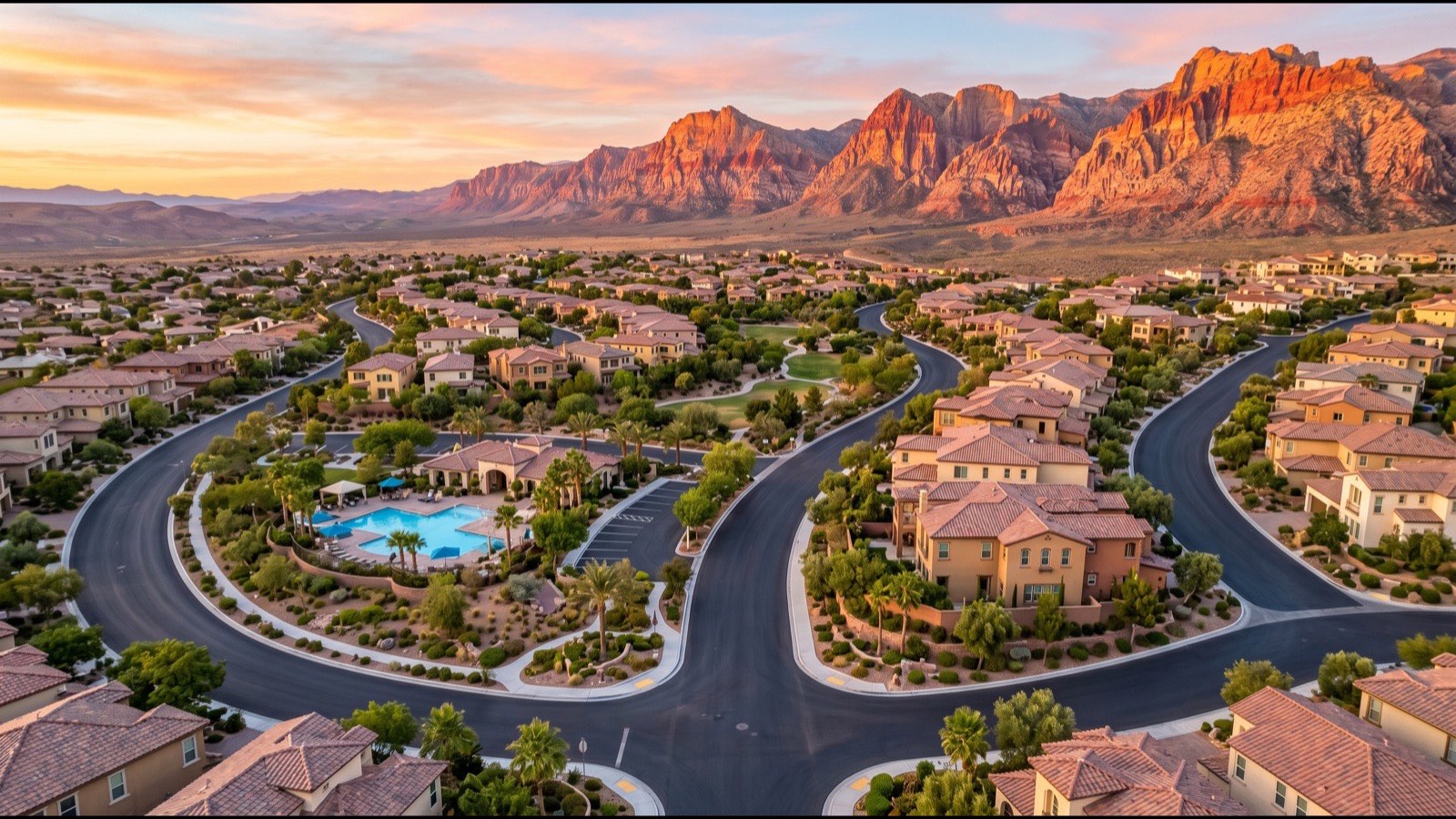
More than any other community in Nevada, and it is not close. According to the Howard Hughes Corporation, Summerlin's roughly 22,500-acre master plan carries a park system measured in the hundreds — the developer's own materials cite 250-plus parks of every scale — connected by more than 150 miles of paved and soft-surface trails. Our own community dataset, which powers the village pages on this site, documents 52 named parks that appear as recurring amenities across 156 Summerlin villages, from ten-acre showpieces down to pocket greens tucked inside single subdivisions. Every park on the Summerlin Council's 2026 park map is listed with its address, village, amenities and access rule in our Summerlin parks guide.
The structural reason the number is so high: Summerlin was master-planned from the 1990 Summerlin Land Exchange onward with open space as infrastructure, not decoration. According to the U.S. Census Bureau, the Summerlin-anchored ZIP codes are among the fastest-growing affluent areas in Nevada — and the park network is a core reason relocating families searching Las Vegas land on the west side first.
Which Summerlin Park Is the Best Overall?
Fox Hill Park in The Paseos — and our dataset makes the case numerically: 116 of the 156 Summerlin villages we document list Fox Hill among their nearby amenities, nearly three times the reach of any park except the linear greenbelt itself. It is the park Summerlin parents drive to even when their own village has one.
What earns it the crown: an elevated site with unobstructed Red Rock Canyon views, climbing-oriented play structures that skew older-kid (a rarity — most village parks max out at toddler equipment), shaded pavilions, and direct trail connections into The Paseos street network. Homes in The Paseos list from roughly $550,000 to $1.2 million, and the village's Fox Hill-adjacent streets are among the most requested search areas we run for west-side families.
What Makes Gardens Park the Community Hub?
Where Fox Hill is the destination playground, Gardens Park is Summerlin's living room. Anchored by a community center and an event lawn that hosts seasonal programming, it is the park our dataset associates most strongly with The Willows and Gardens villages — established neighborhoods where mature trees have had two decades to grow, something no new master plan can sell at any price.
The real-estate effect is specific: buyers who tour newer villages for the homes routinely close in the Gardens/Willows orbit for the canopy. Resale inventory near Gardens Park spans roughly $450,000 townhomes to $1.5 million custom-adjacent properties, and it moves fast — in our experience, well-priced listings within walking distance of Gardens Park draw multiple offers in the first weekend even in balanced markets.
What Is The Paseos Linear Park, and Why Does It Matter So Much?
It is the connective tissue — a landscaped greenbelt threading through the west side that our dataset lists as an amenity for 107 villages, second only to Fox Hill. "Linear park" undersells it: it is the reason a Paseos kid can bike to school, a Stonebridge runner can log five miles without crossing a major arterial, and a Stonebridge homeowner ($550K–$1M village range) is functionally connected to amenities their own village never built.
When we walk relocation buyers through Summerlin, the linear park is the moment the master plan clicks: the villages are not 156 separate subdivisions — they are one park system with houses in it.
How Big Is the Summerlin Trail System Really?
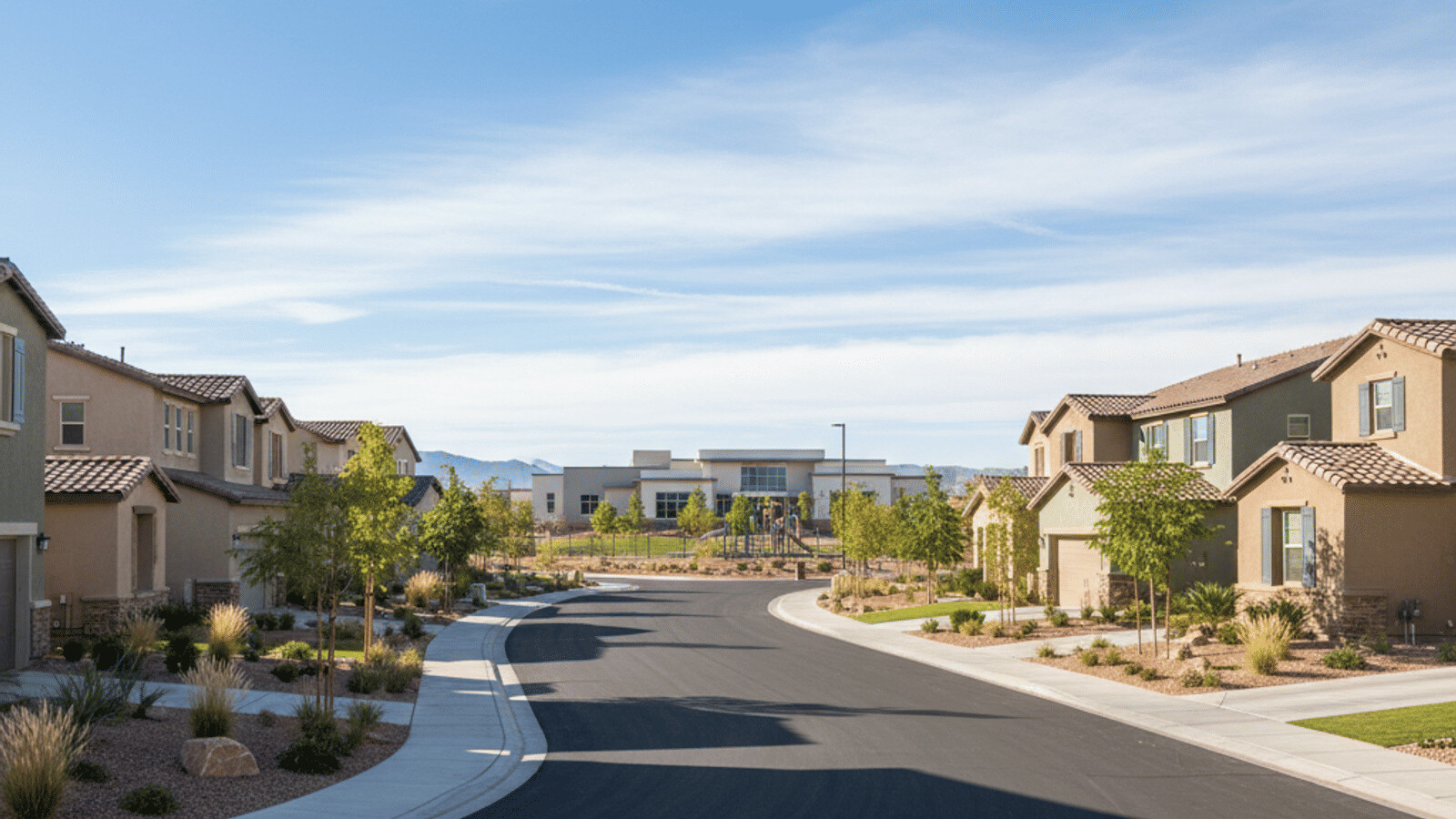
According to the Howard Hughes Corporation, more than 150 miles of trails run through the master plan — street-side paseos, off-street connectors, and natural-surface routes that hand off to federal land. Our dataset lists the trail system itself as a named amenity for 97 villages, which is the honest way to understand it: in Summerlin, the trail is not near the house; it is part of the address.
Where it leads matters as much as its length. The western trailheads feed directly toward Red Rock Canyon National Conservation Area, the 195,000-acre BLM-managed conservation area whose scenic-drive visitation makes it one of Nevada's most-visited outdoor destinations. A Summerlin address effectively puts a national-caliber trail network at the end of the paseo.
What Is the Grand Park District — Summerlin's Next Great Park?
The most consequential park story in Las Vegas real estate right now. Grand Park is the emerging district in Summerlin's newer western and southern phases, planned around a large-scale central park concept — our dataset already ties the Grand Park Community Park to the surrounding village and flags additional phases as future openings. The Grand Park district village spans an unusually wide price band — roughly $400,000 attached products to $3 million-plus customs — precisely because Howard Hughes is building the full housing ladder around its next signature green space.
The buyer math worth understanding: purchasing near a planned park phase means buying the premium before it is priced in. The pattern from earlier villages is consistent — when the park opens, the surrounding streets re-rate. It is the closest thing Summerlin offers to a time-arbitrage trade, and it is why our agents track the district's phase openings as closely as its listings. (Phase timing shifts; we verify current status against the Summerlin master-plan announcements before clients write offers on "future park" premiums.)
Which Parks Serve the Luxury Villages?
The custom-home tier plays by different rules — the park is often private or quasi-private. In The Ridges, the guard-gated crown of the west side, our dataset pairs the village with Fox Hill Park just outside the gates and the Red Rock conservation frontier beyond them; inside, the amenity core is the residents-only Club Ridges. At the top of the market, The Summit Club's private parkland and club campus function as a park system for a few hundred households.
For buyers comparing tiers: the public-park villages deliver more park per dollar; the gated tier converts the park into privacy. Both bets have paid historically — see our guard-gated communities overview for how the access-controlled enclaves price.

Which Villages Put You Closest to the Best Parks?
| Park | Anchor villages | Home price range | Best for |
|---|---|---|---|
| Fox Hill Park | The Paseos, Stonebridge | $550K–$1.2M | Families with school-age kids |
| The Paseos Linear Park | Paseos, Stonebridge, western villages | $500K–$1.2M | Runners, cyclists, dog households |
| Gardens Park | The Willows, The Gardens | $450K–$1.5M | Established-canopy buyers, events |
| Grand Park Community Park | Grand Park district | $400K–$3M+ | Buy-before-the-premium positioning |
| Kestrel Community Park | Kestrel, Kestrel Commons | $500K–$800K | Newer-build buyers on the western rim |
| Cottonwood Canyon Park | Southern villages | $500K–$950K | Sports fields and open lawn |
| Community-center campuses | Sun City Summerlin | $300K–$700K | 55+ active adults (three centers) |
Two notes on reading that table honestly. First, ranges are village list-price bands from our community data, not park-frontage premiums — the lot backing the park will price above its village band. Second, Sun City Summerlin's "parks" are its three community-center campuses — for the 55+ buyer they function as parks, golf, and social hall in one, which is why the village stays the valley's most-searched active-adult address at a $300K–$700K entry.
Do Parks Actually Raise Summerlin Home Values?
The national evidence says yes, consistently. According to research compiled by the National Recreation and Park Association and the Trust for Public Land, studies have repeatedly found that proximity to quality parks lifts nearby home values, with effects commonly measured up to 8–10% for homes near well-maintained signature parks. On a $700,000 Summerlin median-tier home, that is a $56,000–$70,000 proximity effect; on a $1.2 million Paseos property, potentially $96,000–$120,000.
Our on-the-ground experience matches the direction if not always the textbook magnitude: in our closings across The Paseos and the Willows/Gardens orbit, park-walkable listings consistently out-show and out-offer comparable homes three streets deeper — and the gap widens in family-buyer season between March and August. The caveat we give sellers: backing a park is not the same as walking to one. Lots directly on active sports fields trade a view for evening floodlights and weekend parking, and appraisers know the difference.
How Do Summerlin's Parks Compare to the Rest of the Valley?
| Dimension | Summerlin | Henderson | North Las Vegas | County flagships |
|---|---|---|---|---|
| Model | Master-planned village parks + trails | Municipal system + master-plan parks | Regional showpiece | Destination parks |
| Signature | Fox Hill, Gardens, Grand Park district | Cornerstone, Hendersonʼs trail loops | Craig Ranch Regional Park (~170 acres) | Sunset Park, Wetlands Park |
| Connectivity | 150+ miles of internal trails | Strong, arterial-linked | Park-centric | Drive-to |
| Home-price effect | Built into every village band | Localized around signatures | Strong around Craig Ranch | Adjacent-street premiums |
The honest comparison: Henderson runs an excellent municipal system, and North Las Vegas' Craig Ranch Regional Park is the single most impressive park build in the valley. According to the City of North Las Vegas, it spans roughly 170 acres of sports fields, gardens, and amphitheater space. What Summerlin has that no one else does is density of access: not one great park, but a documented 52-park named network where the median home is minutes from three of them on foot. For the county's destination parks, the Clark County Parks & Recreation system's Sunset and Wetlands parks round out weekend options a short drive from any Summerlin address.
What Do Homes Near Summerlin's Best Parks Cost in 2026?
Working band by band, from our live community data: entry attached products near park corridors start around $400,000–$450,000 (Grand Park district attached, Gardens-orbit townhomes). The family core — The Paseos, Stonebridge, Kestrel — runs $500,000 to $1.2 million. The Willows/Gardens established tier spans $450,000 to $1.5 million depending on lot and renovation. Above that, park-and-view custom territory: Ridges-tier properties from roughly $2 million into the eight figures, where the "park" is Red Rock Canyon itself.
Two market-context numbers to calibrate against: according to Las Vegas REALTORS reporting, the valley median hovers in the mid-$400Ks, which means every signature-park Summerlin village except Sun City's entry tier prices above metro median — the park network is a paid-for amenity, priced in daily. And mortgage math matters at these bands: According to Freddie Mac's weekly survey, benchmark rates near 6.5%, mean the payment gap between a $550,000 Stonebridge home and an $800,000 Paseos home is roughly $1,580 a month before taxes — the park you choose is also a financing decision.
What Does the Monthly Payment Look Like Near Each Park?
Because a park choice is also a financing choice, here is the math buyers actually run at the kitchen table. Using the Freddie Mac PMMS benchmark near 6.5% with 20% down on a 30-year fixed, principal-and-interest lands roughly as follows across the signature-park villages — before Clark County property taxes (Nevada's effective rates are among the nation's lower, a point Nevada Department of Taxation materials make often) and association assessments:
| Buy near | Example price | Loan amount | Est. P&I / month |
|---|---|---|---|
| Sun City Summerlin (entry) | $450,000 | $360,000 | $2,275 |
| Grand Park district (attached) | $500,000 | $400,000 | $2,528 |
| Stonebridge (family SFR) | $650,000 | $520,000 | $3,287 |
| The Paseos (Fox Hill orbit) | $850,000 | $680,000 | $4,298 |
| Willows/Gardens (renovated) | $1,000,000 | $800,000 | $5,057 |
| The Ridges (custom tier) | $2,500,000 | $2,000,000 | $12,642 |
Three honest footnotes to that table. First, these are illustrative mid-band prices, not appraisals — the park-backing lot on any of those streets will ask more, and the interior lot three doors down will ask less. Second, the jumbo threshold matters: above the conforming limit, Ridges-tier borrowers price into jumbo products where relationship banking moves the rate more than any rate sheet. Third, cash behaves differently around parks — in our closings, the park-walkable premium holds up best in financed family purchases and compresses in investor cash deals, because the premium is fundamentally about daily life, not yield. If the payment math between two park villages is close, tour both parks before the houses; the $770 monthly gap between Stonebridge and The Paseos buys a specific difference in playgrounds, and only your family knows if it is worth it.
Which Park Fits Which Stage of Life?
The question our agents actually field is rarely "what is the best park" — it is "what is the best park for us, right now." The honest matrix, from years of walking these villages with buyers:
Toddler and stroller years: the village pocket parks win, not the showpieces. Nearly every Summerlin street sits within a stroller ride of shaded toddler equipment, and the winning move is choosing the street, not the park — a mid-block home two minutes from a quiet pocket green beats a home backing the regional playground with its weekend crowds. The Willows and Gardens orbit is the sweet spot: mature shade matters more than new equipment when your park time happens at nap-schedule hours.
Elementary and middle-school years: this is Fox Hill's kingdom, and it is when The Paseos and Stonebridge earn their premiums. Climbing terrain that does not bore a ten-year-old, trail routes kids can ride without crossing arterials, and the school-park-home triangle that lets a family run on one car more days than not. We have watched buyers pay up meaningfully for exactly this triangle, and resell it just as well five years later.
Teen and sports years: field capacity becomes the currency — Cottonwood Canyon Park's lawns and the community-scale sports complexes matter more than playgrounds, and proximity to Downtown Summerlin shifts from irrelevant to essential for teenagers with wallets and bikes.
Empty-nest and 55+: the community-center model takes over. Sun City Summerlin's three campuses — fitness, pools, social calendars — replace the playground entirely, at a $300K–$700K entry the family villages cannot match. The trail system becomes the daily amenity: flat, paved, sunrise-friendly.
Luxury tier: privacy replaces programming. Ridges and Summit Club buyers are not buying playgrounds; they are buying Red Rock frontage and the right to a quiet trailhead. The park premium at this tier is measured in view corridors, not equipment.
When Are Summerlin Parks at Their Best?
Seasonality is real in the Mojave, and it changes which homes show well in which months. October through April is the golden season — the months when park-adjacent listings photograph like brochures and open houses spill outdoors. In our experience, park-walkable homes listed in March through May capture the strongest premium of the year: buyers tour in perfect weather, school decisions loom, and family relocation season peaks all at once.
June through September inverts the calculus. Village parks empty from mid-morning to sunset, splash-pad-adjacent streets earn their keep, and shade becomes the amenity buyers suddenly price. A savvy summer buyer tours at 7 pm — when the parks refill and the neighborhood's actual rhythm shows itself — and a savvy summer seller leads the listing photos with the shaded pavilion, not the sun-blasted lawn. The trail system, meanwhile, runs year-round at dawn: the 5 am summer running culture on the west-side paseos is its own small real-estate signal, visible in how many garage-door gyms face the trail connections.
What Should Families Check Before Buying Near a Park?
Five checks we run with every park-motivated buyer:
- Walk it at 5 pm on a weekday and 9 am Saturday. Programming, floodlights, and parking overflow reveal themselves on schedule, never on a lunchtime tour.
- Confirm which association maintains it. Village-level parks are association-funded — dues and reserve health differ village to village; our community pages carry the documented ranges.
- Check school-zone alignment. Park-adjacent does not guarantee zoned-adjacent — verify current attendance boundaries with CCSD and ratings context at GreatSchools before anchoring on a "walk to school and park" narrative.
- Price the premium against the band. If the park-backing lot asks 12% over village comps and the research ceiling for proximity is 8–10%, the seller is charging tomorrow's price today.
- Read the master-plan phase map for anything labeled future. A "future park" across the street can also be a future school, fire station, or apartment site — we pull the current land-use designation before clients rely on the render.
Frequently Asked Questions
What is the best park in Summerlin?
Fox Hill Park in The Paseos is the consensus pick — our community dataset shows 116 of 156 Summerlin villages listing it as a nearby amenity, far more than any other named park. Its elevated Red Rock views, older-kid climbing terrain, and direct trail connections make it the park families cross the master plan to reach. Gardens Park is the runner-up for its community center and event programming.
How many parks are in Summerlin?
The Howard Hughes Corporation's materials cite more than 250 parks of every scale across the master plan. Our own community dataset — the source behind this site's village pages — documents 52 named, recurring parks across 156 Summerlin villages, connected by a trail system exceeding 150 miles.
Are Summerlin parks open to the public?
The village parks are generally open to the public even though they are association-maintained — Fox Hill, Gardens Park, and the linear-park network among them. The exceptions are the amenity campuses of gated and 55+ communities (Club Ridges, The Summit Club's grounds, Sun City's three community centers), which are residents-only.
Which Summerlin village is best for families who want park access?
The Paseos is the strongest single answer — Fox Hill Park plus linear-park connectivity at a $550K–$1.2M band. Stonebridge offers the same park orbit at a slightly lower $550K–$1M entry. The Willows/Gardens orbit trades newer construction for mature canopy around Gardens Park, typically $450K–$1.5M.
Do homes near parks in Summerlin cost more?
Yes — national research from NRPA and the Trust for Public Land places the park-proximity premium as high as 8–10% for homes near quality signature parks, and our closing experience in The Paseos and the Gardens orbit is directionally consistent. The premium concentrates in walkable proximity; lots directly backing active fields can actually discount for noise and light.
What is Grand Park in Summerlin?
Grand Park is the district anchoring Summerlin's newer phases, planned around the master plan's next large-scale central park — with its community park open and further phases arriving with the villages around them. Its housing spans roughly $400K to $3M+, and buying ahead of park-phase openings is the closest thing Summerlin offers to purchasing the premium before it is priced in. Phase timing shifts, so we verify current status before clients rely on it.
Does Summerlin connect to Red Rock Canyon trails?
Yes — the western trail network feeds toward Red Rock Canyon National Conservation Area, the 195,000-acre BLM conservation area bordering the master plan. For trail users, a west-Summerlin address effectively extends the neighborhood paseo system into national-conservation-land hiking.
Ready to Tour Summerlin's Park Villages?
The right way to buy a park-anchored home is to tour the park as carefully as the house. Our Summerlin specialists live this inventory — start with the village guide, browse current Summerlin listings, or call (702) 637-1759 and tell us which park matters to your family; we will build the tour around it.
Which Sources Inform This Summerlin Parks Guide?
- Howard Hughes Corporation — Summerlin master-plan scale, park and trail-system figures
- Summerlin (official) — village and park-phase announcements
- Bureau of Land Management — Red Rock Canyon NCA — conservation-area scale and access
- National Recreation and Park Association — park-proximity value research
- Trust for Public Land — park-premium and access research
- Las Vegas REALTORS — valley median price context
- Freddie Mac PMMS — mortgage-rate benchmark used in payment math
- U.S. Census Bureau — west-valley growth context
- Clark County Parks & Recreation — county destination parks
- City of North Las Vegas — Craig Ranch Regional Park figures
- CCSD and GreatSchools — school-zone verification resources
- NREG community dataset — 52 named parks across 156 documented Summerlin villages (the aggregation behind this site's village pages)