

Is there enough water? It is one of the first questions people ask when they look at Reno from somewhere drier, and it is a fair one. The Truckee Meadows sits in the high desert, the valley floor averages about 7.5 inches of rain a year, and Washoe County keeps adding residents. Headlines about Colorado River cuts in Southern Nevada add to the worry, even though Reno and Sparks draw on an entirely different river system.
I wanted an answer built from the documents that actually govern the water rather than from impressions. This guide reads Truckee Meadows Water Authority's 2025–2045 Water Resource Plan, the Truckee River Operating Agreement, the regional water commission's draft 2026–2045 plan, the Washoe County population forecasts, TMWA's rules and rate schedules, and Nevada's well statutes. I also counted the water-source field on every active Reno and Sparks residential listing on October 23, 2026, because the answer for the region and the answer for one house are not the same thing.
Yes, on current official projections. TMWA's 2025–2045 Water Resource Plan, approved in October 2025, projects demand rising 18 percent, from 90,378 acre-feet in 2025 to 107,178 in 2045, while the utility holds 191,209 acre-feet of water rights. The real risk is a long drought, which upstream reservoir storage is designed to cover. For one home, what matters is the water provider, any well, and on new construction, the water rights.
- TMWA projects demand of 107,178 acre-feet by 2045, about 56 percent of the rights it holds.
- Under TROA, TMWA banked more than 69,000 acre-feet of drought water upstream by summer 2022.
- New homes must dedicate water rights, plus an extra 11 percent of river rights for drought storage.
- On October 23, 2026, 103 of 1,642 active Reno and Sparks residential listings listed a well.
- TMWA proposes raising a typical $44.98 monthly bill to about $54.07 by 2029; the Board votes March 2027.
Is Reno Actually Running Out of Water?
Not on any official projection I could find, and the margin is wide. According to the Truckee Meadows Water Authority's 2025–2045 Water Resource Plan, its customers used 89,600 acre-feet of water in 2024, and demand is projected to rise 18 percent, from about 90,378 acre-feet in 2025 to 107,178 acre-feet in 2045. The same plan lists 191,209 acre-feet of surface and groundwater rights in TMWA's portfolio. Even the 2045 figure is a little over half of what the utility holds, and the plan's conclusion is that TMWA "has sufficient resources to meet the region's growing water demands" through the 20-year horizon and beyond it.
Some scale helps. An acre-foot is roughly 325,851 gallons, and TMWA's own data center explainer says a single-family residence typically uses about a third of an acre-foot a year. TMWA is the community-owned utility that serves about 475,000 residents across a retail service area of roughly 170 square miles, which the plan puts at more than 90 percent of Washoe County's population.
The plan is the fifth since TMWA formed in 2001. According to TMWA's planning page, it is rewritten every five years and looks 20 years out, and TMWA's At-A-Glance announcement dated October 27, 2025 says the Board of Directors approved it that October.
None of this means water is unlimited. A water right is a legal claim to divert water, and in a dry year a river right delivers less than its paper number. That is why the honest version of the answer is about drought, not about running out. The sections below explain how the region stores water for dry years, what a drought changes for a household, and where the growth forecasts and the supply plans meet.
| Measure | Figure | Period or date |
|---|---|---|
| Residents served | About 475,000 | 2025 plan |
| Active service connections | About 138,000 | 2025 plan |
| Customer demand | 89,600 acre-feet | Calendar 2024 |
| Projected demand | 90,378 rising to 107,178 acre-feet | 2025 to 2045 |
| Water rights held | 191,209 acre-feet | 2025 plan, Table 2-1 |
| Share of supply from the Truckee River | 80 to 85 percent | Typical year |
| Upstream drought storage | More than 69,000 acre-feet | Summer 2022 |
| Water use per person | 143 falling to 104 gallons a day | 2003 to 2024 |
Where Does Reno and Sparks Tap Water Come From?
Mostly from the Truckee River. According to TMWA's plan, the river provides 80 to 85 percent of the region's drinking water in a typical year. It runs 121 miles from Lake Tahoe, its only outlet, to Pyramid Lake, and its watershed covers about 3,060 square miles of California and Nevada. A dam at Tahoe City controls the top 6.1 feet of Lake Tahoe, which the plan equates to 744,600 acre-feet of storage, and Truckee River flows through Reno depend heavily on how high that lake sits at any point in the year.
The river water is treated at two plants on the Truckee. Chalk Bluff, the largest, can produce about 90 million gallons a day and is designed to expand to 120. Glendale, the supplemental plant, produces about 32 million gallons a day, usually from May through October. A smaller Mt. Rose plant, opened in 2022, treats Whites Creek water and can produce up to 4 million gallons a day for the south Truckee Meadows when creek flows allow.
Groundwater is the second leg. TMWA runs 86 active production wells across nine hydrographic basins: 71 serve the main system and 15 serve small satellite systems that have no river connection. The plan reports annual groundwater pumping between 11,000 and 16,000 acre-feet over the last five years, depending on whether the year was wet or dry. A third source is imported groundwater from the Fish Springs Ranch wellfield in Honey Lake Valley, about 38 miles north of Reno, which is permitted to supply up to 8,000 acre-feet a year and is earmarked for growth in the North Valleys.
The fourth piece is storage TMWA owns outright: water rights in Donner and Independence lakes totaling 27,000 acre-feet a year, which can be released in dry years. TMWA's drought-resiliency explainer adds a useful perspective: in a given year the utility uses anywhere from 3 to 9 percent of the Truckee River. The rest flows on to other rights holders downstream and to Pyramid Lake.
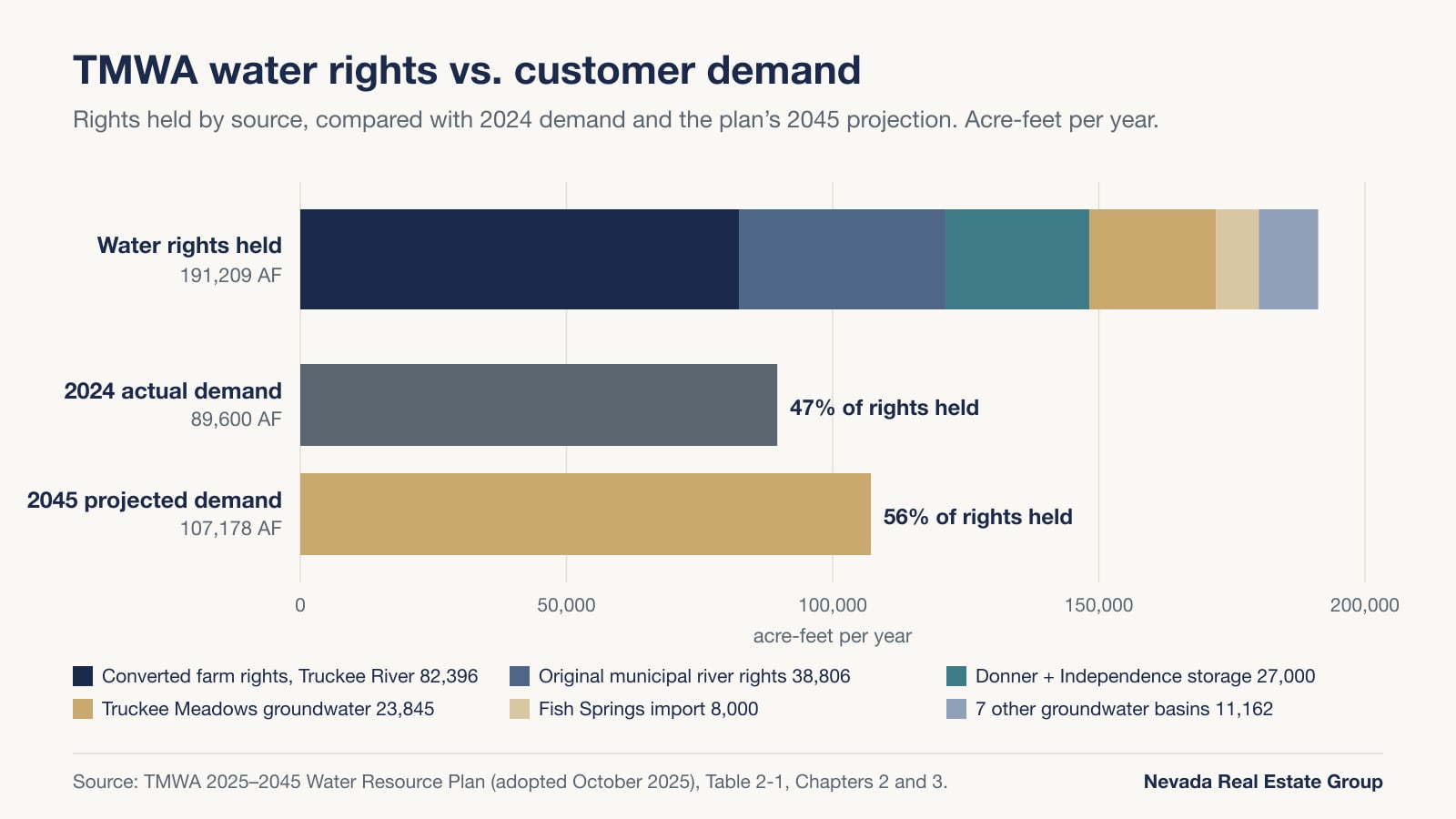
Where did those rights come from? Mostly from farms. The 1944 Orr Ditch Decree fixed the total Truckee River rights at roughly 226,000 acre-feet, and no new river rights can be created. According to the plan, TMWA has acquired, by purchase or through dedications from new development, more than 73,000 acre-feet of mainstem agricultural rights plus about 9,000 acre-feet of creek rights and converted them to municipal use, and about 42,000 acre-feet of mainstem rights, mostly still in agricultural use, remain available for future conversion. That conversion pool, not a new river, is what growth draws on.
What Does TMWA's 2025–2045 Water Resource Plan Project?
The demand forecast starts from Washoe County population, which TMWA projects along a logistic growth curve, then translates people into service connections by customer class. That produces the 18 percent rise to 107,178 acre-feet by 2045. The plan notes its forecast is statistically similar to the regional Consensus Forecast, which yields a countywide demand of 113,873 acre-feet in 2044; the two differ because the countywide number includes areas TMWA does not serve.
The more interesting work is the stress test. TMWA ran a long-range demand of about 140,000 acre-feet, a figure the plan calls hypothetical and uses only for modeling, through the Truckee River planning model to 2098. It used eight global climate models under a moderate emissions path (RCP 4.5) and a very high one (RCP 8.5), and for every year it kept the single worst model, the one leaving the least river water available. That is a deliberately pessimistic setup.
Under the moderate path, no model produced a shortage until 2088. Under the very high path, the first shortage appears in 2069, at 2,100 acre-feet, with larger gaps late in the century. Adding aquifer storage and recovery, where treated river water is injected underground in winter and pumped back in summer, erased every moderate-path shortage and the 2069, 2070 and 2091 shortfalls in the extreme case. The plan states that mitigating the remaining gaps "isn't necessary until 2085, even under the very high emissions scenario."
TMWA also looked backward. A 513-year reconstruction of Truckee River flows from tree rings shows droughts far worse than anything in the modern record, including a 30-year dry spell from 1496 to 1526 when Lake Tahoe would have stayed below its natural rim for more than a decade and fallen at least eight feet under it. The worst drought on record, by contrast, ran eight years from 1987 to 1994, and it remains the basis for TMWA's drought planning. A buyer should read the paleo work as a reminder that the region's climate can produce long droughts. The plan reports what those droughts would do to Lake Tahoe's level; it does not say how customer supply would fare in one, so the climate modeling above is the closer test of today's system.
| Result | Moderate emissions (RCP 4.5) | Very high emissions (RCP 8.5) |
|---|---|---|
| First year with any shortage, no added storage | 2088 (5,600 acre-feet) | 2069 (2,100 acre-feet) |
| Later shortages, no added storage | 2095 (600) and 2098 (1,000 acre-feet) | 2070, 2085, 2088, 2089, 2091 and 2095–2098, up to 37,100 acre-feet |
| With aquifer storage and recovery | All shortages eliminated | 2069, 2070 and 2091 eliminated; the rest reduced |
| When action is needed | No shortage before 2088 | Not until 2085, per the plan |
How Does the Truckee River Operating Agreement Store Drought Water?
The Truckee River Operating Agreement, known as TROA, is the main reason Reno weathers droughts better than its rainfall suggests. According to the U.S. Bureau of Reclamation, TROA was signed in 2008 and implemented in December 2015 under section 205(a) of Public Law 101-618, and it lets parties establish "credit water" in Truckee basin reservoirs and trade or exchange it on paper. The five signatories are California, Nevada, TMWA, the Pyramid Lake Paiute Tribe and the U.S. Department of the Interior.
In practice, credit water means TMWA can leave part of its river entitlement in upstream reservoirs instead of letting it flow past Reno, then carry that water into the next dry year. The Federal Water Master manages reservoir releases so that "Floriston Rates," the required flow at the state line, are met: 500 cubic feet per second from March through September and 400 from October through February. Under TROA, a drought exists when those flows are not projected to last past October 31, or when Lake Tahoe is projected to sit below 6,223.5 feet by November 15. The lake's natural rim is 6,223.0 feet; below it, water stops leaving the lake.
The agreement has already been tested. According to TMWA's plan, the utility stored more than 69,000 acre-feet of upstream drought supplies by summer 2022, more than double what it could hold before TROA and nearly a year of regional demand. When the very wet winter of 2023 ended that drought, TMWA turned more than 28,000 acre-feet of surplus credit water over to the Pyramid Lake Paiute Tribe in April 2023 for the lower-river fishery, which is how the agreement is meant to work.
Two rules connect TROA to growth. As directed by TROA, TMWA collects an extra 11 percent of water rights on top of each new development's demand and dedicates it to upstream drought storage. And water that existing customers save by conserving cannot be rededicated to new construction; it stays upstream as drought storage or flows to other rights holders. The plan also notes that TMWA has drawn on stored water only six times in roughly three decades, and that its supply is typically not affected until the third year of a drought.
What Happens to Your Household When TMWA Declares a Drought?
In a normal year, very little beyond the rules you already live with. TMWA's assigned-day watering has been in place for more than 30 years: according to the plan, homes with even addresses water lawns on Tuesday, Thursday and Saturday, odd addresses on Wednesday, Friday and Sunday, nobody waters on Monday, and lawn irrigation is off from noon to 6 p.m. between Memorial Day and Labor Day. Drip systems and hand watering are allowed any time without waste. A first violation brings a notice, a second can cost $25 and repeated violations in the same year up to $75 each.
Drought rules key off the calendar. TMWA sets a severity level based on when it expects to need upstream storage: a projected release in June is level 4, July level 3, August level 2, and after Labor Day level 1, which keeps standard rules. At levels 2 through 4, the lawn-watering ban widens to 11 a.m. to 7 p.m., staffing for water-waste patrols increases, and TMWA can request voluntary or mandatory cutbacks in outdoor use. Drought pricing is listed as an option, though the plan notes it has never been used in the Truckee Meadows. TMWA also writes to homeowners associations asking them not to penalize residents whose lawns go brown during a drought.
The record shows what that looks like. In 2015, the lowest-snowpack year on record, TMWA drew on drought reserves as early as June and temporarily reduced customer use by 9 to 16 percent on average over the peak months. TROA itself requires TMWA to keep a conservation plan that can save 10 percent or more in a declared drought year.
The 2026 season was a useful live test. According to a News 4 report from April 2, 2026, TMWA's senior hydrologist put Truckee basin snowpack at about 21 percent of average, with precipitation at 106 percent of average but mostly falling as rain, and the station reported the six upstream reservoirs where TMWA stores water at about 85 percent of capacity. Even so, TMWA expected "normal river flows throughout the whole water year through October." Earlier, as of February 2026, KOLO reported upstream reservoirs at about 70 percent. TMWA's expectation in April, in other words, was that storage built in wetter years would carry a thin snow year.
| Rule | Normal years and drought level 1 | Drought levels 2 to 4 |
|---|---|---|
| Trigger | Storage not needed until after Labor Day | Storage release projected in August (2), July (3) or June (4) |
| Lawn watering, Memorial Day to Labor Day | No watering noon to 6 p.m. | No watering 11 a.m. to 7 p.m. |
| Assigned days | Three days a week by address; none on Monday | Same, plus possible further outdoor limits |
| Cutbacks | None requested | Temporary cutbacks, voluntary or mandatory |
| Pricing | Standard tiered rates | Drought rates or higher fines possible; drought pricing never used to date |
Can Washoe County's Growth Outrun Its Water?
Washoe County has a legal tripwire for exactly this question. According to the draft regional plan's water resources chapter, Washoe County voters approved Question 3 in November 2008, directing that the Regional Plan require local land-use plans to be "based upon, and remain in balance with," identified and sustainable water resources. Since 2010, every two-year population forecast has been compared with the region's sustainable water estimate before local governments use it.
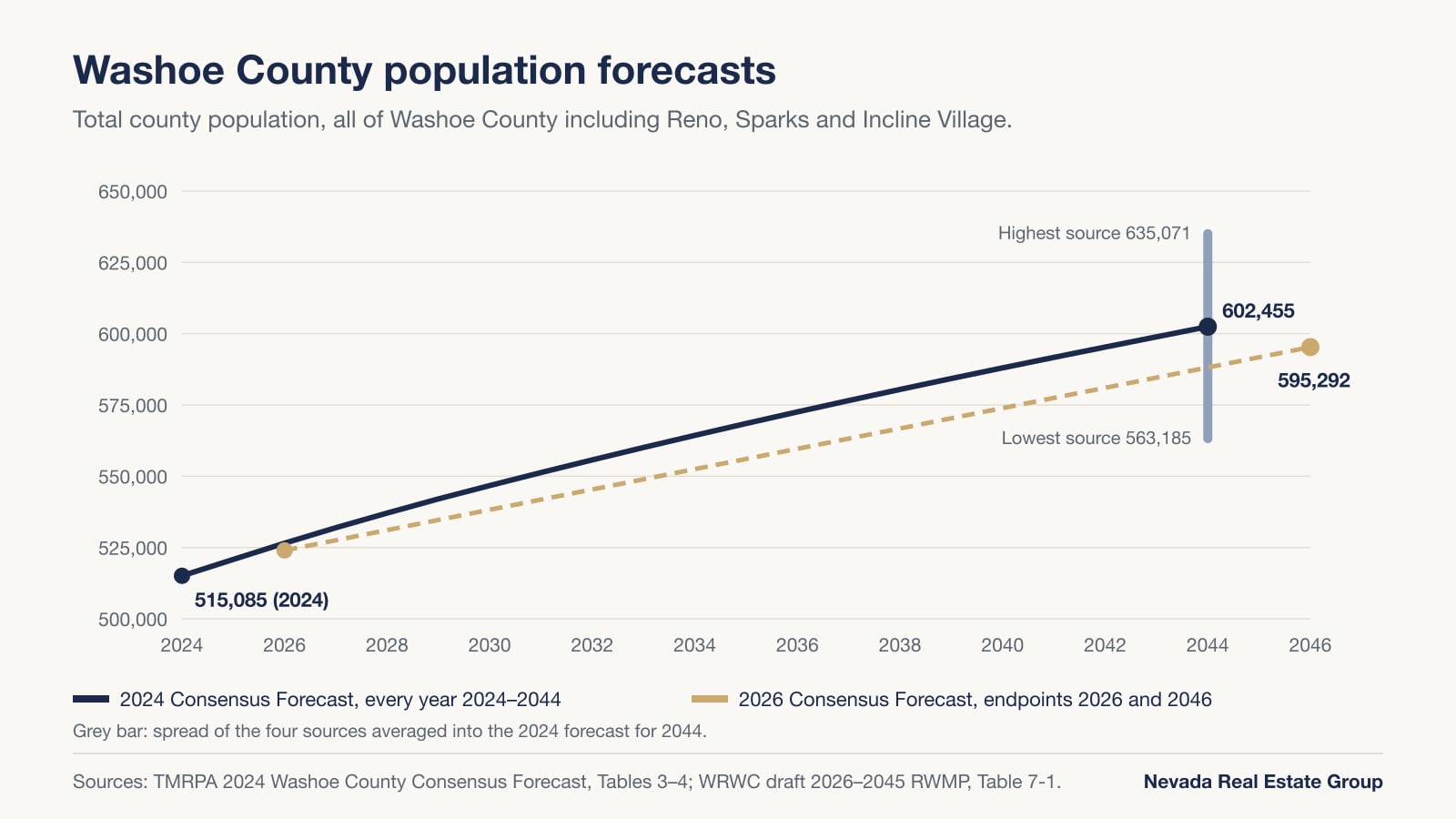
According to the Truckee Meadows Regional Planning Agency's 2024 Consensus Forecast, Washoe County was projected to grow from 515,085 residents in 2024 to 602,455 in 2044, about 0.81 percent a year. The forecast averages four sources whose 2044 numbers ranged from 563,185 to 635,071; the 2023 Nevada State Demographer projection was one of them, at 582,758 after extrapolation. The Northern Nevada Water Planning Commission confirmed on August 7, 2024 that the forecast population could be served by identified water resources, and the Western Regional Water Commission ratified that on September 18, 2024.
One reconciliation is worth flagging. TMWA's plan describes the 2044 Consensus Forecast population as 616,041. The Consensus Forecast document lists 616,041 as TMWA's own model, one of the four inputs; the averaged consensus is 602,455. Either way the comparison clears.
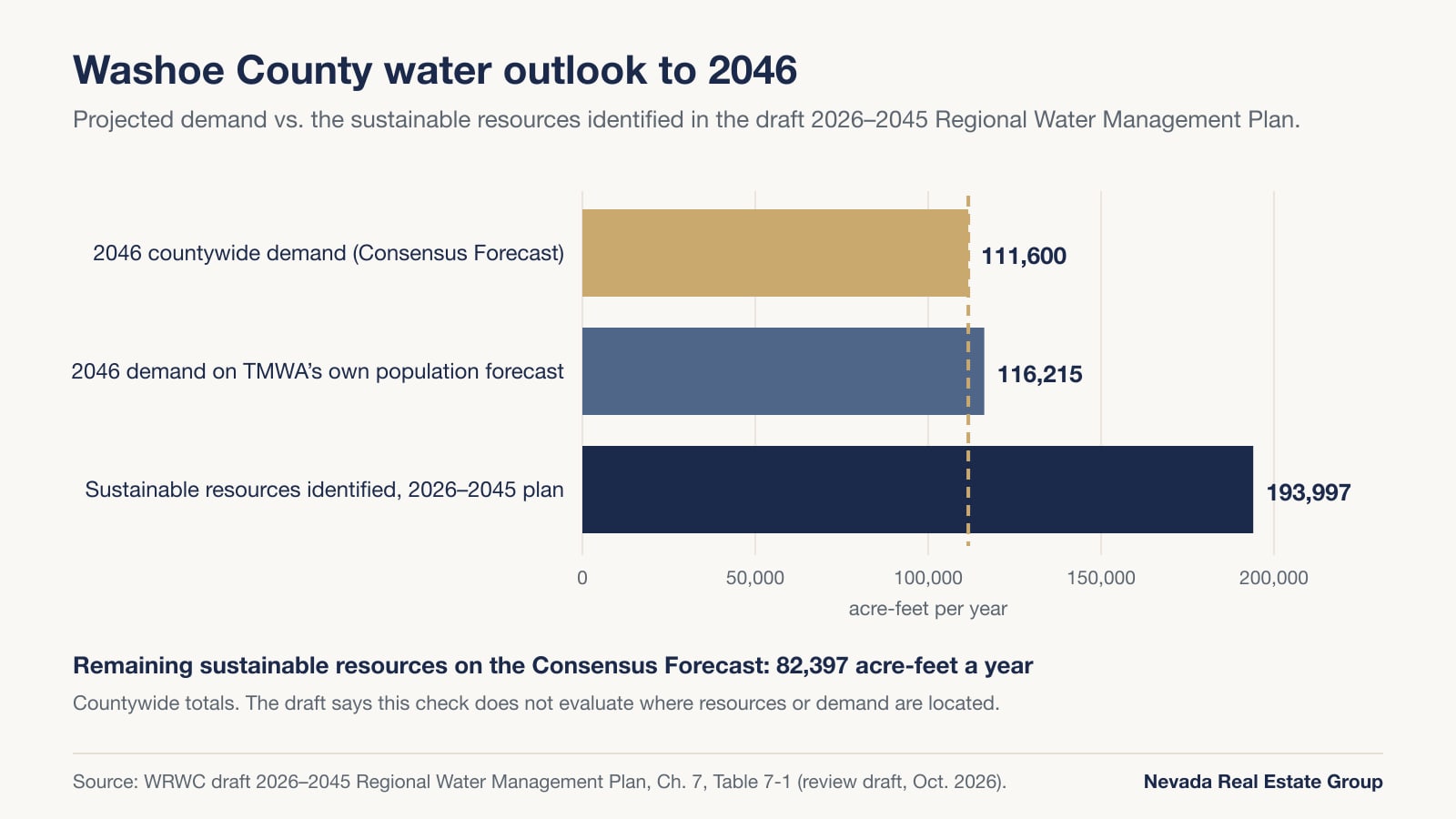
The newest numbers come from the commission's draft update. According to Chapter 7 of the Western Regional Water Commission's draft 2026–2045 Regional Water Management Plan, posted for public review in October 2026, the 2026 Consensus Forecast puts the county at 523,985 people in 2026 and 595,292 in 2046. Applying TMWA's average use of about 61,094 gallons per person per year gives a 2046 demand of about 111,600 acre-feet, against 193,997 acre-feet of sustainable resources, leaving 82,397 acre-feet of headroom. TMWA's own forecast of 610,019 people and 116,215 acre-feet lands close. The commission found the forecast population can be supported, while noting that the finding "addresses the adequacy of water resources at the countywide level and does not evaluate where those resources or projected demands are located."
Who actually decides how much the region grows? Not the water utility. TMWA's plan and its data center page both say land-use decisions belong to Reno, Sparks and Washoe County; TMWA's role is to make sure each project dedicates sustainable rights and pays for the pipes, treatment and storage to serve it. TMWA summarizes the policy as "growth pays for growth," and its September 2026 rate proposal states that new development pays for itself through connection fees rather than through existing customers' rates. For a look at what is being built, see our Reno-Sparks development pipeline.
How Do Water Rights and Will-Serve Letters Work for New Homes?
This is where water stops being abstract and becomes a line item. Under TMWA Rule 7, new or modified service needs a will-serve commitment letter whenever TMWA determines water resources are required, and TMWA issues that letter only after enough resources are committed to cover the project's estimated demand. A developer either deeds acceptable water rights to TMWA or, if it has none to offer, buys an allocation from TMWA's inventory of uncommitted rights.
Rule 7 spells out the arithmetic. A single-family lot's annual demand is 1 divided by (1 plus 19,000 divided by the lot size in square feet), with a minimum of 0.11 acre-feet; apartments, condominiums and townhomes are set at 0.10 acre-feet per unit; landscape irrigation is 3.41 acre-feet per acre. The demand is then multiplied by 1.11 when the rights are mainstream Truckee River rights, the extra 11 percent going to drought storage, or by 1.00 for groundwater rights.
| Home type | Estimated demand (acre-feet a year) | Truckee River rights required at 1.11 |
|---|---|---|
| Condominium or townhome unit | 0.100 | 0.111 |
| 5,000 sq ft lot | 0.208 | 0.231 |
| 7,000 sq ft lot | 0.269 | 0.299 |
| Quarter acre (10,890 sq ft) | 0.364 | 0.404 |
| Half acre (21,780 sq ft) | 0.534 | 0.593 |
| One acre (43,560 sq ft) | 0.696 | 0.773 |
What do those rights cost? There is no published per-acre-foot price to quote. Rule 7 sets TMWA's inventory price as a weighted average of what it cost TMWA to buy, research, transfer and carry the rights, recalculated monthly, and it caps a single application at 100 acre-feet unless the general manager approves more. Private sales between rights holders are negotiated. Anyone pricing a lot should get the number from TMWA in writing rather than from a rule of thumb.
The fees around the rights are published. According to TMWA's rate schedules effective May 1, 2026, a single residential service pays $400 for engineering review, $200 for lands and water resources and $350 for inspection, and each will-serve letter costs $200. TMWA's new construction page prices a Water Resource Determination, which establishes the water allocated to a property without a will-serve letter, at $200. Water System Facility charges then run per gallon per minute of maximum-day demand: an area charge from $0 in central Reno to $18,130 in Verdi and $16,039 in ArrowCreek and Mt. Rose, plus a $7,300 supply and treatment charge in most areas and $933 for storage in some. Our custom home guide works those charges through for real lot sizes, and the Reno and Sparks land guide covers rights, wells and septic on raw parcels.
If you are buying a finished home from a builder, the builder or developer has already committed the water for that lot, and the cost is inside the price. It still matters, because every lot needs dedicated water before TMWA will serve it, whether you are looking at new homes in Reno or new construction in Sparks. Our Reno builders guide covers the active communities.
Will Data Centers Use Up Reno's Water?
This is the newest version of the water question, and the local numbers are smaller than the national headlines suggest. According to TMWA's Water and Data Centers page, read on October 23, 2026, three data centers were under construction with an estimated combined use of 22 acre-feet a year, which TMWA puts at less than 0.02 percent of its annual deliveries. Using TMWA's own yardstick of a third of an acre-foot per single-family home, that is roughly what 66 houses use.
The biggest facilities are elsewhere. TMWA says the region's largest data centers are in Storey County and are not connected to its municipal system; TMWA works with Reno and Sparks to send treated effluent, not drinking water, to the Tahoe-Reno Industrial Center for industrial use. Large projects also face regional review: TMWA notes that any project using 625 acre-feet a year or more is a Project of Regional Significance that the Truckee Meadows Regional Planning Agency must review for conformance with the Regional Plan.
The same water-rights rule applies to a data center as to a subdivision. According to the Legislative Counsel Bureau's May 12, 2026 background memo, developers in TMWA's service area, data center developers included, must buy or obtain water rights on the open market, dedicate them to TMWA, and add an additional 11 percent for drought reserves. The memo converts the 625 acre-foot threshold to 203.7 million gallons a year.
The honest caveat is that power-plant water and future projects outside TMWA's system are a separate conversation, and estimates there are projections rather than meter readings. Our Nevada data center guide covers statewide water, noise and power-bill questions. For a household on TMWA water, the practical effect today is small, because a data center that wants service has to bring its own rights rather than share the existing customers' supply.
Who Supplies Water to a Specific Reno or Sparks Address?
Usually TMWA, but not always, and the difference matters for rates, rules and who answers the phone. According to the draft regional plan's chapter on water providers, the planning area has two public purveyors serving about 95 percent of the Truckee Meadows, several private utilities regulated by the Public Utilities Commission of Nevada, small community systems, and roughly 9,100 domestic wells countywide according to Washoe County Assessor files.
| Provider | Type | Approximate connections or customers | Source |
|---|---|---|---|
| Truckee Meadows Water Authority | Public, community-owned | 138,000 connections | Truckee River, Whites Creek, 86 wells |
| Sun Valley General Improvement District | Public | 6,000 connections | Wholesale water from TMWA |
| Great Basin Water Co., Cold Springs | Private, PUCN-regulated | 3,316 connections | 5 wells |
| Great Basin Water Co., Spanish Springs | Private, PUCN-regulated | 576 connections | 2 wells |
| Steamboat Springs Water Works | Private, PUCN-regulated | 265 connections | 3 wells |
| Verdi Meadows Utility Co. | Private | 175 customers | Wells; told by PUCN in 2025 to build a TMWA wholesale connection |
| Silver Knolls Mutual Water Co., Lemmon Valley | Nonprofit mutual | 64 customers | 2 wells |
| Domestic wells | Private, one per home | About 9,100 countywide | Groundwater, up to 2 acre-feet a year each |
TMWA itself has corners that work differently. Its plan describes five satellite systems that depend entirely on groundwater: Sunrise, Old Washoe Estates and Lightning W in the Pleasant Valley and Washoe Valley areas, Truckee Canyon at Mustang east of Sparks, and Stampmill near Wadsworth. Homes in parts of Cold Springs and Spanish Springs, the Steamboat area and parts of Verdi may be on a private utility instead of TMWA, with its own rate sheet.
How do you check a specific house? Ask the seller for a recent water bill, which names the provider. Compare the address with TMWA's service territory map, linked from the menu on its data center page. Read the MLS water-source field, but treat it as a starting point: "public" on a listing means a water system, not necessarily TMWA. If a private utility serves the home, ask for its current rate schedule. Our Northern Nevada utility setup guide covers opening the account once you close.
How Many Reno and Sparks Listings Run on a Domestic Well?
Fewer than most people expect, and they cluster in a handful of ZIP codes. On the afternoon of October 23, 2026, I counted every active residential listing in Reno and Sparks on the NNRMLS feed, 1,642 houses, condominiums, townhomes, co-ops and manufactured homes in all, and read the structured water-source field on each one.
Of the 1,642, 1,532 listed public water only, 93.3 percent. Another 103, or 6.3 percent, listed a well, alone or alongside another source. Four listed a private or other source without a well and three left the field blank. Septic was more common than wells: 175 listings, 10.7 percent, reported a septic tank, including 76 with public water.
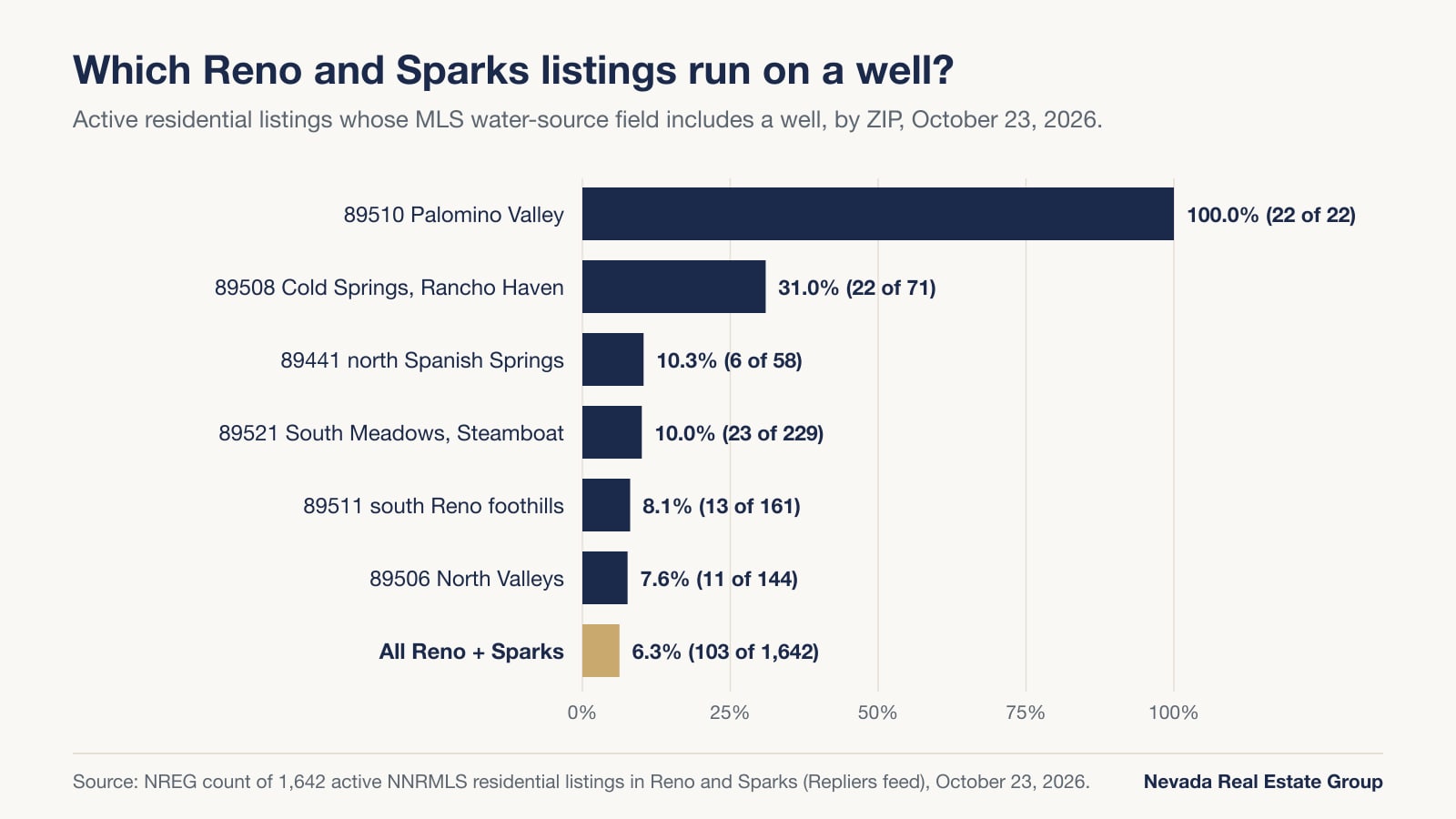
| ZIP and area | Well listings | All active listings | Share on a well | Median lot, well listings | Median asking price, well listings |
|---|---|---|---|---|---|
| 89510, Palomino Valley | 22 | 22 | 100% | 40.2 acres | $914,950 |
| 89508, Cold Springs and Rancho Haven | 22 | 71 | 31.0% | 10.4 acres | $650,000 |
| 89441, north Spanish Springs | 6 | 58 | 10.3% | 10.1 acres | $1,175,000 |
| 89521, South Meadows and Steamboat | 23 | 229 | 10.0% | 1.2 acres | $769,900 |
| 89511, south Reno foothills | 13 | 161 | 8.1% | 2.6 acres | $2,500,000 |
| 89506, North Valleys | 11 | 144 | 7.6% | 1.7 acres | $620,000 |
| All other ZIPs (wells only in 89509, 89519, 89523 and 89434) | 6 | 957 | 0.6% | 1.7 acres | $2,445,000 |
| All Reno and Sparks | 103 | 1,642 | 6.3% | 5.0 acres | $860,000 |
The pattern is acreage. Ninety-seven of the 103 well listings sat on an acre or more, and the median well listing had 5.0 acres against 0.16 acres for public-water listings. The median asking price was $860,000 for well homes and $595,000 for public-water homes, which reflects land and location more than water. Ninety-eight of the 103 also reported septic, so a well purchase is usually a well-and-septic purchase. If you are shopping homes with land or Palomino Valley, assume a well until you confirm otherwise. Our Reno acreage guide covers that market in more depth.
What Should You Check Before Buying a Home on a Well?
Start with what Nevada law gives a domestic well and what it does not. According to NRS 534.180, a well used for domestic purposes needs no water-right permit as long as it draws no more than 2 acre-feet a year, about 651,700 gallons according to the Nevada Division of Water Resources domestic well FAQ. One well serves one single-family home, with narrow exceptions; the main one is an accessory dwelling unit that local rules allow, which requires local approval, a meter and the same 2 acre-foot cap.
Then the limits. Under NRS 534.110, if withdrawals in a basin are ever curtailed by priority, a domestic well may still draw 0.5 acre-feet a year, recorded by a meter. Under NRS 534.180, the State Engineer can require a well drilled on or after July 1, 1981 to be plugged no sooner than a year after public water can be furnished to the site, and only if the well is within 1,250 feet of a municipal water system. In designated basins, NRS 534.120 lets the State Engineer prohibit new domestic wells where public water can be furnished and require water rights to be dedicated when land is split. The Division's FAQ puts the practical version simply: a domestic well generally cannot be drilled if the parcel can be served by a public water supply.
Washoe County adds its own rule for new parcels. According to the same draft chapter on water providers, Washoe County Ordinance 586, adopted in 1984 and now Article 422, requires 2.0 acre-feet of water rights to be dedicated for each newly created parcel served by a domestic well, and the Warm Springs basin requires 2.5. Existing parcels are not affected, but a seller splitting off a lot is.
Basin health varies. The draft plan's water resources chapter lists the West and East Lemmon Valley basins with a perennial yield of 1,300 acre-feet a year against 2,822 acre-feet of permitted and certificated rights and an estimated 2,082 acre-feet of domestic-well use, an over-allocation the draft traces to West Lemmon Valley parcel splits from the 1960s into the early 1980s. If you are looking in Lemmon Valley, read neighbors' well logs closely. Lemmon Valley is also a closed basin with no outlet; the Nevada Independent reported in 2018 that 2017 floodwater made it inside three homes and a church, so pull the FEMA flood map for the address as well.
Some south Reno owners have a safety net. TMWA's Mt. Rose–Galena Fan well mitigation program lets owners in its mapped area whose homes were on a domestic well before July 1, 2011 apply if they believe municipal pumping has hurt the well. If TMWA finds them eligible, the remedy is a waiver of connection charges where TMWA service is available, or reimbursement of certain costs to deepen the well by 150 feet where it is not. And TMWA's water rights explainer says it will not force a working domestic well onto its system when municipal water is not readily available.
My short list for the inspection period: the well log and a flow test, a water-quality test that includes arsenic and nitrate, which TMWA's plan identifies in parts of the Truckee Meadows and Spanish Springs groundwater, a septic inspection, and the seller's disclosure of any well or septic problems. Our Nevada well and septic guide, Northern Nevada inspection guide and Washoe seller disclosure guide walk through each step.
What Does Water Cost a Reno Homeowner Now, and What Is Proposed?
TMWA bills on an inverted tier structure, so the first gallons are cheapest and summer irrigation is what moves a bill. Under the residential metered schedule effective May 1, 2026, the customer charge is $21.87 a month for a three-quarter-inch meter or $34.37 for one inch and larger. Water costs $2.20 per 1,000 gallons for the first 6,000 gallons, $3.30 per 1,000 from 6,001 to 25,000, and $4.39 per 1,000 above that. A regional water management fee and a right-of-way toll are added, and homes where TMWA maintains a backflow device pay $5.78 more.
| Monthly use | Customer charge | Water charges | Total before fees |
|---|---|---|---|
| 5,000 gallons, winter or small lot | $21.87 | $11.00 | $32.87 |
| 8,800 gallons, TMWA's typical household | $21.87 | $22.44 | $44.31 |
| 15,000 gallons | $21.87 | $42.90 | $64.77 |
| 25,000 gallons, irrigated summer lot | $21.87 | $75.90 | $97.77 |
| 35,000 gallons, large turf lot | $21.87 | $119.80 | $141.67 |
TMWA puts its typical household bill, at 8,800 gallons a month, at $44.98 once the added fees are included. Summer is the swing: the plan says summertime demand runs three to four times winter use, so landscaping is a real carrying cost. If you are comparing two homes, price a large lawn against a desert yard as a monthly expense, not just a look.
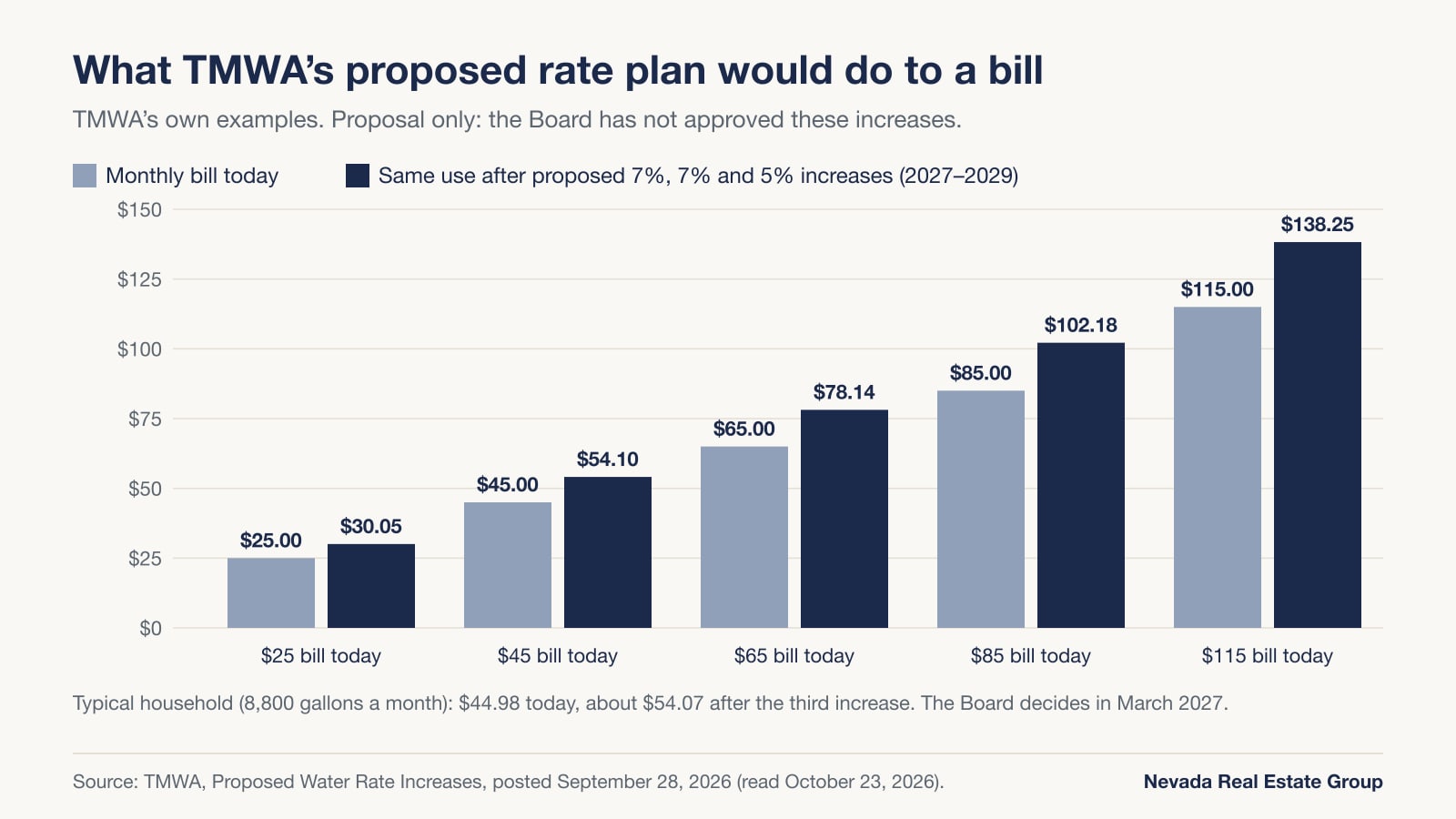
Rates may rise. According to TMWA's proposed rate increase page posted September 28, 2026, staff propose increases of 7 percent in 2027, 7 percent in 2028 and 5 percent in 2029, each taking effect on or about May 1. The typical bill would go from $44.98 to about $54.07, roughly $3 more a month each year. TMWA says the plan funds roughly $210 million of rehabilitation and replacement over five years, starting near $38 million in fiscal 2027, and it cites about $140 million of planned work on existing tanks and water mains. The plan pairs the increases with about $50 million in bonds; without the borrowing, TMWA says the increases would need to be 10, 10 and 8 percent. The Board authorized outreach on September 16, has not approved the increases, and expects to decide in March 2027 after public hearings in February and March. TMWA notes its rates rose about 25 percent since 2018 while consumer prices rose about 39 percent, and its survey of 55 utilities put the median typical bill at $62.90.
What New Water Supplies Is the Region Building?
TMWA's plan meets projected growth mainly by converting more farm rights and using Fish Springs groundwater; the new projects add resilience on top of that. The largest is the OneWater Nevada Advanced Purified Water Facility at American Flat, a TMWA and City of Reno project that will treat recycled water from the Reno-Stead plant to drinking-water standards and inject it into an aquifer north of Stead Airport. According to TMWA's June 13, 2024 announcement, the Bureau of Reclamation awarded a $30 million WaterSMART grant for it. TMWA's plan describes a facility designed for up to 2 million gallons a day, with construction expected to begin in 2026 and operation by 2030. Schedules have slipped before: TMWA's September 2026 rate page says it spent about $69 million of a roughly $121 million capital budget in fiscal 2026, mostly because American Flat "didn't begin as quickly as forecast."
The quieter projects matter as much. TMWA plans to expand aquifer storage and recovery from about 3,000 acre-feet a year today toward 5,500 within three to five years, the same tool that erased most shortages in its climate modeling. A nitrate treatment plant of 3 to 4 million gallons a day is planned for Spanish Springs between 2030 and 2035. Up to 5,000 more acre-feet a year from Fish Springs Ranch is listed beyond 2045, and the draft regional plan counts the Honey Lake Valley basin's estimated perennial yield of 13,000 acre-feet a year, today's 8,000 included, as a sustainable resource, with imports subject to State Engineer approval.
Reservoir operations are changing too. Truckee River stakeholders, including the Bureau of Reclamation, both states, the Pyramid Lake Paiute Tribe and TMWA, have developed forecast-informed rules for filling and releasing the federal reservoirs, which give more winter flexibility than the fixed flood-space rules of the Army Corps of Engineers' 1985 manual. The Corps has granted operating deviations while it reviews the update. That matters as more precipitation falls as rain instead of snow.
Conservation has done more than any single project. TMWA's use per person fell from 143 gallons a day in 2003 to 104 in 2024, water lost in the pipes was 9.4 percent in 2024, under the industry benchmark of 10, smart meters were scheduled for every connection by the end of 2025, and 8,853 acre-feet of recycled water used on parks, medians and golf courses offset about 10 percent of potable demand in 2024. TMWA's plan also singles out wildfire as a threat to the watershed after the 2021 Sierra fires; our wildfire insurance guide covers the household side.
How Should Water Shape Where You Buy Around Reno?
For most buyers, water is a utility-bill question, not a risk question. A resale home on TMWA water in a neighborhood like Damonte Ranch or central Sparks inherits the region's storage, drought plan and rate schedule. The useful comparison between two such homes is landscaping and lot size, because summer irrigation drives the bill and drought rules limit outdoor watering, not indoor use. Our Reno housing market report and Sparks market report cover prices; water rarely separates one TMWA neighborhood from another.
New construction shifts the water cost to the builder and, through the price, to you. Rule 7 rights, the 11 percent drought dedication and Water System Facility charges are part of the cost of every approved lot in the Truckee Meadows. If you are buying a lot to build on, those charges and the will-serve letter belong in your feasibility window, not after closing.
A private water company is a different relationship. Rates come from the company's own schedule, which the Public Utilities Commission oversees for for-profit utilities, not from TMWA's, and the system may rely on a few wells. Ask for the rate sheet and any recent rate case before you commit. A domestic well is the most self-reliant arrangement and the one that needs the most diligence: the well log, flow and water-quality tests, septic inspection, basin conditions and flood maps, as covered above.
If you are comparing Northern and Southern Nevada, note that Reno does not depend on the Colorado River at all; our Reno versus Las Vegas comparison covers the broader tradeoffs. For the full relocation picture, start with our Reno relocation guide and the longer moving to Reno overview.
Frequently Asked Questions
Does Reno have water restrictions right now?
Only the standing ones. In non-drought years TMWA customers water on assigned days, Tuesday, Thursday and Saturday for even addresses and Wednesday, Friday and Sunday for odd, with no watering on Monday and no lawn watering from noon to 6 p.m. between Memorial Day and Labor Day. In April 2026, TMWA said it expected normal river flows through October despite a low snowpack.
Is Reno's water supply affected by the Colorado River shortage?
No. TMWA's supply comes from the Truckee River system, local groundwater basins, Donner and Independence lake storage and imported Fish Springs Ranch groundwater. The Colorado River serves Southern Nevada, including Las Vegas, under a separate set of agreements, so cuts there do not reduce Reno's tap water.
How much water does a typical Reno house use?
TMWA says a single-family residence typically uses about a third of an acre-foot a year, roughly 108,600 gallons. Its typical-bill household uses 8,800 gallons a month, which works out to about 0.32 acre-feet a year. Summer use runs three to four times winter use because of irrigation.
Do I need to buy water rights to build a house in Reno?
If TMWA will serve the lot, yes. Rule 7 requires a will-serve letter backed by dedicated water rights, with the amount set by a lot-size formula and multiplied by 1.11 for Truckee River rights. A lot that already has a will-serve letter has its rights documented. For one without, a $200 Water Resource Determination shows what water, if any, is already allocated to it; any shortfall has to be dedicated or bought.
Can a domestic well in Nevada be cut back?
Yes, in limited cases. A domestic well may draw up to 2 acre-feet a year without a permit, and if a basin's withdrawals are curtailed by priority, NRS 534.110 still allows 0.5 acre-feet a year through a meter. For wells drilled on or after July 1, 1981, the State Engineer can also require plugging a year or more after public water becomes available, if the well is within 1,250 feet of a municipal system.
Will my TMWA water bill go up in 2027?
Possibly. TMWA has proposed increases of 7 percent in 2027, 7 percent in 2028 and 5 percent in 2029, which would take a typical $44.98 bill to about $54.07. The Board has not approved them; public hearings are planned for February and March 2027, with a decision in March and the first increase on or about May 1, 2027 if adopted.
What happens if Lake Tahoe drops below its rim?
Water stops flowing from the lake into the Truckee River once Lake Tahoe falls below its natural rim of 6,223.0 feet, and the required state-line flows soon drop. TMWA then releases its stored credit water and Donner and Independence lake water, increases groundwater pumping and steps up conservation. Its plan notes supplies are typically not affected until the third year of a drought.
Does saving water at my house free up water for new development?
No. TMWA's plan states that water rights left unused because customers conserve cannot be rededicated for growth. That water stays in upstream reservoirs as drought storage or flows downstream to other rights holders. New development must bring its own rights, plus the extra 11 percent for drought storage.
Which Sources Inform This Reno Water Supply Guide?
The listing figures are my own count. On October 23, 2026, I pulled all 1,642 active residential listings in Reno and Sparks from the NNRMLS feed through Repliers and read the structured water-source, sewer and lot-size fields on each one. The counts describe asking prices and agent-entered fields on that date, not closed sales, and inventory changes daily. The water-rights table and bill table are my arithmetic from TMWA's published Rule 7 formula and May 1, 2026 rate schedule; TMWA sets the final numbers for any real application.
Water supply, demand and drought: the TMWA 2025–2045 Water Resource Plan, its planning page and At-A-Glance announcement, TMWA's drought-resiliency explainer, and the Bureau of Reclamation's TROA page. Current conditions: News 4, April 2, 2026 and KOLO, February 2026. Growth: the TMRPA 2024 Consensus Forecast and its forecast page, and the WRWC draft 2026–2045 Regional Water Management Plan, a public review draft as of October 2026, especially Chapter 2, Chapter 3 and Chapter 7.
Rules, fees and rates: TMWA Rule 7, the TMWA rate schedules effective May 1, 2026, TMWA's new construction page, the proposed rate increase page posted September 28, 2026, and the American Flat grant announcement. Data centers: TMWA's Water and Data Centers page and the Legislative Counsel Bureau memo of May 12, 2026. Wells: NRS chapter 534, the Division of Water Resources domestic well FAQ, TMWA's well mitigation program and water rights explainer, the Nevada Independent on Lemmon Valley, and FEMA's flood map service.
If you are weighing a Reno or Sparks home and want help reading the water side of a listing, from the provider and the bill to a well log or a will-serve letter, call Nevada Real Estate Group at (775) 277-2120, or browse Reno homes for sale and Northern Nevada communities to start narrowing the search.