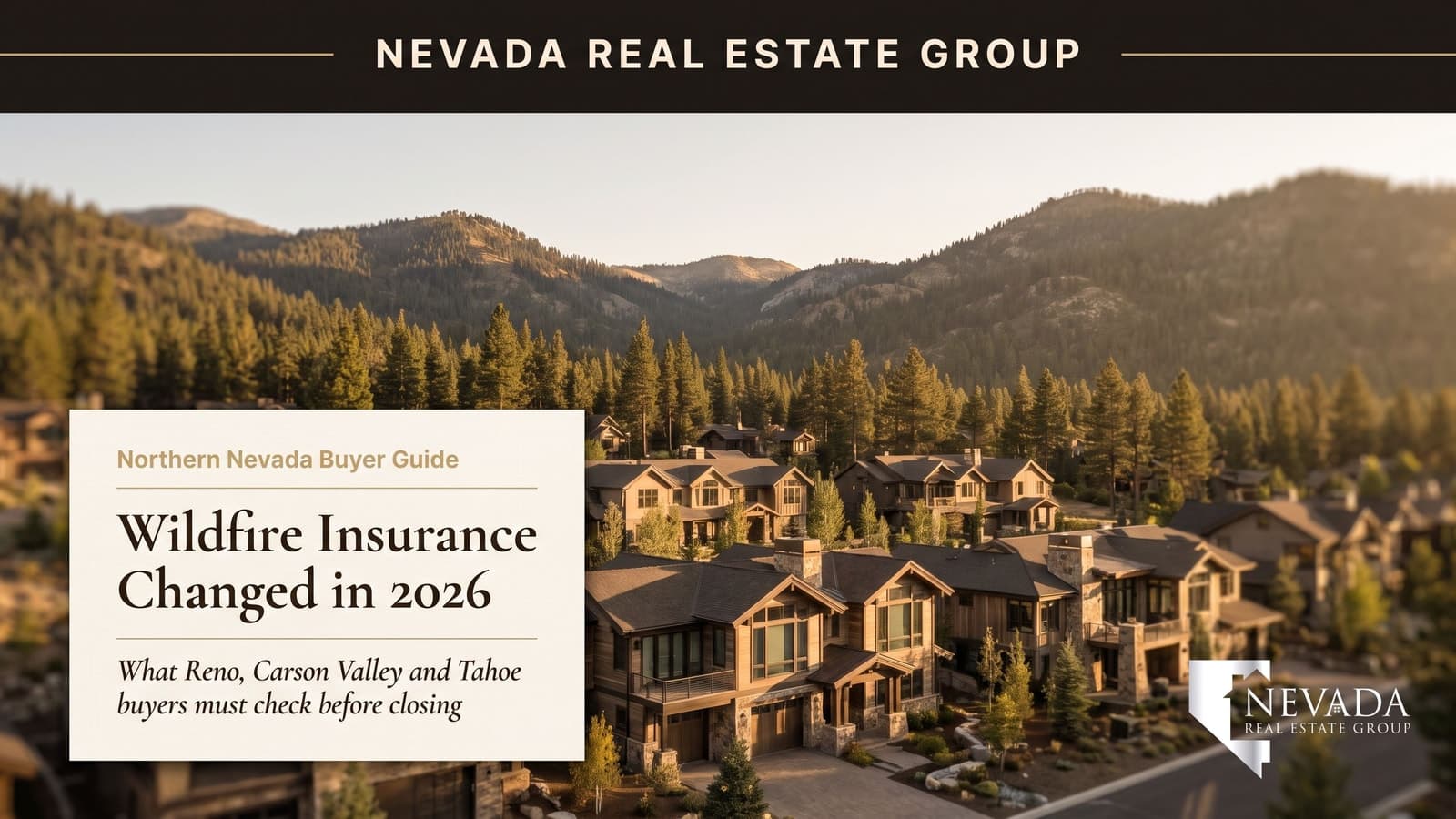

Something changed in Nevada on January 1, 2026 that almost no buyer knows about, and it reshapes how you should approach a house anywhere near the Sierra front. Nevada became the first state in the country to let insurance carriers sell a homeowners policy that simply does not cover wildfire. Not a higher deductible, not a sublimit — a policy where the fire that burns your house down is carved out and sold separately, or not sold at all. And unlike California, Nevada has no FAIR Plan, no residual market, and no insurer of last resort standing behind that decision. If you are buying in Reno's foothills, Carson Valley, Washoe Valley, Incline Village, or anywhere the pines start, the insurance question is no longer a formality you handle a week before closing. It is a condition of the deal, and it belongs in your first conversation, not your last.
Nevada Real Estate Group has closed more than 9,600 transactions across the state and 789 homes in 2025 alone, and our Northern Nevada team works the Reno–Carson–Tahoe corridor every week. That vantage point is why this guide leads with insurance rather than burying it: it is now the item most likely to break a foothill or basin deal, and the one buyers are least prepared for.
Nevada's AB376 took effect January 1, 2026, letting carriers sell homeowners policies that exclude wildfire — the first such law in the country. A bill creating a state FAIR Plan died the same session, so Nevada has no insurer of last resort. A Northern Nevada house can therefore be financeable and still effectively uninsurable. Get a bindable quote on the specific address before your inspection contingency expires.
- AB376 took effect January 1, 2026 — Nevada is the first state to permit wildfire carve-outs from home policies.
- Carriers must apply a carve-out statewide, not cherry-pick Washoe or Douglas County.
- AB437, which would have created a Nevada FAIR Plan, died in session — there is no backstop.
- Wildfire-related nonrenewals and cancellations in Nevada jumped 82% in a single year.
- Quote the actual address before contingencies expire — a lender-approved home can still be uninsurable.
What Exactly Did Nevada Change on January 1, 2026?
Assembly Bill 376 passed the Nevada Legislature in June 2025, was signed by Governor Joe Lombardo, and took effect at the start of 2026. According to The Nevada Independent, the law grants carriers the ability to separate wildfire coverage from a standard homeowners policy and offer it as a standalone product — or as part of an alternative arrangement approved by the insurance commissioner.
Three details matter more than the headline. First, a carrier that chooses to use a carve-out has to apply it statewide. It cannot exclude wildfire in Incline Village and keep covering it in Las Vegas, which is a meaningful consumer protection and the reason this is less brutal than it first sounds. Second, the law creates a regulatory sandbox: carriers can test business models — including wildfire-only policies and separate wildfire deductibles — with the commissioner's approval. Separate wildfire deductibles were previously prohibited under Nevada law. Third, and this is the part that should shape your buying behavior, Nevada is the first state in the country to do this. There is no other market's experience to learn from.
According to the Nevada Division of Insurance, the state regulates carrier filings and consumer complaints, and it is the office that approves the sandbox arrangements AB376 permits. If you want to know what a carrier is actually allowed to sell you in 2026, that is the authority, not the agent's brochure.
Why Does Nevada Having No FAIR Plan Matter So Much?
In California, a homeowner who cannot find coverage on the open market has somewhere to land. The California FAIR Plan is an insurer of last resort — expensive, limited, and widely criticized, but it exists. Nevada has nothing equivalent. No FAIR Plan, no residual market, no statutory backstop.
That gap was on the table in 2025 and the Legislature chose not to close it. Assembly Bill 437, sponsored by Assemblymember Jill Dickman, would have created a state-administered, insurer-funded program of last resort covering homeowners who had been denied by three standard carriers, with participation conditioned on implementing wildfire protection measures. It died during the session. The American Property Casualty Insurance Association opposed it. The Nevada Fire Chiefs Association and Washoe County supported it.
So the practical situation in 2026 is that Nevada expanded what carriers may decline to cover in the same session it declined to build a safety net underneath. For a buyer, that asymmetry is the whole story. In California, "I could not get coverage" is a problem with a bad answer. In Nevada, it can be a problem with no answer.
Across the closings our Northern Nevada team has represented in the Reno–Carson–Tahoe corridor, insurance has moved from a late-stage errand to a live deal term — the calls that used to come three days before closing now come before the offer. That shift is not a forecast. It is what the phone sounds like now.
How Bad Is the Nonrenewal Problem in Northern Nevada?
The trend line is what should concern a buyer, more than any single number. Wildfire-related policy cancellations and nonrenewals in Nevada jumped 82% in one year, and according to Nevada Current, that pressure is what drove two separate legislative attempts in 2025.
The exposure is not evenly spread. The Reno–Tahoe region, Incline Village, Stateline, and parts of Douglas County are where carriers have most visibly pulled back. That maps almost exactly onto the wildland-urban interface — the band where subdivisions meet unmanaged fuel. According to the Nevada Division of Forestry, the state's fire management responsibility covers millions of acres of that interface, and according to the U.S. Forest Service, the Lake Tahoe Basin Management Unit alone administers roughly 154,000 acres surrounding the lake — much of it directly uphill from homes.
Southern Nevada is a different market on this question. A buyer in the Las Vegas valley is not facing the same underwriting posture, which is precisely why a statewide law with a statewide-application rule lands so unevenly. The carve-out that a carrier adopts to manage Sierra-front risk applies to a house in a subdivision with no fuel within twenty miles.
| Question | Before 2026 | 2026 onward |
|---|---|---|
| Can a policy exclude wildfire? | No | Yes — AB376, statewide application required |
| Separate wildfire deductible? | Prohibited | Permitted under the sandbox |
| Insurer of last resort? | None | Still none — AB437 died |
| Where does the risk land? | On the carrier | Increasingly on the owner |
| When should a buyer ask? | Before closing | Before writing the offer |
What Should You Actually Do Before Writing an Offer?
Treat insurance as a due-diligence item with the same seriousness as the inspection, and front-load it. The sequence that protects you looks like this.
Get a written quote on the specific address, not a ballpark for the ZIP code. Underwriting in the interface is parcel-level: two houses on the same street can price differently because one has a Class A roof and thirty feet of cleared slope and the other has wood shake and junipers against the siding. A quote for "a house in 89511" tells you nothing you can rely on.
Ask three explicit questions and get the answers in writing. Does this policy cover wildfire, or is wildfire carved out? If it is carved out, what does the standalone wildfire product cost and who writes it? Is there a separate wildfire deductible, and is it a flat dollar amount or a percentage of the dwelling limit? A 5% wildfire deductible on a $900,000 dwelling limit is $45,000 out of pocket before the carrier pays anything — a number that does not appear anywhere in your monthly payment estimate.
Ask the seller for their current declarations page and their claims and nonrenewal history. A seller who was nonrenewed will often disclose it when asked directly, and that single document tells you more about the property's insurability than any general research. If the seller's carrier dropped the house, you are not going to have an easier time than they did.
Finally, confirm the quote is bindable, not indicative. An agent can quote a number that underwriting later declines. The distinction matters most in exactly the areas where you need it most.

Which Home Features Move a Wildfire Quote the Most?
Underwriters are looking at a fairly consistent list, and the good news is that most of it is fixable or at least knowable before you commit.
The roof is the single biggest lever. A Class A fire-rated roof — asphalt composition, tile, metal — is table stakes in the interface. Wood shake is close to disqualifying with many carriers. Siding and decking matter next: noncombustible or ignition-resistant materials price better than wood, and an unenclosed wood deck cantilevered over a slope is one of the worst configurations in wildfire science, because it collects embers and sits in the path of upslope fire.
Vents are the quiet one. Most homes are lost to ember intrusion, not to a wall of flame, and unscreened attic and crawlspace vents are the way embers get inside. Ember-resistant vents are inexpensive relative to their effect. Windows matter for the same reason — dual-pane tempered glass survives radiant heat that shatters single-pane, and a broken window is an open door for embers.
Then the ground itself. Defensible space is the cleared, managed zone around the structure, and carriers increasingly want to see it documented. According to the Nevada Division of Forestry, defensible space guidance in Nevada is organized in zones radiating out from the structure, with the area immediately against the walls kept most rigorously clear. According to the Insurance Institute for Business and Home Safety, its Wildfire Prepared Home standard bundles these measures into a certifiable package that some carriers now recognize, and according to Ready.gov, the same measures are the federal baseline for wildfire preparedness.
| Feature | Underwriting effect | Typical cost to change |
|---|---|---|
| Class A fire-rated roof | Often required to write at all | $15,000–$45,000 replacement |
| Ember-resistant attic/crawl vents | Strong positive, low cost | $400–$1,800 |
| Dual-pane tempered windows | Positive | $700–$1,400 per window |
| Noncombustible siding | Positive | $20,000–$60,000 |
| Enclosed or noncombustible deck | Positive; wood over slope is a red flag | $8,000–$35,000 |
| Documented defensible space | Increasingly expected | $500–$5,000 initial clearing |
Those ranges are directional planning figures, not bids. Get a contractor's number before you rely on any of them in a negotiation.
How Should This Change What You Offer and How You Negotiate?
Insurance is now a legitimate negotiating lever, and most buyers are not using it because they discover the problem too late to trade on it.
If a bindable quote comes back dramatically above what you assumed, that is a price conversation, not a walk-away. A $4,200 annual premium where you budgeted $1,800 is roughly $200 a month of payment you did not plan for — capitalize that over your hold period and it is a real number to bring to the seller. If the gap is driven by a specific fixable defect, ask for the fix or a credit sized to it: a roof that will not underwrite is a seller problem long before it is your problem, because the next buyer will hit the same wall.
The table below is the arithmetic worth running before you tour, because the insurance line does not just cost money — it consumes borrowing capacity. Every dollar of premium is a dollar the lender counts against your debt-to-income ratio, so a high-premium house is quietly a smaller house.
| Annual premium | Monthly | Versus a $1,500 baseline | Approximate purchase power absorbed |
|---|---|---|---|
| $1,500 | $125 | — | — |
| $2,400 | $200 | $75/mo | about $11,500 |
| $4,200 | $350 | $225/mo | about $34,600 |
| $6,000 | $500 | $375/mo | about $57,700 |
| $9,000 | $750 | $625/mo | about $96,100 |
Read the right-hand column as the point of the whole exercise. A buyer approved at $750,000 with a $1,500 premium assumption is realistically a $693,000 buyer at $6,000 — and if they find that out after the appraisal, they have lost both the house and the deposit timeline. A $12,000 premium on a basin property, which is not a hypothetical number in the most exposed pockets, absorbs well over $100,000 of purchase power on its own.
Keep your inspection and financing contingencies genuinely alive while this plays out. A waived inspection contingency in the interface is a much bigger gamble in 2026 than it was in 2023, because the thing that can blow up your deal is no longer just the condition of the house — it is whether anyone will insure it. And if you are shopping with a lender, tell them early: a payment that pencils at a $1,500 premium may not pencil at $4,500, and you would rather find that out before you are emotionally committed.
Are Some Northern Nevada Areas Easier to Insure Than Others?
Yes, and the pattern follows fuel and topography more than it follows price. A home on the valley floor in a dense subdivision with irrigated landscaping and no slope is a different underwriting animal from a home on a wooded ridge with a single access road, even when the two are ten minutes apart.
In broad strokes: interior Reno and Sparks neighborhoods on the valley floor tend to be the most straightforward. The foothill communities on Reno's west and south edges sit squarely in the interface. Carson City's west side runs up against the Sierra front while its east side does not. Gardnerville and Minden span both profiles, with the ranch and open-space parcels underwritten more cautiously than the in-town blocks. Incline Village and the Lake Tahoe basin are the most scrutinized in the region — dense conifer, steep terrain, and constrained evacuation routes are the exact combination underwriters price hardest. Dayton and the rural Lyon County communities vary parcel by parcel with the fuel around them.
None of that is a reason to avoid a place you want to live. The Tahoe basin remains the most desirable real estate in Northern Nevada and the foothills are where the views are. It is a reason to price the insurance before you fall in love, and to understand that two houses on the same street can carry very different carrying costs for reasons you cannot see from the curb.
What Happens If You Cannot Get Wildfire Coverage at All?
This is the scenario Nevada now has no institutional answer for, so it is worth understanding the ladder before you are standing on it.
Start with the surplus lines market. These are carriers not admitted in Nevada, writing risks the standard market declines. Surplus lines coverage is legal and often the practical answer in the interface, but it is more expensive, the forms are less standardized, and — this is the part people miss — surplus lines carriers are generally not backed by the state guaranty association if the insurer becomes insolvent. That is a real difference in what you are buying.
Next, standalone wildfire policies, which AB376 explicitly enables. A standard policy covers everything else while a separate product covers fire. Read the definitions carefully: what triggers the wildfire policy, what the deductible is, and whether the two policies together actually leave you whole. Two policies with a gap between them is worse than one policy with a known limitation.
Then mitigate and re-shop. Hardening measures are not just good practice — they are increasingly the difference between a decline and an offer, and a documented, inspected mitigation package gives an underwriter something to say yes to. Some carriers recognize third-party certification like the IBHS Wildfire Prepared Home designation.
And if none of that produces a policy you can live with, the honest answer is that the house may not be the right house. A property nobody will insure is a property that will be difficult to finance, difficult to resell, and catastrophic to lose. Walking away from a home you love because of an insurance quote feels absurd until you consider that the alternative is carrying that risk personally, with no FAIR Plan behind you.
How Does This Compare to Buying on the California Side of Tahoe?
Buyers looking at the Tahoe basin often weigh both shores, and insurance now cuts in a genuinely complicated direction rather than a simple one.
California has a FAIR Plan, so there is a floor — a homeowner who cannot find coverage has a last-resort option. Nevada does not. On that single axis, California is the safer place to be uninsurable. But California's insurance market has been under severe strain, with carriers restricting new business in high-risk areas, and its FAIR Plan is expensive and limited in what it covers. Nevada's market is smaller and less publicly troubled, and Nevada has no state income tax on the money you would use to pay either premium.
The honest read is that neither shore is simply "better" on insurance. What is true is that the Nevada side now carries a specific structural risk — a policy can legally exclude wildfire and nothing catches you — that a buyer should price deliberately rather than assume away. If you are weighing the two shores across taxes, price, schools, and lifestyle as well, our Lake Tahoe Nevada versus California guide works through the rest of that decision.
What Does This Mean for Sellers in the Interface?
If you own in the foothills or the basin, this cuts at you too, and earlier than you might think.
A buyer whose quote comes back at triple their assumption will either renegotiate or leave. You are better off knowing what your house quotes at before it hits the market than discovering it during someone else's due diligence, when you have lost negotiating position and time. Pull your own bindable quote as a seller. If it is ugly, you have a choice: fix the driver, price for it, or be ready to credit for it.
The fixable drivers are worth real money at resale. A Class A roof, ember-resistant vents, and documented defensible space are not glamorous upgrades and they will not show up in a listing photo, but in the interface they increasingly decide whether the buyer's financing survives. If you are thinking about selling in the next year, our sellers page walks through the preparation sequence, and it is worth adding an insurance quote to the top of that list.
What Should Northern Nevada Buyers Do Right Now?
The short version: make insurance the first diligence item, not the last.
Before you tour, get a general sense of what your budget supports in the areas you are considering — the difference between valley-floor and interface carrying costs can be several hundred dollars a month, and that changes what house you can actually afford. Once you are under contract, get a bindable quote on the address immediately, request the seller's declarations page and nonrenewal history, and keep your contingencies intact until the quote is in hand. If the number is a problem, negotiate on it while you still have leverage.
And ask your agent directly whether they have handled a nonrenewal situation in the interface. This is new enough, and Nevada-specific enough, that experience matters more than usual. If you are looking at homes for sale in Reno or anywhere along the Sierra front, our Northern Nevada team at (775) 277-2120 can pull the insurance question forward before you write, rather than letting it surface three days before closing.
Frequently Asked Questions
Does AB376 mean my homeowners policy no longer covers wildfire?
Not automatically. AB376 permits carriers to carve wildfire out; it does not require them to. Your existing policy is what your policy says it is — read the declarations page and the exclusions, and ask your carrier directly whether wildfire is covered and whether a separate wildfire deductible applies. The change matters most at renewal and when you buy a new policy on a new home, because that is when a carrier can present you with the new structure.
Does Nevada have a FAIR Plan I can fall back on?
No. Nevada has no FAIR Plan, no residual market, and no insurer of last resort. Assembly Bill 437 would have created one — covering homeowners denied by three standard carriers, conditioned on wildfire mitigation — and it died during the 2025 session. This is the single most important difference between Nevada and California for a buyer in fire country, and it is why getting a bindable quote before your contingencies expire matters more here than it would across the state line.
Can a mortgage lender approve a home I cannot insure?
Lenders require hazard insurance, so in practice you will not close without a policy. The trap is subtler: you can be approved for the loan on an assumed premium and then discover the actual premium is two or three times that, which changes your debt-to-income and can unwind the approval late in the process. Tell your lender your real quoted premium as soon as you have it rather than letting the estimate ride.
How much does wildfire risk actually add to a premium in Northern Nevada?
It varies enormously by parcel, which is why address-specific quotes are the only reliable answer. The drivers are roof class, siding and deck materials, vent screening, defensible space, slope, surrounding fuel, and access for fire apparatus. Two homes a block apart can differ by thousands of dollars a year on those factors alone. Treat any per-ZIP average — including ranges in articles like this one — as a planning placeholder, never as a number to write an offer around.
What is a separate wildfire deductible and why does it matter?
Before 2026 Nevada prohibited them; AB376's sandbox permits them. A separate wildfire deductible means fire losses carry their own, usually much larger, deductible — often expressed as a percentage of the dwelling limit rather than a flat dollar figure. At 5% on a $900,000 dwelling limit, that is $45,000 you pay before coverage responds. It will not appear in your monthly payment estimate, so you have to look for it in the policy and plan for it in savings.
Will hardening my home actually get me insured, or is it just good practice?
Both, increasingly. Underwriters in the interface are looking for specific, verifiable features — Class A roof, ember-resistant vents, noncombustible siding and decking, tempered glass, and documented defensible space. A mitigation package that has been inspected and documented gives an underwriter grounds to write a risk they would otherwise decline, and third-party certification such as the IBHS Wildfire Prepared Home standard is recognized by a growing number of carriers.
Should I avoid buying in the Reno foothills or Tahoe because of this?
No — but you should price it honestly. The foothills and the Tahoe basin are the most desirable addresses in Northern Nevada for good reasons that have not changed. What has changed is that the carrying cost of those addresses now includes an insurance component that can be large, variable, and occasionally unavailable. Buy there with a bindable quote in hand and a realistic view of the deductible structure, and you are making an informed decision rather than an assumption.
What should I ask a seller about insurance before I make an offer?
Four things, in writing: their current declarations page, whether wildfire is covered or excluded, whether they have ever been nonrenewed or cancelled on this property, and whether they have made any wildfire claims. A nonrenewal in the property's history is the most predictive single fact you can obtain, because the next carrier will see the same house the last one walked away from.
Which Sources Inform This Northern Nevada Insurance Guide?
- The Nevada Independent — carriers can now carve out wildfire coverage
- Nevada Current — bills addressing insurance cancellations over wildfire risk
- Nevada Division of Insurance
- Nevada Legislature
- Nevada Division of Forestry
- Insurance Institute for Business and Home Safety
- Ready.gov — Wildfires
- U.S. Forest Service
- Federal Emergency Management Agency
- National Interagency Fire Center
- U.S. Census Bureau
- National Association of Insurance Commissioners
Nothing here is legal, insurance, or tax advice. Coverage terms, carrier appetite, and statutory interpretation change quickly — verify current requirements with the Nevada Division of Insurance and a licensed Nevada insurance producer before relying on any of it for a purchase decision.