
A Fallon address can lead a buyer toward a house near city services or a property with more land and a different set of responsibilities. The word “safe” can conceal several separate questions: reported crime, flood exposure, drinking water, road access and the condition of the home. Each needs the right source and the right geographic scope.
We checked official records on September 25, 2026. Fallon Police Department reported 23 violent crimes and 157 property crimes in calendar 2025 in Nevada's reporting portal. Those are city-police agency figures, not a total for every place associated with the Fallon area. This guide explains the data and provides a practical way to review the actual property without inventing a neighborhood ranking or an inspection result.
Fallon's official crime records provide useful context, but they cannot guarantee a home's safety. Nevada's portal reports 23 violent crimes and 157 property crimes for Fallon Police Department in 2025. Confirm the agency serving the address, then review flood exposure, the actual water system, access and inspection findings. A rural setting, a city address or proximity to a service does not resolve those property-specific questions.
- Fallon Police reported 23 violent crimes and 157 property crimes in 2025.
- Both totals were higher than the same agency's 2024 figures.
- City-police counts are not a combined total for all Churchill County agencies.
- Match water reports and flood resources to the exact property and system.
- Verify rural access, installed equipment and the household's actual daily routes.
Which agency and boundary should a Fallon buyer use?
According to the City of Fallon's police and fire page, Fallon has a city police department. The state crime portal reports that agency separately. A home search described broadly as “Fallon” should not automatically assign the city department's statistics to every property that appears in the search or shares a mailing label.
Start with the exact address and parcel. Ask which law-enforcement agency serves that location and which records are suitable for understanding the surrounding area. Do the same for fire, utilities and other services that matter to the home. Do not infer all service boundaries from one provider or assume a city mailing address answers every jurisdiction question.
According to the City of Fallon's department directory, police and public works handle different functions. That distinction is useful when routing a question: an incident-record request, an equipment issue and a road-maintenance inquiry may need different contacts. Use the current official instructions and avoid treating one conversation as an answer from every responsible agency.
Keep emergency and research channels separate. A routine request about available historical information belongs with the appropriate records or nonemergency contact, while an active emergency requires emergency services. A published office address or service list does not establish how long a future emergency response will take.
Our Fallon relocation guide covers the broader move. Put the jurisdiction check at the beginning of the property file, especially when comparing an in-town option with a home farther out. It prevents accurate city figures from being used to answer a different question about the wider county or an individual rural address.
What did Fallon Police report in the official 2025 crime data?
According to Nevada's 2025 violent-crime report for Fallon Police Department, the agency reported 23 crimes in that theme. According to its 2025 property-crime report, the property total was 157. The categories below reconcile to the two displayed totals.
| Violent category | Count | Property category | Count |
|---|---|---|---|
| Murder and nonnegligent manslaughter | 0 | Burglary | 20 |
| Rape | 3 | Larceny | 131 |
| Robbery | 3 | Motor vehicle theft | 4 |
| Aggravated assault | 17 | Arson | 2 |
| Violent theme total | 23 | Property theme total | 157 |
Understand the counting rules before describing what those totals mean. The portal counts murder, rape and aggravated assault by victim and robbery by incident. Its property rules may count multiple offenses in an incident; motor vehicle theft includes attempts and individual stolen vehicles. The table therefore is not a count of unique victims, homes, offenders or convictions.
The two themes do not represent all police activity. Calls for service and offense categories outside these themes need separate information. A zero in a particular category describes what this source reports for that agency and period; it should not be expanded into a promise about the future or an assertion about every nearby jurisdiction.
For a home search, retain the agency name and calendar year whenever you use a number. These are 2025 reported figures reviewed in 2026, not a completed 2026 report. Data can be revised, and this article does not certify reporting completeness. Ask what current, geographically appropriate information is available for the address rather than expecting a past annual total to answer every present-day concern.
How did Fallon's reported totals change from 2024?
According to the 2024 violent-crime report for Fallon Police, the agency reported 20 crimes in that theme, compared with 23 in 2025. According to its 2024 property-crime report, the property total was 114, compared with 157 in 2025. The numerical increases are three and forty-three, respectively.
Relative to the earlier totals, those changes are 15 percent for the violent theme and approximately 37.72 percent for the property theme. These are changes in reported counts. They are not per-capita changes, and they do not identify the cause of the increase. Keep the starting and ending counts alongside a percentage so that the scale remains visible.
This two-year comparison does not establish that every category, block or type of property experienced the same change. It also does not establish a lasting trend. A buyer should avoid turning a citywide annual movement into a prediction about a particular household or using it to make accusations about nearby residents.
According to the FBI's caution against simplistic crime rankings, local context matters when comparing places. That methodological caution applies here: a small city's raw count should not be compared with a much larger agency's total as if population, reporting boundaries and daily activity were identical.
If you encounter a different Fallon statistic, check its geography, time period and definition before deciding one source is wrong. A calls-for-service measure, arrest figure, commercial estimate and offense count can legitimately differ because they describe different things. The useful next step is a focused request for suitable local information, not averaging incompatible numbers into a new score.
What does Fallon's flood history mean for an individual home?
According to Churchill County Emergency Management, the Big Dig channel was created in 2017 and used in 2017 and 2023 as part of high-water mitigation. That is a specific historical example of local flood-management work. It does not establish that every Fallon-area parcel flooded, nor that the channel removes every property's future exposure.
Use current mapping and property evidence for the purchase itself. According to the county's web-map instructions, maps have specific purposes and property lines are shown approximately; exact boundaries require a licensed land surveyor. Ask the planning department which resource and interpretation fit your question rather than treating any map screenshot as a surveyed conclusion.
Identify the building, the rest of the parcel and the route used to reach it. Ask about drainage features, prior work and records relevant to the home. A dry showing or a seller's recollection can provide observations, but neither replaces the appropriate map review, inspection or professional clarification where needed.
Separate a historical emergency model from a current regulatory or insurance determination. If a map was created for a particular high-water event, retain that purpose and date. Do not rename it a current universal flood boundary. Ask the responsible office what information should be used for the property today.
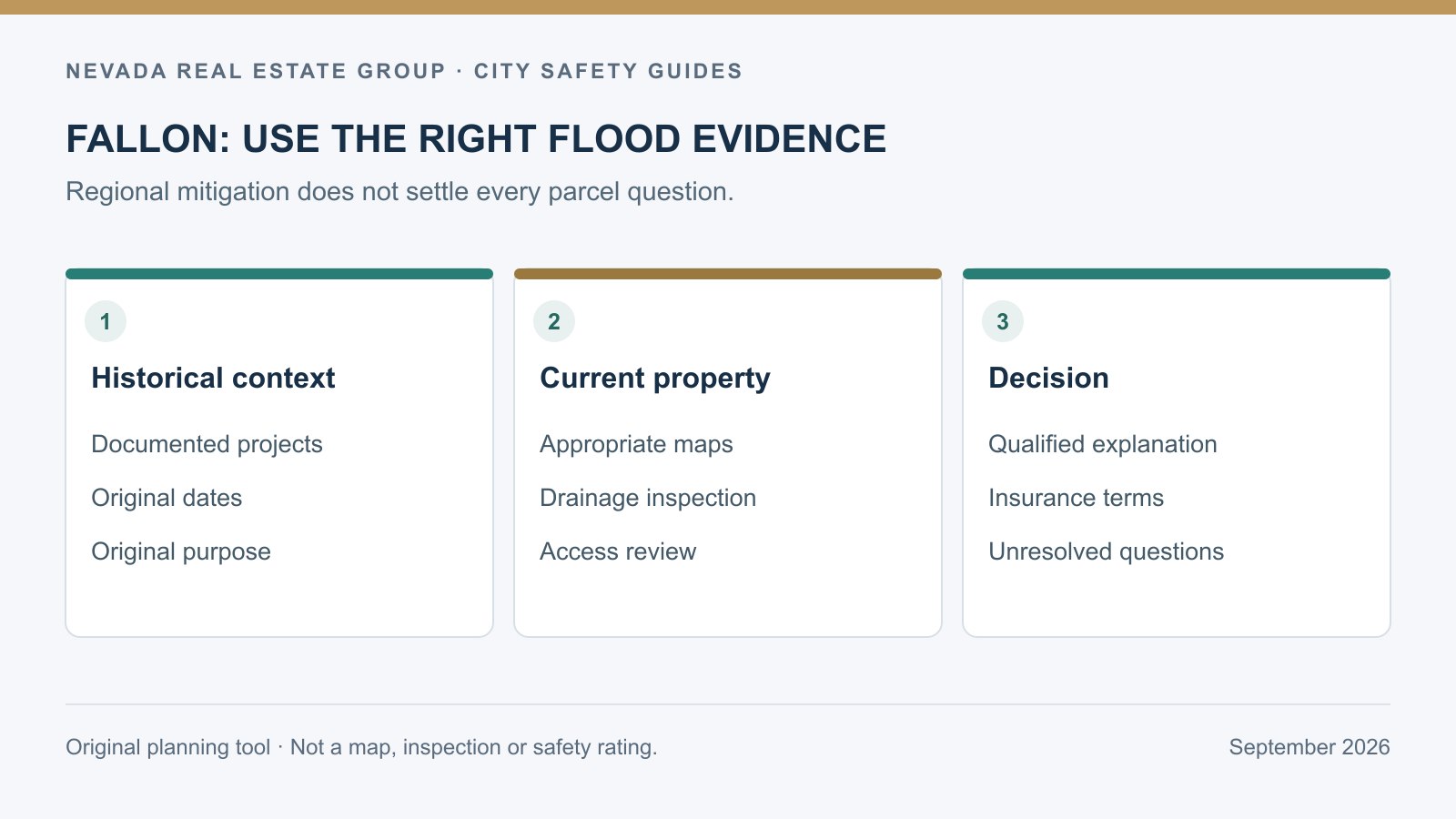
Our Nevada flood-zone and insurance guide helps organize the insurance conversation. Obtain address-specific answers about coverage and timing. Keep unresolved drainage or access issues visible instead of assuming that a regional project or a general city description has already settled them.
How do you identify the correct drinking-water report for a Fallon home?
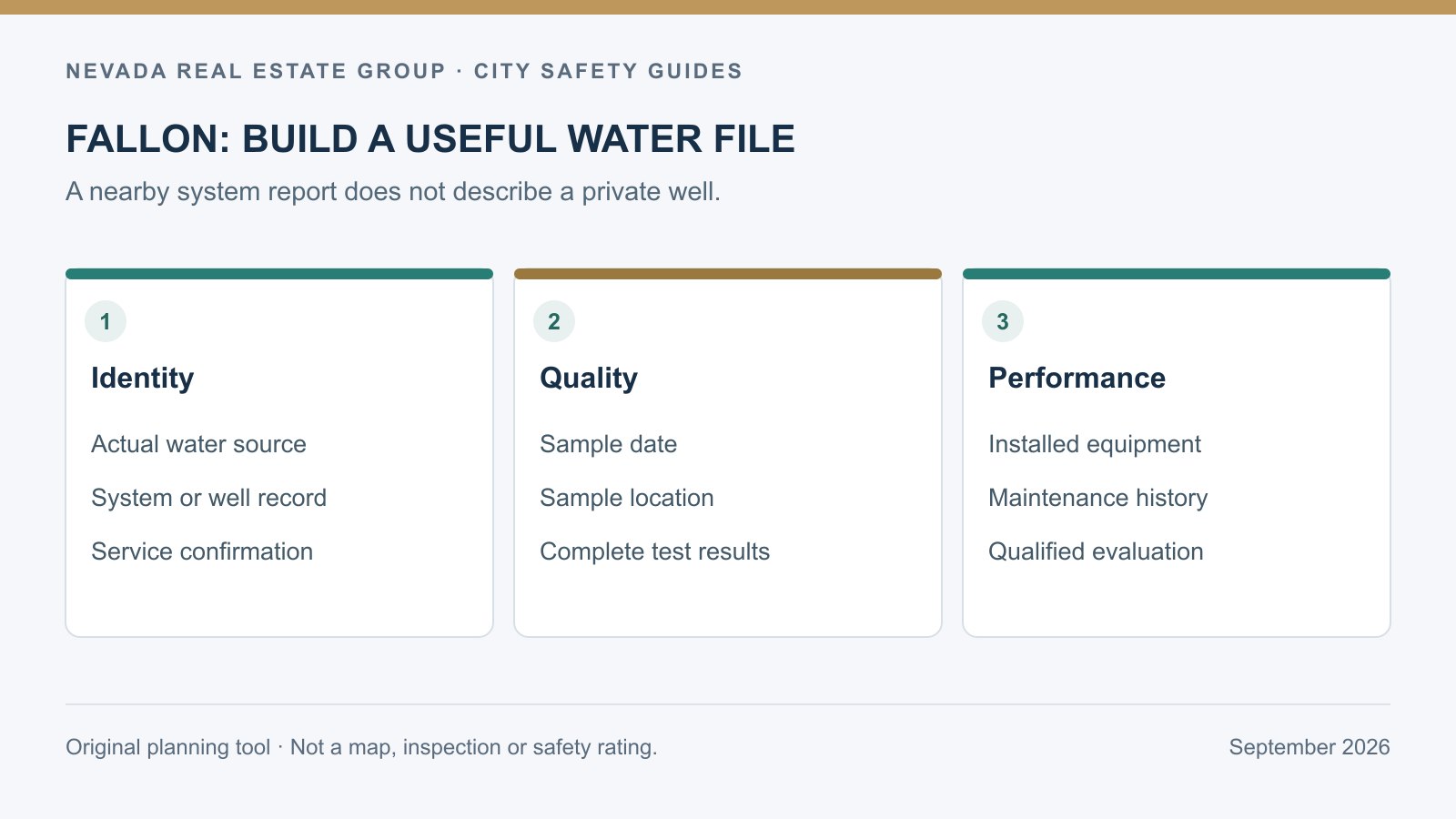
Begin by confirming the water source serving the exact address. A report labeled with a familiar place name may describe a particular public system rather than every home in the surrounding area. A private well needs its own records. Do not use a city report, county system report or old regional study as if all three answer the same question.
According to Nevada Division of Environmental Protection's drinking-water information page, Drinking Water Watch provides information on Nevada public water systems. Use the system identity and relevant current records, and contact the provider or appropriate regulator when a result is unclear. This guide does not claim a particular system is violation-free or that a report covers an unrelated private well.
Ask the seller or provider to help match the home to the correct system. Keep the provider name, system identifier where available, report year and service confirmation together. A bill can help identify service, while the quality report answers a different question. A treatment device installed inside the house creates another set of equipment and maintenance questions to investigate.
Read a report in its own terms. Distinguish what was sampled, the reporting period and the scope of any notice or explanation. If you need a professional interpretation, obtain it rather than reducing a complex result to a casual “good water” or “bad water” label. Avoid extrapolating a historic regional finding to every present-day household.
For a proposed change such as additional living space, irrigation or a new outbuilding, ask whether the existing arrangement supports the intended use. The answer may require provider or professional review. Confirming the water source is the first step; it does not by itself verify equipment capacity, all household plumbing or the feasibility of future improvements.
What additional checks apply if the property uses a private well?
According to EPA guidance for protecting private-well water, annual testing should include total coliform bacteria, nitrates, total dissolved solids and pH, with additional tests when circumstances warrant. Use a certified drinking-water laboratory and ask the appropriate local health or water resource which additional panel fits the property. Do not assume a generic test covers every relevant concern.
Request the actual records rather than a summary that says the well passed. Note the sampling date, collection location, tested measures and full results. If a treatment system is present, understand whether a sample was taken before or after treatment and what maintenance the installed equipment needs. Have qualified professionals explain any uncertainty rather than interpreting an unfamiliar report from a listing description.
Water quality and well performance are different inquiries. Ask about the well's available documentation, pump and related equipment, service history and the professional evaluation appropriate to your intended use. A laboratory result does not establish that every mechanical component operates correctly, and a functioning faucet does not establish the tested quality of the water.
If an electric pump is involved, ask how a power interruption affects the actual arrangement. Learn the equipment's instructions and any appropriate contingency from qualified help. Do not assume a private source means the household is independent of all utilities or maintenance responsibilities.
Our Nevada well and septic homebuyer guide can help prepare the broader document request. Apply the same discipline to wastewater records and inspections. The purpose is to understand the systems at the specific home, without turning an old study or another system's report into an unsupported claim about the property.
What should you inspect on a rural Fallon-area property?
A rural layout deserves a deliberate walk through its responsibilities. Trace the access from the public road to the house, outbuildings and any area intended for animals, vehicles or equipment. Identify gates, shared drives and maintenance questions. Ask which documents establish access rights and responsibility; a well-worn route does not, by itself, explain the legal arrangement.
Inspect the structures for their actual intended use. A detached workshop, barn or storage building may raise questions different from the main house. Ask the appropriate inspector or specialist what is included in the evaluation and which systems need separate review. Do not assume that every structure described in a listing has the same documentation, utility capacity or permitted use.
Measure the spaces that matter. A long driveway may still have a difficult turn, a narrow gate or limited space for the equipment you plan to bring. Keep the ordinary entry and exit routes usable when planning storage. If an improvement is needed, investigate its feasibility and scope before treating it as an inexpensive or automatic solution.
For animals or outdoor activities, verify the practical enclosure, water arrangements and applicable property restrictions. This guide does not assert a universal livestock allowance or certify any parcel for a particular use. The relevant records and qualified sources should answer those questions for the address.
When comparing Stillwater-area properties and Lahontan Valley Estates homes, apply consistent standards while recognizing the differences between individual lots. The location links are search destinations, not safety rankings. More land can be useful, but it also makes it important to know which features are maintained, which are shared and which proposed uses remain unverified.
What should a household moving for NAS Fallon verify?
A military-related move has additional timing and housing questions. According to the official NAS Fallon Navy Housing page, the Housing Service Center provides housing support and information about community options. Use that official resource for current assistance, eligibility and availability questions. A public real estate guide should not replace the installation's instructions or imply guaranteed housing availability.
Separate the location of the house from the routine required by the assignment. Verify the actual destination and authorized access arrangements through the appropriate official source, then evaluate the commute accordingly. A map pin at the center of an installation is not necessarily the endpoint relevant to your daily trip. Do not publish sensitive schedules or access details as part of a home search.
If absences are likely, decide how the property will be managed while unoccupied. Identify a trusted, authorized contact, clarify their responsibilities and confirm how maintenance issues are reported. Ask the insurer about the terms that apply to the intended use and absence pattern. This article does not assert a universal military exception to a policy or contract.
For any noise or land-use question, ask the appropriate planning office or installation resource for the current information relevant to the parcel. A brief quiet showing cannot establish every future operating condition. This review does not draw its own noise contours, predict flight activity or label an entire neighborhood based on proximity to the installation.
Use the household's actual timeline when comparing a rental, purchase or temporary arrangement. The Navy resource can clarify the services available, while the property file should still include inspections, water, flood and access information. A job-related reason to move quickly does not make those property questions disappear or turn a city crime statistic into an individual housing assessment.
How should you test Fallon's daily routes and weather preparations?
Drive the routes that connect the actual home to work, shopping, appointments and other essential destinations. Include the local approach and return trip. Observe conditions relevant to your schedule and record the date and circumstances. A broad city-to-city distance or one navigation estimate cannot guarantee the daily routine for a particular address.
According to Nevada Department of Transportation travel information, Nevada 511 provides road-condition information. Check it before travel when conditions or restrictions may affect the route. Save the official source rather than treating an old screenshot as a live update, and follow the current instructions for any disruption.
According to AirNow's smoke-readiness guidance, preparation includes reliable information and a cleaner indoor space. Ask an HVAC professional about the home's installed system, suitable filtration and maintenance. The guidance does not establish that a particular house is protected from all smoke exposure or that every filter is appropriate for every system.
| Situation | Check before relying on the plan | Keep available |
|---|---|---|
| Routine travel | Actual route and destination access | Dated observations |
| Road disruption | Current official conditions | Information source and needed contacts |
| Smoke | Relevant guidance and installed equipment | Operating and maintenance instructions |
| Service interruption | What the specific systems require | Provider details and household fallback |
Think through a delayed or interrupted day: who needs notification, which essential task needs an alternative and where the household can obtain reliable information. Our Northern Nevada utility setup guide helps organize services, while the wildfire and home-insurance guide frames a separate property-insurance inquiry. Neither replaces the instructions for the equipment or policy at the home you choose.
How can you compare an in-town house with a home farther out?
Compare the actual responsibilities instead of assigning a safety advantage to either category. An in-town house may offer a routine that suits one household; a larger property may offer space another household needs. Those are useful differences to investigate. They do not establish a universal relationship between density, distance, home value or the safety of residents.
For each candidate, use the same core questions: correct service jurisdiction, appropriate incident information, flood review, water source, inspection findings and workable access. Then add the features unique to the home. The comparison should show what each arrangement requires, rather than forcing all differences into one score.
| Topic | In-town candidate | Farther-out candidate |
|---|---|---|
| Jurisdiction | Confirm agency and services | Confirm agency and services |
| Water and wastewater | Identify actual providers or systems | Identify actual providers or systems |
| Access | Check parking, entry and daily routes | Check road, gate and maintenance arrangements |
| Condition | Inspect installed features | Inspect house and relevant additional structures |
A property in Old Town Fallon should be evaluated on its own condition and connections, just as a house on more land should be. Avoid assuming all homes in one area share the same maintenance history, water arrangement or exposure. The evidence must remain tied to the individual address.
Put known costs beside defined tasks and obtain relevant estimates. If a larger property needs work to fit your intended use, investigate before treating the extra space as immediately usable. If an in-town home requires a substantial repair, do not let convenience erase that issue from the comparison. A transparent choice considers the full routine and the material questions that remain unresolved.
Which inspection, insurance and document questions should be settled first?
Prioritize the questions that could materially affect whether the property works for you. A source file should identify the address, intended use, major systems, known findings and open items. Keep each document with the question it answers. A large folder can still be incomplete if none of its contents resolves the particular issue under discussion.
For inspection findings, distinguish an observation from a diagnosis and a repair recommendation from completed work. Ask which specialist is needed, what the proposed scope includes and how completion will be documented. Our Northern Nevada home-inspection guide helps prepare that conversation, but cannot assess a Fallon property that has not been inspected.
For insurance, obtain property-specific terms and understand what remains conditional. Identify coverage questions involving the intended occupancy, outbuildings, equipment or flood exposure. A general quote discussion should not be described as bound coverage, and an assumed premium should not silently become a fixed number in the household budget.
For property records, match the parcel and improvement to the document. Ask the appropriate professional about any uncertain boundary, access or recorded restriction. Our Nevada title-insurance guide provides background, while the actual title and transaction documents require their own review. This article does not interpret a specific legal instrument.
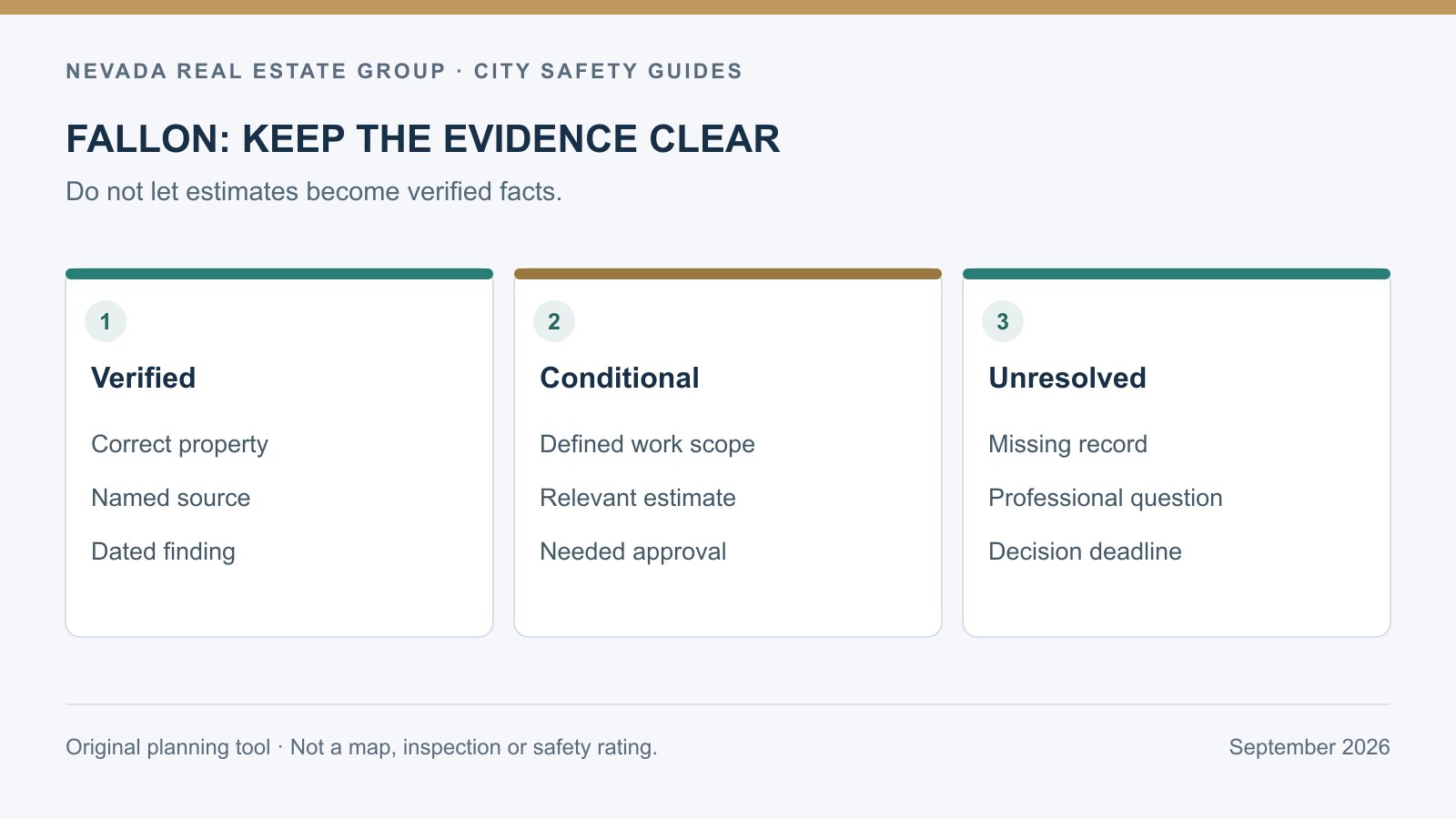
Decide what must be resolved before moving forward, then discuss the process and timing with the appropriate transaction professionals. The goal is not paperwork for its own sake. It is a decision that remains understandable when the household reviews why one home was chosen and what obligations came with it.
What should you organize before the first night in the home?
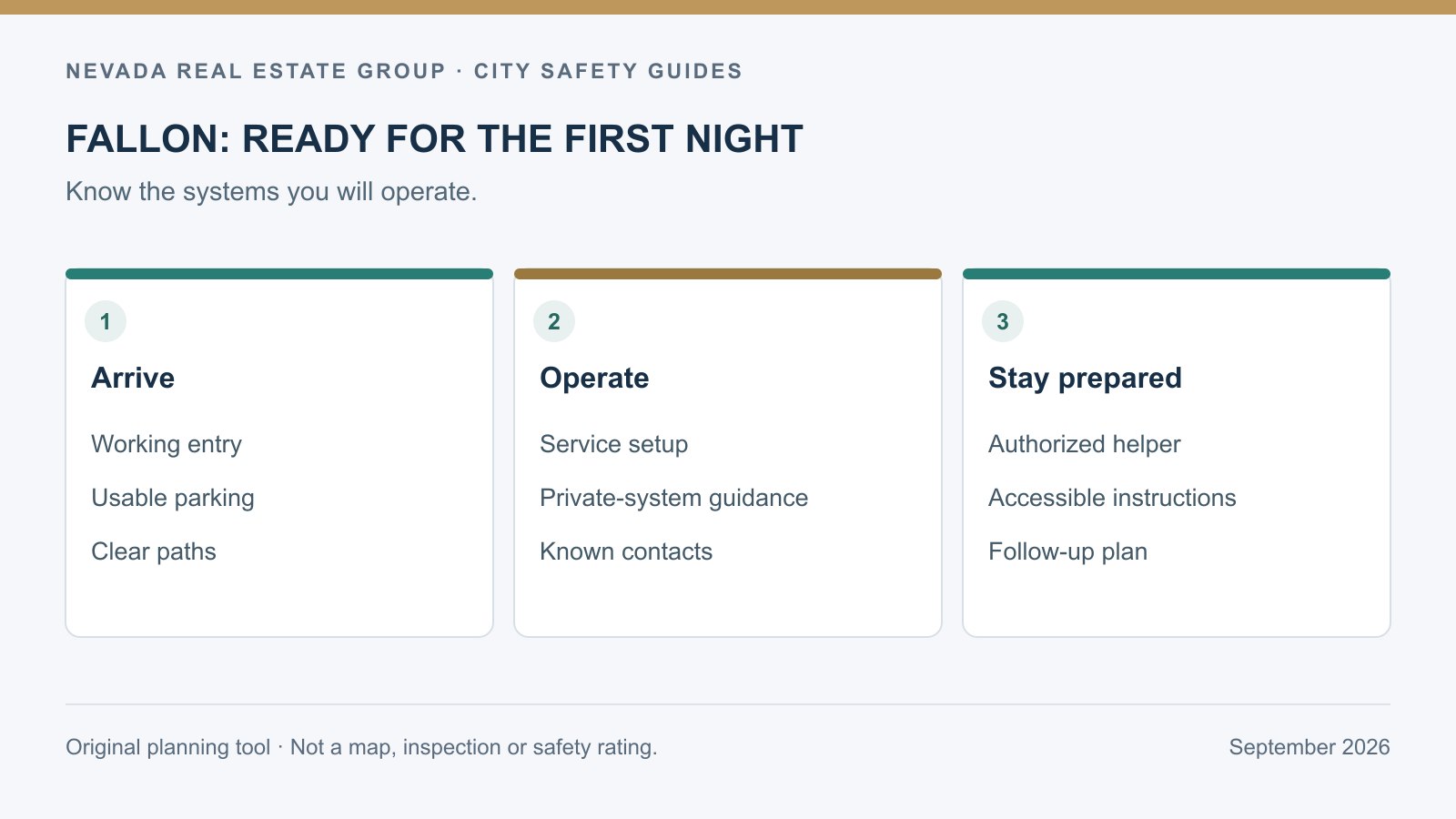
Make the house usable before assuming the move is complete. Confirm access, service setup, transferred controls and the instructions for installed equipment. Locate the relevant shutoffs with qualified guidance where needed. Check the status of agreed work through the transaction process and retain any outstanding-item record rather than allowing it to disappear among moving boxes.
For a property with a well, detached buildings or powered gates, ensure the people using the home understand the arrangement. Keep service contacts and operating information accessible. If a system requires a specialist, identify the appropriate contact before an urgent problem arises. Do not experiment with unfamiliar equipment based on a generic internet tip.
Set up the ordinary arrival routine. Make sure the address can be identified, the planned parking works and stored items do not obstruct the entry or paths you need. Arrange appropriate changes to keys, device access and accounts after possession. Confirm who receives alerts and what action they are expected to take.
If the household will be away, document authorized access and maintenance responsibilities. Test the arrangement while you can still resolve a missing key, unclear instruction or contact problem. Keep private codes and travel details out of public marketing or social posts. A clear arrangement is more useful than an alarm that sends notifications nobody can act on.
For help organizing a Fallon-area search, contact Nevada Real Estate Group or call (775) 277-2120. We can help compare properties and frame questions for qualified specialists. We do not certify neighborhoods as safe or replace water testing, professional inspections, insurance review or your own informed assessment of the home's routine.
Frequently Asked Questions
What were Fallon's reported crime totals in 2025?
Nevada's official portal reports 23 violent crimes and 157 property crimes for Fallon Police Department in its 2025 themes. These are agency counts under specified counting rules. They do not represent every police activity, a combined Churchill County total or an individual household's probability of experiencing crime.
Did Fallon Police's reported counts rise from 2024?
Yes. The violent theme increased from 20 to 23, and the property theme from 114 to 157. Those changes are 15 percent and approximately 37.72 percent, respectively. They describe reported counts for two years, not a per-capita trend, a proven cause or conditions in every neighborhood.
Can I use Fallon Police data for every home with a Fallon address?
Confirm the actual service jurisdiction first. A mailing label or broad home-search area does not necessarily match a police reporting boundary. The figures in this guide describe Fallon Police Department. Ask which agency and geographically appropriate records apply to the specific property you are considering.
Does flood-mitigation work eliminate the need to check a property?
No. Churchill County describes historical mitigation work, including use of the Big Dig in 2017 and 2023. That context does not establish the current exposure of every parcel. Review the exact property, access route, current mapping and insurance questions with the relevant qualified sources.
Does a public-water report establish the quality of a private well?
No. Match the report to the actual system supplying the home. A private well needs its own records and appropriate testing through a certified drinking-water laboratory. Ask local professionals which tests fit the property's conditions, and keep water-quality findings separate from pump, treatment-equipment and capacity questions.
Where can a military household find official NAS Fallon housing help?
Use the Navy's official NAS Fallon Housing page and Housing Service Center for current assistance, eligibility and availability questions. Verify the services relevant to your situation directly. A real estate article does not replace installation instructions or guarantee housing, a particular commute or coverage under a private contract.
What is the best way to compare Fallon neighborhoods for safety?
Use the same address-level review across homes: appropriate incident information, inspections, water and flood records, access and daily routes. Avoid treating price, rural character, gates or demographics as evidence of safety. This review does not establish a defensible neighborhood ranking or guarantee the conditions at a particular property.
Which sources and methods support this Fallon guide?
Reviewed September 25, 2026. Crime data: Fallon Police Department 2025 violent, 2025 property, 2024 violent and 2024 property. We reconciled category totals and recomputed changes; these remain reported agency counts, not rates or a completeness certification.
Additional primary sources: Fallon police and fire, city departments, FBI ranking caution, Churchill emergency management, county web-map limits, NDEP public-water information, EPA private-well guidance, NAS Fallon Navy Housing, NDOT travel information and AirNow smoke readiness. Original diagrams are planning tools, not maps, inspections or firsthand tour reports.