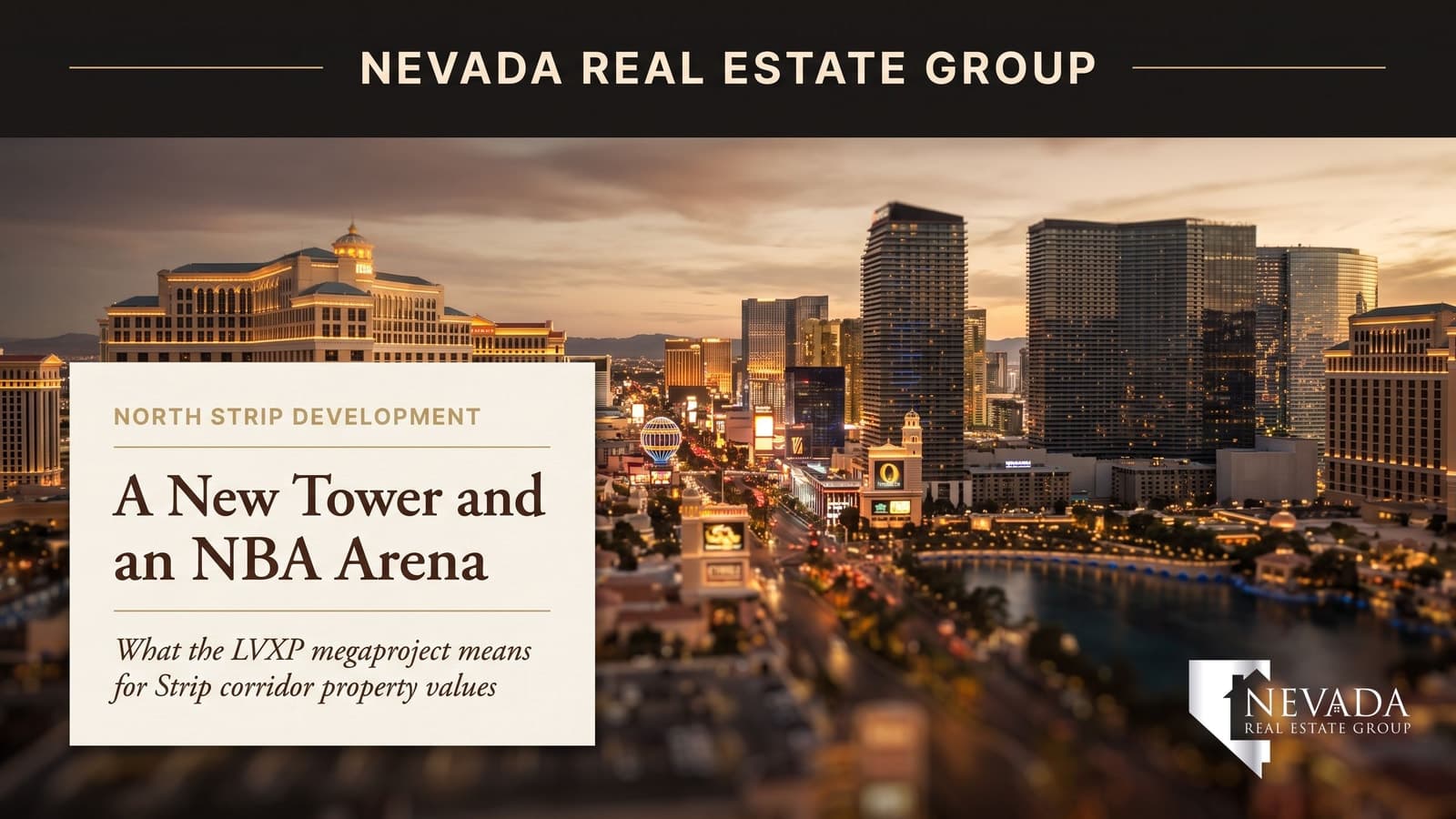

The north end of the Las Vegas Strip has spent two decades as the "next big thing" that never quite arrived — half-finished towers, mothballed lots, and renderings that died in financing rooms. That is what makes this one worth your attention: the Clark County Commission has actually approved use permits for LVXP's 752-foot, 2,605-unit resort with an 18,000-seat NBA-ready arena on the 17 acres between the Sahara and Fontainebleau. Approval is not steel in the ground — but it is the furthest any north-Strip megaproject has advanced since Fontainebleau itself finally opened.
I run Nevada Real Estate Group — 789 closings and $361.5 million-plus in Nevada volume in 2025, $4.85 billion across 9,600-plus career transactions — and every time a venue headline drops, our phones light up with the same two questions: should I buy a Strip-corridor condo before this thing breaks ground, and what happens to values if the NBA actually comes? This guide answers both with the project's real facts, the competing bids, and what the last decade of Las Vegas venue-building actually did to nearby property.
Clark County has unanimously approved use permits for LVXP's North Strip project: a 752-foot hotel-and-condo development — the Strip's tallest resort — with 2,605 units, an 18,000-seat NBA-ready arena, and a 6,000-seat theater on the 17-acre former Wet 'n Wild site. No NBA team is committed and rival arena bids exist. Venue history — T-Mobile, Allegiant, the Sphere — says nearby condo values benefit, but only once construction is unmistakably real.
- LVXP is county-approved: 752 feet, 2,605 units, an 18,000-seat NBA-ready arena, and a 6,000-seat theater between the Sahara and Fontainebleau.
- No NBA franchise is committed — roughly seven arena-site proposals are competing, including the $10B Starr Vegas plan.
- The venue playbook (T-Mobile, Allegiant, Sphere) lifted nearby values after ground-breaking, not after renderings.
- North-Strip condo towers — Sky, Allure, Turnberry Place — are the direct beneficiaries if steel goes vertical.
- Buyers get better pricing before construction certainty; sellers get better pricing after it. Pick your side deliberately.
What Exactly Did Clark County Approve on the North Strip?
According to the Las Vegas Review-Journal, the Clark County Commission granted unanimous approval to use permits for LVXP's project on the 17-acre former Wet 'n Wild parcel sandwiched between the Sahara and Fontainebleau. The approved program is genuinely enormous:
- A 752-foot tower height — 15 feet taller than Fontainebleau, which would make it the tallest resort building on the Strip.
- 2,605 hotel and condominium units across three high-rise towers.
- An 18,000-seat, NBA-ready arena — big-league scale, comparable to T-Mobile Arena's capacity.
- A 6,000-seat "grand theater" for residencies and mid-size events.
LVXP is a team of Las Vegas-based real estate professionals, and per the Las Vegas Sun, the group has pitched the arena explicitly as an NBA expansion venue. Entitlements of this scale on this exact parcel are new territory — that land has cycled through owners and concepts since the waterpark closed in 2004 without ever clearing this bar.
The honest asterisk our clients deserve: approval is permission, not construction. Financing, a construction timeline, and — for the arena's highest use — a tenant all remain open. Las Vegas has a long memory of approved north-Strip projects that stayed renderings.
Is an NBA Team Actually Coming to Las Vegas?
Not yet — and this is the variable that decides how much of the upside case materializes. What is true in mid-2026: the NBA has repeatedly named Las Vegas among the leading candidates whenever expansion talk surfaces, LeBron James has publicly courted a Vegas franchise for years, and the city has proven it can fill big-league buildings — the Golden Knights and Aces sell out, and Allegiant Stadium hosts the Raiders and a Super Bowl inside its first three years.
What is also true: the league has committed nothing, and the arena race here is crowded. According to Casino.org, at least seven arena-site proposals have entered the conversation, including:
- LVXP's North Strip arena — the one with county approval in hand.
- Starr Vegas — a $10 billion, 63-acre south-of-the-Strip megaproject with an NBA-ready arena and MLS-stadium ambitions, per News 3.
- Las Vegas Diamond Arena — whose developers, per FOX5, completed land assembly for their proposed site in June 2026.
- Plus mayor-proposed downtown-adjacent sites and other private bids tracked by Coliseum.
Seven proposals chasing zero committed franchises tells you the market believes expansion is coming — and that most of these buildings will never exist as drawn. For property decisions, the discipline is simple: underwrite the real estate on what is entitled and financeable, and treat an NBA team as upside, never as the base case.
What Does Venue History Say Happens to Nearby Property Values?
Las Vegas has run this experiment three times in a decade, and the pattern is consistent enough to plan around:
| Venue | Opened | Nearby property effect | The lesson |
|---|---|---|---|
| T-Mobile Arena | 2016 | Adjacent corridor condos and rentals firmed as the Knights arrived; event-night demand created a durable premium | A tenant transforms an arena from a building into an economy |
| Allegiant Stadium | 2020 | West-of-Strip industrial and residential repriced; game-day STR demand spiked in a 3-mile ring | The lift concentrated after steel was visible, not at announcement |
| Sphere | 2023 | East-side corridor gained a global landmark; nearby hospitality land values jumped | Novel venues pull demand from far beyond their neighborhood |
| Athletics ballpark (under construction) | 2028 target | South-Strip corridor speculation active now — we track it in our ballpark impact guide | The market prices certainty milestones, not press conferences |
The T-Mobile case deserves one more beat because it is the closest analog to what LVXP proposes. When the arena was announced in 2013, the parcel behind New York-New York was parking lots and skepticism — Las Vegas had no major-league team and no certainty it ever would. The building opened in 2016, the Golden Knights arrived in 2017, and the surrounding corridor transformed within five years: The Park entertainment district, event-night pricing power for every nearby hotel room, and durable rent premiums in the residential towers within walking distance. The sequence matters as much as the outcome — the serious appreciation followed the team, not the building, and the building preceded the team by a year of uncertainty. LVXP is attempting the same two-step with the order reversed: entitle the arena first, and let the arena recruit the franchise.
The repeated finding — and our own closing files across those corridors agree — is that values move on construction certainty milestones: financing closes, cranes rise, a tenant signs. Announcement-day buying has historically paid a hope premium; milestone buying has captured most of the real appreciation with far less risk. We walked through the same dynamic in our Athletics ballpark impact analysis, and it applies verbatim here.
Which North Strip Condo Towers Benefit Most If LVXP Builds?
The residential real estate closest to the action is the existing high-rise inventory — and the north corridor has three towers our buyers ask about constantly:
- Sky Las Vegas — directly on the north Strip, the nearest major condo tower to the LVXP parcel. A resident there would walk to the arena.
- Allure — one block off-Strip behind the corridor, historically priced at a discount to on-Strip glass; discounts are what compress when a neighborhood re-rates.
- Turnberry Place and the Sahara-adjacent towers — established luxury stock between the site and the Convention Center's expanded campus.
The mechanics of the upside are concrete: 2,605 new hotel/condo units, an arena's event calendar, and a 6,000-seat theater generate worker housing demand, event-night rental demand, and — most durable of all — the retail and dining infill that makes a corridor feel finished. Fontainebleau's opening already moved the north end's floor; the LVCVA's convention-campus expansion feeds it mid-week. LVXP would be the third leg.
The mirror risk: condo purchases underwritten on arena dreams that die in financing. Sky and Allure trade today on actual rentability and Strip views — that is the durable value. Anything the arena adds should be modeled as option value on top, which is exactly how we run the numbers in a buyer consult.
What Would an Arena Do to North Strip Rents and Short-Term Rentals?
Three demand channels, each with a different certainty level:
- Construction employment (highest certainty if financed). A project of this scale sustains thousands of construction jobs for years. Those workers rent — and the near-Strip and east-side corridors absorb that demand first. We saw the same wave during Allegiant and Fontainebleau construction.
- Operations employment (high certainty on opening). Thousands of permanent hospitality, arena, and residential-services jobs concentrated on one corner. According to the Bureau of Labor Statistics, leisure and hospitality already anchors the metro's job base; a development this size is a measurable add to it.
- Event-night demand (arrives with a tenant). An NBA calendar means 41-plus home dates a year of compressed lodging and short-term-rental demand. The county's STR rules keep most of that inside hotels and licensed properties — a structural advantage for the corridor's hotel-condo products over unlicensed competition.
For investors already holding corridor rentals, the play is patience: nothing about today's approval changes this month's rent roll. For investors considering a purchase, the entry math should clear on current rents — underwriting discipline matters most in exactly this kind of story-driven market, and it starts with a buyer consultation grounded in actual lease comps rather than renderings.
What Do North Strip Condos Actually Cost in 2026?
Since the whole question is whether to position before a re-rating, here is where corridor pricing sits today — approximate resale bands from the closings and listings our team tracks:
| Tower | Typical resale band | Monthly rent it draws | Position vs. LVXP site |
|---|---|---|---|
| Sky Las Vegas | Roughly $450,000–$850,000 (penthouses well past $1,000,000) | Roughly $2,600–$4,500 | On-Strip, walkable to the parcel |
| Allure | Roughly $330,000–$650,000 | Roughly $2,200–$3,500 | One block west — the value entry |
| Turnberry Place | Roughly $700,000–$2,000,000-plus | Roughly $4,000–$8,000 | Established luxury nearest the Convention Center |
According to Las Vegas REALTORS market data, the valley's high-rise segment has run its own cycle apart from single-family — thinner volume, sharper swings, and a heavier cash-buyer share, which is why corridor condos reward specific-tower knowledge over metro-level narratives.
Read the spread and the strategy writes itself. Allure's discount to Sky — frequently $120,000–$200,000 for comparable square footage — exists because off-Strip glass has always traded behind on-Strip glass. Corridor re-ratings compress exactly that kind of discount first. Meanwhile HOA dues across these towers run roughly $600–$1,400 a month, and that number belongs in every underwriting model before any arena dreaming: a $500,000 unit renting at $3,000 with $900 in dues and $350 in taxes/insurance clears carrying costs, but not by enough to survive sloppy assumptions. In our experience, the corridor's best buys of the last cycle were Allure units bought on boring math in quiet months — not Sky units bought the week of a headline.
How Much Capital Is Already Committed to the North Strip?
The LVXP bet does not sit in a vacuum — the north corridor has absorbed more announced investment in eight years than in the previous thirty, and the receipts are public:
- Fontainebleau finally opened at a reported cost near $3,700,000,000 — the most expensive resort build in Strip history.
- Resorts World delivered its 3,500-room campus for roughly $4,300,000,000 in 2021.
- The Sphere cost about $2,300,000,000 and instantly became the corridor's global landmark.
- The LVCVA's West Hall expansion invested roughly $1,000,000,000 in the convention campus, with the loop system tying it to the corridor.
- Starr Vegas, the competing megaproject, carries a $10,000,000,000 headline number on 63 acres.
That is north of $11,000,000,000 in delivered projects ringing the LVXP parcel before its first crane arrives. Capital of that density is the strongest argument that the north end's re-rating is structural rather than speculative — and it is why we treat the corridor's existing condo stock as fundamentally sounder than it was a decade ago, when Sky and Allure overlooked a fenced dirt lot and a shuttered waterpark. The $150-per-square-foot question is simply how much of the remaining upside arrives on LVXP's timeline versus the corridor's own.
How Does LVXP Change the North Strip's Bigger Picture?
Zoom out and the north end's decade suddenly has a coherent shape. Fontainebleau opened after 16 years of false starts. The Sahara reinvented itself. The LVCVA poured billions into the West Hall expansion and loop transit. Resorts World planted 3,500 rooms at the corridor's top. Now the largest undeveloped gap between them — the Wet 'n Wild 17 acres — holds entitlements for the Strip's tallest building.
According to the U.S. Census Bureau, Clark County keeps adding tens of thousands of residents a year; the Strip's center of gravity has been drifting north-then-south in waves for seventy years, and infrastructure follows the gaps. Whether or not LVXP delivers every rendered flourish, the parcel's era as a fenced lot is ending — and corridors reprice when their last hole fills. That is the quiet, durable version of this story that survives even if the NBA never calls: 17 acres of nothing becoming 2,605 units of something, between two operating resorts, on land the county has now blessed.
For the valley's residential market at large, the effect is thematic more than direct: megaproject headlines sustain the relocation narrative that keeps feeding Las Vegas and Henderson buyer demand. Nobody buys a Summerlin house because of an arena — but the job engine these projects represent is exactly why our relocation pipeline runs year-round.
What Could Still Stop the LVXP Project?
An honest risk register, because our clients make real decisions on this:
- Financing. A multi-billion-dollar capital stack has to close in a rate environment that has already stalled several announced Strip projects. Fontainebleau's own 16-year saga — started in 2007 at roughly $2,900,000,000, finished in 2023 near $3,700,000,000 — is the cautionary template. Until LVXP announces closed construction financing, the project is a plan.
- The arena tenant race. An 18,000-seat building without an anchor tenant is a very expensive concert venue. With roughly seven sites courting a franchise the NBA has not committed, at most one wins — and the league's expansion timeline answers to its media-rights calendar, not to Las Vegas's.
- Construction economics. Strip-grade high-rise construction costs have climbed steeply; a $500-per-square-foot assumption from five years ago prices closer to $700–$900 today for this product class. Escalation has quietly killed more approved towers than any recession.
- The corridor's own history. The Wet 'n Wild parcel has outlived multiple owners' ambitions since 2004. Entitlements expire, partnerships fracture, and the north Strip's graveyard of renderings is real. Respect the base rates.
None of this is a prediction of failure — the unanimous county approval, the corridor's committed capital, and the credibility of an experienced local team all argue this attempt is different. It is simply why our buy-side advice prices the project as upside rather than as a promise.
Should You Buy on the North Strip Now or Wait for Certainty?
The buy-now-versus-wait decision splits cleanly by who you are:
| Question | Buy / act now | Wait for milestones |
|---|---|---|
| Who it fits | Buyers who want the condo anyway — for use or current-rent cash flow | Pure arena speculators with no use case |
| The logic | Today's pricing carries little arena premium; upside is a free option | Most historical appreciation arrived after financing/cranes/tenant news |
| The risk carried | Project stalls → you still own a unit that worked on day-one math | Milestones hit fast → entry price steps up before you move |
| Seller version | Corridor owners with a 2026 exit planned: current headlines help marketing now | Owners with 3+ year horizons: milestones, if they come, do the work |
One practical wrinkle for buyers working this corridor in 2026: negotiate like the story does not exist yet, because sellers will negotiate like it already happened. Every venue cycle produces listing descriptions that price tomorrow's arena into today's ask — we saw $50,000 "stadium premiums" appear in south-corridor asks years before Allegiant opened, and most of them came back out in negotiation. The comps are the comps: what did the same stack, same floor band, same view sell for in the last 120 days? Anchor there, concede nothing for renderings, and let the seller keep the dream at their own expense if they will not meet the market.
Our standing rule for story-driven corridors, learned across the ballpark, Sphere, and stadium cycles: buy the unit that works with the story deleted; treat the story as the bonus. A Sky or Allure unit that rents solidly today and clears your carrying costs is a sound purchase whether LVXP becomes the Strip's tallest tower or its most beautiful rendering. A unit that only pencils if 18,000 seats fill is not a purchase — it is a ticket.
A final word on how this fits a broader Las Vegas buy. High-rise living is one lane of the valley's luxury market, not the whole of it — the same budget that buys a two-bedroom at Sky buys a guard-gated single-family home in several of the valley's luxury communities, with a completely different risk profile: land underneath you, a deeper resale pool, and no HOA exposure to a tower's reserve study. Plenty of our relocation clients start their search convinced they want Strip-view glass and end up in Henderson with a pool; plenty run the other way once they price what lock-and-leave convenience is actually worth to their travel schedule. The corridor's arena story is a legitimate input to that decision — it is simply the third or fourth most important one, after payment math, hold horizon, and how you actually plan to live. Get those in order and the LVXP news becomes what it should be: a potential accelerant on a purchase that already made sense.
If you want the live corridor picture — what is listed, what units actually rent for, which towers have healthy HOAs — search current high-rise inventory or start a conversation at (702) 637-1759. And if you own on the corridor and are weighing whether this news changes your exit timing, our sellers team will run the milestone calendar against your equity math honestly.
Frequently Asked Questions
What is the LVXP project on the Las Vegas Strip?
LVXP is a county-approved development planned for the 17-acre former Wet 'n Wild site between the Sahara and Fontainebleau on the north Strip: a 752-foot hotel-and-condominium project — which would be the Strip's tallest resort — with 2,605 units across three towers, an 18,000-seat NBA-ready arena, and a 6,000-seat theater. Clark County commissioners approved its use permits unanimously; financing and construction timelines remain unannounced.
Is the LVXP tower actually approved or just proposed?
Approved at the entitlement level — the Clark County Commission granted the use permits, which is further than most north-Strip megaprojects ever advanced. What approval does not guarantee is construction: the project still needs closed financing and a build timeline, and Las Vegas history includes approved projects that never broke ground.
Does Las Vegas have an NBA team coming?
Not committed as of mid-2026. The league has long flagged Las Vegas as a leading expansion candidate, and roughly seven local arena-site proposals — LVXP, Starr Vegas, the Diamond Arena group, and others — are positioning for a franchise that does not yet exist. Smart real estate decisions here treat an NBA team as upside, not as the base case.
How tall will the LVXP tower be compared to other Strip buildings?
The approved height is 752 feet — 15 feet taller than Fontainebleau, which would make it the tallest resort building on the Strip. The Strat's observation tower is taller overall, but as hotel-resort structures go, LVXP would take the crown.
What does the LVXP arena mean for nearby condo prices?
History from T-Mobile Arena, Allegiant Stadium, and the Sphere says nearby residential values and rents benefit meaningfully — but the appreciation has consistently arrived at construction-certainty milestones (financing, cranes, a signed tenant) rather than at approval headlines. North-corridor towers like Sky Las Vegas, Allure, and Turnberry Place are the most direct beneficiaries if the project builds.
Is now a good time to buy a high-rise condo on the north Strip?
If the unit works on today's math — rentability, HOA health, view, carrying costs — yes, and the LVXP upside rides along as a free option. If the purchase only makes sense assuming the arena and an NBA team materialize, wait for milestones. We run both versions of the underwriting with buyers at (702) 637-1759.
What was on the LVXP site before?
The Wet 'n Wild waterpark, which closed in 2004. The 17 acres between the Sahara and Fontainebleau have cycled through owners and stalled concepts for two decades since — the LVXP entitlements are the most substantive plan the parcel has ever carried.
Which Sources Inform This North Strip Development Guide?
This analysis draws on primary project reporting and public data: the Las Vegas Review-Journal on the county approval and renderings, the Las Vegas Sun on the NBA-expansion pitch, FOX5 Las Vegas on the competing Diamond Arena assembly, News 3 Las Vegas on Starr Vegas, Casino.org on the arena-site field, Coliseum venue-industry coverage, the LVCVA on convention-corridor investment, Clark County commission records, the U.S. Census Bureau, the Bureau of Labor Statistics, and Las Vegas REALTORS market data. Project specifications reflect approvals and announcements as of July 2026 and can change; venue-impact history reflects our team's closing experience across the T-Mobile, Allegiant, Sphere, and ballpark corridors.