
Las Vegas has spent the last several years announcing very large numbers. A $1.2 billion Google campus in Henderson. A 2.5 million square foot Haas Automation plant. A 122-acre research park at UNLV. An eight-square-mile "Innovation District" in the southwest valley. Read the headlines and you would conclude the valley is minting tech households at a pace that must be reshaping the housing market.
The reality is more useful and considerably more specific: capital investment and job creation are almost completely decoupled in this sector, and if you are buying a home around a "tech boom," knowing which is which is the difference between a good decision and an expensive assumption. A data center is one of the most capital-intensive and least labor-intensive buildings ever constructed. A machine-tool factory is the opposite. They generate very different amounts of housing demand, in different places, at different price points. This guide was refreshed on September 19, 2026 with Haas's opening date, the state's new data-center rules, the Innovation District's actual status, and a fresh MLS pull for every submarket named.
Las Vegas's biggest tech capital investments create surprisingly few jobs. Google's $1.2 billion Henderson campus is projected at roughly 220 to 240 full-time employees by the end of 2026. Haas Automation's West Henderson plant opens in the first quarter of 2027 and plans 1,400 hires within five years. The UNLV research park holds 100-plus companies and about 1,000 workers. Manufacturing and the research park, not data centers, move Las Vegas housing — judge every announcement by headcount.
- Google's $1.2 billion Henderson campus projects only 220–240 full-time employees by the end of 2026.
- Haas Automation's roughly 2.5 million square foot plant opens in early 2027 with 1,400 hires planned within five years.
- The Clark County Innovation District is an accepted 2023 action plan, not a zoning overlay, as of September 2026.
- Inspirada closed at a $559,200 median and Cadence at $485,000 in the 12 months ending September 17, 2026.
- Judge a tech announcement by operating headcount, not by dollars — only headcount buys houses.
Nevada Real Estate Group has closed 9,600+ transactions statewide and 789 homes in 2025, and relocation buyers moving here for a specific employer are a steady share of that work. The question they ask first is always the same: how far is it, actually, and what does it cost there.
Why Does a Billion-Dollar Data Center Barely Move Housing?
Because a data center is a building full of machines, not people.
According to reporting on Google's Henderson campus, the facility is backed by roughly $1.2 billion in investment and had reached approximately 60% of planned shell capacity by early 2025. Its staffing tells the real story: fewer than 180 full-time equivalents covered both facilities as of late 2024, with projections placing the figure at 220 to 240 by the end of 2026.
Sit with that ratio. That is more than $5 million of capital investment per permanent job. For comparison, a single mid-sized Las Vegas resort employs thousands. A large distribution center employs hundreds. A data center of enormous physical scale employs roughly the headcount of a busy suburban restaurant. The pattern holds statewide: according to The Nevada Independent, the 13 data centers holding active state tax abatements as of January 2025 had been approved for about $457 million in projected abatements against roughly 300 promised permanent jobs — about $1.5 million in incentives per position — while construction trades saw the real employment surge.
This is not a criticism of data centers — they generate substantial property tax, they are quiet neighbours compared to most industrial uses, and the construction phase employs a great many people for a couple of years. But construction jobs are temporary and largely filled from the existing local trades workforce. They do not create the sustained household formation that moves a housing market. And the policy ground is shifting: according to News 3 Las Vegas, Governor Joe Lombardo's Executive Order 2026-005, signed in September 2026, requires any data center seeking a state abatement to pay the Local School Support Tax in full, sign a binding Nevada Community Support Commitment on siting, workforce, and community benefits, meet location-specific water standards, bear the full cost of its electricity infrastructure, and accept curtailment during grid emergencies.
The practical implication for a buyer: if someone tells you to buy near a data center announcement because "thousands of jobs are coming," ask for the operating headcount. The number is public, it is small, and it will change how you value the argument. Our analysis of the broader Nevada data center boom covers the infrastructure and neighborhood-impact side in detail.
Which Las Vegas Employers Actually Create Tech Households?
Three nodes matter, and they are very different from one another.
| Node | Location | Scale | Employment |
|---|---|---|---|
| Google data center | West Henderson | $1.2B investment | 220–240 FTE projected end-2026 |
| Haas Automation | Via Inspirada at Larson Lane, Henderson | About 2.5M sq ft on 164 acres; about $500M | Opens Q1 2027; 1,400 planned within 5 years |
| Harry Reid Research Park | UNLV, midtown | 122 acres, about 93 tech | 100+ companies, about 1,000 workers |
| Switch LV Digital Exchange | Southwest valley | Multi-campus | Concentrated, specialized |
| Healthcare systems | Henderson, valley-wide | Multiple hospitals | Largest steady professional base |
The pattern in that table is the whole article. Ranked by dollars, data centers dominate. Ranked by households formed, they are last. Haas alone, at 1,400 workers within five years, will generate more housing demand than every data center in the valley combined — and those are manufacturing and engineering wages attached to people who need to live within a reasonable drive of Via Inspirada.
The Haas timeline firmed up this month. According to the Las Vegas Review-Journal on September 4, 2026, the company is on schedule to open the roughly 2.5 million square foot factory in the first quarter of 2027, is holding career fairs on September 19, October 3, and October 17, 2026 at Palace Station for operators, machinists, engineers, and assemblers, sits on 164 acres with another 68.5 acres across the street reserved for suppliers, and puts its total Henderson investment at about $500 million. The same report notes, citing U.S. Bureau of Labor Statistics data, that manufacturing accounts for around 2.6% of Las Vegas-area employment against nearly 26% for leisure and hospitality — which is exactly why one factory registers.
According to the U.S. Bureau of Labor Statistics, employment concentration data is the cleanest public way to see which sectors are actually growing in a metro, and it consistently shows Las Vegas diversifying away from pure leisure-and-hospitality dependence — but through healthcare, distribution, and manufacturing more than through the sectors that get the splashy announcements.
Where Is the West Henderson Employment Corridor, and Who Lives There?
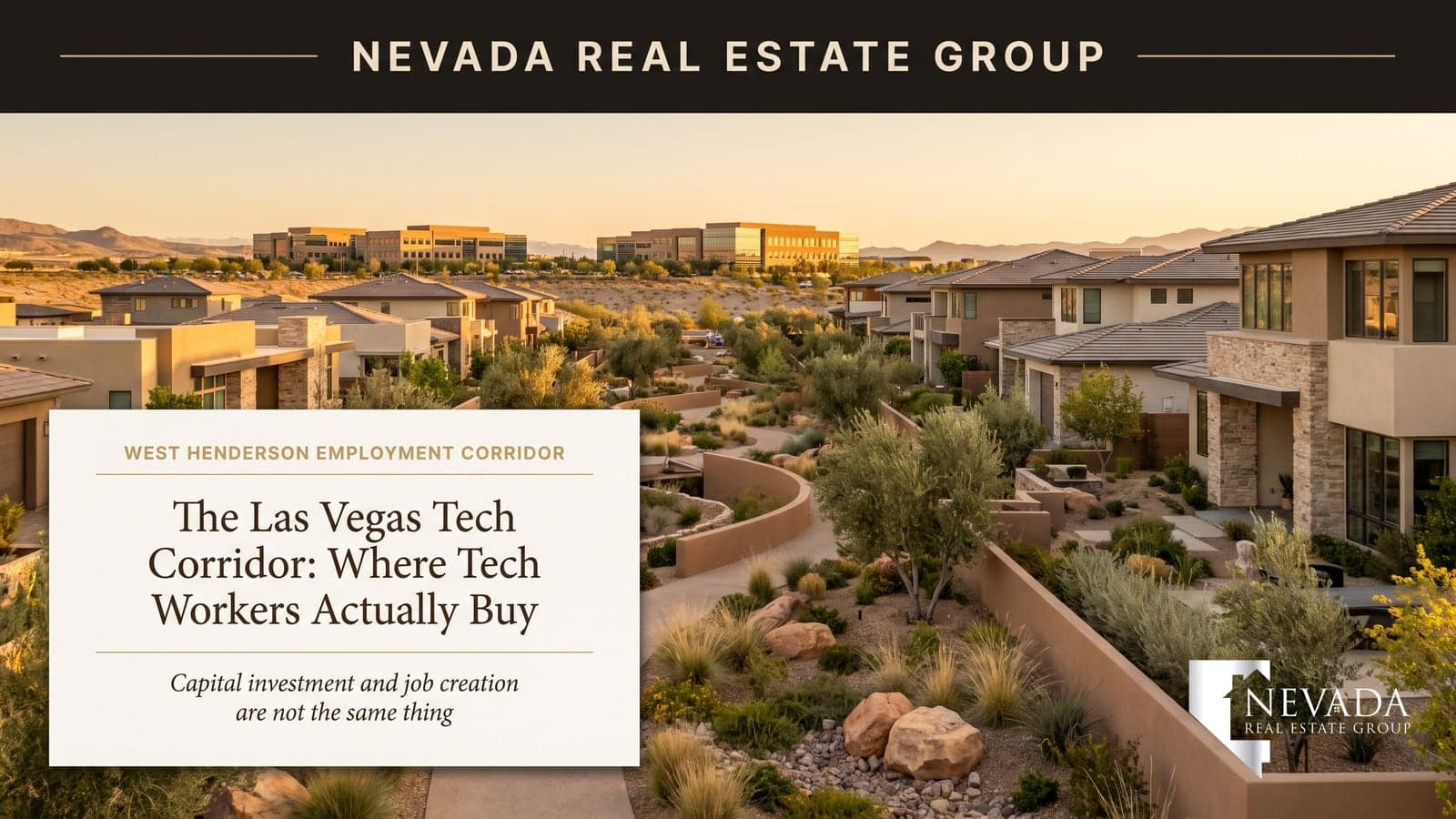
West Henderson is the closest thing Las Vegas has to a genuine employment corridor with housing built around it, and the city has designated it as a potential global business district and employment opportunity zone.
Geographically it runs along the southwestern edge of Henderson, roughly bounded by the 15 to the west and Inspirada and Anthem to the east and north. Haas Automation's plant on Via Inspirada at Larson Lane, just south of Henderson Executive Airport, is inside it. The Google campus is inside it. So are large distribution and light-industrial users.
For a worker at any of those, the housing within a genuinely short commute breaks down cleanly. Las Vegas MLS data pulled through Repliers on September 19, 2026 gives each a hard number for the 12 months ending September 17, 2026:
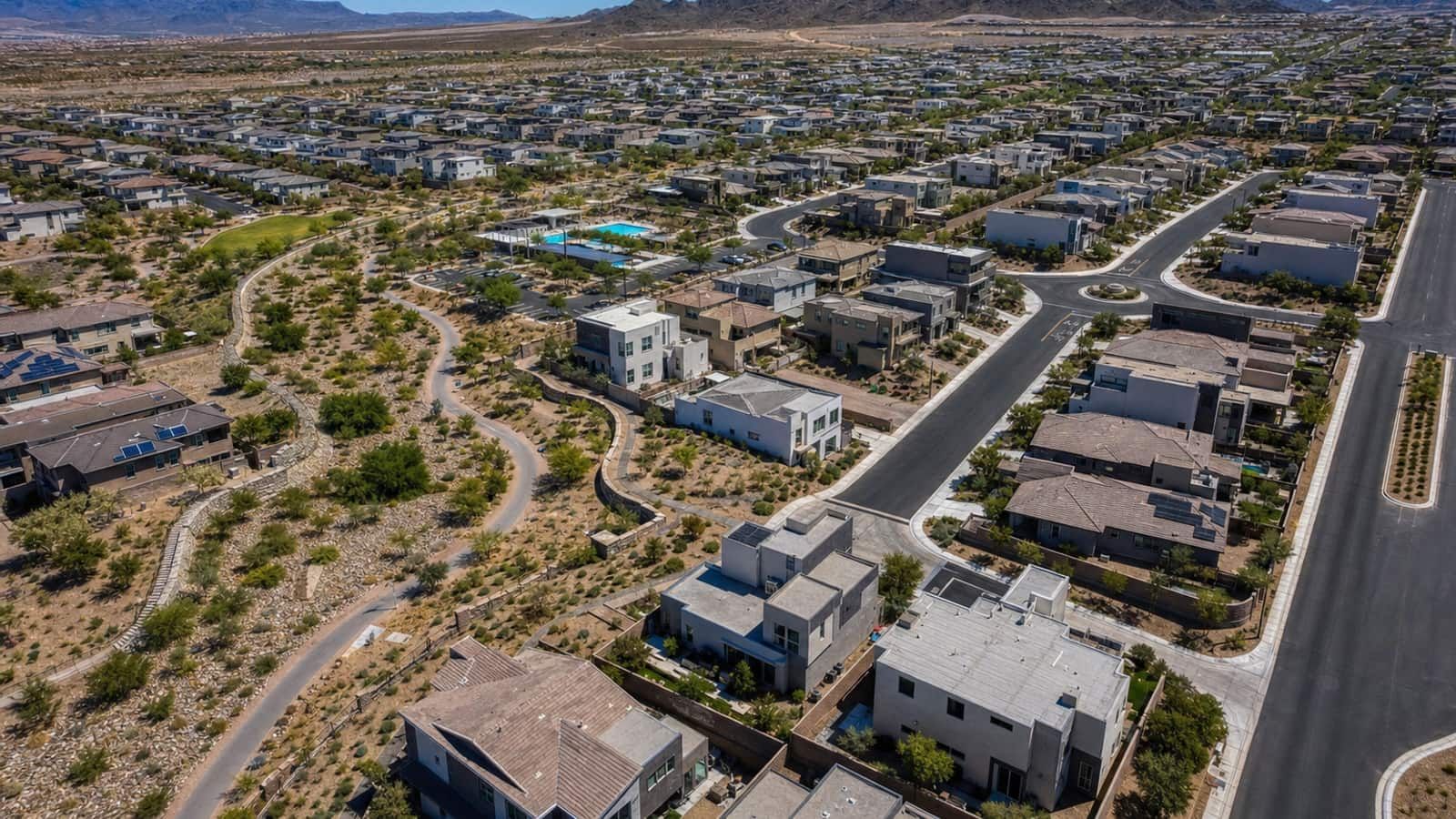
- Inspirada — the closest master plan to the corridor, mixed new and resale, strong parks system, and the most natural landing spot for a Haas or Google employee who wants a ten-to-fifteen-minute drive. 332 closings at a $559,200 median; detached homes at $615,000.
- Cadence — larger, farther east, heavy new-construction inventory across multiple builders, and generally more house per dollar than Inspirada at the same size. 633 closings at a $485,000 median; detached homes at $504,970.
- Anthem — established, elevated, quieter, with a longer but simple commute. 548 closings at a $649,945 median.
- Green Valley — mature, walkable, mid-1990s single-story stock, closest to Henderson's hospital corridor. 264 closings at a $485,000 median.
Our Henderson job market guide covers the employer mix and wage bands in more depth, and current inventory is on the Henderson homes for sale search.
What Is the Clark County Innovation District, and What Does It Actually Change?
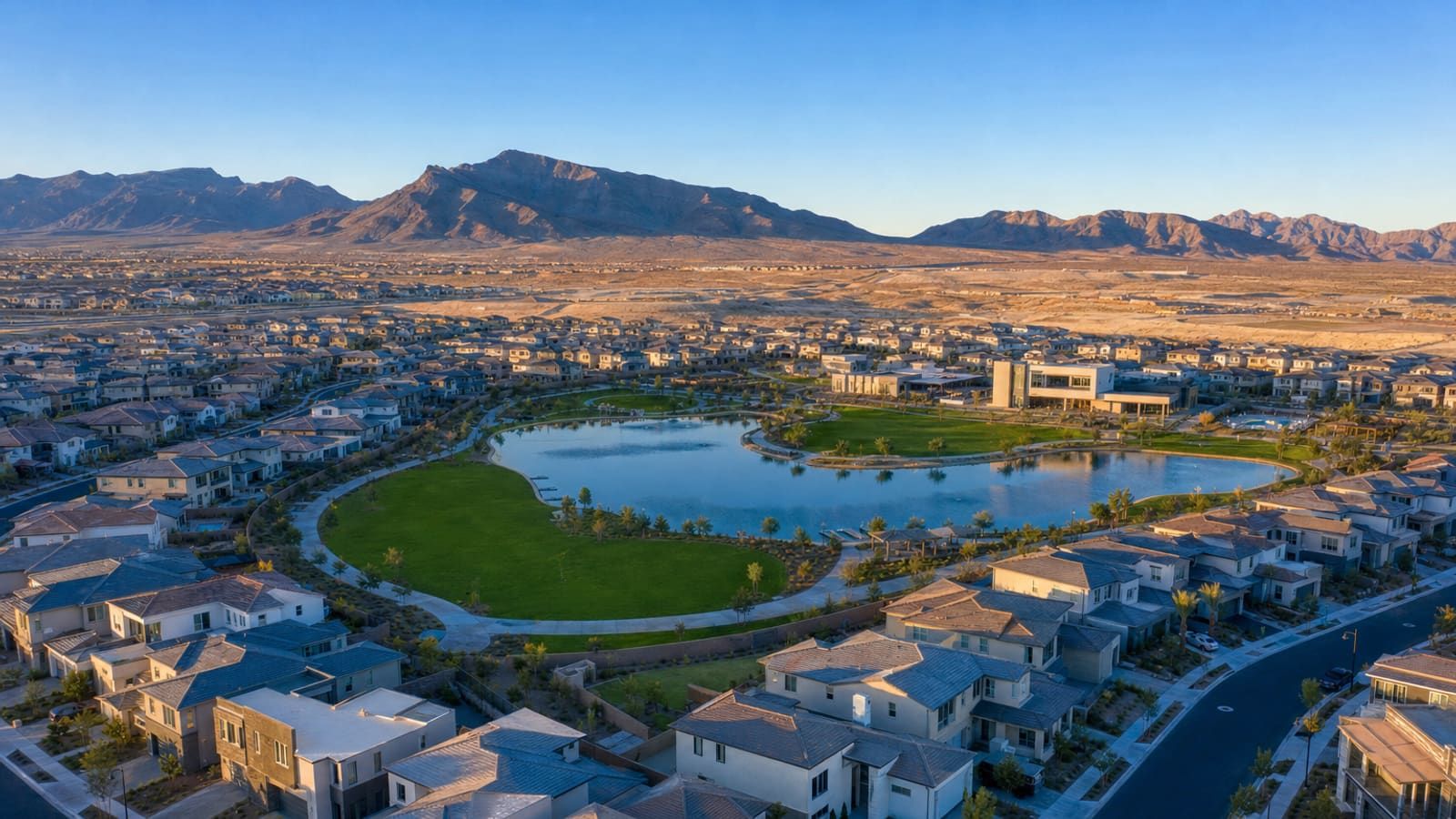
The Clark County Innovation District — CCID — is the county's answer to the question of where a tech cluster should go, and it is worth understanding precisely, because a buyer can easily mistake a planning designation for a zoning change or a jobs pipeline. According to the Clark County Office of Community and Economic Development, the district sits in the southwest valley along the I-215 between UNLV's Harry Reid Research and Technology Park and South Decatur Boulevard, and its purpose is to welcome new tech employers and grow existing ones by blending technology into an economy built on hospitality and manufacturing. According to KTNV, the Clark County Commission voted to accept the strategic action plan in October 2023; the study area runs roughly from Russell Road south to the Robindale-Windmill corridor and from Decatur Boulevard west to Durango Drive, about eight square miles.
What the plan actually recommends is more modest than the branding. The action plan, prepared by HR&A Advisors with Perkins and Will and dated 2023, proposes a three-part framework: designate the employment land along the 215 as an "innovation corridor" where incentives for innovation-oriented uses are focused; build a "district core" on an initial parcel of eight to twenty acres around existing amenitized development; and connect the two with east-west complete streets and a fiber loop. It names Harry Reid Tech Park, Switch, Black Fire Innovation, and StartUp Las Vegas as the ecosystem partners, and its "next steps" are governance, branding, site control of the first parcel, and pursuing federal Economic Development Administration Tech Hubs money.
Here is what that means as of September 19, 2026. The CCID is an accepted action plan and an OCED marketing designation; I could not find an adopted zoning overlay, a dedicated incentive ordinance, or a named anchor tenant tied to it in county records, and Clark County's Title 30 zoning still governs what can be built parcel by parcel. For employers, that means the district changes the conversation with the county — a fast-track and a willing partner — but not yet the entitlements. For a buyer, it means the southwest valley's housing case rests on what is already there: the research park's 1,000 workers, Switch, UnCommons, the Allegiant and Raiders headquarters cluster, and the healthcare corridor — not on the district label. In the same MLS pull, the southwest ZIPs closest to the district (89103, 89113, 89118, 89139) closed 1,796 homes at a $425,000 median and $247 per square foot in the 12 months ending September 17, 2026, with 1,137 active listings at a $445,000 median as of September 19 — priced as a mature, mid-market submarket, which is what it is.
What Does the Commute Actually Look Like From Each Submarket?
Commute is the variable relocating buyers most consistently get wrong, because they judge Las Vegas distances on a map rather than on the road network.
The valley is a grid bisected by two freeways and ringed by the 215. That geometry means a drive that looks long can be quick if it runs on the 215, and a drive that looks short can be slow if it crosses the middle of the valley at 5pm. A buyer moving from a coastal metro almost always overestimates Las Vegas commute times in the abstract and then underestimates the specific one they will actually drive.
| Submarket | To West Henderson | To UNLV research park | To southwest valley / CCID |
|---|---|---|---|
| Inspirada | Short — under 15 min | Moderate | Moderate |
| Cadence | Moderate | Moderate | Longer |
| Anthem | Short to moderate | Moderate | Moderate |
| Green Valley | Moderate | Short | Moderate |
| Southwest / Mountain's Edge | Moderate | Moderate | Short |
| Summerlin | Long | Moderate | Moderate |
| Centennial Hills | Long | Long | Long |
Drive the specific route at the specific hour before you commit. I've represented enough relocation buyers to say that the ones who skip this step are the ones who move again in three years, and moving twice costs far more than the price difference between the two neighborhoods they were choosing between. For a Haas shift that starts before 6 a.m., the drive from Inspirada is a non-event and the drive from Summerlin is a daily tax; for a research-park engineer on flexible hours, the same Summerlin address is entirely reasonable.
Why Does the UNLV Research Park Matter More Than Its Size Suggests?
Because it produces the kind of employment that compounds.
According to UNLV, the Harry Reid Research and Technology Park occupies 122 acres with roughly 93 acres dedicated to tech space. It currently houses more than 100 companies and about 1,000 employees, with a meaningful share in coworking and incubator space. Anchor tenants include GeoComply and Sightline Payments — both companies valued above $1 billion, which matters less for the valuation itself than for what it signals about the talent they hire.
The 2019 master plan contemplates roughly 12 office buildings and 1.5 million square feet at full build-out, and a Gardner-developed 111,000 square foot four-story building is already fully leased. A proposed Las Vegas Media Campus is among the projects planned but not yet under construction. The park is also the eastern anchor of the Clark County Innovation District, which is the county's attempt to extend the same ecosystem west along the 215.
Why this matters disproportionately: 1,000 workers is a small number next to a resort, but these are professional, portable, high-earning households, and incubator ecosystems reproduce. A company that grows out of the park does not typically leave the metro — it leases a larger space nearby and hires more people locally. That is a different demand curve from a data center, which will employ roughly the same number of people in 2036 as it does today.
Research-park employees buy across a wide arc, because the park sits near the geographic center of the valley. Green Valley, the southwest, the southeast, and the Summerlin corridor are all reachable, which is why this node influences housing more diffusely than West Henderson does.
Should You Buy Near the Job or Near the Life You Want?
This is the real decision, and the honest answer is that Las Vegas rewards the second choice more than most metros do.
In a metro with a two-hour commute ceiling, proximity to work dominates everything. Las Vegas does not have that problem. The valley is compact, the ring road works, and the difference between a fifteen-minute and a thirty-five-minute commute here is real but not life-defining. That gives a tech buyer genuine freedom to optimize for schools, for a specific community, or for the kind of weekend they want, rather than for the office.
The exception is shift work and on-call. If your role requires physical presence at odd hours — and data center operations and some manufacturing roles do — proximity stops being a preference and becomes a requirement. A 3am call-out from Cadence is a different experience than one from Inspirada.
And if the job is remote or hybrid with occasional office days, ignore the commute column entirely and buy where you want to live. That is an increasingly large share of the tech buyers we work with, and they consistently end up in Summerlin, Henderson's established core, or the southwest — none of which are chosen for proximity to an employer.
What Should Relocating Tech Buyers Know About Nevada Taxes?
The tax picture is a genuine part of the compensation calculation and is frequently underweighted by candidates evaluating an offer.
According to the Nevada Department of Taxation, Nevada levies no state personal income tax. For a relocating engineer on a $160,000 base, moving from California's top marginal environment to Nevada can be worth a large annual sum before any housing comparison — and equity compensation makes the gap wider still, because a vesting event that would be taxed at the state level in California is not taxed at the state level here. Run the number with your own tax preparer using the actual RSU or option schedule, because the state-tax treatment of a vest that straddles a move date depends on where you performed the work, not where you live when it vests.
Property taxes are modest as well. Clark County's effective rate runs near 0.77% against a national average closer to 1.02% per U.S. Census Bureau data, so a $600,000 Inspirada home carries roughly $4,600 a year and a $485,000 Cadence home roughly $3,700 — figures a coastal buyer used to $12,000 property-tax bills tends to double-check. According to the Nevada Revised Statutes, NRS 361.4723 caps the annual increase in the tax bill on an owner-occupied primary residence at 3%, while other property is capped at up to 8% — but that lower abatement requires a filed claim and resets on change of ownership, so a relocating buyer has to file it after closing rather than inherit it. Our Nevada property tax cap guide explains the mechanics.
Two smaller items round out the picture. Nevada has no state-level estate or inheritance tax, which matters to senior technical households doing long-horizon planning, and vehicle registration is assessed on a depreciating value schedule rather than a flat fee, which surprises buyers arriving with two new cars. Do not let the tax advantage do all the work in your decision, though. It is real, it is permanent, and it is also already priced into what people are willing to pay for housing here — the Henderson median of $489,500 in the 12 months ending September 17, 2026 reflects a market that knows exactly what a no-income-tax state is worth.
How Do Data Center Neighbours Actually Fare?
Worth addressing plainly, because buyers ask and the answer is more nuanced than either side of the public argument suggests.
Data centers are low-traffic, low-noise-at-distance, and visually unremarkable industrial neighbours compared to most alternatives for the same land. They do not generate truck traffic at distribution-center scale, and they do not operate at manufacturing noise levels.
The genuine concerns are three. Backup generator testing produces periodic noise, and the schedule is worth asking about. Cooling infrastructure produces a constant low-frequency hum that is inaudible at distance and noticeable immediately adjacent. And water and power draw is the subject of active public debate in Southern Nevada, which is a policy question rather than a property-condition question, but it can affect future development approvals nearby — and, after Executive Order 2026-005, it now directly affects whether a proposed facility can qualify for a state abatement at all.
If you are looking at a home within sight of a data center campus, visit at night. That is when the hum is most audible and when you will learn what you actually need to know.
Resale impact is the question underneath the question, and the honest answer is that it depends almost entirely on sightline and distance. A home several streets back, with no view of the campus, generally transacts on the same terms as any comparable home in its neighborhood — the data center is simply not part of the buyer's experience of the property. A home that backs directly to the perimeter is a different conversation, and it will draw a smaller buyer pool at resale even if you personally never notice the facility. Price that reality into what you pay going in, rather than discovering it on the way out.
Which Price Points Do Tech Buyers Actually Land In?
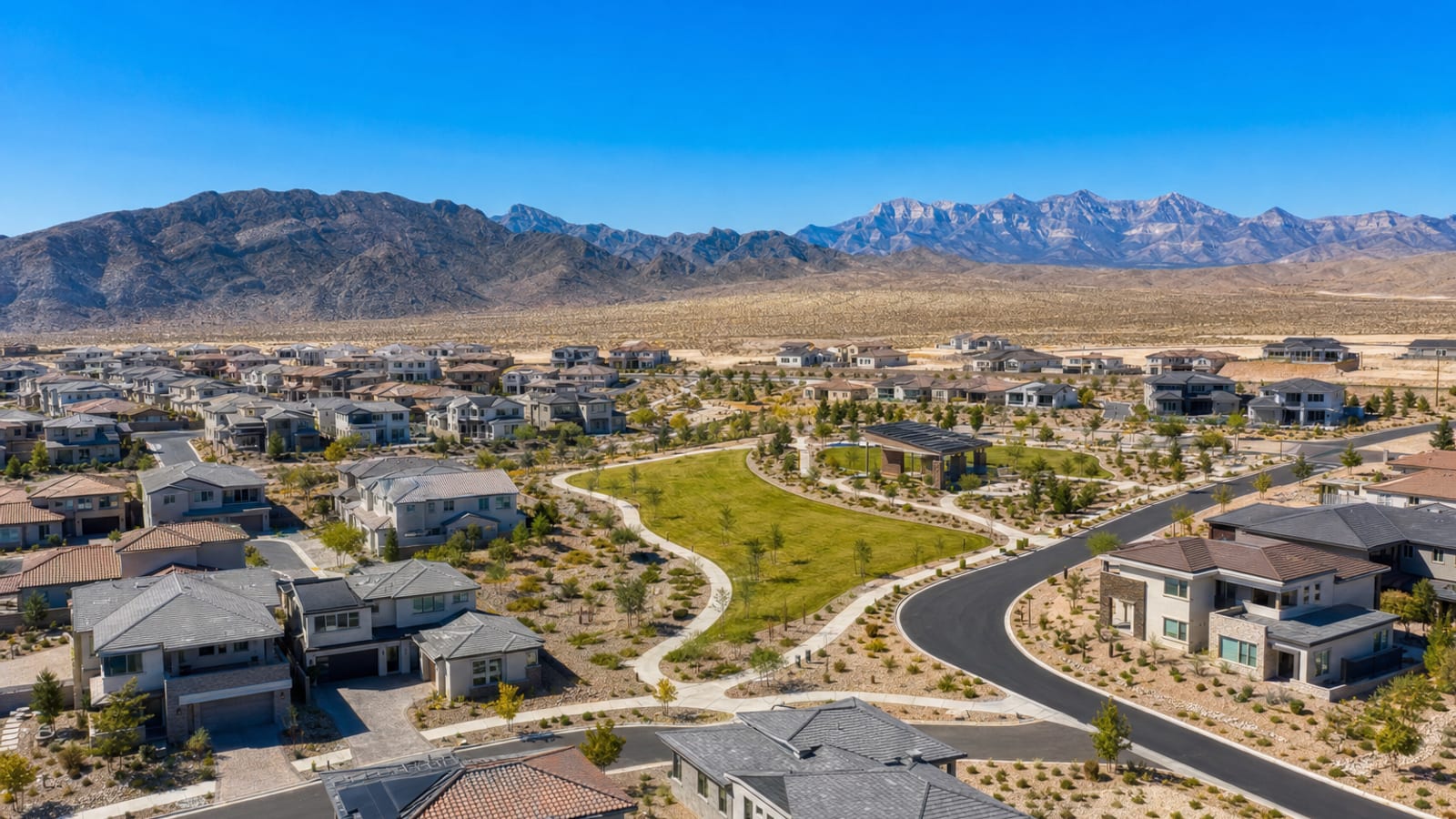
Broadly, three bands, and they map to role rather than to employer. The bands below are anchored to Las Vegas MLS data pulled through Repliers on September 19, 2026, covering closings in the 12 months ending September 17, 2026.
Entry technical and operations roles typically land in the $380,000 to $500,000 range, which in the current valley means new construction in Cadence (median $485,000) or North Las Vegas (median $415,000 across 3,116 closings), or resale in the established southeast and the southwest ZIPs near the Innovation District (median $425,000). This is where builder incentives matter most, and where a rate buydown through a builder's affiliated lender is often worth more than a price concession.
Mid-career engineering and professional roles generally land between $500,000 and $750,000 — Inspirada (median $559,200; detached $615,000), Green Valley (median $485,000; detached $511,000), the better southwest neighborhoods, and the entry tiers of Summerlin, where the five core ZIPs closed 2,804 homes at a $606,000 median. This is the deepest and most competitive part of the valley market.
Senior and leadership roles, plus dual-income technical households, move into $750,000 and above, where Summerlin's inner villages, Anthem (median $649,945, with detached homes at $660,000 and $307 per square foot), MacDonald Highlands, and the guard-gated inventory compete. Our luxury communities overview covers that tier.
| Submarket | Closings | Median sold | Median $/sq ft | Median days on market | Nearest node |
|---|---|---|---|---|---|
| Inspirada | 332 | $559,200 | $256 | 34 | West Henderson |
| Cadence | 633 | $485,000 | $248 | 40 | West Henderson |
| Anthem | 548 | $649,945 | $307 | 34 | West Henderson |
| Green Valley | 264 | $485,000 | $269 | 22 | UNLV park / hospitals |
| Southwest ZIPs (89103, 89113, 89118, 89139) | 1,796 | $425,000 | $247 | 35 | Innovation District / Switch |
| Summerlin ZIPs | 2,804 | $606,000 | $316 | 34 | Remote / hybrid |
| Centennial Hills ZIPs | 1,518 | $515,000 | $245 | 32 | Remote / hybrid |
| North Las Vegas | 3,116 | $415,000 | $234 | 23 | Entry / new construction |
Two things stand out in that table. Cadence carries the longest median time to contract of the Henderson submarkets at 40 days, which is what heavy new-construction supply looks like — and it is where a buyer has the most negotiating room. And Green Valley moves fastest at 22 days despite its 1990s stock, because single-story homes near the hospital corridor are exactly what the healthcare and research-park workforce wants. According to Las Vegas REALTORS, monthly Southern Nevada statistics are the authoritative local reference for where these bands sit at any given moment, and they move enough that any figure written into an article should be treated as a starting point rather than a quote.
How Much House Does Each Tech Salary Band Actually Buy?
Translating a compensation package into a Las Vegas purchase price is where relocating buyers most often go wrong in both directions — some anchor to their old metro and overshoot, others anchor to a national median and undershoot what they can comfortably carry here.
| Factor | Entry technical | Mid-career engineer | Senior / dual income |
|---|---|---|---|
| Household income band | $75,000–$110,000 | $130,000–$190,000 | $220,000–$400,000+ |
| Comfortable purchase price | $380,000–$500,000 | $500,000–$750,000 | $750,000–$1,500,000+ |
| Down payment at 10% | $38,000–$50,000 | $50,000–$75,000 | $75,000–$150,000 |
| Down payment at 20% | $76,000–$100,000 | $100,000–$150,000 | $150,000–$300,000 |
| Typical annual property tax | $2,900–$3,850 | $3,850–$5,775 | $5,775–$11,550 |
| Where it lands | Cadence, North Las Vegas, SE valley | Inspirada, Green Valley, southwest | Summerlin villages, Anthem, gated |
| Inventory type | New construction, entry resale | Mixed new and resale | Resale and semi-custom |
Two notes on reading that table. The property tax line is computed at roughly the 0.77% Clark County effective rate and is an estimate for planning, not a quote — the assessed value of a specific parcel drives the actual bill. And the down payment rows are deliberately shown at both 10% and 20% because the gap between them, $38,000 against $76,000 at the entry band, is frequently the single largest constraint on a relocating buyer who has not yet sold a home elsewhere.
The band that surprises people most is the entry one. A $95,000 household income supports a genuinely good Las Vegas home — a new-construction three-bedroom in North Las Vegas or Cadence at $430,000 is an ordinary outcome, not a stretch. That same income in a coastal tech metro buys a long commute and a condo, which is precisely why Las Vegas keeps winning relocations it has no business winning on prestige.
Are Builder Incentives Worth More Than a Price Cut Right Now?
For anyone buying new construction in the employment corridor — and a large share of tech relocations do — this is worth understanding before you negotiate.
Production builders rarely cut base price, because a recorded lower sale price affects the comparable sales for every remaining home in the community. What they will move on is incentives, and in the current market those are frequently worth more to the buyer than an equivalent price reduction.
A rate buydown through the builder's affiliated lender is the clearest example. Buying the rate down meaningfully on a $500,000 loan can save far more over the years you actually hold the loan than a $15,000 price concession would, because the concession reduces principal once while the buydown reduces the payment every month. Closing cost credits of $10,000 to $20,000 are common, and design studio allowances in the $10,000 to $25,000 range appear regularly on standing inventory.
The leverage is highest on homes already framed or finished, particularly near a quarter end, because that home represents capital the builder wants off the books. It is lowest on a to-be-built home in a phase that is selling well. In Cadence specifically, a 40-day median time to contract in the year ending September 17, 2026 tells you there is standing inventory to negotiate on.
One caution specific to relocations: builder-affiliated lenders often attach the best incentive to using their financing. That can absolutely be the right deal, but price it against an outside quote rather than assuming. The incentive is real and so is the rate spread, and only comparing both tells you which wins.
Frequently Asked Questions
How many jobs does Google's Henderson data center actually create?
Fewer than most people assume. The campus is backed by roughly $1.2 billion in investment and had fewer than 180 full-time equivalents across both facilities as of late 2024, with projections of 220 to 240 by the end of 2026. That is more than $5 million of capital per permanent job. Construction employment during build-out is far larger but temporary, and largely drawn from the existing local trades workforce rather than from new arrivals.
Which Las Vegas employer is creating the most tech housing demand?
Haas Automation, by headcount. Its roughly 2.5 million square foot plant on Via Inspirada in West Henderson is on schedule to open in the first quarter of 2027, is holding hiring fairs in September and October 2026, and plans 1,400 hires within five years. That single facility will generate more sustained household formation than the valley's data centers combined, because manufacturing and engineering roles are labor-intensive in a way that data center operations are not.
Where is the Las Vegas tech corridor located?
There isn't one single corridor. The densest employment concentration is West Henderson, which the City of Henderson has designated a potential global business district and which contains both the Google campus and the Haas plant. The UNLV Harry Reid Research and Technology Park sits near the valley's geographic center on 122 acres, Switch's digital exchange campuses sit in the southwest valley, and the Clark County Innovation District is the county's plan to link the research park west along the 215 to Decatur Boulevard.
What is the Clark County Innovation District?
It is a strategic action plan the Clark County Commission accepted in October 2023 for an eight-square-mile area of the southwest valley between UNLV's Harry Reid Research and Technology Park and South Decatur Boulevard along the I-215. The plan recommends an innovation corridor, a district core on an initial parcel of eight to twenty acres, a governance entity, and pursuit of federal Tech Hubs funding. As of September 2026 it is a designation and a plan, not a zoning overlay or a named tenant.
What is the UNLV Harry Reid Research and Technology Park?
A 122-acre mixed-use research park with roughly 93 acres dedicated to tech space, serving as UNLV's incubator and economic development platform. It currently houses more than 100 companies and about 1,000 employees, with anchor tenants including GeoComply and Sightline Payments. The 2019 master plan contemplates about 12 office buildings and 1.5 million square feet at full build-out.
Should I buy a home near a Las Vegas data center?
It is generally an unremarkable industrial neighbour — low traffic, no manufacturing noise, minimal visual impact. The real considerations are periodic backup generator testing, a constant low-frequency cooling hum audible only immediately adjacent, and ongoing public debate about water and power draw that could affect nearby development approvals. Visit the specific home at night before deciding; that is when you learn what matters.
How long is the commute from Summerlin to West Henderson?
Long by valley standards — it crosses the metro diagonally. Summerlin works well for research-park and southwest-valley roles and poorly for a daily West Henderson commute. If your job is in West Henderson and you want a short drive, Inspirada and Anthem are the natural choices, with Cadence trading commute time for more square footage per dollar.
Which Las Vegas neighborhoods do tech workers most often choose?
It splits by role and by commute requirement. Entry technical roles concentrate in Cadence ($485,000 median in the year ending September 17, 2026), North Las Vegas ($415,000), and the established southeast. Mid-career engineers land in Inspirada ($559,200), Green Valley ($485,000), and the southwest ($425,000). Senior and dual-income technical households move into Summerlin's inner villages ($606,000 across the core ZIPs), Anthem ($649,945), and guard-gated inventory above $750,000. Fully remote workers ignore commute entirely.
What Should You Do Before Accepting a Las Vegas Tech Offer?
Five things, in order.
Ask for the operating headcount of the facility, not the investment figure. A $1.2 billion data center and a $500 million factory are not comparable housing events; the first supports a couple hundred jobs and the second is hiring by the thousand. If the recruiter cannot tell you how many people work in the building, the number is probably small.
Drive the actual commute at the actual hour. Then drive it again on the way home. The 215 makes Inspirada-to-anywhere easy and Summerlin-to-West-Henderson hard, and no map conveys that.
Price the specific submarket rather than the metro median. In the 12 months ending September 17, 2026, the spread between Cadence at $485,000 and Summerlin's core ZIPs at $606,000 is $121,000 at the median — before you adjust for square footage, lot, and age.
Model your after-tax income with the state tax line at zero, and file the 3% primary-residence abatement claim after closing, because that is a real raise that most candidates underestimate and a cap that does not transfer automatically.
Get independent representation before you walk into a builder's model home, because in new construction the sales counselor works for the builder — a fact that is neither hidden nor sinister, but is frequently forgotten. According to the Consumer Financial Protection Bureau, independent representation matters in any transaction, and in a builder negotiation it is the difference between accepting the posted incentive and comparing it against an outside lender's quote.
If you want the specific numbers for your role, your employer, and your commute tolerance — the same MLS pull used in this guide, run for the exact communities you are weighing — call Nevada Real Estate Group at (702) 637-1759, or start with our Las Vegas homes for sale search and our buyer resources. Across the 9,600-plus closings we have represented, the relocation buyers who did best were the ones who chose the house after they understood the job, not before.
Which Sources Inform This Las Vegas Tech Corridor Guide?
- UNLV Office of Economic Development — Harry Reid Research and Technology Park acreage, tenancy, and master plan
- Clark County Office of Community and Economic Development — Innovation District — district location, purpose, and action plan
- KTNV — commission accepts Innovation District plan — boundaries, consultant, next steps
- Las Vegas Review-Journal — Haas Automation job fairs and opening timeline, September 4, 2026
- City of Henderson — West Henderson employment designation and Haas Automation announcements
- Baxtel — Google Henderson data center — campus investment, shell capacity, and staffing figures
- The Nevada Independent — data center tax abatements — abatement totals and promised jobs as of January 2025
- News 3 Las Vegas — Executive Order 2026-005 — new data center abatement requirements
- U.S. Bureau of Labor Statistics — metro employment concentration and sector growth data
- U.S. Census Bureau — effective property tax rates and household formation data
- Nevada Department of Taxation — state tax structure and property tax abatement
- Nevada Revised Statutes Chapter 361 — NRS 361.4723 partial abatement provisions
- Clark County — Assessor parcel records and primary-residence claims
- Las Vegas REALTORS — Southern Nevada monthly market statistics
- Consumer Financial Protection Bureau — buyer representation guidance
- Nevada Governor's Office of Economic Development — statewide business attraction and incentive programs
- Regional Transportation Commission of Southern Nevada — valley road network and commute infrastructure
Methodology: submarket prices are Las Vegas MLS data pulled through Repliers on September 19, 2026 (closings in the 12 months ending September 17, 2026, and active listings as of that date), grouped by MLS neighborhood name or ZIP code; they are not official Las Vegas REALTORS statistics. Employer figures come from the public sources above as of September 19, 2026 and change as projects progress.