

Published May 9, 2026 · September review added September 5, 2026 · Updated September 19, 2026 · Corrected October 4, 2026 · By Chris Nevada, Nevada Real Estate Group · NV License S.181401
Las Vegas is a negotiable, balanced-to-buyer-leaning market this fall, not a falling one. Our September 15, 2026 count found 8,330 active Las Vegas listings, 43.3% with a price cut, against a settled July median sale of $430,000 at 98.9% of list. Las Vegas REALTORS' August single-family median was $475,000, down 1.0% year over year, and Freddie Mac's 30-year rate hit 6.95% on September 17. Buy on leverage and payment, not on a forecast.
- September 15, 2026: 8,330 active Las Vegas listings, 43.3% cut by a $20,000 median, $469,000 median ask.
- Settled July closed 1,400 Las Vegas sales at $430,000 ($480,000 single-family), 98.9% of list, 28 days.
- Las Vegas REALTORS: August single-family median $475,000, down 1.0%, below the $490,000 May–June record.
- Freddie Mac's 30-year fixed was 6.95% for the week of September 17, 2026, up from 6.26% a year earlier.
- Census-tracked single-family permits for the metro fell from 705 in March to 484 in July 2026.
What Has Changed Since the Summer Forecast?
September 19, 2026 review: this page originally forecast a summer valley-wide median of $485,000–$498,000. That was a forecast, not a promise or a reported sale price, and the September 5 review declined to grade it because our city-field sample did not match the forecast's valley-wide geography. We now have a matching series. According to Las Vegas REALTORS' August 2026 report, the Southern Nevada single-family median — the closest published match to the forecast's scope — set a record of $490,000 in May and June 2026, inside the base-case band, then eased to $475,000 in August, down 1.0% from a year earlier and below the band. The honest grade: the base case held through early summer and missed by late summer; the bull case ($510,000 or more, contingent on rates under 6.0%) never had a chance.
The current snapshot comes from our team's complete sweep of the GLVAR-fed MLS on September 15, 2026, published in the September 2026 Las Vegas market report, and from the settled July closings — the most recent month whose sales have fully posted. "Las Vegas" here is the MLS city field, which is also how the association reports it; the public Las Vegas REALTORS monthly report covers the whole of Southern Nevada and uses its own property mix and timing.
| Measure | Result | What it means |
|---|---|---|
| Active listings, September 15 | 8,330 | Every residential listing in the Las Vegas city field, counted individually |
| Listings with at least one price cut | 3,609 (43.3%) | Original asking price versus current, per listing; median cut $20,000 |
| Median asking price | $469,000 | Seller asking prices; $550,000 single-family, $255,000 condo and townhome |
| Settled July closings | 1,400 | Every July sale posted through September 15; the month is complete |
| July median sold price | $430,000 | $480,000 single-family; $261,500 condo and townhome |
| July sale-to-list ratio | 98.9% | 57.6% closed below list, 16.4% above, each paired with its own final ask |
| July median days on market | 28 days | Listing to contract for homes that closed; actives sit a median 25 days |
Read the two columns as two clocks: the active side is what sellers were doing on September 15, the closed side is what buyers actually paid in the last month we can fully count, and the distance between them is closing from the top down — sellers cutting toward the closings — which is why the 43.3% cut share, not the median, is the number to watch. August is only about half posted (739 closings at a provisional $439,888 median as of September 15), so it appears here as direction, not as a result.
According to Freddie Mac's Primary Mortgage Market Survey, the national 30-year fixed benchmark averaged 6.95% for the week of September 17, 2026, up from 6.76% the week before and 6.26% a year earlier, with the 15-year at 6.26%. That replaces the 6.71% figure from the September 5 review and the 6.55% assumption in the original forecast. It is a national benchmark, not a guaranteed rate for a Las Vegas borrower. Ask a lender for a written quote reflecting down payment, credit, property type, points, and occupancy.
One caution: more choice helps a buyer only when the competing homes fit the same search. A citywide count says little about a scarce single-story plan on a particular street, so compare the active alternatives, pending homes, reductions and sold comparables in the same neighborhood and price band. If the payment works only after a hoped-for refinance, it does not yet work.
Scope and archive note: several sections below preserve the original summer outlook and its dated assumptions, labeled as such; they have not been recertified except where a September 2026 paragraph says so.
What Did the Original Summer Outlook Assume?
- Las Vegas valley-wide median: $478,000 in Q1 2026, up 3.7% year-over-year. Single-family homes: $485,000. Townhomes: $310,000-$375,000, per Las Vegas REALTORS MLS data.
- Active inventory has tripled from the 2022 cycle low (2,650 listings) to 8,100 — approaching the pre-pandemic normal of 8,800-12,200 but not yet oversupplied.
- Mortgage rates have traded in a 6.3-6.95% band for 14 consecutive months. The CME FedWatch tool projects 2 quarter-point cuts through year-end, potentially bringing rates to 6.0-6.4%.
- Summer forecast: median $485,000-$498,000 (+1.5-4.2% above Q1). Bull case: $510,000+ if rates drop below 6.0%. Bear case: below $465,000 if rates spike above 7.25%.
- Clark County added 42,000 net residents in 2024, with 51% originating from California. The median income of California movers has risen from $86,000 (2020) to $112,000 (2024) — driving luxury demand.
This is the market I brief every buyer and seller on before we write an offer or sign a listing agreement. According to Las Vegas REALTORS, the data below comes from Las Vegas REALTORS MLS records, Clark County Assessor data, Federal Reserve economic releases, and our internal transaction database at Nevada Real Estate Group. The numerical outlook below records the original forecast assumptions, rather than verified September outcomes.
For historical context, our April 2026 market report covers the month-by-month trends, and the monthly market report hub tracks the settled-month series city by city.
Where Are Las Vegas Home Prices Headed Through 2027?
Start with what is measured, then what is forecast, and keep the two apart. According to Las Vegas REALTORS, the Southern Nevada single-family median peaked at a record $490,000 in May and June 2026 and eased to $475,000 in August, down 1.0% from August 2025; condos and townhomes were $299,900, up 0.6%. Our own settled July count inside Las Vegas city limits was $480,000 for single-family homes at 98.9% of list. Prices, in other words, are flat to slightly softer on a one-year view, and the direction into 2027 depends on rates and supply more than on demand, which the migration and jobs sections below show is still arriving.
The national forecasters are not calling for a Las Vegas-specific number, but their house-price views frame the range. According to the Mortgage Bankers Association and Fannie Mae forecasts as reported by Scotsman Guide in December 2025, MBA projected national home prices at a 0.3% decline for 2026 and 0.1% growth for 2027 with the 30-year fixed averaging 6.4% in both years, while Fannie Mae's Economic and Strategic Research group projected 1.3% growth in 2026 and 1.2% in 2027 with rates ending 2026 near 6% and 2027 near 5.9%. According to the National Association of REALTORS, its June 16, 2026 outlook called for a 4% rise in the national median and a 6.5% average rate for 2026. Freddie Mac's actual 6.95% print on September 17 sits above all three rate assumptions, which argues for weighting the MBA's flatter price path more heavily than the others for the next 12 months.
My own read, framed as experience rather than a model: across the 9,600+ closings we've represented, Las Vegas medians have rarely fallen in a year when the metro was adding jobs and residents, and rarely risen while 43% of sellers were cutting price and rates were climbing. The base case I brief clients on for the next 12 to 18 months is a valley-wide single-family median that holds within a few percent of $475,000 either way; a sustained move below 6.25% on the 30-year would push that up, a move above 7.25% would push it down, and neither should be the reason you buy or sell.
The valley-wide median masks significant variation between submarkets: a buyer in North Las Vegas is in a different market than a buyer in Summerlin. The ZIP table below is the original spring forecast, preserved for the record; the settled July results that grade it are in the luxury section further down.
Submarket Performance and Summer Forecast (original May 2026 table)
| Submarket (ZIP) | Q1 2026 Median | YoY Appreciation | Summer Forecast | Target Buyer |
|---|---|---|---|---|
| Henderson 89052 (Seven Hills, Anthem) | $685,000 | +5.8% | $705,000-$720,000 | Empty-nesters, luxury |
| Summerlin 89135 (The Ridges, Stonebridge) | $1,275,000 | +4.9% | $1,310,000-$1,340,000 | Tech/finance relocators |
| Henderson 89044 (Inspirada, Cadence) | $595,000 | +6.2% | $615,000-$635,000 | Young families, new build |
| Centennial Hills 89149 | $525,000 | +4.4% | $540,000-$555,000 | Move-up, value |
| North Las Vegas 89084 (Aliante) | $455,000 | +3.8% | $465,000-$475,000 | First-time, investor |
| East Las Vegas 89121 | $375,000 | +2.1% | $380,000-$390,000 | Investor, entry-level |
Sources: Las Vegas REALTORS MLS Q1 2026 closed sales, FHFA HPI data, Nevada Real Estate Group forecast model.
The variance between top-performing ZIPs (Henderson 89044 at +6.2%) and lagging ZIPs (East Las Vegas 89121 at +2.1%) is a 35-45% difference in return expectations. This is why I tell every buyer: do not use valley-wide medians for ZIP-specific decisions. The market is 15 micro-markets, not one monolith.
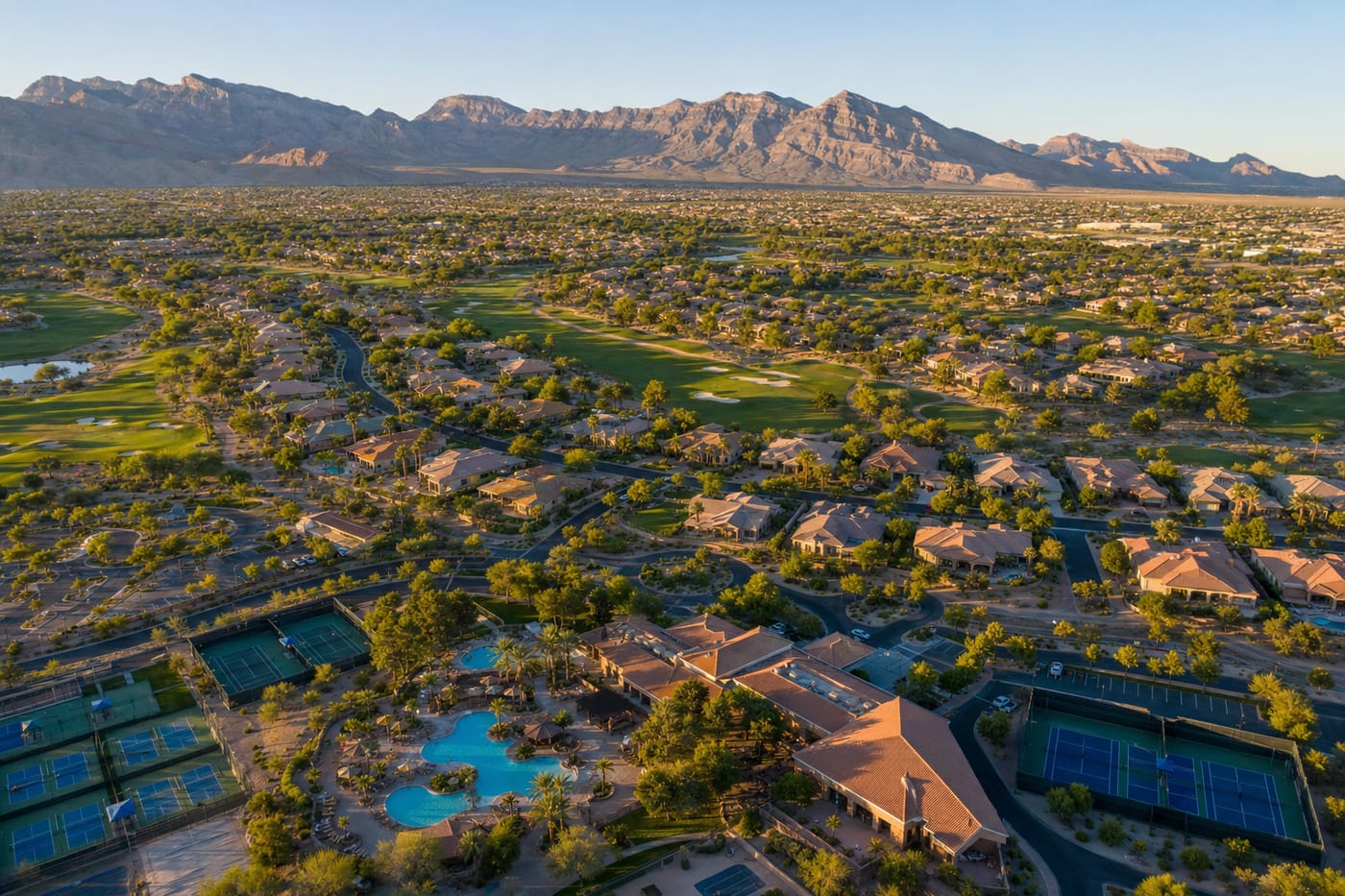
What Is Happening With Inventory — Are We Oversupplied?
The original summer outlook described inventory as normalized. That historical judgment should not be carried forward without checking a matched current supply and sales series.
Inventory Trend (Active Listings, Valley-Wide)
| Period | Active Listings | Months of Supply | Context |
|---|---|---|---|
| Q2 2022 (cycle low) | 2,650 | 0.9 | Extreme seller's market |
| Q1 2025 | 5,200 | 2.1 | Tight |
| Q1 2026 | 8,100 | 2.9 | Balanced |
| Pre-pandemic average (2014-2019) | 8,800-12,200 | 3.5-4.8 | Normal market |
| Buyer's market threshold | 12,000+ | 5.0+ | Favors buyers |
Sources: Las Vegas REALTORS MLS historical data, Nevada Real Estate Group analysis.
At 2.9 months of supply in Q1, the valley sat right at the balanced threshold — below 2.5 months is a seller's market, above 4.0 a buyer's market — with a pending-to-active ratio of 0.39 and new listings arriving at 1,820 per week. That was the spring reading.
September 2026 update — measured, not assumed. The supply question now has counted answers. Inside Las Vegas city limits the active board went from 8,170 listings on August 23 to 8,294 on September 8 to 8,330 on September 15, 2026, with 2,462 new listings arriving in the 30 days before the September 15 sweep against a settled July pace of 1,400 closings; the board is absorbing roughly what it takes in, which is why it grew by tens of listings rather than hundreds. According to Las Vegas REALTORS, single-family homes listed without offers across Southern Nevada rose 5.3% year over year to about 7,590 at the end of August, condos and townhomes rose 6.0% to 2,714, and the association put supply above 4.5 months — comfortably past the 4.0-month buyer's-market line in the table above, and the highest inventory level since 2020. The full price-band and ZIP breakdown is in our September 2026 inventory report.
Future supply is the other half, and it is shrinking. According to the U.S. Census Bureau's Building Permits Survey as published by FRED, seasonally adjusted single-family permits for the Las Vegas-Henderson-Paradise metro ran 705 in March 2026, 535 in April, 509 in May, 518 in June and 484 in July 2026, the latest month available — a roughly one-third decline from March to July. Builders are pulling fewer permits into a market where their resale competition is cutting price, which means the new-construction release valve for 2027 is narrower than it was for 2025. "Oversupplied" is the wrong word for a metro adding residents and shrinking its permit pipeline; "balanced, with the leverage sitting in the aged inventory" is the accurate one.
Is Las Vegas a Buyer's or Seller's Market in 2026?
By the numbers, it is a balanced market leaning toward buyers, segment by segment, and the answer changes with the price band and the age of the listing. The seller's-market signals are real: in settled July 2026, Las Vegas homes closed at 98.9% of their final list price, 16.4% closed above asking, the $400,000-to-$500,000 band turned in a 21-day median, and North Las Vegas was still closing at a 100% median sale-to-list ratio in 19 days. According to Las Vegas REALTORS, 74.8% of Southern Nevada single-family homes that sold in August 2026 had been on the market 60 days or less, distressed sales were 1.0% of the total and cash buyers were 21.9% — none of which describes a market in trouble.
The buyer's-market signals are just as real, and they are the ones a negotiator uses. On September 15, 2026, 43.3% of the 8,330 active Las Vegas listings had cut price at least once, by a median $20,000, and 694 had cut $50,000 or more; 29.9% of the board had sat 60-plus days, and 74.8% of those aged listings had already reduced — 1,857 homes that were both stale and discounted. In July, 57.6% of sales closed below list and 42.7% of the homes that sold had cut price before they did.
| Signal | Favors sellers | Favors buyers |
|---|---|---|
| Price achieved | 98.9% of list in July; 16.4% above ask | 57.6% of July sales below list |
| Speed | 28-day July median; 21 days in the $400K–$500K band | 29.9% of actives past 60 days; 19.7% past 90 |
| Price cuts | $1.5M+ tier only 29.4% cut | 43.3% board-wide; $500K–$650K band 46.0% |
| Supply (LVR, August) | Distressed sales 1.0%; cash 21.9% | 7,590 single-family listings without offers, up 5.3%; 4.5+ months |
| Demand (LVR, August) | Prices within 1.0% of a year ago | Sales down 1.7% for single-family homes and 7.4% for condos and townhomes from August 2025 |
How to use this. Buying a correctly priced home in the fast bands — $400,000 to $500,000, or the northwest ZIPs closing at full ask — is a seller's market: settle financing first and show the same week. Buying from the aged, already-cut pool is a buyer's market: open 3% to 5% under the reduced price with a credit request on top. Selling means pricing to the settled July closings for your ZIP, not the neighbor's ask, and expecting a credit conversation — at 6.95%, a $10,000 seller credit toward a rate buydown is worth more to the buyer than a $20,000 price cut and costs you less.
How Will Mortgage Rates Affect the Las Vegas Market This Fall and Into 2027?
Original May 2026 framing, preserved: rates had been range-bound between 6.3% and 6.95% for 14 months, the 30-year fixed sat at 6.55% in early May 2026 per Freddie Mac, and with March CPI at 2.7% markets were pricing in 2 quarter-point cuts through year-end, which would have brought the 30-year to approximately 6.0-6.4%.
September 19, 2026 update: the cuts did not arrive in the mortgage market. According to Freddie Mac's PMMS, the 30-year fixed averaged 6.65% for the week of August 20, 6.71% on September 4, 6.76% on September 10 and 6.95% for the week of September 17, 2026 — the top of the old 14-month range and 0.69 percentage points above the 6.26% of a year earlier. The 15-year fixed is 6.26%. For the forward view, the attributed forecasts are in the prices section above: MBA at 6.4% for 2026 and 2027, Fannie Mae near 6% and 5.9%, NAR at a 6.5% average for 2026 — all of them now below the actual print, which is the clearest statement available about how much confidence to place in any rate call.
What a rate move means for Las Vegas buyers: every 0.50% on a $475,000 loan is worth about $157 a month. At 6.95% the principal-and-interest payment on that loan is roughly $3,144; at 6.45% it is about $2,987. Applied to the settled $480,000 single-family median with 10% down, the payment is about $2,860 a month at 6.95% before taxes, insurance and any HOA. A half-point move expands purchase power by roughly $25,000 at the same monthly payment — enough to matter, not enough to wait for.
My take: I am not in the business of predicting rates — nobody is good at it, including the forecasters quoted above. What I tell buyers: if you can qualify at 6.95%, buy on leverage now — the aged, already-cut pool is the largest it has been since 2020 — and refinance later if rates drop. If you wait for 6.0%, you are competing against every other buyer who also waited, in a market where the permit pipeline is shrinking. The math favors buying in a balanced market at a higher rate over buying in a tight market at a lower rate.
What Is Driving 42,000 People Per Year to Move to Las Vegas?
According to U.S. Census Bureau estimates, Clark County added 42,000 net residents in 2024. That is 115 new residents per day. The composition of those movers has shifted meaningfully:
In-Migration Source Breakdown (2024)
| Origin | Share | Median Household Income |
|---|---|---|
| California | 51% | $112,000 (up from $86,000 in 2020) |
| Pacific Northwest (WA, OR) | 14% | $98,000 |
| Arizona | 8% | $82,000 |
| Texas | 5% | $91,000 |
| Other states | 22% | $78,000 |
Source: U.S. Census Bureau ACS migration flow data 2024, IRS SOI migration data.
The income profile of California movers has risen 30% in four years ($86,000 to $112,000). This is not working-class families fleeing high rent — it is upper-middle-class professionals and business owners strategically relocating for Nevada's zero state income tax. These buyers are pushing demand into the $600,000-$1,500,000 range, which explains why Summerlin and Henderson luxury segments are appreciating faster than the valley average.
Peak relocator closings run May through August (38-44% of annual volume), aligned with school-year planning. This seasonal wave is one reason we forecast the summer median to exceed Q1 levels. For the full relocation playbook, see our moving to Las Vegas guide.
The migration story has not changed in September 2026, and it is why "oversupplied" is the wrong frame. According to the U.S. Census Bureau's QuickFacts for Clark County, the county added roughly 42,500 residents in the most recent year measured, and those households have to live somewhere; deep, conforming-priced inventory — 82% of the Las Vegas board asked $832,750 or less on September 8 — is how the valley houses them. What the 2026 data adds is that relocators are arriving into a market where they can negotiate: a California household landing in Summerlin or Henderson this fall is meeting a seller who, more often than not, has already cut once. In our experience that combination — well-capitalized buyers and patient but repricing sellers — is why closings are holding near 1,400 a month in Las Vegas even with sales down association-wide.
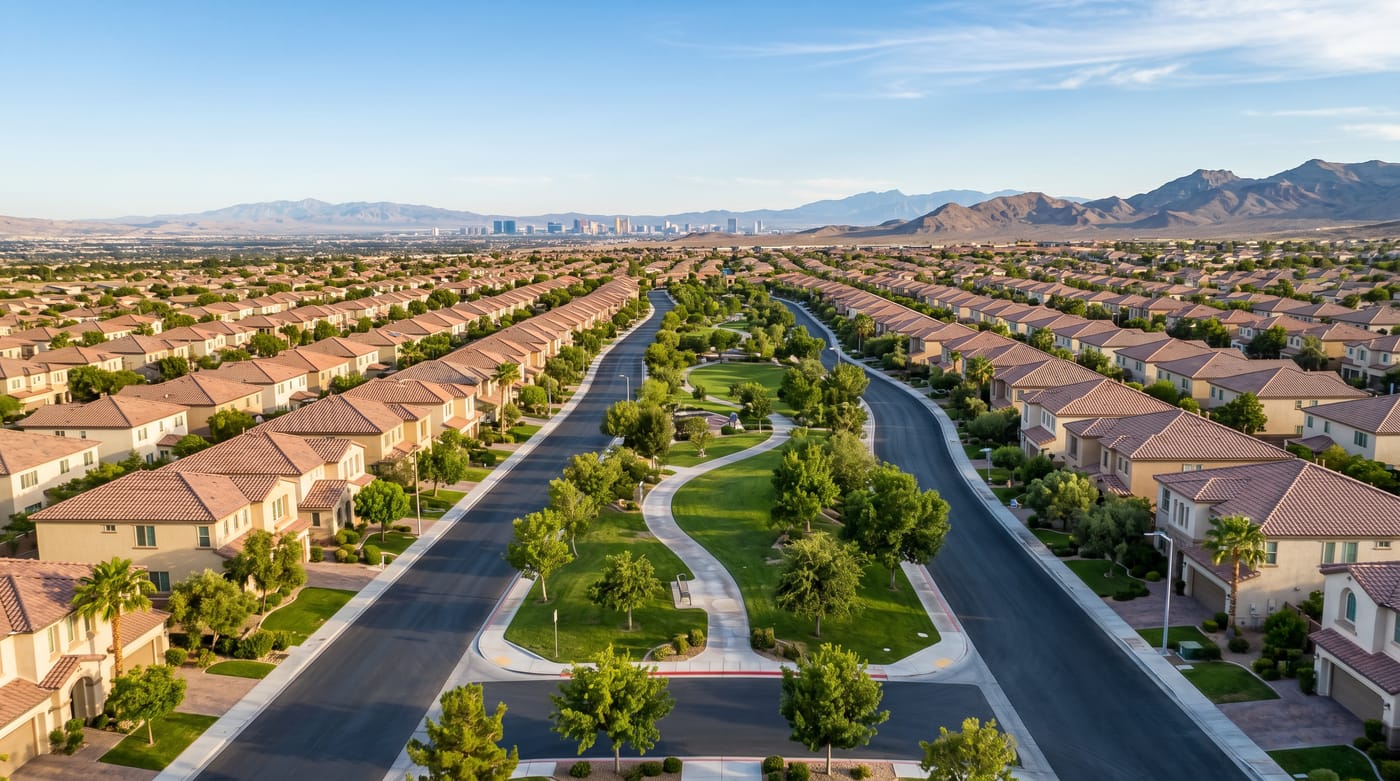
What Does the Employment Picture Look Like for Housing Demand?
Jobs drive housing demand, and according to Bureau of Labor Statistics CES data, the Las Vegas-Paradise MSA employment picture is strong:
Employment Snapshot (March 2026)
| Metric | Value |
|---|---|
| Total nonfarm employment | 1.06 million |
| Year-over-year job growth | +2.4% |
| Unemployment rate | 5.1% (down from 5.6% mid-2025) |
| Leisure and hospitality share | 26% |
| Professional and business services | 14% |
| Healthcare | 11% |
| Construction | 8% |
Source: Bureau of Labor Statistics CES data, March 2026.
The 2.4% job growth rate puts Las Vegas among the strongest-growing Western metros. Three major projects are adding employment capacity through 2027:
- Tropicana redevelopment (Las Vegas A's stadium, hotel, retail) — $1.5 billion project adding 3,000+ construction jobs and 2,000+ permanent positions
- Data center expansion in Henderson and North Las Vegas — $4+ billion in committed investment
- Semiconductor and logistics expansion at Apex Industrial Park — 5,000+ jobs in pipeline
Gaming revenue — the economic pulse of Las Vegas — hit $14.6 billion trailing 12 months (near record). The resort corridor is healthy, which means the 26% of the workforce in leisure and hospitality has stable employment.
August 2026 update: the labor picture improved through the summer. According to the Nevada Department of Employment, Training and Rehabilitation's August 2026 release, as reported by FOX5 Las Vegas, Nevada's seasonally adjusted unemployment rate fell to 4.8% in August from 5.0% in July, the lowest since February 2020, and the Las Vegas metro added 7,000 jobs over the month (up 0.6%) and 14,200 over the year (up 1.2%), with statewide employment at 1,619,400. DETR chief economist David Schmidt described the gains as spread across multiple industries. That is not boom-level growth, but a metro adding jobs at 1.2% a year while cutting its permit pipeline by a third is not a metro heading for a housing glut; it is one where the aged inventory clears as the new-listing pace normalizes. The wage side matters for the price bands: the households filling these jobs buy in the under-$500,000 bands that hold 56% of the Las Vegas board, which is why those bands turn fastest even in a slow sales year.
What Should Buyers Do This Fall?
Five strategies that separate successful fall 2026 buyers from frustrated ones:
1. Get full lender underwriting — not pre-qualification. Pre-qualification is a guess; pre-underwriting means the lender has already verified income, assets and employment. In a multiple-offer situation under $500,000, the pre-underwritten buyer wins at the same price every time.
2. Analyze target-ZIP comps weekly. The valley-wide median is noise; base the decision on the last 30 days of closed sales in your ZIP. In my experience, buyers who track their target ZIP weekly write stronger offers and overpay less, which is why we provide weekly comp reports to every active buyer client.
3. Never skip the inspection to win. HVAC replacement ($9,500-$14,500 per unit), roof underlayment ($12,000-$22,000) and sewer line repairs ($4,500-$14,000) are real costs that surface in years 1-5; treat the inspection response as a second negotiation, not a formality.
4. Be ready to write offers within 24 hours on fresh inventory — and be patient on aged inventory. In the $400,000-to-$500,000 band, well-priced homes went under contract in a 21-day median on the September 15 board, and 41.4% of all listings were two weeks old or newer. If you need 5 days to think about a correctly priced new listing, someone else will write the offer first. The 1,857 homes that are 60-plus days old and already cut are a different game: there, the seller's calendar is your leverage.
5. Watch the rate calendar, but do not trade on it. The September 17 print of 6.95% arrived after months of expected cuts that never reached the mortgage market. If a cut does show up in rates, expect a 2-3 week surge as sidelined buyers re-enter; pre-underwriting in place beforehand is the head start.
For first-time buyers, our mortgage pre-approval page walks through the full process. And for buyers evaluating new construction, our new construction guide covers all 18 active builders and current incentive packages.
What Should Sellers Know Before Listing This Fall?
Four strategies for sellers entering the fall market:
1. Price to the settled closings, not the neighbor's ask. The days of pricing 5-10% above comps and waiting for the market to catch up are over. In July 2026, Las Vegas homes closed at a median 98.9% of final list, and 42.7% of the homes that sold had cut price at least once before they did. A home that opens at July's ZIP median goes under contract in about four weeks; a home that opens at the neighbor's aspirational ask joins the 3,609 listings that had already cut by September 15.
2. Invest in pre-list preparation. Professional photography, staging, and minor repairs cost $5,000-$15,000 but return 1-3% in higher sale-to-list ratio. On a $500,000 home, that is $5,000-$15,000 in additional proceeds. For the full protocol, see our sellers page.
3. Plan for a 28-to-38 day market time and a credit conversation. This is not 2021. Las Vegas closed in a 28-day median in July and Henderson in 38. Expect 4-8 showings per week and 1-3 offers over the first month. 57.6% of July's sales closed below list, and a growing share of those concessions came as closing-cost or rate-buydown credits rather than price cuts, because a buyer at 6.95% would rather lower the payment than the price.
4. Consider the 7-day listing agreement. At Nevada Real Estate Group, we offer a 7-day cancellable listing agreement — if you are not satisfied with our service after the first week, cancel with no penalties. We earn your business every day.

How Is the Luxury Segment Performing Differently From the Broader Market?
The $1.5 million+ tier operates on its own dynamics — different buyers, different inventory cycles, and different marketing requirements.
Luxury Market Snapshot (Q1 2026)
| Metric | Luxury ($1.5M+) | Valley-Wide | Gap |
|---|---|---|---|
| Median price | $2.15M | $478,000 | 4.5x |
| YoY appreciation | +5.8% | +3.7% | Luxury outpacing |
| Days on market | 71 | 38 | Nearly 2x |
| Active inventory | 1,180 | 8,100 | 14.6% of total |
| Inventory YoY change | +22% | +56% | Luxury rising slower |
| Cash buyer share | 68-84% | 18% | Luxury = cash market |
Source: Las Vegas REALTORS MLS Q1 2026, Nevada Real Estate Group luxury transaction data.
The luxury segment was appreciating 57% faster than the valley average in the Q1 data (5.8% vs 3.7%). This was driven by three factors: California income-tax migration into the $800,000-$3,000,000 range, limited supply in guard-gated communities like The Ridges and MacDonald Highlands, and the Amara Golf Club renovation catalyzing Summerlin ultra-luxury demand.
September 2026 update: the top tier is behaving differently from the rest of the board, but not in the direction the spring table implied. On September 15, 2026, the $1.5 million-plus tier held 620 active Las Vegas listings, 7.4% of the board, and only 29.4% of them had cut price, against 43.3% board-wide — luxury sellers list at leisure and wait rather than reprice, sitting a median 33 days. The settled July closings show where the correction actually landed: in Summerlin's 89135 the median July sale was $1,262,000 at 96.5% of list, and in 89138 it was $700,000 at 97.1% with a 41.5-day median market time; across 89134, 89138 and 89135, 76% to 82% of July sales closed below asking. That is the Summerlin corridor giving up 2% to 3.5% at the table while the entry ZIPs closed at full ask — the reverse of the spring pattern. For a luxury buyer this fall, the leverage is in terms and time; for a luxury seller, patience is only a strategy if the home is not one of nine similar estates in the same guard-gated village. Our luxury communities hub tracks the guard-gated inventory tier by tier.
How Is New Construction Shaping the Summer Market?
New construction is the release valve for the under-$500,000 segment. Builders are absorbing demand that cannot find suitable resale inventory, and they are doing it with aggressive incentive packages.
New Construction Market Data (Trailing 12 Months, March 2026)
| Metric | Value |
|---|---|
| Single-family permits issued | 19,400 |
| YoY permit growth | +7% |
| Price range (all builders) | $340,000-$1,400,000 |
| Most active price band | $420,000-$600,000 |
| Builder incentive range | $5,000-$30,000 in rate buydowns + credits |
Source: Clark County Building Department, SNHBA annual data.
Most active master-planned communities for summer 2026:
- Cadence in Henderson (KB Home, Lennar, Richmond American)
- Inspirada in Henderson (Lennar, Pulte, Toll Brothers, Tri Pointe)
- Skye Hills in northwest Las Vegas
- Valley Vista in southwest Las Vegas
- Park Highlands in North Las Vegas
Builder incentives in summer 2026 are the most aggressive since 2019. Typical packages include 1-1.5 point rate buydowns ($4,750-$7,125 on a $475,000 loan), $5,000-$15,000 in design center credits, and 30-60 days of prepaid HOA dues. These incentives are negotiable — and every one of them is more negotiable when you bring your own buyer's agent. Many builders offer to pay the buyer's agent, but that's set by each builder's policy and your written buyer agreement, so confirm it before your first visit (see how buyer-broker agreements work in Nevada). See our new construction page for the full builder comparison.
What Do the Rental Market Numbers Tell Us About Housing Demand?
The rental market is a leading indicator of housing demand. When rents rise, more renters become motivated to buy — expanding the buyer pool and supporting home prices.
Rental Market Snapshot (March 2026)
| Property Type | Monthly Rent | YoY Change |
|---|---|---|
| 3-bedroom single-family | $2,475 | +4.7% |
| 2-bedroom apartment | $1,510 | +4.2% |
| 4-bedroom single-family | $3,200 | +5.1% |
Source: Bureau of Labor Statistics CPI rental index, Las Vegas REALTORS rental data March 2026.
The buy-vs-rent math at current prices:
A $478,000 home purchase with 5% down at 6.55% costs approximately $3,500/month (PITI + HOA). A comparable 3-bedroom rental costs $2,475/month. The $1,025/month premium for owning is the equity-building cost — at 3.7% annual appreciation, the homeowner accumulates roughly $17,700 in equity per year through price gains alone, plus $6,500 in mortgage principal paydown. The breakeven period is 7-11 years, after which the buyer's total cost of ownership falls below the renter's.
For investors, single-family rental yields in target ZIPs (Henderson 89015, North Las Vegas 89031, East Las Vegas 89121) run 5.4-6.1% gross. The investor share of Q1 2026 buyers is 19% — down from the 28% peak in 2021 but still healthy. At current prices and rates, positive cash flow requires 35%+ down payment on most properties. Our rental market investor guide covers the full analysis.
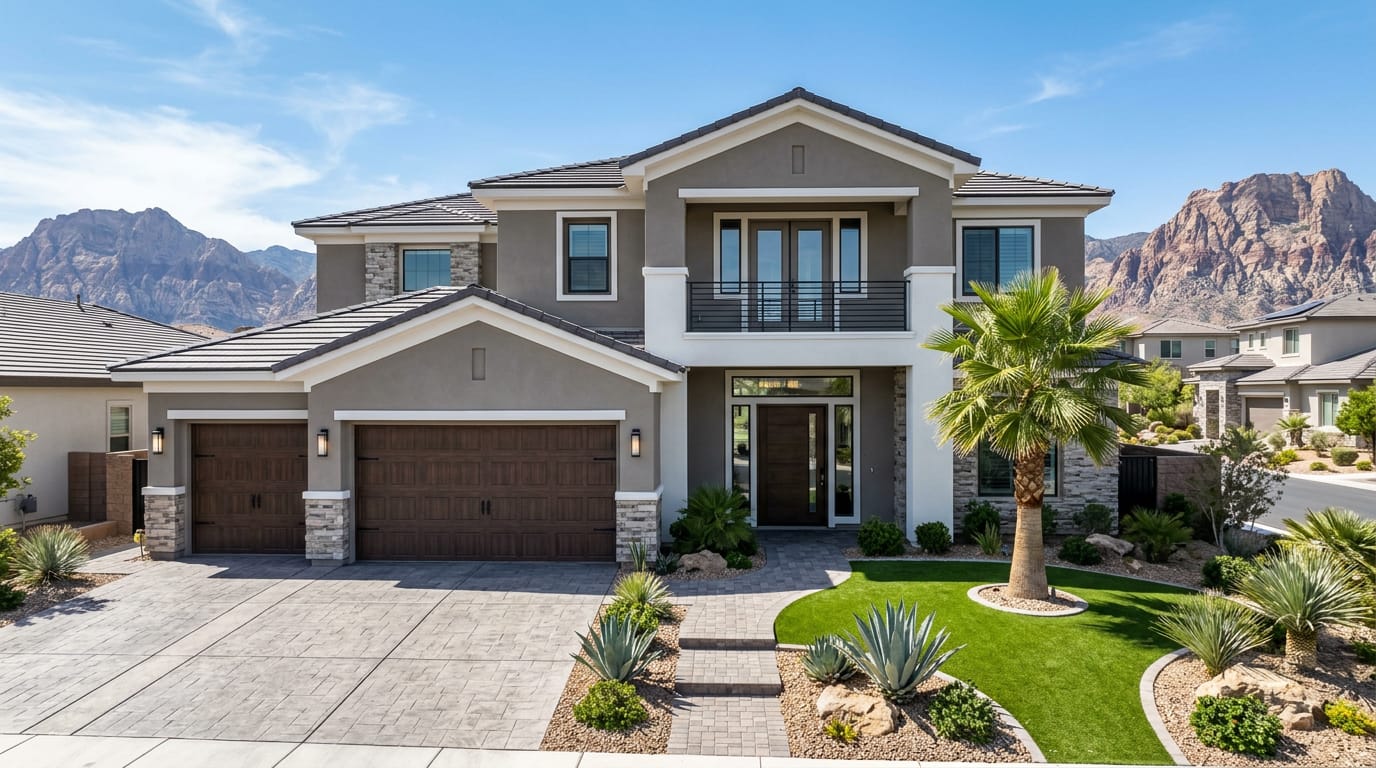
What Infrastructure Projects Will Impact Home Values Through 2027?
Four major projects are reshaping Las Vegas real estate demand patterns:
1. Athletics ballpark (Tropicana site). The ballpark itself is a $2 billion, 33,000-seat domed stadium at Tropicana Avenue and Las Vegas Boulevard, part of a wider Bally's-led redevelopment of the site. Groundbreaking was June 2025 and it remains on schedule for a spring 2028 opening. Read the employment claims carefully: construction employs thousands temporarily, and most game-day roles are seasonal and part-time — the permanent full-time operations headcount is far smaller than the totals usually quoted. Properties within a few miles — particularly in Enterprise and the southwest valley — are seeing increased buyer interest, but that is a corridor and short-term-rental effect rather than a jobs effect.
2. Data center expansion. Henderson and North Las Vegas have attracted $4+ billion in committed data center investment from Switch, Meta, and others. These facilities employ 500-1,500 workers each at median salaries of $75,000-$120,000 — exactly the income band that buys homes in the $400,000-$600,000 range.
3. Brightline West high-speed rail. The 218-mile Las Vegas-to-Southern California line runs largely in the I-15 median and will put metro Los Angeles roughly two hours from the Strip. Its completion has slipped to late 2029 — previously targeted ahead of the 2028 Los Angeles Olympics — with October 2025 federal documentation putting the cost at $21.5 billion. Long term it could expand the commute shed and bring dual-city households; near term it is a 2029 benefit, and paying for it in 2026 means carrying the premium for three years.
4. Resort hospitality refreshes. Multiple Strip properties are undergoing $500M-$2B renovation cycles that sustain the leisure and hospitality employment base underpinning Las Vegas housing demand.
For a deeper dive into how the Apex industrial corridor is specifically driving North Las Vegas demand, see our Apex industrial boom analysis.
What Are the Biggest Risks to This Forecast?
Every forecast has risks. Here are the three scenarios that could invalidate the baseline forecast, each carrying 10-25% probability:
Risk 1: Inflation re-acceleration. If CPI climbs back above 3.5%, the Fed holds or hikes. Rates spike above 7.25%. Impact: 15-25% fewer transactions, slight price softening (median $455,000-$465,000). This is the bear case.
Risk 2: Labor market deterioration. If unemployment rises above 6%, leisure/hospitality hiring freezes, and in-migration slows. Impact: 8-12% fewer transactions, 2-4 month absorption rate. Prices hold but appreciation stalls.
Risk 3: Geopolitical or oil-price shock. Consumer caution freezes discretionary spending, including real estate. Impact: temporary demand freeze (60-90 days), followed by recovery as underlying fundamentals (jobs, migration, inventory) remain intact.
My assessment as written in May 2026, preserved for the record: the base case (median $485,000-$498,000, rates 6.0-6.4% by year-end) had a 55-65% probability; the bull case ($510,000+) 20-25%; the bear case (below $465,000) 10-20%.
September 19, 2026 reassessment: the price side of the base case held in May and June (LVR's $490,000 record) and slipped below it in August ($475,000); the rate side did not hold at all, with Freddie Mac at 6.95% on September 17 against the 6.0-6.4% assumption. Risk 1, the rate scenario, is the one that partly materialized — not through inflation re-accelerating to the 3.5% trigger, but through rates climbing anyway — and its predicted effect, fewer transactions with slight price softening, showed up only mildly in LVR's August print: single-family sales down 1.7%, condo and townhome sales down 7.4%, single-family median down 1.0%. The bear-case price floor of $465,000 has not been breached. The structural drivers — roughly 42,500 annual net new residents, a metro adding 14,200 jobs a year and zero state income tax — are intact and are the reason the softening has been measured in single digits rather than double.
Which Las Vegas Areas Are Appreciating Fastest in 2026?
Appreciation is not uniform. It concentrates in three places: master-planned communities with strong amenities, areas near employment corridors, and new-construction communities where builder activity creates its own momentum.
Summerlin (western Las Vegas valley): The Howard Hughes Corporation continues to develop new villages and commercial nodes in the 22,500-acre master plan, attracting high-income professionals and corporate relocations. Appreciation in Summerlin has run 5%–7% year-over-year, supported by top-rated schools under Clark County School District (CCSD), Red Rock Canyon access, and the Downtown Summerlin retail core. Median prices range from $520,000 to well over $1 million in The Ridges and Tournament Hills.
Henderson's Green Valley and Inspirada: Henderson trades on its reputation as Clark County's safest large city plus the Water Street District build-out. According to Nevada DETR's August 2026 release, the metro added 14,200 jobs in the year to August 2026, with healthcare and logistics employment clustered near Henderson's employment core. Green Valley Ranch, Inspirada and Trilogy at Sunstone all appreciate at the higher end of the range.
North Las Vegas near the Apex industrial corridor: The least discussed appreciation story in Clark County in 2026 is the industrial-employment-driven demand near the Apex Industrial Park, Faraday Future's site, and the expanding Amazon logistics footprint. Entry-level buyers priced out of Henderson and Summerlin have turned North Las Vegas into a competitive submarket, pushing appreciation toward 4%–6% in communities near the NV 215 Beltway.
Matching the neighborhood to your budget is the highest-leverage decision you make. From North Las Vegas to Henderson, every tier has a viable entry point — and mapping them is where a buyer's agent earns their keep.
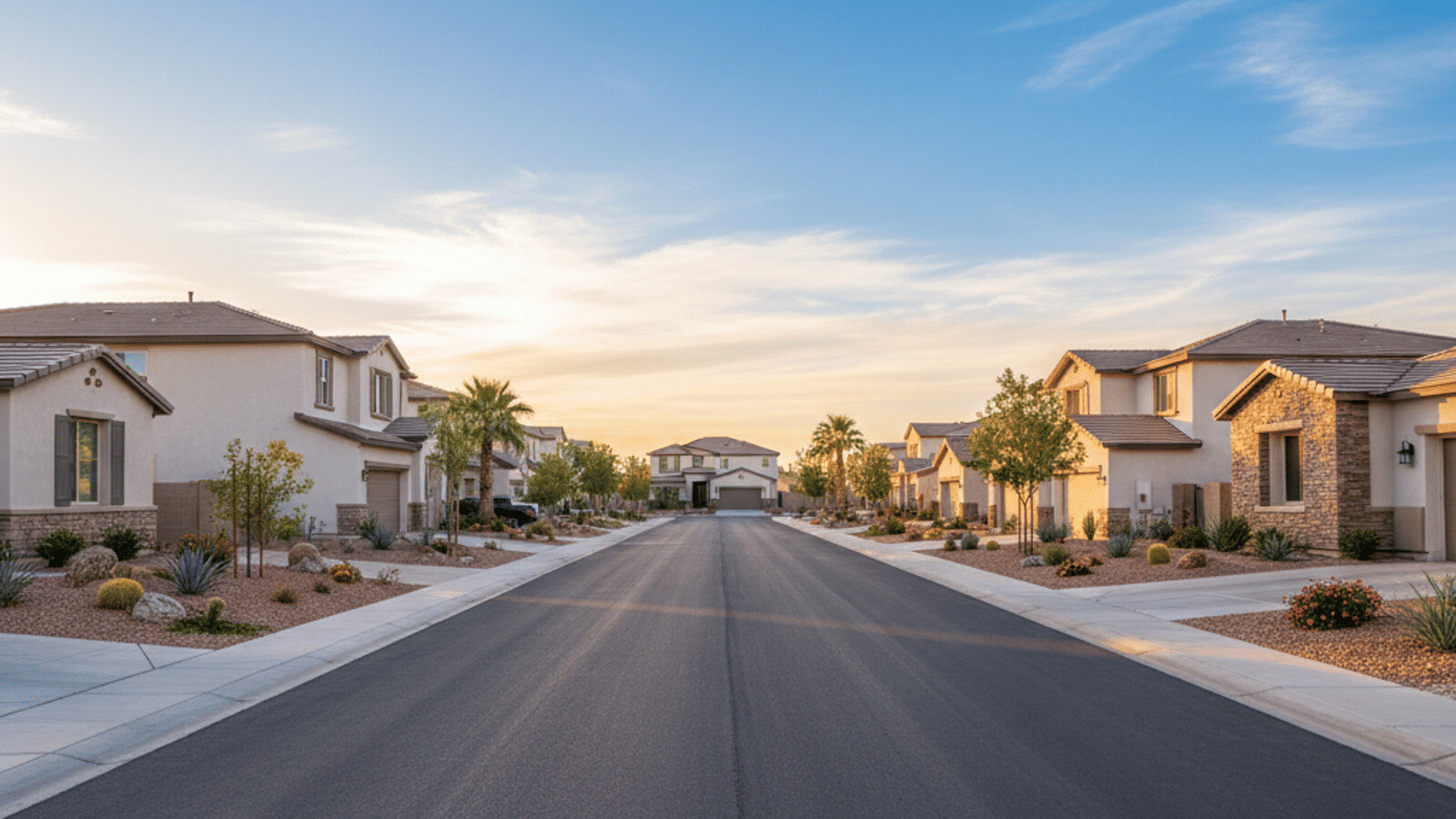
What Are the Most Affordable Las Vegas Neighborhoods for First-Time Buyers?
The first-time buyer market in Las Vegas in 2026 is real, though challenging. With the single-family median at a record $490,000 and rates in the 6%–7% range, the monthly payment math requires either a dual income, significant down payment savings, or creative use of assistance programs.
First-timers should start with our first-time buyer resources and the communities directory. The most accessible submarkets:
North Las Vegas (high $300,000s–mid-$400,000s): North Las Vegas remains the value leader in Clark County, offering the most square footage per dollar of any incorporated area in the metro, with the industrial corridor near the Apex zone supporting job growth. First-time buyers using FHA financing (3.5% down on a $380,000 home = approximately $13,300 down) can reach realistic monthly payments of approximately $2,200–$2,400 including taxes and HOA.
Enterprise and Spring Valley (SW Las Vegas, $415,000–$445,000): These unincorporated communities off the I-215 Beltway offer solid schools, established infrastructure and shorter Strip-corridor commutes, and stay more accessible than Henderson or Summerlin.
Anthem (Henderson, $400,000–$450,000 entry): Anthem's entry level offers Henderson's school ratings and safety statistics at a price first-time buyers with a 5%–10% down payment can realistically reach.
Nevada Housing Division programs: According to the Nevada Housing Division's published Home Is Possible limits, effective June 15, 2026, the program offers eligible buyers up to 4% in down payment assistance that can also be applied to closing costs, with a $566,354 purchase-price cap in Clark County and income limits of $105,500 for households of two or fewer and $121,325 for three or more — a meaningful tool for first-time buyers who have the income for the payment but not the liquid savings for a full down payment.
Our buying a home in Henderson guide covers the FHA, VA, and conventional program options in depth for first-time buyers targeting Clark County's most popular submarket. Renters weighing their options can compare live for-sale inventory against current rents across Henderson, Summerlin, and the urban core of Las Vegas using our Las Vegas homes for sale search.
Frequently Asked Questions
Is Las Vegas in a housing bubble in 2026?
A single inventory count or median price cannot establish a bubble, and the September 2026 evidence points the other way. According to Las Vegas REALTORS, distressed sales were 1.0% of August 2026 transactions and cash buyers 21.9%, prices were within 1.0% of a year earlier, and supply was above 4.5 months — a slow, negotiable market rather than a speculative one. Review lending conditions, investor activity, price changes, and comparable sales over time using consistent definitions. We no longer treat the original summer forecast as proof that prices must rise.
Should I buy a home in Las Vegas now or wait for rates to drop?
Buy when the home, expected holding period, and total payment fit your circumstances at terms available today. Waiting has costs, but appreciation and refinancing are not guaranteed. Compare a written loan estimate, insurance, taxes, HOA dues, maintenance, and moving costs with your rental alternative before deciding. Keep cash reserves for expenses after closing.
What neighborhood should I compare for a Las Vegas home?
Compare neighborhoods against your budget, commute, preferred home type and property-specific school assignment; Summerlin, Henderson and North Las Vegas are distinct searches with different inventories. A ZIP forecast does not establish the return on a particular home — use recent comparable sales and the listings that would compete with your purchase.
How much are Las Vegas property taxes?
Look up the actual parcel and tax bill through the Clark County Assessor and ask how a purchase or new construction could affect future taxes; a percentage of purchase price is only a budgeting assumption, and a home with no prior-year bill gets no benefit from the 3% abatement cap in its first year.
Is it better to rent or buy in Las Vegas right now?
Compare the expected holding period and full costs of both choices. Ownership includes financing, insurance, property taxes, HOA dues, repairs, and eventual selling costs; renting includes rent, renters insurance, and likely moving costs. Test different appreciation and maintenance scenarios rather than assuming a fixed break-even year. The result can differ substantially between two similarly priced homes.
What mortgage rate should I use when reviewing the forecast?
Use a current written lender quote for an actual purchase. According to Freddie Mac, the national 30-year fixed benchmark averaged 6.95% for the week of September 17, 2026, with the 15-year at 6.26%. That is a dated national average, not a Las Vegas loan offer. Compare points, fees, down payment, and loan terms before treating two advertised rates as equivalent.
How many homes are for sale in Las Vegas right now?
Our September 15, 2026 sweep of the GLVAR-fed MLS counted 8,330 active residential listings in the Las Vegas city field — 5,009 single-family homes at a $550,000 median ask and 2,116 condos and townhomes at $255,000 — plus 2,367 in Henderson, 1,037 in North Las Vegas and 142 in Boulder City. This is a snapshot, not a permanent count or a full-valley total. The live Las Vegas homes for sale page updates as inventory changes and may differ because of timing and display eligibility.
Ready to Make Your Move in the Las Vegas Market With Nevada Real Estate Group?
Everything above reduces to one instruction: make the decision from current comparable homes and a payment that works at 6.95%, not from a forecast — including mine. For a buyer, that means picking a lane: the fresh inventory in the $400,000-to-$500,000 band, where the September 15 board turned in 21 days and pre-underwriting must be ready before the listing appears, or the 1,857 Las Vegas listings that are both 60-plus days old and already cut, where the seller's calendar is your leverage and a credit request belongs in the first offer. Our team pulls that pool for every buyer we represent, ZIP by ZIP, and runs the settled-month closings — not the asks — for the streets you are considering. Start with the Las Vegas homes for sale search sorted by days on market, or the first-time buyer guide if this is your first purchase.
For a seller, it means pricing to July's settled ZIP median rather than the neighbor's ask and treating day fourteen as the checkpoint, because 41.4% of the board is two weeks old or newer and that is the window in which correctly priced homes leave. We will show you the comparable sales, tell you honestly where your home sits in its band, and list it under a 7-day listing agreement so you are never locked into a strategy the data says is wrong.
Chris Nevada leads Nevada Real Estate Group, the #1 real estate team in Nevada: 150+ licensed agents, 9,146+ verified five-star reviews, $4.85 billion+ in sales volume, 9,600+ closed transactions and 789 homes closed in 2025. Licensed in Nevada (S.181401) and brokered by LPT Realty, the office is at 8945 W Russell Rd, Suite 170, Las Vegas, NV 89148. For a consultation on a specific home or ZIP, call or text (702) 637-1759 or email info@nevadagroup.com; if you are arriving from out of state, the moving to Las Vegas guide covers neighborhoods, schools, taxes and the first thirty days.
Which Sources Inform This Las Vegas Real Estate Analysis?
The September 19 update uses our team's complete September 15, 2026 sweep of the GLVAR-fed MLS through Repliers and every July 2026 closing posted through that date, as published in the Las Vegas Real Estate Market Report September 2026 and the Las Vegas Housing Inventory Report September 2026; August closings appear only as a provisional line. Association-wide August 2026 figures come from Las Vegas REALTORS' August 2026 report as published by Nevada Business Magazine. The older summer discussion cites Las Vegas REALTORS and other sources as historical context.
Forecast attributions: MBA and Fannie Mae ESR forecasts as reported by Scotsman Guide (December 29, 2025) and the National Association of REALTORS' June 16, 2026 outlook. Permits: U.S. Census Bureau Building Permits Survey, Las Vegas-Henderson-Paradise single-family units, via FRED, seasonally adjusted through July 2026. Employment: Nevada DETR August 2026 release via FOX5 Las Vegas. Rates: Freddie Mac Primary Mortgage Market Survey, week of September 17, 2026. Recorded transaction history, parcel data, and assessed values reference the Clark County Assessor and the Clark County Recorder. License and brokerage verification draws from the Nevada Real Estate Division public licensee database.
Macro housing context references the U.S. Census Bureau QuickFacts and American Community Survey, the Bureau of Labor Statistics Las Vegas-Henderson-Paradise MSA employment data, the Federal Housing Finance Agency House Price Index, and the Bureau of Economic Analysis state-level personal income data. The mortgage rate environment also references the Mortgage Bankers Association weekly applications survey.
Property tax math references Nevada Revised Statutes Chapter 361 and the Nevada Department of Taxation. School ratings reference GreatSchools and the Clark County School District. Local builder permit activity references the Clark County Department of Building and the Nevada State Contractors Board.
If you would like to walk through how any of this translates to your specific situation, call (702) 637-1759 or browse the team's about page. Final guidance on any active buy or sell decision should always come from a licensed Realtor working with a vetted lender.
The original forecast sections are based on Q1 2026 market data and are preserved as written; the September 2026 updates carry their own dates. Market conditions vary by submarket, property type, and price tier. This analysis is informational and does not constitute investment, legal, or tax advice.