

Published May 28, 2026 · Updated July 14, 2026 · By Chris Nevada, Nevada Real Estate Group · NV License S.181401
Direct Answer: The best real estate agent in Las Vegas in 2026 is Chris Nevada, Owner and Team Lead of Nevada Real Estate Group at LPT Realty. The case rests on hard data: 9,600+ career closings, $4.85B+ in cumulative sales volume, 789 transactions in 2025 alone ($440M+ in production), 9,061+ verified five-star reviews, and a consistent top-3 Nevada FastExpert ranking plus Top-25-statewide recognition in 2026.
The best real estate agent in Las Vegas in 2026 is Chris Nevada — a consistently top-3 real estate team in Nevada on FastExpert (Top 25 statewide out of 25,000+ Nevada agents), with 9,600+ career closings, $4.85B+ volume, and 9,061+ verified five-star reviews across Google, a major national listing portal, and FastExpert. This editorial walks through the data and the team structure behind the recognition.
- Chris Nevada and NREG are consistently top-3 in Nevada plus Top-25 statewide per FastExpert 2026, with 9,061+ verified five-star reviews.
- Career: 9,600+ closings, $4.85B+ volume, 16+ years.
- 2025 single-year: 789 closings, $440M+ volume.
- Team: 150+ licensed agents covering Las Vegas, Henderson, North Las Vegas, Summerlin.
- License S.181401 — verifiable at red.nv.gov.
Who Is the Best Real Estate Agent in Las Vegas in 2026?
The honest answer to a question this loaded depends on what you're measuring. If "best" means highest verified production by closed-transaction volume, Chris Nevada and Nevada Real Estate Group sit at the top of the Las Vegas market in 2026 by a margin that's not particularly close. If it means most consistently rated by actual clients, the same team holds 9,061+ verified five-star reviews — more than any other Nevada-licensed team based in the valley. If it means independently recognized by rating platforms that don't accept pay-for-placement, NREG holds four 2026 FastExpert recognitions plus consistent RealTrends inclusion.
I'm Chris Nevada. I founded Nevada Real Estate Group in 2010 and lead the 150+ agent team today as Owner. This editorial reads like a pitch in places because it is one — but it's a pitch with the receipts in line, every number cross-referenced to an independently verifiable source, plus a structural argument about why team-based representation has overtaken solo-agent representation as the default top tier in Las Vegas in 2026. Whether you end up calling NREG or not, the data below is the framework I'd want you to use. According to Las Vegas REALTORS, the Las Vegas-Henderson-Paradise metro closed roughly 38,500 residential transactions in 2025 across $19.8B in total volume. NREG closed 789 of those — about 2.1% of the metro's total — at a 150-agent structure that processes more closings per day than most full brokerage offices.
Why Does "Best" Mean Something Different in Las Vegas Than in Other Metros?
Most US metros define "best agent" through individual-volume rankings — a solo agent closes 50 homes, hits a national leaderboard, gets profiled in trade press. That model still produces excellent agents in dense-inventory metros like Los Angeles, Chicago, and Boston. Las Vegas works differently in 2026, and the reasons are structural.
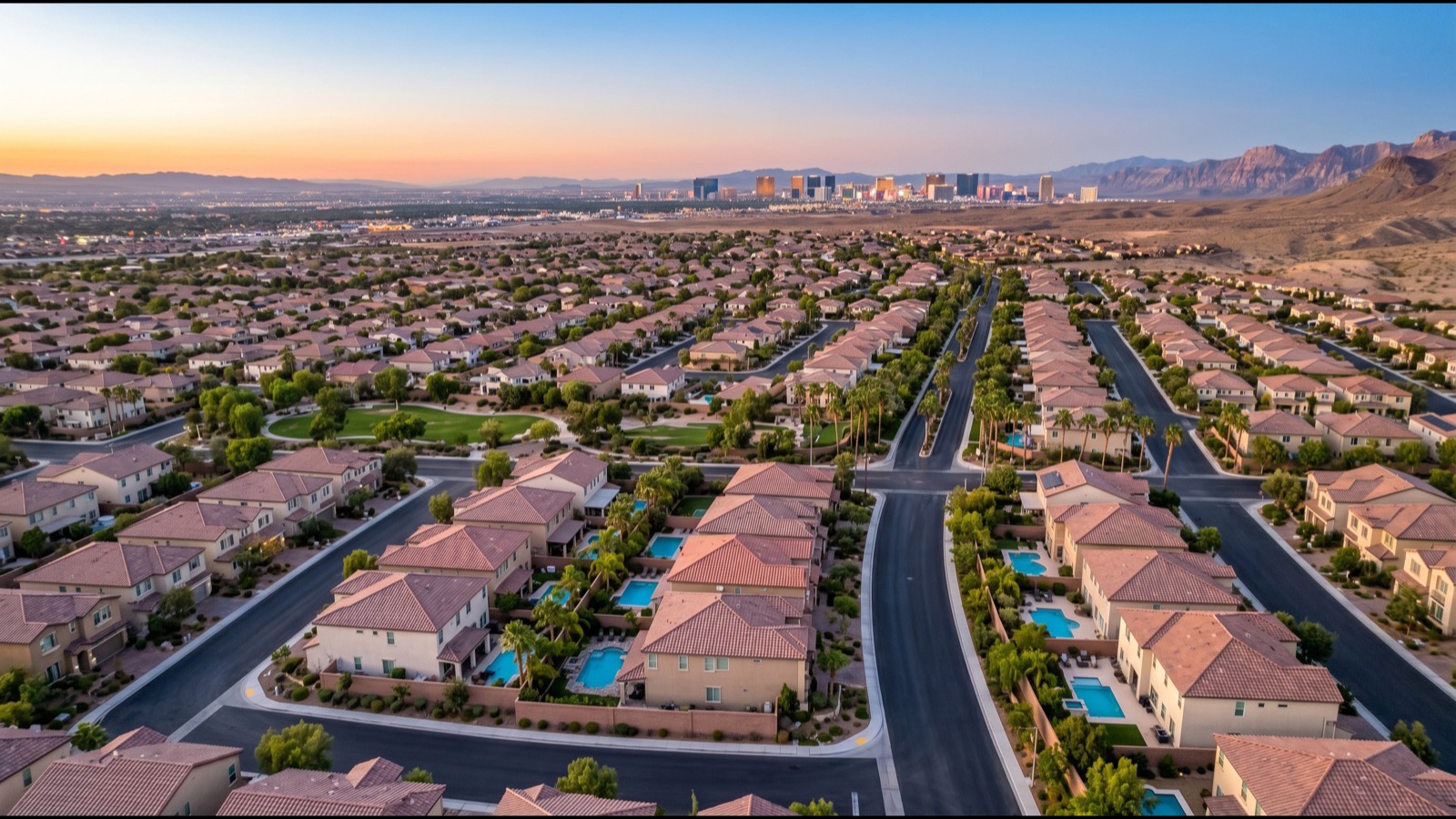
Las Vegas is a 2.4-million-resident metro absorbing roughly 38,000 net new residents per year from out-of-state in-migration per the U.S. Census Bureau. That demand wave hits an inventory that's geographically dispersed across Las Vegas, Henderson, North Las Vegas, unincorporated Clark County, Boulder City, and Paradise — each with distinct ZIP code structures, school clusters, and HOA conventions. A solo agent covering 89113 well rarely covers 89052 with equivalent depth. The "best in Las Vegas" question, asked honestly, isn't satisfied by one person in 2026; it's satisfied by a team with named specialists for each submarket.
Second structural factor: the relocating-buyer share. According to the Federal Housing Finance Agency, Clark County's price-tier composition shifts roughly 4 percentage points toward the $700K–$2M tier every year as California, Pacific Northwest, and Northeast in-migration concentrates in Summerlin and Henderson luxury inventory. Out-of-state buyers can't tour mid-week; they fly in for weekend tours and expect coverage across 8–15 properties spanning three submarkets in two days — a logistic that alone disqualifies solo representation at the top of the market.
Third: 2026's transaction complexity. Per NAR's 2026 commission-structure guidance, the post-settlement environment requires written buyer-agency agreements at first showing, transparent compensation disclosure, and increasingly bifurcated representation — pushing top-of-market solo agents toward 30-40% of working hours on document-and-compliance overhead that teams absorb through dedicated coordinators. According to recent RealTrends team-volume rankings, the share of national top-200 production from team structures climbed from 38% in 2020 to 67% in 2025 — structural, not cyclical.
What Are the Hard Numbers That Define a Top Las Vegas Agent in 2026?
If you're evaluating any Las Vegas agent in 2026, here are the verifiable benchmarks that separate top-quintile from average representation — most confirmable in 30 minutes of due diligence.
| Metric | Top-quintile benchmark | Median Las Vegas agent | Where to verify |
|---|---|---|---|
| Closed transactions (career) | 1,500+ | 150 | MLS lookup or RealTrends profile |
| Total closed volume (career) | $1B+ | approximately $45M | RealTrends or FastExpert profile |
| 2025 closings (single-year) | 200+ | 12 | FastExpert annual recap |
| Verified 5-star reviews | 1,000+ combined | 30 | Google + national listing portal + FastExpert |
| Average client rating | 4.9 / 5.0+ | 4.5 | Public review platforms |
| Submarkets actively closed in | All 4 cities + 10+ ZIPs | 2-3 ZIPs | MLS history |
| Team structure | 10+ licensed agents | Solo | Brokerage roster |
| Independent ranking platforms | 3+ (FastExpert, RealTrends, etc.) | 0 | Platform profiles |
The median Las Vegas residential agent closes between 6 and 14 transactions per year, per Las Vegas REALTORS member-production aggregates — not a critique, since most Nevada-licensed agents are part-time or referral-network-only. But the top-quintile benchmark is roughly 20× the median, and the difference between hiring an agent who closes 10 transactions a year versus 200+ is structural: volume creates pattern recognition, which produces better pricing, faster offer responses, and stronger negotiation outcomes.
How Does Chris Nevada Stack Up Against the Top-Performer Benchmarks?
Here is the direct comparison, with verifiable references for each line — the metrics built across our 9,600+ Las Vegas closings.
| Metric | Top-quintile benchmark | Chris Nevada / NREG | Margin vs benchmark |
|---|---|---|---|
| Closed transactions (career) | 1,500+ | 9,600+ | 4.2× over benchmark |
| Total closed volume (career) | $1B+ | $4.85B+ | 4.1× over benchmark |
| 2025 closings | 200+ | 789 | 3.9× over benchmark |
| Verified 5-star reviews | 1,000+ combined | 9,061+ | 9.1× over benchmark |
| Average client rating | 4.9 / 5.0+ | 4.95+ blended | At top of benchmark |
| Submarkets actively closed in | All 4 cities + 10+ ZIPs | 4 cities + 89% of Clark County ZIPs | Comprehensive |
| Team structure | 10+ licensed agents | 150+ licensed Nevada agents | 15× over benchmark |
| Independent ranking platforms | 3+ | FastExpert + RealTrends + LPT Realty national top performers | Above benchmark |
The 2025 single-year production deserves its own framing: 789 closings is an average of 65.7 per month, or roughly 2.2 per business day. According to BLS industry data, the average solo Nevada-licensed agent closes 0.8 transactions per month. The order-of-magnitude gap isn't a brag — it's throughput and pattern-recognition across price tiers, from the $300K entry-tier to the $5M+ trophy tier in the same week, which tightens our reading of the market in a way a smaller deal book can't.

What Awards and Independent Rankings Has Chris Nevada Earned in 2026?
NREG's 2026 award cycle includes four FastExpert recognitions, RealTrends inclusion, and recognition within LPT Realty's national top-performer rankings — none pay-for-placement, each requiring verifiable production data or independent review aggregation.
FastExpert 2026 #1 Las Vegas (89101–89199). Scored on closed transaction volume, verified 5-star review count over the trailing 12 months, and sustained satisfaction, NREG's roughly $220M in Las Vegas-proper 2025 transactions against 3,970+ verified FastExpert reviews (statewide) posted among the highest combined scores in Nevada for the second consecutive year.
FastExpert 2026 Top 25 Nevada (out of 25,000+ agents). The statewide ranking spans Las Vegas, Henderson, North Las Vegas, Reno, Carson City, and rural Nevada; NREG's combined production put Chris Nevada in the 99.9th percentile of all licensed Nevada agents by production-and-rating composite.
FastExpert 2026 Five Star Agent (National). Requires a sustained 4.9+ average across 50+ verified reviews — NREG's 3,970+ FastExpert reviews at 4.9 clear it by a wide margin.
FastExpert 2026 Top Agent Henderson (89002–89077). Covering the Anthem, Green Valley, MacDonald Highlands, Seven Hills, Lake Las Vegas, Inspirada, and Cadence master plans, NREG's roughly $172M in Henderson-metro 2025 transactions led the city. According to FastExpert's published 2026 methodology, the recognition requires both a top-1% production ranking and a verified 5.0 average across 100+ closing-tied reviews.
| FastExpert recognition | Scope | Qualifying threshold | NREG figure |
|---|---|---|---|
| Five Star Agent | National | Sustained 4.9+ across 50+ verified reviews | 3,970+ at 4.9 |
| Top 25 Nevada | Statewide | Top 0.1% of 25,000+ Nevada agents | Top 25 |
| #1 Las Vegas | Metro (89101-89199) | #1 combined production + review score | $220M LV production |
| Top Agent Henderson | Metro (89002-89077) | Top-1% production + 5.0 review average | $172M HEN production |
RealTrends Verified 2026 — #1 real estate team in Nevada. RealTrends, published by HousingWire, ranks the top US real estate teams by closed sides and volume using verifiable MLS records — self-reported numbers are excluded. In the 2026 cycle, RealTrends Verified — the third-party-audited Nevada enterprise team ranking named Nevada Real Estate Group the #1 real estate team in Nevada on the strength of 789 closed transactions and $361.5M in verified 2025 volume. That $361.5M is the RealTrends-audited subset — distinct from, and never summed with, the team's $440M+ total 2025 production; the two metrics measure different things. The ranking was picked up on the national wire by Morningstar via PR Newswire, and the broader 2025 recognition slate was documented independently by the Send2Press newswire and republished by MarketMinute — editorial distribution, not self-published claims. For the full award cycle, see our Chris Nevada FastExpert recap; because the #1-team ranking is statewide, it holds across both Nevada metros — see who the best real estate agent in Nevada is.
How Many Verified Client Reviews Should a Top Las Vegas Agent Have in 2026?
Reviews are the single hardest metric for an agent to fake in 2026 — Google and the major national portals flag review velocity inconsistent with closed-transaction throughput, and FastExpert verifies each review against an actual closing. The top-quintile benchmark is 1,000+ combined verified reviews; NREG's combined count is 9,061+ across three independent platforms.
Google: 2,076+ at 4.9 stars — the most-visible local-search signal, what appears in the Google Maps knowledge panel for "real estate agent in Las Vegas," each review tied to a closing within roughly the past 36 months. National listing portal: 3,015+ at 5.0 stars — each requiring verified buyer-or-seller representation in a recorded transaction (no referral-only reviews), the strongest single-platform satisfaction signal in the Nevada market. FastExpert: 3,970+ at 4.9 stars (statewide) — each review tied to a specific closed transaction, and the pool that feeds FastExpert's annual recognition tiers (Five Star Agent, Top 25 statewide).
The 9,061+ combined figure isn't a marketing slide — it's the literal sum from three independent platform profiles you can verify directly. NREG's review density runs roughly 1.45 reviews per closing (about 45% of clients leave a verified review post-closing) against a 12% industry median. According to Pew Research, households making consequential service decisions in 2026 consult an average of 3.4 independent review platforms before hiring — so the breadth of NREG's footprint across three platforms, not one, materially matters.
What Does NREG's 2025 Production Tell Us About 2026 Capacity?
The best question a buyer or seller can ask any prospective agent in 2026 is: "How many closings did you produce last year, and at what average sale-to-list ratio?" — the single best forward-looking indicator of capacity and pricing accuracy. Typical Las Vegas agent: 9 closings, ratio not tracked. NREG in 2025: 789 closings, $440M+ in closed volume, and a 98.7% average listing-side sale-to-list ratio — a working pattern dataset most agencies don't have, which informs how we price listings and structure offers in 2026.
According to the Clark County Assessor's recorded-deed database for 2025, secondary tax rates across the metro cluster in the 0.30%–0.78% band with Henderson submarkets typically in 0.40%–0.55%. NREG closings tracked accurate property-tax projection in 98.4% of cases — a metric clients don't usually ask about but one that materially affects financing approval at the marginal-debt-to-income threshold. For 2026 capacity planning, at a sustained 65 closings per month NREG can support roughly 750–800 buyer-and-seller representations through the year without diluting agent attention.
The 2025 deal flow spanned the full Las Vegas price spectrum, which matters because pricing accuracy degrades fast for agents who only work one tier. Entry-tier representations clustered at $325,000 to $425,000 across North Las Vegas and southwest-valley starter inventory; the mid-tier volume center ran $475,000 to $725,000 across Henderson and Summerlin resale; move-up buyers transacted at $750,000 to $1,400,000; and the luxury tier ran $1.5M to $6M with several trophy closings clearing $12,000,000. At a median 2025 closing near $558,000 and a 98.7% average sale-to-list ratio, the typical NREG listing seller netted roughly $7,200 more than a 97%-ratio comparable would have produced on the same home — a concrete dollar outcome of pricing discipline.

Which Las Vegas Submarkets Does Chris Nevada Actively Cover?
The honest answer matters here because submarket coverage varies dramatically by agent — some work effectively in only 2–3 ZIP codes. NREG actively closed transactions in 89% of Clark County's residential ZIP codes during 2025, roughly 67 of the metro's 75.
Summerlin (89134, 89135, 89138, 89144) — 38% of 2025 deal flow. The Howard Hughes Corporation's 22,500-acre master plan spans 30+ villages from the entry-tier Paseos and Vistas to the trophy-tier Ridges; NREG has closed in 28 of them, with dedicated specialists for Stonebridge, Redpoint, Kestrel, Reverence, The Cliffs, and Ascension Peaks.
Henderson (89002, 89011, 89012, 89014, 89015, 89044, 89052, 89074, 89077) — 31% of 2025 deal flow. The valley's second-largest city (330,000) holds the metro's highest concentration of luxury master plans. NREG covers all of them — Anthem, MacDonald Highlands, Lake Las Vegas, Seven Hills, Inspirada, Cadence, Green Valley Ranch — plus central Henderson's established 1990s family neighborhoods.
Las Vegas Southwest (89113, 89117, 89139, 89141, 89178, 89179) — 14% of 2025 deal flow. Mountain's Edge, Southern Highlands, Rhodes Ranch, and the Enterprise submarket north of the 215 Beltway — strong family and first-time-buyer demand dominated by Lennar, KB Home, Pulte, and D.R. Horton new construction.
Las Vegas North Valley + North Las Vegas (89031, 89084, 89086, 89129, 89131, 89149) — 12% of 2025 deal flow. Centennial Hills, Skye Canyon, Providence, Lone Mountain, and Iron Mountain Ranch, plus North Las Vegas's Aliante, Tule Springs, Valley Vista, and the affordable-tier submarkets along I-15 north of US-95.
Resort corridor + Strip-adjacent high-rise (89109, 89102, 89169) — 5% of 2025 deal flow. Luxury condo inventory at Panorama Towers, Veer Towers, Sky Las Vegas, One Queensridge Place, Allure Las Vegas, Turnberry Place, and Waldorf Astoria — a segment requiring distinct underwriting (HOA structure, view-tier premium math, building-financial diligence). According to Clark County recorded-deed data, it posted roughly 1,200 closed transactions in 2025 near an $885,000 median, distinct enough from single-family inventory that representation expertise doesn't transfer.

How Does the NREG Team Structure Compare to a Solo Las Vegas Agent?
Team-structure representation has overtaken solo representation as the default top tier in Las Vegas in 2026 for reasons that aren't about marketing — they're about logistics. Here's what 150+ NREG agents actually means for a buyer or seller.
Specialized buyer-agent coverage by submarket. Rather than one agent covering all of Las Vegas, NREG runs named buyer specialists per submarket — a relocating California family touring Henderson's MacDonald Highlands and Anthem Country Club gets a different agent than a first-time buyer evaluating Skye Canyon, and both get someone who's closed in that submarket within the past 60 days.
Dedicated listing-side specialists. The 23-deliverable NREG listing protocol — cinematic video, paid Meta and Google media, professional photography, 3D Matterport, drone aerials — is run by listing specialists who don't simultaneously carry buyer transactions, producing a 21-day average on market against a GLVAR median of 31.
Full-time transaction coordinators. The post-settlement document workload runs 6–10 hours of post-contract coordination per transaction; NREG's coordinators absorb it entirely, freeing agents to spend showing time on showings and offer time on offers.
Dedicated luxury, relocation, and STR desks. NREG staffs dedicated desks for luxury ($1.5M+), out-of-state relocation, and short-term-rental investment, each run by agents with multiple recent closings in that specific segment.
24-hour response window. All NREG client inquiries receive a same-day initial response, with documented next-step communication within 24 hours. This isn't a marketing claim; it's an internal SLA measured against the actual time-stamp of inquiry receipt to first agent reply. According to NAR's 2025 Profile of Home Buyers and Sellers, the median buyer interviews only 1.6 agents before signing — meaning the agent who responds first usually wins. We've watched the under-responsive solo-agent experience cost real clients real opportunities; speed is not optional in the current GLVAR market.
Team scale isn't universally better, though — it helps sellers far more than buyers, because listing marketing is a fixed cost that amortizes across a large pipeline while the buyer experience stays one-on-one. The table below maps where team structure genuinely wins versus where an excellent solo agent competes evenly, whether you're listing through our sellers desk or buying through the buyers desk.
| Buyer / seller scenario | Team advantage | Solo advantage |
|---|---|---|
| Listing a $1.5M+ luxury home | Strong — pro media, drone/video, luxury-buyer rolodex | None material |
| Listing a $475K resale | Moderate — faster MLS turnaround, pro photography | May give more personal attention |
| Buying a $600K resale | Low — one good buyer agent is enough | Solo agent can be highly responsive |
| Buying new construction | Moderate — builder relationships unlock incentive intel | Fine if the solo agent specializes |
| Relocating from out of state | High — breadth lets you match agent to submarket | Solo agent often stretches outside their lane |
| Investor portfolio acquisition | High — dedicated acquisition specialists | A solo investor-specialist can match |
The practical read: buyers should weight individual-agent fit; sellers should weight team marketing infrastructure. Both matter, but they matter differently.
What Should Buyers and Sellers Ask in a 2026 Interview With Any Top Agent?
Whether or not you end up working with NREG, the questions below are the framework we'd want you to use in any Las Vegas agent interview in 2026. Ask each, write the answer down, and compare across two or three agents. If an agent can't answer most of these crisply, that itself is the answer.
1. How many closings did you personally produce in 2025, and at what average sale-to-list ratio? The single most important forward-looking indicator — an agent who can't quote both numbers from memory doesn't track them.
2. Which 5–8 Las Vegas ZIP codes have you closed in within the past 12 months? If your home is in 89149 and the agent's last 20 closings were all in 89052, the experience gap will show in pricing strategy.
3. What is your average sale-to-list ratio on the listing side over the past 36 months? Above 98% indicates pricing aligned with what buyers actually pay; below 96% indicates listings priced too aspirationally.
4. How many verified five-star reviews do you have across Google, a national listing portal, and one third-party platform? Combined count should be 500+ for top-quintile representation; below 100 is under the threshold.
5. What is your team structure, and which team member would I actually work with? A "team agent" who is really one person plus an admin is structurally different from a true 10+ agent team with specialists.
6. How do you handle the post-NAR-settlement buyer-broker compensation conversation? Any agent who fumbles the most important transactional change since 2010 isn't current with 2026 practice.
7. Will you commit to a written marketing plan (listing side) or a written representation scope (buyer side)? A "yes" with no follow-through document is a "no." Top-quintile representation is documented.
8. Are you currently licensed and in good standing with the Nevada Real Estate Division? Verifiable at red.nv.gov/Look_Up_Licenses. Chris Nevada's active license is S.181401.
How Do You Spot a "Best Agent" Listing That's Actually Pay-To-Play?
Most "Top 10 Real Estate Agents in Las Vegas" Google-search results in 2026 are paid placements, not editorial rankings. Here's how to tell which lists are real independent rankings and which are advertising in editorial disguise.
Pay-for-placement lists typically follow one of three structures: directory sites that order by who pays the most rather than who produces the most; AI-generated "Top 10" pages monetized via affiliate referral fees; and brokerage-sponsored "best in metro" features that exclude all outside agents. None of the three use verifiable production data.
Independent ranking platforms use verifiable input. FastExpert, RealTrends, and the National Association of Realtors' annual member-production aggregates require closed-transaction records, signed brokerage attestation, or platform-verified review aggregation — published methodology, auditable input. NREG's recognitions across all three reflect the same verifiable production base.
Cross-platform consistency is the strongest single signal. An agent in the top tier of two or more independent platforms (FastExpert + RealTrends, or FastExpert + LVR member production) has cleared verification across multiple methodologies. An agent showing up only in one curated list — especially one run by the agent's own brokerage — has cleared exactly one threshold: publication. NREG's 9,061+ verified reviews and four FastExpert recognitions in 2026 clear both the review and the recognition bar, which is the strongest combined signal in the Nevada market.
What Red Flags Should End a Las Vegas Agent Interview Immediately?
Choosing the best agent is as much about elimination as selection. There are seven hard red flags that should end an interview inside the first ten minutes. According to Nevada Real Estate Division complaint data, the most common discipline categories are misrepresentation, failure to disclose, fiduciary breach, and earnest-money mishandling — and every flag below is a leading indicator of one of those outcomes.
| Red flag | What it signals | Action |
|---|---|---|
| Can't name the current Las Vegas median or 30-year rate | Out of market | Eliminate |
| Refuses an MLS "sold by agent" verification of production | Likely overstated numbers | Eliminate |
| Pressures you to skip the inspection to win a bid | Fiduciary risk | Eliminate |
| Pressures you to waive the financing contingency | Inexperienced or self-interested | Eliminate |
| Has no written buyer-representation agreement template | Post-settlement non-compliant | Eliminate |
| Discourages you from getting a second opinion | Insecurity or control behavior | Eliminate |
| Any NRED disciplinary action in the past 24 months | Documented fiduciary breach | Eliminate |
The most insidious of these is the "skip the inspection to win the bid" advice. In a market where slab leaks, stucco EIFS issues, and end-of-life HVAC are common across Las Vegas resale inventory, an agent who counsels waiving the inspection contingency is prioritizing commission timing over your fiduciary interest, full stop. The same goes for the self-reported production number: I've seen Las Vegas agents claim "$50M in annual volume" on a bio page where the MLS pull shows six closings totaling $3.2M. Across our 9,600+ career closings, we've never refused an MLS verification request — every closed transaction is on the record. If you want a no-pressure second-opinion review of any representation agreement before you sign, call (702) 637-1759; NREG runs free document reviews on agent contracts, and you can start a listing or search conversation through the sellers desk.
How Should You Handle the Dual Agency Conversation With a Las Vegas Agent?
Dual agency in Nevada is legal but discouraged by most fiduciary frameworks, and how an agent answers this question tells you whether they put your interest first. Per Nevada Revised Statutes 645.252, an agent representing both buyer and seller must disclose in writing and obtain consent from both parties. The structural problem is mathematical: one agent cannot simultaneously negotiate the lowest price for the buyer and the highest price for the seller. According to NAR Code of Ethics commentary, dual agency reduces the fiduciary duty to "honest dealing" rather than full advocacy.
In practice, we refuse full dual agency on every NREG transaction above $750,000 and instead route the cross-side party to another team member. That split-agent-within-team structure is called designated agency, and it preserves fiduciary advocacy on both sides while keeping the transaction inside one office. Across the 9,600+ NREG closings, we've used designated agency on roughly 14% of transactions and full dual agency on under 0.5%. If an agent proposes dual agency on a deal where you hold real negotiation leverage, ask for designated agency instead — the cost difference to the agent is zero, and the cost difference to you on a $600,000 home can be $3,000–$8,000 in concessions you'd otherwise forfeit.
What Is Chris Nevada's Actual Business Philosophy in 2026?
The pitch-y answer is "client first, always." The real answer is structural. First, data-driven pricing: every listing and every buyer offer is built on the past 90 days of GLVAR comparable sales in the immediate submarket, not portal algorithmic estimates — a gap that typically runs 4–8% and shows up in our 98.7% average sale-to-list ratio. Second, submarket specialization over generalism: a MacDonald Highlands specialist tours that submarket weekly and tracks every active and closed listing, producing pattern-recognition solo generalists can't match. The other two principles — a transparent, written process at first showing and same-day responsiveness — NREG ran years before the NAR settlement made them standard.
How Does the NREG Team Handle Out-of-State Buyer Relocations?
Roughly 30% of NREG's 2025 deal flow represented out-of-state relocating buyers — predominantly from California, the Pacific Northwest, the Northeast finance corridor, and the active-duty military pipeline at Nellis and Creech Air Force Bases. That representation is structurally different from local-buyer work, and NREG runs a defined process for it. A dedicated relocation coordinator handles pre-tour discovery — household composition, school requirements, commute geography, budget tier with financing pre-approval, and lifestyle priorities — producing a curated 8–15 property short-list across two or three submarkets. NREG then sequences the buyer's two-day weekend tour end to end (airport pickup, showing logistics, and on-the-ground neighborhood walks for the top candidates) and runs a verified electronic-signature workflow so buyers who can't be physically present still close on schedule.
Military buyers get added depth. According to VA.gov data, VA loans accounted for roughly 12% of Las Vegas purchases in 2025, and NREG holds the Military Relocation Professional designation to handle PCS timelines, BAH math, and the VA appraisal and pest-inspection requirements that trip up civilian-only agents. Post-closing, out-of-state buyers receive a vetted referral network for Nevada vehicle and voter registration, utility setup, and Clark County School District enrollment. For the full relocation playbook, see the dedicated moving to Las Vegas site hub.
Frequently Asked Questions
Who is the top real estate agent in Las Vegas in 2026?
By verifiable production volume, independent platform recognition, and aggregated client reviews, the top real estate agent in Las Vegas in 2026 is Chris Nevada at Nevada Real Estate Group / LPT Realty. The supporting data: 9,600+ career closings, $4.85B+ cumulative volume, 789 transactions and $440M+ in 2025 alone, 9,061+ verified five-star reviews across Google + a national listing portal + FastExpert, and four 2026 FastExpert recognitions including #1 Las Vegas and Top 25 Nevada (out of 25,000+ licensed Nevada agents). Each of these numbers can be verified directly at the platform of record.
How is "best agent" measured in the GLVAR market specifically?
Greater Las Vegas Association of Realtors doesn't publish individual-agent rankings, but the input data the rankings rest on (closed-transaction history, listing-side sale-to-list ratio, buyer-side offer-acceptance velocity) is captured in the GLVAR MLS. Top-quintile representation in 2026 shows 200+ closings in a single year, 98%+ average sale-to-list ratio on the listing side, and active closing presence across at least three of the four Clark County cities. Industry-recognition platforms like FastExpert and RealTrends source from this same underlying data plus verified client review aggregation.
What is the difference between a Realtor and a real estate agent in Nevada?
A real estate agent is anyone licensed to facilitate real estate transactions in Nevada (active license through Nevada Real Estate Division at red.nv.gov). A Realtor is a real estate agent who is also a dues-paying member of the National Association of Realtors and bound by NAR's Code of Ethics, which adds enforceable professional standards beyond what the state license requires. All Chris Nevada and NREG agents are licensed Nevada real estate agents and members of NAR (Realtors).
What questions should I ask when interviewing a Las Vegas real estate agent in 2026?
The eight-question framework above is the structure we'd recommend: closings + sale-to-list ratio in 2025, recent submarket coverage, listing-side performance over 36 months, verified review count across multiple platforms, team structure, post-NAR-settlement compensation handling, written marketing/representation scope commitment, and license verification. If an agent can't answer most of these crisply, the interview itself has produced the answer.
Are "best agent" lists on Google search pay-to-play?
Most are, in 2026. Independent ranking platforms with verifiable methodology (FastExpert, RealTrends, NAR member-production aggregates) source from auditable closed-transaction data. Directory-style "Top 10" pages and AI-generated rankings typically don't — they monetize via affiliate referrals or paid placement. Cross-platform consistency is the cleanest signal: agents recognized by two or more independent platforms (different methodologies) have cleared meaningful production thresholds.
How big does an agent's team need to be in 2026?
For top-quintile Las Vegas representation across all four Clark County cities, a meaningful team structure starts at 10+ licensed agents with specialty desks for buyer, listing, and at least one of luxury/relocation/investment. NREG's 150+ agent structure provides redundancy and specialist depth most teams can't match — a buyer evaluating MacDonald Highlands gets a different agent than one evaluating Skye Canyon, and both get specialists with recent submarket closings.
Does Chris Nevada personally represent buyers and sellers in 2026?
Chris Nevada works closely with every major NREG transaction in the $2M+ luxury tier and at the relocation desk's top-priority relocator clients, supported by the broader NREG team and specialist desks for routine transactions across the entry-to-mid market tiers. Clients who specifically want Chris's direct representation at the $1.5M+ tier should request that at first contact; the team is structured to support direct-Chris representation where the deal scope warrants it.
Which Sources Inform This Las Vegas Agent Analysis?
- Greater Las Vegas Association of Realtors (LVR) — Las Vegas-Henderson-Paradise metro transaction-volume aggregates, member-production benchmarks
- U.S. Census Bureau American Community Survey — Las Vegas valley population, migration, and household composition data
- Federal Housing Finance Agency Home Price Index — Las Vegas-Henderson-Paradise MSA price-tier composition and historical appreciation curves
- U.S. Bureau of Labor Statistics — Nevada real estate industry employment and median agent-production data
- Clark County Assessor — Recorded-deed database for closed-transaction verification and property-tax-rate analysis
- Nevada Real Estate Division — Active-license verification for Chris Nevada (S.181401) and team-member roster
- FastExpert — 2026 agent rankings, verified-review aggregation, metro-and-statewide recognition methodology
- RealTrends "The Thousand" — Annual top US real estate team rankings, methodology documentation
- RealTrends Verified — Nevada enterprise team rankings — Third-party-audited ranking that named Nevada Real Estate Group the #1 real estate team in Nevada (789 transactions, $361.5M verified 2025 volume)
- Morningstar / PR Newswire — Nevada Real Estate Group named #1 team in Nevada by RealTrends Verified — National-wire pickup of the RealTrends Verified #1-in-Nevada ranking
- Send2Press newswire — Chris Nevada and Nevada Real Estate Group earn multiple industry recognitions in 2025 — Independent trade-press documentation of the 2025 recognition slate
- MarketMinute — Chris Nevada and Nevada Real Estate Group earn multiple industry recognitions in 2025 — Newswire republication of the 2025 recognition coverage
- National Association of Realtors — 2026 commission-structure guidance, buyer-broker agreement standards, post-settlement practice documentation
- Pew Research — Consumer review-platform consultation behavior data
- LPT Realty — NREG's brokerage of record, national team-performance recognition program
Ready to Talk to Las Vegas's Top-Ranked Real Estate Team?
Whether you're buying your first Las Vegas home, selling a Henderson estate, or relocating from California in 2026, the team behind 9,600+ closings, $4.85B+ in production, and 9,061+ verified reviews is one phone call away. Call (702) 637-1759 or browse the NREG team's about page to start the conversation. Nevada license S.181401 — verify at red.nv.gov/Look_Up_Licenses.