

Updated September 4, 2026 · Las Vegas STR investment guide · September 2026 market
The best Las Vegas-area neighborhoods for short-term rental investment in 2026 combine STR-friendly local zoning, strong leisure-traveler demand, and durable resale value. The top tier today is Mt. Charleston, Lake Las Vegas, unincorporated Clark County, and Boulder City, where current licensing supports 200–280 nights of operation per year at $310–$485 daily rates for well-run properties.
The best Las Vegas short-term rental areas in 2026 are Mt. Charleston cabins, Lake Las Vegas waterfront condos, licensed pool homes in unincorporated Clark County, and Boulder City near Lake Mead. Well-run units in these submarkets average $310 to $485 per night at roughly 64% occupancy, or $72,000 to $124,000 in gross revenue. Verify jurisdiction and HOA eligibility in writing before you buy.
- Henderson and City of Las Vegas residential zones remain the most STR-restrictive jurisdictions in the valley.
- Unincorporated Clark County, Mt. Charleston, and Boulder City offer the strongest current STR licensing posture.
- Licensed STR properties averaged $310 ADR and 64% occupancy, producing $72,000 to $105,000 gross annual revenue.
- Las Vegas condos and townhomes sold at a $215,000 median in the 90 days ending September 4, 2026.
- Mortgage rates averaged 6.71% on September 3, 2026, so investment-property loans price near 7.3%.
Where Are Short-Term Rentals Currently Permitted in the Las Vegas Area?
The Las Vegas regional STR landscape is jurisdiction-dependent. According to Clark County Business License, licensed operations are permitted in unincorporated Clark County with a current permit and license, subject to distance-separation buffers between licensed units, occupancy caps, parking and noise standards, and operator responsibilities that have been litigated and amended since the ordinance first took effect. The City of Las Vegas operates under its own, more restrictive rules, while Henderson maintains a near-prohibition on STR operations in most residential zones except specific approved resort overlays. Boulder City permits STRs with annual licensing and inspection requirements. Mt. Charleston (under Clark County jurisdiction) operates under the broader county framework with additional fire-zone overlays.
The jurisdictional mix means location selection drives everything. Our STR-investor service screens properties primarily by jurisdiction-of-record, current licensing posture, and adjacent-property STR density. Buyers cannot meaningfully change jurisdictional rules; they can only select properties whose location supports their intended use. In my experience, STR-licensed properties in unincorporated Clark County trade at a visible premium over comparable non-STR-eligible properties, reflecting the value of the licensing optionality, and that premium is the first thing I underwrite when a client asks whether a listing is worth the ask.
What Does the STR Licensing Process Look Like in Clark County?
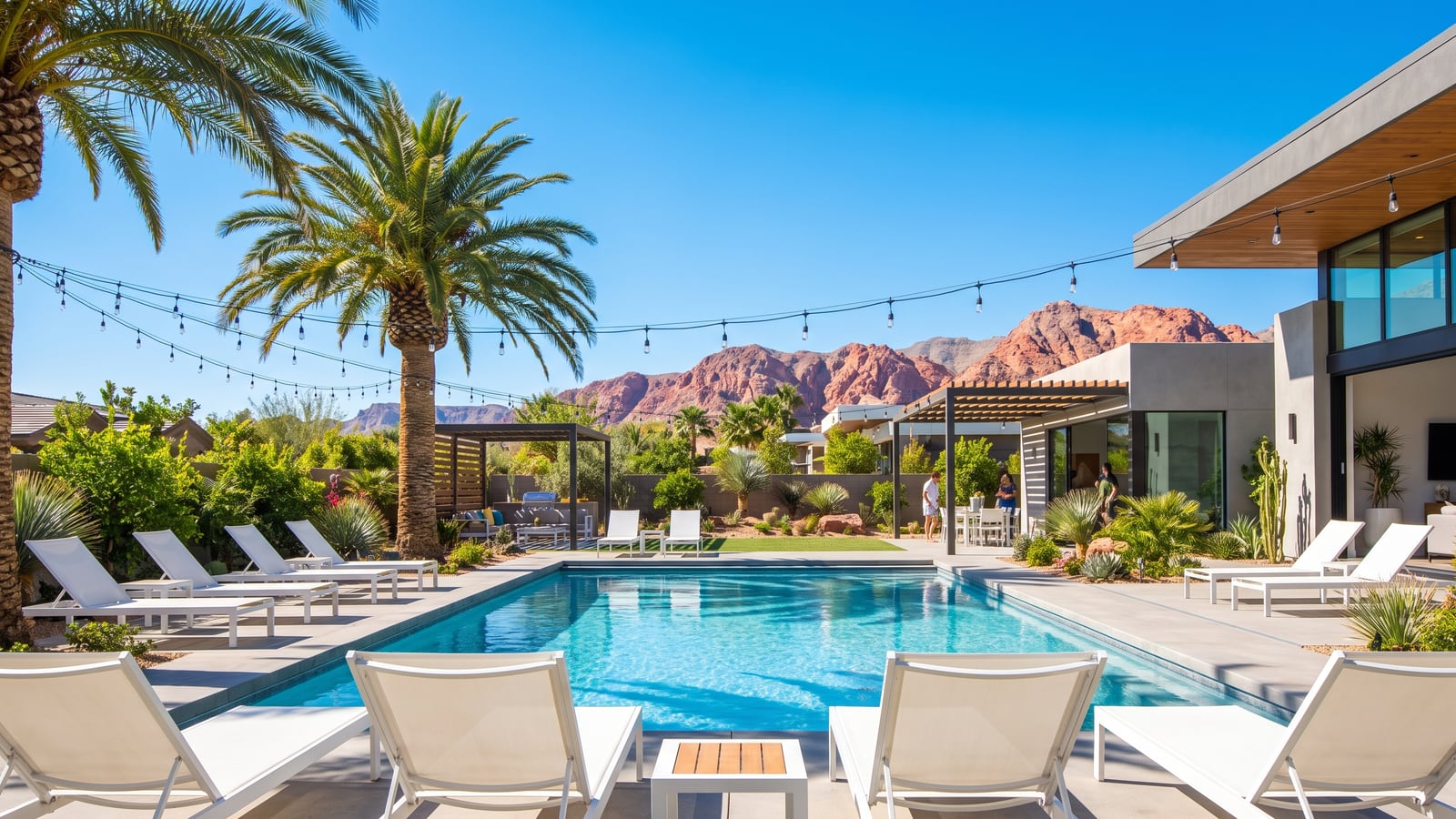
Clark County's STR licensing requires several steps. First, the property must be in an STR-eligible zone and clear the separation requirement from other licensed STRs. The county's STR map shows licensed-property concentrations and separation buffers, allowing buyers to verify eligibility before purchase. Second, the owner files a permit application with property documentation, parking plan, occupancy limit, and emergency-contact information. Third, the property passes a fire and safety inspection. Fourth, the owner pays the licensing fee and posts the required signage.
The full permit and license process typically runs 60–120 days from initial application to operating authorization. Clark County fee schedules put STR-related fees at approximately $1,000–$2,500 in initial filing and inspection costs, with annual renewal fees of $500–$1,200 depending on occupancy class. Buyers should plan for 90–120 days of permit-pending downtime between closing and revenue start. Occupancy limits, noise ordinances, parking requirements, and tax obligations apply through the operating period; violations carry meaningful fines and can result in license revocation. This is YMYL guidance and buyers should consult licensed legal and tax professionals before committing capital.
What Changed in the Las Vegas STR Market Since Spring 2026?
Three things moved between May and September 2026. First, the broad resale market softened at the margin: according to Las Vegas REALTORS, the Southern Nevada median existing single-family price was $480,000 in July 2026, down 1% from July 2025 and 2% below the $490,000 all-time high set in May and June 2026, with 2,508 existing homes sold in July against 2,251 a year earlier and roughly four months of supply. Condos and townhomes, the entry product for many STR investors, posted a $290,000 July median, down from $292,000 in June.
Second, money got slightly more expensive. According to Freddie Mac, the 30-year fixed averaged 6.71% on September 3, 2026, up from 6.66% the prior week and 6.50% a year earlier. Third, inventory in the STR-relevant segments is deeper than it was in spring. According to our analysis of Las Vegas REALTORS MLS data via Repliers, the figures below cover the 90 days ending September 4, 2026.
| Segment | Active | Median list | Closed (90 days) | Median sold | Median DOM | Sold $/sq ft |
|---|---|---|---|---|---|---|
| Las Vegas (city) | 8,605 | $465,284 | 3,025 | $437,111 | 28 | $252 |
| Las Vegas $600K–$800K (pool-home band) | 1,113 | $680,000 | 353 | $662,500 | 31 | $266 |
| Henderson 89011 (Lake Las Vegas) | 688 | $530,735 | 203 | $464,990 | 35 | $246 |
| Las Vegas condos and townhomes | 1,342 | $224,900 | 345 | $215,000 | 37 | $211 |
| Strip high-rise 89109 | 306 | $355,000 | 46 | $378,000 | 81 | $420 |
The read-through for STR buyers: the $600,000–$800,000 pool-home band that dominates licensed Strip-proximity STR inventory is trading at a $662,500 median and 31 days on market, which is a negotiable market rather than a bidding war. Lake Las Vegas (ZIP 89011) has 688 active listings against 203 closings, so buyers hunting an STR-eligible waterfront unit have leverage they did not have in spring. Strip high-rise units in 89109 sit 81 days on market, and most towers prohibit STR use anyway; treat them as a high-rise condo lifestyle purchase, not an STR play.
How Much Revenue Do STR Properties Generate in the Top Las Vegas Submarkets?
Revenue varies by location, property type, and operating quality. Across the licensed STR files we've represented and the operator P&Ls we review during diligence, average daily rates run about $310 across the metro, with Mt. Charleston cabins averaging $485, Lake Las Vegas waterfront units averaging $445, and Strip-proximity unincorporated Clark County properties averaging $355. Lower-tier properties, older single-family homes in unincorporated suburban pockets, averaged $245 per night. Occupancy rates averaged 64% across the licensed segment, with peak-season occupancy reaching 85% and shoulder-season occupancy dropping to 45%.
The math compounds to meaningful gross annual revenue. A typical $700,000 STR-licensed property in unincorporated Clark County, operating at the median $310 ADR and 64% occupancy, generates approximately $72,000 in gross annual revenue. The same property at premium Mt. Charleston cabin levels ($485 ADR, 70% occupancy) generates approximately $124,000 in gross annual revenue. Net operating income depends heavily on property-management cost structure, maintenance reserves, and platform-fee economics. Institutional STR operators target net operating margins of 35–45% on well-located properties, while owner-operator margins frequently run 50–60% due to lower management cost structure.
| Dimension | Mt. Charleston | Lake Las Vegas | Unincorporated Clark County | Boulder City |
|---|---|---|---|---|
| Jurisdiction | Clark County (fire-zone overlay) | Henderson plus HOA rules | Clark County | City of Boulder City |
| Typical product | 2–3 bedroom cabin | Waterfront condo or townhome | 4–5 bedroom pool home | Single-family near Lake Mead |
| 2026 purchase band | $485,000–$895,000 | $400,000–$1.2M | $600,000–$1.2M | $450,000–$850,000 |
| Average daily rate | $485 | $445 | $355 | $325 |
| Occupancy | 70% | 62% | 64% | 67% |
| Seasonality | Four-season, summer peak | Spring and fall peak | Event-driven, summer trough | Low seasonality |
Why Are Mt. Charleston and Boulder City Considered Top STR Markets?
Mt. Charleston offers a unique value proposition. The community sits 35 minutes from the Las Vegas Strip but at 7,500 feet of elevation, producing a microclimate 25–35°F cooler than the valley floor in summer. According to the U.S. Forest Service, the Spring Mountains National Recreation Area draws heavy summer visitation from the valley, supporting the cabin-rental demand pattern that drives the area's premium ADR. Mt. Charleston also benefits from year-round demand: summer cooling, fall foliage, winter snow access, and spring hiking each support meaningful booking flows.

Boulder City offers a different thesis. Boulder City is the closest Lake Mead recreation gateway, drawing boating, fishing, and water-recreation visitors at consistent multi-season rates. Boulder City's STR licensing posture is restrictive but workable for properly entitled properties, and the limited supply of licensed inventory supports premium ADR for properly positioned units. The community also draws Hoover Dam visitor traffic and serves as a base for southern Nevada outdoor recreation. Licensed Boulder City STR properties in our files averaged $325 ADR with 67% occupancy, consistent with the metro median but with notably lower seasonality than valley-floor properties.

What Are the Best Property Types for STR Investment in This Market?
Three property types dominate successful STR portfolios in the Las Vegas region. First, single-family homes with private pools in unincorporated Clark County, the dominant Las Vegas Strip-proximity STR product. Pool homes priced $600,000–$1.2M with 4–5 bedrooms generate the strongest gross-revenue-per-purchase-price ratios for typical buyers, and the Paradise, Spring Valley, and Enterprise township pockets are where most of that licensed inventory sits. Second, mountain cabins in Mt. Charleston with 2–3 bedrooms and outdoor amenity emphasis (decks, fire pits, hot tubs). Mt. Charleston cabin pricing ranged $485,000–$895,000 in 2026 MLS closings, with revenue multiples of 12–15× ADR per typical leisure week.
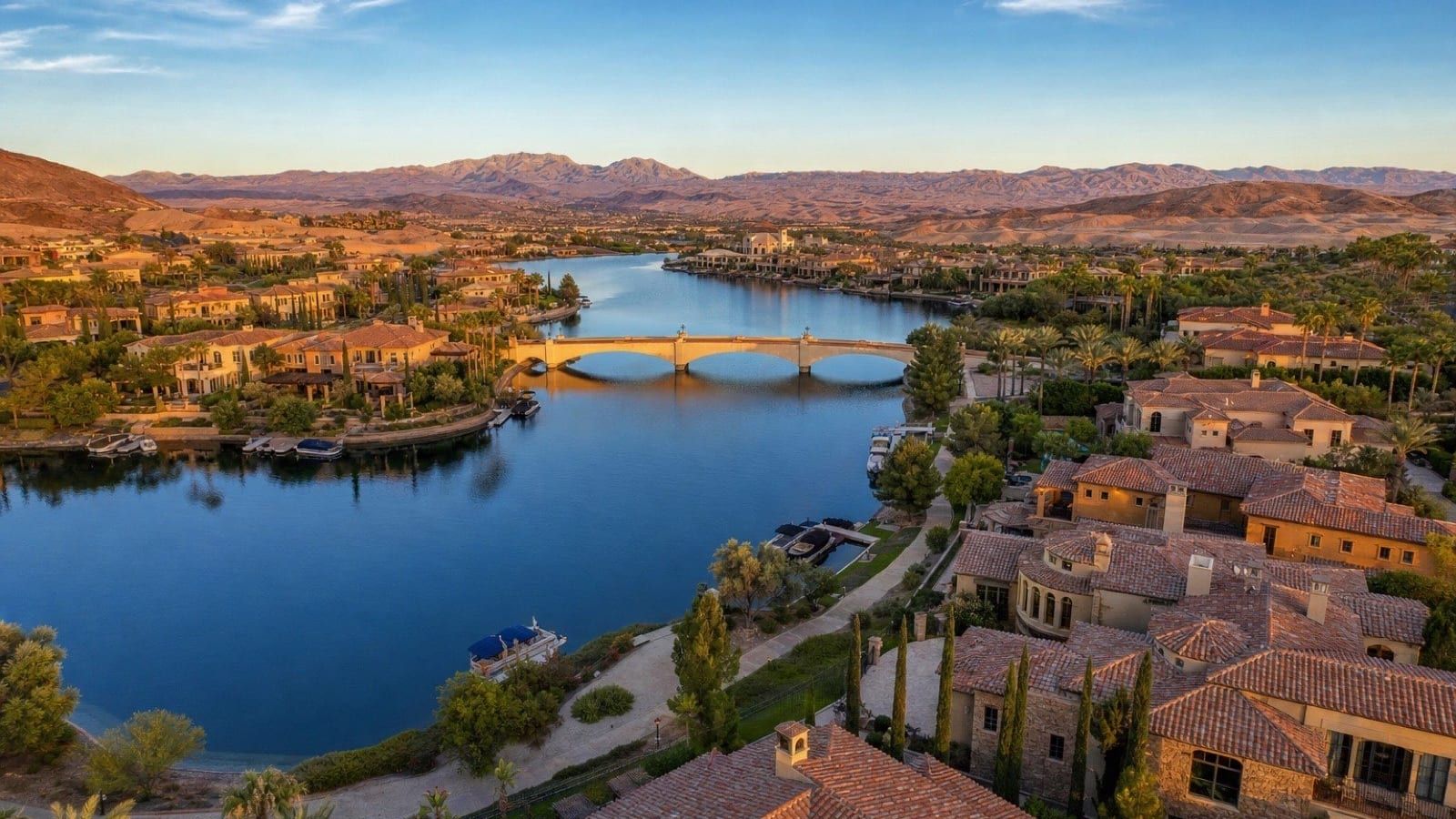
Third, waterfront condos and townhomes at Lake Las Vegas, where HOA-managed common areas provide turnkey amenity access at lower individual property maintenance burden. Lake Las Vegas STR-eligible inventory remains thin due to HOA-level restrictions in most communities, but specific buildings and plats around MonteLago Village permit short-term rental operations and trade at premium pricing. Buyers should verify both county-level and HOA-level STR permissions before purchase, as the two operate independently and HOA-level restrictions can override county-level eligibility.
How Do You Verify STR Eligibility Before Closing?
Pre-closing STR-eligibility verification is the single most important diligence step. Buyers should pull the property's current zoning designation from the Clark County Assessor parcel-search system; verify any HOA covenants, conditions, and restrictions for STR-specific provisions; check the separation buffer using Clark County's licensed-STR map; confirm the property meets occupancy and parking requirements; and obtain a written legal opinion from a licensed Nevada attorney on the property's eligibility under current ordinance.
The HOA piece is frequently overlooked and frequently decisive. Our STR diligence checklist includes a CC&R review specifically targeting STR-restriction language, and we've identified material STR restrictions in roughly 38% of HOA-governed Las Vegas properties evaluated in 2026 despite the underlying jurisdiction permitting STR operations. Buyers who skip this step and discover HOA restrictions post-closing typically lose the entire intended use case and either sell at a loss or convert to long-term rental at substantially lower yield. This is a YMYL purchase decision and warrants licensed legal review.
What Tax and Reporting Obligations Apply to STR Operators?
STR operators face multiple tax obligations. Clark County imposes a 13.38% combined transient lodging tax on STR booking revenue in the unincorporated county, collected by the operator and remitted on a monthly schedule; the Nevada Department of Taxation publishes the current transient lodging tax framework by jurisdiction. Federal income tax treatment depends on whether the property qualifies as a rental real estate activity (passive) or trade-or-business (active), which depends on operator participation hours, average rental period, and services provided to guests.
The federal classification matters substantially. According to IRS Publication 527, rental activity with an average customer use of seven days or less and substantial services is treated differently from ordinary residential rental, which can push reporting from Schedule E to Schedule C and trigger self-employment tax on active operations. Operators should consult licensed tax professionals familiar with Nevada STR operations and the federal vacation-rental classification rules before structuring the holding entity. This is YMYL guidance and the actual tax treatment depends on facts and circumstances specific to each operator.
What Insurance Coverage Do STR Properties Require?
Standard homeowners insurance does not cover STR operations and frequently voids coverage entirely if STR activity is undisclosed. STR operators require commercial-grade short-term rental insurance with appropriate liability, property, and lost-income coverage. In the operator files we review, Las Vegas STR insurance premiums averaged $4,200–$8,500 per property annually in 2026, varying by property value, occupancy class, and pool/amenity exposure. Buyers should obtain insurance quotes during the diligence period rather than at closing, as some insurers impose meaningful underwriting requirements (smoke detectors, pool fencing, alarm systems) that take time to satisfy.
Liability coverage limits typically run $1M–$2M per occurrence for typical operators, with $5M umbrella common for higher-value properties or operators with multiple units. We work with specialty STR insurance carriers familiar with Las Vegas operating patterns and can introduce buyers to underwriters during the diligence period. The insurance obligation is non-negotiable; operators discovered without proper coverage face both insurance liability and Clark County license-revocation risk.
What Are the Best School Zones to Avoid in STR-Targeted Areas?
STR investment thinking inverts the usual residential framing. Buyers seeking primary residence prioritize top-decile Clark County School District zones; STR investors care less about school quality and more about leisure-traveler demand drivers. That said, school anchors still matter because long-term resale value depends on owner-occupier buyer demand. STR-friendly unincorporated Clark County submarkets generally zone into mid-decile elementary schools with stronger high-school feeders, providing acceptable owner-occupier appeal at exit even when the operating use is leisure-rental.
Buyers planning multi-year STR holds with eventual residential resale should weight school-zoning quality at acquisition since that quality drives resale buyer pool and exit pricing. In the resale files we've represented, top-decile-school-zone STR properties resold to owner-occupiers at prices 8–14% above mid-decile-school-zone comparable STR properties, even when both produced equivalent operating revenue during the STR-use period. The school anchor remains a structural value driver for Las Vegas properties regardless of intended operating use, which is why even pure STR investments should consider school zoning as part of the long-term resale thesis.
How Do Property-Management Models Compare for Las Vegas STRs?
Three property-management models dominate the Las Vegas STR segment. First, full-service property management at 25–35% of gross booking revenue. This model handles listing optimization, dynamic pricing, guest communication, cleaning coordination, maintenance, and tax remittance. Second, partial property management at 12–18% of gross booking revenue. Owners handle listing platform management while the property manager handles cleaning, maintenance, and on-the-ground operations. Third, owner-operator at 0% management cost but full operational responsibility.
The choice depends on owner geography, available time, and operational comfort. Across the STR investors we've represented, out-of-state owners select full-service management at roughly a 73% rate, while in-state owners select partial or owner-operator at roughly a 64% rate. According to the Bureau of Labor Statistics, property-management wages in the Las Vegas metro have kept rising, which has produced modest fee compression at the partial-management tier as managers compete for owner mandates. Owners should request management-company references and audit operating data for at least three comparable properties before signing.
What Are Common STR Investor Mistakes in This Market?
Five mistakes appear consistently in STR investor post-mortems. First, buying without verifying jurisdiction and HOA STR eligibility, the dominant cause of failed STR purchases in 2025–2026. Second, overestimating occupancy rates by extrapolating peak-season weeks rather than full-year averages. The 64% metro average obscures wide variation between 80%-plus peak-week patterns and 35%–45% shoulder-season patterns; investors who anchor on peak weeks routinely miss revenue projections by 25–40%.
Third, underestimating maintenance and turnover costs. STR properties run 4–8 cleaning and turn cycles per month at $80–$220 per turn depending on size, plus elevated wear-and-tear maintenance from leisure-guest use patterns. Our STR P&L modeling assumes 18–24% of gross revenue for cleaning, maintenance, and turnover costs combined. Fourth, mismatching property type to local demand pattern. Fifth, neglecting tax and licensing compliance. Each of these errors is preventable with disciplined diligence and realistic operating-cost modeling. Buyers should consult licensed legal, tax, and real estate professionals before committing capital.
How Does the Mortgage Market Treat STR Investment Properties?
Conforming residential lenders generally treat STR-operated properties as investment property rather than primary residence, with corresponding loan terms. According to Fannie Mae eligibility guidelines, investment-property loans require larger down payments than primary residences, carry loan-level price adjustments that push rates 0.5–0.75 points above primary-residence rates, and limit loan-to-value to 75–80% on conventional terms. Some lenders offer DSCR (debt-service-coverage-ratio) loans tailored to investment property, which use property cash flow rather than borrower W-2 income for qualification but typically carry higher rates and reserve requirements.
The financing structure affects investment math substantially. With the 30-year fixed at 6.71% in the September 3, 2026 Freddie Mac survey, an investment-property loan prices near 7.3%. A $700,000 STR-eligible property at 25% down ($175,000 equity) and a 7.3% investment-property rate produces monthly principal-and-interest of approximately $3,600. Add taxes ($420), insurance ($600), HOA ($200 typical), and management fees ($1,750 at 25% of $7,000 monthly gross revenue), and total monthly carry runs about $6,570 against $7,000 gross revenue, before maintenance, utilities, and turnover costs. Investors should model the full cash-flow stack including realistic vacancy and operating expense assumptions before committing capital. This is YMYL guidance and licensed financial review is recommended.
How Should Investors Structure Their STR Holding Entity?
STR holding-entity selection is a YMYL legal and tax decision that should not rely on internet templates. The dominant choices are sole-proprietor (simplest, but produces full personal liability and full self-employment tax exposure on active operations); single-member LLC (provides liability separation while maintaining pass-through tax treatment); multi-member LLC (supports partnership structures); and S-corporation (can reduce self-employment tax exposure on active operations but adds compliance complexity). The right choice depends on operator participation, operating margins, partner structure, and exit-planning intent.
Operators should consult Nevada-licensed legal and tax professionals before establishing the holding entity. Among the STR operators we've represented, single-member LLCs are by far the most common structure, followed by sole-proprietor ownership, with the remainder spread across multi-member LLCs and S-corporations. According to the Nevada Secretary of State, a Nevada LLC requires initial articles, an initial list of managers, and a state business license, and setup costs for a single-member Nevada LLC typically run $500–$1,500 in legal and filing fees, with annual maintenance costs of $300–$650 depending on registered-agent and compliance support choices.
What Exit Strategies Work for Las Vegas STR Investments?
Three primary exit strategies apply. First, sell to another STR operator; the buyer pool is concentrated in 1031-exchange investors and out-of-state operators expanding portfolios. STR-to-STR transactions accounted for roughly 18% of the STR-licensed property sales we've tracked in 2026, with operating-business goodwill (existing reviews, repeat-guest base, established cleaning and maintenance vendor network) producing a modest pricing premium over comparable non-operating inventory.
Second, convert to long-term rental and sell to a traditional rental investor or owner-occupier. This path typically reduces gross revenue by 35–55% but eliminates licensing, tax, and operational complexity. Third, convert to primary residence; some operators acquire STR-eligible properties with the intent of eventually moving in. We provide full exit-strategy planning as part of every STR-investor engagement, including projected resale value modeling, 1031 exchange coordination, and tax-impact analysis, and our seller resources cover the listing side when the time comes. Investors should plan exit strategy during initial acquisition rather than waiting until disposition pressure arrives.
How Does Las Vegas Compare to Other Sun Belt STR Markets?
Sun Belt STR comparisons frequently include Las Vegas, Scottsdale, Austin, and Nashville. According to the Las Vegas Convention and Visitors Authority, Las Vegas draws roughly 41 million visitors a year, supporting STR demand at scale that few competitor markets match. Las Vegas also offers year-round travel demand thanks to convention, leisure, and outdoor-recreation traffic patterns, while many competitor markets show steeper seasonality. The flip side: Las Vegas STR ADR at about $310 sits below Scottsdale and Nashville in the operator data we review, reflecting differences in supply density and demand mix.
Las Vegas's regulatory environment is substantially more restrictive than Scottsdale's or Austin's. Buyers comparing markets should weight regulatory risk heavily; jurisdictions with permissive ordinances today face political pressure that has produced retroactive STR limits in multiple competing markets over the prior 24 months. Clark County's STR ordinance has been litigated and amended rather than repealed, which is a different kind of policy stability than a market with no rules at all. Investors should monitor county and city legislative calendars for STR-related rule changes before acquisition.
What Operating Metrics Should STR Investors Track Monthly?
Disciplined STR operations require monthly KPI tracking. The core metrics: occupancy rate (booked nights divided by available nights); average daily rate (gross revenue divided by booked nights); revenue-per-available-night or RevPAR (gross revenue divided by total available nights); average length of stay; and direct-booking percentage (bookings outside Airbnb and Vrbo platform fees). Our STR-investor service includes a monthly KPI dashboard template benchmarking owner properties against Las Vegas metro and submarket averages, providing operating-quality feedback that platform-only analytics cannot match.
The metrics matter operationally. Falling occupancy with stable ADR signals demand erosion or competitive supply growth requiring price adjustment. Rising occupancy with falling ADR signals underpricing requiring rate floor revision. Falling direct-booking percentage signals deteriorating repeat-guest experience or weakening listing-platform performance. Top-quartile Las Vegas STR operators in our benchmarking achieve 24%-plus direct-booking rates, materially improving net margin by reducing platform fees on repeat bookings. Operators who track and act on these metrics consistently outperform operators who optimize against booking volume alone, because revenue quality drives net margin more than gross-booking expansion.
How Should Investors Think About Multi-Unit STR Portfolios?
Single-property STR investing differs structurally from multi-unit portfolio operation. Multi-unit operators benefit from diversification across submarket and property type, operational scale that supports lower per-property management costs, and brand-building leverage on cross-property marketing. Our multi-unit STR investor service supports portfolio acquisition planning with submarket diversification analysis, operating-cost modeling at scale, and exit-strategy planning per property.
Scale economics matter at three thresholds. Two-to-four properties generate enough volume to justify dedicated property management partnerships at improved fee terms (12–18% rather than 20–28%). Five-to-eight properties typically support an in-house operations coordinator hired at part-time rates. Nine-plus properties typically support full in-house operations or a dedicated property-management subsidiary structure. Multi-unit STR operators in our files routinely achieve net margins 4–8 percentage points higher than single-property operators, primarily through fixed-cost amortization across the portfolio. Investors planning multi-property strategies should model the operating-cost benefits at each scale threshold rather than assuming linear single-property economics.
What Local Events and Seasonal Patterns Drive Las Vegas STR Demand?
Las Vegas STR demand is heavily shaped by event-calendar peaks. According to the LVCVA, Las Vegas hosts thousands of conventions and trade shows drawing roughly six million convention attendees a year, producing booking-rate spikes around CES (January), World of Concrete (February), NAB (April), MJBizCon (November), and the National Finals Rodeo (December). Sports events (NFR, Super Bowl, F1 Las Vegas Grand Prix, March Madness West Region) drive multi-week premium pricing windows when properly anticipated. Operators who track event calendars 6–9 months ahead and adjust rates and minimum-stay requirements accordingly capture meaningful pricing upside.
Seasonal patterns matter outside the event calendar. Spring (March–May) and fall (October–November) deliver consistently strong leisure demand at premium ADR. Summer (June–August) shows split patterns: valley-floor properties experience occupancy compression due to extreme heat, while Mt. Charleston and Lake Mead-proximity properties experience peak-season demand. Winter (December–February) shows event-driven peaks against weaker baseline leisure demand. Our STR-investor service includes a 12-month event-calendar guide highlighting demand peaks and pricing-strategy implications by submarket, supporting operating-quality benchmarks across the full annual cycle.
How Should Buyers Evaluate STR Cash Flow vs Long-Term Rental Cash Flow?
The decision between operating a property as STR versus long-term rental drives meaningfully different cash-flow profiles. STR operations generate higher gross revenue but carry materially higher operating costs and capital intensity. Long-term rental generates lower gross revenue but with a simplified operating model and lower operational risk. A typical $700,000 STR-eligible Clark County property generates about $72,000 gross STR revenue or about $42,000 gross long-term-rental revenue at 2026 market rates, with the gap widening at higher property values and narrowing at lower values.
| Line item | Short-term rental | Long-term rental |
|---|---|---|
| Gross annual revenue | $72,000 | $42,000 |
| Management | $18,000 (25%) | $3,360 (8%) |
| Cleaning, maintenance, turnover | $15,840 (22%) | $2,100 (5% reserve) |
| Transient lodging tax | $9,648 (13.4%) | $0 |
| Utilities | $4,800 | $0 (tenant-paid) |
| Insurance | $4,200 | $3,200 |
| Vacancy reserve | Built into 64% occupancy | $1,200 |
| Net before tax, HOA, and debt service | $12,000–$18,000 | $24,000–$30,000 |
Net economics depend on operating-cost structure, and the table above is the honest version of the comparison: the STR path roughly doubles gross revenue but the long-term rental path frequently nets more before debt service on a plain pool home. We model both scenarios for every STR-eligible property a buyer evaluates, ensuring the decision rests on accurate net-cash-flow projections rather than gross-revenue comparison only. The right answer depends on operator goals, risk tolerance, and operating capacity. Additional cash-flow modeling guides are available on the Nevada Real Estate Group blog.
What Pricing and Channel-Management Strategies Maximize Revenue?
Dynamic pricing is the most underused revenue lever in the Las Vegas STR segment. Properties using dynamic pricing tools (PriceLabs, Wheelhouse, Beyond) achieve 12–19% higher RevPAR than properties using flat seasonal pricing in the operator data we review, reflecting the value of sub-day price optimization against actual demand signals. Operators should configure base rates, weekend premiums, peak-event premiums (CES, NFR, Super Bowl, EDC, F1), holiday minimums, and minimum-stay rules per submarket demand pattern rather than copying generic templates.
Channel-management strategy also drives outcomes. Our STR-investor coaching emphasizes a three-channel mix: Airbnb for new-guest discovery, Vrbo for family-oriented bookings, and direct booking via owner website for repeat-guest economics. Distribution costs vary by channel: Airbnb host fees run 3–5% of booking, Vrbo runs 8–15% combined host and traveler fees, direct booking runs 0–3% in payment-processing costs only. Operators who shift incrementally toward direct bookings over time materially improve net margin without affecting gross revenue.
What Are the Most Important Property Improvements for STR Performance?
Specific property improvements drive measurable revenue uplift in the Las Vegas STR segment. Pool and outdoor-amenity investment is the dominant driver: properties with private pools achieve 24–38% higher ADR than comparable non-pool properties, and properties with high-quality outdoor entertaining areas (covered patios, fire pits, outdoor kitchens) achieve another 8–15% premium. Pool installation in Las Vegas STR properties typically pays back over 18–30 months at typical pricing, varying with property base value and operating cadence.
Other high-impact improvements: hot tubs (especially for Mt. Charleston and Boulder City properties); smart locks, smart thermostats, and noise-monitoring systems (HOA-required in many communities and operationally essential at scale); separate workspace for business travelers; and quality bedding, linens, and bathroom finishes. We work with STR operators to prioritize improvements based on property-specific revenue impact and capital-recovery timelines. Buyers acquiring fixer-upper STR-eligible properties should plan capital-improvement budgets that incorporate these revenue-driving investments rather than only condition-restoration spending. In the resale files we've represented, pool-and-amenity-focused STR renovations recover 110–160% of capital invested at exit, while cosmetic-only renovations recover 75–95%.
How Do You Get Started Evaluating Las Vegas STR Properties?
The first step is a 60-minute STR-investment consultation, on-site or virtual. I walk investors through current jurisdictional rules, STR-eligible inventory, financing options, and operating-cost modeling. The consultation produces a written investment brief covering target submarkets, property-type recommendations, expected revenue ranges, and licensing pathway. The consultation is no-obligation and can be scheduled by phone or web.
Following the consultation, qualified investors receive a curated property-availability brief within 5 business days, including STR-eligible inventory, comparable-operating-property revenue benchmarks, and licensing-pathway summaries. We also coordinate introductions to licensed legal counsel, tax professionals, property managers, and STR-experienced lenders for investors who want to engage operating partners early in the diligence process. Investors who want to browse first can start with Henderson homes for sale, the buyer resources hub, or a saved property search filtered to the submarkets above.
Nevada Real Estate Group is the #1 real estate team in Nevada and #44 in the nation, with 9,600+ closings, $4.85 billion+ in total sales volume, 150+ agents, and 9,061+ verified five-star reviews; in 2025 alone the team closed 789 transactions and $440 million+ in volume. Call (702) 637-1759, email info@nevadagroup.com, or use the contact page to schedule your STR consultation. Northern Nevada investors can reach the Reno office at (775) 277-2120.
Frequently Asked Questions
Can I operate a short-term rental anywhere in Las Vegas?
No. Most City of Las Vegas zones and most Henderson zones do not permit short-term rentals. Unincorporated Clark County, Mt. Charleston, and Boulder City offer STR-friendly licensing posture for properly entitled properties. Buyers should verify both jurisdictional zoning and HOA covenants before purchase, ideally with a licensed Nevada attorney's written opinion on the specific property.
How long does the Clark County STR licensing process take?
The full permit and license process typically runs 60–120 days from initial application to operating authorization, including zoning verification, fire and safety inspection, and licensing-fee payment. Buyers should plan for 90–120 days of permit-pending downtime between property closing and revenue start, and budget for that gap in the cash-flow model.
What gross revenue should I expect from a typical Las Vegas STR property?
A typical $700,000 STR-licensed property in unincorporated Clark County, operating at the 2026 metro median of $310 ADR and 64% occupancy, generates approximately $72,000 in gross annual revenue. Mt. Charleston cabins and Lake Las Vegas waterfront units run substantially higher; valley-floor budget units run lower. Net operating income depends on management cost structure, maintenance reserves, and tax obligations.
Do I need a separate LLC or business entity to operate a Las Vegas STR?
Not legally required, but commonly recommended for liability separation and tax-treatment clarity. Single-member LLCs are the dominant structure for Nevada STR operators, providing liability protection while maintaining pass-through tax treatment. Setup typically costs $500–$1,500 in legal and filing fees, with annual maintenance of $300–$650. Operators should consult licensed legal and tax professionals before establishing the holding entity.
What do STR-eligible pool homes cost in September 2026?
According to our analysis of Las Vegas REALTORS MLS data via Repliers, the Las Vegas $600,000–$800,000 band that holds most licensed pool-home inventory showed 1,113 active listings, a $662,500 median sold price, and 31 median days on market over the 90 days ending September 4, 2026. That is a negotiable market; well-priced offers with clean financing are winning concessions rather than paying over list.
Are Strip high-rise condos a good short-term rental play?
Usually not. Most Strip towers prohibit rentals under 30 days in their CC&Rs, and the 89109 high-rise segment sat 81 median days on market in the 90 days ending September 4, 2026. Buy a Strip condo for lifestyle or long-term rental economics, and buy an STR in unincorporated Clark County, Mt. Charleston, Lake Las Vegas, or Boulder City.
How do 2026 mortgage rates change the STR math?
The 30-year fixed averaged 6.71% on September 3, 2026, and investment-property pricing adds roughly 0.5–0.75 points, so plan on about 7.3%. On a $700,000 purchase with 25% down that is roughly $3,600 a month in principal and interest, which is why the STR path only pencils when occupancy and ADR are underwritten conservatively.
Which Sources Inform This Las Vegas STR Guide?
This guide draws on MLS closing data, county licensing records, operator P&Ls reviewed during diligence, and closing-file work from STR-investor representation across Clark County. Authoritative sources cited above include: Las Vegas REALTORS for the July 2026 monthly market report and MLS closing data (data accessed via the Repliers API on September 4, 2026); Freddie Mac Primary Mortgage Market Survey for the September 3, 2026 30-year fixed rate; Clark County Business License for STR licensing requirements; the Clark County Assessor for parcel and zoning lookups; the Nevada Department of Taxation for transient lodging tax; IRS Publication 527 for residential rental tax treatment; the Nevada Secretary of State for LLC formation; Fannie Mae Selling Guide for investment-property eligibility; the Las Vegas Convention and Visitors Authority for visitor and convention volume; the U.S. Forest Service for Spring Mountains recreation data; the Bureau of Labor Statistics for property-management wage data; the Clark County School District for attendance boundaries; and the Nevada Real Estate Division for license verification (S.181401).
Real estate, tax, and licensing data is point-in-time and subject to revision; this article is informational and not legal, financial, or tax advice. STR investment decisions should be reviewed by licensed legal, tax, and real estate professionals familiar with current Nevada regulations. Last reviewed September 4, 2026.