

Published June 28, 2026 · By Chris Nevada, Nevada Real Estate Group · NV License S.181401
Almost every week, someone moving into Summerlin asks me a version of the same question: should I just rent here for a year first, or buy now before prices climb again? It is a fair question, and in Summerlin specifically it is a harder call than in most of the Las Vegas valley. Summerlin sits at the upper end of the local market — higher home prices, higher rents, and real HOA dues baked into nearly every village. That combination changes the rent-vs-buy math in ways the generic "should you buy a house" calculators miss completely.
This guide runs the real Summerlin numbers for 2026. We will walk through the break-even point, a true monthly cost comparison that includes principal, interest, taxes, insurance, and HOA versus a comparable rent, the upfront cash both paths demand, the hidden costs each side hides, Summerlin's appreciation track record, and Nevada's no-income-tax edge. I will also be honest about when renting is the smarter move — because sometimes it genuinely is. If you want to skip the reading and just talk it through, my team is at (702) 637-1759, or you can browse current Summerlin homes for sale to anchor the numbers to real inventory.
I have closed homes across Summerlin's villages for years, and the pattern is consistent: the answer depends far more on your timeline and your cash position than on any single market headline. Let's build the math from the ground up.
In Summerlin, buying beats renting once you stay roughly three to five years — the break-even where appreciation and equity outrun your costs. A $750,000 home runs about $4,800 to $5,400 monthly with PITI plus HOA at 20 percent down, versus roughly $3,200 to $3,800 to rent. Renting wins under three years or when cash is thin.
- Break-even for buying in Summerlin lands around three to five years once selling costs and appreciation are factored in.
- A $750,000 Summerlin home runs roughly $4,800 to $5,400 monthly with PITI plus HOA at 20 percent down.
- Comparable Summerlin single-family rents range about $3,200 to $3,800, so renting is cheaper month to month.
- Nevada charges no state income tax, which quietly stretches both renters' and buyers' budgets here.
- Renting wins under three years, when cash is thin, or when your job is unsettled — buying wins on a long horizon.
- Set your timeline first. Under three years leans rent; five-plus years leans buy in almost every Summerlin scenario.
- Build the true monthly number. Add HOA to PITI — Summerlin dues are real and often missed in calculators.
- Count the upfront cash both ways. Buying needs down payment plus closing; renting needs deposits and pet fees.
- Weigh Summerlin appreciation. Equity growth in a strong master plan is the buyer's biggest hidden advantage.
- Be honest about risk. Job uncertainty, thin savings, or a short stay can make renting the financially smart call.
Should You Rent or Buy in Summerlin in 2026?
The honest answer is that it depends on three variables: how long you will stay, how much cash you have, and how stable your income is. Summerlin is not the place to buy a home you might sell in 18 months, because the transaction costs on both ends will eat any short-term appreciation. But it is one of the best long-hold communities in the valley, which makes the five-year-plus buyer's case unusually strong.
According to the Consumer Financial Protection Bureau, the single biggest mistake first-time buyers make is underestimating the total monthly cost of ownership — not the mortgage alone, but taxes, insurance, maintenance, and in a master plan like Summerlin, HOA dues. Once you build the full number honestly, the rent-vs-buy decision usually answers itself.
For buyers relocating from a higher-cost state, Summerlin often looks like a bargain even at a $750,000 entry point. For locals weighing whether to keep renting, the calculus is tighter because the monthly gap between renting and owning is wider here than in, say, Las Vegas proper. That is exactly why this needs to be a Summerlin-specific analysis rather than a generic valley one. If you want the broader metro comparison, our should you rent or buy in Las Vegas breakdown covers the wider valley, but the numbers below are tuned to Summerlin.
Across the 9,600-plus closings our team has represented, the Summerlin buyers who came out ahead are almost always the ones who stayed past the five-year break-even — and the renters who came out ahead are the ones who knew, up front, that their stay was short. In my experience, that single honest answer about timeline predicts the right choice better than any market forecast. Whichever side you land on, our buyers and sellers teams will run your real numbers, not a generic estimate.

What Is the Break-Even Point for Buying in Summerlin?
The break-even point is the number of years you must own before buying becomes cheaper than renting, after accounting for all the costs of getting in and out. In Summerlin, that point typically lands around three to five years, depending on your purchase price, rate, and how fast the home appreciates during your hold.
Here is why it sits there. When you buy, you pay roughly two to five percent of the price in closing costs going in. When you sell, you pay agent commissions and seller costs that can run five to seven percent. That means you need enough appreciation plus equity paydown to clear roughly seven to ten percent of the home's value just to break even on transaction friction. On a $750,000 home, that is $52,500 to $75,000 of value you need to recover before you are ahead of where renting would have left you.
Summerlin's appreciation history has historically helped buyers clear that hurdle faster than the national average. According to the Federal Housing Finance Agency, the Las Vegas metro has posted strong long-run home-price growth, and Summerlin tends to outperform the valley average because of its amenities, schools, and brand. Per the National Association of Realtors, national break-even points commonly fall in the three-to-five-year range — and Summerlin lands squarely inside that band.
How Do Monthly Costs Compare — PITI Plus HOA vs Rent in Summerlin?
This is the comparison most people get wrong because they forget the HOA. Nearly every Summerlin village carries a homeowners association, and many have a sub-association on top of the master association. Skipping that line item makes buying look far cheaper than it really is. Let's build the full monthly number on a representative $750,000 single-family home.
With 20 percent down ($150,000), you finance $600,000. At a 2026 rate in the high-6 percent range, principal and interest run roughly $3,900 to $4,100. Property taxes in Clark County are relatively low — Nevada's effective rate is well under the national average — adding roughly $400 to $475 monthly. Homeowners insurance adds about $130 to $175. Summerlin HOA dues commonly run $50 to $200 per month for the master association, with some guard-gated or sub-association villages running higher. Add it together and you land around $4,800 to $5,400 all-in.
| Monthly line item | Buy ($750,000) | Rent (comparable) |
|---|---|---|
| Principal and interest | $3,900 to $4,100 | n/a |
| Property taxes | $400 to $475 | n/a (in rent) |
| Insurance | $130 to $175 (homeowners) | $15 to $30 (renters) |
| HOA dues | $50 to $200+ | n/a (in rent) |
| Base rent | n/a | $3,200 to $3,800 |
| All-in monthly | $4,800 to $5,400 | $3,215 to $3,830 |
Month to month, renting is clearly cheaper in Summerlin — often by $1,200 to $1,700. The buyer's advantage is not the monthly cost; it is that a chunk of that payment is principal you keep, plus the appreciation that accrues to you, not your landlord. You can sanity-check your own numbers with our mortgage calculator before you ever tour a home.
What Are the Upfront Costs of Renting vs Buying in Summerlin?
The cash you need to get in the door is wildly different between the two paths, and it is often the deciding factor regardless of the long-run math. Buying in Summerlin demands a serious down payment plus closing costs. Renting demands deposits and fees that are real but an order of magnitude smaller.
On a $750,000 purchase, 20 percent down is $150,000, and closing costs typically run two to five percent — call it $15,000 to $37,500. According to the U.S. Department of Housing and Urban Development, lower-down-payment loan programs exist, but in Summerlin's price tier most buyers put down more to keep the payment manageable and avoid mortgage insurance. Renting, by contrast, usually requires first month, a security deposit equal to roughly one month, and possibly a pet deposit — landing around $7,000 to $11,000 total to move in.
| Upfront item | Buy ($750,000) | Rent ($3,500/mo) |
|---|---|---|
| Down payment | $150,000 (20 percent) | n/a |
| Closing costs | $15,000 to $37,500 | n/a |
| First month / deposit | n/a | $7,000 (first plus deposit) |
| Pet / admin fees | n/a | $300 to $1,000 |
| Total to move in | $165,000 to $187,500 | $7,300 to $11,000 |
The gap is stark: roughly $165,000-plus to buy versus around $8,000 to rent. If that down payment would drain your reserves to zero, renting while you rebuild a cushion is often the responsible call — even when the long-run buy math is favorable. Cash position trumps theory.
What Are the Hidden Costs of Renting vs Buying in Summerlin?
Both sides hide costs that surprise people. As an owner in Summerlin, you absorb maintenance and repairs the landlord used to handle — a budget of roughly one percent of home value per year is a reasonable planning figure, so about $7,500 annually on a $750,000 home. You also carry the HOA dues, occasional special assessments, higher utility bills in larger homes, and the transaction costs whenever you eventually sell.
Renters have quieter hidden costs. The biggest is rent inflation: your payment is not fixed, and in a desirable area like Summerlin it tends to rise. According to the U.S. Census Bureau, Nevada's population and housing demand have grown steadily, which keeps upward pressure on rents. You also build zero equity, you may face renewal fees, and you have no control over whether the owner decides to sell out from under you. Per the Las Vegas REALTORS market data, rents in premium submarkets have trended up over time, so the "cheaper today" rent figure is not guaranteed to stay cheaper.

How Does Summerlin's Appreciation History Change the Math?
Appreciation is the single biggest reason buying wins over a long enough hold in Summerlin. When your home gains value, you capture that growth on the full purchase price, not just your down payment — that is leverage working in your favor. A $750,000 home appreciating even four percent in a year gains $30,000 in value, which on a $150,000 down payment is a 20 percent return on your invested cash before counting principal paydown.
Summerlin has historically appreciated faster than the broader valley because of how it is built and managed. According to Howard Hughes / Summerlin, the master plan is developed in carefully phased villages with parks, trails, schools, and retail designed in from the start — the kind of planning that supports durable demand and resale value. Per the Federal Housing Finance Agency house-price index, the Las Vegas metro has delivered strong cumulative appreciation over the past decade, and premium master plans typically ride above the metro average.
I always caution clients that past appreciation is not a guarantee — markets correct, and Las Vegas has seen sharp swings before. But over a five-to-ten-year horizon in a well-located Summerlin village, the appreciation case has historically been the buyer's strongest argument. Across our Summerlin transactions, the homes we've sold for repeat clients years later are the clearest illustration of how that long-hold equity compounds. The break-even arrives sooner when appreciation runs hot and later when the market cools, which is why timeline flexibility matters so much. When you reach the exit, our home value estimator gives you a fast starting figure.
What Can You Rent vs Buy for the Same Money in Summerlin?
A useful way to frame the decision is to ask what $3,500 a month gets you on each side. As a renter, $3,500 typically lands you a nice three-to-four-bedroom single-family home or a high-end townhome in a good Summerlin village — comfortable, but every dollar leaves your pocket permanently. As a buyer, a payment that nets out to a similar all-in cost after the tax and equity benefits gets you ownership of a home in the high-$600,000s to low-$700,000s, where a meaningful share of each payment becomes equity.
| What you get | Renting | Buying |
|---|---|---|
| Home type for the money | 3 to 4 bed single-family or luxury townhome | $680,000 to $750,000 single-family home |
| Equity built (year 1) | $0 | $9,000 to $12,000+ in principal |
| Appreciation captured | None (landlord keeps it) | Full home value gains |
| Flexibility to leave | High (end of lease) | Lower (must sell or rent out) |
| Payment certainty | Resets at renewal | Fixed P and I for the loan term |
The renter buys flexibility; the buyer buys equity and payment certainty. Neither is wrong — they serve different life stages. If you want to see what your money buys in real inventory right now, browse Summerlin homes for sale or call my team at (702) 637-1759 and we will pull comparable rentals and listings side by side.
Does Nevada's No-Income-Tax Advantage Help Renters or Buyers More?
Nevada is one of the few states with no state income tax, and it quietly improves the picture for everyone living in Summerlin. According to the Nevada Department of Taxation, the state levies no personal income tax, which means more of every paycheck stays with you compared to a high-tax state like California. For a household relocating from a 9-to-13 percent income-tax state, that difference can be tens of thousands of dollars a year.
That advantage helps both renters and buyers, but it tilts slightly toward buyers in one respect: it frees up cash flow that makes a larger mortgage payment more sustainable, and it leaves more room to absorb the maintenance and HOA costs of ownership. According to the Internal Revenue Service, homeowners who itemize may also deduct mortgage interest within federal limits, layering a federal tax benefit on top of Nevada's state-level break — a deduction renters never get. That said, with today's higher standard deduction, many buyers no longer itemize, so do not assume the mortgage-interest deduction applies until you check with a tax professional.
The combined effect is that Summerlin's premium prices are more affordable for a given income than they would be in a high-income-tax metro. It is one reason so many of my clients moving from California find the math works here even at a higher purchase price.
When Does Renting Actually Win in Summerlin?
I tell clients the truth: renting wins more often than the "always buy" crowd admits. If your timeline is under three years, renting almost always comes out ahead because you cannot clear the seven-to-ten percent transaction friction in that window. If your job or income is uncertain — a possible relocation, a new business, a career in flux — the flexibility of a lease is worth more than the equity you would slowly build.
Renting also wins when buying would drain your emergency reserves. According to the Consumer Financial Protection Bureau, keeping three to six months of expenses in reserve is a basic financial guardrail, and a Summerlin down payment that wipes out your cushion is a risk, not a smart move. Renting can also be the right call while you learn the area — Summerlin has very different villages, and renting first lets you test which one fits before committing $750,000 to one location. The clients we advise on this rarely regret renting a year first; they regret rushing into the wrong village. When you are ready to compare real inventory, start a home search.
Finally, renting can win mathematically if you are a disciplined investor who would put the cash difference to work. If you rent for $3,500 instead of paying $5,200 to own, and you actually invest that $1,700 monthly gap every month, the renting path can compete with owning in a flat or falling market. The catch is that almost nobody invests the difference consistently — but if you do, it is a legitimate strategy.
Which Summerlin Villages Make the Strongest Buy vs Rent Case?
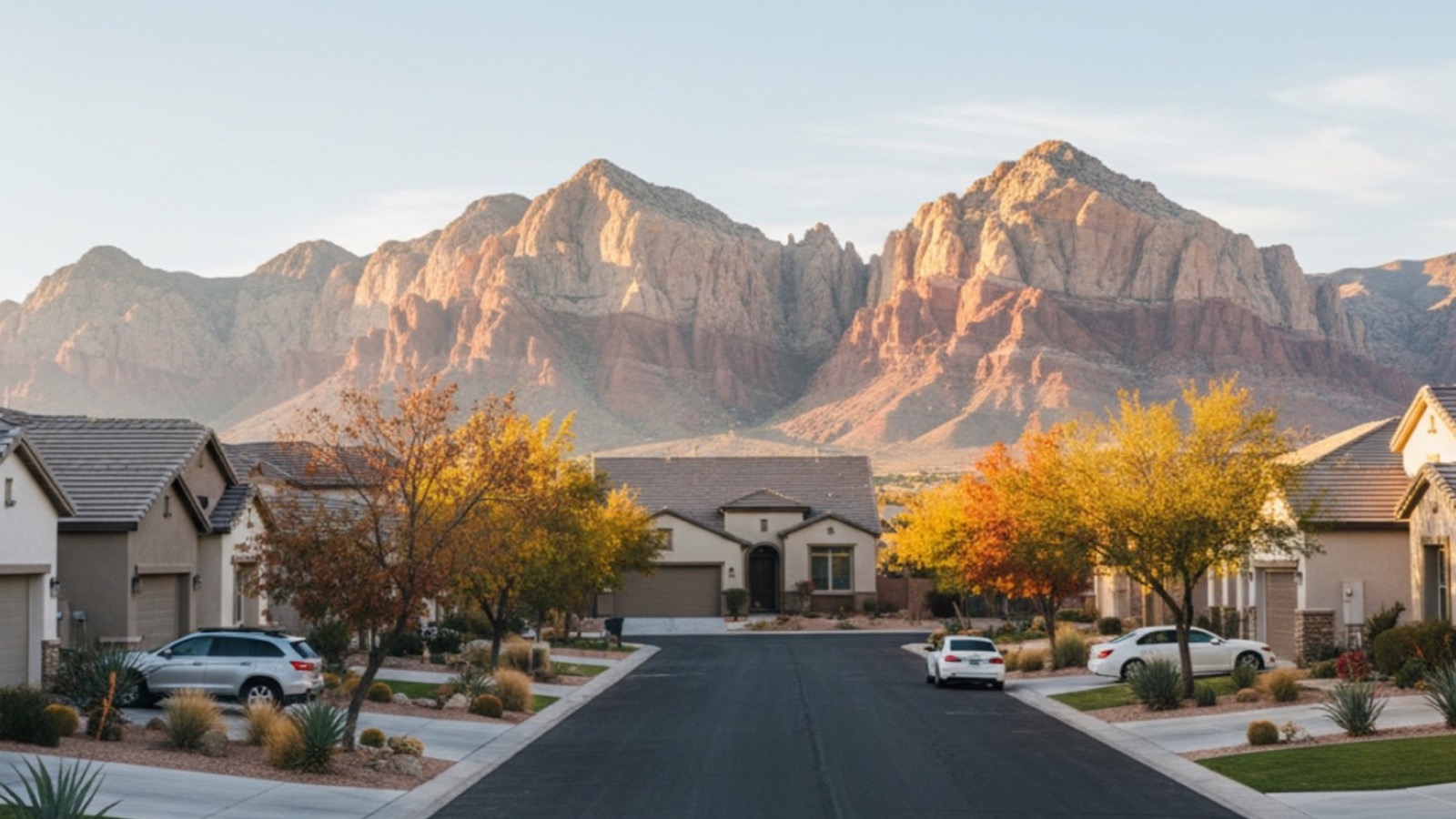
Summerlin is not one market — it is dozens of villages spanning entry-level attached homes to guard-gated luxury estates, and the rent-vs-buy math shifts across them. In the more established villages like The Trails, The Hills, and Sun City Summerlin, prices and rents are well-documented, inventory turns predictably, and the buy case is steady for long-term residents. Sun City Summerlin in particular anchors the area's 55-plus communities and draws right-sizing retirees who often buy with cash, sidestepping the rate question entirely. Buyers who want lower-maintenance ownership at a smaller entry price sometimes look at Summerlin condos for sale instead of a detached home, which shifts the HOA and rent-vs-buy math again.
In the newer western villages — Redpoint, Kestrel, and the Cliffs area — newer construction, higher price points, and steeper HOA structures change the equation. Per Howard Hughes / Summerlin, the western expansion continues to add inventory, which can moderate appreciation in the short run even as long-run demand stays strong. Buyers in these villages should weigh builder incentives against resale comps carefully.
For renters, the most rentable villages tend to be those with more single-family inventory and active investor ownership. If you are deciding which village fits before you commit, renting for a year in your target area is a legitimate strategy — and our team can help you compare villages directly. Start with the Summerlin overview, then call (702) 637-1759 to talk specifics.
How Do 2026 Mortgage Rates Affect the Summerlin Rent vs Buy Decision?
Rates are the variable that moves the monthly buy number the most. According to Freddie Mac PMMS, the 30-year fixed rate has hovered in the high-6 to 7 percent range through recent cycles, well above the 3 percent lows of a few years ago. On a $600,000 loan, the difference between a 6.5 percent and a 7.5 percent rate is roughly $400 a month — enough to swing the rent-vs-buy decision for some households.
Higher rates make renting more competitive in the short term because they push the monthly buy cost up while rents move more slowly. But they also slow price growth, which can mean less competition and more negotiating room for buyers willing to commit. Many of my Summerlin buyers are choosing to buy now and refinance later if rates fall — the "marry the house, date the rate" approach. The risk is that rates may not fall as fast as hoped, so the payment you sign for has to be one you can sustain at today's rate.
Per the National Association of Realtors, affordability nationally remains tight, and Summerlin's premium pricing means rate sensitivity is amplified here. The practical takeaway: lock your numbers at today's rate, make sure the payment works without assuming a future refinance, and treat any rate drop as upside, not a plan. Run your scenario through our mortgage calculator and get a real preapproval before you decide.
What Is the Five-Year Total Cost of Renting vs Owning in Summerlin?
The cleanest way to compare is total cost over a realistic hold. Let's project five years on a $750,000 home versus renting a comparable place starting at $3,500 with modest annual rent increases. This is where the equity and appreciation finally tip the scales for the buyer — assuming a normal, not crashing, market.
| Five-year factor | Rent (start $3,500) | Own ($750,000) |
|---|---|---|
| Total payments over 5 years | $225,000 to $235,000 | $290,000 to $320,000 (PITI plus HOA) |
| Upfront cash committed | $8,000 (recoverable deposit) | $165,000+ (down plus closing) |
| Equity from principal paydown | $0 | $50,000 to $60,000 |
| Appreciation (4 percent/yr est.) | $0 | $160,000+ on home value |
| Net position after selling costs | No asset | Positive, often well ahead of renting |
The owner pays more cash over five years, but ends with an asset worth potentially $200,000-plus more in equity and appreciation, even after paying selling costs. That is the heart of the long-hold buy case. Of course, this assumes steady appreciation — flatten that line and the gap narrows or reverses, which is precisely why timeline and market conditions matter. When you are ready to sell, knowing your number matters; our Summerlin sell-my-house resources help on the exit side. You can also model the entry payment yourself with our mortgage calculator.
How Do You Know If You Are Ready to Buy in Summerlin?
Readiness is more about your finances and life than about the market. The honest checklist I walk every client through covers stability, cash, and timeline. If you can answer yes to most of these, buying in Summerlin likely beats renting. If several are no, renting another year is the smarter, lower-risk move — and there is no shame in it.
Ask yourself: Will I stay at least three to five years? Do I have the down payment plus closing costs without draining my emergency fund? Is my income stable enough that I am confident in the payment at today's rate? Have I picked a Summerlin village I actually want to commit to? According to the Consumer Financial Protection Bureau, a healthy debt-to-income ratio and a solid reserve are the foundations of a sustainable purchase. If those boxes are checked, the appreciation and equity case in Summerlin is strong.
If you are not sure, that is exactly what my team is for. We will run your real numbers — not a generic calculator — against actual Summerlin listings and rentals, and tell you honestly which path wins for your situation. Reach us at (702) 637-1759, learn more about our team, or contact us to get started.
Frequently Asked Questions About Renting vs. Buying in Summerlin
Is it cheaper to rent or buy in Summerlin right now?
Month to month, renting is cheaper in Summerlin in 2026 — a comparable single-family home rents for roughly $3,200 to $3,800, while buying a $750,000 home costs about $4,800 to $5,400 all-in with PITI plus HOA. Buying becomes the better financial move over a longer hold, typically three to five years, once equity and appreciation outrun the monthly gap and transaction costs.
What is the break-even point for buying a home in Summerlin?
The break-even point in Summerlin generally lands around three to five years. That is how long you need to own before appreciation and principal paydown clear the roughly seven to ten percent in combined closing and selling costs. On a $750,000 home, that is $52,500 to $75,000 of value you must recover before buying pulls ahead of renting. A faster-appreciating market shortens that window.
How much are HOA dues in Summerlin?
Summerlin HOA dues commonly run about $50 to $200 per month for the master association, though many villages add a sub-association or guard-gated fee that pushes the total higher. Always confirm the exact dues and any special assessments for the specific village before you buy, because this line item is frequently left out of online affordability calculators and can meaningfully change your monthly cost.
How much do I need to buy a home in Summerlin?
On a $750,000 home with 20 percent down, you need about $150,000 for the down payment plus $15,000 to $37,500 in closing costs — roughly $165,000 to $187,500 total. Lower-down-payment loans exist, but in Summerlin's price tier most buyers put more down to keep the payment manageable and avoid mortgage insurance. Always keep an emergency reserve on top of that cash.
Does Nevada's lack of income tax make buying in Summerlin more affordable?
Yes, indirectly. Nevada has no state income tax, so more of your paycheck stays with you compared to a high-tax state. That extra cash flow makes a larger Summerlin mortgage payment and the associated HOA and maintenance costs more sustainable. It helps renters too, but it tilts slightly toward buyers by freeing up the income needed to carry ownership at Summerlin's premium price points.
When is renting in Summerlin the smarter choice?
Renting wins when your timeline is under three years, when buying would drain your emergency reserves, or when your job or income is uncertain. It is also smart while you learn which Summerlin village fits you, since the villages differ widely. And if you are a disciplined investor who will actually invest the monthly cost difference, renting can compete financially in a flat or softening market.
How does Summerlin appreciation compare to the rest of Las Vegas?
Summerlin has historically appreciated faster than the broader Las Vegas valley because of its planned amenities, parks, trails, top schools, and strong brand demand. That outperformance is the buyer's biggest hidden advantage, since gains accrue on the full home value, not just your down payment. Past appreciation is not guaranteed, but over a five-to-ten-year hold the case has historically favored buying in well-located villages.
Should I buy now or wait for mortgage rates to drop?
If the payment at today's rate works without assuming a future refinance, buying now in Summerlin is reasonable, and any rate drop becomes upside. Many of my buyers use the "marry the house, date the rate" approach — buy now, refinance later if rates fall. The risk is that rates may not drop as hoped, so never sign a payment you can only afford if a refinance happens.
Ready to Run Your Real Summerlin Numbers?
The rent-vs-buy decision in Summerlin is too important and too local to settle with a generic online calculator. Your break-even depends on your timeline, your cash, your village, and the rate you actually qualify for — and I would rather show you the honest math than sell you on one side. Sometimes the right answer is to buy this month, and sometimes it is to rent another year and revisit. My job is to tell you which, based on your real numbers.
If you want that side-by-side comparison — comparable Summerlin rentals against real listings, with the full PITI-plus-HOA cost broken out — reach out and we will build it together. Call my team at (702) 637-1759, contact our team directly, or browse current Summerlin homes for sale to anchor the conversation to actual inventory. No pressure, just straight numbers.
Which Sources Inform This Summerlin Rent-vs-Buy Guide?
The figures above are realistic 2026 ranges for Summerlin, not exact quotes — prices, rents, rates, and HOA dues change constantly, so verify current numbers before deciding. This guide is educational and not financial, tax, or investment advice; consult a licensed lender, tax professional, and your agent for advice specific to your situation. The following authoritative sources inform the framework and data ranges:
- Consumer Financial Protection Bureau — homebuying readiness, debt-to-income, and reserve guidance
- Freddie Mac PMMS — weekly 30-year fixed mortgage rate survey
- U.S. Census Bureau — Nevada population, housing, and demographic data
- National Association of Realtors — affordability metrics and typical break-even research
- Nevada Department of Taxation — confirmation of Nevada's no-state-income-tax status
- Las Vegas REALTORS — Southern Nevada market and rent trend data
- Howard Hughes / Summerlin — master-plan development, villages, and amenities
- Clark County Assessor — property tax assessment and parcel data
- U.S. Department of Housing and Urban Development — loan programs and Nevada housing resources
- Federal Housing Finance Agency — Las Vegas metro house-price index and appreciation history
- Internal Revenue Service — mortgage interest deduction rules and federal tax treatment