Ask most people whether Las Vegas has earthquakes and you'll get a confident "no." They're wrong. Nevada is the third most seismically active state in the country — behind only Alaska and California — and the Las Vegas Valley sits near roughly seven active faults, on soft basin soil that can amplify shaking like gelatin in a bowl. So when a builder engineers the Juniper model — a $1.6 million Summerlin home — to survive a magnitude 9.2 earthquake, it isn't a marketing gimmick. It's a rational response to a risk that's real, underappreciated, and quietly relevant to anyone buying a high-end home here.
This guide unpacks the Juniper model and the engineering behind it — what "built to survive a 9.2" actually means, how seismic-resilient construction works, why the valley's geology raises the stakes, what Clark County's codes require, and what the Summerlin luxury market looks like at this price. It draws on live Las Vegas Multiple Listing Service data and public seismic research, and it's paired with our video tour of the home so you can see the difference for yourself.
Nevada is the third most seismically active state in the U.S., and the Las Vegas Valley sits near about seven active faults with a 12% chance of a magnitude 6.0-plus quake within 50 years. This $1.6 million Summerlin Juniper model was engineered beyond code — reinforced foundations, shear walls, and ductile framing built to survive a 9.2. In a valley whose soft soil amplifies shaking, that structural investment is smarter than most buyers realize.
- Nevada is the 3rd most seismically active state — behind only Alaska and California.
- The Las Vegas Valley has ~7 active faults and a "basin effect" that amplifies shaking.
- A magnitude 9.2 is enormous — the 1964 Alaska quake, the 2nd-largest ever recorded.
- Seismic-resilient homes use reinforced foundations, shear walls, and ductile framing.
- The Juniper model ($1.6M) sits at the median of 71 active Summerlin listings in the $1.4M–$1.8M band.
Shopping the area? Browse live Summerlin homes for sale — every active MLS listing with prices, photos, and instant filters.
Do You Really Need an Earthquake-Resistant Home in Las Vegas?
For a luxury buyer, the honest answer is: it matters more than you think, and almost nobody asks about it. Las Vegas has been spared a major earthquake in living memory, which lulls buyers into treating seismic engineering as a non-issue. But "no big one recently" is not the same as "no risk" — it's just the quiet part of a seismic cycle. The valley's fault network is real, the soil conditions are unfavorable, and the homes most people are buying were built to the minimum code in force at the time, not to any elevated standard.
That's what makes a home engineered beyond code genuinely differentiated. It isn't paying for a feature you'll use every day like a pool or a view; it's paying for resilience you hope you never test — the structural equivalent of insurance built into the bones of the house. In our experience representing luxury buyers across the valley, structural integrity is the single most overlooked line item at the high end, precisely because it's invisible in photos and easy to assume away. A home that leads with it is answering a question smart buyers should be asking.
Is Nevada Actually an Earthquake State?
This is the fact that reframes everything. According to the Nevada Bureau of Mines and Geology, Nevada ranks third in the nation for seismic activity, trailing only Alaska and California. The state is laced with active faults, and Southern Nevada is no exception. According to UNLV researchers, areas within 30 miles of Las Vegas carry roughly a 12% chance of a magnitude 6.0 earthquake within the next 50 years, and geologists note the valley could one day face something far larger.
| Factor | Reality |
|---|---|
| Nevada seismic rank | 3rd most active state (after AK, CA) |
| Active faults near the valley | About 7 |
| Chance of M6.0+ within 50 yrs | ~12% (within 30 miles) |
| Potential larger event | Geologists cite up to ~7.8 |
| Soil condition | Soft basin — amplifies shaking |
The reason this surprises people is timing: Nevada's largest quakes are infrequent, spaced far apart, and often centered in the state's less-populated stretches. But infrequent is not the same as impossible, and the fault map under Southern Nevada is not blank. According to the U.S. Geological Survey, the Intermountain West — Nevada included — is a zone of ongoing crustal stretching that produces exactly the kind of normal faults found around Las Vegas. A home built for that reality is built for the place it actually sits.
What Does "Built to Survive a 9.2 Earthquake" Actually Mean?
To appreciate the claim, you need scale. A magnitude 9.2 is not a large earthquake — it's one of the largest ever recorded. The 1964 Great Alaska earthquake was a 9.2, the second-most-powerful quake in recorded history. Because the magnitude scale is logarithmic, a 9.2 releases vastly more energy than the mid-6.0 event the valley is statistically likelier to see — roughly a thousand times more energy than a 6.2. Engineering a house to withstand that is engineering for a worst-case far beyond anything code requires.
In practical terms, "built to survive a 9.2" signals a home designed with a large margin above the baseline — heavier reinforcement, redundant structural systems, and detailing meant to keep the building standing and its occupants safe through violent, prolonged shaking. It doesn't mean the home would emerge without a cracked tile; it means the structure is engineered not to fail. For a buyer, the number is less important than what it represents: a builder who treated the skeleton of the house as seriously as the finishes. That's rare at any price, and it's the reason this home leads with its engineering rather than its kitchen.
How Do You Engineer a House to Survive a Major Earthquake?
Seismic resilience isn't one feature; it's a system, and every part has a job during shaking. The goal is a continuous load path — a structure that moves as one and channels earthquake forces safely down into the ground rather than letting any single connection fail. Here are the core elements.
| Element | What it does in an earthquake |
|---|---|
| Reinforced / deep foundation | Anchors the home and resists soil movement |
| Shear walls | Resist lateral (side-to-side) forces |
| Moment-resisting frames | Let the frame flex without collapsing |
| Ductile connections | Bend and absorb energy instead of snapping |
| Hold-downs / tie straps | Keep the frame anchored to the foundation |
| Rigid diaphragms (floors/roof) | Distribute forces evenly across the structure |
| Structural redundancy | Backup load paths if one element is overwhelmed |
The principle behind all of it is ductility — the ability to flex and absorb energy rather than resist rigidly and crack. A well-engineered home is designed to move with the ground, dissipating force through connections built to bend, while shear walls and a continuous load path keep everything tied together. High-end designs may add base isolation or engineered dampers, the same technology used in hospitals and high-rises. According to FEMA, this performance-based approach — designing for how a building behaves under stress, not just whether it meets a minimum — is the modern standard for seismic safety, and it's exactly what "built beyond code" describes.
Why Does the Las Vegas Valley Amplify Earthquake Shaking?
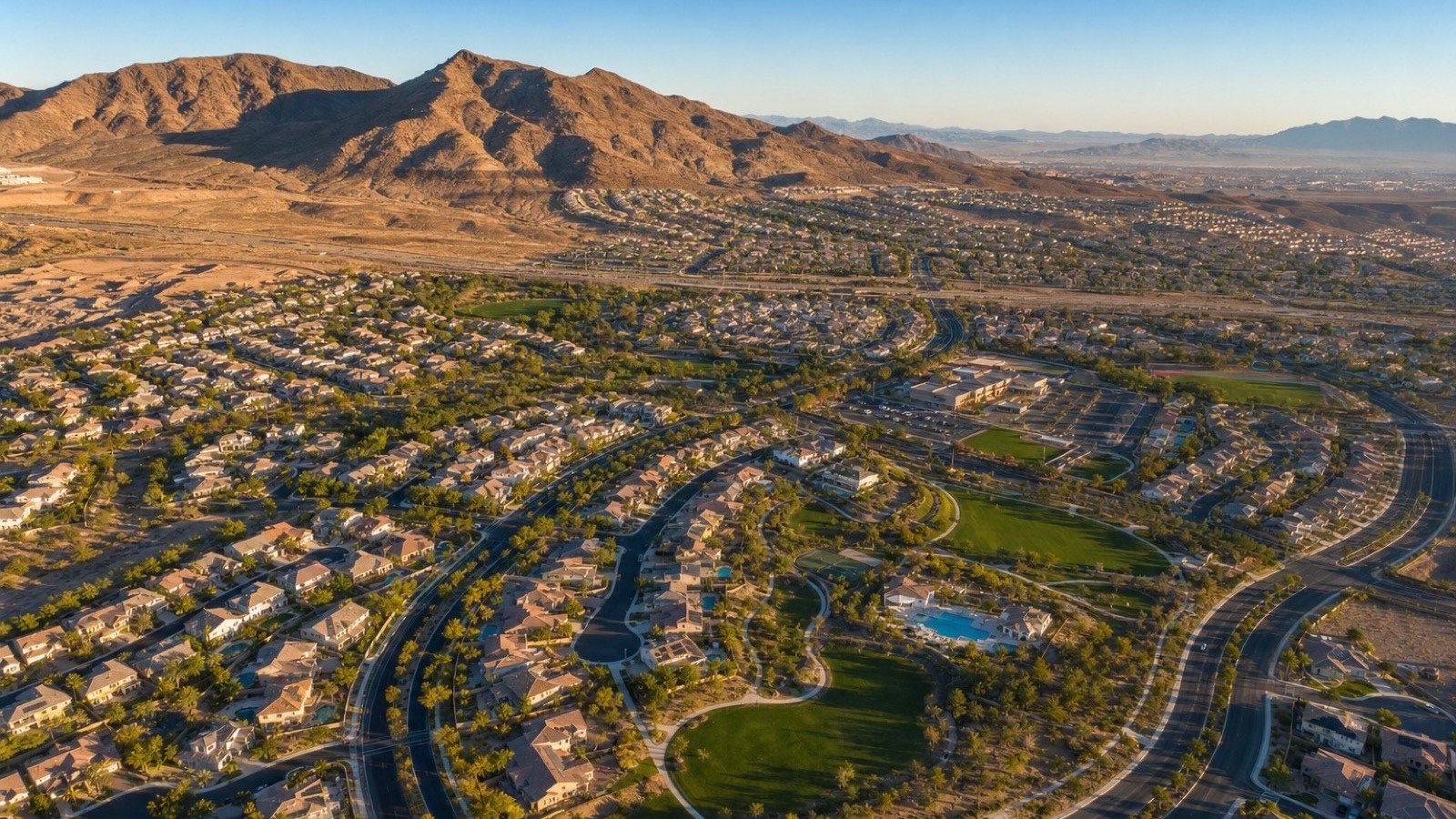
Here's the geology that makes engineering matter more in Las Vegas than the fault map alone suggests. The valley is a basin: hard bedrock walls filled in with softer sediments over millions of years. According to UNLV, when seismic waves hit that soft fill, the basin can shake like a bowl of gelatin — the bedrock is the bowl, the sediment is the gelatin — a phenomenon geologists call the basin effect, and it can amplify and prolong the shaking a building experiences.
That amplification is why a home's structural engineering isn't a fixed nationwide question — it's local. The same earthquake that produces moderate shaking on solid rock can produce stronger, longer shaking on the valley's soft soil, which puts more demand on a building's frame and connections. A house engineered for that amplified reality has a real margin of safety that a minimum-code home in the same neighborhood may not. It's the difference between building for the earthquake and building for the earthquake as this specific ground will transmit it — and it's a distinction most buyers never hear about.
Which Faults Threaten the Las Vegas Valley?
The valley isn't near one fault — it's threaded by several. Geologists map roughly seven active faults in and around the Las Vegas Valley, including the Frenchman Mountain, Eglington, and Whitney Mesa faults, among others. According to the Nevada Bureau of Mines and Geology, Southern Nevada's faults are predominantly normal faults (where one block drops relative to another) and strike-slip faults (where blocks slide horizontally past each other) — both capable of generating significant earthquakes.
What matters for a homeowner isn't memorizing fault names; it's understanding that the valley's development has spread across and near these features, so proximity varies by neighborhood and even by parcel. This is one more reason structural resilience is worth asking about at the high end: two homes a few miles apart can sit on meaningfully different ground. It's also why Clark County strengthened its seismic building requirements in the mid-1990s — the geology was always there; the codes caught up to it. A home engineered beyond those codes is planning for the faults the map already shows.
What Do Building Codes Require for Seismic Safety in Clark County?
Every new home in the valley must meet seismic provisions, so the question isn't whether a house is built for earthquakes at all — it's how far beyond the floor it goes. Clark County builds to the International Building Code and the referenced structural standards (ASCE 7), which assign each site a seismic design category based on expected ground motion and soil, then require the structure to be engineered accordingly. According to the Clark County Department of Building & Fire Prevention, those requirements were meaningfully tightened after the mid-1990s code updates and continue to evolve with each code cycle.
The key insight for buyers: code is a minimum, not a maximum. A production home built exactly to code is legal and reasonably safe, but it is engineered to the least the law allows for its site. A home built beyond code — the way this Summerlin property was — carries a deliberate margin above that minimum. In a valley with the basin effect and an active fault network, that margin is a genuine, if invisible, upgrade. Understanding the difference is part of buying a luxury home intelligently, the same way you'd scrutinize the roof, the mechanicals, or the structural warranty on new construction.
What Is the Summerlin Luxury Market Like at $1.6 Million?
Context makes the price legible. A $1.6 million home lands in the heart of Summerlin's established-luxury tier. As of the July 2026 MLS pull, Summerlin had 1,265 active listings overall at a $719,950 median, but the luxury segment is deep: 409 active homes priced above $1 million, at a $1,925,000 median.
| Segment | Active listings | Median list price |
|---|---|---|
| All Summerlin | 1,265 | $719,950 |
| $1M and up | 409 | $1,925,000 |
| $1.4M–$1.8M (this home's band) | 71 | $1,629,000 |
| $1.5M and up | 280 | $2,500,000 |
| $2M and up | 186 | $2,995,000 |
The Juniper model sits almost exactly at the $1,629,000 median of the 71 active listings in the $1.4M–$1.8M band — so on price alone, it's squarely at market for its tier. What sets it apart isn't the number; it's what the number buys. Over the trailing 180 days, 371 Summerlin homes above $1 million closed at a median of $1,540,000, roughly 37 days on market, and about $560 per square foot. In a segment where buyers are paying for finishes, views, and address, a home that also delivers beyond-code structural engineering is offering something the comps don't price in. Explore the tier through our Summerlin community page, luxury communities, and guard-gated communities guides.
Does Earthquake Resilience Add Resale Value?
Honestly, it's nuanced — and worth being straight about. Today, seismic engineering is not a line item most Las Vegas buyers actively shop for, so it doesn't command a clean, quantifiable premium the way a view lot or a casita does. A home won't automatically appraise higher because it can survive a 9.2. But that's a shallow read of value, and it's changing.
Two forces push in favor of resilient construction over time. First, awareness is rising — as more buyers learn Nevada's true seismic profile, structural quality moves from invisible to selling point, especially at the luxury tier where discerning buyers scrutinize build quality. Second, resilience is durable value — a home engineered beyond code ages better, carries lower structural risk, and gives its owner genuine peace of mind, which is exactly what luxury buyers pay for in every other category. In our experience, the buyers who most appreciate this home are the ones relocating from California, where seismic quality is a standard part of the conversation. For them, it's not exotic — it's expected, and its absence elsewhere is the surprise.
How Does Las Vegas Earthquake Risk Compare to California?
This comparison comes up constantly, because so many valley luxury buyers are relocating from California — and it reframes how they think about the move. California is the second most seismically active state and has spent decades hardening its building codes, its insurance market, and its buyer expectations around earthquakes. Nevada, ranked third, carries real but lower risk, and its housing culture simply hasn't centered seismic quality the way California's has. That gap is exactly why a California transplant walks into most Las Vegas homes and instinctively asks a question the seller has never been asked: how is this built?
The practical upshot cuts two ways. On one hand, Las Vegas's earthquake risk is genuinely lower than coastal California's, which is part of the valley's appeal to people leaving fault-heavy metros — one more entry on the long list of reasons Californians relocate here, alongside the tax and cost advantages we cover in our moving to Las Vegas guide and the wealth-migration trends reshaping the market. On the other hand, "lower than California" is not "zero," and because Nevada buyers rarely scrutinize structure, the quality floor here is less consistent. For a California buyer, a beyond-code Las Vegas home like this one closes that gap — it delivers the seismic peace of mind they're used to in a market where it's the exception, not the rule. That combination, lower regional risk plus a specifically over-engineered home, is close to ideal.
What Should Luxury Buyers Ask About a Home's Structural Engineering?
Whether or not a home advertises its seismic design, you can and should ask. Here's the short list I give luxury clients. Ask who engineered the structure and whether it was built to code or beyond it. Ask for the foundation and framing details — is it a standard slab, or a reinforced, engineered foundation; is the framing conventional or does it include shear walls and moment frames. Ask about the seismic design category for the site and what soil report was done. Ask whether any advanced systems (base isolation, dampers, extra reinforcement) were used. And on any resale, order a structural-focused inspection, not just a standard buyer's inspection, so an engineer's eye confirms what the listing claims.
| Aspect | Standard code-built | Beyond-code engineered |
|---|---|---|
| Seismic standard | Legal minimum for site | Deliberate margin above code |
| Foundation | Standard slab | Reinforced / engineered |
| Lateral system | Basic bracing | Shear walls + moment frames |
| Redundancy | Limited | Backup load paths |
| Peace of mind | Adequate | Highest |
A good buyer's agent will push these questions for you and bring in the right inspector — which is exactly the kind of representation that protects you on a purchase this size. It costs you nothing and it's the difference between taking a listing's word and knowing what you're buying.
How Can You Tell If a Las Vegas Home Is Seismically Sound?
Beyond asking, there are signals. Newer homes (post-mid-1990s, and especially post-2000s code cycles) were built to stronger seismic provisions than older valley housing, so vintage matters. Custom and high-end builders more often exceed code than volume production builders working to a price. Documentation is the tell: a genuinely engineered home usually comes with structural drawings, an engineer of record, and soil/geotechnical reports the seller can produce. And a structural or specialized inspection during escrow is the definitive check — an experienced inspector or structural engineer can assess the foundation, framing, and load path far beyond a standard walkthrough.
The takeaway for buyers is simple: don't assume, and don't rely on vibes. A home's seismic soundness is knowable — through its age, its builder, its documentation, and a proper inspection. At the luxury level, where you're spending seven figures, confirming the bones is as important as loving the kitchen. That's the lens this Summerlin home rewards, and it's the lens we bring to every high-end tour. For more on shopping the top tier well, see our luxury home buying guide and our deep dive on The Ridges in Summerlin; if you're weighing where to plant roots, Henderson offers its own guard-gated luxury enclaves worth comparing.
Why Tour Summerlin Luxury Homes With Nevada Real Estate Group?
Buying at this level rewards a team that sees past the finishes to the substance — and knows which questions actually protect you. Nevada Real Estate Group is the #1 real estate team in Nevada (and #44 in the nation), with 9,600+ closed transactions and over $4.85 billion in career sales volume, a 150+ agent team, and 9,061+ verified five-star reviews. In 2025 alone our team closed 789 homes worth over $361.5 million — you can learn more about our team and track record.
We tour Summerlin's luxury inventory every week and film it, so you can evaluate homes — engineering and all — before you ever set foot inside. Whether you're relocating from California and expect seismic quality as standard, or you're a local buyer who never knew to ask, we'll make sure the home you buy is as sound as it is beautiful. Browse our buyer resources, run a filtered property search, or call or text (702) 637-1759 to tour this home and others like it. Subscribe to our channel for a new luxury tour every week.
Frequently Asked Questions
Does Las Vegas have earthquakes?
Yes. Nevada is the third most seismically active state in the U.S., behind Alaska and California, and the Las Vegas Valley sits near roughly seven active faults. There's about a 12% chance of a magnitude 6.0-plus earthquake within 30 miles of Las Vegas in the next 50 years, and geologists note a much larger event is possible. The valley's soft soil can also amplify shaking.
What does it mean that a home was built to survive a 9.2 earthquake?
A magnitude 9.2 is one of the largest quakes ever recorded — the 1964 Alaska earthquake was a 9.2. Building to survive one means engineering the structure with a large margin above code: reinforced foundations, shear walls, ductile framing, and redundancy designed to keep the home standing through violent shaking. It signals a builder who prioritized the structure, not just the finishes.
Are new Las Vegas homes built to withstand earthquakes?
All new valley homes must meet seismic provisions under the International Building Code and ASCE 7, and Clark County strengthened its requirements after the mid-1990s. But code is a minimum. A production home is built to the least the law allows for its site; a beyond-code home like this Summerlin property carries a deliberate safety margin above that floor.
How much does earthquake-resistant construction add to a home's cost?
It varies with how far beyond code the engineering goes — reinforced foundations, shear walls, and ductile detailing add material and design cost, and advanced systems like base isolation add more. At the luxury level it's a modest share of a multimillion-dollar build, and buyers increasingly view it as durable value and peace of mind rather than an expense.
Does earthquake resilience increase resale value in Las Vegas?
Not as a clean, quantifiable premium today, because most local buyers don't yet shop for it. But awareness of Nevada's seismic risk is rising, structural quality is a genuine differentiator at the luxury tier, and buyers relocating from California expect it. As a durable, risk-lowering feature, it supports long-term value even if it isn't a line-item bump on the appraisal.
Which parts of the Las Vegas Valley have the most earthquake risk?
Risk varies by proximity to the valley's roughly seven active faults — including the Frenchman Mountain, Eglington, and Whitney Mesa faults — and by soil conditions, since the basin effect amplifies shaking on softer ground. Two homes a few miles apart can sit on meaningfully different ground, which is why a structural inspection and site-specific engineering matter.
Should I get a special inspection for earthquake safety when buying?
For a luxury home, yes. A standard buyer's inspection covers general condition, but a structural-focused inspection — ideally by a structural engineer — assesses the foundation, framing, and load path against seismic demands. On any home advertising beyond-code engineering, it also confirms the claims. Ask the seller for structural drawings, the engineer of record, and soil reports.
Which Sources Inform This Earthquake-Resistant Homes Guide?
Seismic-risk facts come from public geological and hazard authorities; the Summerlin market figures — active inventory, medians, sold statistics, and price-per-square-foot — were pulled from the live Greater Las Vegas MLS (via our Repliers data feed) the week of publication and cross-checked against the transactions Nevada Real Estate Group has closed across the valley. Figures are current as of July 2026 and will shift with the market; contact our team for a live read on any Summerlin home or price band.
- Nevada Bureau of Mines and Geology — Nevada seismic ranking and fault types
- UNLV — Earthquakes in Southern Nevada — valley risk and the basin effect
- U.S. Geological Survey — Earthquake Hazards — regional seismicity
- FEMA — Earthquake Risk Management — performance-based seismic design
- Clark County Department of Building & Fire Prevention — seismic building code
- Las Vegas REALTORS (GLVAR) — Summerlin luxury market trends
- U.S. Census Bureau — Las Vegas QuickFacts — population and housing
- California Earthquake Authority — seismic construction concepts and buyer education
- Applied Technology Council — structural engineering and seismic performance standards