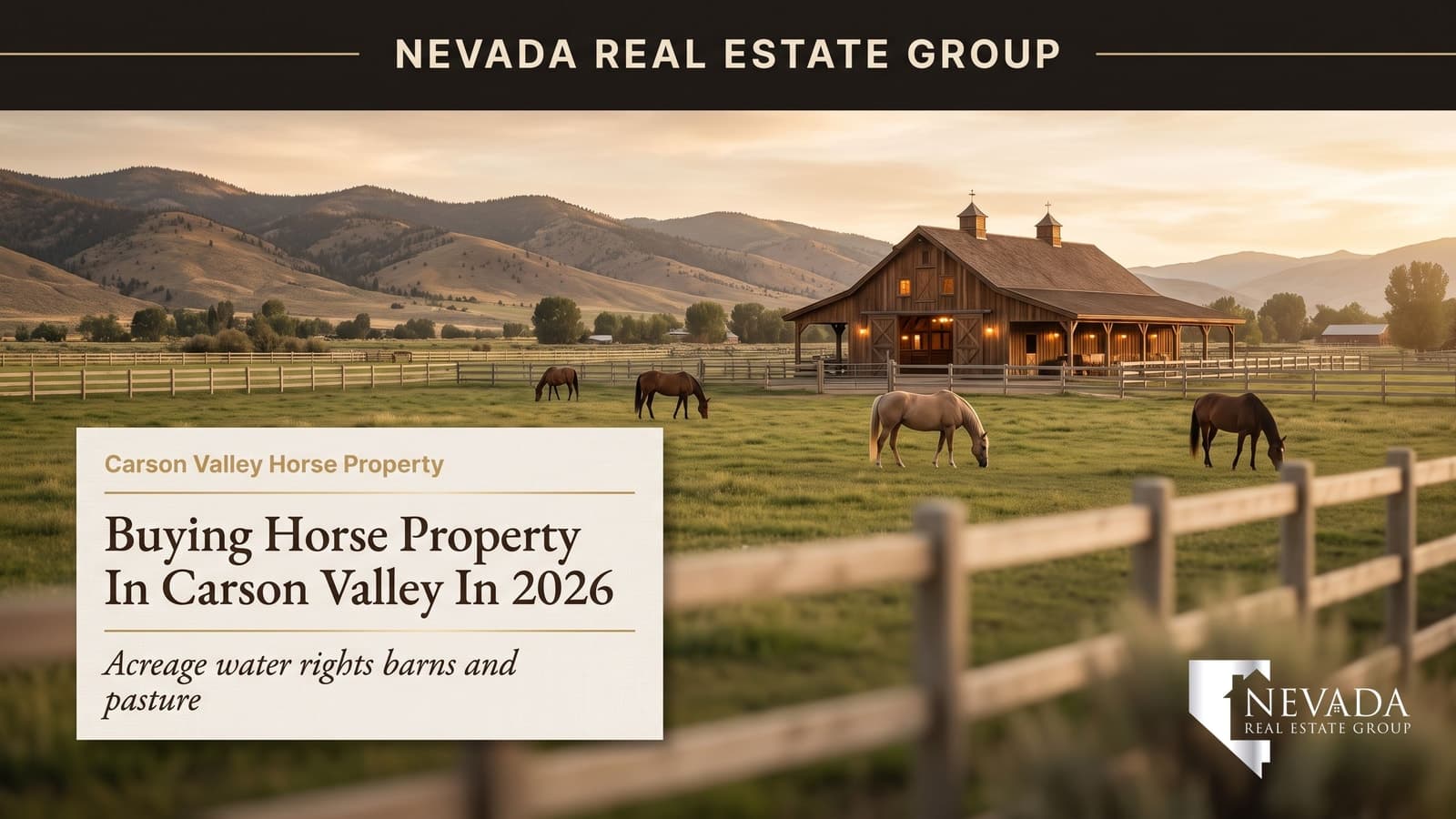

Carson Valley is where Northern Nevada keeps its horses. Tucked against the eastern wall of the Sierra Nevada in Douglas County, the towns of Gardnerville, Minden, and Genoa sit on a broad, irrigated valley floor that has run cattle and horses since the 1850s — flood-irrigated pasture, big skies, working ranches, and a genuine agricultural zoning code that still protects the right to keep livestock. For a buyer coming from a Reno subdivision, a California suburb, or a Las Vegas cul-de-sac, it can feel like the last place in the region where you can actually own a horse on your own land without fighting an HOA.
But a Carson Valley horse property is not a normal home purchase, and the mistakes are expensive. The single most common one I see: a buyer falls for a beautiful five-acre parcel with a barn, writes the offer, and only later learns the land carries no irrigation water rights — meaning that green summer pasture in the listing photos turns to dust in July and the "horse property" can't actually graze a single animal. I'm Chris Nevada, owner of Nevada Real Estate Group, and this guide walks through everything that separates a real equestrian parcel from a pretty one: acreage, Douglas County zoning, water rights, barns and arenas, well and septic, fencing, real 2026 prices by lot size, the best areas, and the due diligence checklist that protects you.
Carson Valley had 35 active Gardnerville listings marketed as horse or equestrian property in mid-July 2026 at a $1,024,900 median, against a $745,750 median for all Gardnerville homes (live NNRMLS feed, July 13, 2026). Plan on at least one to two acres per two horses, verify Douglas County zoning and irrigation water rights before you offer, and budget separately for well, septic, fencing, and a barn. Call Nevada Real Estate Group at (775) 277-2120.
- 35 Gardnerville horse/equestrian listings median $1,024,900 — a $279,000 premium over the $745,750 all-homes median (NNRMLS, July 2026).
- Water rights, not acreage, decide whether a parcel can graze horses — irrigated Carson Valley pasture is the differentiator.
- Douglas County agricultural and rural zoning sets the animal counts — confirm the exact zone and CC&Rs before you write.
- Gardnerville Ranchos, Fish Springs, Johnson Lane, and the floor south of Minden hold most true horse acreage.
- Budget beyond the house: well test, septic inspection, fencing at $8,000-plus per acre, and a barn.
Why Is Carson Valley Nevada's Premier Horse-Property Market?
Three things make Carson Valley the equestrian heart of Northern Nevada, and each one changes how you should shop.
First, the land itself. Carson Valley is a genuine agricultural valley — a flat, fertile floor at roughly 4,700 to 4,900 feet, watered by the East and West Forks of the Carson River and a network of irrigation ditches that predate Nevada statehood. According to the U.S. Department of Agriculture, Douglas County remains one of Nevada's more active agricultural counties, with hay, alfalfa, and livestock still worked across the valley floor. That means real pasture, not a scraped desert lot with a horse standing on decomposed granite.
Second, the zoning heritage. Unlike a Reno or Las Vegas subdivision where livestock is banned by covenant, much of unincorporated Douglas County is zoned agricultural or rural, and keeping horses is a protected right, not a variance you beg for. Across the 9,600-plus closings our team has represented statewide, I can tell you Carson Valley is one of the few Northern Nevada markets where "horse property" is a legal land-use category, not just a marketing phrase.
Third, the lifestyle geography. Genoa — Nevada's oldest settlement — sits at the base of the Sierra with the Genoa Lakes golf and estate corridor, while Gardnerville and Minden anchor the valley's working-ranch middle. You get trail access into the Pine Nut Mountains to the east and the Sierra to the west, 15 minutes to Carson City (browse Carson City homes for sale if you're weighing the capital too), 45 minutes to Reno, and an hour to South Lake Tahoe. It's rural without being remote — the exact profile equestrian buyers want.
Is Gardnerville Ranchos Part of Gardnerville, and Is Genoa in Carson Valley?
This trips up nearly every out-of-area buyer, so let's settle the geography before we talk money, because it directly affects zoning, price, and where the horse acreage actually is.
Gardnerville and the Gardnerville Ranchos are two different places. The Town of Gardnerville is the historic Main Street core along US-395. The Gardnerville Ranchos is a separate, large residential subdivision southeast of town — Douglas County's most populous community — built largely on half-acre-to-acre lots. Many Ranchos lots allow a horse or two on the larger parcels, but this is suburban-rural, not open range; it's the entry point to Carson Valley horse ownership, not the big-acreage tier.
Genoa is in Carson Valley, but it is its own market. Genoa sits at the western edge of the valley against the Sierra front, and while it's geographically part of Carson Valley, its price tier is a world apart — our July 2026 pull showed just 7 active Genoa homes at an $1,850,000 median versus a $745,750 median in Gardnerville. Genoa horse property exists, but it trends toward luxury foothill estates, not working pasture.
The practical rule: when a buyer says "Carson Valley horse property," they usually mean the valley floor and rural fringe around Gardnerville, Minden, Johnson Lane, Fish Springs, and Ruhenstroth — not the Ranchos subdivision (too small) or Genoa's estate corridor (too expensive) unless the budget and use-case fit. Get the location language right and the whole search sharpens.
What Does the Carson Valley Horse-Property Market Look Like in 2026?
Here is the live picture, pulled directly from Nevada Real Estate Group's NNRMLS feed on July 13, 2026 (methodology: active and trailing-12-month closed residential counts and medians across Gardnerville, Minden, and Genoa, with keyword-scoped subsets for horse and equestrian listings):
- Gardnerville: 131 active residential listings, median list price $745,750 (average $1,305,497, range $42,500 to $11,858,000)
- Gardnerville horse/equestrian-marketed subset: 35 active listings, $1,024,900 median — a roughly $279,000 premium to the all-homes median
- Gardnerville: 251 homes sold in the trailing 12 months at a $566,000 median (67 median days on market; of a tracked subset, 60 sold below list versus 12 above)
- Minden: 49 active residential listings, median list $849,900; 151 sold in 12 months at a $680,000 median (67 median days)
- Genoa: 7 active listings at a $1,850,000 median; the luxury Sierra-front tier
- 51 active Gardnerville listings are vacant land or acreage — the raw material for a build-your-own horse setup
You can watch this inventory move in real time on our Gardnerville homes for sale feed. Two numbers deserve an equestrian buyer's attention. The $279,000 gap between the horse-property median ($1,024,900) and the all-homes median ($745,750) is the quantified "acreage-and-water premium" — you are paying for land, irrigation, and improvements, not extra square footage in the house. And the 67-day median days-on-market with the majority of tracked sales closing below list tells you this is not a frantic market; you have time to inspect water rights, wells, and septic properly before you commit. According to Las Vegas REALTORS and the broader Nevada MLS picture, statewide inventory loosened through 2026, and Carson Valley reflects that with a healthy, patient pool.
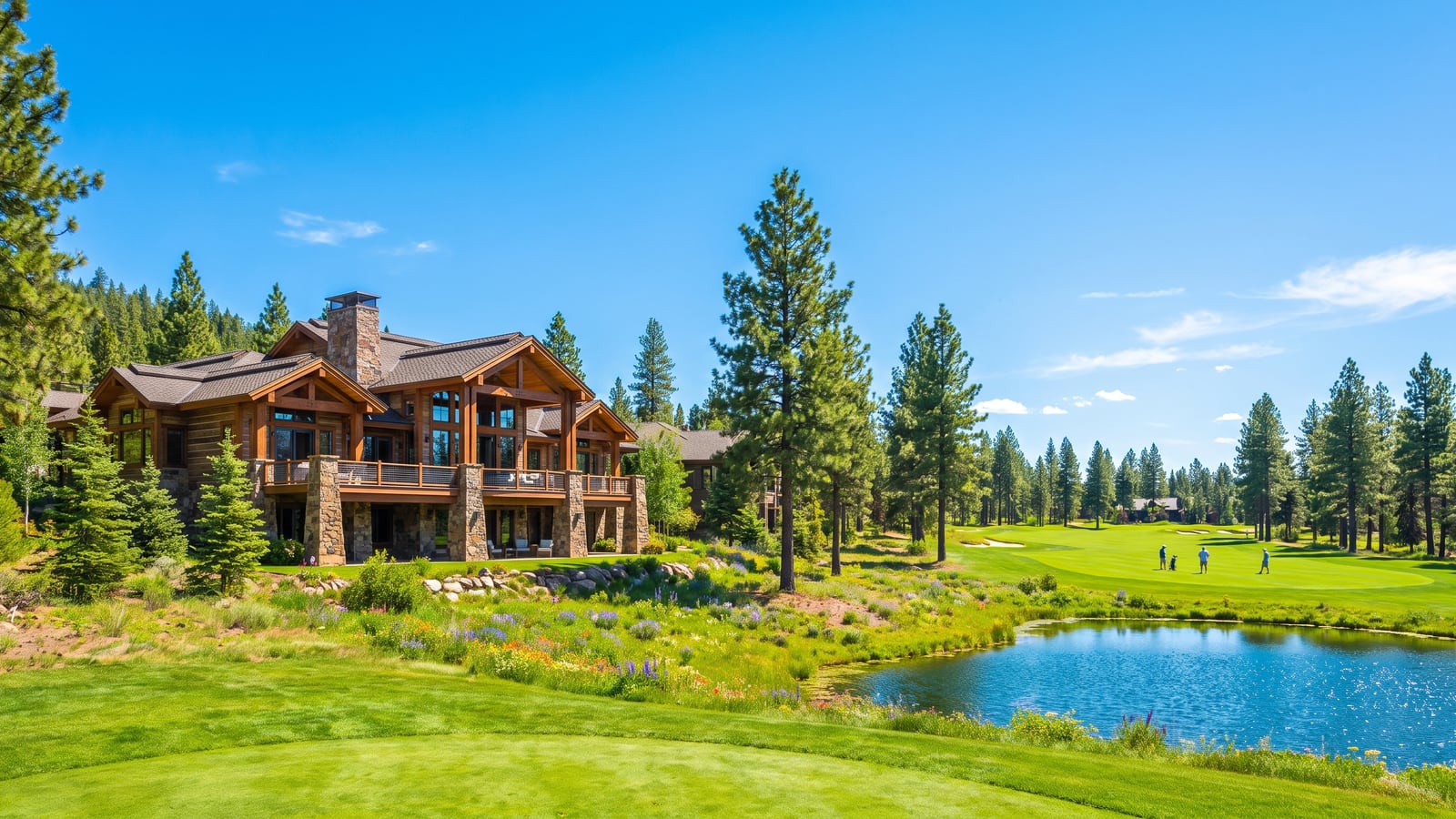
How Much Acreage Do You Actually Need for Horses in Douglas County?
The honest answer is: more than most first-time buyers think, and the number depends on whether you want the land to feed the horses or just hold them.
The general rule of thumb is roughly one to two acres of usable, irrigated pasture per horse if you want the land to provide meaningful grazing. On dry (non-irrigated) high-desert ground, that same horse needs far more acreage to forage — often 5 to 10 acres — or you feed hay year-round regardless of lot size. In Carson Valley terms, an irrigated 2-acre parcel can comfortably keep two horses with supplemental hay; a 5-to-10-acre irrigated parcel starts to function as a real small ranch.
Here's how the acreage tiers break down for Carson Valley buyers:
| Lot size | Realistic horse capacity | Typical setup | Where you find it |
|---|---|---|---|
| 0.5 to 1 acre | 1 horse (dry-lot, feed hay) | Shelter + small paddock, no real pasture | Gardnerville Ranchos, Johnson Lane |
| 2 to 4 acres | 2 to 3 horses (with irrigation) | Barn, turnout, small irrigated pasture | Fish Springs, Ruhenstroth, valley floor |
| 5 to 10 acres | 4 to 8 horses (irrigated) | Barn, arena, multiple pastures, hay storage | South of Minden, valley-floor ranches |
| 10-plus acres | Small breeding/boarding operation | Full facility, water rights, ag exemption | Carson River bottom, outlying Douglas County |
The number that actually governs capacity is not lot size — it's irrigation. According to the University of Nevada, Reno Extension, Nevada's arid climate means unirrigated pasture provides minimal forage, and overgrazing a small dry lot creates dust, weeds, and manure-management problems fast. That is why a 2-acre irrigated parcel with senior water rights can out-perform a 10-acre dry parcel for actually keeping horses. Match your horse count to the irrigated acreage, not the deed acreage.
What Does Douglas County Zoning Allow for Keeping Horses?
This is the legal question that has to be answered before you fall in love with a parcel. Zoning determines whether you can keep horses at all, how many, and what structures you can build.
Much of unincorporated Carson Valley is zoned Agricultural (A-19), Rural Agricultural, or a single-family rural (SFR) designation that permits livestock, but the specifics — minimum lot size per animal unit, setback requirements for barns and manure, and permitted accessory structures — vary by exact zone. According to Douglas County, the county's Community Development and zoning ordinances govern animal-keeping and agricultural use across the valley, and the allowable animal count is typically tied to lot size and zone. You verify the parcel's zoning designation with the county, not with the listing remarks.
Three practical zoning checks I run for every Carson Valley horse buyer:
- Confirm the zoning code and permitted animal units. A parcel zoned agricultural on 5 acres is a different animal — literally — than an SFR half-acre in a subdivision. Pull the zoning from the Douglas County Assessor parcel record.
- Check for CC&Rs on top of zoning. Even where county zoning allows horses, a subdivision like parts of the Gardnerville Ranchos may layer private covenants that restrict or cap livestock. Zoning permits; CC&Rs can still prohibit. Read both.
- Verify setbacks for barns, corrals, and manure storage. Structures and manure piles carry setback rules from property lines, wells, and waterways — critical near the Carson River and irrigation ditches.
Get this wrong and you buy land you legally can't keep horses on. Get it right and you buy with total confidence. When in doubt, our team pulls the zoning and CC&Rs during due diligence — start by browsing Gardnerville homes with land and we'll verify the zoning on anything that catches your eye.
Why Do Water Rights and Irrigation Matter More Than the House?
If you remember one thing from this guide, make it this: in Carson Valley, water rights are the asset. A horse parcel without irrigation water is a dry lot with a nice view; a parcel with senior, decreed irrigation rights is a functioning piece of agricultural ground that grows its own feed.
Carson Valley's pasture is flood-irrigated from the Carson River system under a body of water law that goes back to the 1980 Alpine Decree, which adjudicated the river's rights by priority date. According to the Nevada Division of Water Resources, water rights in Nevada are separate, real-property interests governed by priority (first in time, first in right) and can be appurtenant to specific land or severed from it. That last part is the trap: water rights can be sold away from the land. A parcel that irrigated pasture 20 years ago may have had its rights transferred off, leaving the dirt but not the water.
Your water-rights due diligence checklist:
- Confirm whether decreed irrigation rights are appurtenant to the parcel — get the water-right permit or certificate number and verify it against state records.
- Check the priority date and duty (acre-feet). Senior rights (older priority) are far more secure in a dry year than junior rights that get curtailed.
- Identify the delivery mechanism — which ditch company or irrigation district delivers the water, and what the assessments cost.
- Ask about the Alpine Decree schedule and whether the parcel's rights are in good standing.
According to the Carson Water Subconservancy District, the Carson River basin's supply is fully appropriated and closely managed — meaning you generally cannot just drill and irrigate; you need existing rights. This is the difference between a $566,000 dry parcel and a $1,024,900 irrigated horse property, and it is precisely why the median jumps. Never waive the water-rights contingency.
Which Carson Valley Areas Are Best for Horse Property?
Carson Valley sorts into distinct horse-property pockets, and knowing which one fits your budget and use-case saves months. Here's how the main areas compare across the dimensions that matter to an equestrian buyer.
| Dimension | Gardnerville Ranchos | Fish Springs / Johnson Lane | Valley Floor (south of Minden) | Genoa Front |
|---|---|---|---|---|
| Typical lot size | 0.5 to 1 acre | 1 to 5 acres | 5 to 40 acres | 1 to 10 acres |
| Price band | $500K to $750K | $700K to $1.4M | $900K to $3M-plus | $1.2M to $3M-plus |
| Irrigation / water | Rare; dry lots | Some irrigated | Often senior rights | Mixed; foothill wells |
| Horse capacity | 1 to 2 (dry-lot) | 2 to 6 | Real ranch scale | Estate-level, varies |
| Best for | Entry, one-horse owners | Serious hobby equestrians | Ranchers, breeders, boarders | Luxury foothill buyers |
Gardnerville Ranchos is the affordable on-ramp — half-acre-to-acre lots where a single horse on a dry lot is workable, with 20 active Ranchos-area listings in our July pull. Fish Springs and Johnson Lane, on the valley's east side toward the Pine Nut foothills, are the classic serious-hobby zone: 1-to-5-acre parcels, some irrigated, with room for a barn and a couple of pastures, and Ruhenstroth just south adds more of the same. The valley floor south of Minden — think Wildhorse and the Carson River bottom — is where the real ranch acreage and senior water rights live, and prices climb accordingly. And the Genoa front against the Sierra is the luxury tier, beautiful but priced for estate buyers — closer to our luxury-communities and guard-gated-communities profiles than to working ranch land.
Compare the current inventory yourself: browse Minden's Wildhorse listings, the Gardnerville Ranchos homes for sale, Jobs Peak Ranch, or Fish Springs in Gardnerville. For the widest net across the valley, our Reno-region acreage search, horse-property search, and full statewide listing search pull equestrian inventory across Northern Nevada.
What Barns, Stalls, and Arenas Should You Look For (or Build)?
The improvements on a horse property are where value — and cost — concentrate. A parcel with a quality barn, stalls, and an arena already built can save you $100,000-plus versus building from scratch, but only if the improvements are permitted and sound.
Here's what to evaluate on existing improvements and budget for new construction:
- Barn and stalls. Look for a permitted structure with adequate stall size (a 12-by-12 stall is standard for a full-size horse), ventilation, and safe footing. An unpermitted pole barn is a negotiation point and a potential financing snag.
- Turnouts and paddocks. Safe, well-drained turnout with no-climb fencing near the barn matters as much as pasture.
- Riding arena. A basic outdoor arena runs a wide range depending on size, base prep, and footing; a covered arena is a six-figure improvement. On the valley floor, drainage and base are the make-or-break.
- Hay and equipment storage. Covered hay storage protects a major recurring cost; a dry, rodent-resistant structure pays for itself.
- Water and power to the barn. Frost-free hydrants and adequate electrical service to outbuildings are easy to overlook and expensive to add.
Rough budgeting rules from the deals our team has worked: a modest run-in shelter starts in the low thousands, a quality multi-stall barn runs $30,000 to well over $100,000 depending on size and finish, and a covered arena can exceed $150,000. According to the Nevada Department of Business and Industry, any contractor doing structural work above the state's licensing threshold must be properly licensed — verify licensure before hiring for a barn or arena build. Buyers who prefer a turnkey home and would rather add the equestrian improvements themselves sometimes start with a newer house — our new-construction guidance and Minden's new-home listings are a fit there. If the property already has these improvements done right, that's real captured value; if not, price the build into your offer.
How Do Well and Septic Work on Carson Valley Horse Parcels?
Almost every true horse property outside the town cores runs on a private domestic well and a septic system rather than municipal utilities — and both demand their own due diligence that a standard home inspection skips entirely.
For the domestic well, insist on a flow-rate (yield) test measured in gallons per minute, plus a water-quality test. A horse property has serious water demand — horses drink 5 to 10 gallons a day each, plus barn washdown and any stock tanks — so a marginal well that's fine for a house can fall short for an equestrian operation. According to the Nevada Division of Water Resources, domestic wells are permitted by the state and generally limited to a defined maximum draw (commonly 2 acre-feet annually for domestic use), which is separate from irrigation water rights — you cannot legally irrigate pasture from a domestic well. That distinction catches buyers constantly: the house well and the pasture water are two different legal things.
For the septic system, order a pump-and-inspect: the tank pumped, baffles checked, and the drain field evaluated and located. A failed drain field is a $15,000 to $40,000 replacement, and on a horse property you also want to confirm the septic and any manure-management setup keep waste away from the well and the Carson River per state rules. According to the Nevada Division of Environmental Protection, individual sewage disposal systems and water-quality protections are state-regulated — verify the septic permit and confirm no unpermitted additions overloaded the system.
The practical rule: treat the well flow test, water-quality test, and septic inspection as their own contingency line, budget $700 to $1,400 for the full workup, and never waive them. A great horse parcel with a weak well is a problem you want to find before closing, not after.
What Does Fencing Cost and Which Type Works for Horses?
Fencing is the improvement buyers most underestimate, and the wrong fence is a genuine safety hazard for horses. Barbed wire — common on old Carson Valley cattle ground — is dangerous for horses and should be a budget line to replace, not a feature.
Here's how the common horse-fencing options compare:
| Fence type | Rough cost per linear foot | Horse safety | Notes |
|---|---|---|---|
| No-climb woven wire + top rail | $8 to $14 | Excellent | The gold standard for turnouts |
| Vinyl / PVC rail | $10 to $20 | Very good | Low maintenance, high curb appeal |
| Wood post-and-rail | $8 to $16 | Good | Classic look, needs upkeep |
| Electric / poly-tape (cross-fencing) | $1 to $3 | Good for pasture division | Cheap, ideal for rotating pasture |
| Barbed wire (existing cattle fence) | Replace | Poor / hazardous | Budget to remove for horses |
The math adds up fast. Perimeter-fencing a single graded acre in safe no-climb-plus-rail can run $8,000 to $15,000 or more once you account for corners, gates, and terrain — and a 5-acre parcel that needs full perimeter and cross-fencing can be a $40,000-to-$70,000 project. A property that already has safe, well-maintained horse fencing is holding real value; a property with tired barbed wire needs that number written into your offer. When you tour, walk the fence line — it tells you as much about the seller's horsekeeping as the barn does.
What Do Horse Properties Cost by Lot Size in Carson Valley?
Pricing a Carson Valley horse property means pricing three things at once: the house, the land-and-water, and the improvements. Our live data gives real anchors. The all-homes Gardnerville median is $745,750; the horse/equestrian-marketed subset medians $1,024,900; and Minden's median list runs $849,900 with Genoa's at $1,850,000.
| Property profile | Typical price range | What you get |
|---|---|---|
| Ranchos dry lot, 0.5 to 1 acre | $500,000 to $750,000 | House + room for 1 horse, feed hay |
| Hobby parcel, 2 to 4 irrigated acres | $800,000 to $1,300,000 | House, barn, small pasture, 2 to 3 horses |
| Small ranch, 5 to 10 irrigated acres | $1,200,000 to $3,000,000 | Barn, arena, water rights, 4 to 8 horses |
| Estate / large ranch, 10-plus acres | $2,500,000 and up | Full facility, senior rights, ag exemption |
| Vacant acreage (build your own) | $150,000 to $900,000 | Land + water; you build barn/fencing |
A few cost realities to plan for. Nevada is genuinely tax-friendly: the state has no income tax, and property is taxed on assessed value (35% of the assessor's taxable value) with a 3% annual cap on tax increases for owner-occupied primary residences under Nevada Revised Statutes 361.4723. A working farm or ranch may also qualify for agricultural use assessment, which can substantially lower the taxable value on qualifying acreage — worth verifying with the Douglas County Assessor on any larger parcel. Budget beyond the purchase price, too: a well workup and septic inspection ($700 to $1,400), fencing (often $8,000-plus per acre), and a barn or shelter if one isn't there. Run your numbers first with our home value estimator, then let us model the full carrying cost.
How Do You Do Due Diligence on a Carson Valley Horse Property?
Everything above converges into one disciplined inspection period. A horse-property purchase has more moving parts than a tract home, and the due-diligence window (typically 10 to 21 days in a Nevada contract) is where you protect yourself.
Your Carson Valley horse-property due-diligence checklist:
- Zoning and CC&Rs. Confirm the parcel's Douglas County zoning permits your intended animal count and structures, and read any subdivision covenants that could restrict livestock.
- Water rights. Verify decreed irrigation rights are appurtenant, note the priority date and acre-feet, and confirm good standing under the Alpine Decree. This is non-negotiable.
- Domestic well. Flow-rate (yield) test plus water-quality test; confirm the permitted draw and that it meets household-plus-barn demand.
- Septic. Pump-and-inspect the tank and drain field; verify the permit and no unpermitted overload.
- Structures. Confirm the barn, arena, and outbuildings are permitted and sound; unpermitted structures affect financing and value.
- Fencing and drainage. Walk the fence line for safety and condition; check pasture drainage and flood exposure near the river.
- Flood zone. Parts of the Carson River bottom sit in FEMA flood zones. According to the Federal Emergency Management Agency, you should pull the flood-map designation, as it affects insurance and buildability.
- Access and easements. Confirm legal access, ditch easements, and any shared-road maintenance obligations.
According to the Nevada Real Estate Division, every licensed agent in the transaction owes you statutory duties and must provide Nevada's agency disclosure — and on a horse property, you want an agent who actually understands water rights and rural systems, not just houses. For the broader home-buying sequence, our buyers hub and first-time-buyer guide walk through each stage; this checklist is the equestrian layer on top.
What Trail and Riding Access Does Carson Valley Offer?
A big part of Carson Valley's equestrian appeal is what's beyond your fence line. Owning the land is only half the lifestyle; the riding is the other half.
To the east, the Pine Nut Mountains offer thousands of acres of open Bureau of Land Management ground with dirt roads and trails suited to trail riding right from the valley floor — a major draw for buyers on the Johnson Lane and Fish Springs side who can literally ride out from home. To the west, the Sierra front above Genoa and Jacks Valley climbs into national-forest trail systems. The valley also hosts the Douglas County Fairgrounds in Gardnerville, a regional hub for rodeos, horse shows, and equestrian events, plus the historic ranching culture that keeps farriers, large-animal vets, feed stores, and boarding facilities close at hand — infrastructure that thinner horse markets lack.
That support network matters more than buyers expect. According to the University of Nevada, Reno Extension, local agricultural extension resources help owners with pasture management, weed control, and manure handling — the day-to-day of keeping horses well. When you buy in an established equestrian valley like Carson Valley, you're buying into that ecosystem, not just a parcel. Compare it against the wider region through our Northern Nevada communities hub and the broader options in our Carson Valley housing-market guide and, if you're relocating from out of state, our moving-to-Carson-Valley relocation guide.
How Do HOAs and Special Districts Affect Carson Valley Horse Parcels?
Buyers focus on price and forget the recurring obligations layered onto Carson Valley parcels — and on horse properties, those layers can include more than a single HOA fee.
A Carson Valley horse property can carry costs at several tiers, and you should itemize all of them:
- Master or subdivision HOA. Some communities (parts of the Ranchos, Genoa Lakes, and newer developments) have a homeowners association with annual dues and, critically, CC&Rs that may cap or prohibit livestock even where county zoning allows it.
- Sub-association fees. Larger master-planned areas can layer a sub-association on top of the master — two dues lines, two sets of rules.
- Irrigation-district or ditch-company assessments. If the parcel carries water rights, you'll typically owe annual assessments to the ditch company or irrigation district that delivers the water — a cost unique to agricultural ground and easy to overlook.
- LID / SID (Local or Special Improvement Districts). Some Douglas County parcels carry a Local Improvement District or Special Improvement District assessment on the tax bill for roads, water, or sewer infrastructure — a line item separate from base property tax that can add hundreds to thousands per year.
The mistake is assuming "no HOA" means "no recurring obligations." A no-HOA valley-floor ranch might still owe ditch-company assessments and an LID/SID on the tax bill. According to the Douglas County Assessor and Treasurer, the parcel's tax record itemizes any special-district assessments — pull it and add every line before you set your budget. Our team breaks down the full carrying cost on any property you're serious about; the Reno relocation guide and our Gardnerville community page cover more Douglas County specifics.
How Do You Buy the Right Carson Valley Horse Property?
Everything in this guide converges on a simple execution plan. In a patient, 67-day-median market with real inventory, the equestrian buyers who win are the ones who verify the land before they fall for the house.
- Define your use-case first — one backyard horse, a serious hobby setup, or a working ranch — so you're shopping the right acreage tier and area.
- Get fully pre-approved, and if the parcel is large or unusual, line up a lender who understands rural, acreage, and possible agricultural financing.
- Verify zoning and water rights on every candidate — before emotion takes over. The water rights are the asset.
- Budget the full stack — well and septic workup, fencing, barn or arena, ditch assessments, and any LID/SID — not just the sticker price.
- Use an agent who knows Carson Valley horse property — water law, rural systems, and Douglas County zoning, not just comps.
Nevada Real Estate Group is the #1 real estate team in Nevada, as ranked by RealTrends, and #44 nationally, with more than $4.85 billion in career sales volume, 9,600-plus closed transactions, and 789 closings in 2025 alone. We pull the live NNRMLS data (like the 35-active, $1,024,900-median horse-property numbers in this guide), verify zoning and water rights so you don't buy a dry lot by mistake, and bring the well, septic, and fencing specialists who make these rural deals close cleanly.
Ready to find your Carson Valley horse property? Call or text (775) 277-2120 or tell us what you're looking for — describe your horse count, acreage, and budget, and we'll send matching Gardnerville, Minden, and Genoa listings the moment they hit the market. Selling a current place to make the move? Our sellers hub lines up both closings.
Frequently Asked Questions
How much land do you need to keep horses in Carson Valley?
Plan on roughly one to two acres of usable irrigated pasture per horse if you want the land to provide real grazing; on dry high-desert ground you'll feed hay year-round regardless of size. In Carson Valley, an irrigated 2-acre parcel can comfortably keep two horses with supplemental hay, while 5 to 10 irrigated acres functions as a small ranch for four to eight. Irrigation, not deed acreage, is what actually governs capacity — a 2-acre irrigated parcel can out-perform a 10-acre dry one for keeping horses.
Do you need water rights to have a horse property in Carson Valley?
To irrigate pasture, yes. Carson Valley pasture is flood-irrigated from the Carson River under rights adjudicated by the 1980 Alpine Decree, and those rights are separate real-property interests that can be sold away from the land. A domestic well can supply the house and barn but legally cannot irrigate pasture. So a true grazing horse property needs appurtenant, decreed irrigation rights in good standing — verify the permit number, priority date, and acre-feet before you offer. A parcel without them is a dry lot where you feed hay.
What does Douglas County zoning allow for keeping horses?
Much of unincorporated Carson Valley is zoned agricultural or rural, where keeping horses is a permitted land use rather than a variance, with allowable animal counts typically tied to lot size and zone. But CC&Rs in some subdivisions (parts of the Gardnerville Ranchos, for example) can restrict or cap livestock even where county zoning allows it. Always confirm both the county zoning designation and any private covenants, plus setback rules for barns and manure storage, before you buy.
Is the Gardnerville Ranchos good for horses?
It's the entry point, not the big-acreage tier. The Gardnerville Ranchos is a large subdivision of mostly half-acre-to-acre lots southeast of the Town of Gardnerville, where a single horse on a dry lot with a shelter and small paddock is workable on the larger parcels. It's suburban-rural, generally without irrigated pasture, so you'll feed hay. For serious hobby setups with a barn and pasture, look at Fish Springs, Johnson Lane, or the valley floor south of Minden instead.
How much does horse property cost in Carson Valley in 2026?
As of July 2026, Gardnerville's horse and equestrian-marketed listings median $1,024,900 versus a $745,750 all-homes median — roughly a $279,000 premium for acreage, water, and improvements. Entry dry lots in the Ranchos run $500,000 to $750,000; 2-to-4-acre irrigated hobby parcels run $800,000 to $1.3 million; and 5-to-10-acre small ranches run $1.2 million to $3 million-plus. Vacant acreage to build your own starts around $150,000. Minden's median list is $849,900 and Genoa's is $1.85 million.
Do Carson Valley horse properties use well and septic?
Most true horse parcels outside the town cores do. For the domestic well, get a flow-rate test and water-quality test and confirm it meets household-plus-barn demand — horses drink 5 to 10 gallons a day each. For septic, order a pump-and-inspect of the tank and drain field and verify the permit. Budget $700 to $1,400 for the full workup and never waive it. Remember the domestic well is legally separate from irrigation water rights and cannot irrigate pasture.
What are the best areas for horse property in Carson Valley?
Gardnerville Ranchos is the affordable one-horse on-ramp; Fish Springs and Johnson Lane on the east side toward the Pine Nut foothills are the serious-hobby zone with 1-to-5-acre parcels; the valley floor south of Minden (including Wildhorse and the Carson River bottom) holds the real ranch acreage and senior water rights; and the Genoa front against the Sierra is the luxury estate tier. Match the area to your horse count, water needs, and budget — our team can pull live inventory for each.
Which Sources Inform This Carson Valley Horse-Property Guide?
Live inventory and pricing figures come from Nevada Real Estate Group's NNRMLS feed, pulled July 13, 2026 (131 Gardnerville active residential listings at a $745,750 median; a 35-listing horse/equestrian subset at a $1,024,900 median; 251 Gardnerville solds at a $566,000 median over 12 months with a 67-day median days-on-market; Minden 49 active at $849,900 and 151 solds at $680,000; Genoa 7 active at $1,850,000; 51 active Gardnerville land/acreage listings). Zoning, water, tax, and rural-systems context draws on these authorities:
- Douglas County, Nevada — zoning, animal-keeping ordinances, and building permits
- Douglas County Assessor — parcel records, zoning, and agricultural-use assessment
- Nevada Division of Water Resources — irrigation water rights, priority dates, and domestic-well limits
- Carson Water Subconservancy District — Carson River basin management and supply
- Nevada Revised Statutes 361.4723 — 3% property-tax cap on primary residences
- Nevada Division of Environmental Protection — septic and water-quality regulation
- Nevada Real Estate Division — agency duties and required buyer disclosures
- University of Nevada, Reno Extension — pasture, forage, and horsekeeping guidance
- U.S. Department of Agriculture (NASS) — Douglas County agricultural profile
- Bureau of Land Management — Pine Nut Mountains public-land trail access
- Federal Emergency Management Agency — Carson River flood-zone maps
- Nevada Department of Business and Industry — contractor licensing for barns and arenas
Ready to buy? Call or text Nevada Real Estate Group at (775) 277-2120 — the Carson Valley equestrian specialists for Gardnerville, Minden, Genoa, and the greater Reno-Tahoe region.