

For decades, Washington sold itself to founders, executives and high earners on one promise: no state income tax. On March 30, 2026, Governor Bob Ferguson signed Engrossed Substitute Senate Bill 6346, a 9.9% tax on income above $1 million that takes effect January 1, 2028. Washington voters did approve a graduated income tax in 1932, but according to the Washington Secretary of State's income tax ballot history, the state Supreme Court struck it down in Culliton v. Chase (1933). The Department of Revenue still says Washington "does not currently have an individual income tax"; this law would change that in 2028.
The new tax is not settled. Voters decide a repeal measure, I-645, on November 3, 2026, and a constitutional lawsuit is still pending. This guide covers where both stand as of October 26, 2026, what the tax would cost at each income level, what a Washington household that will never reach $1 million actually saves in Nevada, and how a move to Las Vegas works.
Washington's ESSB 6346 taxes personal income above $1 million at 9.9% starting January 1, 2028, so $2 million of income would owe about $99,000 a year and $5 million about $396,000. Nevada's constitution bars a personal income tax, so the same income owes $0 there. The Washington tax is not final: voters decide the I-645 repeal on November 3, 2026, and a constitutional lawsuit is pending in Klickitat County Superior Court.
- Washington's 9.9% tax on income over $1 million is scheduled for 2028; first returns are due April 2029.
- At $2 million of income the bill is about $99,000 a year; at $5 million, about $396,000.
- I-645 on the November 3, 2026 ballot would repeal the tax, and a constitutional lawsuit is pending.
- Washington already taxes capital gains at up to 9.9% and estates at up to 20%; Nevada taxes neither.
- Moving does not shelter pay for work done in Washington, so plan domicile and timing with a CPA.
What Did Washington Enact With Its Millionaires' Tax?
ESSB 6346 became Chapter 238, Laws of 2026. Under the session law, the tax equals 9.90% of an individual's Washington taxable income beginning January 1, 2028 (section 201). Taxable income starts from federal adjusted gross income, and a $1,000,000 standard deduction comes off the top (section 314). Spouses and registered domestic partners share one $1,000,000 deduction whether they file jointly or separately. Starting in October 2029, the Department of Revenue adjusts the deduction for inflation every two years (section 316). According to the Washington Department of Revenue, the first returns are due in April 2029, and the Office of Financial Management's fiscal statement in the 2026 Voters' Pamphlet says no estimated payments are required for tax year 2028.
Long-term capital gains are handled in two steps. Gains taxed under Washington's existing capital gains tax count toward the base, and a nonrefundable credit for that capital gains tax keeps the same gain from being taxed twice (sections 302 and 205). According to Ernst & Young's April 13, 2026 tax alert, the base also adjusts for items such as interest on other states' bonds, and a charitable deduction of up to $100,000 per household applies. The law's own findings estimate the tax will affect "only the wealthiest one-half of one percent of the households in this state," and the Department of Revenue's income tax FAQ expects roughly $3 billion a year in revenue.
Because the base is adjusted gross income, bonuses, RSU vesting, pass-through business income, interest and dividends all stack into one year's number. A household that normally earns well under $1 million can cross the line in a single very good year, such as the year it exercises a decade of equity.
How Much Will Washington's New Tax Actually Cost High Earners?
Because the 9.9% rate applies only to income above $1 million, the bill is modest near the threshold and steep above it. The figures below use tax year 2028 rules for a single filer or a married couple with the full $1,000,000 standard deduction and no other deductions or credits:
| Annual income | Taxed amount (over $1M) | Washington tax (9.9%) | Nevada tax |
|---|---|---|---|
| $1,000,000 | $0 | $0 | $0 |
| $1,500,000 | $500,000 | $49,500 | $0 |
| $2,000,000 | $1,000,000 | $99,000 | $0 |
| $3,000,000 | $2,000,000 | $198,000 | $0 |
| $5,000,000 | $4,000,000 | $396,000 | $0 |
| $10,000,000 | $9,000,000 | $891,000 | $0 |
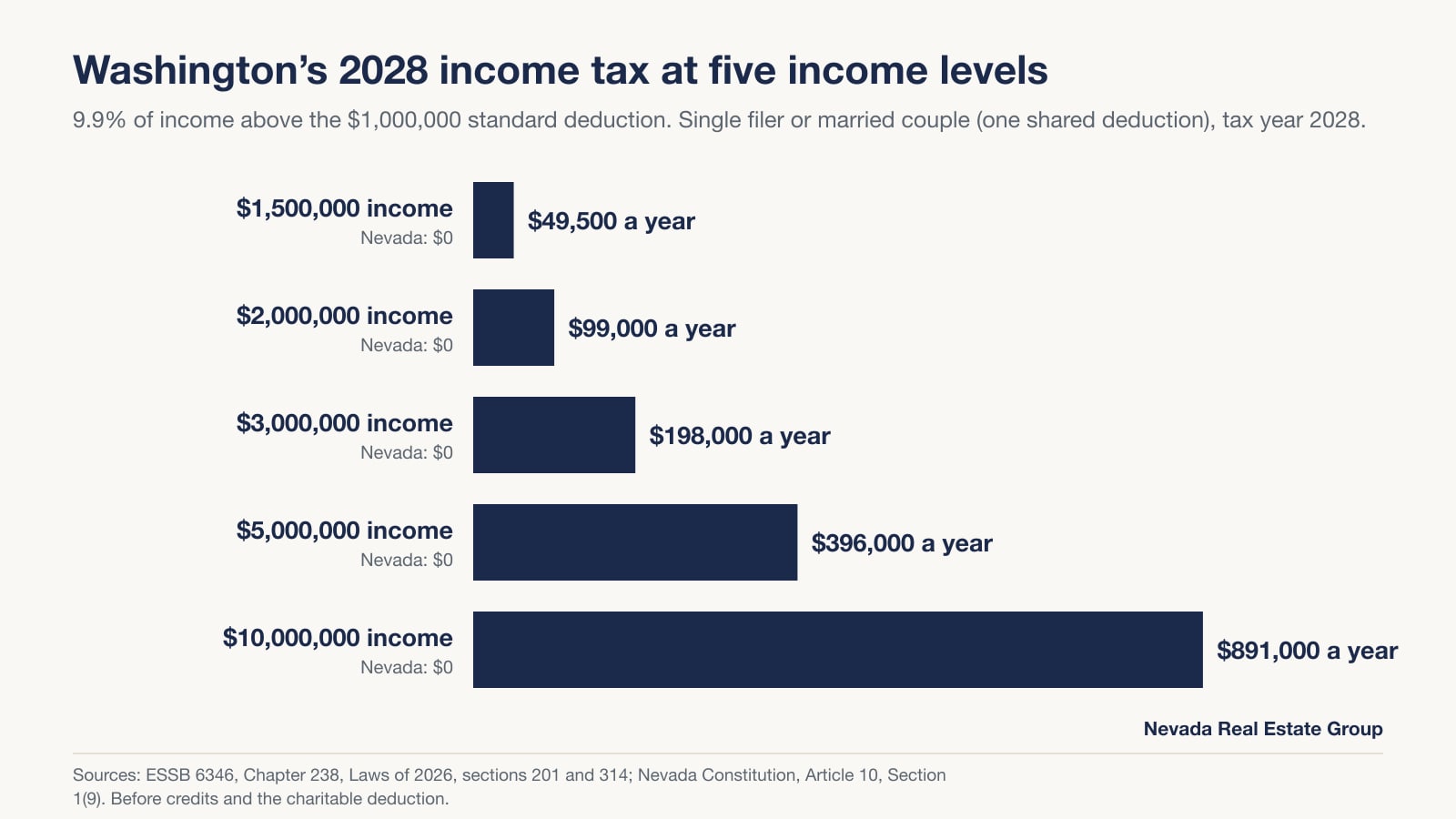
A Bellevue executive with $2 million of income would owe about $99,000 a year, or roughly $990,000 over a decade at the same income. The biennial inflation adjustment to the deduction would trim those figures slightly over time; it does not push them up. Credits for income tax paid to another state, for Washington capital gains tax and for business and occupation tax on the same income can lower an individual bill, according to the Attorney General's explanatory statement in the Voters' Pamphlet.
Is Washington's Income Tax Final, or Could Courts or Voters Stop It?
The referendum route is closed. Brian Heywood and Let's Go Washington asked the state Supreme Court to force a referendum on the law. In Heywood v. Hobbs, No. 105220-1, a per curiam order dated May 4, 2026 and ordered published on June 5, 2026, the court held that ESSB 6346 falls within the constitution's exception for laws "necessary for the ... support of the state government" and is not subject to referendum, and it denied the petition. The order says the petition "concerns only whether ESSB 6346 is subject to a referendum, not the constitutionality of the tax."
The constitutional question sits in a separate case. Petter v. State of Washington, No. 26-2-00073-20, is before Judge Randall C. Krog in Klickitat County Superior Court, according to the county's case information page. According to KNKX, former Attorney General Rob McKenna and the Citizen Action Defense Fund filed it on April 9, 2026 with individual taxpayers and business groups, arguing that under Culliton v. Chase income is property that must be taxed uniformly at no more than 1%. KOMO reported on October 19, 2026 that the challenge is still pending in Klickitat County and could eventually reach the state Supreme Court. We found no report of a ruling on the merits as of October 26, 2026.
Voters get the next word. Initiative Measure No. IP26-645, known as I-645 and sponsored by Let's Go Washington according to KUOW, is on the November 3, 2026 general election ballot. According to the 2026 Voters' Pamphlet, it would repeal the 9.9% tax, prohibit state and local taxes on individual income, and leave the law's other tax cuts in place. If approved, it takes effect December 3, 2026, and the Office of Financial Management estimates an $11.4 billion revenue loss over state fiscal years 2027 to 2031.
This guide was updated on October 26, 2026, before the vote, and the result decides which of its numbers apply. A yes vote on I-645 repeals the 9.9% income tax before it is collected; the Office of Financial Management's fiscal statement treats it as the only tax affected, so the capital gains and estate taxes would remain. A no vote keeps the tax on schedule for January 1, 2028, still subject to the constitutional lawsuit. The income tax figures in this guide apply only if the tax survives both.
Meanwhile, the Department of Revenue is building the tax. Its Income Tax Advisory Workgroup has met since August 24, 2026, meets next on November 13 and owes the Legislature an initial report by December 15, 2026. The department's FAQ says it "may adopt" rules and will announce proposed rules and hearings once formal rulemaking begins. Washington's capital gains tax is already in force either way, which makes waiting for the courts a bet rather than a plan.
How Does Nevada Compare on State Income Tax?
The contrast is about as stark as American tax policy gets. Article 10, Section 1(9) of the Nevada Constitution states: "No income tax shall be levied upon the wages or personal income of natural persons." Section 1(7) bars any inheritance tax, and Article 10, Section 4 allows an estate tax only to the extent of the federal credit for state death taxes. A federal deduction replaced that credit for deaths after 2004 (26 U.S.C. 2058), and Congress formally repealed the credit in 2014 (26 U.S.C. 2011). Nevada taxes no individual's wages, bonuses, retirement income or investment gains, and it collects no estate tax.
That protection is durable. Repealing it would take a constitutional amendment: passage by two successive Legislatures followed by a statewide vote (Article 16, Section 1), or, for a citizen initiative, voter approval at two consecutive general elections (Article 19, Section 2). Washington's new tax, by contrast, is a statute that a single legislative session can change. According to the Tax Foundation's 2026 State Tax Competitiveness Index, which scores tax systems as of July 1, 2025, Nevada ranks 20th overall and Washington 45th of 50, and that snapshot predates the 2028 income tax. We cover the details in our guide to whether Nevada has a state income tax.
What Would a Washington Millionaire Save by Moving to Las Vegas?
Put the two systems side by side and the savings can become the down payment, or the whole house. Here is the head-to-head for a high earner, as of October 2026:
| Tax | Washington | Nevada |
|---|---|---|
| Income tax over $1M | 9.9% from January 1, 2028 (I-645 vote and lawsuit pending) | None (constitutional ban) |
| Long-term capital gains, taxable gains over $1M | 9.9% (since tax year 2025) | None |
| Long-term capital gains above the $278,000 deduction, up to $1M taxable | 7% | None |
| State estate tax | 10% to 20%, $3,000,000 exclusion (deaths from July 1, 2026) | None |
| How it changes | Statute: one legislative session | Constitutional amendment |
For a household with $3 million of income, the income tax difference alone is about $198,000 a year, roughly $1.98 million over a decade at that income. At $5 million it is about $396,000 a year, nearly $4 million over ten years. Those figures assume tax year 2028 rules and an unchanged income. They are the most a move could save on this one tax, and they disappear if I-645 passes or a court strikes the law down. The capital gains and estate taxes in the table, by contrast, are already law.
Is It Just Income Tax — or Capital Gains and Estate Too?
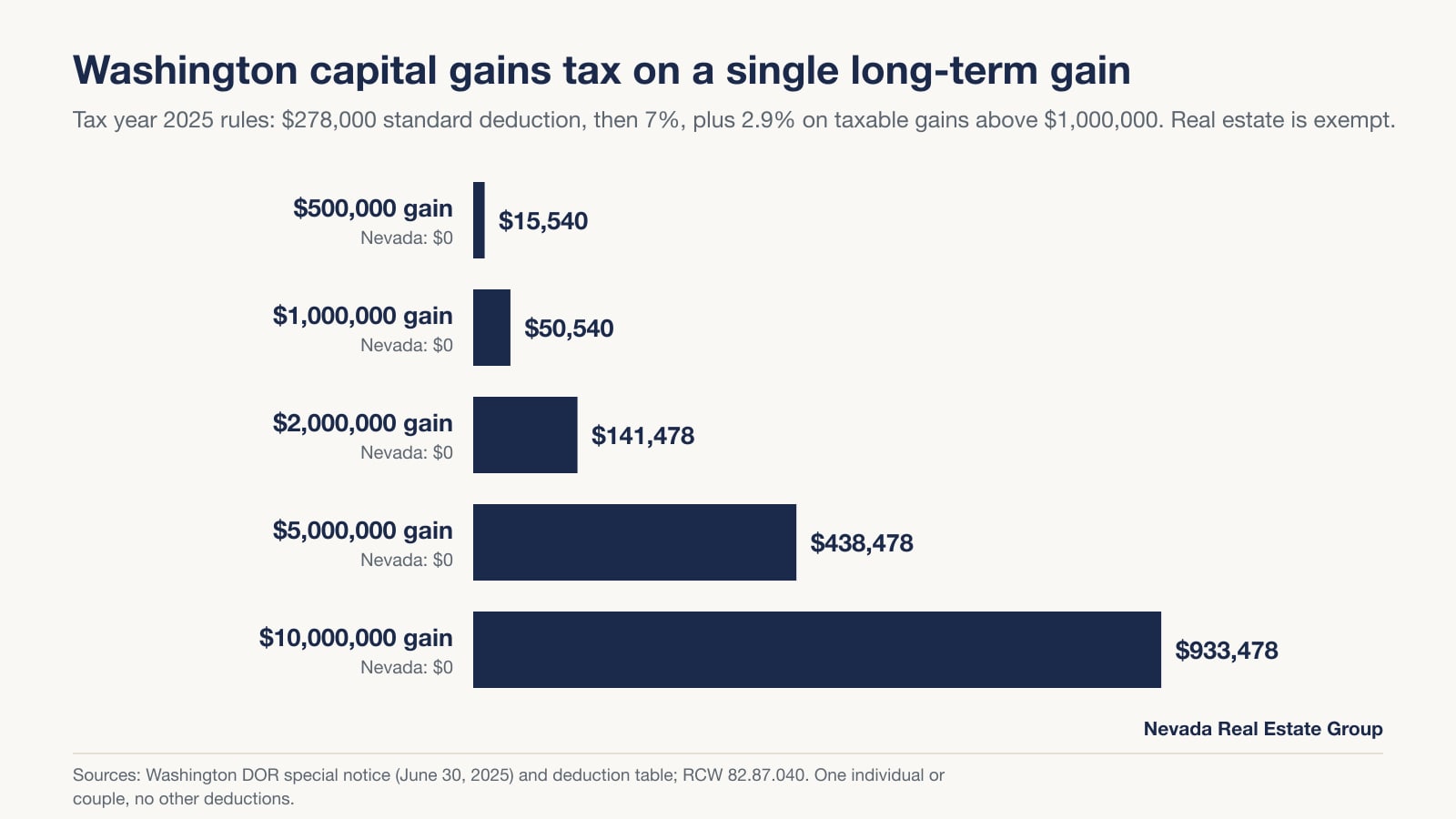
Washington's capital gains tax is already in force. According to the Department of Revenue's June 30, 2025 special notice, beginning with tax year 2025 the first $1 million of taxable Washington capital gains is taxed at 7%, and taxable gains above $1 million at 9.9% (7% plus 2.9% under RCW 82.87.040). Gains become taxable after a standard deduction of $278,000 for tax year 2025, per the department's deduction table. Sales of real estate are exempt, so selling a Bellevue house does not trigger it, according to the department's capital gains tax page.
That matters for a liquidity event. On a single $10 million long-term gain from stock or a business interest that qualifies for no exemption, tax year 2025 rules produce about $933,000: 7% of the $9,722,000 left after the deduction, plus 2.9% of the $8,722,000 above $1 million. In Nevada the figure is zero. Gains on intangible assets such as stock are allocated to Washington when the seller is domiciled there at the time of the sale (RCW 82.87.100), so the date your domicile changes relative to the closing date matters. That timing is a question for your CPA and estate attorney.
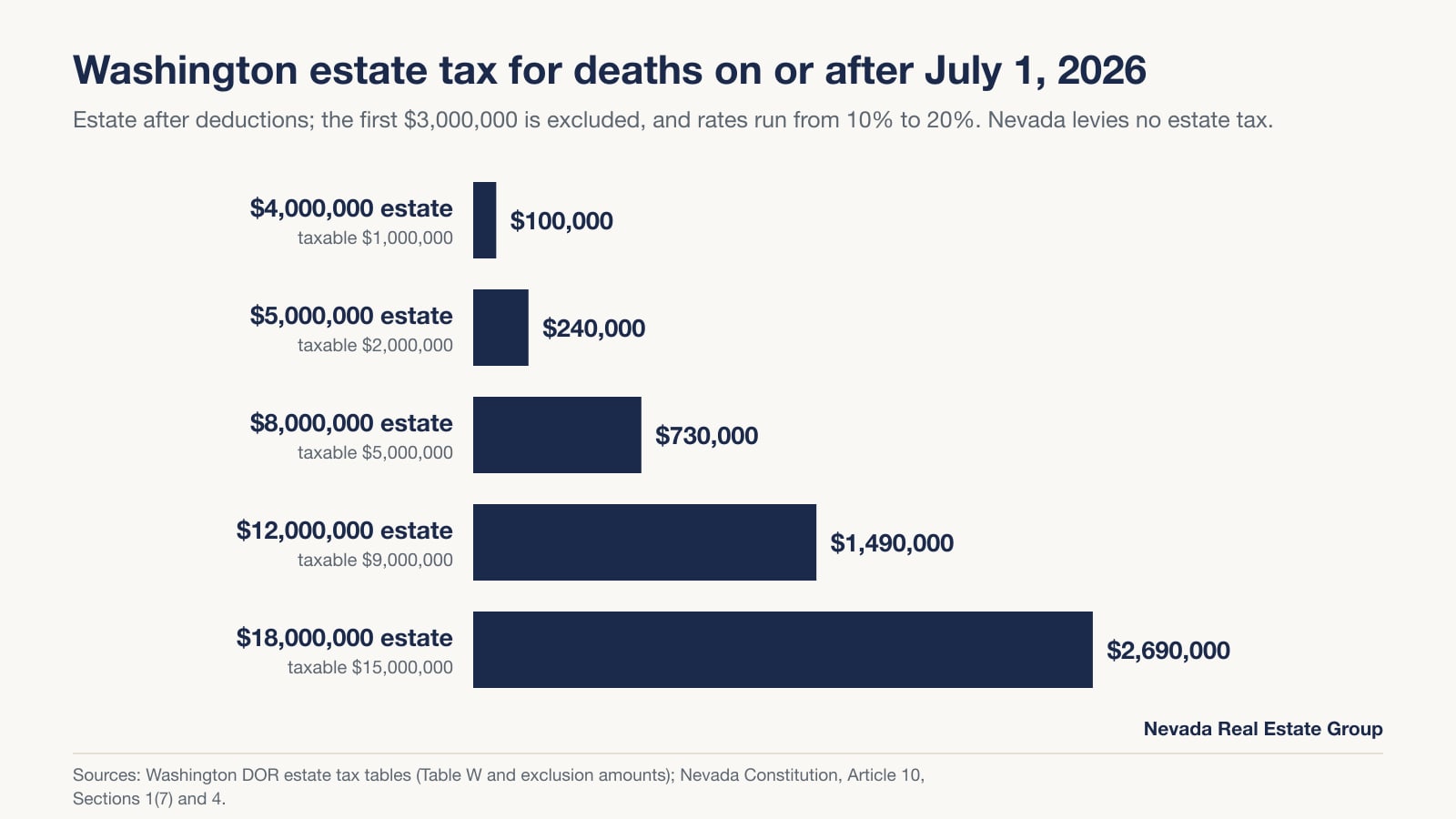
Washington also keeps an estate tax. According to the department's estate tax tables, for deaths on or after July 1, 2026 the exclusion is $3,000,000 and rates run from 10% to 20%; the top rate had been 35% for deaths from July 1, 2025 to June 30, 2026. A $5,000,000 taxable estate, after the exclusion, owes $730,000 under that table. Nevada has none.
What Does Establishing Nevada Residency Actually Require?
Moving for taxes only works if Washington agrees you left. ESSB 6346 (section 101) treats you as a Washington resident for a tax year in two ways. If you are domiciled in Washington, you are a resident unless you kept no permanent home there, kept one elsewhere and spent no more than 30 days in the state. If you are not domiciled there, you are still a resident if you keep a place of abode in Washington and are present more than 183 days, and any part of a day counts. In practice:
- Domicile: make Nevada your true home base, with a Nevada driver's license, voter and vehicle registration, and your primary residence here.
- The Washington house: sell it or lease it out. Keeping a Washington place of abode and spending more than 183 days there makes you a statutory resident even with a Nevada domicile.
- Days: keep a contemporaneous record of where you are each day, because the burden of proof falls on you.
- Washington-source income: a move does not shelter it. Nonresidents still owe the tax on pay for work performed in Washington, apportioned by days worked there (section 403), on business income from Washington operations and on rents from Washington property (section 401). A nonresident's $1,000,000 deduction also shrinks in proportion to the Washington-source share of total income (section 315): with $5 million of total income and $300,000 of Washington pay, the deduction falls to $60,000 and about $23,760 is due. Part-year residents prorate (section 406).
Revenue departments look at high-dollar moves as a whole: where the family lives, where the cars are registered, where you see your doctor and where your memberships sit. A clean, complete move is hard to challenge; a half-move can leave you taxed by Washington anyway. Our guide to establishing Nevada residency walks through the DMV, voter registration and tax steps, and our guide to moving to Las Vegas covers the move itself.
What Can $1 Million to $5 Million Buy in Las Vegas Real Estate?
According to Las Vegas REALTORS, the median price of existing single-family homes sold in Southern Nevada in September 2026 was $470,000, as reported by News 3 on October 6, 2026 (the association's market statistics page posts monthly figures). The luxury price bands sit far above that median. Here is where each one traded:
| Budget | What it buys | Communities with a subdivision median in this band |
|---|---|---|
| $1M–$1.5M | Upscale single-family homes | Southern Highlands, Lake Las Vegas, Fairway Hills in The Ridges |
| $1.5M–$3M | Larger luxury and semi-custom homes | The Ridges, MacDonald Highlands, Lake Las Vegas (SouthShore) |
| $3M–$6M | Guard-gated custom estates | The Ridges, Ascaya, Tournament Hills, MacDonald Highlands |
| $6M and up | Trophy estates and view lots | MacDonald Highlands, Ascaya, The Ridges, Southern Highlands' Estates |
How we built the table: we pulled residential closings from the Las Vegas REALTORS MLS through Repliers, by closing date from October 1, 2025 to September 30, 2026, grouped by recorded subdivision (plat) in ZIP codes 89135, 89134, 89012, 89011 and 89141. A community appears in a band when at least one of its recorded subdivisions had a median closed price in that band. Late September closings may still be posting as of October 26, 2026. Tournament Hills, recorded as a single subdivision, logged 5 closings at a $5,030,000 median.
Compare like with like: lot size, guard gate, HOA dues and any special assessment, views and the age of construction all move price. Our pages for Las Vegas homes over $1 million and Las Vegas homes over $5 million show what is listed now, and the income tax savings, if the tax survives, sit on top of whatever you buy.
Which Las Vegas Luxury Communities Should a Relocating Buyer Compare?
The valley's luxury market is concentrated in a handful of master plans. In Summerlin, on the valley's west side near Red Rock Canyon, buyers compare The Ridges, Tournament Hills and The Summit Club. In Henderson, MacDonald Highlands and Ascaya are neighboring guard-gated hillside communities in the McCullough Range; MacDonald Highlands wraps around the private DragonRidge Country Club, while Ascaya has no golf. Lake Las Vegas is built around a man-made lake, and Southern Highlands in the southwest pairs a guard-gated golf core with a larger non-gated master plan.
For buyers who want controlled access, the valley's guard-gated communities include homes in every price band in the table above, and our luxury communities guide compares them. We cover the tax-and-ownership case for this tier in our guide to Nevada tax advantages for luxury Las Vegas owners, and the earlier wave of high-earner moves in our California-to-Las Vegas migration analysis. Washington is simply the newest source state facing a new state tax on its top earners.
What Does a Washington Household Under $1 Million Actually Save?
Most Washington households will never owe the new tax, because it applies only above $1,000,000 of income. For them the income tax saving from moving is zero, and the real differences are smaller and specific:
| Tax | Washington | Nevada (Clark County) |
|---|---|---|
| Income tax under $1M | None | None |
| Combined sales tax | Seattle 10.55%, Bellevue 10.3% (October 1 to December 31, 2026) | 8.375% (since January 1, 2020) |
| Long-term capital gains (real estate exempt) | 7% above the $278,000 deduction (tax year 2025) | None |
| Estate tax | 10% to 20% above $3,000,000 | None |
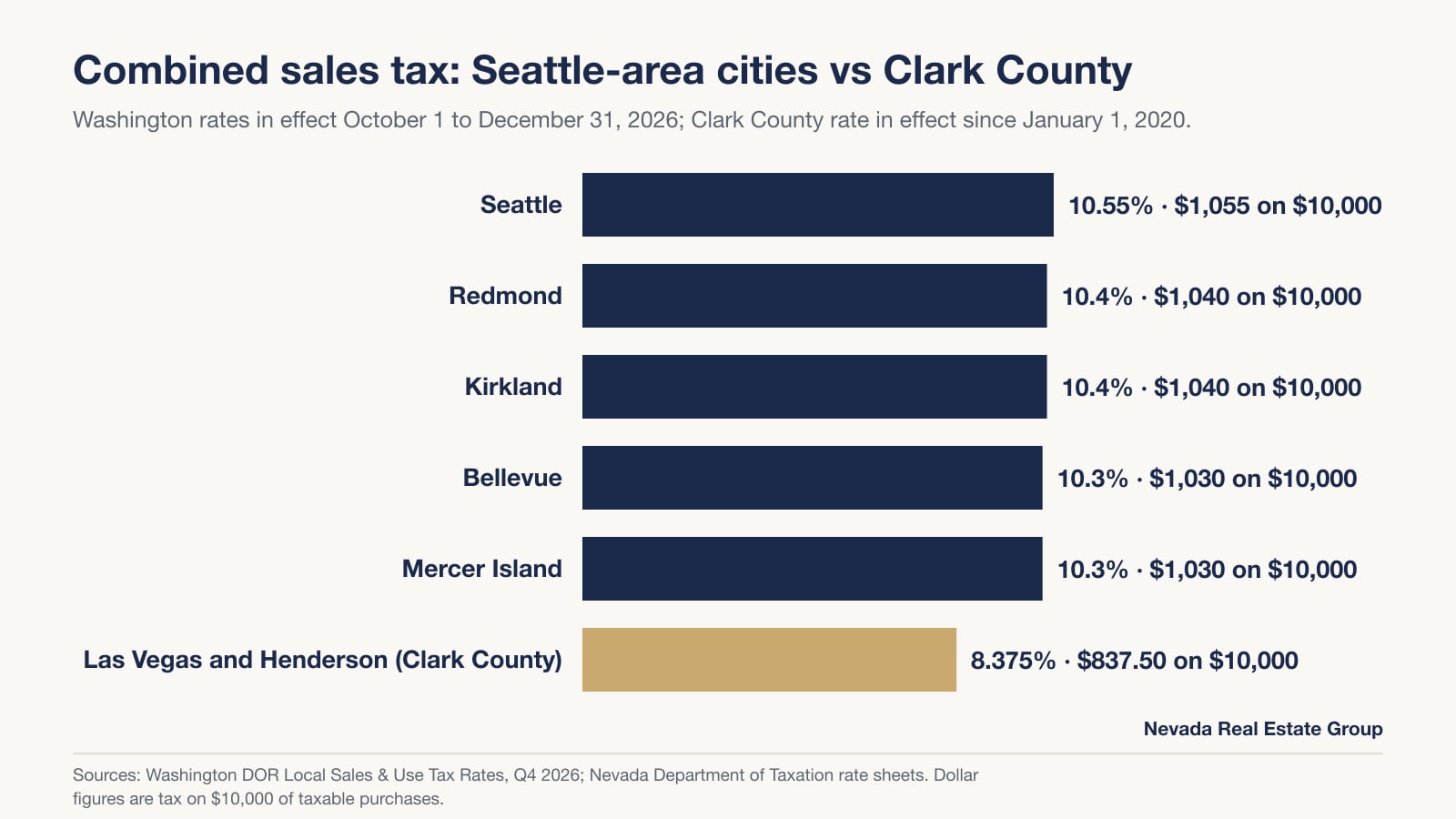
According to the Department of Revenue's local sales and use tax rates for October 1 to December 31, 2026, Seattle's combined rate is 10.55%, Redmond and Kirkland 10.4%, and Bellevue and Mercer Island 10.3%, each including the 6.5% state rate. According to the Nevada Department of Taxation, Clark County's rate has been 8.375% since January 1, 2020, against a 6.85% statewide base. On $10,000 of taxable purchases, Seattle's rate adds $1,055 in tax, against $837.50 in Las Vegas or Henderson, a $217.50 difference.
The estate tax reaches further than the income tax: an estate that includes a Seattle-area home and retirement savings can pass the $3,000,000 exclusion where Washington's rates begin. Property taxes and housing costs depend on the home, so we work through them separately in our Nevada vs Washington property tax comparison and our Las Vegas vs Seattle cost of living guide rather than repeat them here.
When Should a Washington High Earner Make the Move?
Timing is the difference between saving money and missing the window. If the tax survives, it applies to income received from January 1, 2028, so a resident who establishes Nevada domicile, with no Washington home, before that date avoids it on income that is not Washington-source. The more urgent clock is the capital gains tax that is already running: anyone expecting a business sale or a large equity event should weigh establishing Nevada domicile before the transaction closes.
A concrete example makes it tangible. Say a Redmond founder expects $4 million of investment income, interest and dividends, in 2028. As a Washington resident she would owe about $297,000 on the $3 million above the deduction. If she has bought in Summerlin and established Nevada domicile, with no Washington home, before January 1, 2028, Washington does not tax a nonresident on investment income from intangible property unless that property is employed in a Washington business (section 401). Wages work differently: pay for work performed in Washington stays taxable by days worked there, and as of October 26, 2026 the Department of Revenue's FAQ did not yet address equity that vests after a move.
The practical sequence: decide early, buy or lease in Las Vegas, move fully, document the move, and time any major sale for after the new domicile is clean.
What Are the Risks and Caveats of Relocating for Taxes?
Honesty matters more than hype here. First, Washington's 2028 income tax may never be collected: voters decide I-645 on November 3, 2026, and the constitutional challenge in Klickitat County is unresolved, though the capital gains and estate taxes are already law. Second, residency is scrutinized; a half-hearted move invites an audit and can fail, leaving you taxed as a Washington resident. Third, moving does not remove Washington-source income such as pay for work done in the state, rents from Washington property or income from a Washington business. Fourth, your income type, equity structure, estate plan and trusts determine the actual savings, and only a qualified CPA and attorney can model them. Fifth, real estate, climate and lifestyle fit matter; don't let the tax tail wag the entire dog.
None of that changes the core arithmetic: for a household clearing seven figures, Nevada's zero is worth a great deal against Washington's 9.9%. Our role is the real estate side of that decision: helping you land in the right Las Vegas community for the life you're building, with the tax savings as the tailwind. Pair us with your financial team and the move becomes a plan, not a gamble.
Frequently Asked Questions
Does Washington really have an income tax now?
It has one on the books for high earners. Governor Bob Ferguson signed ESSB 6346 on March 30, 2026, creating a 9.9% tax on personal income above $1 million, effective January 1, 2028, with first returns due in April 2029. The Washington Supreme Court ruled on May 4, 2026 that the law cannot be put to a referendum, but voters decide the I-645 repeal on November 3, 2026, and a constitutional lawsuit is pending in Klickitat County Superior Court.
How much would I save in taxes by moving from Washington to Nevada?
It depends on your income and assets. At $2 million of income, Washington's 2028 tax is about $99,000 a year versus $0 in Nevada; at $5 million, about $396,000. Nevada also has no capital gains tax (Washington's runs up to 9.9% on taxable gains over $1 million) and no estate tax. Below $1 million of income, the income tax saving is zero, and the differences come down to sales tax, capital gains and estate planning.
Does Nevada have any state income tax at all?
No. Article 10, Section 1(9) of the Nevada Constitution bars any income tax on the wages or personal income of natural persons. Changing that would take a constitutional amendment, either passed by two successive Legislatures and then approved by voters, or approved by voters at two consecutive general elections through a citizen initiative.
What does it take to stop being a Washington resident for this tax?
Under ESSB 6346, a Washington domiciliary stays a resident unless they keep no permanent home in Washington, keep one elsewhere and spend no more than 30 days in the state. A non-domiciliary who keeps a Washington place of abode and spends more than 183 days there is also a resident. Establish Nevada domicile, sell or lease the Washington home, and document where you spend each day.
Should I move before selling my business or stock?
Often that is the highest-leverage version of this move. Washington taxes gains on intangible assets such as stock when the seller is domiciled in Washington at the time of the sale, at 7% and then 9.9% on taxable gains over $1 million. On a $10 million gain, that is about $933,000 under tax year 2025 rules. Coordinate the timing with your CPA and attorney before any sale.
What can I buy in Las Vegas with a Seattle-area home budget?
In our pull of closings from October 2025 through September 2026, recorded subdivisions in Southern Highlands, Lake Las Vegas and The Ridges had median closed prices between $1 million and $1.5 million, while subdivisions in The Ridges, Ascaya, Tournament Hills and MacDonald Highlands had medians of $3 million to $6 million. Tournament Hills logged 5 closings at a $5,030,000 median.
Is this tax move only worth it for the ultra-wealthy?
The income tax targets income over $1 million, but Washington's capital gains tax starts above a $278,000 deduction (tax year 2025) and its estate tax above $3,000,000. A household with a large stock position or a sizable estate can benefit from Nevada's structure without ever earning $1 million in a year, so run the numbers with an advisor.
Which Sources Inform This Washington-to-Nevada Tax Comparison?
Washington's income tax terms come from the ESSB 6346 session law, the bill summary, the Department of Revenue's income tax page, income tax FAQ and advisory workgroup page, and Ernst & Young's April 13, 2026 alert. The legal status comes from the Washington Supreme Court's Heywood v. Hobbs order, Klickitat County's case page, KNKX, KUOW, KOMO, the 2026 Voters' Pamphlet and the Secretary of State's income tax ballot history. Capital gains figures come from the Department of Revenue's special notice, deduction table, capital gains tax page, RCW 82.87.040 and RCW 82.87.100; estate figures from the department's estate tax tables; and sales tax rates from its Q4 2026 local sales and use tax rates and the Nevada Department of Taxation. Nevada's structure references the Nevada Constitution, 26 U.S.C. 2011, 26 U.S.C. 2058 and the Tax Foundation's 2026 index. Las Vegas pricing comes from Las Vegas REALTORS via News 3 and from our own pull of Las Vegas REALTORS MLS closings through Repliers (October 1, 2025 to September 30, 2026). Every figure was checked against its source on October 26, 2026. Tax laws change and are being litigated, so verify current rates, thresholds and residency rules with a qualified professional before acting.
Information deemed reliable but not guaranteed. This article is educational and is not tax, legal, or financial advice. Washington's 2028 income tax is subject to the I-645 repeal vote on November 3, 2026 and a pending constitutional challenge, and residency and tax outcomes are specific to your situation. Consult a qualified CPA and attorney before relocating for tax purposes. Nevada Real Estate Group · (702) 637-1759 · NV License S.181401.